KMDS

 E-submission

Search
- Page Path
- HOME > Search
Original Article
- Disease Course, Survival, and Genetic Heterogeneity in Chorea-Acanthocytosis: A Case Series of 34 Patients
- Aida Ghasemi, Elahe Amini, Ahmad Chitsaz, Gholamali Shahidi, Seyed Amir Hassan Habibi, Atieh Jafarabadi Ashtiani, Arezoo Farzi, Vadieh Ghodsinezhad, Afagh Alavi, Mohammad Rohani
- J Mov Disord. 2026;19(4):398-408. Published online July 14, 2026
- DOI: https://doi.org/10.14802/jmd.25350

- 958 View
- 99 Download
-
 Abstract
 PDF
 Supplementary Material
- Objective
To quantify key disease milestones, particularly loss of ambulation and survival, and to describe the VPS13A variant spectrum and clinical heterogeneity in patients with chorea-acanthocytosis (ChA).
Methods
We conducted a cross-sectional study of 34 ChA patients from 24 unrelated families. Whole-exome sequencing identified VPS13A variants in all probands. Clinical and paraclinical data were collected through neurological evaluations and electronic medical records. Patients were classified as either surviving (ambulatory or non-ambulatory) or deceased.
Results
Twenty-one VPS13A variants were identified, including 12 novel variants. Median current age and disease duration were 38.5 years (interquartile range [IQR], 34–43 years) and 8.0 years (IQR, 4–12.25 years), respectively. Loss of ambulation occurred in 26.5% of patients after a median of 10 years (range, 5–16 years) from onset. Kaplan–Meier analysis estimated a median time to loss of ambulation of 16.0 years (95% confidence interval [CI], 8.8–23.2 years), with estimated ambulation probabilities of 87.4% at 6 years and 38.0% at 16 years. Seven patients died after a median disease duration of 10 years (range, 3–17 years). The median survival time was not reached during follow-up; the estimated restricted mean survival time was 16.7 years (95% CI, 14.1–19.3 years). Compulsions co-occurred with obsessions in all cases and were associated with higher rates of suicidal ideation, while insomnia was more frequent in patients without compulsions. Suicide and sepsis were the leading causes of death.
Conclusion
This study defines the natural history of ChA, providing prognostic data on ambulation and survival. The discovery of novel VPS13A variants highlights genetic heterogeneity and supports further investigation into disease mechanisms and therapeutic targets.
Case Report
- A New Phenotype of TUBB4A Mutation in a Family With Adult-Onset Progressive Spastic Paraplegia and Isolated Hypomyelination Leukodystrophy: A Case Report and Literature Review
- Pei‐Chen Hsieh, Pei Shan Yu, Wen-Lang Fan, Chun‐Chieh Wang, Chih-Ying Chao, Yih‐Ru Wu
- J Mov Disord. 2024;17(1):94-98. Published online October 23, 2023
- DOI: https://doi.org/10.14802/jmd.23142
- 6,844 View
- 489 Download
- 2 Web of Science
- 2 Crossref
-
Abstract
PDFSupplementary Material
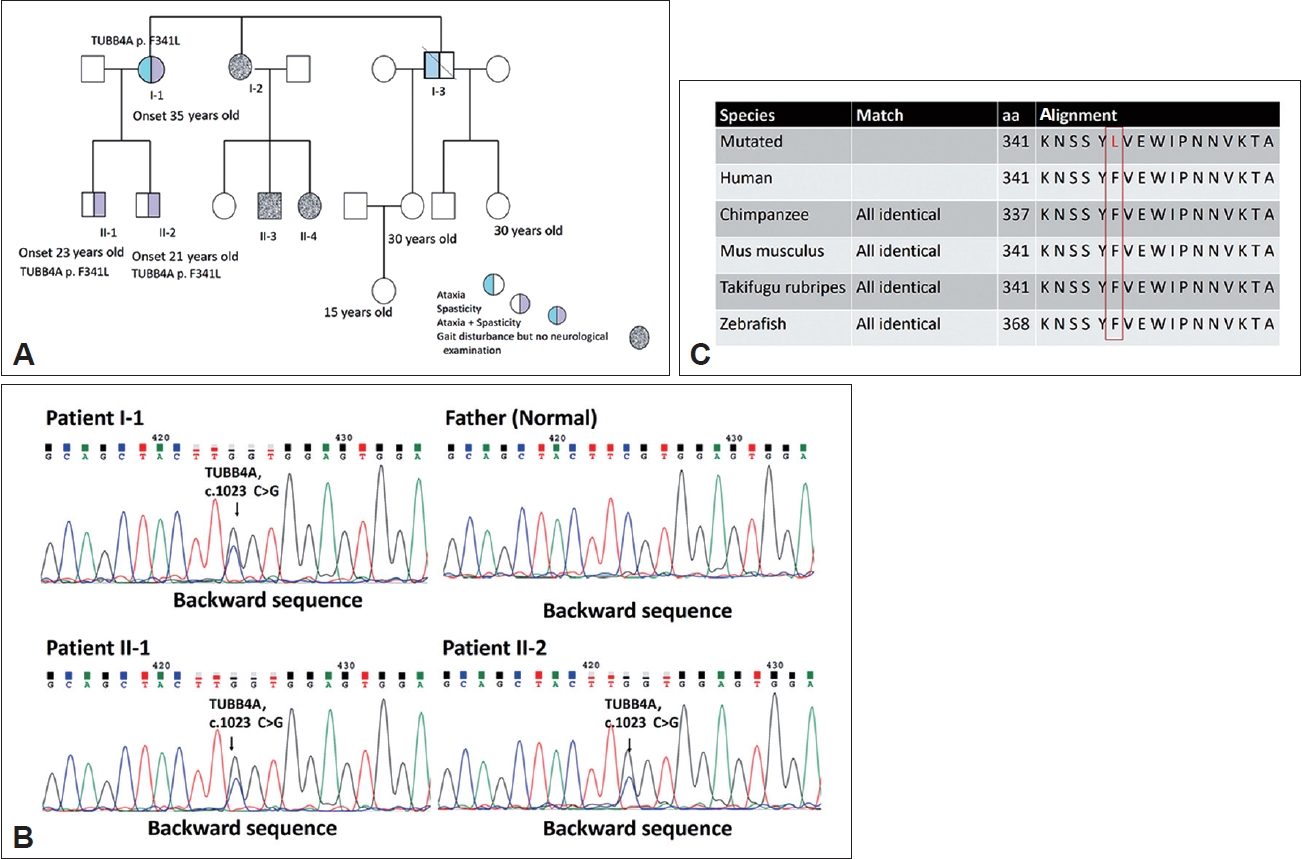
- Tubulin beta 4A class IVa (TUBB4A) spectrum disorders include autosomal dominant dystonia type 4 or hypomyelination with atrophy of the basal ganglia and cerebellum (H-ABC syndrome). However, in rare cases, only mild hypomyelination in the cortex with no basal ganglia atrophy may be observed. We report a case of a family with TUBB4A mutation and complicated hereditary spasticity paraplegia (HSP). We performed quadro whole-exome sequencing (WES) on the family to identify the causative gene of progressive spastic paraparesis with isolated hypomyelination leukodystrophy. We identified a novel TUBB4A p.F341L mutation, which was present in all three affected patients but absent in the unaffected father. The affected patients presented with adult-onset TUBB4A disorder, predominant spastic paraparesis with/without ataxia, and brain hypomyelination with no cognitive impairment or extrapyramidal symptoms. In the literature, HSP is considered a TUBB4A spectrum disorder.
-
Citations
Citations to this article as recorded by
- The role of genetics and molecular mechanisms in early onset scoliosis
Shuang Feng, Yichen Du, Siu Wai Choi, Kelvin Sin Chi Cheung, Jason Pui Yin Cheung, Zezhou Su
Journal of Clinical Orthopaedics and Trauma.2026; 73: 103340. CrossRef - Expanding the adult spectrum of TUBB4A disease: a spasticity–tremor phenotype with network imaging correlates
Edis Hacılar, Bedia Samanci, Ulas Ay, Ebru Erzurumluoglu, Ali Bayram, Erdi Sahin, Mehmet Barburoglu, Sanem Sultan Yoruk Oner, Sevilhan Artan, Hasmet Hanagasi, Basar Bilgic
Neurogenetics.2026;[Epub] CrossRef
- The role of genetics and molecular mechanisms in early onset scoliosis
 First
 Prev