KMDS

 E-submission

Most cited
- Page Path
- HOME > Browse Articles > Most cited

Review Articles
- Functional Neuroanatomy for Posture and Gait Control
- Kaoru Takakusaki
- J Mov Disord. 2017;10(1):1-17. Published online January 18, 2017
- DOI: https://doi.org/10.14802/jmd.16062

- 65,535 View
- 6,821 Download
- 773 Web of Science
- 770 Crossref
-
 Abstract
 PDF
- Here we argue functional neuroanatomy for posture- gait control. Multi-sensory information such as somatosensory, visual and vestibular sensation act on various areas of the brain so that adaptable posture- gait control can be achieved. Automatic process of gait, which is steady-state stepping movements associating with postural reflexes including headeye coordination accompanied by appropriate alignment of body segments and optimal level of postural muscle tone, is mediated by the descending pathways from the brainstem to the spinal cord. Particularly, reticulospinal pathways arising from the lateral part of the mesopontine tegmentum and spinal locomotor network contribute to this process. On the other hand, walking in unfamiliar circumstance requires cognitive process of postural control, which depends on knowledges of self-body, such as body schema and body motion in space. The cognitive information is produced at the temporoparietal association cortex, and is fundamental to sustention of vertical posture and construction of motor programs. The programs in the motor cortical areas run to execute anticipatory postural adjustment that is optimal for achievement of goal-directed movements. The basal ganglia and cerebellum may affect both the automatic and cognitive processes of posturegait control through reciprocal connections with the brainstem and cerebral cortex, respectively. Consequently, impairments in cognitive function by damages in the cerebral cortex, basal ganglia and cerebellum may disturb posture-gait control, resulting in falling.
-
Citations
Citations to this article as recorded by
- Extended high-frequency hearing and cognitive-motor coordination during speech-in-noise walking
Ming`ang Li, Qiqi Zhang, Wei Li
Hearing Research.2027; 483: 109843. CrossRef - Postural adjustments in standing and gait reflect amnestic mild cognitive impairment
Yi-Chun Kuan, Shiuan-Huei Lu, Cheng-Hao Yu, Kuan-Wen Wu, Ting-Ming Wang, Tung-Wu Lu
Gait & Posture.2027; 133: 110685. CrossRef - Effects of cerebellar transcranial alternating current stimulation on balance and gait in healthy subjects
Valerio Sveva, Andrea Guerra, Massimiliano Mangone, Francesco Agostini, Andrea Bernetti, Alfredo Berardelli, Marco Paoloni, Matteo Bologna
Clinical Neurophysiology.2026; 185: 2010706. CrossRef - Unmet needs in the pharmacological management of motor symptoms in Parkinson's disease
Beatrice Heim, Werner Poewe
Journal of Parkinson’s Disease.2026; 16(2_suppl): 24. CrossRef - Vestibular Dysfunction in Parkinson's Disease: A Systematic Review of Signs and Symptoms
Francisco Rosado‐Martins, Beatriz Santos, Cláudia M. Costa, Tiago Eça, Raquel Bouça‐Machado, Joaquim J. Ferreira
Movement Disorders Clinical Practice.2026; 13(2): 318. CrossRef - The immediate effect of anodal tDCS over the motor cortex on postural control and cortical activation in patients with chronic low back pain: A preliminary study
Yan Li, Hao Xie, Jiahui Peng, Zhaoqiang Xu, Ruochen Fu, Xue Cheng, Jiajia Yang, Qiuhua Yu, Haoyu Xie, Xueqiang Wang, Chuhuai Wang
Behavioural Brain Research.2026; 496: 115827. CrossRef - Impact of Pilates training on gait performance in individuals with unilateral transtibial amputation
Janny Mirian Antonelli Tavares, Letícia Pophal Cutisque, John Gerard Buckley, André Luiz Felix Rodacki
Disability and Rehabilitation.2026; 48(11): 3329. CrossRef - A cortico-cerebellar–spinal hierarchical model for adaptive step-length control in bipedal locomotions
Ziqi Chen, Ying Yu, Fang Han, Kaiyu Deng
The European Physical Journal Special Topics.2026; 234(28): 9129. CrossRef - Gait speed and incident depression: A systematic review and meta-analysis
Maria Eduarda A. Guimarães, Marilia G. da Silva, Raissa Machado, Gustavo Oliveira, Laercio Balsan, Heinrich Leon Souza Viera, Rose Löbell, Brendon Stubbs, Davy Vancampfort, Marco Solmi, Nicola Veronese, Fabio Juner Lanferdini, Felipe Barreto Schuch
Journal of Affective Disorders.2026; 394: 120516. CrossRef - Differentiating gait behaviors between early-stage dementia with Lewy bodies and Parkinson’s disease
Karen D.A. Mathias, Arthur E. Casagrande Pinto, Luandrya E. Martins, Elie Matar, Joseph R. Phillips, Simon J.G. Lewis, Kaylena A. Ehgoetz Martens
Gait & Posture.2026; 124: 110034. CrossRef - The mesencephalic locomotor region in neurological disorders: A narrative review of evolutionary conservation, functional connectivity, and clinical translation
Jialu Xu, Le Sun
Brain Circulation.2026; 12(4): 337. CrossRef - Maternal vitamin D deficiency during pregnancy impaired offspring’s spatial learning and memory ability: Insights into the role of the CaMKK2/AMPK/FoxO3a pathway
Xiaoxia Sun, Yu Qiao, Yu Han, Yufei Hou, Jiongnan Wang, Shangyun Lu, Jia Wang, Fubin Qiu
The Journal of Nutritional Biochemistry.2026; 149: 110196. CrossRef - Impact of sensory afferences in postural control quantified by force platform in healthy older adults: Systematic review and meta-analysis
J. Aflalo, C. Truong, A. Nicolaï, L. Gouzer, B. Morisset, F. Bertin-Hugault, D. Ricard, F. Quijoux
Experimental Gerontology.2026; 213: 112976. CrossRef - Sleep deprivation disrupts postural balance and sensorimotor integration: A combined psychophysiological–behavioral analysis
Lin Xu, Lei Peng, Xin An, Xiao Zhong, Yongcong Shao, Yuefang Dong, Weiwei Fu
NeuroImage.2026; 325: 121667. CrossRef - Reduced striatal dopamine transmission as a transdiagnostic substrate of psychomotor retardation
Ian Lam Leong, Tsz Huen Ng, Kunal Sen, Ella Burchill, Harry Costello, James B Badenoch, Jan Coebergh, Robert A McCutcheon, Akshay Nair, Michael Browning, Quentin J M Huys, Glyn Lewis, Andrew Lees, Anthony S David, Jonathan P Rogers
Brain.2026; 149(1): 18. CrossRef - Cortical Correlates of Balance During Single and Dual Tasks in Huntington’s Disease: A Preliminary fNIRS Study
Nicollette L. Purcell, Samuel Stuart, Rodrigo Vitorio, Emily C. Timm, Deborah A. Hall, Christa Cooper, Bichun Ouyang, Joan A. O’Keefe
Neurorehabilitation and Neural Repair.2026; 40(1): 25. CrossRef - From Finger Taps to Footsteps: Gait as a Model for Investigating and Training Rhythmic Abilities
Clara Ziane, Simone Dalla Bella
Annals of the New York Academy of Sciences.2026;[Epub] CrossRef - Sensokognitomotorische Aspekte mit Relevanz für den Krafttransfer auf Gelenke des Bewegungssystems: Teil 1
G. Ebenbichler, T. Bochdansky, H. Tilscher
Manuelle Medizin.2026; 64(1): 10. CrossRef - Transient effects in corticospinal and reticulospinal tract excitability induced by motor skill and isometric resistance training
Rachel Hawthorn, Natalie Phelps, Carolyn Atkinson, Rodolfo Keesey, Zachary Seitz, Haolin Nie, Ismael Seáñez
Brain Research.2026; 1874: 150132. CrossRef - Differential Effect of M1 and Cerebellar Repetitive Transcranial Magnetic Stimulation on Balance Performance in Stroke
Vyoma Parikh, Ann Medley, Jodi Thomas, Hui‐Ting Goh
European Journal of Neuroscience.2026;[Epub] CrossRef - Effects of repeated blocks of split-belt walking on locomotor adaptation, physiological arousal response and cortical activation
Kaya Yoshida, Shannon B. Lim, Lara A. Boyd, Janice J. Eng, Amy Schneeberg, Theodore J. Huppert, Courtney L. Pollock
Experimental Brain Research.2026;[Epub] CrossRef - Pre-Frontal Cortical Activity During Gait is Altered in Pre-Manifest and Early Spinocerebellar Ataxia
Martina Mancini, Carla Silva-Batista, Vrutangkumar V. Shah, Fay B. Horak, Patricia Carlson-Kuhta, Delaram Safarpour, Christopher M. Gomez
Neurorehabilitation and Neural Repair.2026; 40(3): 190. CrossRef - Self-delivered arousal-heightening stimuli to improve mobility in persons with parkinsonism: A case series
Gijs Vissers, Anouk Tosserams, Bastiaan R Bloem, Jorik Nonnekes
Journal of Parkinson’s Disease.2026; 16(1): 185. CrossRef - Comparison of kinetic adaptations in gait initiation following exergaming and balance training in athletes with chronic ankle instability
Sadaf Sepasgozar Sarkhosh, Roya Khanmohammadi
Scientific Reports.2026;[Epub] CrossRef - Medullary and C3–C4 propriospinal pathways underlying mammalian forelimb movement control
Vishwas Jindal, Matteo M. Grudny, Daniel W. Wesson, David E. Vaillancourt, Shahabeddin Vahdat
Proceedings of the National Academy of Sciences.2026;[Epub] CrossRef - Neurovascular Integration Failure and Freezing of Gait: Rethinking Parkinsonism Through a Vascular Lens
Katherine Kim, Sonu M. M. Bhaskar
European Journal of Neuroscience.2026;[Epub] CrossRef - Effectiveness of transcranial electrical stimulation combined with dual-task training in stroke, mild cognitive impairment and Parkinson’s disease: a systematic review and meta-analysis of randomized controlled trials
Yutong Fu, Wenli Wang, Qianxi Yan, Chang Zhu, Siaw Chui Chai, Ponnusamy Subramaniam, Liqing Yao, Devinder Kaur Ajit Singh
Frontiers in Human Neuroscience.2026;[Epub] CrossRef - Spinal cord stimulation therapy for gait impairment in Parkinson’s disease: a double-blinded, randomised feasibility trial with an open extension
Miriam Højholt Terkelsen, Victor S. Hvingelby, Erik L. Johnsen, Mette Møller, Erik Hvid Danielsen, Tove Henriksen, Andreas Nørgaard Glud, Yen Tai, Andreas M. Baun, Anne Lene Knudsen, Rikke Nan Valdemarsen, Jacob Horsager, Niels Okkels, Anne Sofie Møller A
Nature Communications.2026;[Epub] CrossRef - Establishing Normative Data for Single- and Dual-Task Tandem Gait in Healthy Interuniversity Male and Female Athletes
Kyla L. Pyndiura, Alex P. Di. Battista, Lauren Wilcox, Katelyn M. Mitchell, Genevieve Ammendolia Tomé, David W. Lawrence, Michael G. Hutchison
Clinical Journal of Sport Medicine.2026;[Epub] CrossRef - Neural control of anticipatory braking and lateral balance predicts fall risk in older adults: BMI-dependent mechanisms
Youjung Choi, Jiyoung Jeong, Hyungji Lee, Hyang Jun Lee, Ji Won Han, Ki Woong Kim
Frontiers in Aging Neuroscience.2026;[Epub] CrossRef - Case Report: Multi-sensory integration treatment for preschool children with intermittent exotropia and idiopathic scoliosis comorbidity
Yu Huang, Zheng Li, Fanling Zeng, Yashu Li, Xidan Deng, Cheng Yang, Jin Zeng, Yanlei Chen
Frontiers in Medicine.2026;[Epub] CrossRef - A comparative analysis of the utilization of upper and lower extremity functions in mental chronometry tests in individuals with multiple sclerosis
Gizem Şekercan, Mehmet Fatih Yetkin, Rana Karabudak, Aslı Tuncer, Yeliz Salcı
Acta Neurologica Belgica.2026; 126(3): 1025. CrossRef - Phase-specific postural adjustments in children and adults during a challenging balance task
Ludvík Valtr, Lucia Bizovská, Reza Abdollahipour, Bouwien Smits-Engelsman
Frontiers in Integrative Neuroscience.2026;[Epub] CrossRef - Transcranial direct current stimulation with Bosu-ball training increases cortical activation and improves ankle-foot function among individuals with chronic ankle instability: A randomized controlled trial
Xin Luo, Peixin Shen, Xueke Huang, He Gao, Yubin Ge, Zhiwen Dong, Yan Chen, Daniel T.P. Fong, Qipeng Song, Roya Khanmohammadi
PLOS One.2026; 21(2): e0342751. CrossRef - Motor imagery and executive dysfunction in the older population: Difference between realized and imagined Timed-Up and Go is associated with executive dysfunction
Lucas Khodabukus, Alexis Bourgeais, Mathieu Corvaisier, Léa Bourreau, Olivier Brière, Cédric Annweiler
Gait & Posture.2026; 126: 110130. CrossRef - Role of prefrontal cortex in freezing of gait in Parkinson’s disease: mechanisms and neuroimaging evidence
Qiling Ji, Shanshan Mei, Lipeng Cai, Omar Elmadhoun, Yuchuan Ding, Xiaokun Geng
Frontiers in Neurology.2026;[Epub] CrossRef - Deep neurobehavioral phenotyping uncovers neural fingerprints of locomotor deficits in Parkinson’s disease
Elisa Lilly Garulli, Timon Merk, Ghadi El Hasbani, Burçe Kabaoğlu, Rafaël De Sa, Ruben Behrsing, Dennis Doll, Michael Franz-Josef Schellenberger, Ibrahem Hanafi, Arend Vogt, Wolf-Julian Neumann, Chiara Palmisano, Ioannis Ugo Isaias, Yangfan Peng, Matthias
npj Parkinson's Disease.2026;[Epub] CrossRef - Correlation study between brain activation levels and postural control performance in patients with chronic non-specific low back pain
Wenqing Liu, Jiahui Peng, Liping Zhao, Xue Cheng, Yan Leng, Jiajia Yang, Qiuhua Yu, Chuhuai Wang
BMC Musculoskeletal Disorders.2026;[Epub] CrossRef - Music-Based Interventions for Gait Disturbances and Freezing of Gait in Parkinson’s Disease
Seung-Joon Oh, Suk Yun Kang
Journal of Brain Neuromodulation Therapy.2026; 1(1): 1. CrossRef - A Case of HNRNPU‐Related Neurodevelopmental Disorder Presenting With Acute Encephalopathy and Basal Ganglia Lesions
Syunsuke Nagara, Jiro Shinoda, Shungo Fujiki, Emi Tannaka, Shinji Usui, Miwa Kawashiri, Atsushi Imamura, Atsushi Yamagishi
Congenital Anomalies.2026;[Epub] CrossRef - EEG-EMG corticomuscular coherence in bipedal balance control with visual center of pressure feedback
Tatsunori Watanabe, Kenta Oguma, Miku Otani, Kodai Minami, Aoki Takahashi, Riku Ishizaka, Yuki Tanaka, Taisei Miyazaki, Nodoka Shimizume, Shin Ishihara
Gait & Posture.2026; 127: 110160. CrossRef - Age and task-dependent modulations in EMG-EMG coherence during gait: a scoping review
Silvère Milan De Freitas, Fabien Dal Maso, Laetitia Fradet, Denis Arvisais, Yosra Cherni
Journal of Neurophysiology.2026; 135(3): 653. CrossRef - Factors influencing corticomuscular coherence for axial and lower limb musculature in a healthy population: a scoping review
Nadim Fakhry, Pouya Rabiei, Martine Gagnon, Martin Simoneau, Hugo Massé-Alarie
Frontiers in Human Neuroscience.2026;[Epub] CrossRef - Structural and Functional Connectivity in Parkinson's Disease Patients With Freezing of Gait and Other Gait Disturbances
Quynh Le, Arichena Manmatharayan, Mashaal Syed, Kichang Kang, Tsao‐Wei Liang, Mahdi Alizadeh, Chengyuan Wu
Clinical Neuroimaging.2026;[Epub] CrossRef - Wrist Vibration Increases Presynaptic Inhibition of the Soleus Muscle During Step Initiation in People With Freezing of Gait and Parkinson's Disease: A Pilot Study
Carla Silva‐Batista, William Liu, Daniel Boari Coelho, Joseph F. Quinn, Fay B. Horak, Martina Mancini
European Journal of Neuroscience.2026;[Epub] CrossRef - Shared premotor resources underlie dual-task interference between speech and balance
Weina Lu, Sasha Lifton Lewis, Zoey Wire, Ingo Helmich
Behavioural Brain Research.2026; 507: 116170. CrossRef - MRI-based cerebrospinal fluid volumetric indices for predicting tap test response in idiopathic normal pressure hydrocephalus
Shinya Hasegawa, Daisuke Yoshimaru, Norio Hayashi, Shuhei Shibukawa, Mika Takagi, Hisayuki Murai
Radiological Physics and Technology.2026; 19(2): 742. CrossRef - Recovery Patterns of Postural Control in Patients with Subacute Stroke: A Longitudinal Comparison of Supratentorial Versus Infratentorial Lesions Using the Mini-BESTest
Rai Sugiyama, Hisato Nakazono, Takanori Taniguchi, Osuke Shibata, Michihito Mitsuyasu, Maiko Sakamoto, Tsubasa Mitsutake
NeuroRehabilitation.2026; 58(4): 612. CrossRef - The role of proprioception in the management and rehabilitation of adolescent idiopathic scoliosis
Ting Zhang, Qian Zhou, Lulu Shen, Song Gao
Frontiers in Rehabilitation Sciences.2026;[Epub] CrossRef - Intraoperative study of afferent and efferent connections in the upper lumbar spinal cord – Part 2: genitoinguinal reflex
Denise Lima Medeiros de Melo, Dayanne Rodrigues da Cunha Alves Bento Oliveira, Patrícia Lago dos Santos Madureira, Fabricio Dutra Ventura, Michele Dominici, Denise Spinola Pinheiro, Mirela V. Simon
Clinical Neurophysiology.2026; 189: 2111888. CrossRef - Estimating and interpreting how humans prioritize multiple movement goals during walking
Jordan N. Feldman, David Morales Loro, Andrew Chin, Sarah Erickson, Sarah Li, Eliana Bonbrest, Patrick Slade
Journal of NeuroEngineering and Rehabilitation.2026;[Epub] CrossRef - Influence of Trunk Function on Assisted Gait and Independence in Patients With Acute Stroke
Masahiro Ishiwatari, Akihiro Ogawa, Masato Hayakawa, Satoshi Kido, Suraiya Saleem
Stroke Research and Treatment.2026;[Epub] CrossRef - Neuromuscular and Balance Performance Across the Fundamental Preparation Period in Elite Athletes with Lower Limb Deficiencies: A Retrospective Case Series
Luca Cavaggioni, Athos Trecroci, Raffaele Scurati, Massimiliano Tosin, Linda Casalini, Paolo Castiglioni, Giampiero Merati, Damiano Formenti
Sports.2026; 14(4): 144. CrossRef - Contribution of the anterior lateral motor cortex to predictive postural control in rats
Akira Konosu, Kaito Fukuhara, Kenta Ouchida, Tetsuro Funato, Dai Yanagihara
Scientific Reports.2026;[Epub] CrossRef - The potential of utilizing Local Field Potential (LFP) in diagnosis and management of Parkinsonism’s hallmark symptoms: a comprehensive review
Ahmed W. Abbas, Almonzer Al-Qiami, Khalid Sarhan, Ahmed Mohamed Abozaid, Hamdy A. Makhlouf, Abdelmonem Siddiq, Ahmed Negida
Neurological Sciences.2026;[Epub] CrossRef - Protocol for a multicenter prospective sequential intervention study: the effect of adaptive closed-loop postural training on gait disorders in hemiparetic stroke patients
Liping Zhou, Jinping Li, Ying Xu, Xianglian Kang, Jiahui Li, Bo Liang, Bo Chen, Qingjia Guo, Xinzhi Zhang, Zhengfei Wang, Tinghui Huang, Mindan Xu, Zhicheng Bao, Nur Arzuar Abdul Rahim, Ying Hou, Hazwani Ahmad Yusof
Frontiers in Neurology.2026;[Epub] CrossRef - A narrative review of motor control dual pathways: the corticospinal and reticulospinal tracts in synergy and differentiation
Yun Xing, Jiaxin Liu, Linrui Wu, Ke Zhang, Shengbo Yang
Frontiers in Neuroanatomy.2026;[Epub] CrossRef - Cannabinoids in Motor Control: From Receptor Distribution to Motor Disorders
Dan Faganeli, Metoda Lipnik-Stangelj
Biomedicines.2026; 14(4): 844. CrossRef - Neuromodulatory Effects of Substantia Nigra Pars Reticulata Deep Brain Stimulation (SNr-DBS) in the 6-Hydroxydopamine Rat Model of Parkinson’s Disease
Eylem Turgut, Hande Parlak, Pinar Eser, Yasin Temel, Ali Jahanshahi, Levent Sarıkcıoglu, Gamze Erguler Tanrıover, Tanju Ucar, Ersoy Kocabicak, Aysel Agar
Medicina.2026; 62(4): 714. CrossRef - Task-specific cortical modulation induced by Tai Chi during postural control in older adults with diabetic peripheral neuropathy: An fNIRS study
Xiaomei Duan, Xiangyu Wang, Qipeng Song, Zhaoyang Yin, Dewei Mao
Brain Research.2026; 1884: 150333. CrossRef - Postural Control Determinants of Gait Dysfunction in Huntington’s Disease
Franchino Porciuncula, Paula Wasserman, Karen S. Marder, Ashwini K. Rao
Neurorehabilitation and Neural Repair.2026; 40(7): 587. CrossRef - Effect of Transcranial Direct Current Stimulation Targeting Brain Regions Identified Through Voxel‐Based Morphometry on One‐Legged Standing Balance With Eyes Closed
Hirona Takahashi, Yasuto Inukai, Kazuaki Nagasaka, Shota Miyaguchi, Noriko Sakurai, Naoki Kodama, Naofumi Otsuru, Hideaki Onishi
Brain and Behavior.2026;[Epub] CrossRef - Effects of Pelvic Motion During Robotic-Assisted Gait Training on Balance and Gait Speed in Chronic Stroke: A Randomized Controlled Trial
Hyung Joo Lee, Tae Lim Yoon
Medicina.2026; 62(5): 839. CrossRef - Visual cue training for balance, gait and cognition in post-menopausal women: a randomized controlled trial
Aneesa Farooq, Sarah Parveen, Chhavi Arora Sehgal, Arshya Anwar, Muhammad Azhraruddin, Syed Naznin Fatma, Md. Dilshad Manzar, Majumi M. Noohu
Geriatric Care.2026;[Epub] CrossRef - Effects of Tai Chi Cloud Hands on balance and resting-state functional connectivity after stroke: an fNIRS study
Jincheng Li, Zhenghao Dong, Mingxue Fan, Xiang Wang, Yingli Bi, Zhezhe Ma, Shiyan Wang, Jin Wang, Zunke Gong
Frontiers in Neurology.2026;[Epub] CrossRef - Animal Models of Freezing of Gait
Stefano Coletta, Stella M. Papa
European Journal of Neuroscience.2026;[Epub] CrossRef - Age- and cognitive load–related variability and entropy of gait: integrating coefficient of variation, median absolute deviation, and permutation entropy of spatiotemporal parameters into the Semmelweis Study gait assessment framework
Peter Mukli, Mihaly Muranyi, Ágnes Lipecz, Zsofia Szarvas, Tamás Csípő, Mónika Fekete, Vince Fazekas-Pongor, Anna Peterfi, Ágnes Fehér, Norbert Dosa, Csilla Kaposvári, Anna Aliquander, Wei Yi Hung, Dávid Major, Zalan Kaposzta, Attila Matiscsák, Gabriella
GeroScience.2026; 48(3): 3531. CrossRef - Impact of Sleep Quality on Gait Variability: Pilot Cohort Study
Francesca R Marino, Minzae Kim, Phillip H Hwang, Yorghos Tripodis, Michael Alosco, Jesse Mez, Ann McKee, Rhoda Au, Robert Joseph Thomas, Ludy Shih
JMIR Aging.2026; 9: e81630. CrossRef - Altering sensory cues for spatial navigation does not impose a dual-task effect on gait and balance
Sam Beech, Maggie K. McCracken, Christina Geisler, Leland E. Dibble, Colby R. Hansen, Sarah H. Creem-Regehr, Peter C. Fino
Experimental Brain Research.2026;[Epub] CrossRef - Postural Sway Assessment in Virtual Reality and Technology-Assisted Rehabilitation: A Systematic Review
Jong-Seon Oh, Seong-Gil Kim
Applied Sciences.2026; 16(12): 6130. CrossRef - Lifestyle factors moderate emotion–gait coupling in young adults
Danielle D. Wadsworth, Bahman Adlou, John L. Grace, Jerad Kosek, Christopher Wilburn, Wendi Weimar
Experimental Brain Research.2026;[Epub] CrossRef - Interactive effects of combination antiretroviral therapy (cART) and alcohol on the cerebellum of diabetic male Sprague Dawley rats
Jaclyn E. Asouzu Johnson, Ejikeme F. Mbajiorgu
Toxicological Research.2026;[Epub] CrossRef - Digital measurement of ocular microtremor in Parkinson’s Disease: Analytical and clinical validation
Lisa Graham, Rodrigo Vitorio, Patrick Tait, Richard Walker, Alan Godfrey, Rosie Morris, Samuel Stuart, Hualou Liang
PLOS Digital Health.2026; 5(6): e0001439. CrossRef - Identifying Parkinson’s Disease from Gait Biomechanics Using a Participant-Level Machine Learning Analysis Pipeline
Li Jin
Applied Sciences.2026; 16(13): 6296. CrossRef - Working memory load modulates sensorimotor cortical oscillations underlying anticipatory postural adjustments during step initiation
Kodai Minami, Eiji Yamanaka, Kohei Okuyama, Michiyuki Kawakami, Ippei Nojima, Kunitsugu Kondo, Aoki Takahashi, Riku Ishizaka, Yuki Tanaka, Taisei Miyazaki, Kenta Oguma, Nodoka Shimizume, Tatsunori Watanabe
Neuroscience.2026; 609: 15. CrossRef - Vestibular cortex and vestibular agnosia
R.G. Esin, O.R. Esin, L.R. Sakhapova
S.S. Korsakov Journal of Neurology and Psychiatry.2026; 126(4): 35. CrossRef - Walking as a Window to the Brain: Redefining Gait in Neurology
Emmanuel Ortega-Robles, Mario Treviño, Elías Manjarrez, Oscar Arias-Carrión
Medical Sciences.2026; 14(3): 338. CrossRef - Dopamine and the dynamics of subthalamic and leg muscle activities in parkinsonian stepping
Thomas G Simpson, Shenghong He, Laura Wehmeyer, Alek Pogosyan, Fernando Rodriguez Plazas, Ashwini Oswal, Michael G Hart, Rahul S Shah, Harutomo Hasegawa, Christoph Wiest, Sahar Yassine, Xuanjun Guo, Philipp A Loehrer, Anca Merla, Pablo Andrade, Veerle Vis
Brain.2026; 149(7): 2409. CrossRef - Neurovascular decoupling in cerebral small vessel disease-related gait disturbances in middle-aged and older adults: associations with blood biomarkers YKL-40 and neurofilament light chain
Zhenhua Zhang, Tianyu She, Jiajia Yang, Zihan Cheng, Ziruo Zhu, Qiaoqiao Xu
European Journal of Medical Research.2026;[Epub] CrossRef - Neurotransmitter Systems Underlying Freezing of Gait (FOG) in Parkinson's Disease
Minsub Cho, Jin Whan Cho, Dallah Yoo, Jinse Park, Do‐Young Kwon, Seong‐Beom Koh, Jeong‐Ho Park, Jinyoung Youn
European Journal of Neuroscience.2026;[Epub] CrossRef - Levodopa-induced dyskinesia is associated with worse gait and balance in Parkinson’s disease
Gabriele Imbalzano, Federico D’Agata, Claudia Ledda, Carlo Alberto Artusi, Marco Laudadio, Alberto Romagnolo, Mario Giorgio Rizzone, Leonardo Lopiano, Maurizio Zibetti, Marco Bozzali
Journal of Neural Transmission.2026; 133(9): 2589. CrossRef - Aging increases the cortical resources allocated to static balance maintenance
Thomas Legrand, Scott J. Mongold, Laure Müller, Maxime Niesen, Zoritsa Demerdziev, Pierre Coemelck, Esranur Yildiran Carlak, Antonella Iannotta, Gilles Naeije, Mathieu Bourguignon, Marc Vander Ghinst
Proceedings of the National Academy of Sciences.2026;[Epub] CrossRef - Posture and Virtual Reality: How a Head-Mounted Display Affects Postural Stability and Plantar Pressure Parameters in Healthy Population
Ciro Ivan De Girolamo, Allegra Fullin, Ersilia Vallefuoco, Annunziata Attena, Angela Lucariello, Pasquale Arpaia, Paolo De Blasiis
Journal of Functional Morphology and Kinesiology.2026; 11(3): 247. CrossRef - Differences in gait kinematics and spatiotemporal parameters among different Big Five personality types under emotional states: a three-dimensional motion capture study
Xiya Guo, Xinyue Cao, Zhengyang He, Xiaoyu Wang
Frontiers in Psychology.2026;[Epub] CrossRef - Supplementary Motor Area During Motor Actions in Athletes With Neurological Disorders: Observational Study of Cases and Controls
Francisco Echevarría‐Lasaga, Ismael Sanz‐Esteban, Cecilia Estrada‐Barranco, Isabel Rodríguez‐Costa, Juan José García‐Hernández, José Ignacio Serrano
Brain and Behavior.2026;[Epub] CrossRef - Association Between Postoperative Mini-Balance Evaluation Systems Test Scores and Length of Hospital Stay in Patients with Chronic Subdural Hematoma: A Prospective Cohort Study
Mutsumi Shiraishi, Shunsuke Ohji, Ryo Onuma
NeuroRehabilitation.2026; 59(1): 160. CrossRef - PREFRONTAL OXYHEMOGLOBIN CHANGES DURING Y-BALANCE TESTING IN ADOLESCENTS WITH IDIOPATHIC SCOLIOSIS
Esra Süzen, Kadriye Tombak, Buket Şimşek, Şükrü Özen
Mühendislik Bilimleri ve Tasarım Dergisi.2026; 14(2): 297. CrossRef - Neurosensory Integration and Balance Adaptation: Personalization of Postural Control Through the Prism of Individual Spatial Perception
Maxim Baltin, Margarita Nikulina, Diana Sabirova, Tatyana Baltina
Life.2026; 16(7): 1125. CrossRef - Neural network plasticity in Parkinson's disease: the impact of exercise-driven modulation
M. Alberti, D. Momi, C. Battisti, R. Marconi, F. Ginanneschi, A. Rossi, L. Monti
Frontiers in Rehabilitation Sciences.2026;[Epub] CrossRef - Dual-tasking reveals severity-dependent reorganization of cortical beta energy landscapes in Parkinson's disease
Cheng-Ya Huang, Liang-Chi Chen, Ruey-Meei Wu, Ing-Shiou Hwang
Neurobiology of Disease.2026; 228: 107536. CrossRef - The relationship between motor and cognitive performance and cortical activity in patients with multiple sclerosis: a systematic review of functional near-infrared spectroscopy studies
Hongjiao Sun, Haonan Xing, Kechun Hu, Zhongyu Wu, Jiawei Wu
Frontiers in Rehabilitation Sciences.2026;[Epub] CrossRef - Association of gait, balance, and fall risk with dementia in Down syndrome: a systematic review of the literature
Aline de Souza Gonçalves Gomes da Conceição, Luciana Mascarenhas Fonseca, Orestes Vicente Forlenza
Dementia & Neuropsychologia.2026;[Epub] CrossRef - Cerebellar Transcranial Alternating Current Stimulation: Frequency-Specific Modulation of Human Gait
Marc Varel, Michael Doppelmayr, Sergiu Groppa, Traian Popa, Manuel Bange, Adrian Zeitner
The Cerebellum.2026;[Epub] CrossRef - In healthy adults with low-level alcohol intake greater age and lifetime alcohol consumption are associated with poorer manual dexterity and higher lifetime consumption is related to worse postural stability
Timothy C Durazzo, Nicole D Evangelista, M Windy McNerney, Ansgar J Furst, Maheen M Adamson, Keith Humphreys, Dieter J Meyerhoff
Alcohol and Alcoholism.2026;[Epub] CrossRef - Pharmacologically Modulating the Noradrenergic Arousal System to Reduce Freezing of Gait in Parkinson's Disease: Study Protocol of the International AnTi‐FREEZE Study
Franka M. Goossens, Kaylena A. Ehgoetz Martens, Bastiaan R. Bloem, Rick C. Helmich, Erika E. Howe, Roy P. C. Kessels, Melvyn Roerdink, Annie G. Bryant, James M. Shine, Anouk Tosserams, Simon J. G. Lewis, Jorik Nonnekes
European Journal of Neuroscience.2026;[Epub] CrossRef - Associations between ankle strength and physical performance in healthy individuals: a systematic review
Tim S. Babu, Premraj Saini, Rohit K. Thapa, João Bruno, Liam Houlton, Paul J. Byrne, Exal Garcia-Carrillo
Frontiers in Physiology.2026;[Epub] CrossRef - Soy Sauce Odor Improves Upper Limb Motor Performance with Preliminary Evidence of Increased Alpha-Band Intermuscular Coherence Between Postural Muscles: An Exploratory Within-Subjects Crossover Study
Yutaka Yano, Junichi Inatomi, Hajime Yamakage, Tsuyoshi Miyata, Yoshihiro Murata, Mutsuo Taniguchi, Fumino Okutani, Hideto Kaba, Masahiro Yamaguchi
Brain Sciences.2026; 16(7): 737. CrossRef - Horizontal vHIT gain is unaffected by moderate cognitive load: evidence from a single-distance dual-task paradigm
Muhammed Ayas, Jameel Muzaffar, Manohar L. Bance
European Archives of Oto-Rhino-Laryngology.2026; 283(10): 6297. CrossRef - The Impact of Thai Khon Dance Training on Postural Control: A Comparative Study of Khon Dancers and Non-Dancers
Warin Krityakiarana, Sitanan Laojindapun, Krit Sangsuriyachaya, Sunee Bovonsunthonchai, Roongtiwa Vachalathiti, Nopporn Jongkamonwiwat
Journal of Dance Medicine & Science.2026;[Epub] CrossRef - Does plantar pressure distribution influence static balance performance in elite soccer players? A retrospective observational study
Federico Arippa, Bruno Leban, Micaela Porta, Giulia Casu, Massimiliano Pau
Sport Sciences for Health.2026;[Epub] CrossRef - Differential modulation of subjective postural vertical by support-surface conditions in Parkinson's disease with postural abnormalities
Kyohei Mikami, Hiroyuki Hamada, Ken Kikuchi, Atsushi Yamashita, Qi An
Parkinsonism & Related Disorders.2026; 150: 108912. CrossRef - Relative importance of fall risk factors in identifying falls among community-dwelling older adults: A cross-sectional retrospective study
Sara Mahmoudzadeh Khalili, Feng Yang
Geriatric Nursing.2026; 73: 104228. CrossRef - Effect of external versus internal focus of attention instructions on gait performance in people with multiple sclerosis
Razieh Mofateh, Mohammad Masoud Misaghian, Saeideh Monjezi, Neda Orakifar, Mohammad Mehravar, Farshad Molhemi
Neurological Sciences.2026;[Epub] CrossRef - Disentangling sensory contributions to postural control regulation through sample entropy and neural modeling: A preliminary study
Silvia Zanchi, Eleonora Montagnani, Victoria Marchetti, Davide Esposito, Marta Guarischi, Melissa Monti, Cristiano Cuppini, Monica Gori, Yih-Kuen Jan
PLOS One.2026; 21(8): e0355402. CrossRef - Core stability versus postural control training for pain, disability, and sensorimotor function in chronic non-specific low back pain
Shaghayegh Bozorgzad Fahadan, Mostafa Jalili Bafrouei, Mohammad Ali Seyed Hosseini, Hamid Tabatabaei
Scientific Reports.2026;[Epub] CrossRef - Association Between Cortical Cerebral Microinfarct and Motor Performance at One-Year Follow-Up in Patients with Cerebral Small Vessel Disease: An Exploratory Study
Dongyang Zhou, Hongyi Yan, Lei Guo, Shuo Yang, Tingting Wang, Ling Guan, Yilong Wang
Brain Sciences.2026; 16(8): 892. CrossRef - Exploring muscular and postural correlates of the EEG-derived functional connectome during a quiet-standing stabilometric task
Marianna Chianese, Simone Papallo, Giuseppe Prisco, Fabrizio Esposito, Leandro Donisi
Journal of Neural Engineering.2026; 23(4): 046065. CrossRef - Wearable Technologies for Gait Instability Rehabilitation: Mechanisms, Clinical Evidence, and Future Directions
Lijin Liu, Changfa Huang, Zhongyin Ji, Yujie Zhou, Zihua Li, Xueyi Zhang, Zhihong Wu
Bioengineering.2026; 13(9): 1002. CrossRef - Resting State Functional Connectivity Among Cortical and Subcortical Grey Matter Structures Can Distinguish Fallers in Parkinson's Disease
Rodrigo Vitorio, Korey P. Wylie, Justin W. Andrushko
European Journal of Neuroscience.2026;[Epub] CrossRef - Association between chronotype and dual-task gait cost across distinct cognitive domains in healthy young adults
Meeyoung Kim, Jood Dalbah, Alham Al-Sharman, Julio Alejandro Henriques Castro da Costa
PLOS One.2026; 21(8): e0348387. CrossRef - The opioid flexion phenotype: postural flexion and nodding in the fentanyl era
Ovie Martin Albert, Hussain Aboud, Alexander Arthur, Ivor Oghenekpavwe Orukpe
Frontiers in Neuroscience.2026;[Epub] CrossRef - Beyond gait speed: a multidimensional motor signature of motoric cognitive risk syndrome identified through domain-specific anomaly detection
Baptiste Perthuy, Hugues Vinzant, Clément Brifault, Vincent Cabibel, Rémi Laillier, Audrey Sultan, Pierre Denise, Nicolas Lefèvre, Alexandre Dalibot, Nick Stergiou, Fabien Cignetti, Leslie M. Decker
GeroScience.2026;[Epub] CrossRef - Orofacial Central Pattern Generators: Neuroanatomical and Clinical Insights into Sensory, Motor, Emotional Integration
Yong-Shin Hong, Young-Seok Park
Experimental Neurobiology.2026; 35(4): 173. CrossRef - Association Between Smartphone-Based IMU Turning Performance and Screening-Defined Mild Cognitive Impairment in Older Adults
Masayuki Hoshi, Koei Ishida, Ayane Nakamaru, Yuu Okabe, Misuzu Kusano, Yui Miyazaki, Tatsuya Nakanowatari, Toshimi Sato, Akihiko Asao, Natsumi Kimura, Maki Ogasawara, Hiroshi Hayashi, Toshimasa Sone, Yoshitaka Shiba
Sensors.2026; 26(18): 5795. CrossRef - Cortico-pallidal beta dynamics underlie impaired turning in Parkinson’s disease
Poojan D. Shukla, Jessica E. Bath, Kenneth H. Louie, Hamid Fekri Azgomi, Rithvik Ramesh, Eleni Patelaki, Jacob H. Marks, Jannine P. Balakid, Doris D. Wang
npj Parkinson's Disease.2026;[Epub] CrossRef - Early Postural Instability After First Electroconvulsive Therapy in Major Depressive Disorder: Implications for Patient Safety
Berrak Varhan, Yakup Cemel, Arzu Abalay, Saadet Ufuk Yurdalan, Huseyin Cat, Yasin Genc
Psychiatry International.2026; 7(5): 205. CrossRef - Effects of a 12-week Tai Chi program on postural stability and gait biomechanics in prefrail older adults: a randomized controlled study
Jiaxin Gao, Xueling Tu, Jianhao Chen, Sheng Huang, Zongxing Lu, Xiaofei Jia, Jingpeng Chang, Cai Jiang, Zhonghua Lin
Journal of NeuroEngineering and Rehabilitation.2026;[Epub] CrossRef - IMU-Based Analysis of Task-Dependent Associations Between Anticipatory Postural Adjustments and Gait Speed Under Dual-Task Conditions
Yusuke Sakaki, Hiromasa Akagi, Ami Kawata, Daisuke Sawamura, Hiroki Mani, Naoya Hasegawa
Sensors.2026; 26(17): 5630. CrossRef - Motor unit decomposition detects altered trunk neural output during seated postural maintenance after stroke
Hiroki Hanawa, Keisuke Hirata, Taku Miyazawa
Journal of Neural Engineering.2026; 23(5): 056003. CrossRef - A Cortico-Basal Ganglia-Thalamic Network Model Linking Intermittent Postural Control to Sway-Related Beta-Band Oscillations
Shota Tsugaya, Akihiro Nakamura, Taishin Nomura
eneuro.2026; 13(9): ENEURO.0283-26.2026. CrossRef - Subthalamic DBS engages right-lateralized frontal control to improve gait adaptation in Parkinson's disease
Ibrahem Hanafi, Nicolo G. Pozzi, Rita Habib, Salvatore Falciglia, Jasmin Del Vecchio Del Vecchio, Luigi Gianmaria Remore, Giorgio Marotta, Andreas Buck, Gianni Pezzoli, Jens Volkmann, Ioannis U. Isaias, Chiara Palmisano
Brain Stimulation.2026; 19(6): 103207. CrossRef - Association between balance ability and memory function in community-dwelling older adults
Masataka Ohki, Kyoko Minehisa, Keiko Sakai, Maki Takei, Masakazu Imaoka, Masatoshi Takeda, Misa Nakamura
Medicine.2026; 105(39): e50786. CrossRef - Data-driven vestibular fMRI in PPPD and residual dizziness after BPPV: a narrative methodological review of AI-based phenotyping and longitudinal modeling
Bingxing Yang, Liqiong Zhou, Siqi Wang, Yi Du, Peng Zhang, Suwen Bai, Zhaoxia Wang, Fang Ma, Guihao Guan, Xi Chen, Juanjuan Li, Xianhai Zeng
Frontiers in Neurology.2026;[Epub] CrossRef - Rhythmic motor dual-tasking in children with and without Developmental Coordination Disorder: a systematic review and meta-analysis
Michelle Verhoeven, Frederik J.A. Deconinck, Ruth Van der Looven, Lynn Bar-On
Annals of Physical and Rehabilitation Medicine.2026; 69(7): 102178. CrossRef - Association between Executive Function and Physical Performance Measured using the Short Physical Performance Battery in Older Patients with Heart Failure
Naoki KOBAYASHI, Kayo KIKUCHI, Kazutaka HORIKOSHI, Satoshi TSUNODA, Takeshi AKASAKA
Physical Therapy Research.2026;[Epub] CrossRef - Potential Indicators of Transition to Cognitive Decline in Older Men: A Longitudinal Analysis of Multiple Sensory, Balance, and Gait Changes
Jeongeun Yoon, Kiyoung Kwak, Dongwook Kim
Diagnostics.2026; 16(18): 3026. CrossRef - Effects of exercise interventions on gait, motor function, and balance in patients with Parkinson’s disease: A meta-analysis with clinical implications
Chengshuo Zhang, Zhen Jia, Yongdi Wang, Wanli Zang, Assoc. Prof. Phakkharawat Sittiprapaporn
PLOS One.2026; 21(9): e0359274. CrossRef - Effects of age in a cognitive-motor dual task: parametric manipulations of cognitive load and motor difficulty
C. M. Denaro, J. A. Monroy, A. A. Hartley, J. Asta, C. L. Reed
Frontiers in Human Neuroscience.2026;[Epub] CrossRef - Effects of Somatosensory Interventions on Sensory, Motor, and Balance Functions in Individuals with Stroke: A Systematic Review and Meta-Analysis
Hanaan Hafeeq, Sulfikar Ali A, Alison Warren
NeuroRehabilitation.2026;[Epub] CrossRef - Sensorimotor Control Deficits in Individuals with a History of Lower Extremity Joint Injury: A Review and a Proposal from the Perspective of Internal Modulation Mechanisms
Shunya NONOYAMA, Tadao ISAKA, Masafumi TERADA
Rigakuryoho Kagaku.2026; 41(5): 164. CrossRef - Examining Dual-Task Interactions Using a Novel Virtual Reality-Based Simon Task
Madelyn Guidash, Gregory Teodoro, Meir Plotnik, W. Geoffrey Wright
Virtual Worlds.2026; 5(4): 51. CrossRef - Corticospinal function does not predict stride-to-stride gait dynamics in older adults
J. S. Gomes, J. H. Oliveira, P. Bauer, L. Sousa, A. Sel, N. Cortes, J. R. Vaz
Frontiers in Network Physiology.2026;[Epub] CrossRef - Task-dependent associations between subjective dizziness and temporoparietal cortical activation during balance tasks in healthy adults
Kyung Woo Kang, In Hee Cho
Journal of Bodywork and Movement Therapies.2026; 48: 1814. CrossRef - Gait-combined transcranial alternating current stimulation around gait cycle frequency over cerebral motor areas modulates spatiotemporal gait variabilities
Ryosuke Kitatani, Runa Sorimachi, Akane Amano, Rima Watanabe, Naofumi Otsuru, Hideaki Onishi
Neuroscience.2026; 618: 95. CrossRef - When Walking Outlasts Cognition: Rethinking the Late-Stage of Lewy Body Dementia
Patrick Stancu, Anna E. Goodheart, Lisa Hentsch, Caroline Hertler, Gilles Allali, Frédéric Assal
Neurodegenerative Diseases.2026; : 1. CrossRef - Brain structure–function decoupling and neuromuscular coordination during gait and sit-to-stand in healthy aging
Qiaowu Xiong, Weixing Zhong, Xuan Chen, Min Yang, Yuanxun Lin, Hua Lu, Qinhao Fang, Zhaoxing Liu, Lei Qian, Yikai Li, Weidong Cheng
Frontiers in Aging Neuroscience.2026;[Epub] CrossRef - A Low-Cost Markerless DeepLabCut-Based Workflow for Spontaneous Gait and Locomotion Analysis in Freely Moving Mice
Jesús Andrade-Guerrero, Alejandro Meda-Hernández, Valeria Sasia-Saldivar, Sofía Y. Díaz-Miranda, Luis O. Soto-Rojas
Journal of Visualized Experiments.2026;[Epub] CrossRef - Differential and directional body coupling analysis in Parkinsonian gait
Arifa Zahir, Jaehong Yu, Jin-Sun Jun, Kiwon Park, Ryul Kim, Hyundoo Jeong, Avril Mansfield
PLOS One.2026; 21(11): e0361959. CrossRef - Effects of transcranial direct current stimulation on pain, isokinetic muscle strength, and balance function in patients with ankle fractures: a randomized-controlled clinical study
Mingyu Wang, Na Liu, Qianqian Hou, Ming Zhang, Ying-li Bi, Qing Meng, Hong-Wei Zhai, Shi-Ming Feng
Muscles, Ligaments and Tendons Journal.2026;[Epub] CrossRef - JSPE Affiliate News
Journal of the Japan Society for Precision Engineering.2026; 92(11): 822. CrossRef - Walking it off: habituation of gait at virtual high elevation
Kelly Poretti, Toby J. Ellmers, Christopher K. Rhea, Tiphanie Raffegeau
Frontiers in Virtual Reality.2026;[Epub] CrossRef - Distinct neural input strategies to motor units in the soleus and medial gastrocnemius during quiet standing
Hiroki Arakawa, Naotsugu Kaneko, Nadaka Hakariya, Hikaru Yokoyama, Kimitaka Nakazawa
The Journal of Physiology.2026;[Epub] CrossRef - Pathophysiology of REM sleep behaviour disorder
Nita E Alpin, Kristijan D Jovanoski, Pietro-Luca Ratti, David A Menassa, Laura Parkkinen
Brain Communications.2026;[Epub] CrossRef - Learning to adapt through bio-inspired gait strategies for versatile quadruped locomotion
Joseph Humphreys, Chengxu Zhou
Nature Machine Intelligence.2025; 7(7): 1141. CrossRef - Using graphic psychology and spatial design to intervene in balance coordination in patients with balance disorders
Weicong Li, Yueling Liu, Huabin Lv, Yue Ma, Wenwen Shi, Yun Qian
Journal of Asian Architecture and Building Engineering.2025; 24(2): 605. CrossRef - Neuroprotective Roles of Daidzein Through Extracellular Signal-Regulated Kinases Dependent Pathway In Chronic Unpredictable Mild Stress Mouse Model
Nisha, Vijay Paramanik
Molecular Neurobiology.2025; 62(4): 4899. CrossRef - The effect of anxiety on gait: a threat-of-scream study
Rocco Mennella, Sabine Bazin, Carole Ferrel, Sylvie Vernazza-Martin, Morgan Beaurenaut
Psychological Research.2025;[Epub] CrossRef - Association between white matter integrity and lower limb motor impairment after stroke: A systematic review
Renata Loureiro-Chaves, Elissa Embrechts, Amber van Hinsberg, Jonas Schröder, Cathy M. Stinear, Laetitia Yperzeele, Wim Saeys, Steven Truijen
Brazilian Journal of Physical Therapy.2025; 29(1): 101153. CrossRef - Neurophysiological Features of Tremor during Walking in Parkinson's Disease
Matteo Costanzo, Francesco Marchet, Giorgio Leodori, Carolina Cutrona, Maria Ilenia De Bartolo, Giorgio Vivacqua, Antonella Conte, Giovanni Fabbrini, Alfredo Berardelli, Daniele Belvisi
Movement Disorders Clinical Practice.2025; 12(2): 226. CrossRef - In PD, Non-Invasive Trans-Spinal Magnetic Stimulation Enhances the Effect of Transcranial Magnetic Stimulation on Axial Motor Symptoms: A Double-Blind Randomized Clinical Trial
Eman M. Khedr, Nourelhoda A. Haridy, Mohammad A. Korayem, Ahmed Mamdouh Tawfik, Ahmed A. Hamed
Neurorehabilitation and Neural Repair.2025; 39(2): 126. CrossRef - Acute and Longitudinal Effects of Concussion on Reactive Balance in Collegiate Athletes
Cecilia Monoli, Amanda J. Morris, Regan Crofts, Nora F. Fino, Tessa L. Petersell, Trevor Jameson, Leland E. Dibble, Peter C. Fino
Neurorehabilitation and Neural Repair.2025; 39(4): 263. CrossRef - Skin tactile perception is associated with longitudinal gait performance in middle-aged and older Japanese community dwellers
Rei Otsuka, Shu Zhang, Rumi Kozakai, Chikako Tange, Sayaka Kubota, Kanae Furuya, Fujiko Ando, Hiroshi Shimokata, Yukiko Nishita, Hidenori Arai
The Journal of Frailty & Aging.2025; 14(1): 100006. CrossRef - Gaze Stability Test Asymmetry Before and After Individualized Rehabilitation in Youth Athletes With Concussion
Amy Alexander, Rachel Sweenie, Bradley Meacham, Jamie Pardini
Journal of Sport Rehabilitation.2025; 34(3): 201. CrossRef - Neurobiological mechanism of music improving gait disorder in patients with Parkinson’s disease: a mini review
Ling-Zhi Huang, Zhi Qi
Frontiers in Neurology.2025;[Epub] CrossRef - The effects of sleep deprivation on the balance system: following normal sleep, 24 h of sleep deprivation, and rest under eyes-open and eyes-closed conditions
Menekşe Karahan, Enis Uluçam, Metehan Pehlivan, Didem Dönmez Aydın, Eren Ogut
Sleep and Breathing.2025;[Epub] CrossRef - The Effect of Cognitive-Motor Dual Tasks on the Risk of Falls in Female Saudi Students: A Cross-Sectional Study
Salem Alatawi, Hayam Mahmoud
Risk Management and Healthcare Policy.2025; Volume 18: 269. CrossRef - Motor Assessment Timed Test (MATT): A New Timed Test to Assess Functional Mobility in Parkinson’s Disease Patients
Sergio Sebastia-Amat, Juan Tortosa-Martínez, Basilio Pueo
Journal of Clinical Medicine.2025; 14(2): 361. CrossRef - Abnormal neural circuits and altered brain network topological properties in patients with persistent postural-perceptual dizziness
Kangzhi Li, Xia Ling, Jing Zhao, Zhiqun Wang, Xu Yang
Communications Biology.2025;[Epub] CrossRef - How spinal GABAergic circuits modulate cerebral processing of postsurgical pain
Bruno Pradier, Daniel Segelcke, Nathalie Just, Mirjam Augustin, Nina Nagelmann, Cornelius Faber, Esther Pogatzki-Zahn
Pharmacological Research.2025; 212: 107609. CrossRef - A secondary analysis of gait after a 4-week postural intervention for older adults with hyperkyphosis
L. C. Hughes, A. L. Ellis, H. L. Rogers, M. Hadley, R. V. Galloway
BMC Musculoskeletal Disorders.2025;[Epub] CrossRef - Still Functional but Limited Postural Adaptation for Individuals With Parkinson's Disease in Goal‐Directed Visual Tasks
Yann‐Romain Kechabia, Luc Defebvre, Arnaud Delval, Cédrick T. Bonnet
European Journal of Neuroscience.2025;[Epub] CrossRef - Hypokinetic-rigid gait disorders with balance impairment - A walk through clinical and pathophysiological definitions
Constança Jalles, Daniela Guerreiro, Filipa Pona-Ferreira, Rita M. Simões, Sofia Reimão, Joaquim J. Ferreira
Parkinsonism & Related Disorders.2025; 133: 107339. CrossRef - Talking during walking: the diagnostic potential of turn dynamics in Alzheimer’s disease, mild cognitive impairment and cognitive aging
Hedieh Mohammadi, Adel Maghsoudpour, Maryam Noroozian, Fatemeh Mohammadian
Frontiers in Aging Neuroscience.2025;[Epub] CrossRef - Alterations of diffusion kurtosis measures in gait-related white matter in the “ON–OFF state” of Parkinson’s disease
Xuan Wei, Shiya Wang, Mingkai Zhang, Ying Yan, Zheng Wang, Wei Wei, Houzhen Tuo, Zhenchang Wang
Chinese Medical Journal.2025; 138(9): 1094. CrossRef - Effect of Vestibular‐Oriented Balance Training on Postural Control and Risk of Fall in Patients With Parkinson’s Disease
Mohamed Khallaf, Hatem Jaber, Mansoor Alameri, Dina Magdy, Hend Kamal, Mohamed Hassanin, Mohamed Mousa, Eman Fayed, Rita Chiaramonte
Neurology Research International.2025;[Epub] CrossRef - Neuromechanical adaptation of a perturbation protocol during treadmill running
Mina Khajooei, Andrew Quarmby, Frank Mayer, Tilman Engel
Journal of Electromyography and Kinesiology.2025; 81: 102989. CrossRef - Therapeutic effects of Carissa edulis aqueous extract against L-glutamic acid-induced neurotoxicity in brain mice
Sabine Adeline Fanta Yadang, Yvette Nguezeye, Germain Sotoing Taiwe, Gabriel Agbor Agbor, Elisabeth Ngo Bum
IBRO Neuroscience Reports.2025; 18: 453. CrossRef - Design and evaluation of AR-based adaptive human-computer interaction cognitive training
Man Chu, Jing Qu, Tan Zou, Qinbiao Li, Lingguo Bu, Yiran Shen
International Journal of Human-Computer Studies.2025; 199: 103504. CrossRef - Resting state brain network segregation is associated with walking speed and working memory in older adults
Sumire D. Sato, Valay A. Shah, Tyler Fettrow, Kristina G. Hall, Grant D. Tays, Erta Cenko, Arkaprava Roy, David J. Clark, Daniel P. Ferris, Chris J. Hass, Todd M. Manini, Rachael D. Seidler
NeuroImage.2025; 310: 121155. CrossRef - Associations Between Cognitive Profiles and Balance in Essential Tremor
Nathan Hantke, Barbara H. Brumbach, Lauren Siegel, Martina Mancini, Delaram Safarpour
Tremor and Other Hyperkinetic Movements.2025;[Epub] CrossRef - Cognitive cerebellum dominates motor cerebellum in functional decline of older adults with mild cognitive impairment
Maria Devita, Alessandra Coin, Chiara Ceolin, Giulia Debiasi, Mariagiulia Anglani, Chiara Begliomini, Simone Cauzzo, Francesca Biasin, Carlo Gabelli, Alessandra Codemo, Michela Sarlo, Marina De Rui, Giuseppe Sergi, Alessandra Bertoldo, Daniela Mapelli, Ma
PLOS ONE.2025; 20(4): e0321304. CrossRef - Transcutaneous spinal direct current stimulation for motor recovery: a review of mechanistic insights and clinical efficacy
Zhi-Jie Xu, Fabrizio Vecchio, Mou-Xiong Zheng, Xu-Yun Hua, Jia-Jia Wu, Jie Ma, Jian-Guang Xu, Paolo Maria Rossini
Brain Network and Modulation.2025; 4(1): 13. CrossRef - Neural Oscillatory Mechanisms Underlying Step Accuracy: Integrating Microstate Segmentation with eLORETA-Independent Component Analysis
Kohei Okuyama, Kota Maeda, Ryosuke Yamauchi, Daichi Harada, Takayuki Kodama
Brain Sciences.2025; 15(4): 356. CrossRef - Management of freezing of gait — mechanism-based practical recommendations
Anouk Tosserams, Alfonso Fasano, Moran Gilat, Stewart A. Factor, Nir Giladi, Simon J. G. Lewis, Caroline Moreau, Bastiaan R. Bloem, Alice Nieuwboer, Jorik Nonnekes
Nature Reviews Neurology.2025; 21(6): 327. CrossRef - Static and temporal dynamic changes in brain activity in patients with post-stroke balance dysfunction: a pilot resting state fMRI
Zhiqing Tang, Tianhao Liu, Junzi Long, Weijing Ren, Ying Liu, Hui Li, Kaiyue Han, Xingxing Liao, Xiaonian Zhang, Haitao Lu, Hao Zhang
Frontiers in Neuroscience.2025;[Epub] CrossRef - Pelvic Asymmetry and Stiffness of the Muscles Stabilizing the Lumbo–Pelvic–Hip Complex (LPHC) in Tensiomyography Examination
Karol Bibrowicz, Katarzyna Ogrodzka-Ciechanowicz, Zuzana Hudakova, Tomasz Szurmik, Bartosz Bibrowicz, Piotr Kurzeja
Journal of Clinical Medicine.2025; 14(7): 2229. CrossRef - Neurorehabilitation in spinal cord injury: Increased cortical activity through tDCS and robotic gait training
Daniel Boari Coelho, Artur Cesar Aquino dos Santos, João Ricardo Sato, Marcel Simis, Felipe Fregni, Linamara Rizzo Battistella
Clinical Neurophysiology.2025; 173: 199. CrossRef - Examination of Factors Associated with Self-Reported Cane Use among Community-Dwelling Older Adults
Taishiro Kamasaki, Hiroshi Otao, Mizuki Hachiya, Atsuko Kubo, Hiroyuki Okawa, Asuka Sakamoto, Kazuhiko Fujiwara, Kodai Hosaka, Takahiro Kitajima, Suguru Shimokihara, Michio Maruta, Gwanghee Han, Yasuhiro Mizokami, Minoru Kamata, Takayuki Tabira
Annals of Geriatric Medicine and Research.2025; 29(1): 102. CrossRef - Five functional domains associated with gait performance in Parkinson’s disease and lateral trunk flexion
Keisuke Ota, Hiroki Mani, Keita Nochimura, Yuichi Nakashiro, Shinsuke Hamada, Fumio Moriwaka
Frontiers in Neurology.2025;[Epub] CrossRef - Outdoor walking exercise therapy improves walking capacity and well-being in persons with multiple sclerosis: A randomized controlled trial
Lars G. Hvid, Josephine L. Steenberg, Freja Roy, Lasse Skovgaard
Annals of Physical and Rehabilitation Medicine.2025; 68(6): 101985. CrossRef - Relationship between post-stroke trunk function and brain lesion locations: A support vector regression lesion-symptom mapping study
Keita Nitto, Hiroaki Abe, Yuka Hashimoto, Yutaro Yabuki, Mayu Arai, Ryo Sato
Journal of Rehabilitation Medicine.2025; 57: jrm42782. CrossRef - Aerobic exercise acutely increases EEG gamma power in the motor/sensorimotor areas during walking in people with Parkinson’s disease
Diego Orcioli-Silva, Rodrigo Vitório, Victor Spiandor Beretta, Anderson Souza Oliveira, Núbia Ribeiro da Conceição, Priscila Nóbrega-Sousa, Paulo Cezar Rocha dos Santos, Lilian Teresa Bucken Gobbi, José Angelo Barela
Clinical Neurophysiology.2025; 175: 2110755. CrossRef - ArmVR: Innovative Design Combining Virtual Reality Technology and Mechanical Equipment in Stroke Rehabilitation Therapy
Jing Qu, Lingguo Bu, Zhongxin Chen, Yalu Jin, Lei Zhao, Shantong Zhu, Fenghe Guo
IEEE Transactions on Visualization and Computer Graphics.2025; 31(5): 2288. CrossRef - Effects of mental fatigue on biomechanical characteristics and risk associated with non-contact anterior cruciate ligament injuries during landing
Bosong Zheng, Zeyang Zhang, Zeyi Zhang, Youping Sun, Yao Xiao, Mengjie Li
Frontiers in Bioengineering and Biotechnology.2025;[Epub] CrossRef - Falls in people with Alzheimer’s disease: Exploring the role of inhibitory control
Marlee Wells, Jane Alty, Mark R. Hinder, Rebecca J. St George
Neuroscience & Biobehavioral Reviews.2025; 175: 106228. CrossRef - Cortical dynamics underlying initiation of rapid steps with contrasting postural demands
Ilse Giesbers, Lucas Billen, Joris van der Cruijsen, Brian D. Corneil, Vivian Weerdesteyn
Neuroscience.2025; 575: 104. CrossRef - Impact of enlarged perivascular spaces in the basal ganglia on gait in cerebral small vessel disease
Shiyi Yang, Jiwei Jiang, Linlin Wang, Min Zhao, Wenyi Li, Yunyun Duan, Qiwei Ren, Tianlin Jiang, Shirui Jiang, Huiying Zhang, Yilong Wang, Weiqi Chen, Jun Xu
Aging Clinical and Experimental Research.2025;[Epub] CrossRef - Effects of Different Intervention Methods on Postural Control in Athletes with Chronic Ankle Instability: A Randomized Controlled Trial
Xiaoya Zhang, Jianxin Wu, Dun Liang, Bin Ruan, Qi Gao
Journal of Sports Science and Medicine.2025; : 332. CrossRef - Neurobiomechanical Characterization of Feedforward Phase of Gait Initiation in Chronic Stroke: A Linear and Non-Linear Approach
Marta Freitas, Pedro Fonseca, Leonel Alves, Liliana Pinho, Sandra Silva, Vânia Figueira, José Félix, Francisco Pinho, João Paulo Vilas-Boas, Augusta Silva
Applied Sciences.2025; 15(9): 4762. CrossRef - Older people and stroke: a machine learning approach to personalize the rehabilitation of gait
Elvira Maranesi, Federico Barbarossa, Leonardo Biscetti, Marco Benadduci, Elisa Casoni, Ilaria Barboni, Fabrizia Lattanzio, Lorenzo Fantechi, Daniela Fornarelli, Enrico Paci, Sara Mecozzi, Manuela Sallei, Mirko Giannoni, Giuseppe Pelliccioni, Giovanni Ren
Frontiers in Aging.2025;[Epub] CrossRef - Self-Selected Comfortable Foot Position in Upright Standing: Correlation with Anthropometric Measurements and Comparison to Standardized Foot Position During Stabilometric Exam—An Observational Study
Paolo De Blasiis, Ciro Ivan De Girolamo, Allegra Fullin, Paolo Caravaggi, Assunta Tirelli, Pasquale Arpaia, Alberto Leardini, Antonio De Luca
Applied Sciences.2025; 15(10): 5417. CrossRef - Electrophysiological Approaches to Understanding Brain–Muscle Interactions During Gait: A Systematic Review
Maura Seynaeve, Dante Mantini, Toon T. de Beukelaar
Bioengineering.2025; 12(5): 471. CrossRef - Intranasal insulin enhances resting-state functional connectivity in Type 2 Diabetes
Zongpai Zhang, Vera Novak, Peter Novak, Christos Mantzoros, Long Ngo, Vasileios Lioutas, Weiying Dai, Li-Ming Hsu
PLOS One.2025; 20(5): e0324029. CrossRef - Advances in Gait Disorders in Parkinson’s Disease
Yaning Hao, Tianying Fang, Qingli Song, Lin Zhang
International Journal of Neurologic Physical Therapy.2025; 11(1): 1. CrossRef - Ankle proprioception and the relationship to rigidity in Parkinson’s disease
Jacquelyn V.L. Sertic, Jason Kang, Colum D. MacKinnon, Jürgen Konczak
Clinical Neurophysiology.2025; 175: 2110740. CrossRef - The Effects of Deep Brain Stimulation on Balance in Parkinson’s Disease as Measured Using Posturography—A Narrative Review
Bradley Lonergan, Barry M. Seemungal, Matteo Ciocca, Yen F. Tai
Brain Sciences.2025; 15(5): 535. CrossRef - Short-Term Effect of Schroth Method on Pain, Body Awareness, and Quality of Life in Adolescent Individuals with Idiopathic Scoliosis: A Controlled Trial
Fatih Çelik, Numan Bulut, İpek Gürbüz
KTO Karatay Üniversitesi Sağlık Bilimleri Dergisi.2025; 6(1): 96. CrossRef - Effects of simulated cochlear implant listening on postural control in typical-hearing adults
Semire Ozdemir, Merve Ozbal Batuk, Hilal Dincer D’Alessandro, Gonca Sennaroglu
Auris Nasus Larynx.2025; 52(4): 420. CrossRef - Interactions between descending and spinal circuits on motor output
G. Taccola, A.G. Steele, R. Apicella, J. Oh, V. Dietz, S. Rajendran, S.M. Barber, A.H. Faraji, P.J. Horner, D.G. Sayenko
Experimental Neurology.2025; 392: 115347. CrossRef - Self-organising bio-inspired reflex circuits for robust motor coordination in artificial musculoskeletal systems
Elijah Almanzor, Michael Ishida, Arsen Abdulali, Fumiya Iida
Bioinspiration & Biomimetics.2025; 20(4): 046008. CrossRef - Correlations of gait kinematics and cognitive skills in Parkinson disease
Joshua J. Lander, Matthew F. Moran, Hannah R. Alexanian, Miray Budak
PLOS One.2025; 20(6): e0317389. CrossRef - Assessing Brain Network Dynamics During Postural Control Task Using EEG Microstates
Carmine Gelormini, Lorena Guerrini, Federica Pescaglia, Romain Aubonnet, Halldór Jónsson Jr, Hannes Petersen, Giorgio Di Lorenzo, Paolo Gargiulo
Brain Topography.2025;[Epub] CrossRef - Personalized auditory cues improve gait in patients with early Parkinson's disease
Xinjin Li, Shiya Wang, Kai Wang, Wenjie Wang, Houzhen Tuo, Yixin Long, Xiaohui Tan, Wei Sun
Frontiers in Neurology.2025;[Epub] CrossRef - Modeling and optimizing deep brain stimulation to enhance gait in Parkinson’s disease: personalized treatment with neurophysiological insights
Hamid Fekri Azgomi, Kenneth H. Louie, Jessica E. Bath, Kara N. Presbrey, Jannine P. Balakid, Jacob H. Marks, Thomas A. Wozny, Nicholas B. Galifianakis, Marta San Luciano, Simon Little, Philip A. Starr, Doris D. Wang
npj Parkinson's Disease.2025;[Epub] CrossRef - Research on the effects of GLP-1 receptor agonists in treating cognitive dysfunction and gait disorders in elderly patients with diabetes
Yang Yang, Lifeng Chen, Yanjun Zhang, Wenqian Fu, Dandan Liu, Tianyu Jiang
Frontiers in Pharmacology.2025;[Epub] CrossRef - Effects of Auditory Frequency Stimulation on Balance and Rehabilitation Outcomes in Patients With Stroke: A Randomized Case‐Control Study
Ruijin Chen, Lihua Jin, Jin Song, Juchuan Dong, Yongmei Li
Brain and Behavior.2025;[Epub] CrossRef - Cortical activity during balance and walking tasks in stroke patients: Functional near-infrared spectroscopy neuroimaging research
Yun-Juan Xie, Kai-Xuan Chen, Xiao-Dan Ma, Mei-Si Song, Hui Xie, Kui Li, Hong-Mei Wen, Zu-Lin Dou
Brain Research.2025; 1864: 149808. CrossRef - Coordination, Balance and Fine Motor Skills Deficities in Children with Autism Spectrum Disorder Without Co-Occuring Conditions—Application of MABC-2 Test in Pilot Study Among Polish Children
Katarzyna Stachura, Ewa Emich-Widera, Beata Kazek, Magdalena Stania
Journal of Clinical Medicine.2025; 14(14): 4946. CrossRef - Medicine in novel technology and devices quantitative study and evaluation of ankle joint motor-cognitive dual-task post-stroke using eye-tracking technology
Yutong Feng, Hongbei Meng, Zihe Zhao, Xiaomeng Wang, Xiaoxue Zhai, Yansong Hu, Guanyu Wang, Bo Peng, Wenyu Yang, Xuemeng Li, Wenxin Tao, Shuo Gao, Yu Pan
Medicine in Novel Technology and Devices.2025; 27: 100387. CrossRef - Differences in gait apraxia due to reduced regional cerebral blood flow in the supplementary motor area in corticobasal syndrome: a report of two cases
Kota Igari, Motoki Fujimaki, Mera Mai, Moe Sakuma, Shinji Saiki
BMC Neurology.2025;[Epub] CrossRef - Subcortical brain volume changes linked to concern of falling in multiple sclerosis: a structural MRI study
Shay Menascu, Tali Drori, Alon Kalron
Journal of Neurology.2025;[Epub] CrossRef - Temporal prediction and feedforward control in cerebellar ataxia during spontaneous, instructed, and adaptive auditory-motor coupling while walking
Lousin Moumdjian, Bart Moens, Mario Manto, Pierre Cabaraux, Bart Van Wijmeersch, Daphne Kos, Marc Leman, Peter Feys
Scientific Reports.2025;[Epub] CrossRef - Caffeine-augmented exercise as a pretreatment for locomotor and balance impairments induced by REM sleep deprivation in rats
Esmail Karami, Alireza Sarkaki, Yaghoob Farbood, Sadegh Moradi Vastegani
Scientific Reports.2025;[Epub] CrossRef - From thought to action: The organization of spinal projecting neurons
Carla C. Winter, Kuan Hong Wang, Zhigang He
Cell Reports.2025; 44(8): 116153. CrossRef - Impairment in the behavioral control of body sway, gaze shift, and mental workload in Parkinson’s disease
Yann-Romain Kechabia, Luc Defebvre, Arnaud Delval, Cédrick T. Bonnet
Scientific Reports.2025;[Epub] CrossRef - Effects of Wearing Hearing Aids on Gait and Cognition: A Pilot Study
Ryota Sakurai, Maki Nishinakagawa, Keigo Hinakura, Masatoki Takahashi
Audiology and Neurotology.2025; 30(4): 374. CrossRef - Increased fall risk in people with type 2 diabetes and cardiovascular disease: a systematic review and meta-analysis
Aksayan Arunanthy Mahalingasivam, Peter Vestergaard, Nicklas Højgaard-Hessellund Rasmussen
Osteoporosis International.2025; 36(11): 2083. CrossRef - Supplementary motor area microstructure defines the extent of gait impairment in Parkinson’s disease
Paweł P. Wróbel, Annika Peter, Maja Kirsten, Alessandro Gulberti, Maxim Bester, Einar Goebell, Bastian Cheng, Yogesh Rathi, Ofer Pasternak, Tim Magnus, Götz Thomalla, Fanny Quandt, Robert Schulz, Focko L. Higgen, Monika Pötter-Nerger
npj Parkinson's Disease.2025;[Epub] CrossRef - Exploring the sensory profile and pharmacogenetic biomarkers in child and youth ADHD patients undergoing methylphenidate (MPH) treatment: a systematic review conducted in European studies
Sheila Recarey-Rama, Sabela Conde-Pumpido Zubizarreta, Carla Brenlla, Eva Gerpe-Rieiro, Almudena Gil-Rodriguez, María Tubío-Fungueiriño, Marta Pozo-Rodríguez, Angel Carracedo, Olalla Maroñas, Montse Fernández-Prieto
Journal of Psychiatric Research.2025; 190: 512. CrossRef - Neural correlates of forward and backward walking in MS: insights from myelin water imaging
Patrick G. Monaghan, Taylor N. Takla, Maryam M. Abbawi, Michael VanNostrand, Ana M. Daugherty, Jeffrey A. Stanley, Nora E. Fritz
Experimental Brain Research.2025;[Epub] CrossRef - Monoamine depletion and oxidative imbalance underlie ketamine-induced motor deficits in adolescent rats
Natália Harumi Corrêa Kobayashi, Lucas Villar Pedrosa da Silva Pantoja, Brenda Costa da Conceição, Marta Eduarda Oliveira Barbosa, Sabrina de Carvalho Cartágenes, Pedro Iuri Castro da Silva, Jofre Jacob da Silva Freitas, Geanne Matos de Andrade, Enéas And
NeuroToxicology.2025; 111: 103316. CrossRef - Effects of a treadmill and oculomotor dual-task intervention vs. -nordic walking on balance in Parkinson’s disease patients − a pilot study
Marc Niering, Corinna Wirth, Rainer Beurskens, Elisa Ueding, Tim Fischer, Johanna Seifert
Clinical Parkinsonism & Related Disorders.2025; 13: 100392. CrossRef - The Reticular formation: An integrative network for postural control
FJF Viseux, M Simoneau, GM Pamboris, N Sturbois-Nachef, CT Bonnet, M Martinez Carrasco, L Defebvre, M Billot, A Delval
Neurophysiologie Clinique.2025; 55(5): 103100. CrossRef - A pilot study on simultaneous stimulation of the primary motor cortex and supplementary motor area using gait-synchronized rhythmic brain stimulation to improve gait variability in post-stroke hemiparetic patients
Kazuma Yamashita, Ruido Ida, Satoko Koganemaru, Mitsuya Horiba, Ippei Nojima, Tatsuya Mima, Yumie Ono, Sumiya Shibata, Takuya Hosoe, Hiromasa Tachiwa, Hiroaki Yamashita, Akihiro Itoh, Yuuki Murata, Masataka Fujita, Kaoru Kamimoto, Yoshino Ueki
Frontiers in Human Neuroscience.2025;[Epub] CrossRef - Real-world walking patterns are associated with regional brain atrophy and white matter lesions in middle-aged and older people: a Watch Walk–UK Biobank study
Takahiro Tajimi, Lloyd L. Y. Chan, Yoshiro Okubo, Stephen R. Lord
GeroScience.2025; 48(3): 4247. CrossRef - Sensorimotor perturbation-induced cortical responses by a novel PES system: analysis of the N1 component in healthy adults and Parkinson's disease
Christian L. Rathke, Victor C. A. Pimentel, Caroline Cunha do Espirito-Santo, Gabriel A. M. Vasiljevic, André Felipe Oliveira de Azevedo Dantas
Frontiers in Human Neuroscience.2025;[Epub] CrossRef - Three-dimensional gait analysis in spinal disorders: biomechanical insights and clinical applications for diagnosis, surgical planning, and rehabilitation
Jun Yin, Wei Cong, Yanguo Wang, Chao Zhou
Frontiers in Neurology.2025;[Epub] CrossRef - Gait and frontal lobe function become associated in patients with idiopathic normal pressure hydrocephalus after shunt surgery
Masatsune Ishikawa, Etsuro Mori, Hiroaki Kazui
Frontiers in Neurology.2025;[Epub] CrossRef - Postural deficiencies prevalence and correlation with foot conditions, body composition, and coordination, in Romanian preadolescents children: descriptive observational study
Silviu Vlad, Doriana I. Ciobanu, Julia Fulop, Nicola Matei, Dana I. Cristea, Mariana Szabo-Alexi, Florin N. Blaga, Dorina Ianc, Alexandru B. Ilies
Frontiers in Pediatrics.2025;[Epub] CrossRef - Beta to low-gamma rhythmic brain stimulation over primary motor cortex and supplementary motor area differentially modulates oscillatory neural drives during gait
Ryosuke Kitatani, Shiori Hirano, Runa Sorimachi, Rina Numata, Haruki Hoshi, Naofumi Otsuru, Sumiya Shibata, Hideaki Onishi
Experimental Brain Research.2025;[Epub] CrossRef - Balance control in children and adolescents with intellectual disability: a systematic review and meta-analysis
Yan Li, Junjie Zhou, Wenhong Xu, Jing Qi
Scientific Reports.2025;[Epub] CrossRef - Stage-specific efficacy of pharmacological interventions on gait impairments in Parkinson’s disease
Jun Zhang, Le Chen, Jun Li
Frontiers in Neurology.2025;[Epub] CrossRef - Control Deficits and Compensatory Mechanisms in Individuals with Chronic Ankle Instability During Dual-Task Stair-to-Ground Transition
Yilin Zhong, Xuanzhen Cen, Xiaopan Hu, Datao Xu, Lei Tu, Monèm Jemni, Gusztáv Fekete, Dong Sun, Yang Song
Bioengineering.2025; 12(10): 1120. CrossRef - Machine learning analysis of posturography in panic disorder: a pilot study for objective physiological biomarker identification
Luiz Antonio Vesco Gaiotto, Felipe O. Aguiar, Thales Marcon, Julia Souza Gallo, Lucas Murrins Marques, Ricardo R. Uchida
Frontiers in Psychiatry.2025;[Epub] CrossRef - Investigation the concurrent effects of multi-session anodal tDCS and postural training on postural stability and functional balance in patients with multiple sclerosis: cerebellum versus dorsolateral prefrontal cortex stimulation
Narges Jahantigh Akbari, Nahid Tahan, Sedigheh Sadat Naimi, Mohammad Yousefi, Yaghoub Shavehei, Teddy Caderby, Andisheh Bastani
Brain Structure and Function.2025;[Epub] CrossRef - Balancing postural control and motor inhibition during gait initiation
Lorenzo Fiori, Surabhi Ramawat, Isabel Beatrice Marc, Valentina Giuffrida, Alberto Ranavolo, Francesco Draicchio, Pierpaolo Pani, Stefano Ferraina, Emiliano Brunamonti
iScience.2025; 28(3): 111970. CrossRef - The impact of electrical vestibular stimulation on the onset of erector spinae muscles activation elicited by a postural and a voluntary task
Hugo Massé-Alarie, Jeremy Pouliot, Janie Provencher, Amira Cherif, Mikaël Desmons, Edith Elgueta Cancino, Shin-Yi Chiou
Experimental Brain Research.2025;[Epub] CrossRef - Acute effects of an aerobic dual task on processing speed and attention in Parkinson's disease: a randomised controlled trial study
Irimia Mollinedo-Cardalda, Esther Monge-Pereira, Karina Pitombeira Pereira-Pedro, Iris Machado de Oliveira
Journal of Bodywork and Movement Therapies.2025; 45: 1074. CrossRef - Immersive Ecological Virtual Environment for Inducing Balance Disturbances
Nuno Ferrete Ribeiro, André Veloso, Henrique Pires, Cristina P. Santos
IEEE Transactions on Visualization and Computer Graphics.2025; 31(12): 10372. CrossRef - Greater prefrontal cortical activation is associated with higher balance confidence in older adults
Jin-Young Min, Baek-Yong Choi, Seung-Woo Ryoo, Seok-Yoon Son, Sang-Won Ha, Jihyun Cha, Hanseung Nam, JongKwan Choi, Kyoung-Bok Min
GeroScience.2025; 48(2): 3137. CrossRef - Stability analysis and neural control of subcortical oscillations in Parkinson's excitatory-inhibitory network
Sana Motallebi, Mohammad Javad Yazdanpanah, Abdol-Hossein Vahabie
Systems Science & Control Engineering.2025;[Epub] CrossRef - Erector Spinae Degeneration and Gait in NPH: An MRI-Based Retrospective Study
Taegon Kim, Seyoung Lee, Minjoon Kim, Min-jae Kim, Seongyun Kim, Seong-Hyun Park, Eunhee Park, Kyunghun Kang, Young Ho Park, SangYun Kim, Minju Kim, Ki-Su Park
World Neurosurgery.2025; 204: 124566. CrossRef - Embodied Neuromorphic Intelligence in Healthcare: Evaluating Pose-Matching Interaction Using fNIRS and Behavioral Data
Jing Qu, Wenxiu Wang, Xipei Ren, Yuzi Zhang, Lingguo Bu, Lei Liu
IEEE Internet of Things Journal.2025; 12(22): 45946. CrossRef - Personalized versus fixed tactile cueing in Parkinson’s disease: Protocol for a randomized controlled trial on gait automaticity
Pablo I. Burgos, William Liu, Carla Silva-Batista, Francesca Baker-Alcalá, Patricia Carlson-Kuhta, Laurie A. King, Fay B. Horak, Kathryn A. Chung, Jodi A. Lapidus, Martina Mancini, Vanessa Carels
PLOS One.2025; 20(11): e0336859. CrossRef - Balance Impairment in Diabetic Peripheral Neuropathy: Where do We
Stand?
Dimitrios Pantazopoulos, Evanthia Gouveri, Dimitrios Papazoglou, Nikolaos Papanas
Experimental and Clinical Endocrinology & Diabetes.2025; 133(11): 517. CrossRef - Intervención basada en el Concepto Bobath en una paciente con hemiparesia derecha y afasia post-EVC isquémico: un estudio de caso
Pablo Campos Díaz
Revista Terapéutica.2025; 19(2): 89. CrossRef - Gait disorders patients with patients with cerebral microangiopathy: association with the microstructural integrity of the tracts involved in walking
L.A. Dobrynina, E.T. Bitsieva, A.A. Geints, K.V. Shamtieva, E.I. Kremneva, A.S. Filatov, V.O. Belousov, I.M. Egerev, M.V. Krotenkova
S.S. Korsakov Journal of Neurology and Psychiatry.2025; 125(11): 123. CrossRef - Visual feedback adaptation enhances arm-posture coordination during floor-surface perturbations
Yosuke Tomita, Hiroki Mani, Naoya Hasegawa
Frontiers in Human Neuroscience.2025;[Epub] CrossRef - The Neural Contributions to Reactive Balance Control: A Scoping Review of EEG, fNIRS, MRI, and PET Studies
Andrew S. Monaghan, Taylor Takla, Edward Ofori, Daniel S. Peterson, Wendy Wu, Nora E. Fritz, Jason K. Longhurst
Brain Sciences.2025; 15(12): 1330. CrossRef - Influence of posture on prepulse inhibition and its link to postural control in healthy subjects
Matteo Ciocca, Sarah Hosli, Zaeem Hadi, Jingqi Hong, Yen Tai, Barry M. Seemungal
Scientific Reports.2025;[Epub] CrossRef - Noisy galvanic vestibular stimulation and static balance in parkinson’s disease: a multimodal resting‑state fMRI feasibility study
Yun Su Hwang, Jihwan Min, Yongseon Yoo, Jin-Ju Kang, Marianne Dieterich, Seung-Bae Hwang, Jong-Min Lee, Sun-Young Oh
Journal of NeuroEngineering and Rehabilitation.2025;[Epub] CrossRef - Separating the control of moving and holding in human post-stroke arm paresis
Alkis M Hadjiosif, Kahori Kita, Scott T Albert, Robert A Scheidt, Reza Shadmehr, John W Krakauer
eLife.2025;[Epub] CrossRef - Clinical and neuroimaging correlates of disease related gait patterns in patients with multiple system atrophy cerebellar type
Seungmin Lee, Minchul Kim, Kyu Sung Choi, Chanhee Jeong, Ri Yu, Jee-Young Lee, Jung Hwan Shin, Han-Joon Kim, Beomseok Jeon
Scientific Reports.2025;[Epub] CrossRef - Modeling the Posture–Movement Continuum: Predictive Mapping of Spinopelvic Control Across Gait Speeds
Rofaida Mohamed Elsayed, Ibrahim M. Moustafa, Abdulla Alrahoomi, Mishal M. Aldaihan, Abdulrahman M. Alsubiheen, Iman Akef Khowailed
Journal of Clinical Medicine.2025; 15(1): 73. CrossRef - Adaptive control ankle robotics training durably improves gait biomechanics in chronic hemiparetic stroke and footdrop
Anindo Roy, Bradley Hennessie, Charlene Hafer-Macko, Larry W. Forrester, Kelly Westlake, Richard F. Macko
Journal of NeuroEngineering and Rehabilitation.2025;[Epub] CrossRef - The association between amyloid-beta deposition on dual-task gait performance is partially moderated by cognitive functions in healthy older adults
Amgad Droby, Mihir Kurkure, Inbal Maidan, Christian G. Habeck, Jeffrey M. Hausdorff, Yaakov Stern, Anat Mirelman
Scientific Reports.2025;[Epub] CrossRef - AI-driven decoding of naturalistic behaviors enables tailored detection of depressive-like behavior in mice
Hyeonsik Oh, Sian Choi, Jinsu Lee, Heeyoung Lee, Jongpil Shin, Seungkyu Son, Bobae Hyeon, Won Do Heo
Nature Communications.2025;[Epub] CrossRef - Effects of Robotic Tilt-table Training on Functional Recovery in Patients With Subacute Stroke
Seul Hwangbo, Yoonryang Kim, Soyeong Kim, Sein Park
Physical Therapy Korea.2025; 32(3): 270. CrossRef - The impact of pilates mat training on flexibility and core strength in young female volleyball players
Alessandro Cattolico, Carmine Sellitto, Ciro Ivan De Girolamo, Stefano Moffa, Katia Corona, Luigi Bagella, Germano Guerra, Domenico Tafuri, Antonio De Luca, Angela Lucariello
Journal of Human Sport and Exercise.2025; 20(4): 1172. CrossRef - Postural sway due to visual disturbance alters sensory weighting in postural control
Takuya YADA, Kouta KURAMOCHI, Kenya TANAMACHI, Wataru KUWAHARA, Fuminari KANEKO
Biomechanisms.2025; 27: 195. CrossRef - Imagined Timed Up and Go test (iTUG) in people with Parkinson’s Disease: test-retest reliability and validity
Marcos Moreno-Verdú, María del Rosario Ferreira-Sánchez, Patricia Martín-Casas, María Ángeles Atín-Arratibel
Disability and Rehabilitation.2024; 46(5): 1005. CrossRef - Comparison of the effects of rhythmic vibrotactile stimulations and rhythmic auditory stimulations on Parkinson's disease patients’ gait variability: a pilot study
Alexis Lheureux, Thierry Lejeune, Ivan Doncev, Alix Jeanne, Gaëtan Stoquart
Acta Neurologica Belgica.2024; 124(1): 161. CrossRef - Changes in vestibular-related responses to combined noisy galvanic vestibular stimulation and cerebellar transcranial direct current stimulation
Tsubasa Mitsutake, Hisato Nakazono, Tomoyuki Shiozaki, Daisuke Fujita, Maiko Sakamoto
Experimental Brain Research.2024; 242(1): 99. CrossRef - Multisensory Conflict Impairs Cortico-Muscular Network Connectivity and Postural Stability: Insights from Partial Directed Coherence Analysis
Guozheng Wang, Yi Yang, Kangli Dong, Anke Hua, Jian Wang, Jun Liu
Neuroscience Bulletin.2024; 40(1): 79. CrossRef - Correlations between plantar pressure and postural balance in healthy subjects and their comparison according to gender and limb dominance: A cross-sectional descriptive study
Gamze Arin-Bal, Ayse Livanelioglu, Alberto Leardini, Claudio Belvedere
Gait & Posture.2024; 108: 124. CrossRef - The effects of P2 segment of posterior cerebral artery to thalamus blood supply pattern on gait in cerebral small vessel disease: A 7 T MRI based study
Cen Guo, Bei Wang, Yajing Huo, Lili Shan, Tianci Qiao, Zidong Yang, Mingyuan Liu, Yilin Wang, Guanshu Liu, Yajie Liu, He Wang, Yan Han
Neurobiology of Disease.2024; 190: 106372. CrossRef - The relationship between depressive symptoms and physical performance in postmenopausal women: a cross-sectional investigation
Rosely M. Silva, Fábio L. Orsatti, Luana R. Margato, Wellington G. de Sousa, Danyelle C. S. Pelet, Jonathã Luiz Justino da Silva, Anderson D. de Sousa Lino, Cláudio de Oliveira Assumpção, Markus Vinicius C. Souza
Menopause.2024; 31(2): 101. CrossRef - Hyperglycemia affects axial signs in patients with Parkinson’s disease through mechanisms of insulin resistance or non-insulin resistance
Ruidan Wang, Zhaohui Jin, Qiaoxia Zhen, Lin Qi, Cui Liu, Ping Wang, Yonghong Liu, Jinping Fang, Yanjun Liu, Yuan Su, Yixuan Wang, Detao Meng, Hongjiao Yan, Yi Zhen, Zhenzhen Li, Boyan Fang
Neurological Sciences.2024; 45(5): 2011. CrossRef - Changes of neural coupling between cognitive and motor networks associated with dual-task performance in Parkinson’s disease
Eunkyung Kim, Seo Jung Yun, Byung-Mo Oh, Han Gil Seo
Neurological Sciences.2024; 45(6): 2651. CrossRef - Association between depressive symptoms and dynamic balance among young adults in the community
Jinyoung Park, Cynthia Lee, Ye Eun Nam, Hyunhwa Lee
Heliyon.2024; 10(2): e24093. CrossRef - Cross-Cultural Adaptation and Psychometric Characteristics of the Greek Functional Gait Assessment Scale in Healthy Community-Dwelling Older Adults
Sofia Lampropoulou, Anthi Kellari, Ingrid A. Gedikoglou, Danai Gagara Kozonaki, Polymnia Nika, Vasiliki Sakellari
Applied Sciences.2024; 14(2): 520. CrossRef - Analysis of muscle synergy and gait kinematics during regain of gait function through rehabilitation in a monoplegic patient
Akira Ebihara, Mitsuki Hirota, Yasuhiro Kumakura, Masanori Nagaoka
Frontiers in Human Neuroscience.2024;[Epub] CrossRef - Age and Type of Task-Based Impact of Mental Fatigue on Balance: Systematic Review and Meta-Analysis
Abubakar Tijjani Salihu, Keith D. Hill, Shapour Jaberzadeh
Journal of Motor Behavior.2024; 56(3): 373. CrossRef - Influence of maternal high-fat diet on offspring's locomotor activity during anxiety-related behavioral tests: A systematic review
Carolina Cadete Lucena Cavalcanti, Raul Manhães-de-Castro, Wenicios Ferreira Chaves, Erika Vanesa Cadena-Burbano, José Antonio-Santos, Raquel da Silva Aragão
Behavioural Brain Research.2024; 462: 114869. CrossRef - Biochemical, biomechanical and imaging biomarkers of ischemic stroke: Time for integrative thinking
Meryem Şahin Erdoğan, Esra Sümer Arpak, Cemre Su Kaya Keles, Federico Villagra, Esin Öztürk Işık, Nazire Afşar, Can A. Yucesoy, Luis A. J. Mur, Otar Akanyeti, Hale Saybaşılı
European Journal of Neuroscience.2024; 59(7): 1789. CrossRef - Clinical Feasibility of a Markerless Gait Analysis System
Ha Yong Kim, Young Sun An, Seung Hak Oh, Han Cheol Lee
Clinics in Orthopedic Surgery.2024; 16(3): 506. CrossRef - Estimulación de la médula espinal para los trastornos de la marcha en Enfermedad de Parkinson y parkinsonismo atípico: Una revisión sistemática de los estudios preclínicos y clínicos
Matteo Ciocca, Barry M. Seemungal, Yen F. Tai
NeuroTarget.2024; 18(1): 7. CrossRef - Developing a novel dual-injection FDG-PET imaging methodology to study the functional neuroanatomy of gait
Hilmar P. Sigurdsson, Lisa Alcock, Michael Firbank, Ross Wilson, Philip Brown, Ross Maxwell, Elizabeth Bennett, Nicola Pavese, David J. Brooks, Lynn Rochester
NeuroImage.2024; 288: 120531. CrossRef - Moderate-to-Vigorous Physical Activity and Response Inhibition Predict Balance in Adults with Attention Deficit/Hyperactivity Disorder
Mansour M. Alotaibi, Robert W. Motl, Despina Stavrinos, Scott W. Snyder, Harshvardhan Singh, Donald H. Lein
Journal of Clinical Medicine.2024; 13(4): 968. CrossRef - Assessing Cognitive Workload in Motor Decision-Making through Functional Connectivity Analysis: Towards Early Detection and Monitoring of Neurodegenerative Diseases
Leonardo Ariel Cano, Ana Lía Albarracín, Alvaro Gabriel Pizá, Cecilia Elisabet García-Cena, Eduardo Fernández-Jover, Fernando Daniel Farfán
Sensors.2024; 24(4): 1089. CrossRef - Mesencephalic Locomotor Region and Presynaptic Inhibition during Anticipatory Postural Adjustments in People with Parkinson’s Disease
Carla Silva-Batista, Jumes Lira, Daniel Boari Coelho, Andrea Cristina de Lima-Pardini, Mariana Penteado Nucci, Eugenia Casella Tavares Mattos, Fernando Henrique Magalhaes, Egberto Reis Barbosa, Luis Augusto Teixeira, Edson Amaro Junior, Carlos Ugrinowitsc
Brain Sciences.2024; 14(2): 178. CrossRef - The Role of Cognition in Balance Control
Nazrien M.D Nazrien, Novitri, Tertianto Prabowo, Farida Arisanti
OBM Neurobiology.2024; 08(01): 1. CrossRef - Development of a hardware CPG model for controlling both legs of a musculoskeletal humanoid robot with gait and gait cycle change by higher center and sensory information
Tatsumi Goto, Rina Okamoto, Takumi Ishihama, Kentaro Yamazaki, Yugo Kokubun, Minami Kaneko, Fumio Uchikoba
Artificial Life and Robotics.2024; 29(2): 218. CrossRef - Vascular smooth muscle cell-specific Igf1r deficiency exacerbates the development of hypertension-induced cerebral microhemorrhages and gait defects
Lauren R. Miller, Marisa A. Bickel, Michaela L. Vance, Hannah Vaden, Domonkos Nagykaldi, Adam Nyul-Toth, Elizabeth C. Bullen, Tripti Gautam, Stefano Tarantini, Andriy Yabluchanskiy, Tamas Kiss, Zoltan Ungvari, Shannon M. Conley
GeroScience.2024; 46(3): 3481. CrossRef - Aging alters functional connectivity of motor theta networks during sensorimotor reactions
Juliana Yordanova, Michael Falkenstein, Vasil Kolev
Clinical Neurophysiology.2024; 159: 97. CrossRef - Gait impairment-related axonal degeneration in Parkinson’s disease by neurite orientation dispersion and density imaging
Xuan Wei, Shiya Wang, Mingkai Zhang, Ying Yan, Zheng Wang, Wei Wei, Houzhen Tuo, Zhenchang Wang
npj Parkinson's Disease.2024;[Epub] CrossRef - Effects of transcranial direct current stimulation alone and in combination with rehabilitation therapies on gait and balance among individuals with Parkinson’s disease: a systematic review and meta-analysis
Thi Xuan Dieu Nguyen, Phuc Thi Mai, Ya-Ju Chang, Tsung-Hsun Hsieh
Journal of NeuroEngineering and Rehabilitation.2024;[Epub] CrossRef - Early detection of diseases causing dementia using digital navigation and gait measures: A systematic review of evidence
Giedrė Čepukaitytė, Coco Newton, Dennis Chan
Alzheimer's & Dementia.2024; 20(4): 3054. CrossRef - Working memory load modulates anticipatory postural adjustments during step initiation
Kodai Minami, Eiji Yamanaka, Kohei Okuyama, Michiyuki Kawakami, Kunitsugu Kondo, Riku Ishizaka, Aoki Takahashi, Tatsunori Watanabe
Experimental Brain Research.2024; 242(5): 1215. CrossRef - Spatial-temporal parameters during unobstructed walking in people with Parkinson's disease and healthy older people: a public data set
Tiago Penedo, Carlos Augusto Kalva-Filho, Jônatas Augusto Cursiol, Murilo Henrique Faria, Daniel Boari Coelho, Fabio Augusto Barbieri
Frontiers in Aging Neuroscience.2024;[Epub] CrossRef - Influence of oral motor tasks on postural muscle activity during dynamic reactive balance
Daniel Hellmann, Cagla Fadillioglu, Lisa Kanus, Felix Möhler, Hans J. Schindler, Marc Schmitter, Thorsten Stein, Steffen Ringhof
Journal of Oral Rehabilitation.2024; 51(6): 1041. CrossRef - Gait-related beta-gamma phase amplitude coupling in the subthalamic nucleus of parkinsonian patients
AmirAli Farokhniaee, Chiara Palmisano, Jasmin Del Vecchio Del Vecchio, Gianni Pezzoli, Jens Volkmann, Ioannis U. Isaias
Scientific Reports.2024;[Epub] CrossRef - Predicting slight freezing of gait in Parkinson's disease with anticipatory postural adjustments and limits of stability
Weijia Hou, Fan Wu, Yue Wang, Weihua Li, Yuanyuan Cheng, Zhizhong Zhu, Siquan Liang, Peipei Liu, Yang Yu, Jialing Wu
Parkinsonism & Related Disorders.2024; 123: 106949. CrossRef - Sound and postural control during stance tasks in abnormal subjective haptic vertical
Kristina Anton, Arne Ernst, Dietmar Basta
Journal of Vestibular Research.2024; 34(2-3): 93. CrossRef - Assessing Postural Control From Birth to Adulthood Among Individuals Born Preterm: A Systematic Review
Soraia Pereira, Augusta Silva, Rubim Santos, Cláudia Costa Silva
Motor Control.2024; 28(3): 276. CrossRef - Potential Prodromal Digital Postural Sway Markers for Fragile X-Associated Tremor/Ataxia Syndrome (FXTAS) Detected via Dual-Tasking and Sensory Manipulation
Emily C. Timm, Nicollette L. Purcell, Bichun Ouyang, Elizabeth Berry-Kravis, Deborah A. Hall, Joan Ann O’Keefe
Sensors.2024; 24(8): 2586. CrossRef - Critical review of the evidence for Vojta Therapy: a systematic review and meta-analysis
Juan Luis Sánchez-González, Ismael Sanz-Esteban, Mónica Menéndez-Pardiñas, Víctor Navarro-López, José Manuel Sanz-Mengíbar
Frontiers in Neurology.2024;[Epub] CrossRef - The Effect of a Cognitive Dual Task on Gait Parameters among Healthy Young Adults with Good and Poor Sleep Quality: A Cross-Sectional Analysis
Jood Dalbah, Shima A. Mohammad Zadeh, Meeyoung Kim
Journal of Clinical Medicine.2024; 13(9): 2566. CrossRef - Single-Session Cerebellar Transcranial Direct Current Stimulation Improves Postural Stability and Reduces Ataxia Symptoms in Spinocerebellar Ataxia
Rodrigo Brito, João Victor Fabrício, Aurine Araujo, Gabriel Barreto, Adriana Baltar, Kátia Monte-Silva
The Cerebellum.2024; 23(5): 1993. CrossRef - Changes in postural stability after cerebrospinal fluid tap test in patients with idiopathic normal pressure hydrocephalus
Eunhee Park, Sanghyeon Lee, Tae-Du Jung, Ki-Su Park, Jong Taek Lee, Kyunghun Kang
Frontiers in Neurology.2024;[Epub] CrossRef - Trend change analysis in the assessment of body balance during posture adjustment in reaction to anterior-posterior ground perturbation
Piotr Wodarski, Marta Chmura, Michał Szlęzak, Grzegorz Bajor, Marek Gzik, Jacek Jurkojć, Monika Błaszczyszyn
PLOS ONE.2024; 19(4): e0301227. CrossRef - Corticomuscular and intermuscular coherence as a function of age and walking balance difficulty
Andréia Abud da Silva Costa, Renato Moraes, Rob den Otter, Federico Gennaro, Lisanne Bakker, Paulo Cezar Rocha dos Santos, Tibor Hortobágyi
Neurobiology of Aging.2024; 141: 85. CrossRef - Effects of rTMS to primary motor cortex and cerebellum on balance control in healthy adults
Vyoma Parikh, Ann Medley, Hui‐Ting Goh
European Journal of Neuroscience.2024; 60(2): 3984. CrossRef - Brain Networks Modulation during Simple and Complex Gait: A “Mobile Brain/Body Imaging” Study
Gaia Bonassi, Mingqi Zhao, Jessica Samogin, Dante Mantini, Roberta Marchese, Luciano Contrino, Paola Tognetti, Martina Putzolu, Alessandro Botta, Elisa Pelosin, Laura Avanzino
Sensors.2024; 24(9): 2875. CrossRef - Iron and neuromelanin imaging in basal ganglia circuitry in Parkinson's disease with freezing of gait
Youmin Zhang, Chencheng Zhang, Xinhui Wang, Yu Liu, Zhijia Jin, E. Mark Haacke, Naying He, Dianyou Li, Fuhua Yan
Magnetic Resonance Imaging.2024; 111: 229. CrossRef - Impacts of audiovisual simultaneity perception on single-task and dual-task gaits in middle-aged and older adults
Jer-Jen Chang, Yi-Chuan Chen, Su-Ling Yeh, Pei-Fang Tang, Chien-Kuang Tu
Gait & Posture.2024; 113: 99. CrossRef - Differentiation in theta and gamma activation in weight-shifting learning between people with parkinson’s disease of different anxiety severities
Yu-Ting Hung, Ruey-Meei Wu, Cheng-Ya Huang
GeroScience.2024; 46(6): 6283. CrossRef - Trend change analysis of postural balance in Parkinson’s disease discriminates between medication state
Piotr Wodarski, Jacek Jurkojć, Marta Chmura, Elke Warmerdam, Robbin Romijnders, Markus A. Hobert, Walter Maetzler, Krzysztof Cygoń, Clint Hansen
Journal of NeuroEngineering and Rehabilitation.2024;[Epub] CrossRef - Understanding music and aging through the lens of Bayesian inference
Jiamin Gladys Heng, Jiayi Zhang, Leonardo Bonetti, Wilson Peng Hian Lim, Peter Vuust, Kat Agres, Shen-Hsing Annabel Chen
Neuroscience & Biobehavioral Reviews.2024; 163: 105768. CrossRef - Sex-related differences in the posture and vertical perception of gait function in patients with Parkinson's disease
Kyohei Mikami, Tsutomu Kamo, Noriko Ichinoseki-Sekine
Gait & Posture.2024; 113: 324. CrossRef - Comparison of recovery of sheep, goats, and calves from reversible electrical head-only and head-to-body stunning for halal meat production
NJ Beausoleil, MM Farouk, J Webster, CB Johnson, S Dowling, AQ Sazili, C Cameron
New Zealand Veterinary Journal.2024; 72(5): 288. CrossRef - Influence of Impaired Upper Extremity Motor Function on Static Balance in People with Chronic Stroke
Ana Mallo-López, Alicia Cuesta-Gómez, Teresa E. Fernández-Pardo, Ángela Aguilera-Rubio, Francisco Molina-Rueda
Sensors.2024; 24(13): 4311. CrossRef - Eight sessions of transcranial electrical stimulation for postural response in people with Parkinson’s disease: A randomized trial
Victor Spiandor Beretta, Diego Orcioli-Silva, Vinicius Cavassano Zampier, Gabriel Antonio Gazziero Moraca, Marcelo Pinto Pereira, Lilian Teresa Bucken Gobbi, Rodrigo Vitório
Gait & Posture.2024; 114: 1. CrossRef - Embodying rather than encoding: Towards developing a source-filter theory for undulation gait generation
Longchuan Li, Shugen Ma, Isao Tokuda, Zaiyang Liu, Zhenxuan Ma, Yang Tian, Shuai Kang
Biomimetic Intelligence and Robotics.2024; 4(3): 100173. CrossRef - Effects of Anodal tDCS Applied Over the Cerebellum Combined with Physical Therapy on Center of Gravity Sway in a Patient with Cerebellar Ataxia: A Single-Case Study
Yuki Sato, Naruhito Hasui, Naomichi Mizuta, Sora Ohnishi, Yohei Okada, Tomoki Nakatani, Junji Taguchi, Shu Morioka
The Cerebellum.2024; 23(6): 2638. CrossRef - People with Parkinson’s Disease Are Able to Couple Eye Movements and Postural Sway to Improve Stability
Fabio Augusto Barbieri, Paula Favaro Polastri, José Angelo Barela, Cédrick T. Bonnet, Matheus Belizario Brito, Sergio Tosi Rodrigues
Biomechanics.2024; 4(3): 460. CrossRef - Electroencephalography microstate alterations reflect potential double‐edged cognitive adaptation in Ménière's disease
Yi‐Ni Li, Jie Li, Peng‐Jun Wang, Dong‐Zhen Yu, Zheng‐Nong Chen, Zheng‐Yu Shi, Ya‐Qin Wu, Wei‐Dong Qi, Wen Lu, Hai‐Bo Shi
CNS Neuroscience & Therapeutics.2024;[Epub] CrossRef - Gait performance in older adults across the cognitive spectrum: Results from the GAIT cohort
Pauline Ali, Pauline Renaud, Manuel Montero‐Odasso, Jennifer Gautier, Mickaël Dinomais, Cédric Annweiler
Journal of the American Geriatrics Society.2024; 72(11): 3437. CrossRef - Cerebellar Metabolic Connectivity during Treadmill Walking before and after Unilateral Dopamine Depletion in Rats
Heike Endepols, Nadine Apetz, Lukas Vieth, Christoph Lesser, Léon Schulte-Holtey, Bernd Neumaier, Alexander Drzezga
International Journal of Molecular Sciences.2024; 25(16): 8617. CrossRef - Effects of cerebellar transcranial direct current stimulation on the excitability of spinal motor neurons and vestibulospinal tract in healthy individuals
Yuki Sato, Yuta Terasawa, Yohei Okada, Naruhito Hasui, Naomichi Mizuta, Sora Ohnishi, Daiki Fujita, Shu Morioka
Experimental Brain Research.2024; 242(10): 2381. CrossRef - Repetitive Transcranial Magnetic Stimulation with Body Weight-supported Treadmill Training Enhances Independent Walking of Individuals with Chronic Incomplete Spinal Cord Injury: A Pilot Randomized Clinical Trial
Fernanda Nogueira, Lívia Shirahige, Rodrigo Brito, Hamably Lima, João Victor, María Paz Sanchez, Jocemar Ilha, Katia Monte-Silva
Brain Topography.2024; 37(6): 1232. CrossRef - Improving efficacy of repetitive transcranial magnetic stimulation for treatment of Parkinson disease gait disorders
Rupsha Panda, Joseph A. Deluisi, Taraz G. Lee, Sheeba Davis, Isabel Muñoz-Orozco, Roger L. Albin, Michael Vesia
Frontiers in Human Neuroscience.2024;[Epub] CrossRef - Cortical networks of parkinsonian gait: a metabolic and functional connectivity study
Franziska Pellegrini, Nicoló G. Pozzi, Chiara Palmisano, Giorgio Marotta, Andreas Buck, Stefan Haufe, Ioannis U. Isaias
Annals of Clinical and Translational Neurology.2024; 11(10): 2597. CrossRef - Dynamic balance and gait impairments in Parkinson’s disease: novel cholinergic patterns
Nicolaas I Bohnen, Uros Marusic, Stiven Roytman, Noah Paalanen, Fotini Michalakis, Taylor Brown, Peter J H Scott, Giulia Carli, Roger L Albin, Prabesh Kanel
Brain Communications.2024;[Epub] CrossRef - Identifying neural correlates of balance impairment in traumatic brain injury using partial least squares correlation analysis
Vikram Shenoy Handiru, Easter Selvan Suviseshamuthu, Soha Saleh, Haiyan Su, Guang Yue, Didier Allexandre
Journal of Neural Engineering.2024; 21(5): 056012. CrossRef - Preliminary Evidence That Design Fluency Is Related to Dual-Task Treadmill Gait Variability in Healthy Adults
Christopher I. Higginson, Morgan K. Bifano, Kelly M. Seymour, Rachel L. Orr, Kurt M. DeGoede, Jill S. Higginson
NeuroSci.2024; 5(3): 328. CrossRef - Simulating space walking: a systematic review on anti-gravity technology in neurorehabilitation
Mirjam Bonanno, Maria Grazia Maggio, Angelo Quartarone, Alessandro Marco De Nunzio, Rocco Salvatore Calabrò
Journal of NeuroEngineering and Rehabilitation.2024;[Epub] CrossRef - Advanced progress of vestibular compensation in vestibular neural networks
Jun Wang, Yuejin Zhang, Huajing Yang, E. Tian, Zhaoqi Guo, Jingyu Chen, Caijuan Qiao, Hongqun Jiang, Jiaqi Guo, Zhanghong Zhou, Qing Luo, Shiyu Shi, Hongyi Yao, Yisheng Lu, Sulin Zhang
CNS Neuroscience & Therapeutics.2024;[Epub] CrossRef - Hemodynamics of the Frontopolar and Dorsolateral Pre-Frontal Cortex in People with Multiple Sclerosis During Walking, Cognitive Subtraction, and Cognitive-Motor Dual-Task
Felipe Balistieri Santinelli, Renee Veldkamp, Rodrigo Vitório, Daphne Kos, Maxine Vos, Ruth Nijssen, John DeLuca, Cintia Ramari, Peter Feys
Neurorehabilitation and Neural Repair.2024; 38(11-12): 820. CrossRef - Automatic gait evoking in healthy adults through Vojta’s peripheric somatosensory stimulation: a double-blind randomized controlled trial
Luis Perales-López, Ismael Sanz-Esteban, Camen Jiménez-Antona, J. Ignacio Serrano, Ana San-Martín-Gómez, Xisca Vives-Gelabert, Roberto Cano-de-la-Cuerda
Journal of NeuroEngineering and Rehabilitation.2024;[Epub] CrossRef - Posture and vision: How different distances of viewing target affect postural stability and plantar pressure parameters in healthy population
P. De Blasiis, A. Fullin, C.I. De Girolamo, O. Amata, P. Caravaggi, S. Caravelli, M. Mosca, A. Lucariello
Heliyon.2024; 10(21): e39257. CrossRef - Rapid reconfiguration of cortical networks after repeated exposure to visual-vestibular conflicts
Anke Hua, Guozheng Wang, Jingyuan Bai, Zengming Hao, Yi Yang, Xin Luo, Jun Liu, Jun Meng, Jian Wang
Scientific Reports.2024;[Epub] CrossRef - Differential Effects of Cerebellar Transcranial Direct Current Stimulation with Gait Training on Functional Mobility, Balance, and Ataxia Symptoms
Rodrigo Brito, João Victor Fabrício, Aurine Araujo, Mariana Sacchi, Adriana Baltar, Fernanda Albuquerque Lima, Ana Cecília Ribeiro, Bárbara Sousa, Camilla Santos, Clarice Tanaka, Kátia Monte-Silva
The Cerebellum.2024; 23(6): 2457. CrossRef - The effect of deep brain stimulation on cortico-subcortical networks in Parkinson’s disease patients with freezing of gait: Exhaustive exploration of a basic model
Mariia Popova, Arnaud Messé, Alessandro Gulberti, Christian Gerloff, Monika Pötter-Nerger, Claus C. Hilgetag
Network Neuroscience.2024; 8(3): 926. CrossRef - Cognitive impairment mediates the white matter injury load and gait disorders in subcortical ischemic vascular disease
Mengmeng Feng, Ziyang Song, Zheping Zhou, Zhiwei Wu, Mengya Ma, Yuanqing Liu, Yueju Wang, Hui Dai
Brain Imaging and Behavior.2024; 18(6): 1418. CrossRef - Topography of Cholinergic Nerve Terminal Vulnerability and Balance Self-Efficacy in Parkinson's Disease
Jaimie Barr, Robert Vangel, Prabesh Kanel, Stiven Roytman, Chatkaew Pongmala, Roger L. Albin, Peter J. H. Scott, Nicolaas I. Bohnen
Journal of Integrative Neuroscience.2024;[Epub] CrossRef - Effect of cerebrospinal dual-site magnetic stimulation on freezing of gait in Parkinson’s disease
Lina Wang, Huimin Sun, Heng Zhang, Min Ji, Caiting Gan, Aidi Shan, Xingyue Cao, Yongsheng Yuan, Kezhong Zhang
npj Parkinson's Disease.2024;[Epub] CrossRef - Kinematic and neuromuscular characterization of cognitive involvement in gait control in healthy young adults
Valentin Lana, Julien Frère, Vincent Cabibel, Tristan Réguème, Nicolas Lefèvre, Elodie Vlamynck, Leslie M. Decker
Journal of Neurophysiology.2024; 132(5): 1333. CrossRef - Corticocortical and corticomuscular connectivity dynamics in standing posture: electroencephalography study
Kimiya Fujio, Kenta Takeda, Hiroki Obata, Noritaka Kawashima
Cerebral Cortex.2024;[Epub] CrossRef - Pelvic tilt and stiffness of the muscles stabilising the lumbo-pelvic-hip (LPH) complex in tensiomyography examination
Karol Bibrowicz, Tomasz Szurmik, Piotr Kurzeja, Bartosz Bibrowicz, Katarzyna Ogrodzka-Ciechanowicz, Aliah Faisal Shaheen
PLOS ONE.2024; 19(10): e0312480. CrossRef - Rest the brain to learn new gait patterns after stroke
Chandramouli Krishnan, Thomas E. Augenstein, Edward S. Claflin, Courtney R. Hemsley, Edward P. Washabaugh, Rajiv Ranganathan
Journal of NeuroEngineering and Rehabilitation.2024;[Epub] CrossRef - Distinctive Gait Variations and Neuroimaging Correlates in Alzheimer's Disease and Cerebral Small Vessel Disease
Xia Zhou, Wen‐Wen Yin, Chao‐Juan Huang, Si‐Lu Sun, Zhi‐Wei Li, Ming‐Xu Li, Meng‐Meng Ren, Ya‐Ting Tang, Jia‐Bin Yin, Wen‐Hui Zheng, Chao Zhang, Yu Song, Ke Wan, Yue Sun, Xiao‐Qun Zhu, Zhong‐Wu Sun
Journal of Cachexia, Sarcopenia and Muscle.2024; 15(6): 2717. CrossRef - Biomechanical feedback and feedforward responses during perturbed running in asymptomatic individuals
Mina Khajooei, Andrew Quarmby, Frank Mayer, Tilman Engel
Frontiers in Sports and Active Living.2024;[Epub] CrossRef - Association of Striatal Dopamine Depletion and Brain Metabolism Changes With Motor and Cognitive Deficits in Patients With Parkinson Disease
Han Soo Yoo, Han-Kyeol Kim, Han Kyu Na, Sungwoo Kang, Mina Park, Sung Jun Ahn, Jae-Hoon Lee, Young Hoon Ryu, Chul Hyoung Lyoo
Neurology.2024;[Epub] CrossRef - Cortical tracking of postural sways during standing balance
Thomas Legrand, Scott J. Mongold, Laure Muller, Gilles Naeije, Marc Vander Ghinst, Mathieu Bourguignon
Scientific Reports.2024;[Epub] CrossRef - Microstructural Alterations of Cerebellar Peduncles in Relapsing Remitting Multiple Sclerosis: a Systematic Review and Meta-Analysis of Diffusion Tensor Imaging Studies
Nima Broomand Lomer, Alia Saberi, Kamal AmirAshjei Asalemi, Kasra Sarlak
The Cerebellum.2024;[Epub] CrossRef - Comparing effects of wearable robot-assisted gait training on functional changes and neuroplasticity: A preliminary study
Jungsoo Lee, Kassymzhomart Kunanbayev, Donggon Jang, Dae-Shik Kim, Noman Naseer
PLOS ONE.2024; 19(12): e0315145. CrossRef - The effect of sensory manipulation on the static balance control and prefrontal cortex activation in older adults with mild cognitive impairment: a functional near-infrared spectroscopy (fNIRS) study
Guocai Xu, Mian Zhou, Jiangna Wang, Dewei Mao, Wei Sun
BMC Geriatrics.2024;[Epub] CrossRef - Exploring the nexus: unilateral vestibulopathy and visuospatial cognitive impairments
Sun-Young Oh, Thanh Tin Nguyen, Marianne Dieterich
Research in Vestibular Science.2024; 23(4): 132. CrossRef - An experimental framework for conjoint measures of olfaction, navigation, and motion as pre-clinical biomarkers of Alzheimer's disease
Katarina Biljman, Illana Gozes, Jacqueline CK Lam, Victor OK Li
Journal of Alzheimer's Disease Reports.2024; 8(1): 1722. CrossRef - Effects of different exercise types on balance function in healthy older adults and Parkinson’s patients: a systematic review
Xu Bin Guo, Lu Tang
Frontiers in Aging Neuroscience.2024;[Epub] CrossRef - Cortical involvement of lateral trunk flexion and verticality misperception in Parkinson’s disease
Masayuki Kohsaka, Tomoko Oeda, Shigetoshi Takaya, Satoshi Tomita, Kwiyoung Park, Kenji Yamamoto, Hidenao Fukuyama, Hideyuki Sawada
Brain Communications.2024;[Epub] CrossRef - Clinician’s Perspective on Elderly Gait
Woo Sub Kim
Korean Journal of Geriatrics & Gerontology.2024; 25(3): 135. CrossRef - Young adults who improve performance during dual-task walking show more flexible reallocation of cognitive resources: a mobile brain-body imaging (MoBI) study
Eleni Patelaki, John J Foxe, Kevin A Mazurek, Edward G Freedman
Cerebral Cortex.2023; 33(6): 2573. CrossRef - Midfrontal theta dynamics index the monitoring of postural stability
Mitchel Stokkermans, Teodoro Solis-Escalante, Michael X Cohen, Vivian Weerdesteyn
Cerebral Cortex.2023; 33(7): 3454. CrossRef - The Instrumented Stand and Walk (ISAW) test to predict falls in older men
Fay B. Horak, Amy Laird, Patricia Carlson-Kuhta, Melanie Abrahamson, Martina Mancini, Eric S. Orwoll, Jodi A. Lapidus, Vrutangkumar V. Shah
GeroScience.2023; 45(2): 823. CrossRef - Turning and multitask gait unmask gait disturbance in mild‐to‐moderate multiple sclerosis: Underlying specific cortical thinning and connecting fibers damage
Qingmeng Chen, Takaaki Hattori, Hiroshi Tomisato, Masahiro Ohara, Kosei Hirata, Takanori Yokota
Human Brain Mapping.2023; 44(3): 1193. CrossRef - Neurophysiological mechanisms of gait disturbance in advanced Parkinson's disease patients
Kaoru Takakusaki, Mirai Takahashi, Tomohiro Noguchi, Ryosuke Chiba
Neurology and Clinical Neuroscience.2023; 11(4): 201. CrossRef - Altered brain function in patients with vestibular migraine: a study on resting state functional connectivity
Zhengwei Chen, Liangqun Rong, Lijie Xiao, Quan Wang, Yueji Liu, Cunxin Lin, Jianing Wang, Haiyan Liu, Xiu-e Wei
Neuroradiology.2023; 65(3): 579. CrossRef - Assessment of balance in people with mild traumatic brain injury using a balance systems model approach
Kody R. Campbell, Kathleen T. Scanlan, Jennifer L. Wilhelm, Barbara H. Brumbach, Natalie C. Pettigrew, Akira Neilson, Lucy Parrington, Laurie A. King
Gait & Posture.2023; 100: 107. CrossRef - Relationship between lower limb muscle activity and cortical activation among elderly people during walking: Effects of fast speed and cognitive dual task
Jinuk Kim, Jungsoo Lee, Gihyoun Lee, Won Hyuk Chang, Myoung-Hwan Ko, Woo-Kyoung Yoo, Gyu-Ha Ryu, Yun-Hee Kim
Frontiers in Aging Neuroscience.2023;[Epub] CrossRef - Mental states and personality based on real-time physical activity and facial expression recognition
Yating Huang, Dengyue Zhai, Jingze Song, Xuanheng Rao, Xiao Sun, Jin Tang
Frontiers in Psychiatry.2023;[Epub] CrossRef - Sensorimotor recalibration of postural control strategies occurs after whole body vibration
Isotta Rigoni, Giulio Degano, Mahmoud Hassan, Antonio Fratini
Scientific Reports.2023;[Epub] CrossRef - A neuroergonomic approach to assessing motor performance in stroke patients using fNIRS and behavioral data
Lingguo Bu, Jing Qu, Lei Zhao, Yanjie Zhang, Yonghui Wang
Applied Ergonomics.2023; 109: 103979. CrossRef - Case report: A novel approach of closed-loop brain stimulation combined with robot gait training in post-stroke gait disturbance
Atsushi Shima, Tomoaki Miyake, Kazuki Tanaka, Akari Ogawa, Erika Omae, Yui Nagamori, Yusuke Miyata, Koji Ohata, Takakuni Maki, Yumie Ono, Tatsuya Mima, Ryosuke Takahashi, Satoko Koganemaru
Frontiers in Human Neuroscience.2023;[Epub] CrossRef - Cognitive and emotional factors influence specific domains of postural control in individuals with moderate-to-severe Parkinson’s disease
Claudia Eunice Neves de Oliveira, Daniel Boari Coelho, Caroline Ribeiro de Souza, Alana Xavier Batista, Raquel Marquesini, Acácio Moreira-Neto, Carla Silva-Batista, Adriana Tanigawa Bitiati, Luis Augusto Teixeira, Andrea Cristina de Lima-Pardini
Gait & Posture.2023; 101: 66. CrossRef - Developmental changes in straight gait in childhood
Saori Miyagishima, Hiroki Mani, Yui Sato, Takahiro Inoue, Tadayoshi Asaka, Naoki Kozuka, Dimitrios Sokratis Komaris
PLOS ONE.2023; 18(2): e0281037. CrossRef - Case report: Backward gait training combined with gait-synchronized cerebellar transcranial alternating current stimulation in progressive supranuclear palsy
Atsushi Shima, Kazuki Tanaka, Akari Ogawa, Erika Omae, Tomoaki Miyake, Yui Nagamori, Yusuke Miyata, Koji Ohata, Yumie Ono, Tatsuya Mima, Ryosuke Takahashi, Satoko Koganemaru
Frontiers in Human Neuroscience.2023;[Epub] CrossRef - Cerebellar Transcranial Direct Current Stimulation Modulates Anticipatory Postural Adjustments in Healthy Adults
Haian Mao, Wenwu Xiao, Zengming Hao, Shengjun Wen, Huaichun Yang, Fahad Sultan, Chuhuai Wang
The Cerebellum.2023; 23(2): 383. CrossRef - Model of Gait Control in Parkinson’s Disease and Prediction of Robotic Assistance
Clémence Vandamme, Virginie Otlet, Renaud Ronsse, Frédéric Crevecoeur
IEEE Transactions on Neural Systems and Rehabilitation Engineering.2023; 31: 1374. CrossRef - Sex-specific differences in resting-state functional brain activity in pediatric concussion
Bhanu Sharma, Cameron Nowikow, Carol DeMatteo, Michael D. Noseworthy, Brian W. Timmons
Scientific Reports.2023;[Epub] CrossRef - Pain and Parkinson's disease: Current mechanism and management updates
Frederic J. F. Viseux, Arnaud Delval, Martin Simoneau, Luc Defebvre
European Journal of Pain.2023; 27(5): 553. CrossRef - Increased Effective Connectivity of the Left Parietal Lobe During Walking Tasks in Parkinson’s Disease
Yue Wang, Ningbo Yu, Jiewei Lu, Xinyuan Zhang, Jin Wang, Zhilin Shu, Yuanyuan Cheng, Zhizhong Zhu, Yang Yu, Peipei Liu, Jianda Han, Jialing Wu
Journal of Parkinson’s Disease.2023; 13(2): 165. CrossRef - Cortical oscillations and interareal synchronization as a preparatory activity for postural response
Kimiya Fujio, Hiroki Obata, Kenta Takeda, Noritaka Kawashima
European Journal of Neuroscience.2023; 57(9): 1516. CrossRef - Effects of wearable visual cueing on gait pattern and stability in patients with Parkinson’s disease
Wei Zhang, Yun Han, Yuanyuan Shi, Shilei Yan, Wenjing Song, Guiyun Cui, Jie Xiang
Frontiers in Neurology.2023;[Epub] CrossRef - Modulating arousal to overcome gait impairments in Parkinson’s disease: how the noradrenergic system may act as a double-edged sword
Anouk Tosserams, Bastiaan R. Bloem, Kaylena A. Ehgoetz Martens, Rick C. Helmich, Roy P. C. Kessels, James M. Shine, Natasha L. Taylor, Gabriel Wainstein, Simon J. G. Lewis, Jorik Nonnekes
Translational Neurodegeneration.2023;[Epub] CrossRef - Contrôle central de l’équilibre et prévention des chutes : impact sur la rééducation
A.P. Yelnik
Bulletin de l'Académie Nationale de Médecine.2023; 207(5): 649. CrossRef - Variability of the lower limb symmetry index associated with the gait parameters in the overweight adult population with flatfoot: a case-control study
Israel Casado-Hernández, Ricardo Becerro-de-Bengoa-Vallejo, Marta Losa-Iglesias, Juan Gómez-Salgado, Daniel López-López, Javier Bayod
Frontiers in Bioengineering and Biotechnology.2023;[Epub] CrossRef - Influence of wearing complete dentures on control of head position during walking in edentulous older adults
Kento Shimizu, Hiroyuki Suzuki, Naoya Isoyama, Yuiko Yanagihara, Shunsuke Minakuchi
Journal of Oral Rehabilitation.2023; 50(10): 1012. CrossRef - Cortical thickness is related to cognitive-motor automaticity and attention allocation in individuals with Alzheimer’s disease: a regions of interest study
Jason K. Longhurst, Karthik R. Sreenivasan, Jemma Kim, Jeffrey L. Cummings, Samantha E. John, Brach Poston, Dietmar Cordes, John V. Rider, Merrill R. Landers
Experimental Brain Research.2023; 241(6): 1489. CrossRef - Structural-Functional Correlates of Response to Pedunculopontine Stimulation in a Randomized Clinical Trial for Axial Symptoms of Parkinson’s Disease
Sorin Breit, Luka Milosevic, Georgios Naros, Idil Cebi, Daniel Weiss, Alireza Gharabaghi
Journal of Parkinson’s Disease.2023; 13(4): 563. CrossRef - Interrelation between functional decline and dementia: The potential role of balance assessment
Francesca Biasin, Chiara Ceolin, Silvia Celli, Camilla Terziotti, Cecilia Raffaelli, Cristiano Bontempi, Maria Devita, Marina De Rui, Giuseppe Sergi, Alessandra Coin
Human Movement Science.2023; 89: 103095. CrossRef - Trend Change Analysis as a New Tool to Complement the Evaluation of Human Body Balance in the Time and Frequency Domains
Piotr Wodarski
Journal of Human Kinetics.2023;[Epub] CrossRef - Neural underpinnings of freezing-related dynamic balance control in people with Parkinson's disease
Bauke W. Dijkstra, Moran Gilat, Nicholas D'Cruz, Demi Zoetewei, Alice Nieuwboer
Parkinsonism & Related Disorders.2023; 112: 105444. CrossRef - Electrocortical Dynamics of Usual Walking and the Planning to Step over Obstacles in Parkinson’s Disease
Rodrigo Vitório, Ellen Lirani-Silva, Diego Orcioli-Silva, Victor Spiandor Beretta, Anderson Souza Oliveira, Lilian Teresa Bucken Gobbi
Sensors.2023; 23(10): 4866. CrossRef - Mental fatigue does not affect static balance under both single and dual task conditions in young adults
Abubakar Tijjani Salihu, Jibrin Sammani Usman, Keith D. Hill, Maryam Zoghi, Shapour Jaberzadeh
Experimental Brain Research.2023; 241(7): 1769. CrossRef - Contribution of neural circuits tested by transcranial magnetic stimulation in corticomotor control of low back muscle: a systematic review
Mikaël Desmons, Michael Theberge, Catherine Mercier, Hugo Massé-Alarie
Frontiers in Neuroscience.2023;[Epub] CrossRef - Predicting the fatigue in Parkinson's disease using inertial sensor gait data and clinical characteristics
Hui Wang, Binbin Hu, Juan Huang, Lin Chen, Min Yuan, Xingfu Tian, Ting Shi, Jiahao Zhao, Wei Huang
Frontiers in Neurology.2023;[Epub] CrossRef - Basal Ganglia and Brainstem Located Cerebral Microbleeds Contributed to Gait Impairment in Patients with Cerebral Small Vessel Disease
He-Jiao Mao, Jiang-Xia Zhang, Wen-Cheng Zhu, Hao Zhang, Xiang-Min Fan, Fei Han, Jun Ni, Li-Xin Zhou, Ming Yao, Feng Tian, Ning Su, Yi-Cheng Zhu
Journal of Alzheimer's Disease.2023; 94(3): 1005. CrossRef - Facilitating or disturbing? An investigation about the effects of auditory frequencies on prefrontal cortex activation and postural sway
Valeria Belluscio, Giulia Cartocci, Tommaso Terbojevich, Paolo Di Feo, Bianca Maria Serena Inguscio, Marco Ferrari, Valentina Quaresima, Giuseppe Vannozzi
Frontiers in Neuroscience.2023;[Epub] CrossRef - Functional connectome predicting individual gait function and its relationship with molecular architecture in Parkinson's disease
Haoting Wu, Chenqing Wu, Jianmei Qin, Cheng Zhou, Sijia Tan, Xiaojie DuanMu, Xiaojun Guan, Xueqin Bai, Tao Guo, Jingjing Wu, Jingwen Chen, Jiaqi Wen, Zhengye Cao, Ting Gao, Luyan Gu, Peiyu Huang, Baorong Zhang, Xiaojun Xu, Minming Zhang
Neurobiology of Disease.2023; 184: 106216. CrossRef - Behavioral decomposition reveals rich encoding structure employed across neocortex in rats
Bartul Mimica, Tuçe Tombaz, Claudia Battistin, Jingyi Guo Fuglstad, Benjamin A. Dunn, Jonathan R. Whitlock
Nature Communications.2023;[Epub] CrossRef - Efficacy of Dual‐Task Training in Patients with Parkinson's Disease: A Systematic Review with Meta‐Analysis
Héctor García‐López, María de los Ángeles Castillo‐Pintor, Adelaida María Castro‐Sánchez, Inmaculada Carmen Lara‐Palomo, Esteban Obrero‐Gaitán, Irene Cortés‐Pérez
Movement Disorders Clinical Practice.2023; 10(9): 1268. CrossRef - Artificial Intelligence Distinguishes Pathological Gait: The Analysis of Markerless Motion Capture Gait Data Acquired by an iOS Application (TDPT-GT)
Chifumi Iseki, Tatsuya Hayasaka, Hyota Yanagawa, Yuta Komoriya, Toshiyuki Kondo, Masayuki Hoshi, Tadanori Fukami, Yoshiyuki Kobayashi, Shigeo Ueda, Kaneyuki Kawamae, Masatsune Ishikawa, Shigeki Yamada, Yukihiko Aoyagi, Yasuyuki Ohta
Sensors.2023; 23(13): 6217. CrossRef - Transcranial direct current stimulation suggests not improving postural control during adapted tandem position in people with Parkinson's disease: A pilot study
Beatriz Regina Legutke, Lilian Teresa Bucken Gobbi, Diego Orcioli-Silva, Paulo Cezar Rocha dos Santos, Gabriel Antonio Gazziero Moraca, Rodrigo Vitório, Victor Spiandor Beretta
Behavioural Brain Research.2023; 452: 114581. CrossRef - Postural stability and plantar pressure parameters in healthy subjects: variability, correlation analysis and differences under open and closed eye conditions
P. De Blasiis, P. Caravaggi, A. Fullin, A. Leardini, A. Lucariello, A. Perna, G. Guerra, A. De Luca
Frontiers in Bioengineering and Biotechnology.2023;[Epub] CrossRef - The temporal neurovascular coupling response remains intact during sinusoidal hypotensive and hypertensive challenges
Joel S Burma, Selina Rattana, Ibukunoluwa K Oni, Andrew P Lapointe, Jeff F Dunn, Jonathan D Smirl
Physiological Measurement.2023; 44(7): 074002. CrossRef - The generation mechanisms of gait impairment in Parkinson’s disease and corresponding animal models
Yue Wu, Yezhong Tang, Guangzhan Fang
Chinese Science Bulletin.2023; 68(23): 3043. CrossRef - Human upper extremity motor cortex activity shows distinct oscillatory signatures for stereotyped arm and leg movements
Clara Kwon Starkweather, Melanie A. Morrison, Maria Yaroshinsky, Kenneth Louie, Jannine Balakid, Kara Presbrey, Philip A. Starr, Doris D. Wang
Frontiers in Human Neuroscience.2023;[Epub] CrossRef - Discrete cortical control during quiet stance revealed by desynchronization and rebound of beta oscillations
Akihiro Nakamura, Ryota Miura, Yasuyuki Suzuki, Pietro Morasso, Taishin Nomura
Neuroscience Letters.2023; 814: 137443. CrossRef - Soy sauce and vanilla odors improve balance ability in children
Junichi Inatomi, Kiwa Yasuoka, Hideaki Takebayashi, Yutaka Yano, Satoko Kataoka, Masahiro Yamaguchi
Journal of Sensory Studies.2023;[Epub] CrossRef - Brain activities for Open Intelligence : Application of Brain Science for Behavior Adaptation
Shingo Shimoda
Journal of the Robotics Society of Japan.2023; 41(7): 591. CrossRef - In Silico Neuroprotective Effects of Specific Rheum palmatum Metabolites on Parkinson’s Disease Targets
Patrick Jay B. Garcia, Steven Kuan-Hua Huang, Kathlia A. De Castro-Cruz, Rhoda B. Leron, Po-Wei Tsai
International Journal of Molecular Sciences.2023; 24(18): 13929. CrossRef - Effect of COVID-19 on Maintaining Balance in Highly Skilled Handball Players
Emilio Fernández-Rodríguez, Tomasz Niźnikowski, Oscar Romero Ramos, Logan Markwell
Polish Journal of Sport and Tourism.2023; 30(3): 18. CrossRef - Injury of the Vestibulocerebellar Tract and Signs of Ataxia in Patients with Cerebellar Stroke
Sang-Seok Yeo, Seung-Min Nam, In-Hee Cho
Journal of Clinical Medicine.2023; 12(21): 6877. CrossRef - Analysis of abnormal posture in patients with Parkinson's disease using a computational model considering muscle tones
Yuichiro Omura, Hiroki Togo, Kohei Kaminishi, Tetsuya Hasegawa, Ryosuke Chiba, Arito Yozu, Kaoru Takakusaki, Mitsunari Abe, Yuji Takahashi, Takashi Hanakawa, Jun Ota
Frontiers in Computational Neuroscience.2023;[Epub] CrossRef - Functional near-infrared spectroscopy in the assessment of rehabilitation efficacy of virtual reality products for people with cognitive disorders
Jing Qu, Yanjie Zhang, Lingguo Bu
International Journal of Industrial Ergonomics.2023; 97: 103500. CrossRef - Effect of dual-task interaction combining postural and visual perturbations on cortical activity and postural control ability
Ryoki Nishimoto, Sayaka Fujiwara, Yumiko Kutoku, Toru Ogata, Masahito Mihara
NeuroImage.2023; 280: 120352. CrossRef - Tango-therapy vs physical exercise in older people with dementia; a randomized controlled trial
Lucía Bracco, Arrate Pinto-Carral, Linda Hillaert, France Mourey
BMC Geriatrics.2023;[Epub] CrossRef - Circuits and Biomarkers of the Central Nervous System Relating to Astronaut Performance: Summary Report for a NASA-Sponsored Technical Interchange Meeting
Joshua S. Alwood, Ajitkumar P. Mulavara, Janani Iyer, Siddhita D. Mhatre, Susanna Rosi, Mark Shelhamer, Catherine Davis, Christopher W. Jones, Xiao Wen Mao, Rajeev I. Desai, Alexandra M. Whitmire, Thomas J. Williams
Life.2023; 13(9): 1852. CrossRef - Objective Physical Function in the Alzheimer’s Disease Continuum: Association with Cerebrospinal Fluid Biomarkers in the ALBION Study
Stefanos N. Sampatakakis, Eirini Mamalaki, Eva Ntanasi, Faidra Kalligerou, Ioannis Liampas, Mary Yannakoulia, Antonios N. Gargalionis, Nikolaos Scarmeas
International Journal of Molecular Sciences.2023; 24(18): 14079. CrossRef - Differential spatiotemporal gait effects with frequency and dopaminergic modulation in STN-DBS
Ritesh A. Ramdhani, Jeremy Watts, Myriam Kline, Toni Fitzpatrick, Martin Niethammer, Anahita Khojandi
Frontiers in Aging Neuroscience.2023;[Epub] CrossRef - Physical activity and sport practice to improve balance control of visually impaired individuals: a narrative review with future perspectives
Giuditta Carretti, Mirko Manetti, Mirca Marini
Frontiers in Sports and Active Living.2023;[Epub] CrossRef - Regional activity and effective connectivity within the frontoparietal network during precision walking with visual cueing: an fNIRS study
Duc Trung Le, Masato Tsuyuhara, Hiroki Kuwamura, Kento Kitano, Thu Dang Nguyen, Thuan Duc Nguyen, Naoto Fujita, Tatsunori Watanabe, Hisao Nishijo, Masahito Mihara, Susumu Urakawa
Cerebral Cortex.2023; 33(22): 11157. CrossRef - Effects of dual-task training on chronic ankle instability: a systematic review and meta-analysis
Lu Wang, Ge Yu, Yaping Chen
BMC Musculoskeletal Disorders.2023;[Epub] CrossRef - Fluctuations in Upper and Lower Body Movement during Walking in Normal Pressure Hydrocephalus and Parkinson’s Disease Assessed by Motion Capture with a Smartphone Application, TDPT-GT
Chifumi Iseki, Shou Suzuki, Tadanori Fukami, Shigeki Yamada, Tatsuya Hayasaka, Toshiyuki Kondo, Masayuki Hoshi, Shigeo Ueda, Yoshiyuki Kobayashi, Masatsune Ishikawa, Shigenori Kanno, Kyoko Suzuki, Yukihiko Aoyagi, Yasuyuki Ohta
Sensors.2023; 23(22): 9263. CrossRef - Does Impaired Plantar Cutaneous Vibration Perception Contribute to Axial Motor Symptoms in Parkinson’s Disease? Effects of Medication and Subthalamic Nucleus Deep Brain Stimulation
Tobias Heß, Peter Themann, Christian Oehlwein, Thomas L. Milani
Brain Sciences.2023; 13(12): 1681. CrossRef - Cortico-muscular connectivity is modulated by passive and active Lokomat-assisted Gait
Fiorenzo Artoni, Andrea Cometa, Stefania Dalise, Valentina Azzollini, Silvestro Micera, Carmelo Chisari
Scientific Reports.2023;[Epub] CrossRef - Neuroplasticity as the basis of motor rehabilitation
A. E. Amamchyan, G. Sh. Gafiyatullina
Medical Herald of the South of Russia.2023; 14(4): 122. CrossRef - Effect of hardware balance trainings on postural control, risk of falls and cognitive function on elderly people with chronic cerebral ischemia. (Randomized controlled trial)
L.D. Litvina, S.M. Konev, E.S. Koneva, D.U. Butko, K.V. Lyadov, E.N. Zhumanova, L.A. Gridin, N.B. Korchazhkina, K.V. Kotenko
Problems of Balneology, Physiotherapy and Exercise Therapy.2023; 100(6): 31. CrossRef - Effects of Cognitive Task During Unstable Walking on the Frontal Cerebral Blood Flow in Elderly Retirement Home Residents Leading an Independent Daily Life
SEIGOU HASHIGUCHI, HIROO MATSUSE, KENICHI ITO, CHIKA KAMURA, YOSHIO TAKANO
The Kurume Medical Journal.2023; 70(3.4): 115. CrossRef - Impact of Cerebral Microbleeds on Gait, Balance, and Upper Extremities Function in Cerebral Small Vessel Disease
Yutong Hou, Shuna Yang, Yue Li, Wei Qin, Lei Yang, Wenli Hu
Journal of Integrative Neuroscience.2023;[Epub] CrossRef - The impact of reflex creeping in Vojta therapy on locomotion
and postural control
Sun-Young Ha, Wojciech Kiebzak, Yun-Hee Sung
Medical Studies.2023; 39(2): 192. CrossRef - Separated center-of-pressure measurements reveal new characteristics of reduced anticipatory postural adjustments during gait initiation in patients with Parkinson’s disease
Ryo Onuma, Tadashi Masuda, Fumihiko Hoshi, Tadamitsu Matsuda, Tomoko Sakai, Atsushi Okawa, Tetsuya Jinno
Physiotherapy Theory and Practice.2022; 38(13): 2544. CrossRef - Kyphosis and bizarre patterns impair spontaneous gait performance in end-of-life mice with Alzheimer's disease pathology while gait is preserved in normal aging
Lidia Castillo-Mariqueo, Lydia Giménez-Llort
Neuroscience Letters.2022; 767: 136280. CrossRef - Brain network topology and future development of freezing of gait in Parkinson’s disease: a longitudinal study
Nannan Li, Du Lei, Jiaxin Peng, Xueling Suo, Junying Li, Liren Duan, Chaolan Chen, Qiyong Gong, Rong Peng
Journal of Neurology.2022; 269(5): 2503. CrossRef - Changes of cerebral network activity after invasive stimulation of the mesencephalic locomotor region in a rat stroke model
Stefanie D. Krämer, Michael K. Schuhmann, Fabian Schadt, Ina Israel, Samuel Samnick, Jens Volkmann, Felix Fluri
Experimental Neurology.2022; 347: 113884. CrossRef - Neuroticism and Extraversion Are Related to Changes in Postural Stability During Anatomically-Related Cognitive Tasks
Christopher I. Higginson, Marisa Valenti, Karlie Ibrahim, Brian A. Knarr, Rob Ryan, Jill S. Higginson
Journal of Motor Behavior.2022; 54(4): 401. CrossRef - Wide-Field Calcium Imaging of Dynamic Cortical Networks during Locomotion
Sarah L West, Justin D Aronson, Laurentiu S Popa, Kathryn D Feller, Russell E Carter, William M Chiesl, Morgan L Gerhart, Aditya C Shekhar, Leila Ghanbari, Suhasa B Kodandaramaiah, Timothy J Ebner
Cerebral Cortex.2022; 32(12): 2668. CrossRef - Longitudinal Relation Between Structural Network Efficiency, Cognition, and Gait in Cerebral Small Vessel Disease
Mengfei Cai, Mina A Jacob, David G Norris, Frank-Erik de Leeuw, Anil M Tuladhar, Lewis A Lipsitz
The Journals of Gerontology: Series A.2022; 77(3): 554. CrossRef - Presence Hallucinations during Locomotion in Patients with Parkinson's Disease
Jevita Potheegadoo, Herberto Dhanis, Judit Horvath, Pierre R. Burkhard, Olaf Blanke
Movement Disorders Clinical Practice.2022; 9(1): 127. CrossRef - Whole-body vibration exercise and training increase regional CBF in mild cognitive impairment with enhanced cognitive function
Ikuo Odano, Fumio Maeyatsu, Mami Asari, Sayaka Yamaguchi, Tsukasa Miura, Yasuyuki Taki
Annals of Nuclear Medicine.2022; 36(1): 82. CrossRef - Visuomotor errors drive step length and step time adaptation during ‘virtual’ split-belt walking: the effects of reinforcement feedback
Sumire Sato, Ashley Cui, Julia T. Choi
Experimental Brain Research.2022; 240(2): 511. CrossRef - Influence of controlled masticatory muscle activity on dynamic reactive balance
Cagla Fadillioglu, Lisa Kanus, Felix Möhler, Steffen Ringhof, Hans J. Schindler, Thorsten Stein, Daniel Hellmann
Journal of Oral Rehabilitation.2022; 49(3): 327. CrossRef - Discussion of Research Priorities for Gait Disorders in Parkinson's Disease
Nicolaas I. Bohnen, Rui M. Costa, William T. Dauer, Stewart A. Factor, Nir Giladi, Mark Hallett, Simon J.G. Lewis, Alice Nieuwboer, John G. Nutt, Kaoru Takakusaki, Un Jung Kang, Serge Przedborski, Stella M. Papa
Movement Disorders.2022; 37(2): 253. CrossRef - Analysis of the Stability of the Body in a Standing Position When Shooting at a Stationary Target―A Randomized Controlled Trial
Marlena Krawczyk-Suszek, Blanka Martowska, Rafał Sapuła
Sensors.2022; 22(1): 368. CrossRef - Gaps and roadmap of novel neuromodulation targets for treatment of gait in Parkinson’s disease
Rubens Gisbert Cury, Nicola Pavese, Tipu Z. Aziz, Joachim K. Krauss, Elena Moro
npj Parkinson's Disease.2022;[Epub] CrossRef - The Influence of Aging on the Functional Connectivity of the Human Basal Ganglia
Clara Rodriguez-Sabate, Ingrid Morales, Manuel Rodriguez
Frontiers in Aging Neuroscience.2022;[Epub] CrossRef - Effects of task prioritization on a postural-motor task in early-stage Parkinson’s disease: EEG connectivity and clinical implication
Cheng-Ya Huang, Liang-Chi Chen, Ruey-Meei Wu, Ing-Shiou Hwang
GeroScience.2022; 44(4): 2061. CrossRef - Effect of cognitive task complexity on dual task postural stability: a systematic review and meta-analysis
Abubakar Tijjani Salihu, Keith D. Hill, Shapour Jaberzadeh
Experimental Brain Research.2022; 240(3): 703. CrossRef - Targeting Sensory and Motor Integration for Recovery of Movement After CNS Injury
Ahmet S. Asan, James R. McIntosh, Jason B. Carmel
Frontiers in Neuroscience.2022;[Epub] CrossRef - Increased prefrontal activity during usual walking in aging
I. Hoang, L. Paire-Ficout, R. Derollepot, S. Perrey, H. Devos, M. Ranchet
International Journal of Psychophysiology.2022; 174: 9. CrossRef - Effects of sling exercise therapy on post-stroke walking impairment: a systematic review and meta-analysis
Junzi Long, Yasu Zhang, Xiaomin Liu, Xiaoqin Jin
International Journal of Rehabilitation Research.2022; 45(1): 12. CrossRef - Electromyographic responses to unexpected Achilles tendon vibration-induced perturbations during standing in young and older people
Anastasia Papavasileiou, Lida Mademli, Vassilia Hatzitaki, Dimitrios A. Patikas
Experimental Brain Research.2022; 240(4): 1017. CrossRef - Do physical activity, cardiorespiratory fitness, and subcortical brain structures explain reduced walking performance in older adults with multiple sclerosis?
Jessica F. Baird, Gary R. Cutter, Robert W. Motl
Multiple Sclerosis and Related Disorders.2022; 60: 103702. CrossRef - Gait and posture are correlated domains in Parkinson’s disease
Thaisy Moraes Costa, Lucas Simieli, Felipe Marrese Bersotti, Luis Mochizuki, Fabio Augusto Barbieri, Daniel Boari Coelho
Neuroscience Letters.2022; 775: 136537. CrossRef - Why Should Constant Stimulation of Saccular Afferents Modify the Posture and Gait of Patients with Bilateral Vestibular Dysfunction? The Saccular Substitution Hypothesis
Ian S. Curthoys, Paul F. Smith, Angel Ramos de Miguel
Journal of Clinical Medicine.2022; 11(4): 1132. CrossRef - A Neural Controller Model Considering the Vestibulospinal Tract in Human Postural Control
Yuichiro Omura, Kohei Kaminishi, Ryosuke Chiba, Kaoru Takakusaki, Jun Ota
Frontiers in Computational Neuroscience.2022;[Epub] CrossRef - Fear of Falling Does Not Influence Dual-Task Gait Costs in People with Parkinson’s Disease: A Cross-Sectional Study
Tino Prell, Manuela Uhlig, Steffen Derlien, Walter Maetzler, Hannah M. Zipprich
Sensors.2022; 22(5): 2029. CrossRef - Dynamics of cortical and corticomuscular connectivity during planning and execution of visually guided steps in humans
Meaghan E Spedden, Mikkel M Beck, Timothy O West, Simon F Farmer, Jens B Nielsen, Jesper Lundbye-Jensen
Cerebral Cortex.2022; 33(2): 258. CrossRef - Combined Subthalamic and Nigral Stimulation Modulates Temporal Gait Coordination and Cortical Gait-Network Activity in Parkinson’s Disease
Jonas R. Wagner, Miriam Schaper, Wolfgang Hamel, Manfred Westphal, Christian Gerloff, Andreas K. Engel, Christian K. E. Moll, Alessandro Gulberti, Monika Pötter-Nerger
Frontiers in Human Neuroscience.2022;[Epub] CrossRef - Variability of Postural Stability and Plantar Pressure Parameters in Healthy Subjects Evaluated by a Novel Pressure Plate
Allegra Fullin, Paolo Caravaggi, Pietro Picerno, Massimiliano Mosca, Silvio Caravelli, Antonio De Luca, Angela Lucariello, Paolo De Blasiis
International Journal of Environmental Research and Public Health.2022; 19(5): 2913. CrossRef - How Does the Central Nervous System for Posture and Locomotion Cope With Damage-Induced Neural Asymmetry?
Didier Le Ray, Mathias Guayasamin
Frontiers in Systems Neuroscience.2022;[Epub] CrossRef - Rodent models for gait network disorders in Parkinson's disease – a translational perspective
Nikolaus Wenger, Arend Vogt, Matej Skrobot, Elisa L. Garulli, Burce Kabaoglu, Christina Salchow-Hömmen, Thomas Schauer, Daniel Kroneberg, Michael K. Schuhmann, Chi Wang Ip, Christoph Harms, Matthias Endres, Ioannis U. Isaias, Philip Tovote, Robert Blum
Experimental Neurology.2022; 352: 114011. CrossRef - Transcutaneous spinal stimulation alters cortical and subcortical activation patterns during mimicked-standing: A proof-of-concept fMRI study
Gerome A. Manson, Darryn A. Atkinson, Zhaoyue Shi, Jony Sheynin, Christof Karmonik, Rachel L. Markley, Dimitry G. Sayenko
Neuroimage: Reports.2022; 2(2): 100090. CrossRef - Differential Relationships Between Brain Structure and Dual Task Walking in Young and Older Adults
Kathleen E. Hupfeld, Justin M. Geraghty, Heather R. McGregor, C. J. Hass, Ofer Pasternak, Rachael D. Seidler
Frontiers in Aging Neuroscience.2022;[Epub] CrossRef - What Is the Brainstem Control of Locomotion?
Farwa Ali, Eduardo Benarroch
Neurology.2022; 98(11): 446. CrossRef - The emerging postural instability phenotype in idiopathic Parkinson disease
Frank M. Skidmore, William S. Monroe, Christopher P. Hurt, Anthony P. Nicholas, Adam Gerstenecker, Thomas Anthony, Leon Jololian, Gary Cutter, Adil Bashir, Thomas Denny, David Standaert, Elizabeth A. Disbrow
npj Parkinson's Disease.2022;[Epub] CrossRef - Brain Activation During Active Balancing and Its Behavioral Relevance in Younger and Older Adults: A Functional Near-Infrared Spectroscopy (fNIRS) Study
Nico Lehmann, Yves-Alain Kuhn, Martin Keller, Norman Aye, Fabian Herold, Bogdan Draganski, Wolfgang Taube, Marco Taubert
Frontiers in Aging Neuroscience.2022;[Epub] CrossRef - Influence of Controlled Stomatognathic Motor Activity on Sway, Control and Stability of the Center of Mass During Dynamic Steady-State Balance—An Uncontrolled Manifold Analysis
Cagla Fadillioglu, Lisa Kanus, Felix Möhler, Steffen Ringhof, Daniel Hellmann, Thorsten Stein
Frontiers in Human Neuroscience.2022;[Epub] CrossRef - Frequency‐dependent modulation of neural oscillations across the gait cycle
Mingqi Zhao, Gaia Bonassi, Jessica Samogin, Gaia Amaranta Taberna, Elisa Pelosin, Alice Nieuwboer, Laura Avanzino, Dante Mantini
Human Brain Mapping.2022; 43(11): 3404. CrossRef - Gait subgroups among older adults with chronic pain differ in cerebellum and basal ganglia gray matter volumes
Ania L. Lipat, David J. Clark, Chris J. Hass, Yenisel Cruz-Almeida
Experimental Gerontology.2022; 163: 111773. CrossRef - Restorative Action of Vitamin D3 on Motor Dysfunction Through Enhancement of Neurotrophins and Antioxidant Expression in the Striatum
S.K.V. Manjari, Shuvadeep Maity, R. Poornima, Suk-Yu Yau, K. Vaishali, David Stellwagen, Pragya Komal
Neuroscience.2022; 492: 67. CrossRef - Consensus Paper: Ataxic Gait
Pierre Cabaraux, Sunil K. Agrawal, Huaying Cai, Rocco Salvatore Calabro, Carlo Casali, Loic Damm, Sarah Doss, Christophe Habas, Anja K. E. Horn, Winfried Ilg, Elan D. Louis, Hiroshi Mitoma, Vito Monaco, Maria Petracca, Alberto Ranavolo, Ashwini K. Rao, Se
The Cerebellum.2022; 22(3): 394. CrossRef - Body Representation in Patients with Severe Spinal Cord Injury: A Pilot Study on the Promising Role of Powered Exoskeleton for Gait Training
Maria Grazia Maggio, Antonino Naro, Rosaria De Luca, Desiree Latella, Tina Balletta, Lory Caccamo, Giovanni Pioggia, Daniele Bruschetta, Rocco Salvatore Calabrò
Journal of Personalized Medicine.2022; 12(4): 619. CrossRef - Parkinson’s Disease Symptoms Associated with Developing On-State Axial Symptoms Early after Subthalamic Deep Brain Stimulation
Gustavo Fernández-Pajarín, Ángel Sesar, José Luis Relova, Begoña Ares, Isabel Jiménez, Miguel Gelabert-González, Eduardo Arán, Alfonso Castro
Diagnostics.2022; 12(4): 1001. CrossRef - Glycation modulates glutamatergic signaling and exacerbates Parkinson’s disease-like phenotypes
Ana Chegão, Mariana Guarda, Bruno M. Alexandre, Liana Shvachiy, Mariana Temido-Ferreira, Inês Marques-Morgado, Bárbara Fernandes Gomes, Rune Matthiesen, Luísa V. Lopes, Pedro R. Florindo, Ricardo A. Gomes, Patrícia Gomes-Alves, Joana E. Coelho, Tiago Flem
npj Parkinson's Disease.2022;[Epub] CrossRef - The Association Between Gait Speed and Sleep Problems Among Chinese Adults Aged 50 and Greater
Lili Wang, Benxu Zou
Frontiers in Neuroscience.2022;[Epub] CrossRef - Effect of optokinetic virtual reality scenes on a sitting-to-stand movement
Akkradate Siriphorn, Chachane Jarudej, Nuttapong Ochaklin, Sarunyou Nuttawanlop, Theerapan Prasertteerapong
Human Movement Science.2022; 83: 102956. CrossRef - Neurophysiological mechanisms of gait disturbance in advanced Parkinson's disease patients
Kaoru Takakusaki, Mirai Takahashi, Tomohiro Noguchi, Ryosuke Chiba
Neurology and Clinical Neuroscience.2022;[Epub] CrossRef - Is Balance Control Affected by Sleep Deprivation? A Systematic Review of the Impact of Sleep on the Control of Balance
Guilherme Silva Umemura, Fabianne Furtado, Fabia Camile dos Santos, Bruno da Silva Brandão Gonçalves, Arturo Forner-Cordero
Frontiers in Neuroscience.2022;[Epub] CrossRef - Troubleshooting Gait Disturbances in Parkinson’s Disease With Deep Brain Stimulation
Nicoló G. Pozzi, Chiara Palmisano, Martin M. Reich, Philip Capetian, Claudio Pacchetti, Jens Volkmann, Ioannis U. Isaias
Frontiers in Human Neuroscience.2022;[Epub] CrossRef - The functional and structural neural correlates of dynamic balance impairment and recovery in persons with acquired brain injury
Katherin Joubran, Simona Bar-Haim, Lior Shmuelof
Scientific Reports.2022;[Epub] CrossRef - Motor imagery in amyotrophic lateral Sclerosis: An fMRI study of postural control
Malek Abidi, Pierre-Francois Pradat, Nicolas Termoz, Annabelle Couillandre, Peter Bede, Giovanni de Marco
NeuroImage: Clinical.2022; 35: 103051. CrossRef - Brain and muscle activation patterns during postural control affect static postural control
Ken Kumai, Yumi Ikeda, Katsuya Sakai, Keisuke Goto, Kenji Morikawa, Keiichirou Shibata
Gait & Posture.2022; 96: 102. CrossRef - Decoding neural activity preceding balance loss during standing with a lower-limb exoskeleton using an interpretable deep learning model
Akshay Sujatha Ravindran, Christopher A Malaya, Isaac John, Gerard E Francisco, Charles Layne, Jose L Contreras-Vidal
Journal of Neural Engineering.2022; 19(3): 036015. CrossRef - Free-living gait does not differentiate chronic mTBI patients compared to healthy controls
Dylan Powell, Alan Godfrey, Lucy Parrington, Kody R. Campbell, Laurie A. King, Sam Stuart
Journal of NeuroEngineering and Rehabilitation.2022;[Epub] CrossRef - The “Hand as Foot” teaching method in anatomy of the inner ear
Meng Xu, Feifei Zhao, Yanlin Chen, Xiaobo Zhu
Asian Journal of Surgery.2022; 45(11): 2451. CrossRef - Assessing Neurokinematic and Neuromuscular Connectivity During Walking Using Mobile Brain-Body Imaging
Mingqi Zhao, Gaia Bonassi, Jessica Samogin, Gaia Amaranta Taberna, Camillo Porcaro, Elisa Pelosin, Laura Avanzino, Dante Mantini
Frontiers in Neuroscience.2022;[Epub] CrossRef - Stabilometric Biofeedback Training in Cognitive and Affective Function Improvement. Contribution of the Russian Scientific School. Part II
O. M. Bazanova, A. V. Kovaleva
Human Physiology.2022; 48(3): 271. CrossRef - Gait analysis under the lens of statistical physics
Massimiliano Zanin, Felipe Olivares, Irene Pulido-Valdeolivas, Estrella Rausell, David Gomez-Andres
Computational and Structural Biotechnology Journal.2022; 20: 3257. CrossRef - Role of primary motor cortex in gait: automatic-voluntary dissociation seen in paretic leg of a patient who had a stroke
Masanori Nagaoka, Yasuhiro Kumakura, Katsuyuki Inaba, Akira Ebihara, Miyu Usui
BMJ Neurology Open.2022; 4(1): e000275. CrossRef - Reliability and Validity of Mini-Balance Evaluation System Test in Type 2 Diabetic Patients with Peripheral Neuropathy
Sitt Nyein Phyu, Punnee Peungsuwan, Rungthip Puntumetakul, Uraiwan Chatchawan
International Journal of Environmental Research and Public Health.2022; 19(11): 6944. CrossRef - Gray Matter Abnormalities in Myotonic Dystrophy Type 1: A Voxel-Wise Meta-Analysis
Qirui Jiang, Junyu Lin, Chunyu Li, Yanbing Hou, Huifang Shang
Frontiers in Neurology.2022;[Epub] CrossRef - Association of Cervical Vestibular-Evoked Myogenic Potentials (VEMP) and Postural Instability in Patients with Parkinson’s Disease: A Cross-Sectional Study
Archana Gaur, Ravichandran Rajamanickam, Chennappan Chinnathambi, Divya Selvaraju, Varatharajan Sakthivadivel
Annals of Neurosciences.2022; 29(2-3): 137. CrossRef - Neurodegenerative and Cerebrovascular Brain Pathologies Are Differentially Associated With Declining Grip Strength and Gait In Older Adults
Shahram Oveisgharan, Lei Yu, Tianhao Wang, Julie A Schneider, David A Bennett, Aron S Buchman, Lewis A Lipsitz
The Journals of Gerontology: Series A.2022;[Epub] CrossRef - Resting state functional networks predict different aspects of postural control in Parkinson’s disease
Anjanibhargavi Ragothaman, Martina Mancini, John G. Nutt, Damien A. Fair, Oscar Miranda-Dominguez, Fay B. Horak
Gait & Posture.2022; 97: 122. CrossRef - Cumulative additional information does not improve the neuromuscular control during postural responses to perturbations in postural instability/gait disorders subtype of Parkinson's disease
Victor Spiandor Beretta, Paulo Cezar Rocha Santos, Diego Orcioli-Silva, Diego Alejandro Rojas Jaimes, Marcelo Pinto Pereira, Fabio Augusto Barbieri, Lilian Teresa Bucken Gobbi
Experimental Gerontology.2022; 166: 111892. CrossRef - Relation between Cortical Activation and Effort during Robot-Mediated Walking in Healthy People: A Functional Near-Infrared Spectroscopy Neuroimaging Study (fNIRS)
Julien Bonnal, Fanny Monnet, Ba-Thien Le, Ophélie Pila, Anne-Gaëlle Grosmaire, Canan Ozsancak, Christophe Duret, Pascal Auzou
Sensors.2022; 22(15): 5542. CrossRef - Association of Genetic Variant Linked to Hemochromatosis With Brain Magnetic Resonance Imaging Measures of Iron and Movement Disorders
Robert Loughnan, Jonathan Ahern, Cherisse Tompkins, Clare E. Palmer, John Iversen, Wesley K. Thompson, Ole Andreassen, Terry Jernigan, Leo Sugrue, Anders Dale, Mary E. T. Boyle, Chun Chieh Fan
JAMA Neurology.2022; 79(9): 919. CrossRef - Muscle Strength and Balance as Mediators in the Association between Physical Activity and Health-Related Quality of Life in Community-Dwelling Older Adults
Marcelo de Maio Nascimento, Bruna R. Gouveia, Élvio Rúbio Gouveia, Pedro Campos, Adilson Marques, Andreas Ihle
Journal of Clinical Medicine.2022; 11(16): 4857. CrossRef - Spinal cord stimulation therapy for patients with Parkinson’s disease and gait problems (STEP-PD): study protocol for an exploratory, double-blind, randomised, placebo-controlled feasibility trial
Victor S Hvingelby, Miriam Højholt Terkelsen, Erik L Johnsen, Mette Møller, Erik Hvid Danielsen, Tove Henriksen, Andreas Nørgaard Glud, Yen Tai, Anne Sofie Møller Andersen, Kaare Meier, Per Borghammer, Elena Moro, Jens Christian Hedemann Sørensen, Nicola
BMJ Neurology Open.2022; 4(2): e000333. CrossRef - Adaptations of postural sway dynamics and cortical response to unstable stance with stroboscopic vision in older adults
Yi-Ying Tsai, Yi-Ching Chen, Chen-Guang Zhao, Ing-Shiou Hwang
Frontiers in Physiology.2022;[Epub] CrossRef - Blood pressure changes impact corticospinal integrity and downstream gait and balance control
Elizabeth A. Coon, Anna M. Castillo, Timothy G. Lesnick, Sheelakumari Raghavan, Michelle M. Mielke, Robert I. Reid, B. Gwen Windham, Ronald C. Petersen, Clifford R. Jack, Jonathan Graff-Radford, Prashanthi Vemuri
Neurobiology of Aging.2022; 120: 60. CrossRef - Mobile Brain Imaging to Examine Task-Related Cortical Correlates of Reactive Balance: A Systematic Review
Rudri Purohit, Tanvi Bhatt
Brain Sciences.2022; 12(11): 1487. CrossRef - Transcranial direct current stimulation for balance rehabilitation in neurological disorders: A systematic review and meta-analysis
Victor Spiandor Beretta, Paulo Cezar Rocha Santos, Diego Orcioli-Silva, Vinicius Cavassano Zampier, Rodrigo Vitório, Lilian Teresa Bucken Gobbi
Ageing Research Reviews.2022; 81: 101736. CrossRef - Freezing of gait, gait initiation, and gait automaticity share a similar neural substrate in Parkinson's disease
Acácio Moreira-Neto, Carlos Ugrinowitsch, Daniel Boari Coelho, Andrea Cristina de Lima-Pardini, Egberto Reis Barbosa, Luis Augusto Teixeira, Edson Amaro, Fay B. Horak, Martina Mancini, Mariana Penteado Nucci, Carla Silva-Batista
Human Movement Science.2022; 86: 103018. CrossRef - Association between Backward Walking and Cognition in Parkinson Disease: A Systematic Review
Mathias Baptiste Correno, Clint Hansen, Matthias Chardon, Tracy Milane, Edoardo Bianchini, Nicolas Vuillerme
International Journal of Environmental Research and Public Health.2022; 19(19): 12810. CrossRef - The Effect of Dual-Task Motor-Cognitive Training in Adults with Neurological Diseases Who Are at Risk of Falling
Barbara Spanò, Massimo De Tollis, Sara Taglieri, Alice Manzo, Claudia Ricci, Maria G. Lombardi, Lorenzo Polidori, Ivo A. Griffini, Marta Aloisi, Vincenzo Vinicola, Rita Formisano, Carlo Caltagirone, Roberta Annicchiarico
Brain Sciences.2022; 12(9): 1207. CrossRef - Connecting real-world digital mobility assessment to clinical outcomes for regulatory and clinical endorsement–the Mobilise-D study protocol
A. Stefanie Mikolaizak, Lynn Rochester, Walter Maetzler, Basil Sharrack, Heleen Demeyer, Claudia Mazzà, Brian Caulfield, Judith Garcia-Aymerich, Beatrix Vereijken, Valdo Arnera, Ram Miller, Paolo Piraino, Nadir Ammour, Mark Forrest Gordon, Thierry Trooste
PLOS ONE.2022; 17(10): e0269615. CrossRef - Toxicity evaluation induced by single and 28-days repeated exposure of withametelin and daturaolone in Sprague Dawley rats
Muhammad Waleed Baig, Muhammad Majid, Bakht Nasir, Syed Shams ul Hassan, Simona Bungau, Ihsan-ul Haq
Frontiers in Pharmacology.2022;[Epub] CrossRef - Cognitive Function and Postural Control Strategies in Relation to Disease Progression in Patients with Parkinson’s Disease
Monika Zawadka-Kunikowska, Jacek J. Klawe, Małgorzata Tafil-Klawe, Monika Bejtka, Łukasz Rzepiński, Mirosława Cieślicka
International Journal of Environmental Research and Public Health.2022; 19(19): 12694. CrossRef - Effect of sports background on the visual and vestibular signal processing abilities of athletes
F. Zsarnoczky-Dulhazi, A. Hegedus, P. Soldos, L. Trzaskoma, B. Kopper
Science & Sports.2022; 37(8): 798.e1. CrossRef - Abnormal neural oscillations during gait and dual-task in Parkinson’s disease
Rachel O. Nwogo, Stefan Kammermeier, Arun Singh
Frontiers in Systems Neuroscience.2022;[Epub] CrossRef - Effects of different virtual reality technology driven dual-tasking paradigms on posture and saccadic eye movements in healthy older adults
Yu Imaoka, Andri Flury, Laura Hauri, Eling D. de Bruin
Scientific Reports.2022;[Epub] CrossRef - Principles of gait encoding in the subthalamic nucleus of people with Parkinson’s disease
Yohann Thenaisie, Kyuhwa Lee, Charlotte Moerman, Stefano Scafa, Andrea Gálvez, Elvira Pirondini, Morgane Burri, Jimmy Ravier, Alessandro Puiatti, Ettore Accolla, Benoit Wicki, André Zacharia, Mayte Castro Jiménez, Julien F. Bally, Grégoire Courtine, Jocel
Science Translational Medicine.2022;[Epub] CrossRef - Glutamatergic pedunculopontine tegmental neurons control wakefulness and locomotion via distinct axonal projections
Daniel Kroeger, Jack Thundercliffe, Alex Phung, Roberto De Luca, Carolyn Geraci, Samuel Bragg, Kayleen J McCafferty, Sathyajit S Bandaru, Elda Arrigoni, Thomas E Scammell
Sleep.2022;[Epub] CrossRef - Exploring Mediation Effects of Gait Speed, Body Balance, and Falls in the Relationship between Physical Activity and Health-Related Quality of Life in Vulnerable Older Adults
Marcelo de Maio Nascimento, Élvio Rúbio Gouveia, Bruna R. Gouveia, Adilson Marques, Cíntia França, Duarte L. Freitas, Pedro Campos, Andreas Ihle
International Journal of Environmental Research and Public Health.2022; 19(21): 14135. CrossRef - Fronto-parietal cortex activation during walking in patients with Parkinson's disease adopting different postural strategies
Xinyuan Zhang, Yue Wang, Jiewei Lu, Jin Wang, Zhilin Shu, Yuanyuan Cheng, Zhizhong Zhu, PeiPei Liu, Yang Yu, Ningbo Yu, Jianda Han, Jialing Wu
Frontiers in Neurology.2022;[Epub] CrossRef - Perioperative Brain Function Monitoring with Electroencephalography in Horses Anesthetized with Multimodal Balanced Anesthetic Protocol Subjected to Surgeries
Carla Murillo, Hsin-Yi Weng, Ann B. Weil, Matthias Kreuzer, Jeff C. Ko
Animals.2022; 12(20): 2851. CrossRef - Prediction of the gait function using the nigrostriatal and corticoreticulospinal tracts of the affected hemisphere in a cerebral infarct: A diffusion tensor imaging study
Sung Ho Jang, Sang Seok Yeo, Min Jye Cho
Medicine.2022; 101(39): e30788. CrossRef - The Romberg's sign: from walking in the dark to tests on the force plate
Anastasia I. Mezenchuk, Oleg V. Kubryak
Almanac of Clinical Medicine.2022; 50(5): 335. CrossRef - Role of Cervical Spinal Magnetic Stimulation in Improving Posture and Functional Ambulation of Patients with Relapsing Remitting Multiple Sclerosis
Shereen I. Fawaz, Shin-Ichi Izumi, Soha M. Hamada, Abir A. Omara, Ghada O. Wassef, Heba Gamal Saber, Sherihan M. Salama, Cristina Fonte
Rehabilitation Research and Practice.2022; 2022: 1. CrossRef - The brain-body disconnect: A somatic sensory basis for trauma-related disorders
Breanne E. Kearney, Ruth A. Lanius
Frontiers in Neuroscience.2022;[Epub] CrossRef - Dual-task walking improvement with enhanced kinesthetic awareness in Parkinson’s disease with mild gait impairment: EEG connectivity and clinical implication
Cheng-Ya Huang, Yu-An Chen, Ruey-Meei Wu, Ing-Shiou Hwang
Frontiers in Aging Neuroscience.2022;[Epub] CrossRef - Trends in vestibular pathology: persistent postural perceptual dizziness (PPPD)
Daniela Cîrpaciu, Vlad Andrei Budu, Cristina-Maria Goanţă
ORL.ro.2022; 4(57): 14. CrossRef - Biomechanical and Sensory Feedback Regularize the Behavior of Different Locomotor Central Pattern Generators
Kaiyu Deng, Alexander J. Hunt, Nicholas S. Szczecinski, Matthew C. Tresch, Hillel J. Chiel, C. J. Heckman, Roger D. Quinn
Biomimetics.2022; 7(4): 226. CrossRef - Phase-dependent modulation of the vestibular–cerebellar network via combined alternating current stimulation influences human locomotion and posture
Hisato Nakazono, Takanori Taniguchi, Tsubasa Mitsutake, Akinori Takeda, Emi Yamada, Katsuya Ogata
Frontiers in Neuroscience.2022;[Epub] CrossRef - Gait Recovery Characteristic According to the Injury Aspect of Descending Motor Pathway in a Chronic Stroke Patient: a Case Study
Sang Seok Yeo
The Journal of Korean Physical Therapy.2022; 34(6): 326. CrossRef - Cortico-Subthalamic Field Potentials Support Classification of the Natural Gait Cycle in Parkinson’s Disease and Reveal Individualized Spectral Signatures
Kenneth H. Louie, Ro’ee Gilron, Maria S. Yaroshinsky, Melanie A. Morrison, Julia Choi, Coralie de Hemptinne, Simon Little, Philip A. Starr, Doris D. Wang
eneuro.2022; 9(6): ENEURO.0325-22.2022. CrossRef - Test-retest reliability and minimal detectable change of the computerized dynamic posturography PROPRIO for adults with chronic traumatic brain injury
Guilherme M. Cesar, Thad W. Buster, Judith M. Burnfield
Disability and Rehabilitation.2021; 43(14): 2038. CrossRef - Joint-Position Sense Accuracy Is Equally Affected by Vision among Children with and without Cerebral Palsy
Flávia de Andrade e Souza Mazuchi, Luis Mochizuki, Joseph Hamill, Patricia Martins Franciulli, Aline Bigongiari, Isabella Tábata de Almeida Martins, Ulysses Fernandes Ervilha
Journal of Motor Behavior.2021; 53(2): 209. CrossRef - Cortical responses to whole‐body balance perturbations index perturbation magnitude and predict reactive stepping behavior
Teodoro Solis‐Escalante, Mitchel Stokkermans, Michael X. Cohen, Vivian Weerdesteyn
European Journal of Neuroscience.2021; 54(12): 8120. CrossRef - White Matter Microstructure of the Cerebellar Peduncles Is Associated with Balance Performance during Sensory Re-Weighting in People with Multiple Sclerosis
Arianna D. Odom, Sutton B. Richmond, Brett W. Fling
The Cerebellum.2021; 20(1): 92. CrossRef - Highly challenging balance and gait training for individuals with Parkinson’s disease improves pace, rhythm and variability domains of gait – A secondary analysis from a randomized controlled trial
Linda Rennie, Arve Opheim, Espen Dietrichs, Niklas Löfgren, Erika Franzén
Clinical Rehabilitation.2021; 35(2): 200. CrossRef - Traumatic brain injury-induced cerebral microbleeds in the elderly
Luca Toth, Andras Czigler, Peter Horvath, Balint Kornyei, Nikolett Szarka, Attila Schwarcz, Zoltan Ungvari, Andras Buki, Peter Toth
GeroScience.2021; 43(1): 125. CrossRef - Altered prefrontal cortex responses in older adults with subjective memory complaints and dementia during dual‐task gait: An fNIRS study
Wei‐Peng Teo, Timo Rantalainen, Nathan Nuzum, Leah Valente, Helen Macpherson
European Journal of Neuroscience.2021; 53(4): 1324. CrossRef - Connectivity of the Cingulate Sulcus Visual Area (CSv) in Macaque Monkeys
V De Castro, A T Smith, A L Beer, C Leguen, N Vayssière, Y Héjja-Brichard, P Audurier, B R Cottereau, J B Durand
Cerebral Cortex.2021; 31(2): 1347. CrossRef - Efficient Actor-Critic Reinforcement Learning With Embodiment of Muscle Tone for Posture Stabilization of the Human Arm
Masami Iwamoto, Daichi Kato
Neural Computation.2021; 33(1): 129. CrossRef - Single-Session Cerebellar Transcranial Direct Current Stimulation Affects Postural Control Learning and Cerebellar Brain Inhibition in Healthy Individuals
Natsuki Katagiri, Saki Kawakami, Sayuri Okuyama, Tadaki Koseki, Daisuke Kudo, Shigehiro Namba, Shigeo Tanabe, Tomofumi Yamaguchi
The Cerebellum.2021; 20(2): 203. CrossRef - Is freezing of gait correlated with postural control in patients with moderate‐to‐severe Parkinson’s disease?
Daniel Boari Coelho, Caroline Ribeiro de Souza, Andrea Cristina de Lima‐Pardini, Renata de Castro Treza, Thiago Kenzo Fujioka Shida, Carla Silva‐Batista, Luis Augusto Teixeira, Yoland Smith
European Journal of Neuroscience.2021; 53(4): 1189. CrossRef - The use of Motor and Cognitive Dual-Task quantitative assessment on subjects with mild cognitive impairment: A systematic review
Gianmaria Mancioppi, Laura Fiorini, Erika Rovini, Filippo Cavallo
Mechanisms of Ageing and Development.2021; 193: 111393. CrossRef - Functional Near-infrared Spectroscopy Reveals the Compensatory Potential of Pre-frontal Cortical Activity for Standing Balance in Young and Older Adults
Rebecca J. St George, Mark R. Hinder, Rohan Puri, Eliza Walker, Michele L. Callisaya
Neuroscience.2021; 452: 208. CrossRef - Effects of Cognitive Over Postural Demands on Upright Standing Among Young Adults
Kell Grandjean da Costa, Erika K. Hussey, Eduardo Bodnariuc Fontes, Alekya Menta, John W. Ramsay, Clifford L. Hancock, Kari L. Loverro, Elizabeth Marfeo, Nathan Ward
Perceptual and Motor Skills.2021; 128(1): 80. CrossRef - Asymmetry and Variability Should Be Included in the Assessment of Gait Function in Poststroke Hemiplegia With Independent Ambulation During Early Rehabilitation
Woo-Sub Kim, Hanboram Choi, Jung-Woo Jung, Joon Sik Yoon, Ju Hyong Jeoung
Archives of Physical Medicine and Rehabilitation.2021; 102(4): 611. CrossRef - Electroencephalographic Study on Sensory Integration in Visually Induced Postural Sway
Takahiro Kagawa, Scott Makeig, Makoto Miyakoshi
Journal of Cognitive Neuroscience.2021; 33(3): 482. CrossRef - Benefits of nonlinear analysis indices of walking stride interval in the evaluation of neurodegenerative diseases
Frédéric Dierick, Charlotte Vandevoorde, Frédéric Chantraine, Olivier White, Fabien Buisseret
Human Movement Science.2021; 75: 102741. CrossRef - Freezing of Gait in Parkinson’s Disease: Invasive and Noninvasive Neuromodulation
Shervin Rahimpour, Wendy Gaztanaga, Amol P. Yadav, Stephano J. Chang, Max O. Krucoff, Iahn Cajigas, Dennis A. Turner, Doris D. Wang
Neuromodulation: Technology at the Neural Interface.2021; 24(5): 829. CrossRef - Response Inhibition Deficits in Women with the FMR1 Premutation are Associated with Age and Fall Risk
Carly Moser, Lyndsay Schmitt, Joseph Schmidt, Amanda Fairchild, Jessica Klusek
Brain and Cognition.2021; 148: 105675. CrossRef - The potential of noisy galvanic vestibular stimulation for optimizing and assisting human performance
Kim Lajoie, Daniel S. Marigold, Bulmaro A. Valdés, Carlo Menon
Neuropsychologia.2021; 152: 107751. CrossRef - Evaluation of vestibular functions and balance in Edirne Band musicians
Halit Selçuk, Sevgi Özdinç, Menekşe Karahan, Ayşe Zeynep Yılmazer Kayatekin, Enis Uluçam
Work.2021; 68(2): 415. CrossRef - A review of movement disorders in chemotherapy-induced neurotoxicity
Allison B. Wang, Stephen N. Housley, Ann Marie Flores, Sheetal M. Kircher, Eric J. Perreault, Timothy C. Cope
Journal of NeuroEngineering and Rehabilitation.2021;[Epub] CrossRef - REM Sleep Without Atonia and Gait Impairment in People with Mild-to-Moderate Parkinson’s Disease
Sommer L. Amundsen-Huffmaster, Matthew N. Petrucci, Maria E. Linn-Evans, Jae Woo Chung, Michael J. Howell, Aleksandar Videnovic, Paul J. Tuite, Scott E. Cooper, Colum D. MacKinnon
Journal of Parkinson's Disease.2021; 11(2): 767. CrossRef - Age-Related Changes in Presynaptic Inhibition During Gait Initiation
Solival Santos Filho, Daniel Boari Coelho, Carlos Ugrinowitsch, Caroline Ribeiro de Souza, Fernando Henrique Magalhães, Andrea Cristina de Lima-Pardini, Éden Marcos Braga de Oliveira, Eugenia Mattos, Luis Augusto Teixeira, Carla Silva-Batista, David Le Co
The Journals of Gerontology: Series A.2021; 76(4): 568. CrossRef - A synthetic kinematic index of trunk displacement conveying the overall motor condition in Parkinson’s disease
Emahnuel Troisi Lopez, Roberta Minino, Pierpaolo Sorrentino, Rosaria Rucco, Anna Carotenuto, Valeria Agosti, Domenico Tafuri, Valentino Manzo, Marianna Liparoti, Giuseppe Sorrentino
Scientific Reports.2021;[Epub] CrossRef - Gait in Benign Paroxysmal Positional Vertigo
Yong-Hyun Lim, Kyunghun Kang, Ho-Won Lee, Ji-Soo Kim, Sung-Hee Kim
Frontiers in Neurology.2021;[Epub] CrossRef - Pigeon as a model to study peripheral projections from the horizontal semicircular canal vestibular apparatus to a brainstem target immunoreactive for AMPA
João Roberto Rocha, Maria de Fátima Passetto, Julianne dos Santos Maldonado-Menetti, Ana Lúcia Beirão Cabral, Claudio Antônio Barbosa de Toledo, Marcia Koike
Acta Cirúrgica Brasileira.2021;[Epub] CrossRef - Center of pressure responses to unpredictable external perturbations indicate low accuracy in predicting fall risk in people with Parkinson’s disease
Gabriel Antonio Gazziero Moraca, Victor Spiandor Beretta, Paulo Cezar Rocha dos Santos, Priscila Nóbrega‐Sousa, Diego Orcioli‐Silva, Rodrigo Vitório, Lilian Teresa Bucken Gobbi
European Journal of Neuroscience.2021; 53(8): 2901. CrossRef - Gait analysis in a rat model of traumatic brain injury
John Reed, Antigone Grillakis, Alyssa Kline, Anwar E. Ahmed, Kimberly R. Byrnes
Behavioural Brain Research.2021; 405: 113210. CrossRef - Vitamin D, Falls and Balance Capacity Impacts in Older Adults: Update
Ray Marks
Journal of Aging Research and Healthcare.2021; 3(4): 22. CrossRef - Coordinated features in jaw and neck muscle activities induced by chewing of soft and hard gum in healthy subjects
Tomohiro Ishii, Noriyuki Narita, Hiroshi Endo, Masanobu Wakami, Masakazu Okubo, Takeshi Uchida, Ikuo Kantake, Koh Shibutani
Clinical and Experimental Dental Research.2021; 7(5): 868. CrossRef - Cortical activity and gait parameter characteristics in people with multiple sclerosis during unobstructed gait and obstacle avoidance
Felipe Balistieri Santinelli, Emerson Sebastião, Marina Hiromi Kuroda, Vinicius Christianini Moreno, Julia Pilon, Luiz Henrique Palucci Vieira, Fabio Augusto Barbieri
Gait & Posture.2021; 86: 226. CrossRef - Distinct cortical thickness patterns link disparate cerebral cortex regions to select mobility domains
Inbal Maidan, Anat Mirelman, Jeffrey M. Hausdorff, Yaakov Stern, Christian G. Habeck
Scientific Reports.2021;[Epub] CrossRef - Brain connectivity during simulated balance in older adults with and without Parkinson's disease
Elizabeth P. Pasman, Martin J. McKeown, Saurabh Garg, Taylor W. Cleworth, Bastiaan R. Bloem, J. Timothy Inglis, Mark G. Carpenter
NeuroImage: Clinical.2021; 30: 102676. CrossRef - Innovative motor and cognitive dual-task approaches combining upper and lower limbs may improve dementia early detection
Gianmaria Mancioppi, Laura Fiorini, Erika Rovini, Radia Zeghari, Auriane Gros, Valeria Manera, Philippe Robert, Filippo Cavallo
Scientific Reports.2021;[Epub] CrossRef - Cognition mediates the relation between structural network efficiency and gait in small vessel disease
Mengfei Cai, Mina A. Jacob, David G. Norris, Marco Duering, Frank-Erik de Leeuw, Anil M. Tuladhar
NeuroImage: Clinical.2021; 30: 102667. CrossRef - Does the impaired postural control in Parkinson's disease affect the habituation to non-sequential external perturbation trials?
Victor Spiandor Beretta, Mark Gregory Carpenter, Fabio Augusto Barbieri, Paulo Cezar Rocha Santos, Diego Orcioli-Silva, Marcelo Pinto Pereira, Lilian Teresa Bucken Gobbi
Clinical Biomechanics.2021; 85: 105363. CrossRef - A Neural Model of Intrinsic and Extrinsic Hippocampal Theta Rhythms: Anatomy, Neurophysiology, and Function
Stephen Grossberg
Frontiers in Systems Neuroscience.2021;[Epub] CrossRef - A randomized sham-controlled trial on the effect of continuous positive airway pressure treatment on gait control in severe obstructive sleep apnea patients
Sébastien Baillieul, Bernard Wuyam, Dominic Pérennou, Renaud Tamisier, Sébastien Bailly, Meriem Benmerad, Céline Piscicelli, Thibault Le Roux-Mallouf, Samuel Vergès, Jean-Louis Pépin
Scientific Reports.2021;[Epub] CrossRef - Detecting Depression Through Gait Data: Examining the Contribution of Gait Features in Recognizing Depression
Yameng Wang, Jingying Wang, Xiaoqian Liu, Tingshao Zhu
Frontiers in Psychiatry.2021;[Epub] CrossRef - Effects of prolonged-release fampridine on multiple sclerosis-related gait impairments. A crossover, double-blinded, placebo-controlled study
Maxime Valet, Souraya El Sankari, Vincent Van Pesch, Christine Detrembleur, Thierry Lejeune, Gaëtan Stoquart
Clinical Biomechanics.2021; 86: 105382. CrossRef - Gait Impairment and Upper Extremity Disturbance Are Associated With Total Magnetic Resonance Imaging Cerebral Small Vessel Disease Burden
Yutong Hou, Yue Li, Shuna Yang, Wei Qin, Lei Yang, Wenli Hu
Frontiers in Aging Neuroscience.2021;[Epub] CrossRef - Long-Lasting Event-Related Beta Synchronizations of Electroencephalographic Activity in Response to Support-Surface Perturbations During Upright Stance: A Pilot Study Associating Beta Rebound and Active Monitoring in the Intermittent Postural Control
Akihiro Nakamura, Yasuyuki Suzuki, Matija Milosevic, Taishin Nomura
Frontiers in Systems Neuroscience.2021;[Epub] CrossRef - Dual-task walking and automaticity after Stroke: Insights from a secondary analysis and imaging sub-study of a randomised controlled trial
Johnny Collett, Melanie K Fleming, Daan Meester, Emad Al-Yahya, Derick T Wade, Andrea Dennis, Piergiorgio Salvan, Andrew Meaney, Janet Cockburn, Joanna Dawes, Heidi Johansen-Berg, Helen Dawes
Clinical Rehabilitation.2021; 35(11): 1599. CrossRef - Aerobic Exercise Combined With Transcranial Direct Current Stimulation Over the Prefrontal Cortex in Parkinson Disease: Effects on Cortical Activity, Gait, and Cognition
Núbia Ribeiro Conceição, Lilian Teresa Bucken Gobbi, Priscila Nóbrega-Sousa, Diego Orcioli-Silva, Victor Spiandor Beretta, Ellen Lirani-Silva, Alexandre Hideki Okano, Rodrigo Vitório
Neurorehabilitation and Neural Repair.2021; 35(8): 717. CrossRef - Non-ambulatory measures of lower extremity sensorimotor function are associated with walking function in Multiple Sclerosis
Sumire Sato, John Buonaccorsi, Jules D. Miehm, Jongil Lim, Caitlin Rajala, Farnaz Khalighinejad, Carolina Ionete, Jane A. Kent, Richard E.A. van Emmerik
Multiple Sclerosis and Related Disorders.2021; 53: 103051. CrossRef - Self-Perception of the Knee Is Associated with Joint Motion during the Loading Response in Individuals with Knee Osteoarthritis: A Pilot Cross-Sectional Study
Haruki Toda, Tsubasa Maruyama, Koji Fujita, Yuki Yamauchi, Mitsunori Tada
Sensors.2021; 21(12): 4009. CrossRef - Fields of Forel Brain Stimulation Improves Levodopa-Unresponsive Gait and Balance Disorders in Parkinson's Disease
Maria Sheila Guimarães Rocha, Julian Leticia de Freitas, Carlos Daniel Miranda Costa, Maira Okada de Oliveira, Paulo Roberto Terzian, João Welberthon Matos Queiroz, Jamana Barbosa Ferraz, João Fellipe Santos Tatsch, Diogo Coutinho Soriano, Clement Hamani,
Neurosurgery.2021; 89(3): 450. CrossRef - The effects of transcranial direct current stimulation on gait in patients with Parkinson’s disease: a systematic review
Fateme Pol, Mohammad Ali Salehinejad, Hamzeh Baharlouei, Michael A. Nitsche
Translational Neurodegeneration.2021;[Epub] CrossRef - Cerebral Hemodynamic Responses to the Difficulty Level of Ambulatory Tasks in Patients With Parkinson’s Disease: A Systematic Review and Meta-Analysis
Jin P. Lin, Hong S. Feng, Hua Zhai, Xia Shen
Neurorehabilitation and Neural Repair.2021; 35(9): 755. CrossRef - The Dendrite Arbor of Purkinje Cells Is Altered Following to Tail Regeneration in the Leopard Gecko
Stefanie S Bradley, Erika Howe, Craig D C Bailey, Matthew K Vickaryous
Integrative and Comparative Biology.2021; 61(2): 370. CrossRef - The diagnosis of central vestibular disorder based on the complementary examination of the vestibulospinal reflex
Stefani Maihoub, András Molnár, László Tamás, Ágnes Szirmai
Journal of Otology.2021;[Epub] CrossRef - Compromised Brain Activity With Age During a Game-Like Dynamic Balance Task: Single- vs. Dual-Task Performance
Veerle de Rond, Diego Orcioli-Silva, Bauke Wybren Dijkstra, Jean-Jacques Orban de Xivry, Annette Pantall, Alice Nieuwboer
Frontiers in Aging Neuroscience.2021;[Epub] CrossRef - Cognitive and Motor Cortical Activity During Cognitively Demanding Stepping Tasks in Older People at Low and High Risk of Falling
Paulo H. S. Pelicioni, Stephen R. Lord, Daina L. Sturnieks, Bethany Halmy, Jasmine C. Menant
Frontiers in Medicine.2021;[Epub] CrossRef - Uniqueness of gait kinematics in a cohort study
Gunwoo Park, Kyoung Min Lee, Seungbum Koo
Scientific Reports.2021;[Epub] CrossRef - Visual Effect on Brain Connectome That Scales Feedforward and Feedback Processes of Aged Postural System During Unstable Stance
Yi-Ching Chen, Chien-Chun Huang, Chen-Guang Zhao, Ing-Shiou Hwang
Frontiers in Aging Neuroscience.2021;[Epub] CrossRef - The Biology and Pathobiology of Glutamatergic, Cholinergic, and Dopaminergic Signaling in the Aging Brain
Anna Gasiorowska, Malgorzata Wydrych, Patrycja Drapich, Maciej Zadrozny, Marta Steczkowska, Wiktor Niewiadomski, Grazyna Niewiadomska
Frontiers in Aging Neuroscience.2021;[Epub] CrossRef - Dual-Task Training Effect on Cognitive and Body Function, β-amyloid Levels in Alzheimer’s Dementia Patients: A Randomized Controlled Trial
Seung-Min Nam, Seong-gil Kim
The Journal of Korean Physical Therapy.2021; 33(3): 136. CrossRef - Graph‐theoretical analysis ofEEGfunctional connectivity during balance perturbation in traumatic brain injury: A pilot study
Vikram Shenoy Handiru, Alaleh Alivar, Armand Hoxha, Soha Saleh, Easter S. Suviseshamuthu, Guang H. Yue, Didier Allexandre
Human Brain Mapping.2021; 42(14): 4427. CrossRef - Adapting Footfall Rhythmicity to Auditory Perturbations Affects Resilience of Locomotor Behavior: A Proof-of-Concept Study
Deepak K. Ravi, Caroline C. Heimhofer, William R. Taylor, Navrag B. Singh
Frontiers in Neuroscience.2021;[Epub] CrossRef - Towards real-world generalizability of a circuit for action-stopping
Ricci Hannah, Adam R. Aron
Nature Reviews Neuroscience.2021; 22(9): 538. CrossRef - Physiological and cognitive determinants of gait in middle-aged, older-aged and oldest-aged Asian adults – The Yishun study
Lay Khoon Lau, Shiou Liang Wee, Jagadish Ullal Mallya, Philip Lin Kiat Yap, Wei Jun Benedict Pang, Kexun Kenneth Chen, Khalid Abdul Jabbar, Wei Ting Seah, Tze Pin Ng
Aging and Health Research.2021; 1(3): 100030. CrossRef - Amble Gait EEG Points at Complementary Cortical Networks Underlying Stereotypic Multi-Limb Co-ordination
Joyce B. Weersink, Natasha M. Maurits, Bauke M. de Jong
Frontiers in Human Neuroscience.2021;[Epub] CrossRef - Age-Related Differences in Corticospinal Excitability and Anticipatory Postural Adjustments of the Trunk
Rebecca S. Rowland, Ned Jenkinson, Shin-Yi Chiou
Frontiers in Aging Neuroscience.2021;[Epub] CrossRef - Postural sway in the moving room scenario: New evidence for functional dissociation between self-motion perception and postural control
Kentaro Horiuchi, Kuniyasu Imanaka, Masami Ishihara, Manabu Sakakibara
PLOS ONE.2021; 16(9): e0257212. CrossRef - Altered Cortical Cholinergic Network in Parkinson’s Disease at Different Stage: A Resting-State fMRI Study
Wenshuang Sheng, Tao Guo, Cheng Zhou, Jingjing Wu, Ting Gao, Jiali Pu, Baorong Zhang, Minming Zhang, Yunjun Yang, Xiaojun Guan, Xiaojun Xu
Frontiers in Aging Neuroscience.2021;[Epub] CrossRef - Gait phenotype in batten disease: A marker of disease progression
John R. Ostergaard
European Journal of Paediatric Neurology.2021;[Epub] CrossRef - High Sensory Responsiveness in Older Adults is Associated with Walking Outside but Not Inside: Proof of Concept Study
Maayan Agmon, Tami Bar-Shalita, Rachel Kizony
Clinical Interventions in Aging.2021; Volume 16: 1651. CrossRef - Association of Posture Instability with Dopamine Drop of Nigrostriatal System and Hypometabolism of Cerebral Cortex in Parkinson’s Disease
Hongyan Wang, Hong-Yu Li, Xiuhai Guo, Yongtao Zhou
Current Neurovascular Research.2021; 18(2): 244. CrossRef - Does Subthalamic Deep Brain Stimulation Impact Asymmetry and Dyscoordination of Gait in Parkinson’s Disease?
Deepak K. Ravi, Christian R. Baumann, Elena Bernasconi, Michelle Gwerder, Niklas K. Ignasiak, Mechtild Uhl, Lennart Stieglitz, William R. Taylor, Navrag B. Singh
Neurorehabilitation and Neural Repair.2021; 35(11): 1020. CrossRef - Any Behavioral Change May Have Physiological Significance: Benign Neglect In Tier I Neurotoxicity Testing
David V. Gauvin, Zachary J. Zimmermann
Current Opinion in Toxicology.2021;[Epub] CrossRef - Impact of regional white matter hyperintensities on specific gait function in Alzheimer's disease and mild cognitive impairment
Noriko Ogama, Hidetoshi Endo, Shosuke Satake, Shumpei Niida, Hidenori Arai, Takashi Sakurai
Journal of Cachexia, Sarcopenia and Muscle.2021; 12(6): 2045. CrossRef - The effects of different frequencies of rhythmic acoustic stimulation on gait stability in healthy elderly individuals: a pilot study
Roberta Minino, Emahnuel Troisi Lopez, Pierpaolo Sorrentino, Rosaria Rucco, Anna Lardone, Matteo Pesoli, Domenico Tafuri, Laura Mandolesi, Giuseppe Sorrentino, Marianna Liparoti
Scientific Reports.2021;[Epub] CrossRef - Feasibility and tolerance of a robotic postural training to improve standing in a person with ambulatory spinal cord injury
V. Santamaria, T. D. Luna, S. K. Agrawal
Spinal Cord Series and Cases.2021;[Epub] CrossRef - A Novel Viewpoint on the Anticipatory Postural Adjustments During Gait Initiation
Veronica Farinelli, Francesco Bolzoni, Silvia Maria Marchese, Roberto Esposti, Paolo Cavallari
Frontiers in Human Neuroscience.2021;[Epub] CrossRef - Tai Chi and Yoga for Improving Balance on One Leg: A Neuroimaging and Biomechanics Study
Xin-Peng Chen, Le-Jun Wang, Xiao-Qian Chang, Kuan Wang, Hui-Fang Wang, Ming Ni, Wen-Xin Niu, Ming Zhang
Frontiers in Neurology.2021;[Epub] CrossRef - Sleep deprivation affects gait control
Guilherme S. Umemura, João Pedro Pinho, Jacques Duysens, Hermano Igo Krebs, Arturo Forner-Cordero
Scientific Reports.2021;[Epub] CrossRef - Postural Control Strategies and Balance-Related Factors in Individuals with Traumatic Transtibial Amputations
Barbora Kolářová, Miroslav Janura, Zdeněk Svoboda, Petr Kolář, Dagmar Tečová, Milan Elfmark
Sensors.2021; 21(21): 7284. CrossRef - Walking While Talking and Prefrontal Oxygenation in Motoric Cognitive Risk Syndrome: Clinical and Pathophysiological Aspects
Cristina Udina, Emmeline Ayers, Marco Inzitari, Joe Verghese, Marco Canevelli
Journal of Alzheimer's Disease.2021; 84(4): 1585. CrossRef - Cortical and Cerebellar Oscillatory Responses to Postural Instability in Parkinson's Disease
Taylor J. Bosch, Stefan Kammermeier, Christopher Groth, Matt Leedom, Elizabeth K. Hanson, Patti Berg-Poppe, Arun Singh
Frontiers in Neurology.2021;[Epub] CrossRef - Circuits for State-Dependent Modulation of Locomotion
Alejandro J. Pernía-Andrade, Nikolaus Wenger, Maria S. Esposito, Philip Tovote
Frontiers in Human Neuroscience.2021;[Epub] CrossRef - Postural and gait symptoms in de novo Parkinson's disease patients correlate with cholinergic white matter pathology
Muhammad Nazmuddin, Jan-Willem van Dalen, Ronald J.H. Borra, Gilles N. Stormezand, Harm Jan van der Horn, Sygrid van der Zee, Jeffrey Boertien, Teus van Laar
Parkinsonism & Related Disorders.2021; 93: 43. CrossRef - Neurophysiological Support of Motor Control in “Hybrid” Postures. Literature Review
N. D. Babanov, E. A. Biryukova
Neuroscience and Behavioral Physiology.2021; 51(8): 1162. CrossRef - A Narrative Review of Alternate Gait Training Using Knee-ankle-foot Orthosis in Stroke Patients with Severe Hemiparesis
Hiroaki ABE, Kei KADOWAKI, Naohide TSUJIMOTO, Toru OKANUKA
Physical Therapy Research.2021; 24(3): 195. CrossRef - Intrinsic brainstem circuits comprised of Chx10-expressing neurons contribute to reticulospinal output in mice
Jeremy W. Chopek, Ying Zhang, Robert M. Brownstone
Journal of Neurophysiology.2021; 126(6): 1978. CrossRef - Spinal Cord Circuits: Models and Reality
Uwe Windhorst
Neurophysiology.2021; 53(3-6): 142. CrossRef - Cerebellar transcranial direct current stimulation modulates the effect of cerebellar transcranial magnetic stimulation on the excitability of spinal reflex
Akiyoshi Matsugi, Yohei Okada
Neuroscience Research.2020; 150: 37. CrossRef - Dynamic running hexapod robot based on high-performance computing
Xiaokun Leng, Songhao Piao, Lin Chang, Zhicheng He, Zheng Zhu
The Journal of Supercomputing.2020; 76(2): 844. CrossRef - Optic flow and attention alter locomotion differently in the young and old
Kenneth S. Pechtl, J. Richard Jennings, Mark S. Redfern
Gait & Posture.2020; 76: 1. CrossRef - Axonal regeneration and functional recovery driven by endogenous Nogo receptor antagonist LOTUS in a rat model of unilateral pyramidotomy
Ryu Ueno, Hajime Takase, Jun Suenaga, Masao Kishimoto, Yuji Kurihara, Kohtaro Takei, Nobutaka Kawahara, Tetsuya Yamamoto
Experimental Neurology.2020; 323: 113068. CrossRef - Local dynamic stability during long-fatiguing walks in people with multiple sclerosis
I. Arpan, P.C. Fino, B.W. Fling, F. Horak
Gait & Posture.2020; 76: 122. CrossRef - Instrumental assessment of balance and gait in depression: A systematic review
Martino Belvederi Murri, Federico Triolo, Alice Coni, Carlo Tacconi, Erika Nerozzi, Andrea Escelsior, Matteo Respino, Francesca Neviani, Marco Bertolotti, Klea Bertakis, Lorenzo Chiari, Stamatula Zanetidou, Mario Amore
Psychiatry Research.2020; 284: 112687. CrossRef - Baropodometric evaluation of foot load distribution during gait in the group of professionally active nurses
Anna Kołcz, Natalia Główka, Mateusz Kowal, Małgorzata Paprocka-Borowicz
Journal of Occupational Health.2020;[Epub] CrossRef - Effect of aging on H-reflex response to fatigue
Andrew Philip Lavender, Sadik Balkozak, Mustafa Görkem Özyurt, Betilay Topkara, İlhan Karacan, İdil Bilici, Anne-Marie Hill, Kemal Sitki Türker
Experimental Brain Research.2020; 238(2): 273. CrossRef - The repeatability of the instrumented timed Up & Go test: The performance of older adults and parkinson’s disease patients under different conditions
Slavka Viteckova, Radim Krupicka, Petr Dusek, Vaclav Cejka, Patrik Kutilek, Jan Novak, Zoltan Szabo, Evžen Růžička
Biocybernetics and Biomedical Engineering.2020; 40(1): 363. CrossRef - Cerebral Cortical Activity Following Non-invasive Cerebellar Stimulation—a Systematic Review of Combined TMS and EEG Studies
Lara Fernandez, Nigel C. Rogasch, Michael Do, Gillian Clark, Brendan P. Major, Wei-Peng Teo, Linda K. Byrne, Peter G. Enticott
The Cerebellum.2020; 19(2): 309. CrossRef - Resting-state fMRI reveals increased functional connectivity in the cerebellum but decreased functional connectivity of the caudate nucleus in Parkinson’s disease
Oliver Kaut, Clemens Mielacher, René Hurlemann, Ullrich Wüllner
Neurological Research.2020; 42(1): 62. CrossRef - Gait Generation and Its Energy Efficiency Based on Rat Neuromusculoskeletal Model
Misaki Toeda, Shinya Aoi, Soichiro Fujiki, Tetsuro Funato, Kazuo Tsuchiya, Dai Yanagihara
Frontiers in Neuroscience.2020;[Epub] CrossRef - Cognitive and physical markers of prodromal dementia: A 12‐year‐long population study
Giulia Grande, Debora Rizzuto, Davide L. Vetrano, Anna Marseglia, Nicola Vanacore, Erika J. Laukka, Anna‐Karin Welmer, Laura Fratiglioni
Alzheimer's & Dementia.2020; 16(1): 153. CrossRef - The sensory role of the sole of the foot: Review and update on clinical perspectives
Frederic J.F. Viseux
Neurophysiologie Clinique.2020; 50(1): 55. CrossRef - Overactivity in Chronic Pain, the Role of Pain-related Endurance and Neuromuscular Activity
Monika I. Hasenbring, Nicole E. Andrews, Gerold Ebenbichler
The Clinical Journal of Pain.2020; 36(3): 162. CrossRef - Motor tract integrity predicts walking recovery
Julie Soulard, Coline Huber, Sebastien Baillieul, Antoine Thuriot, Felix Renard, Bérengère Aubert Broche, Alexandre Krainik, Nicolas Vuillerme, Assia Jaillard
Neurology.2020;[Epub] CrossRef - Altered intra- and inter-network functional connectivity in patients with persistent postural-perceptual dizziness
Kangzhi Li, Lihong Si, Bin Cui, Xia Ling, Bo Shen, Xu Yang
NeuroImage: Clinical.2020; 26: 102216. CrossRef - The role of physical exercise and rehabilitation in delirium
N. Gual, M. García-Salmones, L. Brítez, N. Crespo, C. Udina, L. M. Pérez, M. Inzitari
European Geriatric Medicine.2020; 11(1): 83. CrossRef - Neural circuits of idiopathic Normal Pressure Hydrocephalus: A perspective review of brain connectivity and symptoms meta-analysis
Alessandra Griffa, Dimitri Van De Ville, François R. Herrmann, Gilles Allali
Neuroscience & Biobehavioral Reviews.2020; 112: 452. CrossRef - Orbitrap mass spectrometry for monitoring the ganglioside pattern in human cerebellum development and aging
Raluca Ica, Alina Petrut, Cristian V.A. Munteanu, Mirela Sarbu, Željka Vukelić, Ligia Petrica, Alina D. Zamfir
Journal of Mass Spectrometry.2020;[Epub] CrossRef - What are the association patterns between handgrip strength and adverse health conditions? A topical review
Ryan McGrath, Nathaniel Johnson, Lukus Klawitter, Sean Mahoney, Kara Trautman, Caroline Carlson, Ella Rockstad, Kyle J Hackney
SAGE Open Medicine.2020;[Epub] CrossRef - Cortical Oscillations during Gait: Wouldn’t Walking Be So Automatic?
Arnaud Delval, Madli Bayot, Luc Defebvre, Kathy Dujardin
Brain Sciences.2020; 10(2): 90. CrossRef - Loss of presynaptic inhibition for step initiation in parkinsonian individuals with freezing of gait
Jumes Leopoldino Oliveira Lira, Carlos Ugrinowitsch, Daniel Boari Coelho, Luis Augusto Teixeira, Andrea Cristina de Lima‐Pardini, Fernando Henrique Magalhães, Egberto Reis Barbosa, Fay B. Horak, Carla Silva‐Batista
The Journal of Physiology.2020; 598(8): 1611. CrossRef - Which Effects on Neuroanatomy and Path-Integration Survive? Results of a Randomized Controlled Study on Intensive Balance Training
Milos Dordevic, Marco Taubert, Patrick Müller, Martin Riemer, Jörn Kaufmann, Anita Hökelmann, Notger G. Müller
Brain Sciences.2020; 10(4): 210. CrossRef - Freezing of gait in Parkinson’s disease: pathophysiology, risk factors and treatments
Chao Gao, Jun Liu, Yuyan Tan, Shengdi Chen
Translational Neurodegeneration.2020;[Epub] CrossRef - Clinical experience of comprehensive treatment on the balance function of Parkinson's disease
Haitao Li, Siquan Liang, Yang Yu, Yue Wang, Yuanyuan Cheng, Hechao Yang, Xiaoguang Tong
Medicine.2020; 99(19): e20154. CrossRef - Digital natives and dual task: Handling it but not immune against cognitive-locomotor interferences
Frédéric Dierick, Fabien Buisseret, Mathieu Renson, Adèle Mae Luta, Slavko Rogan
PLOS ONE.2020; 15(5): e0232328. CrossRef - Functional neuroimaging of human postural control: A systematic review with meta-analysis
Bauke W. Dijkstra, Esther M.J. Bekkers, Moran Gilat, Veerle de Rond, Robert M. Hardwick, Alice Nieuwboer
Neuroscience & Biobehavioral Reviews.2020; 115: 351. CrossRef - The neural correlates of falls: Alterations in large-scale resting-state networks in elderly fallers
Inbal Maidan, Amgad Droby, Yael Jacob, Nir Giladi, Jeffrey M Hausdorff, Anat Mirelman
Gait & Posture.2020; 80: 56. CrossRef - Short rehabilitation training program may improve postural control in children with autism spectrum disorders: preliminary evidences
Simona Caldani, Paola Atzori, Hugo Peyre, Richard Delorme, Maria Pia Bucci
Scientific Reports.2020;[Epub] CrossRef - Effects of injuries to descending motor pathways on restoration of gait in patients with pontine hemorrhage
Sang Seok Yeo, Sung Ho Jang, Ga Young Park, Seunghue Oh
Journal of Stroke and Cerebrovascular Diseases.2020; 29(7): 104857. CrossRef - Handgrip strength accuracy as discriminator of functional independence in centenarian women
Artur Rodrigues Fortunato, Raquel Ester Lima da Silva, Giovana Zarpellon Mazo
Revista Brasileira de Cineantropometria & Desempenho Humano.2020;[Epub] CrossRef - Assessing the effect of current steering on the total electrical energy delivered and ambulation in Parkinson’s disease
Daphne Hui, Aditya A. Murgai, Greydon Gilmore, Shabna I. Mohideen, Andrew G. Parrent, Mandar S. Jog
Scientific Reports.2020;[Epub] CrossRef - Speech disorders and anxiety: interaction mechanisms and therapy potential
E.E. Vasenina, O.S. Levin
Zhurnal nevrologii i psikhiatrii im. S.S. Korsakova.2020; 120(4): 136. CrossRef - Progression of motor disability in cerebral palsy: The role of concomitant epilepsy
Tomoyuki Takano, Anri Hayashi, Yuki Harada
Seizure.2020; 80: 81. CrossRef - Turning Characteristics of the More-Affected Side in Parkinson’s Disease Patients with Freezing of Gait
Hwayoung Park, Changhong Youm, Myeounggon Lee, Byungjoo Noh, Sang-Myung Cheon
Sensors.2020; 20(11): 3098. CrossRef - Fifteen Years of Wireless Sensors for Balance Assessment in Neurological Disorders
Alessandro Zampogna, Ilaria Mileti, Eduardo Palermo, Claudia Celletti, Marco Paoloni, Alessandro Manoni, Ivan Mazzetta, Gloria Dalla Costa, Carlos Pérez-López, Filippo Camerota, Letizia Leocani, Joan Cabestany, Fernanda Irrera, Antonio Suppa
Sensors.2020; 20(11): 3247. CrossRef - Muscle Synergies in Parkinson’s Disease
Ilaria Mileti, Alessandro Zampogna, Alessandro Santuz, Francesco Asci, Zaccaria Del Prete, Adamantios Arampatzis, Eduardo Palermo, Antonio Suppa
Sensors.2020; 20(11): 3209. CrossRef - Transcranial direct current stimulation combined with physical or cognitive training in people with Parkinson’s disease: a systematic review
Victor Spiandor Beretta, Núbia Ribeiro Conceição, Priscila Nóbrega-Sousa, Diego Orcioli-Silva, Luana Karla Braz Fonseca Dantas, Lilian Teresa Bucken Gobbi, Rodrigo Vitório
Journal of NeuroEngineering and Rehabilitation.2020;[Epub] CrossRef - Assessing the Temporal Organization of Walking Variability: A Systematic Review and Consensus Guidelines on Detrended Fluctuation Analysis
Deepak K. Ravi, Vivien Marmelat, William R. Taylor, Karl M. Newell, Nick Stergiou, Navrag B. Singh
Frontiers in Physiology.2020;[Epub] CrossRef - Backward locomotor treadmill training combined with transcutaneous spinal direct current stimulation in stroke: a randomized pilot feasibility and safety study
Oluwole O Awosika, Saira Matthews, Emily J Staggs, Pierce Boyne, Xiao Song, Bridget A Rizik, Heidi J Sucharew, Christina Zhang, Gabrielle Mungcal, Rohitha Moudgal, Amit Bhattacharya, Kari Dunning, Daniel Woo, Brett M Kissela
Brain Communications.2020;[Epub] CrossRef - Behavioural manifestations and associated non-motor features of freezing of gait: A narrative review and theoretical framework
Kaylena A. Ehgoetz Martens, Daniel S. Peterson, Quincy J. Almeida, Simon J.G. Lewis, Jeffrey M. Hausdorff, Alice Nieuwboer
Neuroscience & Biobehavioral Reviews.2020; 116: 350. CrossRef - New insight into Parkinson’s disease‐related impairment of the automatic control of upright stance
Cédrick T. Bonnet, Arnaud Delval, Tarkeshwar Singh, Yann‐Romain Kechabia, Luc Defebvre
European Journal of Neuroscience.2020; 52(12): 4851. CrossRef - Firing activity of locus coeruleus noradrenergic neurons decreases in necdin-deficient mice, an animal model of Prader–Willi syndrome
Rui-Ni Wu, Wei-Chen Hung, Ching-Tsuey Chen, Li-Ping Tsai, Wen-Sung Lai, Ming-Yuan Min, Shi-Bing Wong
Journal of Neurodevelopmental Disorders.2020;[Epub] CrossRef - A functional observational battery for evaluation of neurological outcomes in a rat model of acute bacterial meningitis
Jane Fisher, Chiara Pavan, Luisa S. Ohlmeier, Bo Nilson, Iben Lundgaard, Adam Linder, Peter Bentzer
Intensive Care Medicine Experimental.2020;[Epub] CrossRef - Impact of Extremity Manipulation on Postural Sway Characteristics: A Preliminary, Randomized Crossover Study
Christopher A. Malaya, Joshua Haworth, Katherine A. Pohlman, Cody Powell, Dean L. Smith
Journal of Manipulative and Physiological Therapeutics.2020; 43(5): 457. CrossRef - Dissociated motor learning and de-adaptation in patients with functional gait disorders
Denise Lin, Patricia Castro, Amy Edwards, Akila Sekar, Mark J Edwards, Jan Coebergh, Adolfo M Bronstein, Diego Kaski
Brain.2020; 143(8): 2594. CrossRef - Multicenter Validation of Metabolic Abnormalities Related to PSP According to the MDS‐PSP Criteria
Gloria Martí‐Andrés, Liza van Bommel, Sanne K. Meles, Mario Riverol, Rafael Valentí, Rosalie V. Kogan, Remco J. Renken, Vita Gurvits, Teus van Laar, Marco Pagani, Elena Prieto, M. Rosario Luquin, Klaus L. Leenders, Javier Arbizu
Movement Disorders.2020; 35(11): 2009. CrossRef - Gait initiation in progressive supranuclear palsy: brain metabolic correlates
Chiara Palmisano, Massimiliano Todisco, Giorgio Marotta, Jens Volkmann, Claudio Pacchetti, Carlo A. Frigo, Gianni Pezzoli, Ioannis U. Isaias
NeuroImage: Clinical.2020; 28: 102408. CrossRef - Altered Brain Function in Cerebral Small Vessel Disease Patients With Gait Disorders: A Resting-State Functional MRI Study
Xia Zhou, Chao Zhang, Linlin Li, Yimei Zhang, Wei Zhang, Wenwen Yin, Xianfeng Yu, Xiaoqun Zhu, Yinfeng Qian, Zhongwu Sun
Frontiers in Aging Neuroscience.2020;[Epub] CrossRef - Lower Thalamic Blood Flow Is Associated With Slower Stride Velocity in Older Adults
Noah D. Koblinsky, Sarah Atwi, Ellen Cohen, Nicole D. Anderson, Carol E. Greenwood, Bradley J. MacIntosh, Andrew D. Robertson
Frontiers in Aging Neuroscience.2020;[Epub] CrossRef - Gait-related frequency modulation of beta oscillatory activity in the subthalamic nucleus of parkinsonian patients
Andrea Canessa, Chiara Palmisano, Ioannis U. Isaias, Alberto Mazzoni
Brain Stimulation.2020;[Epub] CrossRef - Immersive Virtual Reality to Restore Natural Long-Range Autocorrelations in Parkinson’s Disease Patients’ Gait During Treadmill Walking
Alexis Lheureux, Julien Lebleu, Caroline Frisque, Corentin Sion, Gaëtan Stoquart, Thibault Warlop, Christine Detrembleur, Thierry Lejeune
Frontiers in Physiology.2020;[Epub] CrossRef - Non-pharmacological Treatment Challenges in Early Parkinson's Disease for Axial and Cognitive Symptoms: A Mini Review
Gabriella Sharpe, Antonella Macerollo, Margherita Fabbri, Elina Tripoliti
Frontiers in Neurology.2020;[Epub] CrossRef - Genetic basis of falling risk susceptibility in the UK Biobank Study
Katerina Trajanoska, Lotta J. Seppala, Carolina Medina-Gomez, Yi-Hsiang Hsu, Sirui Zhou, Natasja M. van Schoor, Lisette C. P. G. M. de Groot, David Karasik, J. Brent Richards, Douglas P. Kiel, Andre G. Uitterlinden, John R. B. Perry, Nathalie van der Veld
Communications Biology.2020;[Epub] CrossRef - Effect of Different Intensities of Transcranial Direct Current Stimulation on Postural Response to External Perturbation in Patients With Parkinson’s Disease
Victor Spiandor Beretta, Rodrigo Vitório, Priscila Nóbrega-Sousa, Núbia Ribeiro Conceição, Diego Orcioli-Silva, Marcelo Pinto Pereira, Lilian Teresa Bucken Gobbi
Neurorehabilitation and Neural Repair.2020; 34(11): 1009. CrossRef - Adapting to the Mechanical Properties and Active Force of an Exoskeleton by Altering Muscle Synergies in Chronic Stroke Survivors
Linda Rinaldi, Ling-Fung Yeung, Patrick Chi-Hong Lam, Marco Y. C. Pang, Raymond Kai-Yu Tong, Vincent C. K. Cheung
IEEE Transactions on Neural Systems and Rehabilitation Engineering.2020; 28(10): 2203. CrossRef - Brain networks associated with anticipatory postural adjustments in Parkinson’s disease patients with freezing of gait
Andrea C. de Lima-Pardini, Daniel B. Coelho, Mariana P. Nucci, Catarina C. Boffino, Alana X. Batista, Raymundo M. de Azevedo Neto, Carla Silva-Batista, Egberto R. Barbosa, Rajal G. Cohen, Fay B. Horak, Luis A. Teixeira, Edson Amaro Jr
NeuroImage: Clinical.2020; 28: 102461. CrossRef - Rhythmic neural activity is comodulated with short-term gait modifications during first-time use of a dummy prosthesis: a pilot study
Vera G. M. Kooiman, Helco G. van Keeken, Natasha M. Maurits, Vivian Weerdesteyn, Teodoro Solis-Escalante
Journal of NeuroEngineering and Rehabilitation.2020;[Epub] CrossRef - Deep brain stimulation: a review of the open neural engineering challenges
Matteo Vissani, Ioannis U Isaias, Alberto Mazzoni
Journal of Neural Engineering.2020; 17(5): 051002. CrossRef - History of and Insights Into Spinal Cord Stimulation in Parkinson Disease
Bruno Braz Garcia, Edson Ricardo Junior, Mariana Ferreira Pereira de Araújo, Hougelle Simplício
Neurorehabilitation and Neural Repair.2020; 34(11): 967. CrossRef - Influence of Robotic Mechanotherapy in Various Combinations with Non-Invasive Electrostimulation of Muscles and Spinal Cord on the Postural Balance in Children with Severe Forms of Cerebral Palsy
I.E. Nikityuk, E.L. Kononova, G.A. Ikoeva, I.Yu Solokhina
Bulletin of Restorative Medicine.2020; 98(4): 26. CrossRef - Toward a Regulatory Qualification of Real-World Mobility Performance Biomarkers in Parkinson’s Patients Using Digital Mobility Outcomes
Marco Viceconti, Sabina Hernandez Penna, Wilhelmus Dartee, Claudia Mazzà, Brian Caulfield, Clemens Becker, Walter Maetzler, Judith Garcia-Aymerich, Giorgio Davico, Lynn Rochester
Sensors.2020; 20(20): 5920. CrossRef - Brain Network Oscillations During Gait in Parkinson’s Disease
Doris D. Wang, Julia T. Choi
Frontiers in Human Neuroscience.2020;[Epub] CrossRef - Disrupted white matter integrity and network connectivity are related to poor motor performance
Feifei Zhai, Jie Liu, Ning Su, Fei Han, Lixin Zhou, Jun Ni, Ming Yao, Shuyang Zhang, Zhengyu Jin, Liying Cui, Feng Tian, Yicheng Zhu
Scientific Reports.2020;[Epub] CrossRef - Serotonergic Modulation of Locomotor Activity From Basal Vertebrates to Mammals
Aurélie Flaive, Maxime Fougère, Cornelis Immanuel van der Zouwen, Dimitri Ryczko
Frontiers in Neural Circuits.2020;[Epub] CrossRef - Classification of Rhythmic Cortical Activity Elicited by Whole-Body Balance Perturbations Suggests the Cortical Representation of Direction-Specific Changes in Postural Stability
Teodoro Solis-Escalante, Digna De Kam, Vivian Weerdesteyn
IEEE Transactions on Neural Systems and Rehabilitation Engineering.2020; 28(11): 2566. CrossRef - Executive Control of Walking in People With Parkinson’s Disease With Freezing of Gait
Rodrigo Vitorio, Samuel Stuart, Martina Mancini
Neurorehabilitation and Neural Repair.2020; 34(12): 1138. CrossRef - Postural instability in Parkinson’s disease: Review and bottom-up rehabilitative approaches
Frederic J.F. Viseux, Arnaud Delval, Luc Defebvre, Martin Simoneau
Neurophysiologie Clinique.2020; 50(6): 479. CrossRef - Can dual-task paradigms predict Falls better than single task? – A systematic literature review
Madli Bayot, Kathy Dujardin, Lucile Dissaux, Céline Tard, Luc Defebvre, Cédrick T. Bonnet, Etienne Allart, Gilles Allali, Arnaud Delval
Neurophysiologie Clinique.2020; 50(6): 401. CrossRef - Neural Correlates of Freezing of Gait in Parkinson's Disease: An Electrophysiology Mini-Review
J. Sebastian Marquez, S. M. Shafiul Hasan, Masudur R. Siddiquee, Corneliu C. Luca, Virendra R. Mishra, Zoltan Mari, Ou Bai
Frontiers in Neurology.2020;[Epub] CrossRef - Association of Postural Instability with Autonomic Dysfunction in Early Parkinson’s Disease
Sooyeoun You, Hyun Ah Kim, Hyung Lee
Journal of Clinical Medicine.2020; 9(11): 3786. CrossRef - Neural Mechanisms for Locomotor and Postural Control in Man and Its Application to Neurorehabilitation
Ichiro Miyai
The Japanese Journal of Rehabilitation Medicine.2020; 57(10): 965. CrossRef - A case of generalized tonic seizures related to acute myocarditis
Jeong-Hwan Yang, Jae Yoon Na, Jinseok Lee, Da-Eun Kim, Jinyoung Song, I-Seok Kang, Hyeryun Yeh
Pediatric Emergency Medicine Journal.2020; 7(2): 127. CrossRef - Rapid and robust patterns of spontaneous locomotor deficits in mouse models of Huntington’s disease
Taneli Heikkinen, Timo Bragge, Niina Bhattarai, Teija Parkkari, Jukka Puoliväli, Outi Kontkanen, Patrick Sweeney, Larry C. Park, Ignacio Munoz-Sanjuan, Yuqing Li
PLOS ONE.2020; 15(12): e0243052. CrossRef - The Relationship of Rapid Eye Movement Sleep Behavior Disorder and Freezing of Gait in Parkinson’s Disease
Chelsea Mae N Nobleza, Mariah Siddiqui, Parth V Shah, Prachi Balani, Angel R Lopez, Safeera Khan
Cureus.2020;[Epub] CrossRef - Influence of Autocorrelated Rhythmic Auditory Stimulations on Parkinson’s Disease Gait Variability: Comparison With Other Auditory Rhythm Variabilities and Perspectives
Alexis Lheureux, Thibault Warlop, Charline Cambier, Baptiste Chemin, Gaëtan Stoquart, Christine Detrembleur, Thierry Lejeune
Frontiers in Physiology.2020;[Epub] CrossRef - A Roadmap to Inform Development, Validation and Approval of Digital Mobility Outcomes: The Mobilise-D Approach
Lynn Rochester, Claudia Mazzà, Arne Mueller, Brian Caulfield, Marie McCarthy, Clemens Becker, Ram Miller, Paolo Piraino, Marco Viceconti, Wilhelmus P. Dartee, Judith Garcia-Aymerich, Aida A. Aydemir, Beatrix Vereijken, Valdo Arnera, Nadir Ammour, Michael
Digital Biomarkers.2020; 4(Suppl. 1): 13. CrossRef - Cerebellar contribution to locomotor behavior: A neurodevelopmental perspective
Aaron Sathyanesan, Vittorio Gallo
Neurobiology of Learning and Memory.2019; 165: 106861. CrossRef - A meta-analysis: Parkinson's disease and dual-task walking
Tiphanie E. Raffegeau, Lisa M. Krehbiel, Nyeonju Kang, Frency J. Thijs, Lori J.P. Altmann, James H. Cauraugh, Chris J. Hass
Parkinsonism & Related Disorders.2019; 62: 28. CrossRef - Treadmill exercise intervention improves gait and postural control in alpha-synuclein mouse models without inducing cerebral autophagy
Georgia Minakaki, Fabio Canneva, Frédéric Chevessier, Frederik Bode, Stefanie Menges, Ivanna K. Timotius, Liubov S. Kalinichenko, Holger Meixner, Christian P. Müller, Bjoern M. Eskofier, Nicolas Casadei, Olaf Riess, Rolf Schröder, Jürgen Winkler, Wei Xian
Behavioural Brain Research.2019; 363: 199. CrossRef - Acupuncture Enhances Communication between Cortices with Damaged White Matters in Poststroke Motor Impairment
Xiao Han, Lijun Bai, Chuanzhu Sun, Xuan Niu, Yanzhe Ning, Zhen Chen, Yingying Li, Kuangshi Li, Diyang Lyu, Caihong Fu, Fangyuan Cui, Zhengguang Chen, Zhongjian Tan, Lixin Tang, Yihuai Zou
Evidence-Based Complementary and Alternative Medicine.2019; 2019: 1. CrossRef - Improvement of gait and balance by non-invasive brain stimulation: its use in rehabilitation
Soumya Ghosh
Expert Review of Neurotherapeutics.2019; 19(2): 133. CrossRef - Neural Substrates of Cognitive Motor Interference During Walking; Peripheral and Central Mechanisms
Emad Al-Yahya, Wala’ Mahmoud, Daan Meester, Patrick Esser, Helen Dawes
Frontiers in Human Neuroscience.2019;[Epub] CrossRef - Efficiency of Sensorimotor Networks: Posture and Gait in Young and Older Adults
G. Di Scala, M. Dupuy, E. Guillaud, E. Doat, E. Barse, B. Dillhareguy, F.A.M. Jean, M. Audiffren, J.R. Cazalets, S. Chanraud
Experimental Aging Research.2019; 45(1): 41. CrossRef - Central pattern generators in the brainstem and spinal cord: an overview of basic principles, similarities and differences
Inge Steuer, Pierre A. Guertin
Reviews in the Neurosciences.2019; 30(2): 107. CrossRef - The Effects of Dual‐Task Cognitive Interference and Environmental Challenges on Balance in Huntington's Disease
Nicollette L. Purcell, Jennifer G. Goldman, Bichun Ouyang, Bryan Bernard, Joan A. O'Keefe
Movement Disorders Clinical Practice.2019; 6(3): 202. CrossRef - Descending dopaminergic control of brainstem locomotor circuits
Maxime Fougère, Aurélie Flaive, Alain Frigon, Dimitri Ryczko
Current Opinion in Physiology.2019; 8: 30. CrossRef - Visual Fixation and Continuous Head Rotations Have Minimal Effect on Set-Point Adaptation to Magnetic Vestibular Stimulation
Bryan K. Ward, David S. Zee, Dale C. Roberts, Michael C. Schubert, Nicolas Pérez-Fernández, Jorge Otero-Millan
Frontiers in Neurology.2019;[Epub] CrossRef - Computational modeling of brainstem circuits controlling locomotor frequency and gait
Jessica Ausborn, Natalia A Shevtsova, Vittorio Caggiano, Simon M Danner, Ilya A Rybak
eLife.2019;[Epub] CrossRef - Structure and function of the mesencephalic locomotor region in normal and parkinsonian primates
Brian Lau, Chantal François, Carine Karachi
Current Opinion in Physiology.2019; 8: 121. CrossRef - Ambulation Patterns Post-Discharge in Older Adults Identified as Fall Risk: A Descriptive Pilot Study
Barbara J. King, Roger Brown, Linsey Steege, Haocen Wang, Fang-lin Kuo, Cynthia Brown
Research in Gerontological Nursing.2019; 12(3): 113. CrossRef - Quantification of trunk segmental coordination and head stability in laterally unstable sitting identifies aging and cerebellar ataxia
Koshiro Haruyama, Kenji Kasai, Ryohei Makino, Fumihiko Hoshi, Ken Nishihara
Clinical Biomechanics.2019; 63: 127. CrossRef - Deterioration of Brain Neural Tracts in Elderly Women with Sarcopenia
So Young Kwak, Sang Gyu Kwak, Tae Sang Yoon, Eun Jung Kong, Min Cheol Chang
The American Journal of Geriatric Psychiatry.2019; 27(8): 774. CrossRef - “Special K” Drug on Adolescent Rats: Oxidative Damage and Neurobehavioral Impairments
Sabrina de Carvalho Cartágenes, Luanna Melo Pereira Fernandes, Taiana Cristina Vilhena Sarmento Carvalheiro, Thais Miranda de Sousa, Antônio Rafael Quadros Gomes, Marta Chagas Monteiro, Ricardo Sousa de Oliveira Paraense, Maria Elena Crespo-López, Rafael
Oxidative Medicine and Cellular Longevity.2019; 2019: 1. CrossRef - Current models of speech motor control: A control-theoretic overview of architectures and properties
Benjamin Parrell, Adam C. Lammert, Gregory Ciccarelli, Thomas F. Quatieri
The Journal of the Acoustical Society of America.2019; 145(3): 1456. CrossRef - Falls and Fractures in Diabetes—More than Bone Fragility
Nicklas Højgaard Rasmussen, Jakob Dal
Current Osteoporosis Reports.2019; 17(3): 147. CrossRef - Expression of aggressiveness modulates mesencephalic c-fos activation during a social interaction test in Japanese quail (Coturnix japonica)
Jorge Martin Caliva, Fernando Falkenburger Melleu, Jose Marino-Neto, Raul Hector Marin, Jackelyn Melissa Kembro
Behavioural Brain Research.2019; 367: 221. CrossRef - Positive verbal suggestion optimizes postural control
Bernardo Villa-Sánchez, Mehran Emadi Andani, Giulia Menegaldo, Michele Tinazzi, Mirta Fiorio
Scientific Reports.2019;[Epub] CrossRef - Neuromodulation to improve gait and balance function using a sensory neuroprosthesis in people who report insensate feet – A randomized control cross-over study
Sara R. Koehler-McNicholas, Lori Danzl, Alana Y. Cataldo, Lars I. E. Oddsson, Alfonso Fasano
PLOS ONE.2019; 14(4): e0216212. CrossRef - Selective suppression of the vestibulo-ocular reflex during human locomotion
Haike Dietrich, Max Wuehr
Journal of Neurology.2019; 266(S1): 101. CrossRef - Gait stride-to-stride variability and foot clearance pattern analysis in Idiopathic Parkinson’s Disease and Vascular Parkinsonism
Flora Ferreira, Miguel F. Gago, Estela Bicho, Catarina Carvalho, Nafiseh Mollaei, Lurdes Rodrigues, Nuno Sousa, Pedro Pereira Rodrigues, Carlos Ferreira, João Gama
Journal of Biomechanics.2019; 92: 98. CrossRef - Von der Biomechanik zur Bioinformatik
Philip Eckardt
Osteopathische Medizin.2019; 20(2): 27. CrossRef - Measuring gait speed to better identify prodromal dementia
Giulia Grande, Federico Triolo, Arturo Nuara, Anna-Karin Welmer, Laura Fratiglioni, Davide L. Vetrano
Experimental Gerontology.2019; 124: 110625. CrossRef - Effects of transcranial direct current stimulation (tDCS) on balance improvement: a systematic review and meta-analysis
Maria Clara D. Soares de Moura, Fuad A. Hazime, Luana V. Marotti Aparicio, Luanda A. C. Grecco, André R. Brunoni, Renata Hydeé Hasue
Somatosensory & Motor Research.2019; 36(2): 122. CrossRef - Long-Term Effects of Whole-Body Vibration on Human Gait: A Systematic Review and Meta-Analysis
Matthieu Fischer, Thomas Vialleron, Guillaume Laffaye, Paul Fourcade, Tarek Hussein, Laurence Chèze, Paul-André Deleu, Jean-Louis Honeine, Eric Yiou, Arnaud Delafontaine
Frontiers in Neurology.2019;[Epub] CrossRef - Effective Parameters for Gait Analysis in Experimental Models for Evaluating Peripheral Nerve Injuries in Rats
Ivair Matias Júnior, Priscila Medeiros, Renato Leonardo de Freita, Hilton Vicente-César, José Raniery Ferreira Junior, Hélio Rubens Machado, Rafael Menezes-Reis
Neurospine.2019; 16(2): 305. CrossRef - Freezing of gait in Parkinson’s disease reflects a sudden derangement of locomotor network dynamics
Nicoló G Pozzi, Andrea Canessa, Chiara Palmisano, Joachim Brumberg, Frank Steigerwald, Martin M Reich, Brigida Minafra, Claudio Pacchetti, Gianni Pezzoli, Jens Volkmann, Ioannis U Isaias
Brain.2019; 142(7): 2037. CrossRef - Usual walking and obstacle avoidance are influenced by depressive and anxiety symptoms in patients with Parkinson's disease
Priscila Nóbrega‐Sousa, Diego Orcioli‐Silva, Ellen Lirani‐Silva, Victor Spiandor Beretta, Rodrigo Vitório, Lilian Teresa Bucken Gobbi
Geriatrics & Gerontology International.2019; 19(9): 868. CrossRef - Complexity based measures of postural stability provide novel evidence of functional decline in fragile X premutation carriers
Clodagh O’Keeffe, Laura P. Taboada, Niamh Feerick, Louise Gallagher, Timothy Lynch, Richard B. Reilly
Journal of NeuroEngineering and Rehabilitation.2019;[Epub] CrossRef - Motor-Cognitive Neural Network Communication Underlies Walking Speed in Community-Dwelling Older Adults
Victoria N. Poole, On-Yee Lo, Thomas Wooten, Ikechukwu Iloputaife, Lewis A. Lipsitz, Michael Esterman
Frontiers in Aging Neuroscience.2019;[Epub] CrossRef - Programmable coupled oscillators for synchronized locomotion
Sourav Dutta, Abhinav Parihar, Abhishek Khanna, Jorge Gomez, Wriddhi Chakraborty, Matthew Jerry, Benjamin Grisafe, Arijit Raychowdhury, Suman Datta
Nature Communications.2019;[Epub] CrossRef - Immediate effects of rhythmic auditory stimulation on gait kinematics in Parkinson’s disease ON/OFF medication
Carmen Erra, Ilaria Mileti, Marco Germanotta, Martina Petracca, Isabella Imbimbo, Alessandro De Biase, Stefano Rossi, Diego Ricciardi, Alessandra Pacilli, Enrica Di Sipio, Eduardo Palermo, Anna Rita Bentivoglio, Luca Padua
Clinical Neurophysiology.2019; 130(10): 1789. CrossRef - Patterns of co‐altered brain structure and function underlying neurological soft signs in schizophrenia spectrum disorders
Dusan Hirjak, Mahmoud Rashidi, Stefan Fritze, Alina L. Bertolino, Lena S. Geiger, Zhenxiang Zang, Katharina M. Kubera, Mike M. Schmitgen, Fabio Sambataro, Vince D. Calhoun, Matthias Weisbrod, Heike Tost, Robert C. Wolf
Human Brain Mapping.2019; 40(17): 5029. CrossRef - Spinal Cord Stimulation for Freezing of Gait: From Bench to Bedside
Erich Talamoni Fonoff, Andrea C. de Lima-Pardini, Daniel Boari Coelho, Bernardo Assumpção Monaco, Birajara Machado, Carolina Pinto de Souza, Maria Gabriela dos Santos Ghilardi, Clement Hamani
Frontiers in Neurology.2019;[Epub] CrossRef - Head Anticipation During Locomotion With Auditory Instruction in the Presence and Absence of Visual Input
Felix Dollack, Monica Perusquía-Hernández, Hideki Kadone, Kenji Suzuki
Frontiers in Human Neuroscience.2019;[Epub] CrossRef - Neuroplasticity Modifications Following a Lower‐Limb Amputation: A Systematic Review
Francisco Molina‐Rueda, Cristian Navarro‐Fernández, Alicia Cuesta‐Gómez, Isabel M Alguacil‐Diego, Alberto Molero‐Sánchez, María Carratalá‐Tejada
PM&R.2019; 11(12): 1326. CrossRef - Correlation between selected gait variables and emotion using virtual reality
Young Kim, JunYoung Moon, Nak-Jun Sung, Min Hong
Journal of Ambient Intelligence and Humanized Computing.2019;[Epub] CrossRef - Neural substrates of reduced walking activity after supratentorial stroke: A voxel-based lesion symptom mapping study
Sébastien Baillieul, Charlotte Elsworth-Edelsten, Arnaud Saj, Gilles Allali
Human Movement Science.2019; 67: 102517. CrossRef - Olfactory Stimulation with Japanese Soy Sauce Improves Upper Limb Performance
Yutaka Yano, Yoshihiro Murata, Mutsuo Taniguchi, Fumino Okutani, Masahiro Yamaguchi, Hideto Kaba
Occupational Therapy International.2019; 2019: 1. CrossRef - Botulinum toxin A injection into the entopeduncular nucleus improves dynamic locomotory parameters in hemiparkinsonian rats
Adrianna R. Tsang, Nagalingam Rajakumar, Mandar S. Jog, David I. Finkelstein
PLOS ONE.2019; 14(10): e0223450. CrossRef - Functional and Brain Activation Changes Following Specialized Upper-Limb Exercise in Parkinson’s Disease
Luca Valerio Messa, Federica Ginanneschi, Davide Momi, Lucia Monti, Carla Battisti, David Cioncoloni, Barbara Pucci, Emiliano Santarnecchi, Alessandro Rossi
Frontiers in Human Neuroscience.2019;[Epub] CrossRef - Neuroimaging advances in Parkinson's disease with freezing of gait: A systematic review
Komal Bharti, Antonio Suppa, Silvia Tommasin, Alessandro Zampogna, Sara Pietracupa, Alfredo Berardelli, Patrizia Pantano
NeuroImage: Clinical.2019; 24: 102059. CrossRef - Effects of supraspinal feedback on human gait: rhythmic auditory distortion
Arturo Forner-Cordero, João Pedro Pinho, Guilherme Umemura, João Carlos Lourenço, Bruno Mezêncio, Cinthia Itiki, Hermano Igo Krebs
Journal of NeuroEngineering and Rehabilitation.2019;[Epub] CrossRef - Cortical disconnection of the ipsilesional primary motor cortex is associated with gait speed and upper extremity motor impairment in chronic left hemispheric stroke
Denise M. Peters, Julius Fridriksson, Jill C. Stewart, Jessica D. Richardson, Chris Rorden, Leonardo Bonilha, Addie Middleton, Ezequiel Gleichgerrcht, Stacy L. Fritz
Human Brain Mapping.2018; 39(1): 120. CrossRef - Effects of transcranial direct current stimulation over the supplementary motor area body weight-supported treadmill gait training in hemiparetic patients after stroke
Atsushi Manji, Kazu Amimoto, Tadamitsu Matsuda, Yoshiaki Wada, Akira Inaba, Sangkyun Ko
Neuroscience Letters.2018; 662: 302. CrossRef - Gender-related differences in neural responses to gaming cues before and after gaming: implications for gender-specific vulnerabilities to Internet gaming disorder
Guangheng Dong, Lingxiao Wang, Xiaoxia Du, Marc N Potenza
Social Cognitive and Affective Neuroscience.2018; 13(11): 1203. CrossRef - Stem Cell Transplantation and Physical Exercise in Parkinson’s Disease, a Literature Review of Human and Animal Studies
Jaison Daniel Cucarián Hurtado, Jenny Paola Berrío Sánchez, Ramiro Barcos Nunes, Alcyr Alves de Oliveira
Stem Cell Reviews and Reports.2018; 14(2): 166. CrossRef - Postural control and the relation with cervical sensorimotor control in patients with idiopathic adult-onset cervical dystonia
J. De Pauw, R. Mercelis, A. Hallemans, G. Van Gils, S. Truijen, P. Cras, W. De Hertogh
Experimental Brain Research.2018; 236(3): 803. CrossRef - Efecto de un programa de rehabilitación mediante entrenamiento en tapiz rodante con tareas duales en las alteraciones del equilibrio y la marcha en el daño cerebral adquirido
Á. Aguilera-Rubio, P. Fernández-González, F. Molina-Rueda, A. Cuesta-Gómez
Rehabilitación.2018; 52(2): 107. CrossRef - Noisy vestibular stimulation increases gait speed in normals and in bilateral vestibulopathy
Shinichi Iwasaki, Chisato Fujimoto, Naoya Egami, Makoto Kinoshita, Fumiharu Togo, Yoshiharu Yamamoto, Tatsuya Yamasoba
Brain Stimulation.2018; 11(4): 709. CrossRef - Paradoxical kinesia induced by appetitive 50-kHz ultrasonic vocalizations in rats depends on glutamatergic mechanisms in the inferior colliculus
Luan Castro Tonelli, Markus Wöhr, Rainer Schwarting, Liana Melo-Thomas
Neuropharmacology.2018; 135: 172. CrossRef - Managing Gait, Balance, and Posture in Parkinson’s Disease
Bettina Debû, Clecio De Oliveira Godeiro, Jarbas Correa Lino, Elena Moro
Current Neurology and Neuroscience Reports.2018;[Epub] CrossRef - Vestibular signals in primate cortex for self-motion perception
Yong Gu
Current Opinion in Neurobiology.2018; 52: 10. CrossRef - What If Low Back Pain Is the Most Prevalent Parkinsonism in the World?
Jesse V. Jacobs, Sharon M. Henry, Fay B. Horak
Frontiers in Neurology.2018;[Epub] CrossRef - The Dorsal Column Lesion Model of Spinal Cord Injury and Its Use in Deciphering the Neuron‐Intrinsic Injury Response
Callan L. Attwell, Mike van Zwieten, Joost Verhaagen, Matthew R. J. Mason
Developmental Neurobiology.2018; 78(10): 926. CrossRef - Exergames Inherently Contain Cognitive Elements as Indicated by Cortical Processing
Phillipp Anders, Tim Lehmann, Helen Müller, Karoline B. Grønvik, Nina Skjæret-Maroni, Jochen Baumeister, Beatrix Vereijken
Frontiers in Behavioral Neuroscience.2018;[Epub] CrossRef - Phase matters: A role for the subthalamic network during gait
Gabriele Arnulfo, Nicolò Gabriele Pozzi, Chiara Palmisano, Alice Leporini, Andrea Canessa, Joachim Brumberg, Gianni Pezzoli, Cordula Matthies, Jens Volkmann, Ioannis Ugo Isaias, Nader Pouratian
PLOS ONE.2018; 13(6): e0198691. CrossRef - Social jetlag impairs balance control
Guilherme Silva Umemura, João Pedro Pinho, Bruno da Silva Brandão Gonçalves, Fabianne Furtado, Arturo Forner-Cordero
Scientific Reports.2018;[Epub] CrossRef - The consequence of cerebral small vessel disease: Linking brain atrophy to motor impairment in the elderly
Ning Su, Xinyu Liang, Fei‐Fei Zhai, Li‐Xin Zhou, Jun Ni, Ming Yao, Feng Tian, Shu‐Yang Zhang, Zheng‐Yu Jin, Li‐Ying Cui, Gaolang Gong, Yi‐Cheng Zhu
Human Brain Mapping.2018; 39(11): 4452. CrossRef - Extrapyramidal deficits in ALS: a combined biomechanical and neuroimaging study
Maryse Feron, Annabelle Couillandre, Eya Mseddi, Nicolas Termoz, Malek Abidi, Eric Bardinet, Daniel Delgadillo, Timothée Lenglet, Giorgia Querin, Marie-Laure Welter, Nadine Le Forestier, François Salachas, Gaelle Bruneteau, Maria del Mar Amador, Rabab Deb
Journal of Neurology.2018; 265(9): 2125. CrossRef - Brain responses during strategic online gaming of varying proficiencies: Implications for better gaming
Min Wang, Guangheng Dong, Lingxiao Wang, Hui Zheng, Marc N. Potenza
Brain and Behavior.2018;[Epub] CrossRef - Adaptations to Postural Perturbations in Patients With Freezing of Gait
Esther M. J. Bekkers, Sam Van Rossom, Elke Heremans, Kim Dockx, Surendar Devan, Sabine M. P. Verschueren, Alice Nieuwboer
Frontiers in Neurology.2018;[Epub] CrossRef - Influence of the intensity of galvanic vestibular stimulation and cutaneous stimulation on the soleus H-reflex in healthy individuals
Yohei Okada, Tomoyuki Shiozaki, Junji Nakamura, Yuji Azumi, Miyo Inazato, Moe Ono, Honoka Kondo, Miyuki Sugitani, Akiyoshi Matsugi
NeuroReport.2018; 29(13): 1135. CrossRef - Role of medical ozone in attenuating age-related changes in the rat cerebellum
Wael B Elkholy, Marwa A Al-Gholam
Microscopy.2018; 67(4): 214. CrossRef - A bio-inspired self-responding emotional behavior system for virtual creatures
Diana G. Gómez-Martínez, Jonathan-Hernando Rosales, Vianney Muñoz-Jiménez, Félix Ramos, Marco Ramos
Biologically Inspired Cognitive Architectures.2018; 26: 26. CrossRef - Balancing between the two: Are freezing of gait and postural instability in Parkinson’s disease connected?
E.M.J. Bekkers, B.W. Dijkstra, E. Heremans, S.M.P. Verschueren, B.R. Bloem, A. Nieuwboer
Neuroscience & Biobehavioral Reviews.2018; 94: 113. CrossRef - Effects of spinal cord stimulation on postural control in Parkinson's disease patients with freezing of gait
Andrea Cristina de Lima-Pardini, Daniel Boari Coelho, Carolina Pinto Souza, Carolina Oliveira Souza, Maria Gabriela dos Santos Ghilardi, Tiago Garcia, Mariana Voos, Matija Milosevic, Clement Hamani, Luis Augusto Teixeira, Erich Talamoni Fonoff
eLife.2018;[Epub] CrossRef - The Balance of Sleep: Role of the Vestibular Sensory System
Stephane Besnard, Brahim Tighilet, Christian Chabbert, Martin Hitier, Joseph Toulouse, Anne Legall, Marie-Laure Machado, Paul F. Smith
Sleep Medicine Reviews.2018;[Epub] CrossRef - Neural Mechanism of Human Gait and Postural Control
Hiroaki Fujimoto, Ichiro Miyai
The Japanese Journal of Rehabilitation Medicine.2018; 55(9): 724. CrossRef - Targeting the pedunculopontine nucleus in Parkinson's disease: Time to go back to the drawing board
Roger L. Albin, D. James Surmeier, Cecilia Tubert, Martin Sarter, Martijn L.T.M. Müller, Nicolaas I. Bohnen, William T. Dauer
Movement Disorders.2018; 33(12): 1871. CrossRef - Vestibular System and Self-Motion
Zhixian Cheng, Yong Gu
Frontiers in Cellular Neuroscience.2018;[Epub] CrossRef - Physical exercise enhances adult cortical plasticity in a neonatal rat model of hypoxic-ischemic injury: Evidence from BOLD-fMRI and electrophysiological recordings
Sun Young Chae, Jun Ho Jang, Geun Ho Im, Ji-Hyun Jeong, Won-Beom Jung, Sukjin Ko, Hyesoo Jie, Ji Hye Kim, Yun Sil Chang, Seungsoo Chung, Ki-Soo Kim, Jung Hee Lee
NeuroImage.2018;[Epub] CrossRef - Detection and Diagnosis of Paralysis Agitans
Xiao Fan, Wanrong Sun, Aifeng Ren, Dou Fan, Nan Zhao, Daniyal Haider, Xiaodong Yang, Qammer H. Abbasi
IEEE Access.2018; 6: 73023. CrossRef - Effect of Treadmill Training With Eyes Open and Closed on Knee Proprioception, Functional Balance and Mobility in Children With Spastic Diplegia
Samah Attia El Shemy
Annals of Rehabilitation Medicine.2018; 42(6): 854. CrossRef - Magnetic Vestibular Stimulation (MVS) As a Technique for Understanding the Normal and Diseased Labyrinth
Bryan K. Ward, Jorge Otero-Millan, Prem Jareonsettasin, Michael C. Schubert, Dale C. Roberts, David S. Zee
Frontiers in Neurology.2017;[Epub] CrossRef - Postural Control in Bilateral Vestibular Failure: Its Relation to Visual, Proprioceptive, Vestibular, and Cognitive Input
Andreas Sprenger, Jann F. Wojak, Nico M. Jandl, Christoph Helmchen
Frontiers in Neurology.2017;[Epub] CrossRef - Diabetic Neuropathy and Gait: A Review
Uazman Alam, David R. Riley, Ravinder S. Jugdey, Shazli Azmi, Satyan Rajbhandari, Kristiaan D’Août, Rayaz A. Malik
Diabetes Therapy.2017; 8(6): 1253. CrossRef - Freezing of gait is associated with cortical thinning in mesial frontal cortex
Miroslav Vastik, Pavel Hok, Jan Valosek, Petr Hlustik, Katerina Mensikova, Petr Kanovsky
Biomedical Papers.2017; 161(4): 389. CrossRef - Cerebral Small Vessel Disease Burden Is Associated with Motor Performance of Lower and Upper Extremities in Community-Dwelling Populations
Ning Su, Fei-Fei Zhai, Li-Xin Zhou, Jun Ni, Ming Yao, Ming-Li Li, Zheng-Yu Jin, Gao-Lang Gong, Shu-Yang Zhang, Li-Ying Cui, Feng Tian, Yi-Cheng Zhu
Frontiers in Aging Neuroscience.2017;[Epub] CrossRef - Cough-Anal Reflex May Be the Expression of a Pre-Programmed Postural Action
Paolo Cavallari, Francesco Bolzoni, Roberto Esposti, Carlo Bruttini
Frontiers in Human Neuroscience.2017;[Epub] CrossRef - The effect of visual information on gait parameters with induced ankle muscle fatigue
Hye Rim Suh, Jin-Hee Hwang, Su-Young Lee
Physical Therapy Rehabilitation Science.2017; 6(3): 140. CrossRef - Construct Validity and Reliability of the SARA Gait and Posture Sub-scale in Early Onset Ataxia
Tjitske F. Lawerman, Rick Brandsma, Renate J. Verbeek, Johannes H. van der Hoeven, Roelineke J. Lunsing, Hubertus P. H. Kremer, Deborah A. Sival
Frontiers in Human Neuroscience.2017;[Epub] CrossRef - Striatal But Not Extrastriatal Dopamine Receptors Are Critical to Dopaminergic Motor Stimulation
Yuhan Wang, Fu-Ming Zhou
Frontiers in Pharmacology.2017;[Epub] CrossRef
- Extended high-frequency hearing and cognitive-motor coordination during speech-in-noise walking
- Neurodegeneration with Brain Iron Accumulation: Diagnosis and Management
- Penelope Hogarth
- J Mov Disord. 2015;8(1):1-13. Published online January 31, 2015
- DOI: https://doi.org/10.14802/jmd.14034

- 65,535 View
- 1,533 Download
- 174 Web of Science
- 165 Crossref
-
Abstract
PDF
- Neurodegeneration with brain iron accumulation (NBIA) encompasses a group of inherited disorders that share the clinical features of an extrapyramidal movement disorder accompanied by varying degrees of intellectual disability and abnormal iron deposition in the basal ganglia. The genetic basis of ten forms of NBIA is now known. The clinical features of NBIA range from rapid global neurodevelopmental regression in infancy to mild parkinsonism with minimal cognitive impairment in adulthood, with wide variation seen between and within the specific NBIA sub-type. This review describes the clinical presentations, imaging findings, pathologic features, and treatment considerations for this heterogeneous group of disorders.
-
Citations
Citations to this article as recorded by- A Comprehensive Overview of the Clinical, Electrophysiological, and Neuroimaging Features of BPAN: Insights From a New Case Series
Seda Susgun, Ozgu Kizek, Sibel Aylin Ugur Iseri, Ibrahim Kamaci, Ayse Deniz Elmali, Pinar Iscen, Berfin Gulkaya Guzel, Gul Yalcin Cakmakli, Bulent Elibol, Berril Donmez, Raif Cakmur, Pinar Topaloglu, Nerses Bebek, Murat Emre, Zuhal Yapici
Annals of Clinical and Translational Neurology.2026; 13(3): 453. CrossRef - Iron Dysregulation in Neurodegeneration with Brain Iron Accumulation (NBIA): Links between Mutations Occurring in BPAN, PKAN, MPAN and PLAN Types and Iron Metabolism
Karolina Wiśniewska, Maria Szota, Magdalena Żabińska, Aneta Szulc, Łukasz Grabowski, Grzegorz Węgrzyn, Karolina Pierzynowska
Molecular Neurobiology.2026;[Epub] CrossRef - Clinical Evaluation of Three KRS Families and Cellular Analysis of Distinct ATP13A2 Mutations Reveal Different Levels of Iron Accumulation
Ezgi Erterek, Benan Temizci, Şeyma Tekgül, Bilal Çakır, A. Nazlı Başak, Murat Gültekin, Zuhal Yapıcı, Arzu Karabay
Journal of Neurochemistry.2026;[Epub] CrossRef - Carrier Frequency of Neurodegeneration with Brain Iron Accumulation (NBIA) Disorders in a Middle Eastern Clinical Cohort Based on Retrospective Genetic Testing Data
Hasan Ozturk, Hasan Bas, Zuhal Yapici, Fatma Devrez, M. Burak Yilmaz, Mine Ocal, Rana B. Cakir, Harun Bal, Serdar Ceylaner
Movement Disorders.2026; 41(9): 2518. CrossRef - Neuropathologic Characterisation of Mitochondrial Membrane Protein–Associated Neurodegeneration (MPAN) With Coexisting α‐Synuclein and Tau Pathology in a Young Adult
Laura Gomez‐Isaza, Javier Redding‐Ochoa, Maria Luongo, Russell Alexander, Anindita Ray, Sonja W. Scholz, Juan C. Troncoso
Neuropathology and Applied Neurobiology.2026;[Epub] CrossRef - Early Phenotypic Features of Beta-Propeller Protein-Associated Neurodegeneration: Insights From a Korean Series
Yun Soo Kim, Soo-Yeon Kim, Yun-Jin Lee, Seung Hwan Oh, Seong-Min Choi, Jae‑Hyeok Lee
Journal of Movement Disorders.2026; 19(2): 187. CrossRef - Pantothenate kinase associated neurodegeneration in late adulthood: an atypical case from India
Rupal V. Dosi, Krupal D. Chudasama, Bhavika J. Gangwani, Shloka S. Parmar
International Journal of Scientific Reports.2026; 12(8): 288. CrossRef - Clinically Suspected Atypical Pantothenate Kinase-Associated Neurodegeneration Without the Eye-of-the-Tiger Sign: A Case Report
Rasika Rode, Preetam Salunkhe, Jayshree Madavi, Pratiksha Virdande
Cureus.2026;[Epub] CrossRef - Sleep Disturbances in Neurodegeneration with Brain Iron Accumulation: A Pilot Case-Control Study Across Three Tertiary Centers in India
Niraj Kumar, Sweety Kumari, Sahil Mehta, Jagdeep Singh, Deepika Joshi, Ravi Gupta
Sleep and Vigilance.2026;[Epub] CrossRef - From Common Pathway to Divergent Diseases: Metabolic Aspects of Inborn Errors of CoA Biosynthesis
Ivano Di Meo, Yair Anikster, Valeria Tiranti, Arcangela Iuso
Journal of Inherited Metabolic Disease.2026;[Epub] CrossRef - Juvenile mitochondrial membrane protein-associated neurodegeneration with early parkinsonism and obsessive-compulsive behavior
Juan Sebastian Sanchez Leon, Ingrid Lorena da Silva Gomes, Thomas Hugentobler Schlickmann, Bruno Samuel Fraiman de Oliveira, Sheila Trentin, Daniel Teixeira-dos-Santos, Diego Ehlers, Leonardo Simão Medeiros, Thais Lampert Monte, Artur Francisco Schumacher
Parkinsonism & Related Disorders.2026; : 108969. CrossRef -
Речевой профиль при болезни Галлервордена-Шпатца: клинический случай
Е.С. Бердникович
Modern scientist.2026; (11): 248. CrossRef - Syndromic Retinitis Pigmentosa: A Narrative Review
Márta Janáky, Gábor Braunitzer
Vision.2025; 9(1): 7. CrossRef - Hallerworden – Spatz DISEASE. Clinical case
L. B. Novikova, K. M. Ziultsle, A. P. Akopian
Medical alphabet.2025; (33): 34. CrossRef - Overview of neuroimaging in primary mitochondrial disorders
Sedat Giray Kandemirli, Khalid Al-Dasuqi, Bulent Aslan, Amy Goldstein, Cesar Augusto P. F. Alves
Pediatric Radiology.2025; 55(4): 765. CrossRef - Eye movement disorders in genetic dystonia syndromes: A literature overview
Luca Pollini, Ilaria Pettenuzzo, Marina A.J. Tijssen, Lisette H. Koens, Tom J. De Koning, Vincenzo Leuzzi, Hendriekje Eggink
Parkinsonism & Related Disorders.2025; 133: 107325. CrossRef - Pantothenate Kinase-associated Neurodegeneration with Dysarthria
Rabia Uddin, Suman Badhal, Annie Mathew
Indian Journal of Physical Medicine and Rehabilitation.2025; 35(1): 48. CrossRef - Clinical and genetic characteristics of PLA2G6-related parkinsonism in Southwest China and a comprehensive literature review
Yangfan Cheng, Yang Zhang, Yi Xiao, Shichan Wang, Sihui Chen, Xiaoting Zheng, Tianmi Yang, Qirui Jiang, Jingxuan Huang, Junyu Lin, Ruwei Ou, Chunyu Li, Qianqian Wei, Xueping Chen, Huifang Shang
Journal of Medical Genetics.2025; 62(8): 508. CrossRef - Neuroferroptosis in health and diseases
Peng Lei, Tara Walker, Scott Ayton
Nature Reviews Neuroscience.2025; 26(8): 497. CrossRef - Pediatric Genetic Dystonias: Current Diagnostic Approaches and Treatment Options
Graziana Ceraolo, Giulia Spoto, Carla Consoli, Elena Modafferi, Gabriella Di Rosa, Antonio Gennaro Nicotera
Life.2025; 15(7): 992. CrossRef - Blepharoclonus – a novel phenotypic association with a VAC14 variant
Karri Madhavi, Rukmini Mridula Kandadai, Sruthi Kola, Rupam Borgohain, VVSRK Prasad
Clinical Parkinsonism & Related Disorders.2025; 13: 100386. CrossRef - Patient‐Derived Neurons Exhibit α‐Synuclein Pathology and Previously Unrecognized Major Histocompatibility Complex Class I Elevation in Mitochondrial Membrane Protein–Associated Neurodegeneration
Leonie M. Heger, Leonie Kertess, Clara Kaufhold, Francesco Gubinelli, Aida Cardona‐Alberich, Gamze Özata, Stephan A. Müller, Sarah K. Tschirner, Oliver Stehling, Martina Schifferer, Camille Peron, Valeria Tiranti, Roland Lill, Arcangela Iuso, Luigi Zecca,
Movement Disorders.2025; 40(12): 2811. CrossRef - Pantothenate kinase-associated neurodegeneration
L. B. Novikova, A. P. Akopyan, K. M. Ziultsle
Russian neurological journal.2025; 30(4): 44. CrossRef - Early-Onset Parkinson’s Disease: Unique Features and Management Approaches
Jordan Hickman, Andrew Tsai, Michelle Fullard, Michael Korsmo, Emily Forbes, Sana Aslam, Alexander J. Baumgartner, Jeanne S. Feuerstein, Ece Bayram
Current Neurology and Neuroscience Reports.2025;[Epub] CrossRef -
WDR45 Gene and Its Role in Pediatric Epilepsies
Federica Filosco, Sebastiano Billone, Ausilia Collotta, Tiziana Timpanaro, Monica Tosto, Raffaele Falsaperla, Silvia Marino, Antonio Zanghì, Andrea D. Praticò
Journal of Pediatric Neurology.2024; 22(01): 008. CrossRef - Olfactory status in neurodegeneration with brain iron accumulation disorders
Elahe Amini, Mohammad Rohani, Maryam Jalessi, Zahra Azad, Franco Valzania, Francesco Cavallieri, Mohammad Farhadi, Zeinab Gholibeigian
Neurological Sciences.2024; 45(2): 647. CrossRef - Neurodegeneration with Brain Iron Accumulation Disorders and Retinal Neurovascular Structure
Elahe Amini, Mohammad Rohani, Alfonso Fasano, Zahra Azad, Shahnaz Miri, Seyed Amir Hassan Habibi, Maziar Emamikhah, Reza Mirshahi, Mohammad Taghi Joghataei, Zeinab Gholibeigian, Khalil Ghasemi Falavarjani
Movement Disorders.2024; 39(2): 411. CrossRef - Femur Fractures in 5 Individuals With Pantothenate Kinase-associated Neurodegeneration: The Role of Dystonia and Suggested Management
Laken Behrndt, Allison Gregory, Katrina Wakeman, Alison Freed, Jenny L. Wilson, Robert Spaull, Manju A. Kurian, Santosh Mordekar, James A. Fernandes, Susan J. Hayflick, Penelope Hogarth, Scott Yang
Journal of Pediatric Orthopaedics.2024; 44(1): e61. CrossRef - Transcranial sonography in neurodegeneration with brain iron accumulation disorders
Seyed Amir Hassan Habibi, Sharmin Aghavali, Zahra Azad, Elahe Amini, Masoumeh Falah, Zeinab Gholibeigian, Narges Yazdi, Maziar Emamikhah, Mohammad Rohani
Clinical Neurology and Neurosurgery.2024; 236: 108074. CrossRef - Estimation of Ambulation and Survival in Neurodegeneration with Brain Iron Accumulation Disorders
Elahe Amini, Mohammad Rohani, Anthony E. Lang, Zahra Azad, Seyed Amir Hassan Habibi, Afagh Alavi, Gholamali Shahidi, Maziar Emamikhah, Ahmad Chitsaz
Movement Disorders Clinical Practice.2024; 11(1): 53. CrossRef - Mitochondrial-Membrane-Protein-Associated Neurodegeneration in Longitudinal Magnetic Resonance Imaging Over 11 Years of Follow-Up
Jiyun Lee, Jin Ju Kim, Chul Hyoung Lyoo, Yun Joong Kim
Journal of Clinical Neurology.2024; 20(2): 220. CrossRef - Clinical, neuroimaging and genetic findings in Brazilian patients with neurodegeneration with brain iron accumulation
Rubens Paulo Araújo Salomão, Flávio Moura Rezende Filho, Vanderci Borges, Manju A. Kurian, Henrique Ballalai Ferraz, Guido J. Breedveld, Vincenzo Bonifati, Orlando G. Barsottini, José Luiz Pedroso
Parkinsonism & Related Disorders.2024; 123: 106103. CrossRef - Genetic Targets and Applications of Iron Chelators for Neurodegeneration with Brain Iron Accumulation
Neharika Marupudi, May P. Xiong
ACS Bio & Med Chem Au.2024; 4(3): 119. CrossRef - Trace Elements in Alzheimer’s Disease and Dementia: The Current State of Knowledge
Magdalena Tyczyńska, Marta Gędek, Adam Brachet, Wojciech Stręk, Jolanta Flieger, Grzegorz Teresiński, Jacek Baj
Journal of Clinical Medicine.2024; 13(8): 2381. CrossRef - Woodhouse-Sakati syndrome: genotype–phenotype review and case of intra-familial heterogeneity
Victor Wakim, Mohammad El Dassouki, Ahlam Azar, Abeer Hani, Cybel Mehawej, Eliane Chouery, Marie-Jeanne Baroudi, Gerard Wakim
Journal of Rare Diseases.2024;[Epub] CrossRef - Early Onset Parkinsonism: Differential diagnosis and what not to miss
Norlinah Mohamed Ibrahim, Chin Hsien Lin
Parkinsonism & Related Disorders.2024; 129: 107100. CrossRef - Postencephalitic Parkinsonism: Unique Pathological and Clinical Features—Preliminary Data
Sabrina Strobel, Jeswinder Sian-Hulsmann, Dennis Tappe, Kurt Jellinger, Peter Riederer, Camelia-Maria Monoranu
Cells.2024; 13(18): 1511. CrossRef - Encefalopatie metaboliche e tossiche
J. Bureau, P. Codron, C. Verny
EMC - Neurologia.2024; 24(4): 1. CrossRef - C19orf12 gene mutation with neuropsychiatric symptoms: a case report
İrem Yıldırım, Ali Tarık Altunç, Ege Gür, Gamze Hacikurteş, Nazife Gamze Usta Sağlam, Güneş Kızıltan, Şenol Turan
Neurocase.2024; 30(4): 156. CrossRef - Neurodegeneration with iron accumulation in the brain, peculiarities of course and approach to treatment
Т.A. Dovbonos, V.O. Svystilnyk, V.Yu. Krylova, G.G. Simonenko
INTERNATIONAL NEUROLOGICAL JOURNAL.2024; 20(7): 375. CrossRef - Neurodegeneration with brain iron accumulation 5: report of three cases
Sheyda Khalilian, Mohadeseh Fathi, Akram Ghahghaei-Nezamabadi, Mohammad Miryounesi, Soudeh Ghafouri-Fard
Neurogenetics.2024;[Epub] CrossRef - Encéphalopathies métaboliques et toxiques
J. Bureau, P. Codron, C. Verny
EMC - Neurologie.2024; 47(3): 1. CrossRef - Missing heritability of Wilson disease: a search for the uncharacterized mutations
Shubhrajit Roy, Sampurna Ghosh, Jharna Ray, Kunal Ray, Mainak Sengupta
Mammalian Genome.2023; 34(1): 1. CrossRef - A Mild Form of Neurodegeneration with Brain Iron Accumulation attributed to Coenzyme A Synthase Mutation
Narges Hashemi, Reza Nejad Shahrokh Abadi, Afagh Alavi, Ali Reza Tavasoli, Mohammad Rohani
Movement Disorders Clinical Practice.2023; 10(2): 331. CrossRef - Neurodegeneration with brain iron accumulation: a case series highlighting phenotypic and genotypic diversity in 20 Indian families
Haseena Sait, Somya Srivastava, Manmohan Pandey, Deepak Ravichandran, Anju Shukla, Kausik Mandal, Deepti Saxena, Arya Shambhavi, Purvi Majethia, Lakshmi Priya Rao, Suvasini Sharma, Shubha R. Phadke, Amita Moirangthem
neurogenetics.2023; 24(2): 113. CrossRef - Status Epilepticus in Coenzyme A Synthase Protein-Associated Neurodegeneration - Expanding the Clinical Phenotype
Valaparambil Karthika Ajit, Prabhu Selvaraj, KP Divya, Bejoy Thomas, Ramshekhar N. Menon, Soumya Sundaram
Indian Journal of Pediatrics.2023; 90(5): 519. CrossRef - Exploring the genetic and genomic connection underlying neurodegeneration with brain iron accumulation and the risk for Parkinson’s disease
Pilar Alvarez Jerez, Jose Luis Alcantud, Lucia de los Reyes-Ramírez, Anni Moore, Clara Ruz, Francisco Vives Montero, Noela Rodriguez-Losada, Prabhjyot Saini, Ziv Gan-Or, Chelsea X. Alvarado, Mary B. Makarious, Kimberley J. Billingsley, Cornelis Blauwendra
npj Parkinson's Disease.2023;[Epub] CrossRef - Substance abuse and neurodegenerative diseases: focus on ferroptosis
Cheng Guo, Lei Chen, Yun Wang
Archives of Toxicology.2023; 97(6): 1519. CrossRef - Clinical, imaging and genetic profile of twenty-four patients with pantothenate kinase-associated neurodegeneration (PKAN)- A single centre study from India
Neeharika Sriram, Vikram V. Holla, Riyanka Kumari, Nitish Kamble, Jitender Saini, Rohan Mahale, Manjunath Netravathi, Hansashree Padmanabha, Vykuntaraju K. Gowda, Rajani Battu, Akhilesh Pandey, Ravi Yadav, Babylakshmi Muthusamy, Pramod Kumar Pal
Parkinsonism & Related Disorders.2023; 111: 105409. CrossRef - Heme: The Lord of the Iron Ring
Vanessa Azevedo Voltarelli, Rodrigo W. Alves de Souza, Kenji Miyauchi, Carl J. Hauser, Leo Edmond Otterbein
Antioxidants.2023; 12(5): 1074. CrossRef - Beta-propeller protein-associated neurodegeneration: A clinical update with a case report
Moustafa A. Mansour, Yehia Moawad, Hassan Ali
eNeurologicalSci.2023; 31: 100469. CrossRef - The Effects of Modulators of the Coenzyme A Biosynthesis System on Metabolic Stress and the Glutathione System in the CNS in Aluminum Neurotoxicosis
D. S. Semenovich, V. A. Gurinovich, E. P. Lukienko, I. N. Katkovskaya, O. V. Titko, N. P. Kanunnikova, A. G. Moiseenok
Neurochemical Journal.2023; 17(1): 65. CrossRef - Late‐Onset Beta‐Propeller Protein‐Associated Neurodegeneration: A Case Report
Roger Collet‐Vidiella, Gonzalo Olmedo‐Saura, Iñigo Ruiz‐Barrio, Ana Martínez‐Viguera, Benjamin Rodriguez‐Santiago, Sara Bernal, Jaime Kulisevsky, Javier Pagonabarraga
Movement Disorders Clinical Practice.2023; 10(8): 1211. CrossRef - The first reports of FA2H-associated neurodegeneration from two unrelated Iranian families
Narges Hashemi, Reza Nejad Shahrokh Abadi, Afagh Alavi, Mohammad Rohani, Aida Ghasemi, Ali Reza Tavasoli
Neurological Sciences.2023; 44(12): 4359. CrossRef - Autosomal Dominant MPAN: Mosaicism Expands the Clinical Spectrum to Atypical Late‐Onset Phenotypes
Chloé Angelini, Christelle Marie Durand, Patricia Fergelot, Julie Deforges, Anne Vital, Patrice Menegon, Elizabeth Sarrazin, Rémi Bellance, Stéphane Mathis, Victoria Gonzalez, Mathilde Renaud, Solène Frismand, Emmanuelle Schmitt, Marie Rouanet, Lydie Burg
Movement Disorders.2023; 38(11): 2103. CrossRef - Treatment of Pantothenate-Kinase Neurodegeneration With Baclofen, Botulinum Toxin, and Deferiprone: A Case Report
Marya Hameed, Fatima Siddiqui, Muhammad Khuzzaim Khan, Sindhura Tadisetty, Prasanna Kumar Gangishetti
Brain & Neurorehabilitation.2023;[Epub] CrossRef - Enzyme a Biosynthesis System on Manifestation of Metabolic Stress and Glutathione System in the CNS under Aluminium Neurotoxicosis
D. S. Semenovich, V. A. Gurinovich, E. P. Lukiyenko, I. N. Katkovskaya, O. V. Titko, N. P. Kanunnikova, A. G. Moiseenok
Нейрохимия.2023; 40(1): 48. CrossRef - Ювенилен паркинсонизъм – Дистония-паркинсонизъм, Атаксия-паркинсонизъм, Спастична параплегия-паркинсонизъм, Паркинсонизъм при нарушение на обмяната на металите – II част
Илияна Александрова, А. Асенова, В. Божинова
Bulgarian Neurology.2023; 24(3): 106. CrossRef - Neurodegeneration with Brain Iron Accumulation and a Brief Report of the Disease in Iran
Reza Hajati, Maziar Emamikhah, Fardad Danaee Fard, Mohammad Rohani, Afagh Alavi
Canadian Journal of Neurological Sciences / Journal Canadien des Sciences Neurologiques.2022; 49(3): 338. CrossRef - A Practical Approach to Early-Onset Parkinsonism
Giulietta M. Riboldi, Emanuele Frattini, Edoardo Monfrini, Steven J. Frucht, Alessio Di Fonzo
Journal of Parkinson's Disease.2022; 12(1): 1. CrossRef - Parkinsonism and tremor syndromes
Steven Bellows, Joseph Jankovic
Journal of the Neurological Sciences.2022; 433: 120018. CrossRef - Aceruloplasminemia: MRI and Biochemical Profile Clue to Early Diagnosis in an Adolescent
Swapnil Sheth, Seema Sud, Tarvinder B. S. Buxi, Salil Bhargava, Ratna Dua Puri, Sapna Sandal, C.S. Agrawal
Journal of Pediatric Neurology.2022; 20(02): 133. CrossRef - Lifetime risk of autosomal recessive neurodegeneration with brain iron accumulation (NBIA) disorders calculated from genetic databases
Hana Kolarova, Jing Tan, Tim M. Strom, Thomas Meitinger, Matias Wagner, Thomas Klopstock
eBioMedicine.2022; 77: 103869. CrossRef - Two cases with mitochondrial membrane protein-associated neurodegeneration: genetic features and long-term clinical follow-up
Sevcan Mercan, Sibel Aylin Ugur Iseri, Remzi Yigiter, Nihan Hande Akcakaya, Esen Saka, Zuhal Yapici
Neurocase.2022; 28(1): 37. CrossRef - CHARACTERISTIC UPPER LIMB DYSTONIA PATTERN AS A CORRELATE TO THE 'EYE OF TIGER' MRI SIGN.
Akash Chheda, Dnyaneshwar V Jadhav, Sangeeta Ravat
GLOBAL JOURNAL FOR RESEARCH ANALYSIS.2022; : 28. CrossRef - A case of senile-onset progressive hemiballism and cognitive decline with diffuse brain iron accumulations
I-Ting Lin, Ni-Chung Lee, Sung-Pin Fan, Chang-Jin Huang, PoWei Cheng, Jyh-Horng Chen, Chin-Hsien Lin
Parkinsonism & Related Disorders.2022; 98: 114. CrossRef - A Case of MPAN with “Eye of the Tiger Sign,” Mimicking PKAN
Masoumeh Dehghan Manshadi, Mohammd Rohani, Ali Rezaei, Omid Aryani
Movement Disorders Clinical Practice.2022; 9(5): 693. CrossRef - Spinal cord stimulation for freezing of gait in Parkinson's disease and progressive supranuclear palsy: a case series
Vladislav V. Kovalev, Ekaterina V. Bril, Maksim S. Semenov, Yury A. Seliverstov, Levan T. Lepsveridze
Almanac of Clinical Medicine.2022; 50(5): 315. CrossRef - Early Neuroimaging Markers in β Propeller Protein-Associated Neurodegeneration
L. Chiapparini, G. Zorzi
American Journal of Neuroradiology.2022; 43(12): 1815. CrossRef - Deletion of ferritin H in neurons counteracts the protective effect of melatonin against traumatic brain injury‐induced ferroptosis
Tongyu Rui, Haochen Wang, Qianqian Li, Ying Cheng, Yuan Gao, Xuexian Fang, Xuying Ma, Guang Chen, Cheng Gao, Zhiya Gu, Shunchen Song, Jian Zhang, Chunling Wang, Zufeng Wang, Tao Wang, Mingyang Zhang, Junxia Min, Xiping Chen, Luyang Tao, Fudi Wang, Chengli
Journal of Pineal Research.2021;[Epub] CrossRef - Correlation of dystonia severity and iron accumulation in Rett syndrome
Tz-Yun Jan, Lee-Chin Wong, Ming-Tao Yang, Chien-Feng Judith Huang, Chia-Jui Hsu, Steven Shinn-Forng Peng, Wen-Yih Isaac Tseng, Wang-Tso Lee
Scientific Reports.2021;[Epub] CrossRef - The Case of a Patient with Pantothenate Kinase-Associated Neurodegeneration Presenting with a Prolonged History of Stuttering Speech and a Misdiagnosis of Parkinson’s Disease
Prashant A Natteru, Juebin Huang
Journal of Movement Disorders.2021; 14(1): 86. CrossRef - Retrospective analysis of 17 patients with mitochondrial membrane protein-associated neurodegeneration diagnosed in Russia
Peter Sparber, Tatiana Krylova, Svetlana Repina, Nina Demina, Galina Rudenskaya, Inna Sharkova, Artem Sharkov, Vitaly Kadyshev, Ilya Kanivets, Sergey Korostelev, Ekaterina Pomerantseva, Vladimir Kaimonov, Svetlana Mikhailova, Ekaterina Zakharova, Mikhail
Parkinsonism & Related Disorders.2021; 84: 98. CrossRef - Arching deep brain stimulation in dystonia types
Han-Joon Kim, Beomseok Jeon
Journal of Neural Transmission.2021; 128(4): 539. CrossRef - Emerging Disease-Modifying Therapies in Neurodegeneration With Brain Iron Accumulation (NBIA) Disorders
Vassilena Iankova, Ivan Karin, Thomas Klopstock, Susanne A. Schneider
Frontiers in Neurology.2021;[Epub] CrossRef - Neurodegeneration with brain iron accumulation: Characterization of clinical, radiological, and genetic features of pediatric patients from Southern India
Naveen Kumar Bhardwaj, Vykuntaraju K. Gowda, Jitendra Saini, Ashwin Vivek Sardesai, Rashmi Santhoshkumar, Anita Mahadevan
Brain and Development.2021; 43(10): 1013. CrossRef - Autophagic defects observed in fibroblasts from a patient with β‐propeller protein‐associated neurodegeneration
Jae‐Hyeok Lee, Sang Ook Nam, Eun Kyoung Kim, Jin‐Hong Shin, Seung Hwan Oh, Dongryeol Ryu, Hye Eun Lee, Ji Young Mun
American Journal of Medical Genetics Part A.2021; 185(12): 3866. CrossRef - Consensus clinical management guideline for beta‐propeller protein‐associated neurodegeneration
Jenny L Wilson, Allison Gregory, Manju A Kurian, Ittai Bushlin, Fanny Mochel, Lisa Emrick, Laura Adang, Penelope Hogarth, Susan J Hayflick
Developmental Medicine & Child Neurology.2021; 63(12): 1402. CrossRef - Findings of Magnetic Resonance and Dopamine Transporter Imaging in Beta-Propeller Protein-Associated Neurodegeneration
Seong Ho Jeong
Journal of the Korean Neurological Association.2021; 39(3): 239. CrossRef - An Eye on Movement Disorders
Duncan Wilson, Mark Hallett, Tim Anderson
Movement Disorders Clinical Practice.2021; 8(8): 1168. CrossRef - Towards Precision Therapies for Inherited Disorders of Neurodegeneration with Brain Iron Accumulation
Robert V.V. Spaull, Audrey K.S. Soo, Penelope Hogarth, Susan J. Hayflick, Manju A. Kurian
Tremor and Other Hyperkinetic Movements.2021;[Epub] CrossRef - Novel C19orf12 loss-of-function variant leading to neurodegeneration with brain iron accumulation
Antonia Lefter, Iulia Mitrea, Dan Mitrea, Vasilica Plaiasu, Aida Bertoli-Avella, Christian Beetz, Liviu Cozma, Delia Tulbă, Cristina Elena Mitu, Bogdan Ovidiu Popescu
Neurocase.2021; 27(6): 481. CrossRef - Leucine encoding codon TTG shows an inverse relationship with GC content in genes involved in neurodegeneration with iron accumulation
Taha Alqahtani, Rekha Khandia, Nidhi Puranik, Ali M Alqahtani, Mohannad A. Almikhlafi, Mubarak Ali Algahtany
Journal of Integrative Neuroscience.2021;[Epub] CrossRef - Early-onset presentation of a new subtype of β-Propeller protein-associated neurodegeneration (BPAN) caused by a de novo WDR45 deletion in a 6 year-old female patient
Stephanie Christoforou, Kyproula Christodoulou, Violetta Anastasiadou, Paola Nicolaides
European Journal of Medical Genetics.2020; 63(3): 103765. CrossRef - A rare PANK2 deletion in the first north African patient affected with pantothenate kinase associated neurodegeneration
Stephanie Efthymiou, Yamna Kriouile, Vincenzo Salpietro, Rhouda Hajar, Zouiri Ghizlane, Kshitij Mankad, Mohamed El Khorassani, Mhammed Aguennouz, Henry Houlden, Sarah Wiethoff
Journal of the Neurological Sciences.2020; 410: 116639. CrossRef - Chemical Chaperones as Novel Drugs for Parkinson’s Disease
Jordi Pujols, Samuel Peña-Díaz, Irantzu Pallarès, Salvador Ventura
Trends in Molecular Medicine.2020; 26(4): 408. CrossRef - A case of novel WDR45 mutation with beta-propeller protein-associated neurodegeneration (BPAN) presenting asymmetrical extrapyramidal signs
Ryota Sato, Michiaki Koga, Kazuhiro Iwama, Tsuyoshi Mizuguchi, Naomichi Matsumoto, Takashi Kanda
Rinsho Shinkeigaku.2020; 60(5): 317. CrossRef - Atypical pantothenate kinase-associated neurodegeneration with PANK2 mutations : clinical description and a review of the literature
Si Pan, Chenkai Zhu
Neurocase.2020; 26(3): 175. CrossRef - The roles of iron and HFE genotype in neurological diseases
Yunsung Kim, James R. Connor
Molecular Aspects of Medicine.2020; 75: 100867. CrossRef - L'acéruléoplasminémie héréditaire, une pathologie à ne pas méconnaître
H. Lobbes, Q. Reynaud, S. Mainbourg, J-C. Lega, I. Durieu, S. Durupt
La Revue de Médecine Interne.2020; 41(11): 769. CrossRef - Atypical brain MRI in neurological Wilson disease
Jong Hyeon Ahn, Joomee Song, Inyoung Choi, Ji Sun Kim, Jin Whan Cho, Jinyoung Youn
Parkinsonism & Related Disorders.2020; 78: 70. CrossRef - Clinical features and blood iron metabolism markers in children with beta-propeller protein associated neurodegeneration
Anezka Belohlavkova, Katalin Sterbova, Cornelia Betzler, Stuve Burkhard, Axel Panzer, Markus Wolf, Petra Lassuthova, Marketa Vlckova, Martin Kyncl, Barbora Benova, Alena Jahodova, Martin Kudr, Maria Goerg, Petr Dusek, Pavel Seeman, Gerhard Kluger, Pavel K
European Journal of Paediatric Neurology.2020;[Epub] CrossRef - Loss of tyrosine hydroxylase, motor deficits and elevated iron in a mouse model of phospholipase A2G6-associated neurodegeneration (PLAN)
Michael Minkley, Patrick MacLeod, Christopher K. Anderson, Raad Nashmi, Patrick B. Walter
Brain Research.2020; 1748: 147066. CrossRef - Nanotechnology-based Targeting of Neurodegenerative Disorders: A Promising Tool for Efficient Delivery of Neuromedicines
Kuldeep Rajpoot
Current Drug Targets.2020; 21(8): 819. CrossRef - Brain MRI Pattern Recognition in Neurodegeneration With Brain Iron Accumulation
Jae-Hyeok Lee, Ji Young Yun, Allison Gregory, Penelope Hogarth, Susan J. Hayflick
Frontiers in Neurology.2020;[Epub] CrossRef - Molecular Defects in Friedreich’s Ataxia: Convergence of Oxidative Stress and Cytoskeletal Abnormalities
Frances M. Smith, Daniel J. Kosman
Frontiers in Molecular Biosciences.2020;[Epub] CrossRef - Neuroimaging of Basal Ganglia in Neurometabolic Diseases in Children
Justyna Paprocka, Magdalena Machnikowska-Sokołowska, Katarzyna Gruszczyńska, Ewa Emich-Widera
Brain Sciences.2020; 10(11): 849. CrossRef - Eye of tiger sign in patient with extrapyramidal syndrome - unique case report
Martin Daniš, Juraj Cisár, Georgi Krastev
Neurologie pro praxi.2020; 21(4): 319. CrossRef - Early onset developmental delay and epilepsy in pediatric patients with WDR45 variants
Hongbo Chen, Yanyan Qian, Sha Yu, Deyong Xiao, Xiao Guo, Qing Wang, Lili Hao, Kai Yan, Yulan Lu, Xinran Dong, Wenhao Zhou, Bingbing Wu, Shuizhen Zhou, Huijun Wang
European Journal of Medical Genetics.2019; 62(2): 149. CrossRef - A new NBIA patient from Turkey with homozygous C19ORF12 mutation
Çiğdem Seher Kasapkara, Leyla Tümer, Allison Gregory, Fatih Ezgü, Aslı İnci, Betül Emine Derinkuyu, Rachel Fox, Caleb Rogers, Susan Hayflick
Acta Neurologica Belgica.2019; 119(4): 623. CrossRef - Substantia Nigra Swelling and Dentate Nucleus T2 Hyperintensity May Be Early Magnetic Resonance Imaging Signs of β‐Propeller Protein‐Associated Neurodegeneration
Camilla Russo, Anna Ardissone, Elena Freri, Serena Gasperini, Marco Moscatelli, Giovanna Zorzi, Celeste Panteghini, Barbara Castellotti, Barbara Garavaglia, Nardo Nardocci, Luisa Chiapparini
Movement Disorders Clinical Practice.2019; 6(1): 51. CrossRef - A Golgi-targeting fluorescent probe for labile Fe(ii) to reveal an abnormal cellular iron distribution induced by dysfunction of VPS35
Tasuku Hirayama, Masatoshi Inden, Hitomi Tsuboi, Masato Niwa, Yasuhiro Uchida, Yuki Naka, Isao Hozumi, Hideko Nagasawa
Chemical Science.2019; 10(5): 1514. CrossRef - Iron in Neurodegeneration – Cause or Consequence?
Alain Ndayisaba, Christine Kaindlstorfer, Gregor K. Wenning
Frontiers in Neuroscience.2019;[Epub] CrossRef - Aceruloplasminemia: A Severe Neurodegenerative Disorder Deserving an Early Diagnosis
Giacomo Marchi, Fabiana Busti, Acaynne Lira Zidanes, Annalisa Castagna, Domenico Girelli
Frontiers in Neuroscience.2019;[Epub] CrossRef - FAHN/SPG35: a narrow phenotypic spectrum across disease classifications
Tim W Rattay, Tobias Lindig, Jonathan Baets, Katrien Smets, Tine Deconinck, Anne S Söhn, Konstanze Hörtnagel, Kathrin N Eckstein, Sarah Wiethoff, Jennifer Reichbauer, Marion Döbler-Neumann, Ingeborg Krägeloh-Mann, Michaela Auer-Grumbach, Barbara Plecko, A
Brain.2019; 142(6): 1561. CrossRef - Juvenile parkinsonism: Differential diagnosis, genetics, and treatment
Nicki Niemann, Joseph Jankovic
Parkinsonism & Related Disorders.2019; 67: 74. CrossRef - Woodhouse–Sakati Syndrome: First report of a Portuguese case
Pedro Louro, João Durães, Diana Oliveira, Sandra Paiva, Lina Ramos, Maria Carmo Macário
American Journal of Medical Genetics Part A.2019; 179(11): 2237. CrossRef - Patterns of neurological manifestations in Woodhouse-Sakati Syndrome
Saeed Bohlega, Ali H. Abusrair, Fahad S. Al-Ajlan, Norah Alharbi, Abdulaziz Al-Semari, Balsam Bohlega, Dalya Abualsaud, Fowzan Alkuraya
Parkinsonism & Related Disorders.2019; 69: 99. CrossRef - Clinical case of a rare neurodegenerative disease with iron accumulation in the brain, type 4, in a 15-year-old child
I. F. Fedoseeva, T. V. Poponnikova, G. Yu. Galieva, S. V. Moschnegootz
Rossiyskiy Vestnik Perinatologii i Pediatrii (Russian Bulletin of Perinatology and Pediatrics).2019; 64(5): 109. CrossRef - Levodopa-induced dyskinesias in mitochondrial membrane protein–associated neurodegeneration
Daniel Savitt, Joseph Jankovic
Neurology Clinical Practice.2019;[Epub] CrossRef - On the complexity of clinical and molecular bases of neurodegeneration with brain iron accumulation
C. Tello, A. Darling, V. Lupo, B. Pérez‐Dueñas, C. Espinós
Clinical Genetics.2018; 93(4): 731. CrossRef - Les mouvements anormaux : mise au point
M. Béreau, C. Tranchant
La Revue de Médecine Interne.2018; 39(8): 641. CrossRef - Ferrosenescence: The iron age of neurodegeneration?
Adonis Sfera, Kelsey Bullock, Amy Price, Luzmin Inderias, Carolina Osorio
Mechanisms of Ageing and Development.2018; 174: 63. CrossRef - Chemodosimeters and chemoreactands for sensing ferric ions
Karl J. Wallace, Ashley D. G. Johnson, W. Scott Jones, Erendra Manandhar
Supramolecular Chemistry.2018; 30(5-6): 353. CrossRef - Beta‐propeller protein‐associated neurodegeneration: a case report and review of the literature
Kjersti Eline Stige, Ivar Otto Gjerde, Gunnar Houge, Per Morten Knappskog, Charalampos Tzoulis
Clinical Case Reports.2018; 6(2): 353. CrossRef - Looking Deep into the Eye-of-the-Tiger in Pantothenate Kinase–Associated Neurodegeneration
J.-H. Lee, A. Gregory, P. Hogarth, C. Rogers, S.J. Hayflick
American Journal of Neuroradiology.2018; 39(3): 583. CrossRef - Novel PLA2G6 mutations and clinical heterogeneity in Chinese cases with phospholipase A2-associated neurodegeneration
Yi-Jun Chen, Yu-Chao Chen, Hai-Lin Dong, Li-Xi Li, Wang Ni, Hong-Fu Li, Zhi-Ying Wu
Parkinsonism & Related Disorders.2018;[Epub] CrossRef - Expanding the phenotype of SLC25A42‐associated mitochondrial encephalomyopathy
M. Almannai, A. Alasmari, A. Alqasmi, E. Faqeih, F. Al Mutairi, M. Alotaibi, M.M. Samman, W. Eyaid, Y.I. Aljadhai, H.E. Shamseldin, W. Craigen, F.S. Alkuraya
Clinical Genetics.2018; 93(5): 1097. CrossRef - Basal ganglia calcification and novel compound heterozygous mutations in the PANK2 gene in a Chinese boy with classic Pantothenate kinase-associated neurodegeneration
Xulai Shi, Feixia Zheng, Xiuyun Ye, Xiucui Li, Qianlei Zhao, Zhongdong Lin, Ying Hu, Jiwen Wang
Medicine.2018; 97(15): e0316. CrossRef - Botulinum toxin injection to improve functional independence and to alleviate parenting stress in a child with advanced pantothenate kinase-associated neurodegeneration
Cho-I Lin, Kuan-Lin Chen, Ta-Shen Kuan, Sheng-Han Lin, Wei-Pin Lin, Yu-Ching Lin
Medicine.2018; 97(20): e10709. CrossRef - Expanding the Spectrum of Dopa-Responsive Dystonia (DRD) and Proposal for New Definition: DRD, DRD-plus, and DRD Look-alike
Woong-Woo Lee, Beomseok Jeon, Ryul Kim
Journal of Korean Medical Science.2018;[Epub] CrossRef - Oxidative stress and neurodegeneration: the involvement of iron
Alessia Carocci, Alessia Catalano, Maria Stefania Sinicropi, Giuseppe Genchi
BioMetals.2018; 31(5): 715. CrossRef - Non-cell-autonomous actions of α-synuclein: Implications in glial synucleinopathies
Somin Lim, Han-Joon Kim, Dong-Kyu Kim, Seung-Jae Lee
Progress in Neurobiology.2018; 169: 158. CrossRef - Longitudinal study of multiple sclerosis lesions using ultra-high field (7T) multiparametric MR imaging
Sanjeev Chawla, Ilya Kister, Tim Sinnecker, Jens Wuerfel, Jean-Christophe Brisset, Friedemann Paul, Yulin Ge, Quan Jiang
PLOS ONE.2018; 13(9): e0202918. CrossRef - Brain MR Imaging Findings in Woodhouse-Sakati Syndrome
A.H. Abusrair, S. Bohlega, A. Al-Semari, F.S. Al-Ajlan, K. Al-Ahmadi, B. Mohamed, A. AlDakheel
American Journal of Neuroradiology.2018; 39(12): 2256. CrossRef - The Involvement of Iron in Traumatic Brain Injury and Neurodegenerative Disease
Maria Daglas, Paul A. Adlard
Frontiers in Neuroscience.2018;[Epub] CrossRef - Imaging of dentate nucleus pathologies; a pictorial essay
Kajari Bhattacharya, Hima Pendharkar, Arun K Gupta
Indian Journal of Radiology and Imaging.2018; 28(02): 152. CrossRef - Identification of Novel Compound Mutations in PLA2G6-Associated Neurodegeneration Patient with Characteristic MRI Imaging
Sen Guo, Liu Yang, Huijie Liu, Wei Chen, Jinchen Li, Ping Yu, Zhong Sheng Sun, Xiang Chen, Jie Du, Tao Cai
Molecular Neurobiology.2017; 54(6): 4636. CrossRef - Serum Ferritin Levels Are Lower in Children With Tic Disorders Compared with Children Without Tics: A Cross-Sectional Study
Matan Avrahami, Ran Barzilay, Miki HarGil, Abraham Weizman, Nathan Watemberg
Journal of Child and Adolescent Psychopharmacology.2017; 27(2): 192. CrossRef - Autres syndromes parkinsoniens
Christine Tranchant
La Presse Médicale.2017; 46(2): 210. CrossRef - Ferrous Iron Up-regulation in Fibroblasts of Patients with Beta Propeller Protein-Associated Neurodegeneration (BPAN)
Rosaria Ingrassia, Maurizio Memo, Barbara Garavaglia
Frontiers in Genetics.2017;[Epub] CrossRef - Radiological Findings of Two Sisters with Aceruloplasminemia Presenting with Chorea
H. K. Kim, C. S. Ki, Y. J. Kim, M. S. Lee
Clinical Neuroradiology.2017; 27(3): 385. CrossRef - Mitochondrial membrane protein-associated neurodegeneration
Angela Deutschländer, Takuya Konno, Owen A. Ross
Parkinsonism & Related Disorders.2017; 39: 1. CrossRef - Intragenic deletion of the WDR45 gene in a male with encephalopathy, severe psychomotor disability, and epilepsy
Sylvia Redon, Caroline Benech, Sacha Schutz, Aurore Despres, Paul Gueguen, Pauline Le Berre, Cédric Le Marechal, Sylviane Peudenier, Philippe Meriot, Philippe Parent, Claude Ferec
American Journal of Medical Genetics Part A.2017; 173(5): 1444. CrossRef - Clinical and Imaging Presentation of a Patient with Beta-Propeller Protein-Associated Neurodegeneration, a Rare and Sporadic form of Neurodegeneration with Brain Iron Accumulation (NBIA)
Elke Hattingen, Nikolaus Handke, Kirsten Cremer, Sabine Hoffjan, Guido Matthias Kukuk
Clinical Neuroradiology.2017; 27(4): 481. CrossRef - Dentate Update: Imaging Features of Entities That Affect the Dentate Nucleus
K.M. Bond, W. Brinjikji, L.J. Eckel, D.F. Kallmes, R.J. McDonald, C.M. Carr
American Journal of Neuroradiology.2017; 38(8): 1467. CrossRef - Available treatment options for dystonia
Isabel Alfradique-Dunham, Joseph Jankovic
Expert Opinion on Orphan Drugs.2017; 5(9): 707. CrossRef - Clinical rating scale for pantothenate kinase‐associated neurodegeneration: A pilot study
Alejandra Darling, Cristina Tello, María Josep Martí, Cristina Garrido, Sergio Aguilera‐Albesa, Miguel Tomás Vila, Itziar Gastón, Marcos Madruga, Luis González Gutiérrez, Julio Ramos Lizana, Montserrat Pujol, Tania Gavilán Iglesias, Kylee Tustin, Jean Pie
Movement Disorders.2017; 32(11): 1620. CrossRef - iPSC-derived neuronal models of PANK2-associated neurodegeneration reveal mitochondrial dysfunction contributing to early disease
Charles Arber, Plamena R. Angelova, Sarah Wiethoff, Yugo Tsuchiya, Francesca Mazzacuva, Elisavet Preza, Kailash P. Bhatia, Kevin Mills, Ivan Gout, Andrey Y. Abramov, John Hardy, James A. Duce, Henry Houlden, Selina Wray, Fanis Missirlis
PLOS ONE.2017; 12(9): e0184104. CrossRef - Presynaptic Dopaminergic Degeneration in a Patient with Beta-Propeller Protein-Associated Neurodegeneration Documented by Dopamine Transporter Positron Emission Tomography Images: A Case Report
Min Ki Kim, Nan Young Kim, Sangkyoon Hong, Hyeo-Il Ma, Yun Joong Kim
Journal of Movement Disorders.2017; 10(3): 161. CrossRef - Iron in neurodegenerative disorders: being in the wrong place at the wrong time?
Sotirios Apostolakis, Anna-Maria Kypraiou
Reviews in the Neurosciences.2017; 28(8): 893. CrossRef - Lessons from a pair of siblings with BPAN
Yuri A Zarate, Julie R Jones, Melanie A Jones, Francisca Millan, Jane Juusola, Annette Vertino-Bell, G Bradley Schaefer, Michael C Kruer
European Journal of Human Genetics.2016; 24(7): 1080. CrossRef - “Eye of tiger sign” mimic in an adolescent boy with mitochondrial membrane protein associated neurodegeneration (MPAN)
Sangeetha Yoganathan, Sniya Valsa Sudhakar, Maya Thomas, Atanu Kumar Dutta, Sumita Danda
Brain and Development.2016; 38(5): 516. CrossRef - Gene co-expression networks shed light into diseases of brain iron accumulation
Conceição Bettencourt, Paola Forabosco, Sarah Wiethoff, Moones Heidari, Daniel M. Johnstone, Juan A. Botía, Joanna F. Collingwood, John Hardy, Elizabeth A. Milward, Mina Ryten, Henry Houlden
Neurobiology of Disease.2016; 87: 59. CrossRef - Brain iron accumulation affects myelin-related molecular systems implicated in a rare neurogenetic disease family with neuropsychiatric features
M Heidari, D M Johnstone, B Bassett, R M Graham, A C G Chua, M J House, J F Collingwood, C Bettencourt, H Houlden, M Ryten, J K Olynyk, D Trinder, E A Milward
Molecular Psychiatry.2016; 21(11): 1599. CrossRef - WDR45 mutations in Rett (-like) syndrome and developmental delay: Case report and an appraisal of the literature
Sabine Hoffjan, Aysegül Ibisler, Anne Tschentscher, Gabriele Dekomien, Carla Bidinost, Alberto L. Rosa
Molecular and Cellular Probes.2016;[Epub] CrossRef - Missions of <italic>Journal of Movement Disorders</italic>
Yun Joong Kim
Journal of Movement Disorders.2016; 9(1): 1. CrossRef - Clinical Heterogeneity of Atypical Pantothenate Kinase-Associated Neurodegeneration in Koreans
Jae-Hyeok Lee, Jongkyu Park, Ho-Sung Ryu, Hyeyoung Park, Young Eun Kim, Jin Yong Hong, Sang Ook Nam, Young-Hee Sung, Seung-Hwan Lee, Jee-Young Lee, Myung Jun Lee, Tae-Hyoung Kim, Chul Hyoung Lyoo, Sun Ju Chung, Seong Beom Koh, Phil Hyu Lee, Jin Whan Cho,
Journal of Movement Disorders.2016; 9(1): 20. CrossRef - «Et høist mærkeligt Sygdomstilfælde hos flere Sødskende» – en norsk førstegangsbeskrivelse fra 1830?
Magne Nylenna, Noralv Breivik, Arvid Heiberg, Øivind Larsen
Tidsskrift for Den norske legeforening.2016; 136(5): 437. CrossRef - Woodhouse-Sakati Syndrome: Report of the First Tunisian Family with the C2orf37 Gene Mutation
Olfa Hdiji, Emna Turki, Nouha Bouzidi, Imen Bouchhima, Mariem Damak, Saeed Bohlega, Chokri Mhiri
Journal of Movement Disorders.2016; 9(2): 120. CrossRef - Encefalopatie metaboliche e tossiche non farmacologiche
P. Codron, C. Verny
EMC - Neurologia.2016; 16(3): 1. CrossRef - Iron and Non-Iron-Related Characteristics of Multiple Sclerosis and Neuromyelitis Optica Lesions at 7T MRI
S. Chawla, I. Kister, J. Wuerfel, J.- C. Brisset, S. Liu, T. Sinnecker, P. Dusek, E. M. Haacke, F. Paul, Y. Ge
American Journal of Neuroradiology.2016; 37(7): 1223. CrossRef - Freezing of Gait in Parkinson’s Disease: From Pathophysiology to Emerging Therapies
Alberto Cucca, Milton C Biagioni, Jori E Fleisher, Shashank Agarwal, Andre Son, Pawan Kumar, Miroslaw Brys, Alessandro Di Rocco
Neurodegenerative Disease Management.2016; 6(5): 431. CrossRef - Neurodegeneration with brain iron accumulation
João Carlos Papaterra Limongi
Arquivos de Neuro-Psiquiatria.2016; 74(7): 517. CrossRef - Neurodegeneration with brain iron accumulation: A case report
Daniel Nassif, João Santos Pereira, Mariana Spitz, Cláudia Capitão, Alessandra Faria
Dementia & Neuropsychologia.2016; 10(2): 160. CrossRef - What’s in a name? Problems, facts and controversies regarding neurological eponyms
Hélio A. G. Teive, Plínio M. G. Lima, Francisco M. B. Germiniani, Renato P. Munhoz
Arquivos de Neuro-Psiquiatria.2016; 74(5): 423. CrossRef - A diagnostic approach for neurodegeneration with brain iron accumulation: clinical features, genetics and brain imaging
Rubens Paulo Araújo Salomão, José Luiz Pedroso, Maria Thereza Drumond Gama, Lívia Almeida Dutra, Ricardo Horta Maciel, Clécio Godeiro-Junior, Hsin Fen Chien, Hélio A. G. Teive, Francisco Cardoso, Orlando G. P. Barsottini
Arquivos de Neuro-Psiquiatria.2016; 74(7): 587. CrossRef - Novel homozygous PANK2 mutation identified in a consanguineous Chinese pedigree with pantothenate kinase-associated neurodegeneration
Yan-Fang Li, Hong-Fu Li, Yan-Bin Zhang, Ji-Min Wu
Biomedical Reports.2016; 5(2): 217. CrossRef - NBIA - neurodegeneration with brain iron accumulation
Lenka Hvizdošová, Michaela Kaiserová, Petr Kaňovský, Marek Baláž
Neurologie pro praxi.2016; 17(5): 328. CrossRef - Encéphalopathies métaboliques et toxiques non médicamenteuses
P. Codron, C. Verny
EMC - Neurologie.2016; 39(2): 1. CrossRef - Orally Bioavailable Metal Chelators and Radical Scavengers: Multifunctional Antioxidants for the Coadjutant Treatment of Neurodegenerative Diseases
Hiroyoshi Kawada, Peter F. Kador
Journal of Medicinal Chemistry.2015; 58(22): 8796. CrossRef - Voxel-based analysis in neuroferritinopathy expands the phenotype and determines radiological correlates of disease severity
M. J. Keogh, B. S. Aribisala, J. He, E. Tulip, D. Butteriss, C. Morris, G. Gorman, R. Horvath, P. F. Chinnery, Andrew M. Blamire
Journal of Neurology.2015; 262(10): 2232. CrossRef - A field guide to current advances in paediatric movement disorders
Laura Silveira-Moriyama, Jean-Pierre Lin
Current Opinion in Neurology.2015; 28(4): 437. CrossRef - A man in his 50s with high ferritin levels and increasing cognitive impairment
Marte Helene Bjørk, Ivar Otto Gjerde, Charalampos Tzoulis, Rune Johan Ulvik, Laurence Albert Bindoff
Tidsskrift for Den norske legeforening.2015; 135(15): 1369. CrossRef - Iron, Aging, and Neurodegeneration
Dafina Angelova, David Brown
Metals.2015; 5(4): 2070. CrossRef
- A Comprehensive Overview of the Clinical, Electrophysiological, and Neuroimaging Features of BPAN: Insights From a New Case Series
- Many Faces of Parkinson’s Disease: Non-Motor Symptoms of Parkinson’s Disease
- Hye Mi Lee, Seong-Beom Koh
- J Mov Disord. 2015;8(2):92-97. Published online May 31, 2015
- DOI: https://doi.org/10.14802/jmd.15003
- 34,290 View
- 641 Download
- 152 Web of Science
- 155 Crossref
-
Abstract
PDF
- Parkinson’s disease (PD) is a multi-systemic disorder that is characterized by a combination of motor and non-motor symptoms (NMS). The dopaminergic neurodegeneration of PD is involved in the genesis of NMS, but other conditions and side effects of levodopa are also associated with NMS. NMS can develop at all stage of PD and rapid eyeball movement sleep behavior disorder (RBD), constipation, depression, and olfactory dysfunction are considered prodromal signs of PD. Many NMS related with motor deficits and cognitive dysfunction. Some NMS including olfactory dysfunction, RBD and abnormal stereopsis are associated with presence of other NMS of PD. In addition, several NMS can be helpful to differentiate between idiopathic PD and other parkinsonian disorders. Early recognition and management of NMS in PD patients is important for preserving quality of life.
-
Citations
Citations to this article as recorded by- Psychometric Properties of the Korean King’s Parkinson’s Disease Pain Scale and Its Associations With Clinical Factors and Quality of Life
Yusun Park, Sunyoung Kim, Hui Young So, Sungyang Jo, Hye Young Kim, Jihyun Lee, Sangjin Lee, Sung Reul Kim, Sun Ju Chung
Pain Management Nursing.2026; 27(4): e639. CrossRef - The effect of saffron supplementation on indices of oxidative stress, inflammation, mental health, and quality of life in patients with Parkinson's disease: a randomized, triple-blind, placebo-controlled clinical trial
Zahra Hajhashemy, Mohammad Bagherniya, Omid Sadeghi, Fariborz Khorvash, Gholamreza Askari
Food & Function.2026; 17(2): 889. CrossRef - Efficacy and safety of repetitive transcranial magnetic stimulation on motor function, depression, and cognitive dysfunction in Parkinson’s disease: A systematic review and meta-analysis of randomized controlled trials
Wenming Lu, Longxiang Yan, Chuangguo Li, Kai Wang, Qijing Wang, Sisi Xu, Benguo Wang
Clinical Parkinsonism & Related Disorders.2026; 14: 100422. CrossRef - Long‐Term Trends in Parkinson's Disease and Associated Mental Health Disorders: Insights From the CDC WONDER Database, 1999–2023
Taha Alam, Waqas Burney, Sohaima Kamal, Ahmad Kamal, Iman Osman Abufatima, Umair Ali, Muhammad Mukhlis, Aneezeh Khatri, Norina Usman, Noorulain Aqeel, Mohammed Shahabuddin Mollah, Muhammad Shaheer Bin Faheem
Brain and Behavior.2026;[Epub] CrossRef - Subcortical Brain‐Age Gaps Reveal Asymmetric Aging Patterns in Parkinson's Disease With Cognitive Impairment
Sadegh Ghaderi, Ali Fathi Jouzdani, Ali Mohammad Pourbagher‐Shahri, Sana Mohammadi
Brain and Behavior.2026;[Epub] CrossRef - Herbal and Herbomineral Preparation in Neurodegenerative Disorder
Rashmi Baby Raj, Vinodini Nithyananda Madom Anantharaya, Nayanatara Arun Kumar, Sushith, Smrithi Shetty
Annals of African Medicine.2026; 25(2): 225. CrossRef - Clinician and patient perspectives on meaningful Parkinson's disease impacts for digital assessment
Andrew Pearlmutter, Robert Ellis, M. Judith Peterschmitt
Frontiers in Neurology.2026;[Epub] CrossRef - Cerebellar oligodendrocytic α-synuclein pathology and dentate nucleus neuronal hypertrophy in Parkinson’s disease
Diego Iacono, Hui Peng, John Paul Bouffard, Roger Kurlan
Scientific Reports.2026;[Epub] CrossRef - Digital Technology for Sleep Symptoms in Parkinson’s Disease: A Scoping Review
Kye Won Park, Ki-Young Jung, Han-Joon Kim, Jung Hwan Shin
Journal of Movement Disorders.2026; 19(2): 119. CrossRef - Advances in sex-specific single-cell transcriptomic profiling in Parkinson's disease
Vivien Hoof, Julia Schulze-Hentrich
Journal of Parkinson’s Disease.2026; 16(5): 809. CrossRef - Specificity of non-motor symptoms of Parkinson’s disease: A systematic review and meta-analysis
Holly Jackson, Judith Anzures-Cabrera, Rayo Akande, Ronald B. Postuma, Tanya Simuni, Gennaro Pagano
Sage Open Chronic Disease.2026;[Epub] CrossRef - Bridging Trauma and Parkinson’s Disease: Mechanisms, Models, and Biomarkers of Post-Traumatic Parkinsonism
Singh Ankit Satyaprakash, Nitesh Kumar Gupta, Shekhar Singh, Rajaneesh Kumar Gupta, Surya Pratap Singh
Journal of Neurotrauma.2026;[Epub] CrossRef - The Influence of Gut Microbiome on Alpha-Synuclein Aggregation: Implications for Parkinson’s Disease Pathogenesis
Muskan Sain, Shital Rani, Suraj Pratap Singh, Pritiman Pothal, Shubham Yadav, Ashish Suttee, Akhilesh Kumar, Santosh Kumar, Pavitra Ranawat, Gurpal Singh, Ravi Pratap Barnwal
Molecular Neurobiology.2026;[Epub] CrossRef - Neural correlates of Parkinson’s improvements after combined digital-levodopa therapy: a pilot study
Merav Catalogna, Nira Saporta, Tal Tamir, Shira Molcho, Rotem Sivan Hoffmann, Yasmin De Picciotto, Shai Erlich, Sheila Oren, Shahar Shelly, Amir Amedi
Brain Communications.2026;[Epub] CrossRef - Therapeutic Effects of Cinnamaldehyde on Neuromuscular Function in Rat Parkinson's Model Induced by Rotenone
Belgin Buyukakilli, Ebru Balli, Munevver Arslan, Hatice Oruc Demirbag
European Journal of Neuroscience.2026;[Epub] CrossRef - Acupuncture‐Related Therapies as a Potential Adjuvant Option for Parkinson’s Disease: Effects on Symptom Management, Medication Use, and Mortality
Ye-Seul Lee, Han-Gyul Lee, Hi-Joon Park, Seungwon Kwon, Bo-Hyoung Jang, Semonti Nandi
Parkinson's Disease.2026;[Epub] CrossRef - Network Pharmacology, Molecular Docking, and Molecular Dynamics Simulation of Mucuna pruriens for Parkinson's Disease Treatment
Luis Antonio Ramirez-Contreras, Edar O. Pech-Santiago, Gabriela Camargo-Hernandez, Fernando Martinez-Esquivias, Leonardo Hernandez-Hernandez, Juan Manuel Guzman-Flores
Current Drug Targets.2026; 27(5): 312. CrossRef - KLF4 in Parkinson’s Disease: Decoding the Molecular Puzzle of Neuroinflammation, Oxidative Stress, and Emerging Therapies
Anjali Kumari, Khadga Raj Aran
Current Medical Science.2026; 46(4): 946. CrossRef - An Observational Study To Analyze The Effect Between Aerobic Exercise And Resistance Training In Parkinson Disease To Improve Balance, Mobility And Quality Of Life
Deepti Bhargava, Dr. Dipika Balala PT, Dr. Deepak Lohar, Dr. Jafar khan PT, Dr. Shubham Menariya, Dr. Priyank Bhargava
PAIN, JOINTS, SPINE.2026; 16(7S): 1001. CrossRef - The role of dynamic Lowenstein occupational therapy and cognitive assessment scale for the elderly with Parkinson’s disease
Fatıma Yaman, Fatma Akkoyun Arıkan, Esra Aysu Soylu, Elif Pekşen, Merve Akdeniz Leblebicier, Aysun Özlü, Hasan Hüseyin Gökpınar, Barış Yenen, Vural Kavuncu
BMC Geriatrics.2026;[Epub] CrossRef - Lexico‐Semantic and Morphosyntactic Skills in Individuals With Parkinson's Disease: A Scoping Review
Leire Escalada‐Cebadero, Gemma Moya‐Galé
International Journal of Language & Communication Disorders.2026;[Epub] CrossRef - Ayurvedic therapy as an adjunct in the management of Parkinson’s disease: A case report of symptom improvement and reduction in L-DOPA requirement
Minal Bhalala, Prakash Ashok Kumbar
Journal of Research in Ayurvedic Sciences.2026; 10(5): 278. CrossRef - Unravelling the role and functions of ubiquitin carboxy-terminal hydrolase L1 (UCHL1) in Parkinson’s disease pathogenesis and therapeutics
Balachandar Vellingiri, Kiruthika Balasubramani, Panimalar Abirami Karuppusamy, Deenathayalan Uvarajan, Nandhitha Sri Muneeshwaran, Vikas Lakhanpal, Sindduja Muthukumar, Ajay Elangovan, Harysh Winster Suresh Babu, Mukesh Kumar Yadav, Dibbanti HariKrishnaR
Genes & Diseases.2026; : 102548. CrossRef - Serum Insulin‐Like Growth Factor‐1 (IGF‐1) in Parkinson's Disease: A Systematic Review and Meta‐Analysis
Sajjad Mahdavi, Shahryar Rajai Firouzabadi, Ida Mohammadi, Soroush Oraee, Mohammadreza Alinejadfard, Seyed Ali Mofidi, Mehri Salari, Ehsan Sharifipour
Brain and Behavior.2026;[Epub] CrossRef - Evolving Landscape of Parkinson’s Disease Research: Challenges and Perspectives
Rumiana Tenchov, Janet M. Sasso, Qiongqiong Angela Zhou
ACS Omega.2025; 10(2): 1864. CrossRef - Neuroimaging and cognitive correlates of postural control in Parkinson’s disease: a systematic review
Patrick Tait, Lisa Graham, Rodrigo Vitorio, Tamlyn Watermeyer, Emily C. Timm, Joan O’Keefe, Samuel Stuart, Rosie Morris
Journal of NeuroEngineering and Rehabilitation.2025;[Epub] CrossRef - Sodium Butyrate ameliorates pain and mood disorders in a mouse model of Parkinson disease
Carmen Avagliano, Carmen De Caro, Mariarosaria Cuozzo, Roberta Roberti, Emilio Russo, Giovanna La Rana, Roberto Russo
Biomedicine & Pharmacotherapy.2025; 184: 117903. CrossRef - Evidence of COMT dysfunction in the olfactory bulb in Parkinson’s disease
Leah C. Beauchamp, Laura J. Ellett, Sydney M. A. Juan, Xiang M. Liu, Cameron P. J. Hunt, Clare L. Parish, Laura H. Jacobson, Claire E. Shepherd, Glenda M. Halliday, Ashley I. Bush, Laura J. Vella, David I. Finkelstein, Kevin J. Barnham
Acta Neuropathologica.2025;[Epub] CrossRef - Evaluating Heart Rate Variability as a Biomarker for Autonomic Function in Parkinson’s Disease Rehabilitation: A Clustering-Based Analysis of Exercise-Induced Changes
Ahmed M. Basri, Ahmad F. Turki
Medicina.2025; 61(3): 527. CrossRef - Comparative analysis of Parkinson’s and inflammatory bowel disease gut microbiomes reveals shared butyrate-producing bacteria depletion
Maeve E. Krueger, Jake Sondag Boles, Zachary D. Simon, Stephan D. Alvarez, Nikolaus R. McFarland, Michael S. Okun, Ellen M. Zimmermann, Christopher E. Forsmark, Malú Gámez Tansey
npj Parkinson's Disease.2025;[Epub] CrossRef - Influence of sociodemographic variables on patient and practitioner knowledge of non-pharmacological management options for Parkinson's disease
Paula Abola, Benjamin Wolden, Mitchell Wolden
Exercise and Quality of Life.2025; 17(2): 35. CrossRef - Clearance Pathways for α‐Synuclein in Parkinson's Disease
Margaret S. Ho
Journal of Neurochemistry.2025;[Epub] CrossRef - Reduced Risk of Benign Paroxysmal Positional Vertigo in Patients with Parkinson’s Disease: A Nationwide Korean Cohort Study
Dae Myoung Yoo, Ho Suk Kang, Ji Hee Kim, Joo-Hee Kim, Hyo Geun Choi, Kyeong Min Han, Nan Young Kim, Woo Jin Bang, Mi Jung Kwon
Healthcare.2025; 13(10): 1145. CrossRef - In vivo and in silico models of Drosophila for Parkinson's disease
Müberra Fatma Cesur, Rachel Strazdins, Souvarish Sarkar, Tunahan Çakır
The FEBS Journal.2025; 292(18): 4753. CrossRef - Parkinson’s disease: exploring the systemic immune mechanisms through molecular investigations
Maneesh Mohan, Ashi Mannan, Thakur Gurjeet Singh
Inflammopharmacology.2025; 33(7): 3679. CrossRef - Exploring the Manifestation of Non-motor Symptoms in Parkinson's Disease in a Tertiary Care Center: A Comprehensive Analysis
Deepak S Gonaboyina, Pragateshnu Das, Nikhilesh Pradhan, Prerana Dash, Vipin Venugopalan, Santosh Dash
Cureus.2025;[Epub] CrossRef - Mapping the distribution of neurotransmitters to resting-state functional connectivity in Parkinson’s disease
Weihua Li, Nicholas P Lao-Kaim, Runtian Li, Antonio Martín-Bastida, Andreas-Antonios Roussakis, Graham E Searle, Natalie Valle-Guzman, Viswas Dayal, Dilan Athauda, Zinovia Kefalopoulou, Philipp Mahlknecht, Alistair Church, Kathryn J Peall, Håkan Widner, G
Brain Communications.2025;[Epub] CrossRef - Dysregulation of melatonin rhythm in Parkinson’s and Huntington’s disease: a systematic review and meta-analysis
Reema Priyanka Suram, Rida Fatima, Rajesh Madhuvilakku, Jin Ho Jung, Sang Jin Kim, Yonggeun Hong
Frontiers in Aging Neuroscience.2025;[Epub] CrossRef - Neurobiochemical alterations in patients with idiopathic Parkinson’s disease in sensorimotor cortex using 1H-MRS
Sadhana Kumari, S Senthil Kumaran, Roopa Rajan, Sakshi Arora, Shefali Chaudhary, Achal Kumar Srivastava, Richard Anthony Edward Edden
Neuroscience.2025; 588: 1. CrossRef - Prevalence and Clinical Characteristics of Mirror Movements in a Chinese Cohort of Parkinson’s Disease Patients
Yuan Yuan, Meiling Cao, Ming Liu, Lihua Yu, Nan Ye, Min Tang, Ping Liu, Guoping Peng
Annals of Indian Academy of Neurology.2025; 28(5): 693. CrossRef - Effect of saffron supplementation on Parkinson’s disease: a study protocol for a triple-blind randomised controlled clinical trial
Zahra Hajhashemy, Fariborz Khorvash, Mohammad Bagherniya, Gholamreza Askari
BMJ Open.2025; 15(10): e093167. CrossRef - Neuropharmacological Interventions of Plant Origin for Parkinson's Disease: A Comprehensive Appraisal
Umar Muzaffer, Bisma Gull, Zabeer Ahmed, Muzamil Ahmad
Current Neuropharmacology.2025; 23(14): 1816. CrossRef - Nanoplastics cause an increased risk of Parkinson’s disease compared to microplastics at environmental exposure levels
Hyeju Jeong, Joycie Shanmugiah, Jaehee Jang, Do Hee Lee, Jonghoon Choi, Jin Su Kim
Journal of Hazardous Materials Advances.2025; 20: 100941. CrossRef - Validation of an aspiration risk prediction model for Parkinson’s disease based on nomogram: a single-center study
Yan Yan Xu, Yun Wei, Ling Sha
PeerJ.2025; 13: e20443. CrossRef - Challenges in Managing Nonmotor Symptoms of Parkinson's Disease in Low‐Resourced Settings with Unavailability of Newer Drugs
Zakiyah Aldaajani, Hanan Khalil
Movement Disorders Clinical Practice.2024; 11(2): 123. CrossRef - Is there any correlation between alpha-synuclein levels in tears and retinal layer thickness in Parkinson's disease?
Azyadeh Camacho-Ordonez, Amin Cervantes-Arriaga, Mayela Rodríguez-Violante, Ana Jimena Hernandez-Medrano, Selma Alin Somilleda-Ventura, Hector J. Pérez-Cano, Ángel Nava-Castañeda, Oscar Guerrero-Berger
European Journal of Ophthalmology.2024; 34(1): 252. CrossRef - Robotic technology for Parkinson's disease: Needs, attitudes and concerns of individuals with Parkinson's disease and their family members. A focus group study
Azriel Kaplan, Shirel Barkan-Slater, Yair Zlotnik, Shelly Levy-Tzedek
International Journal of Human-Computer Studies.2024; 181: 103148. CrossRef - Associations of dual-task walking costs with cognition in Parkinson’s disease
Danial Kazemi, Amir Shayan Chadeganipour, Mina Dehghani, Fatemeh Ghorbali
Gait & Posture.2024; 110: 48. CrossRef - Lifestyle Modulators of Neuroplasticity in Parkinson’s Disease: Evidence
in Human Neuroimaging Studies
Silvia Paola Caminiti, Silvia Gallo, Federico Menegon, Andrea Naldi, Cristoforo Comi, Giacomo Tondo
CNS & Neurological Disorders - Drug Targets.2024; 23(5): 602. CrossRef - Buty and the beast: the complex role of butyrate in Parkinson’s disease
Joshua D. Elford, Nanette Becht, Johan Garssen, Aletta D. Kraneveld, Paula Perez-Pardo
Frontiers in Pharmacology.2024;[Epub] CrossRef - Butyrate as a potential therapeutic agent for neurodegenerative disorders
Prapti Chakraborty, Hasinika K.A.H. Gamage, Angela S. Laird
Neurochemistry International.2024; 176: 105745. CrossRef - Real-world Chinese herbal medicine for Parkinson's disease: a hospital-based retrospective analysis of electronic medical records
Shaohua Lyu, Claire Shuiqing Zhang, Zhenhui Mao, Xinfeng Guo, Zhe Li, Xiaodong Luo, Jingbo Sun, Qiaozhen Su
Frontiers in Aging Neuroscience.2024;[Epub] CrossRef - General Treatments Promoting Independent Living in Parkinson’s Patients and Physical Therapy Approaches for Improving Gait—A Comprehensive Review
Dae-Hwan Lee, Bong-Sik Woo, Yong-Hwa Park, Jung-Ho Lee
Medicina.2024; 60(5): 711. CrossRef - Cysteamine HCl Administration Impedes Motor and Olfactory Functions, Accompanied by a Reduced Number of Dopaminergic Neurons, in Experimental Mice: A Preclinical Mimetic Relevant to Parkinson’s Disease
Divya Bharathi Selvaraj, Anusiya Panneerselvam, Jemi Feiona Vergil Andrews, Mahesh Kandasamy
Brain Sciences.2024; 14(7): 632. CrossRef - Revolutionizing our understanding of Parkinson’s disease: Dr. Heinz Reichmann’s pioneering research and future research direction
Masaru Tanaka, László Vécsei
Journal of Neural Transmission.2024; 131(12): 1367. CrossRef - The Impact of the Dietary Intake of Vitamin B12, Folic Acid, and Vitamin D3 on Homocysteine Levels and the Health-Related Quality of Life of Levodopa-Treated Patients with Parkinson’s Disease—A Pilot Study in Romania
Adina Turcu-Stiolica, Mihaela-Simona Naidin, Steliana Halmagean, Ana Ionescu, Ionica Pirici
Diagnostics.2024; 14(15): 1609. CrossRef - Prevalence and clinical correlates of nonmotor symptoms in Parkinson’s disease in a tertiary health-care center in Turkey
H. Onder, S. Comoglu
Neurological Research.2024; 46(11): 1054. CrossRef - Effects of Mucuna pruriens (L.) DC. and Levodopa in Improving Parkinson’s Disease in Rotenone Intoxicated Mice
Sheher Bano Zaigham, Dong-Guk Paeng
Current Issues in Molecular Biology.2024; 46(8): 9234. CrossRef - Diffusion tensor metrics, motor and non-motor symptoms in de novo Parkinson’s disease
Nayron Medeiros Soares, Pedro Henrique Rodrigues da Silva, Gabriela Magalhães Pereira, Renata Ferranti Leoni, Carlos Roberto de Mello Rieder, Thatiane Alves Pianoschi Alva
Neuroradiology.2024; 66(11): 1955. CrossRef - Commentary on A Meta-Analysis of Exercise Intervention and the Effect on Parkinson’s Disease Symptoms: What Activities Are Best?
Syed Omar Ahmad, Dana Stiles, Emily Born, Julie Scheffler, Katie Vogel
Applied Sciences.2024; 14(16): 7236. CrossRef - Static and Dynamic Functional Network Connectivity in Parkinson's Disease Patients With Postural Instability and Gait Disorder
Bo Shen, Qun Yao, Yixuan Zhang, Yinyin Jiang, Yaxi Wang, Xu Jiang, Yang Zhao, Haiying Zhang, Shuangshuang Dong, Dongfeng Li, Yaning Chen, Yang Pan, Jun Yan, Feng Han, Shengrong Li, Qi Zhu, Daoqiang Zhang, Li Zhang, Yun‐cheng Wu
CNS Neuroscience & Therapeutics.2024;[Epub] CrossRef - Functional neural substrates of Parkinson’s disease and potential underpinnings of acute responses to acupuncture stimulation
Hyoung-Min Lee, Dong-Hyuk Lee, Han-Gyul Lee, Seungwon Kwon, Seung-Yeon Cho, Woo-Sang Jung, Sang-Kwan Moon, Jung-Mi Park, Chang-Nam Ko, Seong-Uk Park
Neuroscience.2024; 562: 148. CrossRef - Clinical characteristics and treatment of psychosis in Parkinson’s disease: A narrative review
Jelena Stamenović, Biljana Živadinović, Vanja Đurić
Journal of the Chinese Medical Association.2024; 87(11): 972. CrossRef - Genetic-based diagnostics of Parkinson’s disease and other Parkinsonian syndromes
Emma N. Somerville, Ziv Gan-Or
Expert Review of Molecular Diagnostics.2024; 24(12): 1111. CrossRef - Neuroprotective effect of anethole against rotenone induced non-motor deficits and oxidative stress in rat model of Parkinson’s disease
Sadegh Moradi Vastegani, Seyed Esmaeil Khoshnam, Esrafil Mansouri, Somayeh Hajipour, Samireh Ghafouri, Nima Bakhtiari, Alireza Sarkaki, Yaghoob Farbood
Behavioural Brain Research.2023; 437: 114100. CrossRef - The effects of synbiotic supplementation on oxidative stress markers, mental status, and quality of life in patients with Parkinson’s disease: A double-blind, placebo-controlled, randomized controlled trial
Sanaz Mehrabani, Fariborz Khorvash, Zahra Heidari, Maryam Tajabadi-Ebrahimi, Reza Amani
Journal of Functional Foods.2023; 100: 105397. CrossRef - Role of Ceramides and Sphingolipids in Parkinson's Disease
Melissa Vos, Christine Klein, Andrew A Hicks
Journal of Molecular Biology.2023; 435(12): 168000. CrossRef - Efficacy of herbal medicine treatment based on syndrome differentiation for Parkinson’s disease: A systematic review and meta-analysis of randomized placebo-controlled clinical trials
Purumea Jun, HuiYan Zhao, In Chul Jung, Ojin Kwon, Chang-Hyun Han, Jiyoon Won, Jung-Hee Jang
Frontiers in Pharmacology.2023;[Epub] CrossRef - A meta-analysis of exercise intervention and the effect on Parkinson’s Disease symptoms
Syed Omar Ahmad, Jason Longhurst, Dana Stiles, Lana Downard, Stephanie Martin
Neuroscience Letters.2023; 801: 137162. CrossRef - Controlling the Impact of Helicobacter pylori-Related Hyperhomocysteinemia on Neurodegeneration
Jannis Kountouras, Michael Doulberis, Apostolis Papaefthymiou, Stergios A. Polyzos, Christos Zavos, Evangelos Kazakos, Stergios Arapoglou, Foteini Kyrailidi, Maria C. Mouratidou, Marina Boziki, Elisabeth Vardaka
Medicina.2023; 59(3): 504. CrossRef - Case management interventions in chronic disease reduce anxiety and depressive symptoms: A systematic review and meta-analysis
Angelika D. Geerlings, Jules M. Janssen Daalen, Jan H. L. Ypinga, Bastiaan R. Bloem, Marjan J. Meinders, Marten Munneke, Sirwan K. L. Darweesh, Vincenzo De Luca
PLOS ONE.2023; 18(4): e0282590. CrossRef - Bio-synthesized selenium nanoparticles ameliorate Brain oxidative stress in Parkinson disease rat models
Sanaz Salaramoli, Hamed Amiri, Hamid Reza Joshaghani, Mahmoud Hosseini, Seyed Isaac Hashemy
Metabolic Brain Disease.2023; 38(6): 2055. CrossRef - Therapeutic Approaches to Non-Motor Symptoms of Parkinson's Disease:
A Current Update on Preclinical Evidence
Poornima D.E. Weerasinghe-Mudiyanselage, Sohi Kang, Joong-Sun Kim, Changjong Moon
Current Neuropharmacology.2023; 21(3): 560. CrossRef - Psychosis in Parkinson’s Disease and Current Management Trends- an Updated Review of Literature
Rajib Dutta
Journal of Neuroscience and Neurological Disorders.2023; 7(2): 027. CrossRef - The Molecular Mechanisms of the Relationship between Insulin Resistance and Parkinson’s Disease Pathogenesis
Viviana A. Ruiz-Pozo, Rafael Tamayo-Trujillo, Santiago Cadena-Ullauri, Evelyn Frias-Toral, Patricia Guevara-Ramírez, Elius Paz-Cruz, Sebastián Chapela, Martha Montalván, Tania Morales-López, Daniel Simancas-Racines, Ana Karina Zambrano
Nutrients.2023; 15(16): 3585. CrossRef - Enhancing Parkinson's disease severity assessment through voice-based wavelet scattering, optimized model selection, and weighted majority voting
Farhad Abedinzadeh Torghabeh, Seyyed Abed Hosseini, Elham Ahmadi Moghadam
Medicine in Novel Technology and Devices.2023; 20: 100266. CrossRef - A look back at the prodromal findings in Parkinson’s disease
Seyed-Amirabbas Ahadiat, Zeinab Hosseinian
Bulletin of the National Research Centre.2023;[Epub] CrossRef - Parkinson’s Disease Non-Motor Subtypes Classification in a Group of Slovenian Patients: Actuarial vs. Data-Driven Approach
Timotej Petrijan, Jan Zmazek, Marija Menih
Journal of Clinical Medicine.2023; 12(23): 7434. CrossRef - Unveiling the Hidden Challenges: Non-Motor Disorders in Parkinson’s Disease
Francisco Nieto-Escamez, Esteban Obrero-Gaitán, Héctor García-López, Irene Cortés-Pérez
Brain Sciences.2023; 13(12): 1710. CrossRef - REM sleep behavioral disorder may be an independent risk factor for orthostatic hypotension in Parkinson’s disease
Kangfu Yin, Chuanbin Zhou, Yongyun Zhu, Weifang Yin, Lei Yin, Bin Liu, Hui Ren, Zhong Xu, Xinglong Yang
Aging Clinical and Experimental Research.2022; 34(1): 159. CrossRef - Gender Differences and Impact of Autonomic Disturbance on Fatigue and Quality of Life in Parkinson's Disease
Nahush R Bansal, Birinder S Paul, Gunchan Paul, Gagandeep Singh
Neurology India.2022; 70(1): 203. CrossRef - Exploring Unmet Information Needs of People with Parkinson’s Disease and Their Families: Focusing on Information Sharing in an Online Patient Community
Hyeon Sik Chu, Hye Young Jang
International Journal of Environmental Research and Public Health.2022; 19(5): 2521. CrossRef - Gut microbiota and inflammation in Parkinson’s disease: Pathogenetic and therapeutic insights
Tong Guo, Li Chen
European Journal of Inflammation.2022;[Epub] CrossRef - Diffusion Tensor Imaging Reveals Deep Brain Structure Changes in Early Parkinson’s Disease Patients with Various Sleep Disorders
Yanyan Jiang, Hedi An, Qian Xi, Weiting Yang, Hongrong Xie, Yang Li, Dongya Huang
Brain Sciences.2022; 12(4): 463. CrossRef - Clinical Aspects of the Differential Diagnosis of Parkinson’s Disease and Parkinsonism
Hae-Won Shin, Sang-Wook Hong, Young Chul Youn
Journal of Clinical Neurology.2022; 18(3): 259. CrossRef - Effect of mobile health intervention for self-management on self-efficacy, motor and non-motor symptoms, self-management, and quality of life in people with Parkinson's disease: Randomized controlled trial
Yusun Park, Sung Reul Kim, Hui Young So, Sungyang Jo, Seung Hyun Lee, Yun su Hwang, Mi Sun Kim, Sun Ju Chung
Geriatric Nursing.2022; 46: 90. CrossRef - Ghrelin mediated regulation of neurosynaptic transmitters in depressive disorders
Milind V. Masule, Sumit Rathod, Yogeeta Agrawal, Chandragouda R. Patil, Kartik T. Nakhate, Shreesh Ojha, Sameer N. Goyal, Umesh B. Mahajan
Current Research in Pharmacology and Drug Discovery.2022; 3: 100113. CrossRef - Psychosis in Parkinson’s Disease: A Lesson from Genetics
Efthalia Angelopoulou, Anastasia Bougea, Sokratis G. Papageorgiou, Chiara Villa
Genes.2022; 13(6): 1099. CrossRef - Non-motor manifestation of Parkinson's disease: a cross-sectional study in a teaching hospital in Jordan
Said Salah Dahbour, Mohammad J. Al Murr, Liyan H. Oweis, Nada T. Al Antary, Maram Mohsen, Safa Al Fegi
The Egyptian Journal of Neurology, Psychiatry and Neurosurgery.2022;[Epub] CrossRef - Spectrum of Cardiovascular Autonomic Dysfunction and 24-hour Blood Pressure Variability in Idiopathic Parkinson's Disease
Ivy Sebastian, Mahesh P. Kate, Himani Khatter, Bharat Singh, Jeyaraj D. Pandian
Annals of Indian Academy of Neurology.2022; 25(5): 902. CrossRef - Relationship between Apathy and Subjective Poor Night-time Sleep in de novo, Untreated Parkinson’s Disease
Chae-Moon Hong, Do-Hoon Kim, Byeong-Cheol Ahn, Jong-Geun Seo, Ho-Sung Ryu
Journal of Integrative Neuroscience.2022;[Epub] CrossRef - Neuroprotective effects of probiotics bacteria on animal model of Parkinson’s disease induced by 6-hydroxydopamine: A behavioral, biochemical, and histological study
Esmail Alipour Nosrani, Omid Reza Tamtaji, Zahra Alibolandi, Parichehr Sarkar, Mohsen Ghazanfari, Abolfazl Azami Tameh, Mohsen Taghizadeh, Zarrin Banikazemi, Razie Hadavi, Mojtaba Naderi Taheri
Journal of Immunoassay and Immunochemistry.2021; 42(2): 106. CrossRef - SURINPARK: Safinamide for Urinary Symptoms in Parkinson’s Disease
Ana Gómez-López, Arantxa Sánchez-Sánchez, Elena Natera-Villalba, Victoria Ros-Castelló, Álvaro Beltrán-Corbellini, Samira Fanjul-Arbós, Isabel Pareés Moreno, José Luis López-Sendon Moreno, Juan Carlos Martínez Castrillo, Araceli Alonso-Canovas
Brain Sciences.2021; 11(1): 57. CrossRef - People with Parkinson’s Disease: What Symptoms Do They Most Want to Improve and How Does This Change with Disease Duration?
Rebecca J. Port, Martin Rumsby, Graham Brown, Ian F. Harrison, Anneesa Amjad, Claire J. Bale
Journal of Parkinson's Disease.2021; 11(2): 715. CrossRef - Rho‐kinase inhibition by fasudil modulates pre‐synaptic vesicle dynamics
Kim Ann Saal, Carmina Warth Pérez Arias, Anna‐Elisa Roser, Jan Christoph Koch, Mathias Bähr, Silvio O. Rizzoli, Paul Lingor
Journal of Neurochemistry.2021; 157(4): 1052. CrossRef - A Comprehensive Phenotype of Non-motor Impairments and Distribution of Alpha-Synuclein Deposition in Parkinsonism-Induced Mice by a Combination Injection of MPTP and Probenecid
Na-Ra Han, Yu-Kang Kim, Sora Ahn, Tae-Yeon Hwang, Hyejung Lee, Hi-Joon Park
Frontiers in Aging Neuroscience.2021;[Epub] CrossRef - Association of Parkinson’s Disease With Microbes and Microbiological Therapy
Zhao-Ji Chen, Cheng-Yu Liang, Li-Qing Yang, Si-Min Ren, Yan-Min Xia, Lei Cui, Xiao-Fang Li, Bu-Lang Gao
Frontiers in Cellular and Infection Microbiology.2021;[Epub] CrossRef - Plasma Lipopolysaccharide-Binding Protein Reflects Risk and Progression of Parkinson’s Disease
Szu-Ju Chen, Yu-Chiao Chi, Chang-Han Ho, Wei-Shiung Yang, Chin-Hsien Lin
Journal of Parkinson's Disease.2021; 11(3): 1129. CrossRef - The Importance of Drosophila melanogaster Research to UnCover Cellular Pathways Underlying Parkinson’s Disease
Melissa Vos, Christine Klein
Cells.2021; 10(3): 579. CrossRef - Docosahexaenoic and Arachidonic Acids as Neuroprotective Nutrients throughout the Life Cycle
Verónica Sambra, Francisca Echeverria, Alfonso Valenzuela, Raphaël Chouinard-Watkins, Rodrigo Valenzuela
Nutrients.2021; 13(3): 986. CrossRef - What substance P might tell us about the prognosis and mechanism of Parkinson's disease?
Paola Tirassa, Tommaso Schirinzi, Marcello Raspa, Massimo Ralli, Antonio Greco, Antonella Polimeni, Roberta Possenti, Nicola Biagio Mercuri, Cinzia Severini
Neuroscience & Biobehavioral Reviews.2021; 131: 899. CrossRef - Baicalein alleviates depression-like behavior in rotenone- induced Parkinson's disease model in mice through activating the BDNF/TrkB/CREB pathway
Xiaoyue Zhao, Dewen Kong, Qimeng Zhou, Guangyi Wei, Junke Song, Yu Liang, Guanhua Du
Biomedicine & Pharmacotherapy.2021; 140: 111556. CrossRef - Apathy and actions- another consideration when theorizing about embodied nature of language in Parkinson's disease
Logan Wolff, Jared F. Benge, Samia Ortiz-Hernandez, Samantha Beevers, Alexandra Armitage, Jungjun Park, Daniel L. Drane
Journal of Communication Disorders.2021; 93: 106144. CrossRef - Association analysis and polygenic risk score evaluation of 38 GWAS-identified Loci in a Chinese population with Parkinson’s disease
Ran Zheng, Song Qiao, Ying Chen, Chongyao Jin, Yi Fang, Zhihao Lin, Naijia Xue, Yiqun Yan, Luyan Gu, Ting Gao, Jun Tian, Yaping Yan, Xinzhen Yin, Jiali Pu, Baorong Zhang
Neuroscience Letters.2021; 762: 136150. CrossRef - Non-motor impairments affect walking kinematics in Parkinson disease patients: A cross-sectional study
Sara Liguori, Antimo Moretti, Angela Palomba, Marco Paoletta, Francesca Gimigliano, Rosa De Micco, Mattia Siciliano, Alessandro Tessitore, Giovanni Iolascon
NeuroRehabilitation.2021; 49(3): 481. CrossRef - The role of gut dysbiosis in Parkinson’s disease: mechanistic insights and therapeutic options
Qing Wang, Yuqi Luo, K Ray Chaudhuri, Richard Reynolds, Eng-King Tan, Sven Pettersson
Brain.2021; 144(9): 2571. CrossRef - Clinical features contributing to the sit-to-stand transfer in people with Parkinson’s disease: a systematic review
Charmaine Pearl Da Cunha, Pratiksha Tilak Rao, Suruliraj Karthikbabu
The Egyptian Journal of Neurology, Psychiatry and Neurosurgery.2021;[Epub] CrossRef - Integration of Aluminium Interdigitated Electrodes with Zinc Oxide as Nanocomposite for Selectively Detect Alpha-Synuclein for Parkinson’s Disease Diagnosis
Hussaini Adam, Subash C. B Gopinath, Uda Hashim
Journal of Physics: Conference Series.2021; 2129(1): 012094. CrossRef - Effects of depression and exercise on health-related quality of life in patients with Parkinson's disease
George W Koutsouras, Kimberly Levine, Nathalie Duroseau, Christina Ciraco, Vivian Chan, Kathleen Pergament, Thomas Chan, Jayme D Mancini, Adena N Leder, Bhuma Krishnamachari
Chronic Illness.2020; 16(3): 190. CrossRef - Glial Cell Line–Derived Neurotrophic Factor Receptor Rearranged During Transfection Agonist Supports Dopamine Neurons In Vitro and Enhances Dopamine Release In Vivo
Arun Kumar Mahato, Jaakko Kopra, Juho‐Matti Renko, Tanel Visnapuu, Ilari Korhonen, Nita Pulkkinen, Maxim M. Bespalov, Andrii Domanskyi, Eric Ronken, T. Petteri Piepponen, Merja H. Voutilainen, Raimo K. Tuominen, Mati Karelson, Yulia A. Sidorova, Mart Saar
Movement Disorders.2020; 35(2): 245. CrossRef - Early transcranial direct current stimulation treatment exerts neuroprotective effects on 6-OHDA-induced Parkinsonism in rats
Xiao-Jun Feng, Yu-Ting Huang, Ying-Zu Huang, Chi-Wei Kuo, Chih-Wei Peng, Alexander Rotenberg, Chi-Hung Juan, Yu-Cheng Pei, Yuan-Hao Chen, Kai-Yun Chen, Yung-Hsiao Chiang, Hui-Hua Liu, Jian-Xian Wu, Tsung-Hsun Hsieh
Brain Stimulation.2020; 13(3): 655. CrossRef - Dizziness in patients with early stages of Parkinson's disease: Prevalence, clinical characteristics and implications
Kyum‐Yil Kwon, Suyeon Park, Mina Lee, Hyunjin Ju, Kayeong Im, Byung‐Euk Joo, Kyung Bok Lee, Hakjae Roh, Moo‐Young Ahn
Geriatrics & Gerontology International.2020; 20(5): 443. CrossRef - The Dysfunctional Autonomic Function and “Dysfunctional” Fatigue in Drug Naïve Parkinson’s Disease
Jong Hyeon Ahn, Minkyeong Kim, Jun Kyu Mun, Yoonsu Cho, Ji Sun Kim, Jinyoung Youn, Joong-Seok Kim, Jin Whan Cho
Journal of Parkinson's Disease.2020; 10(2): 605. CrossRef - Assessments of plasma acyl-ghrelin levels in Parkinson’s disease patients treated with deep brain stimulation
Wojciech Pietraszko, Agata Furgala, Agnieszka Gorecka-Mazur, Borys Kwinta, Jolanta Kaszuba-Zwoinska, Jaroslaw Polak, Urszula Fiszer, Krzysztof Gil, Anna Krygowska-Wajs
Peptides.2020; 128: 170299. CrossRef - Common and unique connectivity at the interface of motor, neuropsychiatric, and cognitive symptoms in Parkinson's disease: A commonality analysis
Stefan Lang, Zahinoor Ismail, Mekale Kibreab, Iris Kathol, Justyna Sarna, Oury Monchi
Human Brain Mapping.2020; 41(13): 3749. CrossRef - Systems Biology Approaches to Understand the Host–Microbiome Interactions in Neurodegenerative Diseases
Dorines Rosario, Jan Boren, Mathias Uhlen, Gordon Proctor, Dag Aarsland, Adil Mardinoglu, Saeed Shoaie
Frontiers in Neuroscience.2020;[Epub] CrossRef - Rpt2 proteasome subunit reduction causes Parkinson's disease like symptoms in Drosophila
Iván Fernández-Cruz, Iván Sánchez-Díaz, Verónica Narváez-Padilla, Enrique Reynaud
IBRO Reports.2020; 9: 65. CrossRef - Boxing to Improve Sleep Quality and Daytime Sleepiness in Individuals With Parkinson Disease
Macy Urrutia, Cynthia Ivy, Patricia S. Pohl, Linda Denney
Topics in Geriatric Rehabilitation.2020; 36(3): 170. CrossRef - Effects of the probiotic formulation SLAB51 in in vitro and in vivo Parkinson’s disease models
Vanessa Castelli, Michele d’Angelo, Francesca Lombardi, Margherita Alfonsetti, Andrea Antonosante, Mariano Catanesi, Elisabetta Benedetti, Paola Palumbo, Maria Grazia Cifone, Antonio Giordano, Giovambattista Desideri, Annamaria Cimini
Aging.2020; 12(5): 4641. CrossRef - Depressive symptoms are associated with worse cognitive prognosis in patients with newly diagnosed idiopathic Parkinson disease
Jeong Hoon Park, Seung Hwan Lee, Yeshin Kim, Sang‐Won Park, Gi Hwan Byeon, Jae‐Won Jang
Psychogeriatrics.2020; 20(6): 880. CrossRef - Lack of association between dopamine transporter loss and non-motor symptoms in patients with Parkinson’s disease: a detailed PET analysis of 12 striatal subregions
Soo Bin Park, Kyum-Yil Kwon, Jeong-Yoon Lee, Kayeong Im, Jun-Sang Sunwoo, Kyung Bok Lee, Hakjae Roh, Moo-Young Ahn, Suyeon Park, Soo-Jong Kim, Jungsu S. Oh, Jae Seung Kim
Neurological Sciences.2019; 40(2): 311. CrossRef - Cognitive Problems in Parkinson Disease: Perspectives and Priorities of Patients and Care Partners
Katrina L. Raein, Samia Ortiz-Hernández, Jared F. Benge
Cognitive and Behavioral Neurology.2019; 32(1): 16. CrossRef - Probiotics mixture increases butyrate, and subsequently rescues the nigral dopaminergic neurons from MPTP and rotenone-induced neurotoxicity
Sunil Srivastav, Sabita Neupane, Sunil Bhurtel, Nikita Katila, Sailesh Maharjan, Hyukjae Choi, Jin Tae Hong, Dong-Young Choi
The Journal of Nutritional Biochemistry.2019; 69: 73. CrossRef - Asymptomatic Hearing Impairment Frequently Occurs in Early-Onset Parkinson’s Disease
Kuldeep Shetty, Syam Krishnan, Jissa Vinoda Thulaseedharan, Manju Mohan, Asha Kishore
Journal of Movement Disorders.2019; 12(2): 84. CrossRef - Detecting Non-cognitive Features of Prodromal Neurodegenerative Diseases
Alon Seifan, Christine A. Ganzer, Krista Ryon, Michael Lin, Rahman Mahmudur, Henriquez Adolfo, Cindy Shih, Alan R. Jacobs, Molly Greenwald, Richard S. Isaacson
Current Aging Science.2019; 11(4): 242. CrossRef - Elevated Serum Homocysteine Levels Have Differential Gender-Specific Associations with Motor and Cognitive States in Parkinson’s Disease
Megan C. Bakeberg, Alexa Jefferson, Maddeson Riley, Michelle Byrnes, Soumya Ghosh, Frank L. Mastaglia, Malcom K. Horne, Sarah McGregor, Rick Stell, Jade Kenna, Sue Walters, Dana Hince, Ryan S. Anderton
Parkinson's Disease.2019; 2019: 1. CrossRef - α-Synuclein in Parkinson’s disease: causal or bystander?
Peter Riederer, Daniela Berg, Nicolas Casadei, Fubo Cheng, Joseph Classen, Christian Dresel, Wolfgang Jost, Rejko Krüger, Thomas Müller, Heinz Reichmann, Olaf Rieß, Alexander Storch, Sabrina Strobel, Thilo van Eimeren, Hans-Ullrich Völker, Jürgen Winkler,
Journal of Neural Transmission.2019; 126(7): 815. CrossRef - Selegiline Recovers Synaptic Plasticity in the Medial Prefrontal Cortex and Improves Corresponding Depression-Like Behavior in a Mouse Model of Parkinson’s Disease
Motoki Okano, Kazue Takahata, Junya Sugimoto, Shizuko Muraoka
Frontiers in Behavioral Neuroscience.2019;[Epub] CrossRef - Inner retinal thinning as a biomarker for cognitive impairment in de novo Parkinson’s disease
Mi Sun Sung, Seong-Min Choi, Jonghwa Kim, Jun Young Ha, Byeong-Chae Kim, Hwan Heo, Sang Woo Park
Scientific Reports.2019;[Epub] CrossRef - Probiotics for Parkinson’s Disease
Parisa Gazerani
International Journal of Molecular Sciences.2019; 20(17): 4121. CrossRef - The Role of the Gut Microbiota in the Pathogenesis of Parkinson's Disease
Dongming Yang, Deming Zhao, Syed Zahid Ali Shah, Wei Wu, Mengyu Lai, Xixi Zhang, Jie Li, Zhiling Guan, Huafen Zhao, Wen Li, Hongli Gao, Xiangmei Zhou, Lifeng Yang
Frontiers in Neurology.2019;[Epub] CrossRef - Long-Term Voluntary Physical Exercise Exerts Neuroprotective Effects and Motor Disturbance Alleviation in a Rat Model of Parkinson’s Disease
Wan-Ling Tsai, Hsin-Yung Chen, Ying-Zu Huang, Yuan-Hao Chen, Chi-Wei Kuo, Kai-Yun Chen, Tsung-Hsun Hsieh
Behavioural Neurology.2019; 2019: 1. CrossRef - The effectiveness of istradefylline for the treatment of gait deficits and sleepiness in patients with Parkinson’s disease
Keita Matsuura, Hiroyuki Kajikawa, Ken-ichi Tabei, Masayuki Satoh, Hirotaka Kida, Naoko Nakamura, Hidekazu Tomimoto
Neuroscience Letters.2018; 662: 158. CrossRef - Predictors of Mortality in Nondemented Patients With Parkinson Disease: Motor Symptoms Versus Nonmotor Symptoms
D. Santos-García, E. Suárez-Castro, J. Ernandez, I. Expósito-Ruiz, C. Tuñas-Gesto, M. Aneiros-Díaz, T. de Deus-Fonticoba, M. López-Fernández, D. Núñez-Arias
Journal of Geriatric Psychiatry and Neurology.2018; 31(1): 19. CrossRef - Additive Effects of Levodopa and a Neurorestorative Diet in a Mouse Model of Parkinson’s Disease
Paula Perez-Pardo, Laus M. Broersen, Tessa Kliest, Nick van Wijk, Amos Attali, Johan Garssen, Aletta D. Kraneveld
Frontiers in Aging Neuroscience.2018;[Epub] CrossRef - Ghrelin and Neurodegenerative Disorders—a Review
Limin Shi, Xixun Du, Hong Jiang, Junxia Xie
Molecular Neurobiology.2017; 54(2): 1144. CrossRef - The neurological effects of ghrelin in brain diseases: Beyond metabolic functions
Qian Jiao, Xixun Du, Yong Li, Bing Gong, Limin Shi, Tingting Tang, Hong Jiang
Neuroscience & Biobehavioral Reviews.2017; 73: 98. CrossRef - First‐in‐human assessment of PRX002, an anti–α‐synuclein monoclonal antibody, in healthy volunteers
Dale B. Schenk, Martin Koller, Daniel K. Ness, Sue G. Griffith, Michael Grundman, Wagner Zago, Jay Soto, George Atiee, Susanne Ostrowitzki, Gene G. Kinney
Movement Disorders.2017; 32(2): 211. CrossRef - Normal ‘heart’ in Parkinson's disease: is this a distinct clinical phenotype?
J.‐S. Kim, H.‐E. Park, I.‐S. Park, Y.‐S. Oh, D.‐W. Ryu, I.‐U. Song, Y.‐A. Jung, I. R. Yoo, H.‐S. Choi, P. H. Lee, K.‐S. Lee
European Journal of Neurology.2017; 24(2): 349. CrossRef - α-Synuclein in the colon and premotor markers of Parkinson disease in neurologically normal subjects
Joong-Seok Kim, In-Seok Park, Hyung-Eun Park, Su-Young Kim, Jung A Yun, Chan Kwon Jung, Hye-Young Sung, Jin-Kwon Lee, Won-Kyung Kang
Neurological Sciences.2017; 38(1): 171. CrossRef - Use of monoamine oxidase inhibitors in chronic neurodegeneration
Peter Riederer, Thomas Müller
Expert Opinion on Drug Metabolism & Toxicology.2017; 13(2): 233. CrossRef - Validation of the Korean Version of the Scale for Outcomes in Parkinson’s Disease-Autonomic
Ji-Young Kim, In-Uk Song, Seong-Beom Koh, Tae-Beom Ahn, Sang Jin Kim, Sang-Myung Cheon, Jin Whan Cho, Yun Joong Kim, Hyeo-Il Ma, Mee-Young Park, Jong Sam Baik, Phil Hyu Lee, Sun Ju Chung, Jong-Min Kim, Han-Joon Kim, Young-Hee Sung, Do Young Kwon, Jae-Hyeo
Journal of Movement Disorders.2017; 10(1): 29. CrossRef - Retinal biomarkers provide “insight” into cortical pharmacology and disease
Christine T.O. Nguyen, Flora Hui, Jason Charng, Shajan Velaedan, Anna K. van Koeverden, Jeremiah K.H. Lim, Zheng He, Vickie H.Y. Wong, Algis J. Vingrys, Bang V. Bui, Magnus Ivarsson
Pharmacology & Therapeutics.2017; 175: 151. CrossRef - Promising Effects of Neurorestorative Diets on Motor, Cognitive, and Gastrointestinal Dysfunction after Symptom Development in a Mouse Model of Parkinson's Disease
Paula Perez-Pardo, Esther M. de Jong, Laus M. Broersen, Nick van Wijk, Amos Attali, Johan Garssen, Aletta D. Kraneveld
Frontiers in Aging Neuroscience.2017;[Epub] CrossRef - DaT-SPECT assessment depicts dopamine depletion among asymptomatic G2019S LRRK2 mutation carriers
Moran Artzi, Einat Even-Sapir, Hedva Lerman Shacham, Avner Thaler, Avi Orr Urterger, Susan Bressman, Karen Marder, Talma Hendler, Nir Giladi, Dafna Ben Bashat, Anat Mirelman, Elisa Greggio
PLOS ONE.2017; 12(4): e0175424. CrossRef - The gut-brain axis in Parkinson's disease: Possibilities for food-based therapies
Paula Perez-Pardo, Tessa Kliest, Hemraj B. Dodiya, Laus M. Broersen, Johan Garssen, Ali Keshavarzian, Aletta D. Kraneveld
European Journal of Pharmacology.2017; 817: 86. CrossRef - Who Can Diagnose Parkinson's Disease First? Role of Pre-motor Symptoms
Mayela Rodríguez-Violante, Rosalía Zerón-Martínez, Amin Cervantes-Arriaga, Teresa Corona
Archives of Medical Research.2017; 48(3): 221. CrossRef - Microbes Tickling Your Tummy: the Importance of the Gut-Brain Axis in Parkinson’s Disease
Paula Perez-Pardo, Mitch Hartog, Johan Garssen, Aletta D. Kraneveld
Current Behavioral Neuroscience Reports.2017; 4(4): 361. CrossRef - The Therapeutic Potential of Exercise to Improve Mood, Cognition, and Sleep in Parkinson's Disease
Gretchen O. Reynolds, Michael W. Otto, Terry D. Ellis, Alice Cronin‐Golomb
Movement Disorders.2016; 31(1): 23. CrossRef - Orthostatic hypotension and cardiac sympathetic denervation in Parkinson disease patients with REM sleep behavioral disorder
Joong-Seok Kim, Hyung-Eun Park, Yoon-Sang Oh, Si-Hoon Lee, Jeong-Wook Park, Byung-chul Son, Kwang-Soo Lee
Journal of the Neurological Sciences.2016; 362: 59. CrossRef - Relearning of Writing Skills in Parkinson's Disease After Intensive Amplitude Training
Evelien Nackaerts, Elke Heremans, Griet Vervoort, Bouwien C.M. Smits‐Engelsman, Stephan P. Swinnen, Wim Vandenberghe, Bruno Bergmans, Alice Nieuwboer
Movement Disorders.2016; 31(8): 1209. CrossRef - Cardiovascular Autonomic Dysfunction in Mild and Advanced Parkinson’s Disease
Joong-Seok Kim, Si-Hoon Lee, Yoon-Sang Oh, Jeong-Wook Park, Jae-Young An, Sung-Kyung Park, Si-Ryung Han, Kwang-Soo Lee
Journal of Movement Disorders.2016; 9(2): 97. CrossRef - The KMDS-NATION Study: Korean Movement Disorders Society Multicenter Assessment of Non-Motor Symptoms and Quality of Life in Parkinson's Disease NATION Study Group
Do-Young Kwon, Seong-Beom Koh, Jae Hyeok Lee, Hee Kyung Park, Han-Joon Kim, Hae-Won Shin, Jinyoung Youn, Kun Woo Park, Sun-Ah Choi, Sang Jin Kim, Seong-Min Choi, Ji-Yun Park, Beom S. Jeon, Ji Young Kim, Sun Ju Chung, Chong Sik Lee, Jeong-Ho Park, Tae-Beom
Journal of Clinical Neurology.2016; 12(4): 393. CrossRef - Bent out of shape: α‐Synuclein misfolding and the convergence of pathogenic pathways in Parkinson's disease
Esteban Luna, Kelvin C. Luk
FEBS Letters.2015; 589(24PartA): 3749. CrossRef - Differentiated Cells Derived from Fetal Neural Stem Cells Improve Motor Deficits in a Rat Model of Parkinson's Disease
Wei Wang, Hao Song, Aifang Shen, Chao Chen, Yanming Liu, Yabing Dong, Fabin Han
Translational Neuroscience and Clinics.2015; 1(2): 75. CrossRef
- Psychometric Properties of the Korean King’s Parkinson’s Disease Pain Scale and Its Associations With Clinical Factors and Quality of Life
- What Is Wrong with Balance in Parkinson’s Disease?
- Jeong-Ho Park, Yeo-Jeong Kang, Fay Bahling Horak
- J Mov Disord. 2015;8(3):109-114. Published online September 10, 2015
- DOI: https://doi.org/10.14802/jmd.15018
- 36,213 View
- 586 Download
- 140 Web of Science
- 142 Crossref
-
Abstract
PDF
- Postural instability and resulting falls are major factors determining quality of life, morbidity, and mortality in individuals with Parkinson’s disease (PD). A better understanding of balance impairments would improve management of balance dysfunction and prevent falls in patients with PD. The effects of bradykinesia, rigidity, impaired proprioception, freezing of gait and attention on postural stability in patients with idiopathic PD have been well characterized in laboratory studies. The purpose of this review is to systematically summarize the types of balance impairments contributing to postural instability in people with PD.
-
Citations
Citations to this article as recorded by- Discriminative power of static posturography for identifying recurrent fallers in Parkinson’s disease patients
Sergio Sebastia-Amat, Juan Tortosa-Martinez, Ralph J.F. Manders, Basilio Pueo
Disability and Rehabilitation.2026; 48(3): 860. CrossRef - Ongoing Revision of Balance Dysfunction Diagnoses: Pilot Survey of Clinical Physical Therapists
Lois D. Hedman, Kathleen M. Gill-Body, Laura Plummer, Leslie Wolf, Laura Doyle, Lina Kleinschmidt
Journal of Neurologic Physical Therapy.2026; 50(2): 108. CrossRef - Gait quality improves after unilateral subthalamic nucleus deep brain stimulation in Parkinson's disease patients
Brandon M. Peoples, Harrison C. Walker, Kenneth D. Harrison, Keven G. Santamaria-Guzman, Silvia E. Campos-Vargas, Damaris C. Cifuentes, Natasha Brooks, Christopher P. Hurt, Jaimie A. Roper
Gait & Posture.2026; 124: 110059. CrossRef - Effects of Visual Deprivation Training on Balance and Gait in Patients With Parkinson's Disease: A Systematic Review
Parisa Faridfar, Maryam Mostajeran, Hamid Reza Rostami, Ahmad Chitsaz
Neurology and Clinical Neuroscience.2026; 14(2): 109. CrossRef - Predictive simulations of postural control: exploring the role of signal noise and neural delays in Parkinson’s disease
Julian Shanbhag, Iris Wechsler, Sophie Fleischmann, Bjoern M. Eskofier, Anne D. Koelewijn, Jürgen Winkler, Sandro Wartzack, Heiko Gassner, Jörg Miehling
Scientific Reports.2026;[Epub] CrossRef - Physiotherapy interventions for balance impairments in Parkinson’s disease: evidence from a systematic review and dose-response meta-analysis
Rebecca Cardini, Elisa Gervasoni, Stefano Giannoni-Luza, Anna Cavalca, Alessia Piva, Davide Cattaneo, Elisa Pelosin, Tommaso Bocci, Sara Marceglia, Alberto Priori, Matteo Guidetti
npj Parkinson's Disease.2026;[Epub] CrossRef - THE ROLE OF DOPAMINE IN BODY BALANCING IN SPACE
I. I. Sobko, S. V. Babak
Bulletin of Problems Biology and Medicine.2026; 1(1): 103. CrossRef - Corticomotor inhibition is associated with balance performance in early Parkinson’s disease
Hsin-Hsuan Liu, Yin-Liang Lin, Ray-Yau Wang, Shih-Jung Cheng, Yea-Ru Yang
Clinical Neurophysiology.2026; 187: 2111878. CrossRef - Cortically Mediated Muscle Responses to Balance Perturbations Increase with Perturbation Magnitude in Older Adults with and without Parkinson's Disease
Scott E. Boebinger, Aiden M. Payne, Jifei Xiao, Giovanni Martino, Michael R. Borich, J. Lucas McKay, Lena H. Ting
eneuro.2026; 13(4): ENEURO.0423-25.2026. CrossRef - Effects of a Soft Robotic Exoskeleton for Gait Training on Clinical Outcomes in Patients With Parkinson Disease: Randomized Controlled Pilot Study
Shiying Bu, Xiaoqing Luo, Shuangfang Li, Yuqin Shi, Lingjing Jin, Qing Zhao
Journal of Medical Internet Research.2026; 28: e82629. CrossRef - Can table tennis protect the aging brain? A systematic review and meta-analysis in neurodegenerative diseases
Kinga Łosińska, Adam Maszczyk
Acta Psychologica.2026; 267: 107135. CrossRef - Effects of a Home-Based Exercise Program Incorporating Mindfulness and Yoga on Balance and Mobility in People With Parkinson Disease: Protocol for a Randomized Controlled Trial
Jojo Yan Yan Kwok, Lily Man Lee Chan, Yuki Yuk Shum, Shirley Yin Yu Pang, Man Auyeung, Bastiaan R Bloem
JMIR Research Protocols.2026; 15: e97781. CrossRef - Differences in Spatial Cognition and Motor–Cognitive Integration by Side of Onset in People with Parkinson’s Disease
Ejew Beyla Kim, Morgan Brianna Patrick, Liang Ni, J. Lucas McKay, Madeleine Eve Hackney
Brain Sciences.2026; 16(6): 619. CrossRef - Identifying Parkinson’s Disease from Gait Biomechanics Using a Participant-Level Machine Learning Analysis Pipeline
Li Jin
Applied Sciences.2026; 16(13): 6296. CrossRef - Dual-task interference during a functional mobility task in Parkinson’s disease persists across medication states
Colin Waltz, Anson B. Rosenfeldt, Sumner Jones, Eric Zimmerman, John Gardner, Elizabeth Claire Weyman Heller, Logan Scelina, Kathryn Scelina, Jay L. Alberts
Gait & Posture.2026; 130: 110272. CrossRef - Neural Correlates of Balance in People With Parkinson’s Disease, Older, and Younger Adults: An fNIRS Study
Patrick Tait, Rodrigo Vitorio, Lisa Graham, Tamlyn Watermeyer, Richard Walker, Claire McDonald, Martina Mancini, Samuel Stuart, Rosie Morris
Neurorehabilitation and Neural Repair.2026;[Epub] CrossRef - Enhancing dynamic postural stability during gait in Parkinson’s disease with textured insoles and auditory cue training: a randomized controlled trial study
Thanakorn Angkurasiripaiboon, Chernkhuan Stonsaovapak, Thitichaya Soythong, Maria Justine, Akkradate Siriphorn
Disability and Rehabilitation.2026; : 1. CrossRef - Which exercise intervention is most promising for Parkinson's balance? A network meta-analysis
Ying Li, Meiling Zhao, Zhaojun Luo, Yanxia Tang
Frontiers in Aging Neuroscience.2026;[Epub] CrossRef - Impaired visual reweighting and adaptive postural control in Parkinson's disease: insights from rambling-trembling and stochastic analyses
Elvira Molinero-Martín, Miguel Ángel Fernández-del-Olmo, Antonio Luque-Casado
Parkinsonism & Related Disorders.2026; 150: 108916. CrossRef - Dual Task Cost with assistive device use in people with Parkinson’s disease and community-dwelling older adults
Madelynn Ponder, Mikayla Roberson, Riley VanZandt, Ashley Rich, Andrew Thomas, Jaevon Haywood, Heidi Moyer
Disability and Rehabilitation: Assistive Technology.2026; : 1. CrossRef - Using Loss of Balance to Understand Postural Instability Associated With Parkinson’s Disease
Ryan D. Kaya, Andrew Bazyk, Colin Waltz, Eric Zimmerman, Joshua D. Johnston, Benjamin L. Walter, Adam Margolius, Anson B. Rosenfeldt, Mandy Miller Koop, Jay L. Alberts, Suraiya Saleem
Parkinson's Disease.2026;[Epub] CrossRef - A Case Study of Music Therapy Rehabilitation Process of a Young Man with Intellectual Disability and Severe Fear of Falling
Jaana Ruotsalainen, Emily Carlson
Music & Science.2026;[Epub] CrossRef - The effects of neuromuscular electrical stimulation on neurological function, balance, and quality of life in patients with parkinson’s disease
Muhammet Sahin Elbasti, Songul Baglan Yentur, Tuvana Cikoglu
Irish Journal of Medical Science (1971 -).2026;[Epub] CrossRef - The Role of Ecological and Complex Gait and Postural Tasks in the Assessment of Subtle Deficits in Parkinson’s Disease
Patrizio Manzari, Amaranta Soledad Orejel Bustos, Andree Rossi, Giuseppe Vannozzi, Maria Gabriella Buzzi, Valeria Belluscio
Healthcare.2026; 14(18): 3108. CrossRef - Comparison of Postural Control During Activities of Daily Living Between Trained Individuals With Parkinson’s Disease and Healthy Older Adults With Different Exercise Levels
Larissa Alessandra Pereira, Patrícia Gonçalves Broto, Hayslenne Andressa Gonçalves Olivei Araújo, Andressa Leticia Miri, Natália Mariano Barboza, Marcelle Brandão Terra, Suhaila Mahmoud Smaili
Journal of Aging and Physical Activity.2026; : 1. CrossRef - Reliability Test of Mobile-Embedded Accelerometers and Gyroscopes With the Goal of Measuring Postural Stability for People With Parkinson's Disease
Matthew Thelen, Alexis Meeker, Fardeen Mazumder, Mariam Tabbah, Linda Zhu, Charlotte Tang, Nathaniel S. Miller
Journal of Engineering and Science in Medical Diagnostics and Therapy.2025;[Epub] CrossRef - Enhanced scaling crossover detection in long-range correlated time series
Yudai Fujimoto, Madhur Mangalam, Ken Kiyono
Chaos, Solitons & Fractals: X.2025; 14: 100125. CrossRef - Assessment of neurotoxicity of rotenone and the possible protective effect of alpha lipoic acid in adult male albino rats
Miriam Ramzy Riad, Abdelghany Hassan Abdelghany, Nahla Mohamed Salah
Alexandria Journal of Medicine.2025; 61(1): 67. CrossRef - Exploring Non-invasive Brain Stimulation Effects on Physical Outcomes in People With Parkinson’s Disease: An Umbrella Evidence Mapping Review With Meta-analyses
Dale M. Harris, Christopher Latella, Nicholas Tripodi, Steven J. O’Bryan
Neurorehabilitation and Neural Repair.2025; 39(4): 321. CrossRef - Still Functional but Limited Postural Adaptation for Individuals With Parkinson's Disease in Goal‐Directed Visual Tasks
Yann‐Romain Kechabia, Luc Defebvre, Arnaud Delval, Cédrick T. Bonnet
European Journal of Neuroscience.2025;[Epub] CrossRef - Sensory reweighting for balance in people living with Parkinson’s Disease: Postural adaptation, muscle co-contraction, and perceptual delays
Paul McDonnell, Matthew Rodger, Luis Augusto Teixeira, Gary Mitchell, Michail Doumas
Gait & Posture.2025; 117: 342. CrossRef - Group rehabilitation in Parkinson’s disease: A case study combining music and physiotherapy
Jaana Ruotsalainen, Emily Carlson, Jaakko Erkkilä
Nordic Journal of Music Therapy.2025; 34(4): 333. CrossRef - Evaluating the Effects of Levodopa on the Vestibulo-Ocular Reflex in Parkinson's Disease: A Case Series
Devin L. McCaslin, Taylor Brown, Jaimie Barr, Stiven Roytman, Kevin Kerber, Nicolaas I. Bohnen
American Journal of Audiology.2025; 34(1): 139. CrossRef - The vestibulo-ocular and vestibulospinal reflexes minimally impact the freezing of gait in patients with early-to-moderate Parkinson’s disease
Yukang Kim, Tonghoon Woo, Hanseob Kim, Kyoungwon Baik, Sun-Uk Lee, Chan-Nyoung Lee, Gerard J. Kim, Seoui Kwag, Hyunsoh Park, Ji-Soo Kim, Kun-Woo Park
Clinical Parkinsonism & Related Disorders.2025; 12: 100319. CrossRef - Posturografia móvel para a avaliação do equilíbrio e do risco de queda na doença de Parkinson: revisão sistemática
Gisele Mara Silva Gonçalves, Mario Edvin Greters, Julia Lana Fonseca
Cuadernos de Educación y Desarrollo.2025; 17(4): e7927. CrossRef - Supervised aerobic-strength exercise reduces postural sway and improves dual-task gait in Parkinson’s disease
Pavol Martiš, Diana Bzdúšková, Zuzana Košutzká, Lucia Slobodová, Igor Straka, Karin Marček Malenovská, Oksana Mytiai, Veronika Tirpáková, Patrik Konrády, Viera Litváková, Martin Turi Nagy, Zuzana Urbančík, Peter Valkovič, Jozef Ukropec, Barbara Ukropcová,
Scientific Reports.2025;[Epub] CrossRef - System-wise balance evaluation and its association with structural brain changes in Parkinson’s disease
Takaaki Nakamura, Toru Baba, Tomoko Totsune, Iori Kawasaki, Yoko Sugimura, Hideki Oizumi, Hiroyasu Tanaka, Masaru Yoshioka, Toshiaki Takahashi, Ken-ichi Nagamatsu, Naoto Sugeno, Takafumi Hasegawa, Atsushi Takeda
Clinical Neurology and Neurosurgery.2025; 257: 109040. CrossRef - Neurophysiological underpinnings of balance control and cognitive-motor interaction in early Parkinson’s disease
Manca Peskar, Paolo Manganotti, Uros Marusic, Klaus Gramann
Scientific Reports.2025;[Epub] CrossRef - Does Reduced Reactivity Explain Altered Postural Control in Parkinson's Disease? A Predictive Simulation Study
Julian Shanbhag, Sophie Fleischmann, Iris Wechsler, Heiko Gassner, Jürgen Winkler, Bjoern M. Eskofier, Anne D. Koelewijn, Sandro Wartzack, Jörg Miehling
IEEE Open Journal of Engineering in Medicine and Biology.2025; 6: 515. CrossRef - Balance and biomechanics: exploring lower extremity biomechanics in Parkinson’s disease
Senanur Duzenli, Merve Sevinc Gunduz, Gulenay Yildirim, Aysen Elif Yilmaz, Yuksel Erdal, Rüstem Mustafaoğlu
Irish Journal of Medical Science (1971 -).2025; 194(5): 1837. CrossRef - Neurodegenerative features of damage to Deiters neurons in the lateral vestibular nucleus of mice after vestibular stimulation
Irina B. Mikheeva, Natalya S. Zhuikova, Irina Yu. Chernomorets, Lyubov L. Pavlik, Vladimir I. Arkhipov
Neuroscience Letters.2025; 865: 138363. CrossRef - A Brief Overview: The Utility of Wearable Motion Sensor Technology for Neurodegenerative Diseases
Samkit Bothra, Edward P. Davis, Valentina N. Saracino, Alpa Raval, Rebecca Millard, Vibhor Agrawal, Abhijit S. Pandya
International Journal of Applied Sciences & Development.2025; 4: 205. CrossRef - Assessment of postural control in individuals with Parkinson’s disease during functional activities under different attentional demands
Patrícia Gonçalves Broto, Larissa Alessandra Pereira, Hayslenne Andressa Gonçalves Araújo de Oliveira, Marcelle Brandão Terra, Suhaila Mahmoud Smaili
Journal of Bodywork and Movement Therapies.2025; 45: 767. CrossRef - Neuromotor rehabilitation in Parkinsonian syndromes: outcomes and disability after hip fracture
Pietro Giuseppe Scamarcia, Ferdinando Ambrosi, Alessandra Demontis, Emanuela Monica Huci, Sabrina Perego, Luca Sanavia, Laura Vulpio, Gianluca Concardi
European Journal of Medical Research.2025;[Epub] CrossRef - RETRACTED: Can table tennis protect the aging brain? A systematic review and meta-analysis in neurodegenerative diseases
Kinga Łosińska, Adam Maszczyk
Acta Psychologica.2025; 261: 105884. CrossRef - Cognitive Flexibility is Critical for Postural Control in Parkinson Disease
Matt Leedom, Patti Berg-Poppe, Arturo I. Espinoza, Arun Singh
Cognitive and Behavioral Neurology.2025; 38(4): 197. CrossRef - Methods for evaluating gait associated dynamic balance and coordination in rodents
Akshat D. Modi, Anavi Parekh, Zeenal H. Patel
Behavioural Brain Research.2024; 456: 114695. CrossRef - Imbalance and gait impairment in Parkinson’s disease: discussing postural instability and ataxia
Carlos Henrique F. Camargo, Silvia Aparecida Ferreira-Peruzzo, Danieli Isabel Romanovitch Ribas, Gustavo L. Franklin, Hélio A. G. Teive
Neurological Sciences.2024; 45(4): 1377. CrossRef - Wearable devices for gait and posture monitoring via telemedicine in people with movement disorders and multiple sclerosis: a systematic review
Francesca Salaorni, Giulia Bonardi, Federico Schena, Michele Tinazzi, Marialuisa Gandolfi
Expert Review of Medical Devices.2024; 21(1-2): 121. CrossRef - An improved intermittent control model of postural sway during quiet standing implemented by a data driven approach
Maosheng Gao, Kai Chen, Ying Yang
Journal of Biomechanics.2024; 163: 111921. CrossRef - Effects of physical exercise interventions on balance, postural stability and general mobility in Parkinson’s disease: a network meta-analysis
Patricia Lorenzo-García, Iván Cavero-Redondo, Sergio Núñez de Arenas-Arroyo, María José Guzmán-Pavón, Susana Priego-Jiménez, Celia Álvarez-Bueno
Journal of Rehabilitation Medicine.2024; 56: jrm10329. CrossRef - Dynamic Measures of Balance during Obstacle-Crossing in Self-Selected Gait in Individuals with Mild-to-Moderate Parkinson’s Disease
Cathy Harro, Gordon Alderink, Lauren Hickox, David W. Zeitler, Michele Avery, Courtney Daman, Dori Laker
Applied Sciences.2024; 14(3): 1271. CrossRef - Older adults and individuals with Parkinson’s disease control posture along suborthogonal directions that deviate from the traditional anteroposterior and mediolateral directions
Madhur Mangalam, Damian G. Kelty-Stephen, Ivan Seleznov, Anton Popov, Aaron D. Likens, Ken Kiyono, Nick Stergiou
Scientific Reports.2024;[Epub] CrossRef - Exploring the Strategies People with Parkinson's Disease Use to Self-track Symptoms and Medications
Charlotte Tang, Imrul K. Shuva, Matthew Thelen, Linda Zhu, Nathaniel S. Miller
ACM Transactions on Accessible Computing.2024; 17(1): 1. CrossRef - Spatial variability and directional shifts in postural control in Parkinson’s disease
Damian G. Kelty-Stephen, Ken Kiyono, Nick Stergiou, Madhur Mangalam
Clinical Parkinsonism & Related Disorders.2024; 10: 100249. CrossRef - Dual-Task vs. Single-Task Gait Training to Improve Spatiotemporal Gait Parameters in People with Parkinson’s Disease: A Systematic Review and Meta-Analysis
Elisabetta Sarasso, Marco Pietro Parente, Federica Agosta, Massimo Filippi, Davide Corbetta
Brain Sciences.2024; 14(5): 517. CrossRef - Dynamic Balance in Parkinson´s Disease Can be Ameliorated by External Focus of Attention
Rudolf Psotta, Jolana Semencová, Daniel Dostál
Studia sportiva.2024;[Epub] CrossRef - EFFECTS OF TREADMILL GAIT TRAINING ON BALANCE IN PARKINSON’S PATIENTS AFTER DEEP BRAIN STIMULATION
Viviane Carolina Sales de Andrade, Angelica Castilho Alonso, Natalia Mariana Silva Luna, Fernanda Botta Tarallo Rogatto, Guilherme Carlos Brech, Danilo Sales Bocalini, Júlia Maria D’Andrea Greve
Acta Ortopédica Brasileira.2024;[Epub] CrossRef - Comparison of Balance during Dual-Task in-between Cognitively Impaired and Nonimpaired Individuals with Parkinson’s Disease
Samruddhi Sunil Kandharkar, Sayli S. Paldhikar
Acta Medica International.2024; 11(2): 158. CrossRef - Exercise, Neuroprotective Exerkines, and Parkinson’s Disease: A Narrative Review
Alexandra K. Mitchell, Rebecca R. Bliss, Frank C. Church
Biomolecules.2024; 14(10): 1241. CrossRef - Balancing the prescription of virtual reality balance training for Parkinson disease: a critically appraised topic
Ashley V. Manning, Katherine A. Bain, Lindsay A. Carroll
Physical Therapy Reviews.2024; 29(5-6): 211. CrossRef - Motor actions across psychiatric disorders: A research domain criteria (RDoC) perspective
K. Juston Osborne, Sebastian Walther, Vijay A. Mittal
Clinical Psychology Review.2024; 114: 102511. CrossRef - Effectiveness of aerobic exercise interventions on balance, gait, functional mobility and quality of life in Parkinson’s disease: an umbrella review
Mehmet C. Yildirim, Hatice S. Ekici, Jemima Collins, Jessica Piasecki, Rob Skelly, Adam L. Gordon, Bethan E. Phillips
Translational Exercise Biomedicine.2024; 1(3-4): 195. CrossRef - Assessing perceptions to a virtual reality intervention to improve trunk control in Parkinson’s disease: a preliminary study
Alexander Stamenkovic, Matthew Underation, Leslie J. Cloud, Peter E. Pidcoe, Mark S. Baron, Robert Hand, Christopher R. France, Susanne M. van der Veen, James S. Thomas
Virtual Reality.2023; 27(1): 465. CrossRef - Association of Depression With Early Occurrence of Postural Instability in Parkinson’s Disease
Yun Su Hwang, Sungyang Jo, Kye Won Park, Seung Hyun Lee, Sangjin Lee, Sun Ju Chung
Journal of Movement Disorders.2023; 16(1): 68. CrossRef - Clinical and MRI features of gait and balance disorders in neurodegenerative diseases
Elisabetta Sarasso, Massimo Filippi, Federica Agosta
Journal of Neurology.2023; 270(3): 1798. CrossRef - The Use of the Static Posturography to Assess Balance Performance in a Parkinson’s Disease Population
Sergio Sebastia-Amat, Juan Tortosa-Martínez, Basilio Pueo
International Journal of Environmental Research and Public Health.2023; 20(2): 981. CrossRef - Der Einfluss vom Exergaming mit kommerziell verfügbaren Spielkonsolen auf die Balance und Lebensqualität bei Menschen mit idiopathischem Parkinson-Syndrom – Eine systematische Übersichtsarbeit
Gaith Akrama, Lennert Sitzmann, Christian Baumann
physioscience.2023; 19(02): 63. CrossRef - Do cervical stabilization exercises change the effects of conventional exercises in patients with Parkinson’s disease?
Emine Nur Demircan, Nezire Köse, Gül Yalçın Çakmaklı, Songül Aksoy, Rahşan Göçmen, Hatice Yağmur Zengin, Bülent Elibol
Neurological Research.2023; 45(10): 936. CrossRef - Design of SmartWalk for Estimating Implication of Pathway With Turn and Task Condition on Postural and Gait Indices: Relevance to Fear of Fall
Priya Pallavi, Neeti Jariwala, Niravkumar Patel, Manasi Kanetkar, Shraddha Diwan, Uttama Lahiri
IEEE Transactions on Neural Systems and Rehabilitation Engineering.2023; 31: 406. CrossRef - Rehabilitation Interventions for Improving Balance in Parkinson’s Disease
Francesco Lena, Nicola Modugno, Giulio Greco, Monica Torre, Simone Cesarano, Marco Santilli, Auwal Abdullahi, Giuseppe Giovannico, Mohammad Etoom
American Journal of Physical Medicine & Rehabilitation.2023; 102(3): 270. CrossRef - Effects of Different Exercise Modes on Gait Performance of Parkinson’s Disease Patients: A Systematic Review and Network Meta-Analysis
Shi-kun Zhang, Mei-ling Gu, Hong Xu, Wen-sheng Zhou, Su-jie Mao, Yong Yang
Perceptual and Motor Skills.2023; 130(4): 1524. CrossRef - Validity and Reliability of the Thai Version of the Freezing of Gait Questionnaire in Individuals With Parkinson’s disease
Arisa Taweekitikul, Phakamas Tanvijit, Pheeravut Tantisuvanitchkul, Prachaya Srivanitchapoom, Yuvadee Pitakpatapee, Fuengfa Khobkhun, Piyapong Akkathep
Annals of Rehabilitation Medicine.2023; 47(1): 45. CrossRef - Anticipatory Postural Adjustments and Compensatory Postural Responses to Multidirectional Perturbations—Effects of Medication and Subthalamic Nucleus Deep Brain Stimulation in Parkinson’s Disease
Tobias Heß, Christian Oehlwein, Thomas L. Milani
Brain Sciences.2023; 13(3): 454. CrossRef - PRIORITIZING FALL RISK MANAGEMENT: IRRESPECTIVE OF PARKINSON’S DISEASE PROGRESSION DURING REHABILITATION
Fakhir Ansari
Pakistan Journal of Rehabilitation.2023; 12(1): 84. CrossRef - Functional balance training in people with Parkinson’s disease: a protocol of balanceHOME randomized control trial with crossover
Sara Monleón Guinot, Constanza San Martín Valenzuela, Vivina Aranda Asensi, Concepción de Salazar Antón, Manuel Villanueva Navarro, Jose M. Tomás
Frontiers in Aging Neuroscience.2023;[Epub] CrossRef - Characterizing Freezing of Gait Episodes for Parkinson’s Disease Using a Wearable Device Quantifying Gait and Posture
Priya Pallavi, Niravkumar Patel, Manasi Kanetkar, Uttama Lahiri
Journal of Medical and Biological Engineering.2023; 43(3): 266. CrossRef - Dynamic Measures of Balance during a 90° Turn in Self-Selected Gait in Individuals with Mild Parkinson’s Disease
Gordon Alderink, Cathy Harro, Lauren Hickox, David W. Zeitler, Marie Bourke, Akeya Gosla, Sarah Rustmann
Applied Sciences.2023; 13(9): 5428. CrossRef - Differences between physical therapist ratings, self-ratings, and posturographic measures when assessing static balance exercise intensity
Jamie Ferris, Jonathan Zwier, Wendy J. Carender, Kathleen H. Sienko
Frontiers in Rehabilitation Sciences.2023;[Epub] CrossRef - Validity, reliability and minimal detectable change of Mini-BESTest Turkish version in neurological disorders
Bilinc Dogruoz Karatekin, Afitap İcagasioglu, Ozge Pasin
Acta Neurologica Belgica.2023; 123(4): 1519. CrossRef - A non-expensive bidimensional kinematic balance assessment can detect early postural instability in people with Parkinson’s disease
Gabriel Venas Santos, Matheus Silva d'Alencar, Andre Frazão Helene, Antonio C. Roque, José Garcia Vivas Miranda, Maria Elisa Pimentel Piemonte
Frontiers in Neurology.2023;[Epub] CrossRef - Unveiling the Impact of Outpatient Physiotherapy on Specific Motor Symptoms in Parkinson’s Disease: A Prospective Cohort Study
Yuta Terasawa, Koki Ikuno, Shintaro Fujii, Yuki Nishi, Emi Tanizawa, Sachio Nabeshima, Yohei Okada
Brain & Neurorehabilitation.2023;[Epub] CrossRef - Does Impaired Plantar Cutaneous Vibration Perception Contribute to Axial Motor Symptoms in Parkinson’s Disease? Effects of Medication and Subthalamic Nucleus Deep Brain Stimulation
Tobias Heß, Peter Themann, Christian Oehlwein, Thomas L. Milani
Brain Sciences.2023; 13(12): 1681. CrossRef - The influence of cognitive tasks on sensory organization test performance
Nathan Morelli, Nicholas R. Heebner, Courtney J. DeFeo, Matthew C. Hoch
Brazilian Journal of Otorhinolaryngology.2022; 88(6): 841. CrossRef - Influence of radial optic flow stimulation on static postural balance in Parkinson's disease: A preliminary study
Alessandro Piras, Aurelio Trofè, Andrea Meoni, Milena Raffi
Human Movement Science.2022; 81: 102905. CrossRef - The effect of Tai Chi on functional mobility, balance and falls in Parkinson's disease: A systematic review and meta-analysis of systematic reviews
Bahar Aras, Gulce Kallem Seyyar, Oznur Fidan, Ertugrul Colak
EXPLORE.2022; 18(4): 402. CrossRef - Avaliação do risco de quedas entre pessoas com doença de Parkinson
Franciny da Silva, Angela Maria Alvarez, Simony Fabíola Lopes Nunes, Maria Eduarda Massari Silva, Silvia Maria Azevedo Dos Santos
Escola Anna Nery.2022;[Epub] CrossRef - Acceptability and Preliminary Results of Technology-Assisted Balance Training in Parkinson’s Disease
Elvira Maranesi, Valentina Di Donna, Giuseppe Pelliccioni, Valentina Cameriere, Elisa Casoni, Renato Baldoni, Marco Benadduci, Nadia Rinaldi, Lorenzo Fantechi, Cinzia Giammarchi, Riccardo Luzi, Paolo Pelliccioni, Mirko Di Rosa, Pietro Scendoni, Giovanni R
International Journal of Environmental Research and Public Health.2022; 19(5): 2655. CrossRef - A systematic review on the effectiveness of perturbation-based balance training in postural control and gait in Parkinson’s disease
Daniel Boari Coelho, Claudia Eunice Neves de Oliveira, Marcos Vinicius Carvalho Guimarães, Caroline Ribeiro de Souza, Márcio Luiz dos Santos, Andrea C. de Lima-Pardini
Physiotherapy.2022; 116: 58. CrossRef - Therapeutic Implications of Caffeic Acid in Cancer and Neurological Diseases
Manzar Alam, Sarfraz Ahmed, Abdelbaset Mohamed Elasbali, Mohd Adnan, Shoaib Alam, Md. Imtaiyaz Hassan, Visweswara Rao Pasupuleti
Frontiers in Oncology.2022;[Epub] CrossRef - Rasch Validation of the Mini-BESTest in People With Parkinson Disease
Franco Franchignoni, Marco Godi, Stefano Corna, Andrea Giordano
Journal of Neurologic Physical Therapy.2022; 46(3): 219. CrossRef - Factors Contributing to Repeated Falls in Patients with Parkinsonʼs Disease : Focusing on Falls Self-efficacy and Cognition of Punishment
Yasuomi Tomii, Mika Otsuki, Naoya Hasegawa
Higher Brain Function Research.2022; 42(1): 29. CrossRef - Short‐Term Motor Outcomes in Parkinson’s Disease after Subthalamic Nucleus Deep Brain Stimulation Combined with Post‐Operative Rehabilitation: A Pre‐Post Comparison Study
Kazunori Sato, Yoshihide Hokari, Eriko Kitahara, Nana Izawa, Kozo Hatori, Kaoru Honaga, Genko Oyama, Taku Hatano, Hirokazu Iwamuro, Atsushi Umemura, Yasushi Shimo, Nobutaka Hattori, Toshiyuki Fujiwara, Giuseppina Martella
Parkinson's Disease.2022;[Epub] CrossRef - Effects of Oral Levodopa on Balance in People with Idiopathic Parkinson’s Disease
Tim Leroy, Remco J. Baggen, Nina Lefeber, Nolan Herssens, Patrick Santens, Miet De Letter, Leen Maes, Katie Bouche, Anke Van Bladel
Journal of Parkinson’s Disease.2022; 13(1): 3. CrossRef - A influência das tarefas cognitivas no desempenho do teste de organização sensorial
Nathan Morelli, Nicholas R. Heebner, Courtney J. DeFeo, Matthew C. Hoch
Brazilian Journal of Otorhinolaryngology (Versão em Português).2022; 88(6): 841. CrossRef - Re-conceptualizing postural control assessment in sport-related concussion: Transitioning from the reflex/hierarchical model to the systems model
Thaer S. Manaseer, Douglas P. Gross, Martin Mrazik, Kathryn Schneider, Jackie L. Whittaker
Physiotherapy Theory and Practice.2021; 37(7): 763. CrossRef - Short-term effects of postural control by standing on a tilting board in patients with Parkinson’s disease
Naoya Hasegawa, Keita Ishikawa, Yuki Sato, Yasuhide Nakayama, Tadayoshi Asaka
Physiotherapy Theory and Practice.2021; 37(12): 1306. CrossRef - Comparison of the effect of whole-body vibration therapy versus conventional therapy on functional balance of patients with Parkinson’s disease: adding a mixed group
Eduardo Guadarrama-Molina, Carlos Enrique Barrón-Gámez, Ingrid Estrada-Bellmann, Jesús D. Meléndez-Flores, Paola Ramírez-Castañeda, Rosa María Gisela Hernández-Suárez, Minerva Menchaca-Pérez, Oscar Salas-Fraire
Acta Neurologica Belgica.2021; 121(3): 721. CrossRef - Impact of Physiotherapy Absence in COVID-19 Pandemic on Neurological State of Patients With Parkinson Disease
Alen Kapel, Domen Serdoner, Ester Fabiani, Tomaz Velnar
Topics in Geriatric Rehabilitation.2021; 37(1): 50. CrossRef - The relationship between attention and static balance disturbance in patients with Parkinson’s disease
Amir Dana, Amir Shams, Nahid Allafan, Alireza Bahrami
Neurological Sciences.2021; 42(12): 5107. CrossRef - Does the impaired postural control in Parkinson's disease affect the habituation to non-sequential external perturbation trials?
Victor Spiandor Beretta, Mark Gregory Carpenter, Fabio Augusto Barbieri, Paulo Cezar Rocha Santos, Diego Orcioli-Silva, Marcelo Pinto Pereira, Lilian Teresa Bucken Gobbi
Clinical Biomechanics.2021; 85: 105363. CrossRef - Abnormal center of mass feedback responses during balance: A potential biomarker of falls in Parkinson’s disease
J. Lucas McKay, Kimberly C. Lang, Sistania M. Bong, Madeleine E. Hackney, Stewart A. Factor, Lena H. Ting, Manabu Sakakibara
PLOS ONE.2021; 16(5): e0252119. CrossRef - Establishing the Rotenone-Induced Parkinson's Disease Animal Model in Wistar Albino Rats
Gangadhara Swamy, Rajendra Holla, Suresh R. Rao
Journal of Health and Allied Sciences NU.2021; 11(03): 158. CrossRef - Development of a Parkinson’s disease specific falls questionnaire
Dale M. Harris, Rachel L. Duckham, Robin M. Daly, Gavin Abbott, Liam Johnson, Timo Rantalainen, Wei-Peng Teo
BMC Geriatrics.2021;[Epub] CrossRef - Correlation between community balance and mobility scale (CB&M) with a battery of outcome measures to assess balance in Parkinson’s disease – a cross-sectional study
Ziona Lionel Dsouza, Sydney Roshan Rebello, Cherishma Dsilva
Archives of Physiotherapy.2021;[Epub] CrossRef - Cholinesterase inhibitors for gait, balance, and fall in Parkinson disease: a meta-analysis
Jia-Hung Chen, Tsai-Wei Huang, Chien-Tai Hong
npj Parkinson's Disease.2021;[Epub] CrossRef - Dancing With Parkinson's Disease: The SI-ROBOTICS Study Protocol
Roberta Bevilacqua, Marco Benadduci, Anna Rita Bonfigli, Giovanni Renato Riccardi, Giovanni Melone, Angela La Forgia, Nicola Macchiarulo, Luca Rossetti, Mauro Marzorati, Giovanna Rizzo, Pierpaolo Di Bitonto, Ada Potenza, Laura Fiorini, Federica Gabriella
Frontiers in Public Health.2021;[Epub] CrossRef - Balance and mobility in patients with newly diagnosed Parkinson’s disease – a five-year follow-up of a cohort in northern Sweden
Christer Johansson, Britta Lindström, Lars Forsgren, Gudrun M. Johansson
Disability and Rehabilitation.2020; 42(6): 770. CrossRef - Minimal Detectable Change for Balance Using the Biodex Balance System in Patients with Parkinson Disease
Jumes Leopoldino de Oliveira Lira, Carlos Ugrinowitsch, Rafael Fecchio, Daniel Boari Coelho, Acácio Moreira‐Neto, Renan Germano, Angelo Corrêa de Lima Miliatto, Bianca Cristina dos Santos Vieira Yano, Carla Silva‐Batista
PM&R.2020; 12(3): 281. CrossRef - Perception of whole-body motion during balance perturbations is impaired in Parkinson's disease and is associated with balance impairment
Sistania M. Bong, J. Lucas McKay, Stewart A. Factor, Lena H. Ting
Gait & Posture.2020; 76: 44. CrossRef - Postural impairments in Parkinson’s disease are not associated with changes in circadian rhythms changes
Luiz Claudio Zulai, André Martinez Albuquerque, Caluê Papcke, Fernando Mazzilli Louzada, Eduardo Mendonça Scheeren
Chronobiology International.2020; 37(1): 135. CrossRef - Choreographing life-experiences of balance control in people with Parkinson’s disease
Sofie LaGrone, Conran Joseph, Hanna Johansson, Birgit Enberg, Erika Franzén
BMC Neurology.2020;[Epub] CrossRef - Effect of home-based Tai Chi, Yoga or conventional balance exercise on functional balance and mobility among persons with idiopathic Parkinson’s disease: An experimental study
Arva Khuzema, A. Brammatha, V. Arul Selvan
Hong Kong Physiotherapy Journal.2020; 40(01): 39. CrossRef - A comparison of the relationship between manual dexterity and postural control in young and older individuals with Parkinson’s disease
Aybuke Cansu Kalkan, Turhan Kahraman, Biron Onur Ugut, Berril Donmez Colakoglu, Arzu Genc
Journal of Clinical Neuroscience.2020; 75: 89. CrossRef - Explaining Parkinsonian postural sway variabilities using intermittent control theory
Ranjita Dash, Vrutangkumar V. Shah, Harish J. Palanthandalam-Madapusi
Journal of Biomechanics.2020; 105: 109791. CrossRef - Rehabilitation of older people with Parkinson’s disease: an innovative protocol for RCT study to evaluate the potential of robotic-based technologies
Roberta Bevilacqua, Elvira Maranesi, Mirko Di Rosa, Riccardo Luzi, Elisa Casoni, Nadia Rinaldi, Renato Baldoni, Fabrizia Lattanzio, Valentina Di Donna, Giuseppe Pelliccioni, Giovanni Renato Riccardi
BMC Neurology.2020;[Epub] CrossRef - Assessment of Functional Activities in Individuals with Parkinson’s Disease Using a Simple and Reliable Smartphone-Based Procedure
Pilar Serra-Añó, José Francisco Pedrero-Sánchez, Marta Inglés, Marta Aguilar-Rodríguez, Ismael Vargas-Villanueva, Juan López-Pascual
International Journal of Environmental Research and Public Health.2020; 17(11): 4123. CrossRef - New insight into Parkinson’s disease‐related impairment of the automatic control of upright stance
Cédrick T. Bonnet, Arnaud Delval, Tarkeshwar Singh, Yann‐Romain Kechabia, Luc Defebvre
European Journal of Neuroscience.2020; 52(12): 4851. CrossRef - Innovative Parkinson's Disease Patients' Motor Skills Assessment: The i-PROGNOSIS Paradigm
Sofia Balula Dias, Athina Grammatikopoulou, José Alves Diniz, Kosmas Dimitropoulos, Nikos Grammalidis, Vicky Zilidou, Theodore Savvidis, Evdokimos Konstantinidis, Panagiotis D. Bamidis, Hagen Jaeger, Michael Stadtschnitzer, Hugo Silva, Gonçalo Telo, Ioann
Frontiers in Computer Science.2020;[Epub] CrossRef - Effects of multimodal balance training supported by rhythmical auditory stimuli in people with advanced stages of Parkinson's disease: a pilot randomized clinical trial
Tamine T.C. Capato, Jorik Nonnekes, Nienke M. de Vries, Joanna IntHout, Egberto R. Barbosa, Bastiaan R. Bloem
Journal of the Neurological Sciences.2020; 418: 117086. CrossRef - Responsiveness of Objective vs. Clinical Balance Domain Outcomes for Exercise Intervention in Parkinson's Disease
Naoya Hasegawa, Vrutangkumar V. Shah, Graham Harker, Patricia Carlson-Kuhta, John G. Nutt, Jodi A. Lapidus, Se Hee Jung, Nancy Barlow, Laurie A. King, Fay B. Horak, Martina Mancini
Frontiers in Neurology.2020;[Epub] CrossRef - Neuroprotective Effects of Coffee Bioactive Compounds: A Review
Katarzyna Socała, Aleksandra Szopa, Anna Serefko, Ewa Poleszak, Piotr Wlaź
International Journal of Molecular Sciences.2020; 22(1): 107. CrossRef - Parkinson's Disease and Parkinsonism
Michael T. Hayes
The American Journal of Medicine.2019; 132(7): 802. CrossRef - How to Select Balance Measures Sensitive to Parkinson’s Disease from Body-Worn Inertial Sensors—Separating the Trees from the Forest
Naoya Hasegawa, Vrutangkumar V. Shah, Patricia Carlson-Kuhta, John G. Nutt, Fay B. Horak, Martina Mancini
Sensors.2019; 19(15): 3320. CrossRef - Treatment options for postural instability and gait difficulties in Parkinson’s disease
Martijn L.T.M. Müller, Uros Marusic, Miriam van Emde Boas, Daniel Weiss, Nicolaas I. Bohnen
Expert Review of Neurotherapeutics.2019; 19(12): 1229. CrossRef - A new technique to test the effect of cognition on standing balance in Parkinson’s disease
M Bhatt, B Mahana, JJ Marotta, JH Ko, T Szturm
Open Journal of Parkinson's Disease and Treatment.2019; 2(1): 006. CrossRef - Step length determines minimum toe clearance in older adults and people with Parkinson’s disease
Lisa Alcock, Brook Galna, Ruth Perkins, Sue Lord, Lynn Rochester
Journal of Biomechanics.2018; 71: 30. CrossRef - Long-term effects of highly challenging balance training in Parkinson’s disease—a randomized controlled trial
Martin Benka Wallén, Maria Hagströmer, David Conradsson, Kimmo Sorjonen, Erika Franzén
Clinical Rehabilitation.2018; : 026921551878433. CrossRef - Parkinson's disease versus ageing: different postural responses to soleus muscle vibration
Diana Bzdúšková, Peter Valkovič, Zuzana Hirjaková, Jana Kimijanová, František Hlavačka
Gait & Posture.2018; 65: 169. CrossRef - A High-Intensity Multicomponent Agility Intervention Improves Parkinson Patients’ Clinical and Motor Symptoms
József Tollár, Ferenc Nagy, Norbert Kovács, Tibor Hortobágyi
Archives of Physical Medicine and Rehabilitation.2018; 99(12): 2478. CrossRef - Parkinson’s disease does not alter automatic visual-motor coupling in postural control
Caio Ferraz Cruz, Maria Elisa Pimentel Piemonte, Líria Akie Okai-Nobrega, Erika Okamoto, Ana Claudia de Souza Fortaleza, Martina Mancini, Fay Bahling Horak, José Angelo Barela
Neuroscience Letters.2018; 686: 47. CrossRef - Assessing Walking Adaptability in Parkinson's Disease: “The Interactive Walkway”
Daphne J. Geerse, Melvyn Roerdink, Johan Marinus, Jacobus J. van Hilten
Frontiers in Neurology.2018;[Epub] CrossRef - Camptocormia with Transient Ischemic Attack
Ju-Hee Oh, Dong-Woo Ryu, Si-Hoon Lee, Joong-Seok Kim
Journal of Movement Disorders.2017; 10(1): 62. CrossRef - Motor dysfunction and alterations in glutathione concentration, cholinesterase activity, and BDNF expression in substantia nigra pars compacta in rats with pedunculopontine lesion
Lisette Blanco-Lezcano, Javier Jimenez-Martin, Mei-Li Díaz-Hung, Esteban Alberti-Amador, Maylin Wong-Guerra, Ma. Elena González-Fraguela, Bárbara Estupiñán-Díaz, Teresa Serrano-Sánchez, Liliana Francis-Turner, Susana Delgado-Ocaña, Yanier Núñez-Figueredo,
Neuroscience.2017; 348: 83. CrossRef - Axial rigidity is related to the risk of falls in patients with Parkinson’s disease
Roberto Cano-de-la-Cuerda, Lydia Vela-Desojo, Juan Carlos Miangolarra-Page, Yolanda Macías-Macías
NeuroRehabilitation: An International, Interdisciplinary Journal.2017; 40(4): 569. CrossRef - Body Posture, Postural Stability, and Metabolic Age in Patients with Parkinson’s Disease
Jacek Wilczyński, Agnieszka Pedrycz, Dariusz Mucha, Tadeusz Ambroży, Dawid Mucha
BioMed Research International.2017; 2017: 1. CrossRef - Investigation of Anticipatory Postural Adjustments during One-Leg Stance Using Inertial Sensors: Evidence from Subjects with Parkinsonism
Gianluca Bonora, Martina Mancini, Ilaria Carpinella, Lorenzo Chiari, Maurizio Ferrarin, John G. Nutt, Fay B. Horak
Frontiers in Neurology.2017;[Epub] CrossRef - Altered neurofilament protein expression in the lateral vestibular nucleus in Parkinson’s disease
Thomas P. Wellings, Alan M. Brichta, Rebecca Lim
Experimental Brain Research.2017; 235(12): 3695. CrossRef - Biomechanical Analysis of Dance for Parkinson’s Disease: A Paradoxical Case Study of Balance and Gait Effects?
Kristen L. Sowalsky, Jill Sonke, Lori J.P. Altmann, Leonardo Almeida, Chris J. Hass
EXPLORE.2017; 13(6): 409. CrossRef - Femur Fractures in Parkinsonism: Analysis of a National Sample Cohort in South Korea
Soo Jeong An, Seung-Hwan Lee, Seo-Young Lee, Jae-Woo Kwon, Seung-Joon Lee, Young-Ju Kim
Journal of Clinical Neurology.2017; 13(4): 380. CrossRef - The International Classification of Functioning, Disability and Health as Applied to Parkinson’s Disease: A Literature Review
Audrin Said Vojciechowski, Talita Gianello Gnoato Zotz, Ana Paula Cunha Loureiro, Vera Lúcia Israel
Advances in Parkinson's Disease.2016; 05(02): 29. CrossRef - Can Gait Signatures Provide Quantitative Measures for Aiding Clinical Decision-Making? A Systematic Meta-Analysis of Gait Variability Behavior in Patients with Parkinson's Disease
Niklas König, Navrag B. Singh, Christian R. Baumann, William R. Taylor
Frontiers in Human Neuroscience.2016;[Epub] CrossRef
- Discriminative power of static posturography for identifying recurrent fallers in Parkinson’s disease patients
Original Article
- Exosome-Based Delivery of miR-124 in a Huntington’s Disease Model
- Soon-Tae Lee, Wooseok Im, Jae-Jun Ban, Mijung Lee, Keun-Hwa Jung, Sang Kun Lee, Kon Chu, Manho Kim
- J Mov Disord. 2017;10(1):45-52. Published online January 18, 2017
- DOI: https://doi.org/10.14802/jmd.16054

- 25,041 View
- 414 Download
- 157 Web of Science
- 139 Crossref
-
Abstract
PDF
- Objective
Huntington’s disease (HD) is a genetic neurodegenerative disease that is caused by abnormal CAG expansion. Altered microRNA (miRNA) expression also causes abnormal gene regulation in this neurodegenerative disease. The delivery of abnormally downregulated miRNAs might restore normal gene regulation and have a therapeutic effect.
Methods
We developed an exosome-based delivery method to treat this neurodegenerative disease. miR-124, one of the key miRNAs that is repressed in HD, was stably overexpressed in a stable cell line. Exosomes were then harvested from these cells using an optimized protocol. The exosomes (Exo-124) exhibited a high level of miR-124 expression and were taken up by recipient cells.
Results
When Exo-124 was injected into the striatum of R6/2 transgenic HD mice, expression of the target gene, RE1-Silencing Transcription Factor, was reduced. However, Exo-124 treatment did not produce significant behavioral improvement.
Conclusion
This study serves as a proof of concept for exosome-based delivery of miRNA in neurodegenerative diseases. -
Citations
Citations to this article as recorded by- Extracellular vesicles in neurodegenerative diseases: A new frontier in diagnosis and therapy
Suleiman Ibrahim Mohammad, Asokan Vasudevan, Ghaleb Oriquat, Tushar B. Gajjar, Malathi Hanumanthayya, Sandeep Kumar Shukla, Navin Kumar Tailor, Mirza R. Baig, Omar Fadaam, Amir S. Abdul
Behavioural Brain Research.2027; 516: 116455. CrossRef - Exosomes in neurodegenerative diseases: Therapeutic potential and modification methods
Hongli Chen, Na Li, Yuanhao Cai, Chunyan Ma, Yutong Ye, Xinyu Shi, Jun Guo, Zhibo Han, Yi Liu, Xunbin Wei
Neural Regeneration Research.2026; 21(2): 478. CrossRef - MicroRNAs in polyglutamine diseases: Mechanistic insights, circulating biomarkers, and emerging microRNA-based therapeutic strategies
Yang Liu, Ying Cui, Miao Sun, Lin Gong, Kailiang Liu, Simiao Zhang, Xiaoping Tan, Shuyan Cong
Neurobiology of Disease.2026; 229: 107603. CrossRef - Insights into the Versatile Role of Extracellular Vesicles in the Treatment of CNS Disorders
Koushik Jana, Somnath Ghosh, Pijus Parua, Biplab Debnath, Jitu Halder, Rakesh Kumar Sahoo, Vineet Kumar Rai, Deepak Pradhan, Priyanka Dash, Chandan Das, Biswakanth Kar, Goutam Ghosh, Goutam Rath
Molecular Neurobiology.2026;[Epub] CrossRef - MicroRNAs and Long Non-Coding RNAs Affect the Mechanisms Involved in Age-Related Neurodegeneration in a Manner Depending on RNA-Binding Proteins
Mehrdad Hashemi, Pezhman Shafiei Asheghabadi, Mahdi Moassesfar, Saba Mashhadikhan, Sevda Nasirzade, Ali Vasheghani Farahani, Shaghayegh Mehdizadeh, Shinoo Minaei, Maryam Rahmani, Faranak Jamshidian, Najma Farahani, Russel J. Reiter, Afshin Taheriazam, Far
Molecular Neurobiology.2026;[Epub] CrossRef - Bioreactor expansion of human neural progenitor cells for exosome scalable production and miRNA-engineering
Miriam Corraliza-Gomez, Marta Ianni, Diogo E. S. Nogueira, William O. S. Salvador, Mafalda Miguéis, Monica Garcia-Alloza, Carlos A. V. Rodrigues, Joaquim M. S. Cabral, Dora Brites
Journal of Biological Engineering.2026;[Epub] CrossRef - Exosomal bioactive molecules: molecular regulation, functional heterogeneity, and translational implications in disease diagnostics and therapeutics
Victor Uchenna Chigozie
Clinical and Experimental Medicine.2026;[Epub] CrossRef - Human iPSC-derived exosomes for amelioration of Huntington’s disease through mitochondrial, synaptic, and anti-apoptotic mechanisms
Seoho Jahng, Nuria Palomar-Alonso, Jangsup Moon, Byung Guk Yang, Mijung Lee, Manho Kim
Biomedicine & Pharmacotherapy.2026; 197: 119217. CrossRef - Decoding the implicit paradigm of exosome targeting blood brain barrier in neurodegenerative diseases: Molecular insight and therapeutic perspective
Rishika Koley, Sriparna De, Adrija Ghosh, Dipanjan Bhattacharjee, Ankan Mitra, Banashree Mondal, Agnish Pahari, Meghasri Nandi, Rachana Kanri, Sanjukta Dasgupta, Dipankar Chattopadhyay
In vitro models.2026;[Epub] CrossRef - MicroRNAs in the pathogenesis of neurodegenerative disorders: Potential as therapeutic targets
Aditi Singh, Manivannan Subramanian, Amit Singh
Neural Regeneration Research.2026; 21(7): 2772. CrossRef - Biomaterials and Nanoparticle-Based Therapeutics in Neurodegenerative Diseases: Bridging the Gap Between Innovation and Translation
Dia Panchal, Dattavi Solanki, Raghu Solanki, Amit K. Yadav, Dhiraj Bhatia, Pankaj Yadav
ACS Chemical Neuroscience.2026; 17(10): 1824. CrossRef - The nano-intervention in Huntington’s disease: A theragnostic approach
Ayush Kumar, Jay Prakash Dewangan, Siddhant Kumar, Shagufta Parveen, Amirhossein Sahebkar, Prashant Kesharwani, Rahul Shukla
Neuroscience.2026; 612: 1. CrossRef - The Role of MicroRNA in Diagnosis of Huntington’s Disease: A Systematic Review
Sariya Khan, Husna Irfan Thalib, Tanveer Nidal Khan, Kenanah Maher Alawi, Zahra Hussein Alabdrabalrasol, Fatma E. Hassan
Molecular Neurobiology.2026;[Epub] CrossRef - Extracellular Vesicles and Exosomes as Biomarkers in Huntington’s Disease: Uncovering Pathogenic Insights and Pioneering Therapies
Asma Vafadar, Dorsa Shaghaghian, Hossein Charami, Farzin Hadinia, Daryoush Didehdar, Ahmad Movahedpour, Sajad Ehtiati
Molecular Neurobiology.2026;[Epub] CrossRef - Advances in gene and cellular therapeutic approaches for Huntington’s disease
Xuejiao Piao, Dan Li, Hui Liu, Qing Guo, Yang Yu
Protein & Cell.2025; 16(5): 307. CrossRef - Advances in Huntington’s Disease Biomarkers: A 10-Year Bibliometric Analysis and a Comprehensive Review
Sarah Aqel, Jamil Ahmad, Iman Saleh, Aseela Fathima, Asmaa A. Al Thani, Wael M. Y. Mohamed, Abdullah A. Shaito
Biology.2025; 14(2): 129. CrossRef - Extracellular vesicles for the delivery of gene therapy
Emilio Di Ianni, Wataru Obuchi, Koen Breyne, Xandra O. Breakefield
Nature Reviews Bioengineering.2025; 3(5): 360. CrossRef - Exosomes enriched with miR-124-3p show therapeutic potential in a new microfluidic triculture model that recapitulates neuron–glia crosstalk in Alzheimer’s disease
Artemizia Évora, Gonçalo Garcia, Ana Rubi, Eleonora De Vitis, Ana Teresa Matos, Ana Rita Vaz, Francesca Gervaso, Giuseppe Gigli, Alessandro Polini, Dora Brites
Frontiers in Pharmacology.2025;[Epub] CrossRef - Exosomes as Biomarkers and Therapeutic Agents in Neurodegenerative Diseases: Current Insights and Future Directions
Sam Dehghani, Ozgecan Ocakcı, Pars Tan Hatipoglu, Veli Cengiz Özalp, Atakan Tevlek
Molecular Neurobiology.2025; 62(7): 9190. CrossRef - Research progress of extracellular vesicles derived from mesenchymal stem cells in the treatment of neurodegenerative diseases
Haibin Shen, Jie Chen, Meijin Liu, Minghong Zhao, Die Hu, Fangfang Xie, Qing Jin, Dewang Xiao, Zongbo Peng, Tao Qin, Dingyu Rao, Defa Huang
Frontiers in Immunology.2025;[Epub] CrossRef - Targeting of Extracellular Vesicle-Based Therapeutics to the Brain
Anastasia Williams, Heather Branscome, Fatah Kashanchi, Elena V. Batrakova
Cells.2025; 14(7): 548. CrossRef - Exploring Exosome-Based Approaches for Early Diagnosis and Treatment of Neurodegenerative Diseases
Vibhav Varshney, Baneen C. Gabble, Ashok Kumar Bishoyi, Pooja Varma, Sarraa Ahmad Qahtan, Aditya Kashyap, Rajashree Panigrahi, Deepak Nathiya, Ashish Singh Chauhan
Molecular Neurobiology.2025; 62(11): 14683. CrossRef - Exosome-powered neuropharmaceutics: unlocking the blood-brain barrier for next-gen therapies
Sepehr Mehdizadeh, Mobin Mamaghani, Somayyeh Hassanikia, Younes Pilehvar, Yavuz Nuri Ertas
Journal of Nanobiotechnology.2025;[Epub] CrossRef - Extracellular vesicles as a promising tool in neuropsychiatric pharmacotherapy application and monitoring
Nikola Balic, Matea Nikolac Perkovic, Tina Milos, Barbara Vuic, Matea Kurtovic Kodzoman, Dubravka Svob Strac, Gordana Nedic Erjavec
Progress in Neuro-Psychopharmacology and Biological Psychiatry.2025; 139: 111393. CrossRef - Cell membrane-coated nanoparticles for neurodegenerative disorders management
Nitin Thakur, Tarun Kumar, Charan Singh, Raj Kumar, Arun Kumar
International Journal of Pharmaceutics.2025; 681: 125875. CrossRef - Unveiling Exosome
Potential: Transforming Treatments
for Neurodegeneration
Ankit Tiwari, Brijesh Singh, Gireesh Kumar Singh, Jairam Meena, Ashish Kumar Agrawal, Saroj Kumar, Gyan Modi
ACS Applied Bio Materials.2025; 8(7): 5406. CrossRef - Multifaceted roles of extracellular vesicles in the interplay of neuroinflammation and neurodegenerative diseases
Zhujie Deng, Haiyan Chen, Jiazhi Chen, Zhiyun Du, Wei Zhou, Zhengqiang Yuan
Biochimica et Biophysica Acta (BBA) - Molecular Basis of Disease.2025; 1871(7): 167960. CrossRef - Small Extracellular Vesicles in Neurodegenerative Disease: Emerging Roles in Pathogenesis, Biomarker Discovery, and Therapy
Mousumi Ghosh, Amir-Hossein Bayat, Damien D. Pearse
International Journal of Molecular Sciences.2025; 26(15): 7246. CrossRef - MicroRNAs in the abscopal effect: bridging radiotherapy and systemic anti-tumor immunity for enhanced cancer therapy
Fatemeh Hosseinpour-Soleimani, Amir Tajbakhsh, Zahra Salmasi, Mohammad-Taha Pirsalehi, Cambyz Irajie
Clinical & Experimental Metastasis.2025;[Epub] CrossRef - Exosomes as nanocarriers for brain-targeted delivery of therapeutic nucleic acids: advances and challenges
Nima Sanadgol, Mohsen Abedi, Masoud Hashemzaei, Zahra Kamran, Roghayeh Khalseh, Cordian Beyer, Clara Voelz
Journal of Nanobiotechnology.2025;[Epub] CrossRef - Exosome‐Based Therapeutics: A Natural Solution to Overcoming the Blood–Brain Barrier in Neurodegenerative Diseases
Min Sun, Feng Qin, Qian Bu, Yue Zhao, Xiaofeng Yang, Dingwen Zhang, Xiaobo Cen
MedComm.2025;[Epub] CrossRef - MicroRNAs in neurodegenerative diseases: from molecular mechanisms to clinical biomarkers, detection methods and therapeutic strategies—advances and challenges
Hafiz Muhammad Husnain Azam, Mehvish Mumtaz, Stefan Rödiger, Peter Schierack, Nazim Hussain, Ambreen Aisha
Neurological Sciences.2025; 46(12): 6277. CrossRef - The Impact of Neurotoxin Proteins Trafficked by Primary Cilia and Extracellular Vesicles in Neurodegenerative Diseases
Riley Danna, Soham Kondle, Orr Amar, Michayla Mabourakh, Gratiana Chen, Wala B. Fadol, Ashraf M. Mohieldin
Biology.2025; 14(12): 1787. CrossRef - Extracellular vesicle-based therapies for neurodegenerative diseases
Guoku Hu, Christina Gogzheyan, Sudipta Panja, Susmita Sil, Howard E. Gendelman
NeuroImmune Pharmacology and Therapeutics.2025; 4(4): 377. CrossRef - Extracellular RNAs as Messengers and Early Biomarkers in Neurodegeneration
Kaidong Lu, Magdalena J. Koziol
International Journal of Molecular Sciences.2025; 27(1): 320. CrossRef - The Role of Exosomes as Endogenous Nanocarriers for Targeted Drug Delivery: Isolation, Engineering, and Clinical Progress in Neurological and Other Diseases
Xue-Qing Liu, Rui Sheng
Journal of Integrative Neuroscience.2025;[Epub] CrossRef - Progress of Exosomal MicroRNAs and Traditional Chinese Medicine Monomers in Neurodegenerative Diseases
Jinping Liang, Yuchen Zhu, Shasha Liu, Boyu Kuang, Zhifeng Tian, Ling Zhang, Songwei Yang, Meiyu Lin, Naihong Chen, Xuan Liu, Qidi Ai, Yantao Yang
Phytotherapy Research.2024; 38(11): 5323. CrossRef - The role of exosomes in adult neurogenesis: implications for neurodegenerative diseases
Zhuoyang Yu, Yan Teng, Jing Yang, Lu Yang
Neural Regeneration Research.2024; 19(2): 282. CrossRef - A vivid outline demonstrating the benefits of exosome-mediated drug delivery in CNS-associated disease environments
Rachayeeta Ray, Sougata Ghosh Chowdhury, Parimal Karmakar
Archives of Biochemistry and Biophysics.2024; 753: 109906. CrossRef - Current progression in application of extracellular vesicles in central nervous system diseases
Xiang-Min Zhang, Jie Huang, Xiao-Ying Ni, Hui-Ru Zhu, Zhong-Xin Huang, Shuang Ding, Xin-Yi Yang, Yan-Di Tan, Jian-Fu Chen, Jin-Hua Cai
European Journal of Medical Research.2024;[Epub] CrossRef - Therapeutic advances in neural regeneration for Huntington's disease
Francesco D'Egidio, Vanessa Castelli, Giorgia Lombardozzi, Fabrizio Ammannito, Annamaria Cimini, Michele d'Angelo
Neural Regeneration Research.2024; 19(9): 1991. CrossRef - Extracellular vesicles in nanomedicine and regenerative medicine: A review over the last decade
Saeid Moghassemi, Arezoo Dadashzadeh, Maria João Sousa, Hanne Vlieghe, Jie Yang, Cecibel María León-Félix, Christiani A. Amorim
Bioactive Materials.2024; 36: 126. CrossRef - Most recent advances and applications of extracellular vesicles in tackling neurological challenges
Mandeep Kaur, Salvatore Fusco, Bram Van den Broek, Jaya Aseervatham, Abdolmohamad Rostami, Lorraine Iacovitti, Claudio Grassi, Barbara Lukomska, Amit K. Srivastava
Medicinal Research Reviews.2024; 44(4): 1923. CrossRef - Dual Role of Exosome in Neurodegenerative Diseases: A Review Study
Mohsen Sheykhhasan, Fatemeh Heidari, Mohsen Eslami Farsani, Maryam Azimzadeh, Naser Kalhor, Shima Ababzadeh, Reihaneh Seyedebrahimi
Current Stem Cell Research & Therapy.2024; 19(6): 852. CrossRef -
Posttranscriptional regulation of
FAN1
by miR-124-3p at rs3512 underlies onset-delaying genetic modification in Huntington’s disease
Kyung-Hee Kim, Eun Pyo Hong, Yukyeong Lee, Zachariah L. McLean, Emanuela Elezi, Ramee Lee, Seung Kwak, Branduff McAllister, Thomas H. Massey, Sergey Lobanov, Peter Holmans, Michael Orth, Marc Ciosi, Darren G. Monckton, Jeffrey D. Long, Diane Lucente, Vane
Proceedings of the National Academy of Sciences.2024;[Epub] CrossRef - Exosome-Based Macromolecular neurotherapeutic drug delivery approaches in overcoming the Blood-Brain barrier for treating brain disorders
Krishna Yadav, R. Vijayalakshmi, Kantrol Kumar Sahu, Pavani Sure, Kavita Chahal, Renu Yadav, Sucheta, Akhilesh Dubey, Megha Jha, Madhulika Pradhan
European Journal of Pharmaceutics and Biopharmaceutics.2024; 199: 114298. CrossRef - MicroRNA biomarkers as next-generation diagnostic tools for neurodegenerative diseases: a comprehensive review
Hafiz Muhammad Husnain Azam, Rosa Ilse Rößling, Christiane Geithe, Muhammad Moman Khan, Franziska Dinter, Katja Hanack, Harald Prüß, Britta Husse, Dirk Roggenbuck, Peter Schierack, Stefan Rödiger
Frontiers in Molecular Neuroscience.2024;[Epub] CrossRef - Extracellular Vesicles: The Next Generation of Biomarkers and Treatment for Central Nervous System Diseases
Gabriele Zanirati, Paula Gabrielli dos Santos, Allan Marinho Alcará, Fernanda Bruzzo, Isadora Machado Ghilardi, Vinicius Wietholter, Fernando Antônio Costa Xavier, João Ismael Budelon Gonçalves, Daniel Marinowic, Ashok K. Shetty, Jaderson Costa da Costa
International Journal of Molecular Sciences.2024; 25(13): 7371. CrossRef - Exosome-derived microRNAs: emerging players in vitiligo
Wenquan li, Yaobin Pang, Qingying He, Zongzou Song, Xin Xie, Jinhao Zeng, Jing Guo
Frontiers in Immunology.2024;[Epub] CrossRef - Mmu-let-7a-5p inhibits macrophage apoptosis by targeting CASP3 to increase bacterial load and facilities mycobacterium survival
Xuehua Zhan, Wenqi Yuan, Rong Ma, Yueyong Zhou, Guangxian Xu, Zhaohui Ge, Francesco Sessa
PLOS ONE.2024; 19(9): e0308095. CrossRef - Extracellular vesicle and CRISPR gene therapy: Current applications in Alzheimer's disease, Parkinson's disease, amyotrophic lateral sclerosis, and Huntington's disease
Enes Akyuz, Feyza Sule Aslan, Enise Gokce, Oguzkan Ilmaz, Feyzullah Topcu, Seda Kakac
European Journal of Neuroscience.2024; 60(8): 6057. CrossRef - MicroRNAs regulation in Parkinson’s disease, and their potential role as diagnostic and therapeutic targets
Nour Shaheen, Ahmed Shaheen, Mahmoud Osama, Abdulqadir J. Nashwan, Vishal Bharmauria, Oliver Flouty
npj Parkinson's Disease.2024;[Epub] CrossRef - Exosomes as nanocarrier for Neurotherapy: Journey from application to challenges
Yogita Ale, Nidhi Nainwal
Journal of Drug Delivery Science and Technology.2024; 101: 106312. CrossRef - Exosome Cargo in Neurodegenerative Diseases: Leveraging Their Intercellular Communication Capabilities for Biomarker Discovery and Therapeutic Delivery
Shuai Zhang, Yu Yang, Xinchen Lv, Xue Zhou, Wangqian Zhao, Linfeng Meng, Shaohua Zhu, Zhixiang Zhang, Ying Wang
Brain Sciences.2024; 14(11): 1049. CrossRef - Exosomal microRNAs as diagnostic biomarkers and therapeutic applications in neurodegenerative diseases
Xuehereti Sataer, Zhu Qifeng, Zhang Yingying, He Chunhua, Feng Bingzhenga, Xu Zhiran, Li Wanli, Yang Yuwei, Chen Shuangfeng, Wu Lingling, Huang Hongri, Chen Jibing, Ren Xiaoping, Gao Hongjun
Neurological Research.2023; 45(3): 191. CrossRef - The role of microRNAs in neurodegenerative diseases: a review
Shijie Li, Zhixin Lei, Taolei Sun
Cell Biology and Toxicology.2023; 39(1): 53. CrossRef - Exosomes based strategies for brain drug delivery
Fawad Ur Rehman, Yang Liu, Meng Zheng, Bingyang Shi
Biomaterials.2023; 293: 121949. CrossRef - Contribution of Extracellular Vesicles and Molecular Chaperones in Age-Related Neurodegenerative Disorders of the CNS
Leila Noori, Kamila Filip, Zohreh Nazmara, Simin Mahakizadeh, Gholamreza Hassanzadeh, Celeste Caruso Bavisotto, Fabio Bucchieri, Antonella Marino Gammazza, Francesco Cappello, Maciej Wnuk, Federica Scalia
International Journal of Molecular Sciences.2023; 24(2): 927. CrossRef - Nucleic acid drug vectors for diagnosis and treatment of brain diseases
Zhi-Guo Lu, Jie Shen, Jun Yang, Jing-Wen Wang, Rui-Chen Zhao, Tian-Lu Zhang, Jing Guo, Xin Zhang
Signal Transduction and Targeted Therapy.2023;[Epub] CrossRef - Exosome-Based Carrier for RNA Delivery: Progress and Challenges
Yicheng Lu, Wei Huang, Meng Li, Aiping Zheng
Pharmaceutics.2023; 15(2): 598. CrossRef - MicroRNA‑124: an emerging therapeutic target in central nervous system disorders
Wen-Hao Zhang, Lian Jiang, Mei Li, Jing Liu
Experimental Brain Research.2023; 241(5): 1215. CrossRef - The role of exosomes in pathogenesis and the therapeutic efficacy of mesenchymal stem cell-derived exosomes against Parkinson’s disease
Maryam Abrishamdar, Maryam Sadat Jalali, Neda Yazdanfar
Neurological Sciences.2023; 44(7): 2277. CrossRef - Small Extracellular Vesicles’ miRNAs: Biomarkers and Therapeutics for Neurodegenerative Diseases
Wei Qing Lim, Kie Hoon Michelle Luk, Kah Yee Lee, Nasuha Nurul, Sin Jade Loh, Zhen Xiong Yeow, Qi Xuan Wong, Qi Hao Daniel Looi, Pan Pan Chong, Chee Wun How, Sharina Hamzah, Jhi Biau Foo
Pharmaceutics.2023; 15(4): 1216. CrossRef - Bioengineered Mesenchymal-Stromal-Cell-Derived Extracellular Vesicles as an Improved Drug Delivery System: Methods and Applications
Cristiana Ulpiano, Cláudia L. da Silva, Gabriel A. Monteiro
Biomedicines.2023; 11(4): 1231. CrossRef - Mmu-miR-25-3p promotes macrophage autophagy by targeting DUSP10 to reduce mycobacteria survival
Wenqi Yuan, Xuehua Zhan, Wei Liu, Rong Ma, Yueyong Zhou, Guangxian Xu, Zhaohui Ge
Frontiers in Cellular and Infection Microbiology.2023;[Epub] CrossRef - Exosomes in brain diseases: Pathogenesis and therapeutic targets
Qingying Si, Linlin Wu, Deshui Pang, Pei Jiang
MedComm.2023;[Epub] CrossRef - Repressor Element-1 Binding Transcription Factor (REST) as a Possible Epigenetic Regulator of Neurodegeneration and MicroRNA-Based Therapeutic Strategies
Ajmal Nassar, Sairaj Satarker, Prasada Chowdari Gurram, Dinesh Upadhya, SM Fayaz, Madhavan Nampoothiri
Molecular Neurobiology.2023; 60(10): 5557. CrossRef - Standardization Approaches for Extracellular Vesicle Loading with Oligonucleotides and Biologics
Josepha Roerig, Michaela Schulz‐Siegmund
Small.2023;[Epub] CrossRef - Small extracellular vesicles: a novel drug delivery system for neurodegenerative disorders
Renjie Pan, Dongdong Chen, Lanlan Hou, Rong Hu, Zhigang Jiao
Frontiers in Aging Neuroscience.2023;[Epub] CrossRef - Mesenchymal Stem Cell-Derived Extracellular Vesicles: An Emerging Diagnostic and Therapeutic Biomolecules for Neurodegenerative Disabilities
Mahmoud Kandeel, Mohamed A. Morsy, Khalid M. Alkhodair, Sameer Alhojaily
Biomolecules.2023; 13(8): 1250. CrossRef - Research progress on the role of extracellular vesicles in neurodegenerative diseases
Zhengzhe Li, Xiaoling Wang, Xiaoxing Wang, Xiaomei Yi, Yin Kwan Wong, Jiyang Wu, Fangfang Xie, Die Hu, Qi Wang, Jigang Wang, Tianyu Zhong
Translational Neurodegeneration.2023;[Epub] CrossRef - Exosomes as cell-derivative carriers in the diagnosis and treatment of central nervous system diseases
Gayatri Gopal Shetgaonkar, Shirleen Miriam Marques, Cleona E. M. DCruz, R. J. A. Vibhavari, Lalit Kumar, Rupesh Kalidas Shirodkar
Drug Delivery and Translational Research.2022; 12(5): 1047. CrossRef - Emerging prospects of extracellular vesicles for brain disease theranostics
Ruoning Wang, Xiaohong Wang, Yuting Zhang, Huacong Zhao, Jiwei Cui, Junsong Li, Liuqing Di
Journal of Controlled Release.2022; 341: 844. CrossRef - Stem Cell Transplantation Therapy and Neurological Disorders: Current Status and Future Perspectives
Md. Rahman, Md. Islam, Mohammad Islam, Md. Harun-Or-Rashid, Mahfuzul Islam, Sabirin Abdullah, Mohammad Uddin, Sumit Das, Md. Rahaman, Muniruddin Ahmed, Fahad Alhumaydhi, Talha Emran, Amany Mohamed, Mohammad Faruque, Mayeen Khandaker, Gomaa Mostafa-Hedeab
Biology.2022; 11(1): 147. CrossRef - Non-viral vectors for RNA delivery
Yi Yan, Xiao-Yu Liu, An Lu, Xiang-Yu Wang, Lin-Xia Jiang, Jian-Cheng Wang
Journal of Controlled Release.2022; 342: 241. CrossRef - MicroRNA-22: a Novel and Potent Biological Therapeutics in Neurological Disorders
Seyed Hamidreza Rastegar-moghaddam, Alireza Ebrahimzadeh-Bideskan, Sara Shahba, Amir Mohammad Malvandi, Abbas Mohammadipour
Molecular Neurobiology.2022; 59(5): 2694. CrossRef - Functional Extracellular Vesicles for Regenerative Medicine
Han Young Kim, Seunglee Kwon, Wooram Um, Sol Shin, Chan Ho Kim, Jae Hyung Park, Byung‐Soo Kim
Small.2022;[Epub] CrossRef - Emerging role of exosomes in the pathology of chronic obstructive pulmonary diseases; destructive and therapeutic properties
Hadi Rajabi, Nur Konyalilar, Sinem Erkan, Deniz Mortazavi, Seval Kubra Korkunc, Ozgecan Kayalar, Hasan Bayram, Reza Rahbarghazi
Stem Cell Research & Therapy.2022;[Epub] CrossRef - MicroRNA Alteration, Application as Biomarkers, and Therapeutic Approaches in Neurodegenerative Diseases
T. P. Nhung Nguyen, Mandeep Kumar, Ernesto Fedele, Giambattista Bonanno, Tiziana Bonifacino
International Journal of Molecular Sciences.2022; 23(9): 4718. CrossRef - Protective Signature of IFNγ-Stimulated Microglia Relies on miR-124-3p Regulation From the Secretome Released by Mutant APP Swedish Neuronal Cells
Gonçalo Garcia, Adelaide Fernandes, Frank Stein, Dora Brites
Frontiers in Pharmacology.2022;[Epub] CrossRef - Therapeutic Potential of Exosomes Derived from Diabetic Adipose Stem Cells in Cutaneous Wound Healing of db/db Mice
Hsiang-Hao Hsu, Aline Yen Ling Wang, Charles Yuen Yung Loh, Ashwin Alke Pai, Huang-Kai Kao
Pharmaceutics.2022; 14(6): 1206. CrossRef - Recent progresses in exosome-based systems for targeted drug delivery to the brain
Santosh Bashyal, Chhitij Thapa, Sangkil Lee
Journal of Controlled Release.2022; 348: 723. CrossRef - MicroRNA-124 attenuates PTSD-like behaviors and reduces the level of inflammatory cytokines by downregulating the expression of TRAF6 in the hippocampus of rats following single-prolonged stress
Yao Chen, Qi An, Shu-Ting Yang, Yu-Lu Chen, Lei Tong, Li-Li Ji
Experimental Neurology.2022; 356: 114154. CrossRef - Exosomes─Nature’s Lipid Nanoparticles, a Rising Star in Drug Delivery and Diagnostics
Rumiana Tenchov, Janet M. Sasso, Xinmei Wang, Wen-Shing Liaw, Chun-An Chen, Qiongqiong Angela Zhou
ACS Nano.2022; 16(11): 17802. CrossRef - The emerging role of long non-coding RNAs, microRNAs, and an accelerated epigenetic age in Huntington’s disease
Soudeh Ghafouri-Fard, Tayyebeh Khoshbakht, Bashdar Mahmud Hussen, Mohammad Taheri, Kaveh Ebrahimzadeh, Rezvan Noroozi
Frontiers in Aging Neuroscience.2022;[Epub] CrossRef - Intracellular and intercellular transport of RNA organelles in CXG repeat disorders: The strength of weak ties
Deepti Kailash Nabariya, Annika Heinz, Sabrina Derksen, Sybille Krauß
Frontiers in Molecular Biosciences.2022;[Epub] CrossRef - Extracellular vesicles in neurodegenerative diseases: Insights and new perspectives
Qian Yuan, Xiao-dong Li, Si-miao Zhang, Hong-wei Wang, Yun-liang Wang
Genes & Diseases.2021; 8(2): 124. CrossRef - Therapeutic antisense oligonucleotides for movement disorders
Epaminondas Doxakis
Medicinal Research Reviews.2021; 41(5): 2656. CrossRef - RETRACTED: An update on the role of miR-124 in the pathogenesis of human disorders
Soudeh Ghafouri-Fard, Hamed Shoorei, Zahra Bahroudi, Atefe Abak, Jamal Majidpoor, Mohammad Taheri
Biomedicine & Pharmacotherapy.2021; 135: 111198. CrossRef - Ancient Evolutionary Origin and Properties of Universally Produced Natural Exosomes Contribute to Their Therapeutic Superiority Compared to Artificial Nanoparticles
Phillip W. Askenase
International Journal of Molecular Sciences.2021; 22(3): 1429. CrossRef - Intriguing Biomedical Applications of Synthetic and Natural Cell-Derived Vesicles: A Comparative Overview
Brateen Datta, Debashish Paul, Uttam Pal, Tatini Rakshit
ACS Applied Bio Materials.2021; 4(4): 2863. CrossRef - Nucleic acid delivery with extracellular vesicles
Michaela Schulz-Siegmund, Achim Aigner
Advanced Drug Delivery Reviews.2021; 173: 89. CrossRef - Emerging Roles of Exosomes in Huntington’s Disease
Hanadi Ananbeh, Petr Vodicka, Helena Kupcova Skalnikova
International Journal of Molecular Sciences.2021; 22(8): 4085. CrossRef - Stem Cell-Derived Exosomes: a New Strategy of Neurodegenerative Disease Treatment
Nashmin Fayazi, Mohsen Sheykhhasan, Sara Soleimani Asl, Rezvan Najafi
Molecular Neurobiology.2021; 58(7): 3494. CrossRef - Altered microRNA expression in animal models of Huntington’s disease and potential therapeutic strategies
Bridget Martinez, PhilipV Peplow
Neural Regeneration Research.2021; 16(11): 2159. CrossRef - Roles of glia-derived extracellular vesicles in central nervous system diseases: an update
Hao Sun, Xiaojuan Su, Shiping Li, Dezhi Mu, Yi Qu
Reviews in the Neurosciences.2021; 32(8): 833. CrossRef - Oligonucleotides as therapeutic tools for brain disorders: Focus on major depressive disorder and Parkinson's disease
Analia Bortolozzi, Sharon Manashirov, Alon Chen, Francesc Artigas
Pharmacology & Therapeutics.2021; 227: 107873. CrossRef - Perspective insights and application of exosomes as a novel tool against neurodegenerative disorders: An expository appraisal
Amey Kadbhane, Monica Patel, Saurabh Srivastava, Pankaj Kumar Singh, Jitender Madan, Shashi Bala Singh, Dharmendra Kumar Khatri
Journal of Drug Delivery Science and Technology.2021; 63: 102526. CrossRef - Harnessing the therapeutic potential of extracellular vesicles for cancer treatment
Ying Zhang, Yu Xiao, Gaoge Sun, Xue Jin, Lerui Guo, Tian Li, Hang Yin
Seminars in Cancer Biology.2021; 74: 92. CrossRef - Neural Stem Cell-Derived Exosomes Regulate Neural Stem Cell Differentiation Through miR-9-Hes1 Axis
Ping Yuan, Lu Ding, Huili Chen, Yi Wang, Chunhong Li, Shu Zhao, Xiaoyu Yang, Yizhao Ma, Jie Zhu, Xinrui Qi, Yanyan Zhang, Xiaohuan Xia, Jialin C. Zheng
Frontiers in Cell and Developmental Biology.2021;[Epub] CrossRef - Diagnostic and Therapeutic Potential of Exosomal MicroRNAs for Neurodegenerative Diseases
Miao He, Hai-nan Zhang, Zhen-chu Tang, Shu-guang Gao, Laura Baroncelli
Neural Plasticity.2021; 2021: 1. CrossRef - Profiling of Extracellular Small RNAs Highlights a Strong Bias towards Non-Vesicular Secretion
Helena Sork, Mariana Conceicao, Giulia Corso, Joel Nordin, Yi Xin Fiona Lee, Kaarel Krjutskov, Jakub Orzechowski Westholm, Pieter Vader, Marie Pauwels, Roosmarijn E. Vandenbroucke, Matthew JA Wood, Samir EL Andaloussi, Imre Mäger
Cells.2021; 10(6): 1543. CrossRef - Neuroinflammation: The next target of exosomal microRNAs derived from mesenchymal stem cells in the context of neurological disorders
Mehrdad Hajinejad, Sajad Sahab‐Negah
Journal of Cellular Physiology.2021; 236(12): 8070. CrossRef - Exosomal microRNAs from mesenchymal stem/stromal cells: Biology and applications in neuroprotection
Aida Nasirishargh, Priyadarsini Kumar, Lalithasri Ramasubramanian, Kaitlin Clark, Dake Hao, Sabrina V Lazar, Aijun Wang
World Journal of Stem Cells.2021; 13(7): 776. CrossRef - Central Nervous System Cell‐Derived Exosomes in Neurodegenerative Diseases
Yang Tian, Chen Fu, Yifan Wu, Yao Lu, Xuemei Liu, Yunling Zhang, Yanfang Xian
Oxidative Medicine and Cellular Longevity.2021;[Epub] CrossRef - The regulatory roles of microRNAs toward pathogenesis and treatments in Huntington's disease
Chih-Wei Tung, Pin-Yu Huang, Siew Chin Chan, Pei-Hsun Cheng, Shang-Hsun Yang
Journal of Biomedical Science.2021;[Epub] CrossRef - Dosing extracellular vesicles
Dhanu Gupta, Antje Maria Zickler, Samir El Andaloussi
Advanced Drug Delivery Reviews.2021; 178: 113961. CrossRef - Therapeutic Potential of Nucleic Acids when Combined with Extracellular Vesicles
Brian Jurgielewicz, Steven Stice, Yao Yao
Aging and disease.2021; 12(6): 1476. CrossRef - Effects of exosomal miRNAs in the diagnosis and treatment of Alzheimer’s disease
Guo-hong Cui, Jing Zhu, Ya-chao Wang, Jing Wu, Jian-ren Liu, Hai-dong Guo
Mechanisms of Ageing and Development.2021; 200: 111593. CrossRef - MicroRNA-124: A Key Player in Microglia-Mediated Inflammation in Neurological Diseases
Jiuhan Zhao, Zhenwei He, Jialu Wang
Frontiers in Cellular Neuroscience.2021;[Epub] CrossRef - DNAJB6b-enriched small extracellular vesicles decrease polyglutamine aggregation in in vitro and in vivo models of Huntington disease
Bhagyashree S. Joshi, Sameh A. Youssef, Reinier Bron, Alain de Bruin, Harm H. Kampinga, Inge S. Zuhorn
iScience.2021; 24(11): 103282. CrossRef - Diagnostic and Therapeutic Potential of Exosomes in Neurodegenerative Diseases
Panyue Gao, Xinrong Li, Xinzhe Du, Sha Liu, Yong Xu
Frontiers in Aging Neuroscience.2021;[Epub] CrossRef - MiR-124 and the Underlying Therapeutic Promise of Neurodegenerative Disorders
Dong Han, Xiaoyu Dong, Dongming Zheng, Jianfei Nao
Frontiers in Pharmacology.2020;[Epub] CrossRef - Circulating Exosomal miRNA as Diagnostic Biomarkers of Neurodegenerative Diseases
Lin Wang, Lijuan Zhang
Frontiers in Molecular Neuroscience.2020;[Epub] CrossRef - Current Status of microRNA-Based Therapeutic Approaches in Neurodegenerative Disorders
Sujay Paul, Luis Alberto Bravo Vázquez, Samantha Pérez Uribe, Paula Roxana Reyes-Pérez, Ashutosh Sharma
Cells.2020; 9(7): 1698. CrossRef - Progress in the molecular pathogenesis and nucleic acid therapeutics for Parkinson's disease in the precision medicine era
Dunhui Li, Frank L. Mastaglia, Sue Fletcher, Steve D. Wilton
Medicinal Research Reviews.2020; 40(6): 2650. CrossRef - MicroRNAs Dysregulation and Mitochondrial Dysfunction in Neurodegenerative Diseases
Mariano Catanesi, Michele d’Angelo, Maria Grazia Tupone, Elisabetta Benedetti, Antonio Giordano, Vanessa Castelli, Annamaria Cimini
International Journal of Molecular Sciences.2020; 21(17): 5986. CrossRef - Exosome engineering: Current progress in cargo loading and targeted delivery
Shengyang Fu, Yi Wang, Xiaohuan Xia, Jialin C. Zheng
NanoImpact.2020; 20: 100261. CrossRef - Strategies and materials of "SMART" non-viral vectors: Overcoming the barriers for brain gene therapy
Yan Li, Linying Liu, Weihong Ji, Huang Peng, Ruichen Zhao, Xin Zhang
Nano Today.2020; 35: 101006. CrossRef - Therapeutic miRNA-Enriched Extracellular Vesicles: Current Approaches and Future Prospects
Javaria Munir, Jeong Kyo Yoon, Seongho Ryu
Cells.2020; 9(10): 2271. CrossRef - The Role of Exosomal microRNAs and Oxidative Stress in Neurodegenerative Diseases
Xiaoyu Wang, Yunxiang Zhou, Qiannan Gao, Dongnan Ping, Yali Wang, Wei Wu, Xu Lin, Yuanjian Fang, Jianmin Zhang, Anwen Shao, Yanfang Xian
Oxidative Medicine and Cellular Longevity.2020; 2020: 1. CrossRef - Nanocarriers as a powerful vehicle to overcome blood-brain barrier in treating neurodegenerative diseases: Focus on recent advances
Xiaoqian Niu, Jiejian Chen, Jianqing Gao
Asian Journal of Pharmaceutical Sciences.2019; 14(5): 480. CrossRef - Blood exosomes as a tool for monitoring treatment efficacy and progression of neurodegenerative diseases
Hanin Abdel-Haq
Neural Regeneration Research.2019; 14(1): 72. CrossRef - MiR-124 Enriched Exosomes Promoted the M2 Polarization of Microglia and Enhanced Hippocampus Neurogenesis After Traumatic Brain Injury by Inhibiting TLR4 Pathway
Yongxiang Yang, Yuqin Ye, Chuiguang Kong, Xinhong Su, Xin Zhang, Wei Bai, Xiaosheng He
Neurochemical Research.2019; 44(4): 811. CrossRef - Resveratrol (3, 5, 4′-Trihydroxy-trans-Stilbene) Attenuates a Mouse Model of Multiple Sclerosis by Altering the miR-124/Sphingosine Kinase 1 Axis in Encephalitogenic T Cells in the Brain
K. Alexa Orr Gandy, Jiajia Zhang, Prakash Nagarkatti, Mitzi Nagarkatti
Journal of Neuroimmune Pharmacology.2019; 14(3): 462. CrossRef - Advances in therapeutic applications of extracellular vesicles
Oscar P. B. Wiklander, Meadhbh Á. Brennan, Jan Lötvall, Xandra O. Breakefield, Samir EL Andaloussi
Science Translational Medicine.2019;[Epub] CrossRef - Exosome-mediated therapeutic delivery: A new horizon for human neurodegenerative disorders’ treatment (with a focus on siRNA delivery improvement)
Nayer Seyfizadeh, Narges Seyfizadeh, Sajad Borzouisileh, Farideh Elahimanesh, Vahid Hosseini, Mohammad Nouri
Process Biochemistry.2019; 85: 164. CrossRef - Exosomes released from neural progenitor cells and induced neural progenitor cells regulate neurogenesis through miR-21a
Yizhao Ma, Chunhong Li, Yunlong Huang, Yi Wang, Xiaohuan Xia, Jialin C. Zheng
Cell Communication and Signaling.2019;[Epub] CrossRef - Exosomal miRNAs in central nervous system diseases: biomarkers, pathological mediators, protective factors and therapeutic agents
Xiaohuan Xia, Yi Wang, Yunlong Huang, Han Zhang, Hongfang Lu, Jialin C. Zheng
Progress in Neurobiology.2019; 183: 101694. CrossRef - Role of Exosomes in Central Nervous System Diseases
Wanying Liu, Xiaodan Bai, Ao Zhang, Juanjuan Huang, Shixin Xu, Junping Zhang
Frontiers in Molecular Neuroscience.2019;[Epub] CrossRef - miR-124 and Parkinson’s disease: A biomarker with therapeutic potential
Efthalia Angelopoulou, Yam Nath Paudel, Christina Piperi
Pharmacological Research.2019; 150: 104515. CrossRef - The Potential Role of MicroRNA-124 in Cerebral Ischemia Injury
Xiaolu Liu, Zhitao Feng, Lipeng Du, Yaguang Huang, Jinwen Ge, Yihui Deng, Zhigang Mei
International Journal of Molecular Sciences.2019; 21(1): 120. CrossRef - Epigenetic regulation of astrocyte function in neuroinflammation and neurodegeneration
Matthew Neal, Jason R. Richardson
Biochimica et Biophysica Acta (BBA) - Molecular Basis of Disease.2018; 1864(2): 432. CrossRef - Potential of Extracellular Vesicles in Neurodegenerative Diseases: Diagnostic and Therapeutic Indications
Mehrnaz Izadpanah, Arshia Seddigh, Somayeh Ebrahimi Barough, Seyed Abolhassan Shahzadeh Fazeli, Jafar Ai
Journal of Molecular Neuroscience.2018; 66(2): 172. CrossRef - Regenerative Approaches in Huntington’s Disease: From Mechanistic Insights to Therapeutic Protocols
Jenny Sassone, Elsa Papadimitriou, Dimitra Thomaidou
Frontiers in Neuroscience.2018;[Epub] CrossRef - Exosome-based small RNA delivery: progress and prospects
Mei Lu, Haonan Xing, Zhe Xun, Tianzhi Yang, Pingtian Ding, Cuifang Cai, Dongkai Wang, Xiaoyun Zhao
Asian Journal of Pharmaceutical Sciences.2017;[Epub] CrossRef - Extracellular Vesicles in Brain Tumors and Neurodegenerative Diseases
Federica Ciregia, Andrea Urbani, Giuseppe Palmisano
Frontiers in Molecular Neuroscience.2017;[Epub] CrossRef - The miR-124 family of microRNAs is crucial for regeneration of the brain and visual system in the planarian Schmidtea mediterranea
Vidyanand Sasidharan, Srujan Marepally, Sarah A. Elliott, Srishti Baid, Vairavan Lakshmanan, Nishtha Nayyar, Dhiru Bansal, Alejandro Sánchez Alvarado, Praveen Kumar Vemula, Dasaradhi Palakodeti
Development.2017; 144(18): 3211. CrossRef - Mutant Huntingtin Inhibits αB-Crystallin Expression and Impairs Exosome Secretion from Astrocytes
Yan Hong, Ting Zhao, Xiao-Jiang Li, Shihua Li
The Journal of Neuroscience.2017; 37(39): 9550. CrossRef
- Extracellular vesicles in neurodegenerative diseases: A new frontier in diagnosis and therapy
Review Articles
- Altered Gut Microbiome and Intestinal Pathology in Parkinson’s Disease
- Han-Lin Chiang, Chin-Hsien Lin
- J Mov Disord. 2019;12(2):67-83. Published online May 30, 2019
- DOI: https://doi.org/10.14802/jmd.18067

- 28,391 View
- 823 Download
- 89 Web of Science
- 89 Crossref
-
Abstract
PDF
- Parkinson’s disease (PD) is a common neurodegenerative disorder arising from an interplay between genetic and environmental risk factors. Studies have suggested that the pathological hallmarks of intraneuronal α-synuclein aggregations may start from the olfactory bulb and the enteric nervous system of the gut and later propagate to the brain via the olfactory tract and the vagus nerve. This hypothesis correlates well with clinical symptoms, such as constipation, that may develop up to 20 years before the onset of PD motor symptoms. Recent interest in the gut–brain axis has led to vigorous research into the gastrointestinal pathology and gut microbiota changes in patients with PD. In this review, we provide current clinical and pathological evidence of gut involvement in PD by summarizing the changes in gut microbiota composition and gut inflammation associated with its pathogenesis.
-
Citations
Citations to this article as recorded by- Multimodal relationships and multifactorial associations between oral microecological and neurodegenerative diseases
Yi Zhou, Jiaxuan Li, Di Wang, Ling Peng, Keda Chen
Neuropharmacology.2026; 283: 110760. CrossRef - Gut microbiome differences in Parkinson’s disease patients in Central Kerala population
Anjali Anne Jacob, Sudeshna Rout, Rishikesh Dash, Giriprasad Venugopal, Ankita Ramdass Punde, John K. John, Saritha Susan Varghese, Cleetus Cherupanakkal, George Chandy Mattethra, Balamurugan Ramadass
Neurodegenerative Disease Management.2026; 16(3): 299. CrossRef -
Akkermansia muciniphila
Selectively Reshapes Small Intestinal Cell Populations
Rachel Edens-Valentine, Kristen A. Engevik, Melinda A. Engevik, Amy C. Engevik
Journal of Histochemistry & Cytochemistry.2026; 74(2): 215. CrossRef - Pantothenic Acid and Parkinson Disease: A Systematic Review of Metabolomics Analysis Studies
Sorayya Kheirouri, Mohammad Alizadeh
Nutrition Reviews.2026;[Epub] CrossRef - Gut–brain axis in neurological disorders: mechanistic links and regulatory role of Chinese herbal medicines
Seema Sharma, Sampat Singh Tanwar
Journal of Holistic Integrative Pharmacy.2026; 7(1): 66. CrossRef - Duodenal microbiota profiling and its effects on gastrointestinal tract dysfunction
Amir Sohrabi, Fatemeh Sadeghi, Ulrika Zagai, Anna Andreasson, Michael Vieth, Lars Agréus, Nicholas J. Talley, Weimin Ye
Frontiers in Cellular and Infection Microbiology.2026;[Epub] CrossRef - The Influence of Gut Microbiome on Alpha-Synuclein Aggregation: Implications for Parkinson’s Disease Pathogenesis
Muskan Sain, Shital Rani, Suraj Pratap Singh, Pritiman Pothal, Shubham Yadav, Ashish Suttee, Akhilesh Kumar, Santosh Kumar, Pavitra Ranawat, Gurpal Singh, Ravi Pratap Barnwal
Molecular Neurobiology.2026;[Epub] CrossRef - Association Between Blood-Brain Barrier Disruption and Gut Microbiota Dysbiosis in Parkinson’s Disease
Wanyu Yao, Li Liu, Jiaxin Wang, Shanshan Chen, Chaofan Zhang, Ruiyi Liao, Yiwei Wang, Kunling Ou, Lirong Jiang, Yang Yu, Wei Dong
Cellular and Molecular Neurobiology.2026;[Epub] CrossRef - Efficacy of acupuncture for patients with Parkinson’s disease–related constipation: study protocol for a randomized controlled, double-blind trial
Shumin Lin, Junwei Lin, Yuhan Li, Xin Liu, Danxia Gu, Fan Zhang, Yixuan Wu, Yuting Wang, Jingqi Fan, Lixing Zhuang
Frontiers in Neuroscience.2026;[Epub] CrossRef - Gut Microbiome Changes in Preclinical Alzheimer’s Disease
D. M. Sithara Dissanayaka, Stephanie R. Rainey-Smith, Hamid R. Sohrabi, Thilini N. Jayasinghe, Vincent Ho, Vijay Jayasena, Kevin Taddei, Colin L. Masters, Ralph N. Martins, W. M. A. D. Binosha Fernando
Nutrients.2026; 18(15): 2469. CrossRef - Proinflammatory and GABA eating bacteria in Parkinson's disease gut microbiome from a meta-analysis perspective
Nour H. Marzouk, Hannah H. Rashwan, Mohamed El-Hadidi, Raghda Ramadan, Mohamed Mysara
npj Parkinson's Disease.2025;[Epub] CrossRef - Gut–brain–immune axis implications for mental health and disease
Hadi Nasiri, Zahra Valedkarimi, Morteza Akbari
Molecular and Cellular Biochemistry.2025; 480(10): 5243. CrossRef -
Breaking down barriers: is intestinal mucus degradation by
Akkermansia muciniphila
beneficial or harmful?
Anna M. Tingler, Melinda A. Engevik, Karen M. Ottemann
Infection and Immunity.2025;[Epub] CrossRef - Hydroxyl carboxylic acid receptor-2 (HCAR2) as a potential target in neurometabolic diseases
Lara Testai, Francesca Guida, Silvia Salerno, Simone Brogi, Andrea Maria Morace, Leonardo Carbonetti, Federica Ricciardi, Michela Perrone, Enza Palazzo, Vincenzo Calderone, Sabatino Maione, Livio Luongo
Pharmacology & Therapeutics.2025; 274: 108909. CrossRef - The Role of the human microbiome in neurodegenerative diseases: A Perspective
Nilabha Mukherjea, Ashwin Khandelwal, Rohit Saluja, Neetu Kalra
Current Genetics.2025;[Epub] CrossRef - Evaluating the efficacy of probiotics in treating Parkinson’s disease model rats using magnetic resonance enhanced gradient echo T2-weighted angiography sequence
Yanmin Su, Yanchao Dong, Jingtao Feng, Xiaoxia Zhang, Ying Yu, Hongzhi Lu
Frontiers in Neuroscience.2025;[Epub] CrossRef - Parkinson's Disease: The Epidemiology, Risk Factors, Molecular Pathogenesis, Prevention, and Therapy
Xue‐Yao Guo, Dong‐Yan Song, Ming‐Yang Wu, Jing‐Qi Zhang, Jia‐Yi Li, Lin Yuan
MedComm.2025;[Epub] CrossRef - Buty and the beast: the complex role of butyrate in Parkinson’s disease
Joshua D. Elford, Nanette Becht, Johan Garssen, Aletta D. Kraneveld, Paula Perez-Pardo
Frontiers in Pharmacology.2024;[Epub] CrossRef - Acupuncture ameliorates depression-like behavior of poststroke depression model rats through the regulation of gut microbiota and NLRP3 inflammasome in the colon
Wa Cai, Xi-Fang Wei, Jing-Ruo Zhang, Larissa Tao, Dong Li, Kun Zhang, Wei-Dong Shen
NeuroReport.2024; 35(14): 883. CrossRef - Intestinal Barrier Function and Neurodegenerative Disease
Shijing Wu, Liangfang Yang, Yiwei Fu, Zhimin Liao, De Cai, Zhou Liu
CNS & Neurological Disorders - Drug Targets.2024; 23(9): 1134. CrossRef - Advice to People with Parkinson’s in My Clinic: Probiotics and Prebiotics
Jia Wei Hor, Tzi Shin Toh, Shen-Yang Lim, Ai Huey Tan
Journal of Parkinson’s Disease.2024; 14(7): 1507. CrossRef - The Role of the Gut Microbiota in Sanfilippo Syndrome’s Physiopathology: An Approach in Two Affected Siblings
Raquel Barbero-Herranz, María Garriga-García, Ana Moreno-Blanco, Esther Palacios, Pedro Ruiz-Sala, Saioa Vicente-Santamaría, Sinziana Stanescu, Amaya Belanger-Quintana, Guillem Pintos-Morell, Beatriz Arconada, Rosa del Campo, José Avendaño-Ortiz
International Journal of Molecular Sciences.2024; 25(16): 8856. CrossRef - Spectrum of Non-Motor Symptoms in Parkinson’s Disease — a Review
Syed Zohair Husain Rizvi, Vikram Palimar, Chandni Gupta, Lydia S. Andrade
Annals of Clinical and Experimental Neurology.2024; 18(3): 72. CrossRef - Oral exposure to benzalkonium chlorides in male and female mice reveals alteration of the gut microbiome and bile acid profile
Vanessa A Lopez, Joe J Lim, Ryan P Seguin, Joseph L Dempsey, Gabrielle Kunzman, Julia Y Cui, Libin Xu
Toxicological Sciences.2024; 202(2): 265. CrossRef - Use of Caenorhabditis elegans to Unravel the Tripartite Interaction of Kynurenine Pathway, UPRmt and Microbiome in Parkinson’s Disease
Charles Viau, Alyssa Nouar, Jianguo Xia
Biomolecules.2024; 14(11): 1370. CrossRef - Revisiting PD: Unraveling the brain-first and body-first perspectives
Woong-Woo Lee
Annals of Clinical Neurophysiology.2024; 26(2): 39. CrossRef - Neuroinflammation as an Integral Component of Neurodegeneration in Parkinson's Disease
Z. F. Sayfitdinkhuzhaev, N. G. Zhukova, A. N. Baidanova
Personalized Psychiatry and Neurology.2024; 4(4): 26. CrossRef - Adipose tissue, systematic inflammation, and neurodegenerative diseases
AnaPaula de A. Boleti, PedroHenrique de O. Cardoso, BrenoEmanuel F. Frihling, PatríciaSouza e Silva, LuizFilipe R. N. de Moraes, Ludovico Migliolo
Neural Regeneration Research.2023; 18(1): 38. CrossRef - Parkinson's Disease: A Multisystem Disorder
Helena Nunes Costa, Ana Raquel Esteves, Nuno Empadinhas, Sandra Morais Cardoso
Neuroscience Bulletin.2023; 39(1): 113. CrossRef - Brain modulation by the gut microbiota: From disease to therapy
Sarmistha Mitra, Raju Dash, Amena Al Nishan, Sarmin Ummey Habiba, Il Soo Moon
Journal of Advanced Research.2023; 53: 153. CrossRef - Plasma Metabolic Analysis Reveals the Dysregulation of Short-Chain Fatty Acid Metabolism in Parkinson’s Disease
Ao Qi, Lulu Liu, Junjie Zhang, Simei Chen, Simin Xu, Yusen Chen, Lijiang Zhang, Chun Cai
Molecular Neurobiology.2023; 60(5): 2619. CrossRef - Fecal microbiota transplantation in Parkinson's disease—A randomized repeat-dose, placebo-controlled clinical pilot study
Herbert L. DuPont, Jessika Suescun, Zhi-Dong Jiang, Eric L. Brown, Heather T. Essigmann, Ashley S. Alexander, Andrew W. DuPont, Tehseen Iqbal, Netanya S. Utay, Michael Newmark, Mya C. Schiess
Frontiers in Neurology.2023;[Epub] CrossRef - Mesoporous silica nanoparticles: Their potential as drug delivery carriers and nanoscavengers in Alzheimer's and Parkinson's diseases
Mohamed S. Attia, Ahmed Yahya, Nada Abdel Monaem, Shereen A. Sabry
Saudi Pharmaceutical Journal.2023; 31(3): 417. CrossRef - GSDMD in peripheral myeloid cells regulates microglial immune training and neuroinflammation in Parkinson's disease
Bingwei Wang, Yan Ma, Sheng Li, Hang Yao, Mingna Gu, Ying Liu, You Xue, Jianhua Ding, Chunmei Ma, Shuo Yang, Gang Hu
Acta Pharmaceutica Sinica B.2023; 13(6): 2663. CrossRef - Gut-microbiome-brain axis: the crosstalk between the vagus nerve, alpha-synuclein and the brain in Parkinson’s disease
Júlio César Claudino dos Santos, Leandro Freitas Oliveira, Felipe Micelli Noleto, Camilla Teixeira Pinheiro Gusmão, Gerly Anne de Castro Brito, Glauce Socorro de Barros Viana
Neural Regeneration Research.2023; 18(12): 2611. CrossRef - Beyond the Microbiota: Understanding the Role of the Enteric Nervous System in Parkinson’s Disease from Mice to Human
Martina Montanari, Paola Imbriani, Paola Bonsi, Giuseppina Martella, Antonella Peppe
Biomedicines.2023; 11(6): 1560. CrossRef - Effects of gut microbiota on neurodegenerative diseases
Saima Khatoon, Nida Kalam, Summya Rashid, Gulnaz Bano
Frontiers in Aging Neuroscience.2023;[Epub] CrossRef - From-Toilet-to-Freezer: A Review on Requirements for an Automatic Protocol to Collect and Store Human Fecal Samples for Research Purposes
Frances Widjaja, Ivonne M. C. M. Rietjens
Biomedicines.2023; 11(10): 2658. CrossRef - Association between the risk and severity of Parkinson’s disease and plasma homocysteine, vitamin B12 and folate levels: a systematic review and meta-analysis
Yuxin Quan, Jisen Xu, Qing Xu, Zhiqing Guo, Ruwei Ou, Huifang Shang, Qianqian Wei
Frontiers in Aging Neuroscience.2023;[Epub] CrossRef - Oral pathogens exacerbate Parkinson’s disease by promoting Th1 cell infiltration in mice
Xue-Bing Bai, Shuo Xu, Lu-Jun Zhou, Xiao-Qian Meng, Yu-Lin Li, Yan-Lin Chen, Yi-Han Jiang, Wen-Zhen Lin, Bo-Yan Chen, Lin-Juan Du, Guo-Cai Tian, Yan Liu, Sheng-Zhong Duan, Ya-Qin Zhu
Microbiome.2023;[Epub] CrossRef - The intestinal luminal sources of α-synuclein: a gastroenterologist perspective
Aaron Lerner
Nutrition Reviews.2022; 80(2): 282. CrossRef - Mild Chronic Colitis Triggers Parkinsonism in LRRK2 Mutant Mice Through Activating TNF‐α Pathway
Chin‐Hsien Lin, Han‐Yi Lin, En‐Pong Ho, Yi‐Ci Ke, Mei‐Fang Cheng, Chyng‐Yann Shiue, Chi‐Han Wu, Peng‐Hsiang Liao, Angela Yu‐Huey Hsu, Li‐An Chu, Ya‐Ding Liu, Ya‐Hui Lin, Yi‐Cheng Tai, Chia‐Tung Shun, Han‐Mo Chiu, Ming‐Shiang Wu
Movement Disorders.2022; 37(4): 745. CrossRef - Digesting recent findings: gut alpha-synuclein, microbiome changes in Parkinson’s disease
Ehraz Anis, Aoji Xie, Lena Brundin, Patrik Brundin
Trends in Endocrinology & Metabolism.2022; 33(2): 147. CrossRef - Animal models of brain-first and body-first Parkinson's disease
Nathalie Van Den Berge, Ayse Ulusoy
Neurobiology of Disease.2022; 163: 105599. CrossRef - Microbiome Changes in Humans with Parkinson’s Disease after Photobiomodulation Therapy: A Retrospective Study
Brian Bicknell, Ann Liebert, Craig S. McLachlan, Hosen Kiat
Journal of Personalized Medicine.2022; 12(1): 49. CrossRef - Passive Immunization in Alpha-Synuclein Preclinical Animal Models
Jonas Folke, Nelson Ferreira, Tomasz Brudek, Per Borghammer, Nathalie Van Den Berge
Biomolecules.2022; 12(2): 168. CrossRef - Dietary Succinoglycan Riclin Improves Glycemia Control in Mice with Type 2 Diabetes
Zhao Ding, Yang Zhao, Junhao Liu, Wenhao Ge, Xi Xu, Shiming Wang, Jianfa Zhang
Journal of Agricultural and Food Chemistry.2022; 70(6): 1819. CrossRef - Role of Microbiota-Gut-Brain Axis in Regulating Dopaminergic Signaling
Sevag Hamamah, Armin Aghazarian, Anthony Nazaryan, Andras Hajnal, Mihai Covasa
Biomedicines.2022; 10(2): 436. CrossRef - Distribution of α-Synuclein Aggregation in the Peripheral Tissues
Yan-yan Li, Tian-tian Zhou, Yi Zhang, Nai-Hong Chen, Yu-He Yuan
Neurochemical Research.2022; 47(12): 3627. CrossRef - Effects of Subdiaphragmatic Vagotomy in the MPTP-induced Neurotoxicity in the Striatum and Colon of Mice
Jiajing Shan, Youge Qu, Jiancheng Zhang, Li Ma, Kenji Hashimoto
Clinical Psychopharmacology and Neuroscience.2022; 20(2): 389. CrossRef - Alpha-Synuclein Strain Variability in Body-First and Brain-First Synucleinopathies
Mie Kristine Just, Hjalte Gram, Vasileios Theologidis, Poul Henning Jensen, K. Peter R. Nilsson, Mikael Lindgren, Karoline Knudsen, Per Borghammer, Nathalie Van Den Berge
Frontiers in Aging Neuroscience.2022;[Epub] CrossRef - Urolithins: potential biomarkers of gut dysbiosis and disease stage in Parkinson's patients
María Romo-Vaquero, Emiliano Fernández-Villalba, Ana-Luisa Gil-Martinez, Lorena Cuenca-Bermejo, Juan Carlos Espín, María Trinidad Herrero, María Victoria Selma
Food & Function.2022; 13(11): 6306. CrossRef - Short chain fatty acids-producing and mucin-degrading intestinal bacteria predict the progression of early Parkinson’s disease
Hiroshi Nishiwaki, Mikako Ito, Tomonari Hamaguchi, Tetsuya Maeda, Kenichi Kashihara, Yoshio Tsuboi, Jun Ueyama, Takumi Yoshida, Hiroyuki Hanada, Ichiro Takeuchi, Masahisa Katsuno, Masaaki Hirayama, Kinji Ohno
npj Parkinson's Disease.2022;[Epub] CrossRef - Opicapone, a Novel Catechol-O-methyl Transferase Inhibitor, for Treatment of Parkinson’s Disease “Off” Episodes
Amnon A. Berger, Ariel Winnick, Jonathan Izygon, Binil M. Jacob, Jessica S. Kaye, Rachel J. Kaye, Elisa E. Neuchat, Adam M. Kaye, Edward S. Alpaugh, Elyse M. Cornett, Andrew H. Han, Alan D. Kaye
Health Psychology Research.2022; 10(5): 1. CrossRef - The role of LRRK2 in the periphery: link with Parkinson's disease and inflammatory diseases
George Tsafaras, Veerle Baekelandt
Neurobiology of Disease.2022; 172: 105806. CrossRef - What Is the Prognostic Significance of Rapid Eye Movement Sleep Without Atonia in a Polysomnogram?
Frank Ralls, Lisa Cutchen, Madeleine M. Grigg-Damberger
Journal of Clinical Neurophysiology.2022; 39(5): 346. CrossRef - Lippia grata essential oil complexed with β-cyclodextrin ameliorates biochemical and behavioral deficits in an animal model of progressive parkinsonism
Jose Ivo A. Beserra-Filho, Amanda Maria-Macêdo, Suellen Silva-Martins, Ana Cláudia Custódio-Silva, Beatriz Soares-Silva, Sara Pereira Silva, Rafael Herling Lambertucci, Adriano Antunes de Souza Araújo, Angélica Maria Lucchese, Lucindo J. Quintans-Júnior,
Metabolic Brain Disease.2022; 37(7): 2331. CrossRef - Oral and gut dysbiosis leads to functional alterations in Parkinson’s disease
Sungyang Jo, Woorim Kang, Yun Su Hwang, Seung Hyun Lee, Kye Won Park, Mi Sun Kim, Hyunna Lee, Hyung Jeong Yoon, Yoo Kyoung Park, Mauricio Chalita, Je Hee Lee, Hojun Sung, Jae-Yun Lee, Jin-Woo Bae, Sun Ju Chung
npj Parkinson's Disease.2022;[Epub] CrossRef - Deciphering Intertwined Molecular Pathways Underlying Metabolic Syndrome Leading to Parkinson’s Disease
Ritu Soni, Jigna Shah
ACS Chemical Neuroscience.2022; 13(15): 2240. CrossRef - Therapeutic potential of short-chain fatty acid production by gut microbiota in neurodegenerative disorders
Sarika Yadav, Ashish Dwivedi, Anurag Tripathi, Amit Kumar Tripathi
Nutrition Research.2022; 106: 72. CrossRef - Development of neurodegenerative disorders and the role of gut
Woong-Woo Lee
Journal of Geriatric Neurology.2022; 1(2): 53. CrossRef - What Are the Key Gut Microbiota Involved in Neurological Diseases? A Systematic Review
Bruno Bonnechère, Najaf Amin, Cornelia van Duijn
International Journal of Molecular Sciences.2022; 23(22): 13665. CrossRef - Gut microbiota in dementia with Lewy bodies
Hiroshi Nishiwaki, Jun Ueyama, Kenichi Kashihara, Mikako Ito, Tomonari Hamaguchi, Tetsuya Maeda, Yoshio Tsuboi, Masahisa Katsuno, Masaaki Hirayama, Kinji Ohno
npj Parkinson's Disease.2022;[Epub] CrossRef - Gut dysbiosis in stroke and its implications on Alzheimer’s disease‐like cognitive dysfunction
Justin Cho, You Jeong Park, Bella Gonzales‐Portillo, Madeline Saft, Blaise Cozene, Nadia Sadanandan, Cesar V. Borlongan
CNS Neuroscience & Therapeutics.2021; 27(5): 505. CrossRef - Plasma Lipopolysaccharide-Binding Protein Reflects Risk and Progression of Parkinson’s Disease
Szu-Ju Chen, Yu-Chiao Chi, Chang-Han Ho, Wei-Shiung Yang, Chin-Hsien Lin
Journal of Parkinson's Disease.2021; 11(3): 1129. CrossRef - Parkinson's disease and the gut: Models of an emerging relationship
Adam J. Bindas, Subhash Kulkarni, Ryan A. Koppes, Abigail N. Koppes
Acta Biomaterialia.2021; 132: 325. CrossRef - Ageing promotes pathological alpha-synuclein propagation and autonomic dysfunction in wild-type rats
Nathalie Van Den Berge, Nelson Ferreira, Trine Werenberg Mikkelsen, Aage Kristian Olsen Alstrup, Gültekin Tamgüney, Páll Karlsson, Astrid Juhl Terkelsen, Jens Randel Nyengaard, Poul Henning Jensen, Per Borghammer
Brain.2021; 144(6): 1853. CrossRef - Desulfovibrio Bacteria Are Associated With Parkinson’s Disease
Kari E. Murros, Vy A. Huynh, Timo M. Takala, Per E. J. Saris
Frontiers in Cellular and Infection Microbiology.2021;[Epub] CrossRef - “Janus-Faced” α-Synuclein: Role in Parkinson’s Disease
Bipul Ray, Arehally M. Mahalakshmi, Sunanda Tuladhar, Abid Bhat, Asha Srinivasan, Christophe Pellegrino, Anbarasu Kannan, Srinivasa Rao Bolla, Saravana Babu Chidambaram, Meena Kishore Sakharkar
Frontiers in Cell and Developmental Biology.2021;[Epub] CrossRef - Influence of probiotic bacteria on gut microbiota composition and gut wall function in an in-vitro model in patients with Parkinson's disease
Jonas Ghyselinck, Lynn Verstrepen, Frédéric Moens, Pieter Van Den Abbeele, Arnout Bruggeman, Jawal Said, Barry Smith, Lynne Ann Barker, Caroline Jordan, Valentina Leta, K. Ray Chaudhuri, Abdul W. Basit, Simon Gaisford
International Journal of Pharmaceutics: X.2021; 3: 100087. CrossRef - The Role of The Gut Microbiome in Parkinson’s Disease
Amy Gallop, James Weagley, Saif-ur-Rahman Paracha, George Grossberg
Journal of Geriatric Psychiatry and Neurology.2021; 34(4): 253. CrossRef - The Baseline Structure of the Enteric Nervous System and Its Role in Parkinson’s Disease
Gianfranco Natale, Larisa Ryskalin, Gabriele Morucci, Gloria Lazzeri, Alessandro Frati, Francesco Fornai
Life.2021; 11(8): 732. CrossRef - Regulation of neurotoxicity in the striatum and colon of MPTP-induced Parkinson’s disease mice by gut microbiome
Jiajing Shan, Youge Qu, Siming Wang, Yan Wei, Lijia Chang, Li Ma, Kenji Hashimoto
Brain Research Bulletin.2021; 177: 103. CrossRef - Cholecystectomy and subsequent risk of Parkinson’s disease: a nationwide retrospective cohort study
Ryul Kim, Jee-Young Lee, Sanghyun Park, Kyungdo Han, Cheol Min Shin
npj Parkinson's Disease.2021;[Epub] CrossRef - Benefits of Helicobacter pylori Eradication on Extragastric Diseases
Tae Jun Kim, Hyuk Lee
The Korean Journal of Helicobacter and Upper Gastrointestinal Research.2021; 21(4): 275. CrossRef - Higher cerebrospinal fluid to plasma ratio of p-cresol sulfate and indoxyl sulfate in patients with Parkinson’s disease
Bartłomiej Sankowski, Karolina Księżarczyk, Emilia Raćkowska, Stanisław Szlufik, Dariusz Koziorowski, Joanna Giebułtowicz
Clinica Chimica Acta.2020; 501: 165. CrossRef - The microbiome-gut-brain axis in acute and chronic brain diseases
Corinne Benakis, Camille Martin-Gallausiaux, Jean-Pierre Trezzi, Philip Melton, Arthur Liesz, Paul Wilmes
Current Opinion in Neurobiology.2020; 61: 1. CrossRef - The progress of gut microbiome research related to brain disorders
Sibo Zhu, Yanfeng Jiang, Kelin Xu, Mei Cui, Weimin Ye, Genming Zhao, Li Jin, Xingdong Chen
Journal of Neuroinflammation.2020;[Epub] CrossRef - Minireview on the Relations between Gut Microflora and Parkinson’s Disease: Further Biochemical (Oxidative Stress), Inflammatory, and Neurological Particularities
Ovidiu-Dumitru Ilie, Alin Ciobica, Jack McKenna, Bogdan Doroftei, Ioannis Mavroudis, Tuane B. Sampaio
Oxidative Medicine and Cellular Longevity.2020; 2020: 1. CrossRef - Microbiota-gut-brain axis in health and disease: Is NLRP3 inflammasome at the crossroads of microbiota-gut-brain communications?
Carolina Pellegrini, Luca Antonioli, Vincenzo Calderone, Rocchina Colucci, Matteo Fornai, Corrado Blandizzi
Progress in Neurobiology.2020; 191: 101806. CrossRef - Meta‐Analysis of Gut Dysbiosis in Parkinson's Disease
Hiroshi Nishiwaki, Mikako Ito, Tomohiro Ishida, Tomonari Hamaguchi, Tetsuya Maeda, Kenichi Kashihara, Yoshio Tsuboi, Jun Ueyama, Teppei Shimamura, Hiroshi Mori, Ken Kurokawa, Masahisa Katsuno, Masaaki Hirayama, Kinji Ohno
Movement Disorders.2020; 35(9): 1626. CrossRef - In Search of Effective Treatments Targeting α-Synuclein Toxicity in Synucleinopathies: Pros and Cons
Maria Fouka, Panagiota Mavroeidi, Grigoria Tsaka, Maria Xilouri
Frontiers in Cell and Developmental Biology.2020;[Epub] CrossRef - Role of Carbon Monoxide in Host–Gut Microbiome Communication
Christopher P. Hopper, Ladie Kimberly De La Cruz, Kristin V. Lyles, Lauren K. Wareham, Jack A. Gilbert, Zehava Eichenbaum, Marcin Magierowski, Robert K. Poole, Jakob Wollborn, Binghe Wang
Chemical Reviews.2020; 120(24): 13273. CrossRef - Neurodegeneration and Inflammation—An Interesting Interplay in Parkinson’s Disease
Chrysoula Marogianni, Maria Sokratous, Efthimios Dardiotis, Georgios M. Hadjigeorgiou, Dimitrios Bogdanos, Georgia Xiromerisiou
International Journal of Molecular Sciences.2020; 21(22): 8421. CrossRef - Niacin and Butyrate: Nutraceuticals Targeting Dysbiosis and Intestinal Permeability in Parkinson’s Disease
Tennekoon B. Karunaratne, Chijioke Okereke, Marissa Seamon, Sharad Purohit, Chandramohan Wakade, Amol Sharma
Nutrients.2020; 13(1): 28. CrossRef - Short-Chain Fatty Acid-Producing Gut Microbiota Is Decreased in Parkinson’s Disease but Not in Rapid-Eye-Movement Sleep Behavior Disorder
Hiroshi Nishiwaki, Tomonari Hamaguchi, Mikako Ito, Tomohiro Ishida, Tetsuya Maeda, Kenichi Kashihara, Yoshio Tsuboi, Jun Ueyama, Teppei Shimamura, Hiroshi Mori, Ken Kurokawa, Masahisa Katsuno, Masaaki Hirayama, Kinji Ohno, Chaysavanh Manichanh
mSystems.2020;[Epub] CrossRef - The Intestinal Barrier in Parkinson’s Disease: Current State of Knowledge
Sven C. D. van IJzendoorn, Pascal Derkinderen, Teus van Laar
Journal of Parkinson’s Disease.2019; 9(s2): S323. CrossRef - Medical management, prevention and mitigation of environmental risks factors in Neurology
J. Reis, G.C. Román, M. Giroud, V.S. Palmer, P.S. Spencer
Revue Neurologique.2019; 175(10): 698. CrossRef - Antibiotic-induced microbiome depletion protects against MPTP-induced dopaminergic neurotoxicity in the brain
Yaoyu Pu, Lijia Chang, Youge Qu, Siming Wang, Kai Zhang, Kenji Hashimoto
Aging.2019; 11(17): 6915. CrossRef
- Multimodal relationships and multifactorial associations between oral microecological and neurodegenerative diseases
- Update on Current Technologies for Deep Brain Stimulation in Parkinson’s Disease
- Michelle Paff, Aaron Loh, Can Sarica, Andres M. Lozano, Alfonso Fasano
- J Mov Disord. 2020;13(3):185-198. Published online August 31, 2020
- DOI: https://doi.org/10.14802/jmd.20052

- 33,307 View
- 930 Download
- 86 Web of Science
- 87 Crossref
-
Abstract
PDF
- Deep brain stimulation (DBS) is becoming increasingly central in the treatment of patients with Parkinson’s disease and other movement disorders. Recent developments in DBS lead and implantable pulse generator design provide increased flexibility for programming, potentially improving the therapeutic benefit of stimulation. Directional DBS leads may increase the therapeutic window of stimulation by providing a means of avoiding current spread to structures that might give rise to stimulation-related side effects. Similarly, control of current to individual contacts on a DBS lead allows for shaping of the electric field produced between multiple active contacts. The following review aims to describe the recent developments in DBS system technology and the features of each commercially available DBS system. The advantages of each system are reviewed, and general considerations for choosing the most appropriate system are discussed.
-
Citations
Citations to this article as recorded by- Advancing neural interfaces: a framework for the fabrication and characterization of freestanding micro-nanodevices
M. J. I. Airaghi Leccardi, B. X. E. Desbiolles, S. Yadav, Y. Yu, D. Sarkar
Microsystems & Nanoengineering.2026;[Epub] CrossRef - Budget impact analysis of deep brain stimulation devices with different longevity in Parkinson's disease: insights from real-world data
Mariachiara Sensi, Pietro Antenucci, Fabiana Colucci, Andrea Gozzi, Jay Guido Capone, Chiara Angelini, Fatima Waheed, Michele Alessandro Cavallo, Alba Scerrati
Frontiers in Public Health.2026;[Epub] CrossRef - Test-retest reliability of resting-state functional magnetic resonance imaging during deep brain stimulation for Parkinson’s disease
Skyler Deutsch, Juhi Mehta, Lee B. Reid, Andrea Fuentes, Sarah Wang, John Kornak, Philip A. Starr, Jill L. Ostrem, Doris D. Wang, Ian O. Bledsoe, Melanie A. Morrison
NeuroImage: Clinical.2026; 49: 103973. CrossRef - Integrative Advances in Parkinson's Disease: Pathophysiology, Diagnostics, Therapeutics, and Experimental Modeling
Kaushik Sunder
Restorative Neurology and Neuroscience.2026; 44(3): 289. CrossRef - Factors Affecting Patient Compliance with Rechargeable Implantable Pulse Generators for Deep Brain Stimulation
Abdurrahim Tekin, Kemal Paksoy, Enes Özlük, Gülşah Öztürk
Biophysica.2026; 6(3): 43. CrossRef - Iranian Deep Brain Stimulation Registry for Parkinson’s Disease (IDBSR-PD): establishment and feasibility study
Saeed Abdollahifard, Sara Maghsoodzadeh, Raziyeh Rezaei, Amirhossein Najibi, Afshin Heidarian, Malihe Mehdinejad Haghighi, Fatemeh Khademi, Sina Sabet, Saba Torabzade-Tari, Aliasghar Karimi, Ali Razmkon, Nematollah Jaafari
Acta Neurologica Belgica.2026; 126(5): 1639. CrossRef - Ergothioneine alleviates motor dysfunction in Parkinson’s disease mouse model by restoring neural oscillations
Xinyu Zhu, Wentai Zhang, Xinyue Shen, Yixin Feng, Ningning Lin, Longfei Li, Chi Man Koon, Fan Hu
Food Science and Human Wellness.2026; 15(6): 9250721. CrossRef - Electromagnetic neuromodulation for chronic pain: historical context, contemporary modalities, and evidence gaps
Laura Dipietro, Ciro Ramos-Estebanez, Paola Gonzalez-Mego, Anna Carolyna Gianlorenco, Arisara Wongtanawat, Christopher Robinson, Salim M. Hayek, Felipe Fregni, Timothy Wagner
Frontiers in Pain Research.2026;[Epub] CrossRef - Nanoparticles as MRI contrast agents for improving target nuclei localization in deep brain stimulation: a systematic review
Farzan Fahim, Mahdi Mehmandoost, Ali Khorram, Ali Saravani, Parisa NikbakhtAmirabad, Hossein Sattari, Negar Imani, Amirhossein Rastegar, Zahra Azadegan, Amirhosein Dadashzadeh Asl, Mobina Mahyapour Lori, Alireza Zali
Interdisciplinary Neurosurgery.2026; 46: 102373. CrossRef - Deep brain stimulation of the subthalamic nucleus in Parkinson disease 2013–2023: where are we a further 10 years on?
Andrew Brian O’Keeffe, Anca Merla, Keyoumars Ashkan
British Journal of Neurosurgery.2025; 39(5): 603. CrossRef - Statistical Multiscore Functional Atlas Creation for Image-Guided Deep Brain Stimulation
Xiongbiao Luo, Zhuo Zeng, Song Zheng, Jianhui Chen, Pierre Jannin
IEEE Transactions on Neural Systems and Rehabilitation Engineering.2025; 33: 818. CrossRef - The impact of sociodemographic factors and surgical modalities on deep brain stimulation for Parkinson’s disease
David Shin, Miguel Angel Lopez-Gonzalez
Surgical Neurology International.2025; 16: 91. CrossRef - Lack of neuropsychological effects following short-term subcallosal cingulate gyrus deep brain stimulation in treatment-resistant depression: a randomised crossover study
Fatemeh Gholamali Nezhad, Vanessa K Tassone, Yuelee Khoo, Michelle Wu, Qiaowei Lin, Ilya Demchenko, Reinhard Janssen-Aguilar, Amanda K Ceniti, Sakina J Rizvi, Wendy Lou, Peter Giacobbe, Sidney H Kennedy, Andres M Lozano, Mary Pat McAndrews, Venkat Bhat
BMJ Mental Health.2025; 28(1): e301408. CrossRef - Innovative developments in deep brain stimulation devices
Della Torre Attilio, La Torre Domenico, Guzzi Giusy, Volpentesta Giorgio, Lavano Angelo
Interdisciplinary Neurosurgery.2025; 40: 102035. CrossRef - The role of interleukin (IL)-2 cytokine family in Parkinson's disease
Pouya Goleij, Alireza Amini, Mohammad Amin Khazeei Tabari, Mahboube Hadipour, Pantea Majma Sanaye, Khalaf F. Alsharif, Maria Daglia, Danaé S. Larsen, Haroon Khan
Cytokine.2025; 191: 156954. CrossRef - Polypyrrole Coatings as Possible Solutions for Sensing and Stimulation in Bioelectronic Medicines
Cristian Sevcencu, Izabella Crăciunescu, Alin-Alexandru Andrei, Maria Suciu, Sergiu Macavei, Lucian Barbu-Tudoran
Biosensors.2025; 15(6): 366. CrossRef - Patient, target, device, and program selection for DBS in Parkinson’s disease: advancing toward precision care
Aparna Wagle Shukla, Manuel Bange, Muthuraman Muthuraman
npj Parkinson's Disease.2025;[Epub] CrossRef - Deep brain stimulation within a multi-center US-based healthcare system – A descriptive epidemiologic review from 2010 through 2021
Mark F. Sedrak, Richard N. Chang, Patrick Pezeshkian, Chelsea E. Reyes, Heather A. Prentice, Elizabeth W. Paxton, Monica A. Skordilis, Patrick T. Hickey, Siddharth Srivastava, Ross Anderson
Journal of Clinical Neuroscience.2025; 139: 111428. CrossRef - Rechargeable and Nonrechargeable Implantable Pulse Generators for Deep Brain Stimulation in Parkinson’s Disease: Long‐Term Experience
Pietro Antenucci, Fabiana Colucci, Andrea Gozzi, Chiara Angelini, Michele Alessandro Cavallo, Alba Scerrati, Ilaria Casetta, Mariachiara Sensi, Mohammadsobhan S. Andalibi
Acta Neurologica Scandinavica.2025;[Epub] CrossRef - Deep brain stimulation in globus pallidus internus travels to thalamus and subthalamic nuclei along physiological pathways
Maral Kasiri, Jessica Vidmark, Estefania Hernandez-Martin, S. Alireza Seyyed Mousavi, Terence D. Sanger
Frontiers in Neuroscience.2025;[Epub] CrossRef - Emerging techniques for precision neuromodulation: A comparative framework from bench to bedside
Yi Liu, Xuyang Sun, Nan Liu, Yaxiong Yang
The Innovation Life.2025; 3(3): 100150. CrossRef - A comprehensive guide to digital neurology. An update on current development on digital neurology derived from the Digital Neuro Hub project
Francesco Iodice, Luca Cuffaro, Michele Romoli, Edoardo Bianchini, Maddalena Sparaco, Andrea Arighi, Chiara Cerami, Simone Salemme, Giuseppe Reale, Ilaria Orologio, Luigi Lavorgna, Alessandro Padovani
Neurological Sciences.2025; 46(12): 6167. CrossRef - Battery Longevity in Deep Brain Stimulation for Parkinson’s Disease
Forough Yazdanian, Alejandro Enriquez-Marulanda, Nima Dehmamy, Ali Mortezaei, Taimur Hassan, Jay L. Shils, Ron L. Alterman
Stereotactic and Functional Neurosurgery.2025; 103(4): 227. CrossRef - Deep Brain Stimulation: Psychological and Neuroethical Perspectives
Stella Sremic, Antea Krsek, Lara Baticic
Neurology International.2025; 17(10): 158. CrossRef - Multitarget neurostimulation of the deep brain: clinical opportunities, challenges, and emerging technologies
Michael J Del Sesto, Serban Negoita, Maria Bruzzone Giraldez, Zachary LaJoie, Khaleda Akhter Sathi, Joshua K Wong, Alik S Widge, Michael S Okun, Adam Khalifa
Journal of Neural Engineering.2025; 22(5): 051004. CrossRef - Beyond Accuracy: A Multidimensional Comparative Evaluation of ChatGPT, Gemini, and DeepSeek for Deep Brain Stimulation Patient Education (Preprint)
Shichao Liu, Yinqing Wang, Yuandong Zhuang, Risheng Liang
Journal of Medical Internet Research.2025;[Epub] CrossRef - Current DBS programming
Yıldız Değirmenci
Deep Brain Stimulation.2024; 4: 29. CrossRef - Technological developments in electric-based DBS
Mehmet Tonge
Deep Brain Stimulation.2024; 4: 36. CrossRef - Movement disorder Deep brain stimulation Hybridization: Patient and caregiver outcomes
Nathan Esplin, Dorian Kusyk, Seung W Jeong, Shahed Elhamdani, Khaled Abdel Aziz, Amanda Webb, Cindy Angle, Donald Whiting, Nestor D. Tomycz
Clinical Parkinsonism & Related Disorders.2024; 10: 100234. CrossRef - Preventing Sudden Cessation of Implantable Pulse Generators in Deep Brain Stimulation: A Systematic Review and Protocol Proposal
Spencer J. Oslin, Helen H. Shi, Andrew K. Conner
Stereotactic and Functional Neurosurgery.2024; 102(2): 127. CrossRef - Janus microparticles-based targeted and spatially-controlled piezoelectric neural stimulation via low-intensity focused ultrasound
Mertcan Han, Erdost Yildiz, Ugur Bozuyuk, Asli Aydin, Yan Yu, Aarushi Bhargava, Selcan Karaz, Metin Sitti
Nature Communications.2024;[Epub] CrossRef - Real-Time Precise Targeting of the Subthalamic Nucleus via Transfer Learning in a Rat Model of Parkinson’s Disease Based on Microelectrode Arrays
Qianli Jia, Luyi Jing, Yuxin Zhu, Meiqi Han, Peiyao Jiao, Yu Wang, Zhaojie Xu, Yiming Duan, Mixia Wang, Xinxia Cai
IEEE Transactions on Neural Systems and Rehabilitation Engineering.2024; 32: 1787. CrossRef - Gene Electrotransfer via Conductivity‐Clamped Electric Field Focusing Pivots Sensori‐Motor DNA Therapeutics: “A Spoonful of Sugar Helps the Medicine Go Down”
Jeremy L. Pinyon, Georg von Jonquieres, Edward N. Crawford, Amr Al Abed, John M. Power, Matthias Klugmann, Cherylea J. Browne, David M. Housley, Andrew K. Wise, James B. Fallon, Robert K. Shepherd, John Y. Lin, Catherine McMahon, David McAlpine, Catherine
Advanced Science.2024;[Epub] CrossRef - Subthalamic deep brain stimulation in advanced Parkinson’s disease using the STarFix system
Amr Elnaggar, Ahmad Elshanawany, Ahmad Ebrahim Elgheriany, Mahmoud Hasan Ragab, Ahmad Radwan Nouby
Egyptian Journal of Neurosurgery.2024;[Epub] CrossRef - Unveiling Trends: Nanoscale Materials Shaping Emerging Biomedical Applications
Kevin J. Hughes, Jianjun Cheng, Kavita A. Iyer, Krittika Ralhan, Magesh Ganesan, Chia-Wei Hsu, Yutao Zhan, Xinning Wang, Bowen Zhu, Menghua Gao, Huaimin Wang, Yue Zhang, Jiaxing Huang, Qiongqiong Angela Zhou
ACS Nano.2024; 18(26): 16325. CrossRef - Exploring the cognitive implications of traditional and novel subthalamic nucleus deep brain stimulation paradigms in Parkinson’s disease
Anouk Wolters, Yasin Temel, Hans Clusmann, Sarah-Anna Hescham
Deep Brain Stimulation.2024; 6: 9. CrossRef - Brain computer interface for the treatment of neurodegenerative diseases
Anqi Dai, E.-S. Salama
E3S Web of Conferences.2024; 553: 05010. CrossRef - Efficacy of deep brain stimulation for treatment-resistant depression: systematic review and meta-analysis
Sandesh Reddy, Katherine E. Kabotyanski, Samad Hirani, Tommy Liu, Zain Naqvi, Nisha Giridharan, Mohammed Hasen, Nicole R. Provenza, Garrett P. Banks, Sanjay J. Mathew, Wayne K. Goodman, Sameer A. Sheth
Biological Psychiatry: Cognitive Neuroscience and Neuroimaging.2024;[Epub] CrossRef - Current and future applications of local field potential-guided programming for Parkinson’s disease with the Percept™ rechargeable neurostimulator
Weerawat Saengphatrachai, Joohi Jimenez-Shahed
Neurodegenerative Disease Management.2024; 14(5): 131. CrossRef - The Impact of the Blood–Brain Barrier and Its Dysfunction in Parkinson’s Disease: Contributions to Pathogenesis and Progression
Muhammad Khalid Iqbal, Bakhtawar Khan, Hifsa, Ge YuXuan, Muhammad Mujahid, Mubin Mustafa Kiyani, Hamid Khan, Shahid Bashir
ACS Omega.2024; 9(46): 45663. CrossRef - Closed-loop systems for deep brain stimulation to treat neuropsychiatric disorders
Arjun Balachandar, Onanong Phokaewvarangkul, Alfonso Fasano
Expert Review of Medical Devices.2024; 21(12): 1141. CrossRef - Spinal Cord Stimulation for Parkinson’s Disease: A Systematic Review and Meta-Analysis of Pain and Motor Outcomes
Can Sarica, Ajmal Zemmar, Omid Yousefi, Andrew C. Yang, Ayse Uzuner, Zhiyuan Sheng, Brendan Santyr, Nardin Samuel, Michael Colditz, Artur Vetkas, Jürgen Germann, Cletus Cheyuo, Mohammadmahdi Sabahi, Raja Niranjan Jani, Ghazaleh Darmani, Kazuaki Yamamoto,
Stereotactic and Functional Neurosurgery.2023; 101(4): 244. CrossRef - Long-term motor outcomes of deep brain stimulation of the globus pallidus interna in Parkinson's disease patients: Five-year follow-up
Yun Su Hwang, Sungyang Jo, Seung Hyun Lee, Nayoung Kim, Mi-Sun Kim, Sang Ryong Jeon, Sun Ju Chung
Journal of the Neurological Sciences.2023; 444: 120484. CrossRef - Implementing automation in deep brain stimulation: has the time come?
Marco Bonizzato, Alfonso Fasano
The Lancet Digital Health.2023; 5(2): e52. CrossRef - Proceedings of the 10th annual deep brain stimulation think tank: Advances in cutting edge technologies, artificial intelligence, neuromodulation, neuroethics, interventional psychiatry, and women in neuromodulation
Joshua K. Wong, Helen S. Mayberg, Doris D. Wang, R. Mark Richardson, Casey H. Halpern, Lothar Krinke, Mattia Arlotti, Lorenzo Rossi, Alberto Priori, Sara Marceglia, Ro’ee Gilron, James F. Cavanagh, Jack W. Judy, Svjetlana Miocinovic, Annaelle D. Devergnas
Frontiers in Human Neuroscience.2023;[Epub] CrossRef - Deep brain stimulation: new programming algorithms and teleprogramming
Renato Puppi Munhoz, Ghadh Albuainain
Expert Review of Neurotherapeutics.2023; 23(5): 467. CrossRef - Impact of modeled field of view in electroconvulsive therapy current flow simulations
Alexander Guillen, Christopher C. Abbott, Zhi-De Deng, Yu Huang, Paula Pascoal-Faria, Dennis Q. Truong, Abhishek Datta
Frontiers in Psychiatry.2023;[Epub] CrossRef - Access to device-aided therapies in advanced Parkinson’s disease: navigating clinician biases, patient preference, and prognostic uncertainty
Manon Auffret, Daniel Weiss, Fabrizio Stocchi, Marc Vérin, Wolfgang H. Jost
Journal of Neural Transmission.2023; 130(11): 1411. CrossRef - Multifunctional Fiber‐Based Optoacoustic Emitter as a Bidirectional Brain Interface
Nan Zheng, Ying Jiang, Shan Jiang, Jongwoon Kim, Guo Chen, Yueming Li, Ji‐Xin Cheng, Xiaoting Jia, Chen Yang
Advanced Healthcare Materials.2023;[Epub] CrossRef - Neurological Insights into Sleep Disorders in Parkinson’s Disease
Subramanian Thangaleela, Bhagavathi Sundaram Sivamaruthi, Periyanaina Kesika, Subramanian Mariappan, Subramanian Rashmi, Thiwanya Choeisoongnern, Phakkharawat Sittiprapaporn, Chaiyavat Chaiyasut
Brain Sciences.2023; 13(8): 1202. CrossRef - Investigation of a Deep Brain Stimulator (DBS) System
Jennifer Whitestone, Anmar Salih, Tarun Goswami
Bioengineering.2023; 10(10): 1160. CrossRef - Thirty Years of Global Deep Brain Stimulation: “Plus ça change, plus c’est la même chose”?
Marwan Hariz, Laura Cif, Patric Blomstedt
Stereotactic and Functional Neurosurgery.2023; 101(6): 395. CrossRef - The Safety to Switch from Constant Voltage to Constant Current with a Mixed Internal Pulse Generator in Deep Brain Stimulation
Gülşah Öztürk, Kemal Paksoy
Annals of Indian Academy of Neurology.2023; 26(4): 507. CrossRef - Advances in Deep Brain Stimulation: From Mechanisms to Applications
Stephanie S. Sandoval-Pistorius, Mallory L. Hacker, Allison C. Waters, Jing Wang, Nicole R. Provenza, Coralie de Hemptinne, Kara A. Johnson, Melanie A. Morrison, Stephanie Cernera
The Journal of Neuroscience.2023; 43(45): 7575. CrossRef - Brain stimulation treatments in epilepsy: Basic mechanisms and clinical advances
Thomas J. Foutz, Michael Wong
Biomedical Journal.2022; 45(1): 27. CrossRef - Neurodegenerative disorders management: state-of-art and prospects of nano-biotechnology
Raj Kumar, Keshaw Ram Aadil, Kunal Mondal, Yogendra Kumar Mishra, David Oupicky, Seeram Ramakrishna, Ajeet Kaushik
Critical Reviews in Biotechnology.2022; 42(8): 1180. CrossRef - Sleep and circadian rhythms in Parkinson’s disease and preclinical models
Jeremy Hunt, Elizabeth J. Coulson, Rajendram Rajnarayanan, Henrik Oster, Aleksandar Videnovic, Oliver Rawashdeh
Molecular Neurodegeneration.2022;[Epub] CrossRef - Jose Delgado: A controversial trailblazer in neuromodulation
Nicholas D. Lorusso, Uma R. Mohan, Joshua Jacobs
Artificial Organs.2022; 46(4): 531. CrossRef - Local and distant cortical responses to single pulse intracranial stimulation in the human brain are differentially modulated by specific stimulation parameters
Angelique C. Paulk, Rina Zelmann, Britni Crocker, Alik S. Widge, Darin D. Dougherty, Emad N. Eskandar, Daniel S. Weisholtz, R. Mark Richardson, G. Rees Cosgrove, Ziv M. Williams, Sydney S. Cash
Brain Stimulation.2022;[Epub] CrossRef - Proceedings of the Ninth Annual Deep Brain Stimulation Think Tank: Advances in Cutting Edge Technologies, Artificial Intelligence, Neuromodulation, Neuroethics, Pain, Interventional Psychiatry, Epilepsy, and Traumatic Brain Injury
Joshua K. Wong, Günther Deuschl, Robin Wolke, Hagai Bergman, Muthuraman Muthuraman, Sergiu Groppa, Sameer A. Sheth, Helen M. Bronte-Stewart, Kevin B. Wilkins, Matthew N. Petrucci, Emilia Lambert, Yasmine Kehnemouyi, Philip A. Starr, Simon Little, Juan Ans
Frontiers in Human Neuroscience.2022;[Epub] CrossRef - Past, Present, and Future of Deep Brain Stimulation: Hardware, Software, Imaging, Physiology and Novel Approaches
Jessica Frey, Jackson Cagle, Kara A. Johnson, Joshua K. Wong, Justin D. Hilliard, Christopher R. Butson, Michael S. Okun, Coralie de Hemptinne
Frontiers in Neurology.2022;[Epub] CrossRef - Parkinson’s Disease Management via Wearable Sensors: A Systematic Review
Huma Mughal, Abdul Rehman Javed, Muhammad Rizwan, Ahmad S. Almadhor, Natalia Kryvinska
IEEE Access.2022; 10: 35219. CrossRef - Conversion to Hybrid Deep Brain Stimulation System to Enable Multi‐Contact Fractionation Can be Therapeutic
Disep I. Ojukwu, Allan R. Wang, Traci S. Hornbeck, Erika A. Lim, Jennifer Sharrard, Rohit Dhall, Vivek P. Buch, Casey H. Halpern
Movement Disorders.2022; 37(6): 1321. CrossRef - Developments in Deep Brain Stimulators for Successful Aging Towards Smart Devices—An Overview
Angelito A. Silverio, Lean Angelo A. Silverio
Frontiers in Aging.2022;[Epub] CrossRef - Single-interface bioelectronic medicines—concept, clinical applications and preclinical data
Cristian Sevcencu
Journal of Neural Engineering.2022; 19(3): 031001. CrossRef - Current Steering Using Multiple Independent Current Control Deep Brain Stimulation Technology Results in Distinct Neurophysiological Responses in Parkinson’s Disease Patients
Jana Peeters, Alexandra Boogers, Tine Van Bogaert, Robin Gransier, Jan Wouters, Bart Nuttin, Myles Mc Laughlin
Frontiers in Human Neuroscience.2022;[Epub] CrossRef - Managing Intractable Symptoms of Parkinson's Disease: A Nonsurgical Approach Employing Infralow Frequency Neuromodulation
Stella B. Legarda, P. Andreas Michas-Martin, Dana McDermott
Frontiers in Human Neuroscience.2022;[Epub] CrossRef - Directional Deep Brain Stimulation in the Treatment of Parkinson's Disease
Akash Mishra, Ritesh A Ramdhani
Neurology.2022; 18(1): 64. CrossRef - Approach to the Treatment of Pediatric Dystonia
Carolina Gorodetsky, Alfonso Fasano
Dystonia.2022;[Epub] CrossRef - CRISPR and iPSCs: Recent Developments and Future Perspectives in Neurodegenerative Disease Modelling, Research, and Therapeutics
Tirthankar Sen, Rajkumar P. Thummer
Neurotoxicity Research.2022; 40(5): 1597. CrossRef - Encoding type, medication, and deep brain stimulation differentially affect memory-guided sequential reaching movements in Parkinson's disease
Fabian J. David, Yessenia M. Rivera, Tara K. Entezar, Rishabh Arora, Quentin H. Drane, Miranda J. Munoz, Joshua M. Rosenow, Sepehr B. Sani, Gian D. Pal, Leonard Verhagen-Metman, Daniel M. Corcos
Frontiers in Neurology.2022;[Epub] CrossRef - Remote programming for subthalamic deep brain stimulation in Parkinson's disease
Si Chen, Shu-jun Xu, Wei-guo Li, Teng Chen, Chao Li, Shuo Xu, Ning Yang, Yi-ming Liu
Frontiers in Neurology.2022;[Epub] CrossRef - Longevity of Deep Brain Stimulation Batteries; a Global Survey of Neurosurgeons and Neurologists
Marwan Hariz, Gun‐Marie Hariz, Patric Blomstedt
Movement Disorders.2021; 36(5): 1273. CrossRef - Basic Tips: How Do I Start Programming Deep Brain Stimulation in Parkinson Disease Patients?
Carolina Gorodetsky, Alfonso Fasano
Movement Disorders Clinical Practice.2021; 8(4): 639. CrossRef - Deep brain stimulation: Challenges at the tissue‐electrode interface and current solutions
Emily Kolaya, Bonnie L. Firestein
Biotechnology Progress.2021;[Epub] CrossRef - An Update on Medical and Surgical Treatments of Parkinson’s Disease
Dipali Nemade, Thyagarajan Subramanian, Vikram Shivkumar
Aging and disease.2021; 12(4): 1021. CrossRef - Experimental Characterization of Ferroelectric Capacitor Circuits for the Realization of Simply Designed Electroceuticals
Yves Olsommer, Frank R. Ihmig
Electronic Materials.2021; 2(3): 299. CrossRef - Flexible vs. standard subthalamic stimulation in Parkinson disease: A double-blind proof-of-concept cross-over trial
Derrick Soh, Ricardo Maciel, Musleh Algarni, Karlo Lizarraga, Aaron Loh, Jürgen Germann, Gavin Elias, Alexandre Boutet, Renato P. Munhoz, Suneil K. Kalia, Mojgan Hodaie, Andres M. Lozano, Alfonso Fasano
Parkinsonism & Related Disorders.2021; 89: 93. CrossRef - Telemedicine and Deep brain stimulation - Current practices and recommendations
Vibhash D. Sharma, Delaram Safarpour, Shyamal H. Mehta, Nora Vanegas-Arroyave, Daniel Weiss, Jeffrey W. Cooney, Zoltan Mari, Alfonso Fasano
Parkinsonism & Related Disorders.2021; 89: 199. CrossRef - Subspace-based predictive control of Parkinson’s disease: A model-based study
Mahboubeh Ahmadipour, Mojtaba Barkhordari-Yazdi, Saeid R. Seydnejad
Neural Networks.2021; 142: 680. CrossRef - Advances in Triboelectric Nanogenerators for Self‐Powered Regenerative Medicine
Samira Parandeh, Niloofar Etemadi, Mahshid Kharaziha, Guorui Chen, Ardo Nashalian, Xiao Xiao, Jun Chen
Advanced Functional Materials.2021;[Epub] CrossRef - Implantable Pulse Generators for Deep Brain Stimulation: Challenges, Complications, and Strategies for Practicality and Longevity
Can Sarica, Christian Iorio-Morin, David H. Aguirre-Padilla, Ahmed Najjar, Michelle Paff, Anton Fomenko, Kazuaki Yamamoto, Ajmal Zemmar, Nir Lipsman, George M. Ibrahim, Clement Hamani, Mojgan Hodaie, Andres M. Lozano, Renato P. Munhoz, Alfonso Fasano, Sun
Frontiers in Human Neuroscience.2021;[Epub] CrossRef - Microstimulation Is a Promising Approach in Achieving Better Lead Placement in Subthalamic Nucleus Deep Brain Stimulation Surgery
Lin Shi, Shiying Fan, Tianshuo Yuan, Huaying Fang, Jie Zheng, Zunyu Xiao, Yu Diao, Guanyu Zhu, Quan Zhang, Huanguang Liu, Hua Zhang, Fangang Meng, Jianguo Zhang, Anchao Yang
Frontiers in Neurology.2021;[Epub] CrossRef - Revisiting brain stimulation in Parkinson’s disease
Carola A. Haas
Science.2021; 374(6564): 153. CrossRef - A New Implantable Closed-Loop Clinical Neural Interface: First Application in Parkinson’s Disease
Mattia Arlotti, Matteo Colombo, Andrea Bonfanti, Tomasz Mandat, Michele Maria Lanotte, Elena Pirola, Linda Borellini, Paolo Rampini, Roberto Eleopra, Sara Rinaldo, Luigi Romito, Marcus L. F. Janssen, Alberto Priori, Sara Marceglia
Frontiers in Neuroscience.2021;[Epub] CrossRef - Update on Parkinson's Disease Therapy
Rebecca M Gilbert
Neurology.2021; 17(2): 92. CrossRef - Deep Brain Stimulation for Parkinson's Disease: Currents Status and Emerging Concepts
PareshK Doshi, Deepak Das
Neurology India.2020; 68(8): 179. CrossRef
- Advancing neural interfaces: a framework for the fabrication and characterization of freestanding micro-nanodevices
- Diagnostic Criteria for Dementia with Lewy Bodies: Updates and Future Directions
- Masahito Yamada, Junji Komatsu, Keiko Nakamura, Kenji Sakai, Miharu Samuraki-Yokohama, Kenichi Nakajima, Mitsuhiro Yoshita
- J Mov Disord. 2020;13(1):1-10. Published online November 8, 2019
- DOI: https://doi.org/10.14802/jmd.19052

- 44,805 View
- 1,999 Download
- 86 Web of Science
- 87 Crossref
-
Abstract
PDF
- The aim of this article is to describe the 2017 revised consensus criteria for the clinical diagnosis of dementia with Lewy bodies (DLB) with future directions for the diagnostic criteria. The criteria for the clinical diagnosis of probable and possible DLB were first published as the first consensus report in 1996 and were revised in the third consensus report in 2005. After discussion at the International DLB Conference in Fort Lauderdale, Florida, USA, in 2015, the International DLB Consortium published the fourth consensus report including the revised consensus criteria in 2017. The 2017 revised criteria clearly distinguish between clinical features and diagnostic biomarkers. Significant new information about previously reported aspects of DLB has been incorporated, with increased diagnostic weighting given to rapid eye movement (REM) sleep behavior disorder (RBD) and iodine-123-metaiodobenzylguanidine (MIBG) myocardial scintigraphy. Future directions include the development of the criteria for early diagnosis (prodromal DLB) and the establishment of new biomarkers that directly indicate Lewy-related pathology, including α-synuclein imaging, biopsies of peripheral tissues (skin, etc.) for the demonstration of α-synuclein deposition, and biochemical markers (cerebrospinal fluid/blood), as well as the pathological evaluation of the sensitivity and specificity of the 2017 revised diagnostic criteria. In conclusion, the revised consensus criteria for the clinical diagnosis of DLB were reported with the incorporation of new information about DLB in 2017. Future directions include the development of the criteria for early diagnosis and the establishment of biomarkers directly indicative of Lewy-related pathology.
-
Citations
Citations to this article as recorded by- A Scoping Review of Clinical Utility from the Montreal Cognitive Assessment Memory Index Score
Oscar R. Kronenberger, Alyssa N. Kaser, Jeff Schaffert, Vishal J. Thakkar, William Goette, Christian LoBue, Laura H. Lacritz
Journal of Geriatric Psychiatry and Neurology.2026; 39(3): 261. CrossRef - Expanding the scope of olfactory evaluation in Alzheimer's disease and related dementias (ADRD): A narrative review of the role for odor memory and recognition in AD/ADRD
Tiana M Saak, Jeremy P Tervo, Jeffrey N Motter, Jonathan B Overdevest
Journal of Alzheimer’s Disease.2026;[Epub] CrossRef - Multicenter development and validation of a probability-based model to diagnose Lewy body disease using ¹²³I-meta-iodobenzylguanidine
Kenichi Nakajima, Junji Komatsu, Takeshi Matsumura, Satoshi Orimo, Mitsuhiro Yoshita, Viviana Frantellizzi, Maria Silvia De Feo, Gemma Greenfinch, Alan Thomas, Roberta Assante, Wanda Acampa, Naoki Shirasaki, Kunihiko Yokoyama, Hiroshi Wakabayashi, Moeko N
European Journal of Nuclear Medicine and Molecular Imaging.2026; 53(5): 3481. CrossRef - Mapping Symptom Complexity in Dementia With Lewy Bodies: A Network Analysis Approach
Emanuela Pizzolla, Wissal El Ouahidi, Kurt Segers, Murielle Surquin, Florence Benoît, Giovanni Briganti
The Journal of Neuropsychiatry and Clinical Neurosciences.2026; 38(3): 231. CrossRef - Clinical Characterization of Probable Dementia with Lewy Bodies Based on the Initial Clinical Presentation in a Latin American Low- and Middle-Income Country
Nilton Custodio, Marco Malaga, Diego Bustamante-Paytan, José Huilca-Flores, Katherine Agüero, Graciet Verastegui, Pamela Bartolo, Daniela Bendezu, Zadith Yauri, Rosa Montesinos
Neurodegenerative Diseases.2026; 26(2): 118. CrossRef - Exposure to Air Pollutants and Lewy Body and Parkinson Disease–Related Dementias
Dimitry S. Davydow, Gregory M. Pontone, Michael S. Okun, Melissa J. Armstrong, Theresa Wimberley Böttger, Camila Geels, Lise Marie Frohn, Jørgen Brandt, Julie Werenberg Dreier, Jakob Christensen, Carsten Bøcker Pedersen, Henriette Thisted Horsdal
JAMA Network Open.2026; 9(5): e2612601. CrossRef - Prodromal Dementia with Lewy Bodies
Jyoti Sharma, Madhura Ghate, Suprakash Chaudhury
Annals of Indian Psychiatry.2026;[Epub] CrossRef - Long-term outcomes of hyperadrenergic orthostatic hypotension
Robert A. Castro, Pouya E. Mehr, Patricio Millar Vernetti, Naome Mwesigwa, Italo Biaggioni, Satish R. Raj, Esraa Shehata, Amber J. Hackstadt, Tan Ding, Horacio Kaufmann, Cyndya A. Shibao
Clinical Autonomic Research.2026; 36(4): 545. CrossRef - Mind the gap: obtaining reliable sleep estimates and the diagnostic value of sleep discrepancy in individuals with Alzheimer's disease and Lewy body disease
Victoria Grace Gabb, Jonathan Blackman, Hamish Duncan Morrison, Nicholas Turner, Amanda Heslegrave, Elizabeth Coulthard
Alzheimer's & Dementia.2026;[Epub] CrossRef - Correlative ultrastructural mapping of Lewy pathology reveals regional diversity in Parkinson’s and dementia with Lewy bodies
Notash Shafiei, Daria Proniakova, Marija Simjanoska, Anniken Mathea Rafnum Sjødal, Daniel Stähli, Lukas van den Heuvel, Marta Di Fabrizio, Eve Aaron, Sandor Kasas, Mathis Solal Krause, Mallory Wittwer, Julika Radecke, Henning Stahlberg, Wilma D. J. van de
Acta Neuropathologica.2026;[Epub] CrossRef - Natural Product-Derived Carbon Dots in Neurodegenerative Diseases: Advances in Blood–Brain-Barrier-Related Delivery, Neuroprotection, and Theranostics
Kaixin Song, Xiang Gu, Na Sun, Rujia Xie, Ziyan Chen, Zili Wang, Ya Li, Lei Meng
Biology.2026; 15(15): 1235. CrossRef - Update on Parkinson’s Disease Psychosis: Epidemiology, Mechanisms and Management
Caroline Kruse, Daniel Weintraub, John Duda, James F. Morley
Neurology and Therapy.2026;[Epub] CrossRef - Neuropathologic features of cognitively defined Alzheimer's disease subgroups in the Adult Changes in Thought study
Caitlin S. Latimer, Rod L. Walker, Marika Bogdani, C. Dirk Keene, Amber L. Nolan, Daniel D. Child, Shubhabrata Mukherjee, Seo‐Eun Choi, Michael L. Lee, Connie Nakano, Kelly Ehrlich, Linda K. McEvoy, Paul K. Crane
Alzheimer's & Dementia.2026;[Epub] CrossRef - Qualitative analysis of staff views on caring for inpatients with delirium and Parkinson's disease: Challenges, tensions and team working
Rachel Cullinan, Alison J Yarnall, Glenn Stebbins, John-Paul Taylor, David J Burn, Louise M Allan, Sarah J Richardson, Andrew Teodorczuk, Rachael A Lawson
Journal of Parkinson’s Disease.2026;[Epub] CrossRef - The risk of bias – symptom and performance validity (RoB-spv): A risk of bias checklist for systematic review and meta-analysis
Esteban Puente-López, David Pina, Robert D. Shura, Reyes Lopez-López, Thomas Merten, Begoña Martínez-Jarreta
The Clinical Neuropsychologist.2025; 39(7): 1996. CrossRef - Cognitive impairment in Parkinson’s disease and other parkinsonian syndromes
Alexandros Giannakis, Chrissa Sioka, Eugenia Kloufetou, Spiridon Konitsiotis
Journal of Neural Transmission.2025; 132(3): 341. CrossRef - What is the future for dementia with Lewy bodies?
Bianca Palushaj, Simon J. G. Lewis, Carla Abdelnour
Journal of Neurology.2025;[Epub] CrossRef - Peripheral Single‐Cell Immune Characteristics Contribute to the Diagnosis of Alzheimer's Disease and Dementia With Lewy Bodies
Conglong Qiu, Danhua Zhang, Majie Wang, Xi Mei, Wei Chen, Haihang Yu, Weiwei Yin, Guoping Peng, Shaohua Hu
CNS Neuroscience & Therapeutics.2025;[Epub] CrossRef - An audit on the assessment and management of osteoporosis in a Parkinson’s and related diseases clinic in Australia
Nethmi Nuwanji Amarasekera, Janice Taylor, Christopher Coppin, Simon J. G. Lewis
Journal of Neurology.2025;[Epub] CrossRef - Identifying Dementia Lewy Bodies in Alzheimer Dementia: Case Report
Christophorus Aditya Pawitan, Yulia Fatima Bessing, Erikavitri Yulianti
Research Journal of Pharmacy and Technology.2025; : 191. CrossRef - The relationship between age and physical activity as objectively measured by accelerometers in older adults with and without dementia
Karl Brown, Andrew Shutes-David, Sarah Payne, Adrienne Jankowski, Katie Wilson, Edmund Seto, Debby W Tsuang
DIGITAL HEALTH.2025;[Epub] CrossRef - Comment on “Motor Signs and Incident Dementia With Lewy Bodies in Older Adults With Mild Cognitive Impairment”
Neziha Erken, Dilara Erdem, Mehmet Ilkin Naharci
Journal of the American Geriatrics Society.2025; 73(9): 2943. CrossRef - Longitudinal Remote Sleep and Cognitive Research in Older Adults With Mild Cognitive Impairment and Dementia: Prospective Feasibility Cohort Study
Victoria Grace Gabb, Jonathan Blackman, Hamish Morrison, Haoxuan Li, Adrian Kendrick, Nicholas Turner, Rosemary Greenwood, Bijetri Biswas, Amanda Heslegrave, Elizabeth Coulthard
JMIR Aging.2025; 8: e72824. CrossRef - Use of Amyloid Positron-Emission Tomography to Diagnose Alzheimer's Disease in Clinical Practice in South Korea: Expert Recommendations
Kee Hyung Park, Seong Hye Choi, YongSoo Shim, Young Chul Youn, Dong Won Yang, SangYun Kim
Journal of Clinical Neurology.2025; 21(4): 251. CrossRef - PINK1 deficiency permits the development of Lewy body dementia with coexisting Aβ pathology
Tong‐Yao Gao, Xu‐Zheng Wang, Yu‐Han Xie, Tong Wang, Yun‐Bi Lu, Lu‐Long Huang, Cong Chen, Ming Zhang, Xin Ma, Ya‐Ling Chen, Fu‐Xiang Liang, Zhi‐Ling Lou, Jin‐Sheng Li, Yi‐Fan Yu, Jian‐Bin Wu, Xiao‐Ru Ma, Hua‐Li Wang, Chun Tang, Wei‐Ping Zhang
Alzheimer's & Dementia.2025;[Epub] CrossRef - Associations Between Cognitive Performance and Motor Signs in Older Adults with Alzheimer’s Dementia
Ioannis Liampas, Vasileios Siokas, Chrysoula Marogianni, Antonia Tsika, Metaxia Dastamani, Polyxeni Stamati, Efthimios Dardiotis
Medicina.2025; 61(12): 2116. CrossRef - Safety and efficacy of pimavanserin in patients with Lewy body dementia experiencing dementia-related psychosis in the HARMONY study
Yasar Torres-Yaghi, Lambros Chrones, Victor Abler, Greg Brunson
BMC Neurology.2025;[Epub] CrossRef - The Role of Electroconvulsive Therapy in the Treatment of Catatonia Associated With Lewy Body Dementia: A Case Report
Javeria Sahib Din, Thomas Boes, Ernesto Navarro Garcia, Hiba Al-Rubaye
Cureus.2024;[Epub] CrossRef - α-Synuclein pathology from the body to the brain: so many seeds so close to the central soil
Yunying Yang, Zhentao Zhang
Neural Regeneration Research.2024; 19(7): 1463. CrossRef - Suspecting Non-Alzheimer’s Pathologies and Mixed Pathologies: A Comparative Study Between Brain Metabolism and Tau Images
Vincent Malotaux, Lise Colmant, Lisa Quenon, Lara Huyghe, Thomas Gérard, Laurence Dricot, Adrian Ivanoiu, Renaud Lhommel, Bernard Hanseeuw
Journal of Alzheimer's Disease.2024; 97(1): 421. CrossRef - Supercomplex formation of mitochondrial respiratory chain complexes in leukocytes from patients with neurodegenerative diseases
Tsukasa Hara, Ryosuke Amagai, Ryuji Sakakibara, Ayako Okado-Matsumoto
The Journal of Biochemistry.2024; 175(3): 289. CrossRef - Latest advances in mechanisms of epileptic activity in Alzheimer’s disease and dementia with Lewy Bodies
Mariane Vicente, Kwaku Addo-Osafo, Keith Vossel
Frontiers in Neurology.2024;[Epub] CrossRef - The clinical diagnosis of Parkinson's disease
Renato P. Munhoz, Vitor Tumas, José Luiz Pedroso, Laura Silveira-Moriyama
Arquivos de Neuro-Psiquiatria.2024; 82(06): 001. CrossRef - Identification of Potentially Repurposable Drugs for Lewy Body Dementia Using a Network-Based Approach
Megha Manoj, Siddarth Sowmyanarayan, Arjun V. Kowshik, Jhinuk Chatterjee
Journal of Molecular Neuroscience.2024;[Epub] CrossRef - Altered structural and functional connectivity in Posterior Cortical Atrophy and Dementia with Lewy bodies
Neha Atulkumar Singh, Austin W. Goodrich, Jonathan Graff-Radford, Mary M. Machulda, Irene Sintini, Arenn F. Carlos, Carling G. Robinson, Robert I. Reid, Val J. Lowe, Clifford R. Jack, Ronald C. Petersen, Bradley F. Boeve, Keith A. Josephs, Kejal Kantarci,
NeuroImage.2024; 290: 120564. CrossRef - Clinicopathological correlation of cerebrospinal fluid alpha‐synuclein seed amplification assay in a behavioral neurology autopsy cohort
Niyatee Samudra, D. Luke Fischer, Steven Lenio, Argentina Lario Lago, Peter A. Ljubenkov, Julio C. Rojas, William W. Seeley, Salvatore Spina, Adam M. Staffaroni, Jonathan Tablante, Fattin Wekselman, Jennifer Lamoureux, Luis Concha‐Marambio, Lea T. Grinber
Alzheimer's & Dementia.2024; 20(5): 3334. CrossRef - New insight of exercise on dementia; combinatory effects of physical and cognitive exercise
Hyo-Jeong Cha, Jun Hong Park, Changwan Hong
Molecular & Cellular Toxicology.2024; 20(4): 767. CrossRef - Diagnostic Challenge of an Advanced Stage Dementia Case
Emin Taşkıran
European Journal of Geriatrics and Gerontology.2024; 6(1): 73. CrossRef - Dementia with Lewy bodies
Cheri M. Jrolf
JAAPA.2024; 37(6): 22. CrossRef - Absolute quantitation of sympathetic nerve activity using [123I] metaiodobenzylguanidine SPECT-CT in neurology
Shintaro Saito, Kenichi Nakajima, Junji Komatsu, Takayuki Shibutani, Hiroshi Wakabayashi, Hiroshi Mori, Aki Takata, Kenjiro Ono, Seigo Kinuya
EJNMMI Reports.2024;[Epub] CrossRef - Sympathetic 123I-metaiodobenzylguanidine index for Lewy body disease: probability-based diagnosis and identifying patients exempt from late imaging
Kenichi Nakajima, Takeshi Matsumura, Junji Komatsu, Hiroshi Wakabayashi, Kenjiro Ono, Seigo Kinuya
Annals of Nuclear Medicine.2024; 38(10): 814. CrossRef - The usefulness of combined analysis using CIScore and VSRAD parameters for differentiating between dementia with Lewy body and Alzheimer’s disease
Gaku Honda, Shigeki Nagamachi, Mai Takahashi, Yukie Higuma, Tomonobu Tani, Kosuke Hida, Kengo Yoshimitsu, Koji Ogomori, Yoshio Tsuboi
Japanese Journal of Radiology.2024; 42(10): 1206. CrossRef - Biofluid Detection of Pathological α-Synuclein in the Prodromal Phase of Synucleinopathies
Annika Kluge, Alex Iranzo
Journal of Parkinson’s Disease.2024; 14(s2): S323. CrossRef - Multiple system atrophy: Diagnostic challenges and a proposed diagnostic algorithm
Deepmala Nandanwar, Daniel D. Truong
Clinical Parkinsonism & Related Disorders.2024; 11: 100271. CrossRef - Substantia nigra hyperechogenicity and brain ventricular size as biomarkers of early dementia with Lewy bodies
Anna Planas-Ballvé, Jose Rios, Mireia Gea, Neus Rabaneda-Lombarte, Lourdes Ispierto, Laia Grau, Marta Jiménez, Cynthia Cáceres, Sílvia Martínez, Katrin Beyer, Ramiro Álvarez, Pau Pastor, Dolores Vilas
Alzheimer's Research & Therapy.2024;[Epub] CrossRef - The Diagnostic Challenges of Late-onset Neuropsychiatric Symptoms and Early-onset Dementia: A Clinical and Neuropathological Case Study
Miguel Restrepo-Martinez, Ramiro Ruiz-Garcia, Jacob Houpt, Lee Cyn Ang, Sumit Chaudhari, Elizabeth Finger
Cognitive and Behavioral Neurology.2024; 37(4): 226. CrossRef - Quantitative proteomic analysis using a mouse model of Lewy body dementia induced by α-synuclein preformed fibrils injection
Fatih Akkentli, In kyu Jang, Yoonseop Choi, Young Min, Jinhee Park, Heejin Jo, Leoni Kim, Aashi Mendpara, Bikram Bains, Dongyoon Yoo, Jinchong Xu, Chan Hyun Na, Sung-Ung Kang
Frontiers in Dementia.2024;[Epub] CrossRef - Magnetic resonance imaging in the diagnosis of progressive supranuclear palsy: A case report and review of literature
Baraka Alphonce, Francisca Komanya, Mbelwa Bitesigilwe, John R. Meda, Azan Nyundo
Clinical Case Reports.2023;[Epub] CrossRef - Parkinson's disease fluid biomarkers for differential diagnosis of atypical parkinsonian syndromes
Jun Yang, Ayotimofe Idowu, Liana Rosenthal, Xiaobo Mao
Clinical and Translational Discovery.2023;[Epub] CrossRef - Neurofilament light chain is increased in the parahippocampal cortex and associates with pathological hallmarks in Parkinson’s disease dementia
Irene Frigerio, Max A. Laansma, Chen-Pei Lin, Emma J. M. Hermans, Maud M. A. Bouwman, John G. J. M. Bol, Yvon Galis-de Graaf, Dagmar H. Hepp, Annemieke J. M. Rozemuller, Frederik Barkhof, Wilma D. J. van de Berg, Laura E. Jonkman
Translational Neurodegeneration.2023;[Epub] CrossRef - Machine learning-based prediction of conversion coefficients for I-123 metaiodobenzylguanidine heart-to-mediastinum ratio
Koichi Okuda, Kenichi Nakajima, Chiemi Kitamura, Michael Ljungberg, Tetsuo Hosoya, Yumiko Kirihara, Mitsumasa Hashimoto
Journal of Nuclear Cardiology.2023; 30(4): 1630. CrossRef - Costs During the Last Five Years of Life for Patients with Clinical and Pathological Confirmed Diagnosis of Lewy Body Dementia and Alzheimer’s Disease
Carolyn W. Zhu, Yian Gu, Anton J. Kociolek, Kayri K. Fernandez, Stephanie Cosentino, Yaakov Stern
Journal of Alzheimer's Disease.2023; 92(2): 457. CrossRef - Early- and late-onset of isolated rapid eye movement sleep behavior disorder: A retrospective cohort study
Li Zhou, Bei Huang, Jing Wang, Steven WH. Chau, Joey WY. Chan, Jihui Zhang, Mandy WM. Yu, Jessie CC. Tsang, Shirley Xin Li, Vincent CT. Mok, Yun Kwok Wing, Yaping Liu
Sleep Medicine.2023;[Epub] CrossRef - Parkinson Disease Dementia Management: an Update of Current Evidence and Future Directions
Oliver Phillips, Debolina Ghosh, Hubert H. Fernandez
Current Treatment Options in Neurology.2023; 25(5): 93. CrossRef - Rapidly progressive dementia with severe insomnia: an unusual case of progressive supranuclear palsy mimicking dementia with Lewy bodies
Rae On Kim, Eun Ji Lee, Seong-Ik Kim, Sung-Hye Park, Kyum-Yil Kwon
Neurological Sciences.2023; 44(8): 2953. CrossRef - Significance of clinical symptoms and red flags in early differential diagnosis of Parkinson’s disease and atypical Parkinsonian syndromes
Nils Schröter, Thilo van Eimeren, Joseph Classen, Johannes Levin, Christoph Redecker, Martin Wolz, Lars Tönges
Journal of Neural Transmission.2023; 130(6): 839. CrossRef - Electroencephalography in young onset dementia
Casey W Brown, Huei-Yang Chen, Peter K Panegyres
BMC Neurology.2023;[Epub] CrossRef - Clinical trials in dementia with Lewy bodies: the evolving concept of co-pathologies, patient selection and biomarkers
Lucy L. Gibson, Carla Abdelnour, Joyce Chong, Clive Ballard, Dag Aarsland
Current Opinion in Neurology.2023; 36(4): 264. CrossRef - Coexistence of Posterior Cortical Atrophy and Parkinson’s Disease
Eun-Byul Ko, Il-Joong Hwang, Jung-Woo Kim, Dar-Eun Jung, Ju-Suk Lee, Sang-Won Yoo, Joong-Seok Kim
Journal of the Korean Neurological Association.2023; 41(3): 216. CrossRef - Toward a new nosology of neurodegenerative diseases
Manuel Menéndez‐González
Alzheimer's & Dementia.2023; 19(8): 3731. CrossRef - Autonomic dysfunction in dementia with Lewy bodies: Focusing on cardiovascular and respiratory dysfunction
Katsuyoshi Mizukami
Psychiatry and Clinical Neurosciences Reports.2023;[Epub] CrossRef - Beyond Strains: Molecular Diversity in Alpha-Synuclein at the Center of Disease Heterogeneity
Marcelina J. Wojewska, Maria Otero-Jimenez, Jose Guijarro-Nuez, Javier Alegre-Abarrategui
International Journal of Molecular Sciences.2023; 24(17): 13199. CrossRef - Case Study 6: The Diagnostic Challenge of a 75-Year-Old Man Who Had, Then Didn’t Have, Then Did Have Alzheimer’s Disease
Sergio A. Ramírez-Salazar, Cassie MacRae, Mel B. Feany, Michael Miller, Hyun-Sik Yang, Mary-Ellen Meadows, Scott M. McGinnis, David Silbersweig, Seth A. Gale, Kirk R. Daffner
The Journal of Neuropsychiatry and Clinical Neurosciences.2023; 35(4): 325. CrossRef - Cardiac 123I-Metaiodobenzylguanidine (MIBG) Scintigraphy in Parkinson’s Disease: A Comprehensive Review
Jamir Pitton Rissardo, Ana Letícia Fornari Caprara
Brain Sciences.2023; 13(10): 1471. CrossRef - A Unique Perspective on Lead Compounds for Dementia with the Lewy
Body
Menaka Subramani, Amuthalakshmi Sivaperuman, Ramalakshmi Natarajan, Keerthana Dhinakaran
Medicinal Chemistry.2023; 19(10): 946. CrossRef - Three-Dimensional Heart Segmentation and Absolute Quantitation of Cardiac 123I-metaiodobenzylguanidine Sympathetic Imaging Using SPECT/CT
Shintaro Saito, Kenichi Nakajima, Takayuki Shibutani, Hiroshi Wakabayashi, Hiroto Yoneyama, Takahiro Konishi, Hiroshi Mori, Aki Takata, Seigo Kinuya
Annals of Nuclear Cardiology.2023; 9(1): 61. CrossRef - Comparison of Taiwanese and European Calibration Factors for Heart-to-Mediastinum Ratio in Multicenter 123I-mIBG Phantom Studies
Koichi Okuda, Kenichi Nakajima, Guang-Uei Hung, Hao-Ting Wu, Derk O. Verschure, Hein J. Verberne, Chiemi Kitamura
Annals of Nuclear Cardiology.2023; 9(1): 54. CrossRef - Clinical biomarkers for Lewy body diseases
Mai M. Abdelmoaty, Eugene Lu, Rana Kadry, Emma G. Foster, Shaurav Bhattarai, R. Lee Mosley, Howard E. Gendelman
Cell & Bioscience.2023;[Epub] CrossRef - Proteomic comparison between non‐purified cerebrospinal fluid and cerebrospinal fluid‐derived extracellular vesicles from patients with Alzheimer's, Parkinson's and Lewy body dementia
Yael Hirschberg, Natalia Valle‐Tamayo, Oriol Dols‐Icardo, Sebastiaan Engelborghs, Bart Buelens, Roosmarijn E. Vandenbroucke, Yannick Vermeiren, Kurt Boonen, Inge Mertens
Journal of Extracellular Vesicles.2023;[Epub] CrossRef - The connection between cerebral amyloid angiopathy and Alzheimer’s disease
Hans Rolf Jäger
European Radiology.2023; 34(4): 2171. CrossRef - Young-onset dementia with Lewy Bodies presenting with apathy and alexithymia
Stefania Kaninia, Rosaleen A. McCarthy, Zia Saad, George P Pengas
Neurocase.2023; 29(6): 191. CrossRef - Autonomic symptoms are predictive of dementia with Lewy bodies
Wenzheng Hu, Shuai Liu, Fei Wang, Han Zhu, Xiaoshan Du, Lingyun Ma, Jinghuan Gan, Hao Wu, Xiaodan Wang, Yong Ji
Parkinsonism & Related Disorders.2022; 95: 1. CrossRef - Delusion and Delirium in Neurodegenerative Disorders: An Overlooked Relationship?
Daniele Urso, Valentina Gnoni, Marco Filardi, Giancarlo Logroscino
Frontiers in Psychiatry.2022;[Epub] CrossRef - Clinical Trajectories at the End of Life in Autopsy-Confirmed Dementia Patients With Alzheimer Disease and Lewy Bodies Pathologies
Yian Gu, Anton Kociolek, Kayri K. Fernandez, Stephanie A. Cosentino, Carolyn Wei Zhu, Zhezhen Jin, James B. Leverenz, Yaakov B. Stern
Neurology.2022;[Epub] CrossRef - Diagnostic Performance for Differential Diagnosis of Atypical Parkinsonian Syndromes from Parkinson’s Disease Using Quantitative Indices of 18F-FP-CIT PET/CT
Miju Cheon, Seung Min Kim, Sang-Won Ha, Min Ju Kang, Hea-Eun Yang, Jang Yoo
Diagnostics.2022; 12(6): 1402. CrossRef - The promise of amplification assays for accurate early detection of α-synucleinopathies: A review
Regina Kurapova, Leonidas Chouliaras, John T. O'Brien
Experimental Gerontology.2022; 165: 111842. CrossRef - Progressive Olfactory Impairment and Cardiac Sympathetic Denervation in REM Sleep Behavior Disorder
Annette Janzen, David Vadasz, Jan Booij, Markus Luster, Damiano Librizzi, Martin T. Henrich, Lars Timmermann, Mahboubeh Habibi, Elisabeth Sittig, Geert Mayer, Fanni Geibl, Wolfgang Oertel
Journal of Parkinson's Disease.2022; 12(6): 1921. CrossRef - Lewy body Dementia: What are the challenges of early and accurate diagnosis?
Madelaine B. Rañola
Australasian Journal of Neuroscience.2022; 32(1): 40. CrossRef - A Systematic Review and Comparison of Neurocognitive Features of Late-Life Attention-Deficit/Hyperactivity Disorder and Dementia With Lewy Bodies
Jennifer L. Prentice, Morgan J. Schaeffer, Alexandra K. Wall, Brandy L. Callahan
Journal of Geriatric Psychiatry and Neurology.2021; 34(5): 466. CrossRef - Dementia with Lewy bodies in first-generation immigrants in a European memory clinic
Kurt Segers, Florence Benoit, Jean-Marie Meyts, Gérald Glibert, Sophie Levy, Murielle Surquin
Acta Neurologica Belgica.2021; 121(1): 219. CrossRef - The development of new method to differentiate between Dementia with Lewy bodies and Alzheimer’s disease by cerebral perfusion SPECT-comparison to CIScore
Gaku Honda, Shigeki Nagamachi, Masanari Nonokuma, Koichi Takano, Yasuo Kuwabara, Kengo Yoshimitsu, Hitoshi Iida, Koji Ogomori, Hiroaki Kawasaki, Yoshio Tsuboi
Japanese Journal of Radiology.2021; 39(2): 198. CrossRef - Impaired meningeal lymphatic drainage in patients with idiopathic Parkinson’s disease
Xue-Bing Ding, Xin-Xin Wang, Dan-Hao Xia, Han Liu, Hai-Yan Tian, Yu Fu, Yong-Kang Chen, Chi Qin, Jiu-Qi Wang, Zhi Xiang, Zhong-Xian Zhang, Qin-Chen Cao, Wei Wang, Jia-Yi Li, Erxi Wu, Bei-Sha Tang, Ming-Ming Ma, Jun-Fang Teng, Xue-Jing Wang
Nature Medicine.2021; 27(3): 411. CrossRef - Mechanisms of Neurodegeneration in Various Forms of Parkinsonism—Similarities and Differences
Dariusz Koziorowski, Monika Figura, Łukasz M. Milanowski, Stanisław Szlufik, Piotr Alster, Natalia Madetko, Andrzej Friedman
Cells.2021; 10(3): 656. CrossRef - Advances in computerized MRI‐based biomarkers in Alzheimer’s disease
Raymond Wong, Yishan Luo, Vincent Chung-tong Mok, Lin Shi
Brain Science Advances.2021; 7(1): 26. CrossRef - Convolutional neural network-based automatic heart segmentation and quantitation in 123I-metaiodobenzylguanidine SPECT imaging
Shintaro Saito, Kenichi Nakajima, Lars Edenbrandt, Olof Enqvist, Johannes Ulén, Seigo Kinuya
EJNMMI Research.2021;[Epub] CrossRef - A direct comparison of the 2005 and 2017 criteria for dementia with Lewy bodies
Kurt Segers, Florence Benoit, Jean‐Marie Meyts, Gerald Glibert, Murielle Surquin
Psychogeriatrics.2020; 20(5): 785. CrossRef - Calibrated scintigraphic imaging procedures improve quantitative assessment of the cardiac sympathetic nerve activity
Koichi Okuda, Kenichi Nakajima, Chiemi Kitamura, Yumiko Kirihara, Mitsumasa Hashimoto, Seigo Kinuya
Scientific Reports.2020;[Epub] CrossRef
- A Scoping Review of Clinical Utility from the Montreal Cognitive Assessment Memory Index Score
Original Article
- The Frequency and Severity of Gastrointestinal Symptoms in Patients with Early Parkinson’s Disease
- Hye-Young Sung, Jeong-Wook Park, Joong-Seok Kim
- J Mov Disord. 2014;7(1):7-12. Published online April 30, 2014
- DOI: https://doi.org/10.14802/jmd.14002
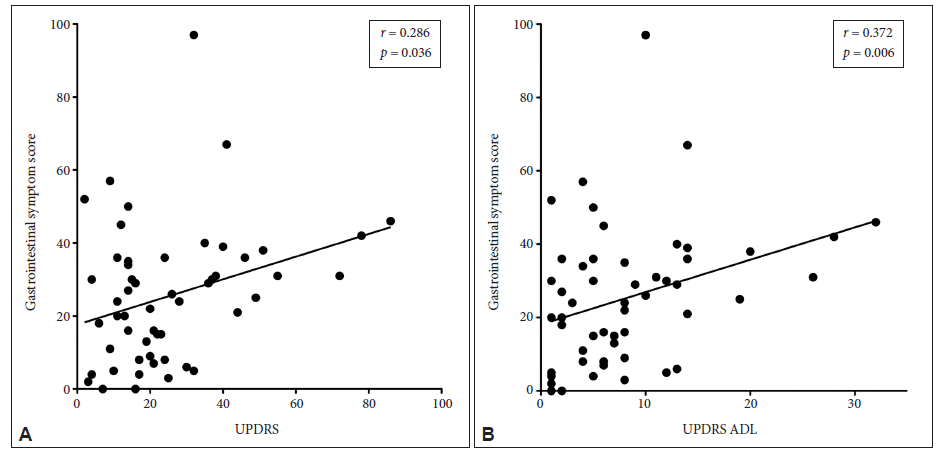
- 25,920 View
- 222 Download
- 82 Web of Science
- 83 Crossref
-
Abstract
PDF
- Objective: Although gastrointestinal dysfunctions occur in the majority of patients with Parkinson’s disease (PD), they are often unrecognized because many patients remain relatively asymptomatic in the early stage. We investigated the frequency of gastrointestinal symptoms in patients with PD using newly developed gastrointestinal symptom questionnaires.
Methods: Early PD patients with a symptom duration not exceeding 3 years were included in this study. All PD patients were evaluated using a questionnaire, which consisted of three relevant domains: oropharyngoesophageal (10 items); gastric (3 items); and intestinal-anorectal (7 items). The frequency of symptoms was calculated as a proportion with an item score ≥ 2.
Results: Of the 54 patients enrolled, 48 patients (88.9%) responded that bowel symptoms developed before the onset of Parkinsonian motor symptoms, and four patients reported that the onset of two types of symptoms (i.e., bowel and neurological) occurred approximately simultaneously, with only months between them. The frequencies of gastrointestinal symptoms are as follows: speech disturbance (40.7%), drooling (24.1%), sense of getting stuck (31.5%), choking (27.8%), globus pharyngis (16.7%), repetitive deglutition (29.6%), pain during swallowing (5.6%), food regurgitation (3.7%), acid reflux (7.4%), nausea/ vomiting (11.1%), early satiety (16.7%), postprandial fullness (14.8%), epigastric soreness (9.3%), abdominal pain (3.7%), constipation (46.3%), excessive strain during defecation (33.3%), fecal incontinence (7.4%), tenesmus (20.4%), loose stool or diarrhea (3.7%), and difficulty in relaxing anal sphincter (11.1%). Two patients were scored at zero.
Conclusions: Our findings confirm that gastrointestinal dysfunction occurs in early PD in relatively high frequency. -
Citations
Citations to this article as recorded by- Striatal 6-hydroxydopamine lesion in rats induces dysregulation of the gut barrier
Cassandra J. Kaufhold, Kaylin A. Pickle, Debanjana Das, Zara Akbari, Esteban D. Lepe, Maia L. Martin, Rachel Pilla, Rahul Srinivasan, Farida Sohrabji
Experimental Neurology.2027; 407: 116024. CrossRef - Movement disorders associated with diarrhoea
Claudia Lazcano-Ocampo, Tobias Warnecke, Iro Boura, Daniele Urso, Valentina Leta, Karolina Poplawska-Domaszewicz, Lucia Batzu, Ece Bayram, Vanessa Raeder, Chin-Hsien Lin, Cristian Falup-Pecurariu, K. Ray Chaudhuri
Journal of Neural Transmission.2026; 133(1): 15. CrossRef - Microbial Metabolism of Levodopa as an Adjunct Therapeutic Target in Parkinson’s Disease
Jimmy B. Feix, Gang Cheng, Micael Hardy, Balaraman Kalyanaraman
Antioxidants.2026; 15(1): 120. CrossRef - Rare Abdominal Manifestations in a Patient with Parkinson’s Disease after Deep Brain Stimulation of the Subthalamic Nucleus: A Case Report
Hiroshi Koyama, Ryoma Morigaki, Kazuhisa Miyake, Taku Matsuda, Joji Fujikawa, Keisuke Shinohara, Yoshihiko Nishida, Yasushi Takagi
Case Reports in Neurology.2026; 18(1): 128. CrossRef - Effects of daily walking exercise on constipation in patients with Parkinson’s disease
Yi-Ping Wu, I-Chien Wu, Ming-Kuei Lu
BMJ Open Sport & Exercise Medicine.2026; 12(1): e002696. CrossRef - Association of Gastrointestinal Symptoms With Severity and Progression of Cognitive Impairment in Parkinson’s Disease: A Systematic Review and Meta‐Analysis
Kimberly Ho, Jeena Khan, Abraham Z. Cheloff, Ashish Malhotra, Aasma Shaukat
Journal of Gastroenterology and Hepatology.2026; 41(6): 1659. CrossRef - Severe Colonic Dysmotility and Constipation Leading to Hydronephrosis in Advanced Parkinson’s Disease: A Case Report and Literature Review
Giovannie Isaac-Coss, Swathi Kavuri, Jayalekshmi Jayakumar, Zoe Post, Atsushi Sakuraba
Cureus.2025;[Epub] CrossRef - Muscle Dystonia Manifesting as Unilateral Rectus Abdominis Hypertrophy and Abdominal Pain in Parkinson’s Disease: A Case Report
Chengjian Wu, Yanhui Meng, Ming Yang
Journal of Movement Disorders.2025; 18(1): 108. CrossRef - Systemic exposure to rotenone toxicity induces gastro-inflammatory damage in mice: protective response of Zingiber officinale Roscoe extract
Olusegun G. Adebayo, Emmanuel U. Modo, Blessing Ogechukwu Orji, Joseph Chimezie, Iheanyichukwu Wopara, Adebimpe V. Masanwoola, Ichipi-Ifukor Patrick Chukwuyenum, Benjamin Oritsemuelebi, Iria Kelly Esezobor
Nutrire.2025;[Epub] CrossRef - Reported Symptoms in Prodromal and Early Motor Parkinson's Disease: A Scoping Review on the Patient Perspective
Joseph Saade, Alice van Wyk, Glenn T. Stebbins, Tiago A. Mestre
Movement Disorders Clinical Practice.2025; 12(6): 721. CrossRef - Gastrointestinal Manifestations in Parkinson's Disease Using a Validated Arabic Version of Gastrointestinal Dysfunction Scale: A Multicenter Study
Ali Soliman Shalash, Marwa Yassien Badr, Yara Salah, Shimaa Elgamal, Shaimaa Ahmed Elaidy, Eman Abdel‐Mageed Elhamrawy, Hayam Abdel‐Tawab, Eman Hamid, Ehab Ahmed El‐Seidy, Noha Lotfy Dawood
Movement Disorders Clinical Practice.2025; 12(7): 947. CrossRef - Systematic review and consensus conceptual model of meaningful symptoms and functional impacts in early Parkinson’s Disease
Jennifer R. Mammen, Jamie L. Adams, Rikki Mangrum, Yuge Xiao, William Barbosa, Mirinda Tyo, Christopher Redmond, Cheryl Carter, Kelly Cifelli, Robert Cifelli, Hope Maruzo, Jim Meeker, Gerry Shultz, Colbren Thomas, Claire Bale, Evan Davies, Catherine M. Ko
npj Parkinson's Disease.2025;[Epub] CrossRef - Acupuncture modulates the microbiota-gut-brain axis: a new strategy for Parkinson’s disease treatment
Zimo Zang, Fang Yang, Liang Qu, Minghui Ge, Liang Tong, Lihui Xue, Xiuye Sun, Ying Hai
Frontiers in Aging Neuroscience.2025;[Epub] CrossRef - Epidemiology of autonomic dysfunction in Parkinson's disease (Review)
Jamir Rissardo, Ahmed Gadelmawla, Ibrahim Khalil, Ayah Abdulgadir, Karandeep Bhatti, Ana Fornari Caprara
Medicine International.2025; 5(6): 1. CrossRef - Parkinson’s disease and the gut-brain connection: unveiling pathways, mechanisms and promising therapies
Suhas Hajare, Yogesh A. Kulkarni
Brain Research.2025; 1868: 149975. CrossRef - Parkinson’s disease beyond the brain: implications for treatments
Setareh Malekian Naeini, Marc Danzell Lopez, Paul E. Fraser, Anurag Tandon
Frontiers in Aging Neuroscience.2025;[Epub] CrossRef - Characteristics of pain symptoms in Parkinson’s disease
Dung Thi Hoang, Frank Xing, Daniel Truong
Clinical Parkinsonism & Related Disorders.2025; 13: 100404. CrossRef - Helicobacter pylori infection and α-synuclein pathology drive parallel neurodegenerative pathways in the substantia nigra
Alejandro Soto-Avellaneda, Alice Prigent, Lindsay Meyerdirk, Noah Schautz, John Andrew Pospisilik, Lena Brundin, Michael X. Henderson
Journal of Neuroinflammation.2025;[Epub] CrossRef - Neuroimmune Connectomes in the Gut and Their Implications in Parkinson’s Disease
Beatriz Thomasi, Luisa Valdetaro, Brian Gulbransen, Ana Lúcia Tavares-Gomes
Molecular Neurobiology.2024; 61(4): 2081. CrossRef - Effect of Lycium ruthenicum and Lycium barbarum intake on Parkinson based on microbiology and metabonomics: A randomized pilot trial
Lingyu Wu, Liwen Chu, Hongdou Cao, Qi Tian, Hua Gao, Jinghong Huo, Qinghan Gao
Food Bioscience.2024; 57: 103548. CrossRef - The missing piece of the puzzle – The key role of the dietitian in the management of Parkinson's disease
Richelle Flanagan, Carley Rusch, Fiona E. Lithander, Indu Subramanian
Parkinsonism & Related Disorders.2024; 121: 106021. CrossRef - Gastric-filling ultrasonography to evaluate gastric motility in patients with Parkinson's disease
Xianwei Zou, Xiaqing Chen, Yanxia Wen, Xiaofeng Jing, Man Luo, Fengyue Xin, Yao Tang, Mengfei Hu, Jian Liu, Fan Xu
Frontiers in Neurology.2024;[Epub] CrossRef - Water extract of ginseng alleviates parkinsonism in MPTP–induced Parkinson’s disease mice
Ning Xu, Shuyang Xing, Jie Li, Bo Pang, Meichen Liu, Meiling Fan, Yu Zhao, Chun-Hua Wang
PLOS ONE.2024; 19(9): e0296424. CrossRef - Neuronal threshold functions: Determining symptom onset in neurological disorders
Luc Jordi, Ole Isacson
Progress in Neurobiology.2024; 242: 102673. CrossRef - α-synuclein overexpression and the microbiome shape the gut and brain metabolome in mice
Livia H. Morais, Joseph C. Boktor, Siamak MahmoudianDehkordi, Rima Kaddurah-Daouk, Sarkis K. Mazmanian
npj Parkinson's Disease.2024;[Epub] CrossRef - Persistent intolerable abdominal pain in patients with Parkinson’s disease
Hiroshi Kataoka, Kazuma Sugie
Clinical Neurology and Neurosurgery.2023; 224: 107558. CrossRef - Striatal Dopaminergic Loss and Dysphagia in Parkinson Disease
Ji Hwan Kim, Jonghu Jeon, Young Lee, Seung Min Kim, Miju Cheon, Jun Yup Kim
Clinical Nuclear Medicine.2023; 48(2): 143. CrossRef - The gut microbiota is an emerging target for improving brain health during ageing
Marcus Boehme, Katherine Elizabeth Guzzetta, Caroline Wasén, Laura Michelle Cox
Gut Microbiome.2023;[Epub] CrossRef - 6-OHDA-Induced Changes in Colonic Segment Contractility in the Rat Model of Parkinson’s Disease
Maria Del Pilar Murillo, Ebba Johansson, Victoria Bryntesson, Patrik Aronsson, Gunnar Tobin, Michael Winder, Thomas Carlsson, Stephen Fink
Gastroenterology Research and Practice.2023; 2023: 1. CrossRef - Efficacy of acupuncture for the treatment of Parkinson’s disease-related constipation (PDC): A randomized controlled trial
Ying-Jia Li, Ian-I Leong, Jing-Qi Fan, Ming-Yue Yan, Xin Liu, Wei-Jing Lu, Yuan-Yuan Chen, Wei-Qiang Tan, Yu-Ting Wang, Li-Xing Zhuang
Frontiers in Neuroscience.2023;[Epub] CrossRef - Considerations for developing a targeted amino acid supplement for people with Parkinson’s disease that promotes health while accounting for pathophysiology and medication interference
Jacob E Earp, Cristina Colon-Semenza, Dara L LoBuono
Nutrition Reviews.2023; 81(8): 1063. CrossRef - Lactobacillus plantarum CCFM405 against Rotenone-Induced Parkinson’s Disease Mice via Regulating Gut Microbiota and Branched-Chain Amino Acids Biosynthesis
Chuanqi Chu, Leilei Yu, Yiwen Li, Hang Guo, Qixiao Zhai, Wei Chen, Fengwei Tian
Nutrients.2023; 15(7): 1737. CrossRef - The longitudinal progression of autonomic dysfunction in Parkinson's disease: A 7-year study
Charlotte B. Stewart, David Ledingham, Victoria K. Foster, Kirstie N. Anderson, Sahana Sathyanarayana, Debra Galley, Nicola Pavese, Jacopo Pasquini
Frontiers in Neurology.2023;[Epub] CrossRef - Association of dysphagia with altered brain glucose metabolism in Parkinson's disease
Ji Yeon Oh, Eui Jin An, Young Lee, Seung Min Kim, Miju Cheon, Jun Yup Kim
CNS Neuroscience & Therapeutics.2023; 29(9): 2498. CrossRef - Differential Findings on Anorectal Manometry in Patients with Parkinson's Disease and Defecatory Dysfunction
Wendy Zhou, George Triadafilopoulos, Brooke Gurland, Houssam Halawi, Laren Becker, Patricia Garcia, Linda Nguyen, Mitchell Miglis, Srikanth Muppidi, Dong‐In Sinn, Safwan Jaradeh, Leila Neshatian
Movement Disorders Clinical Practice.2023; 10(7): 1074. CrossRef - Abdominal pain in Parkinson’s disease
A.A. Pilipovich, O.V. Vorobyova, S.A. Makarov
Russian Journal of Pain.2023; 21(2): 12. CrossRef - Microbiome-Based Therapies in Parkinson’s Disease: Can Tuning the
Microbiota Become a Viable Therapeutic Strategy?
Adejoke Y. Onaolapo, Folusho O. Ojo, Anthony T. Olofinnade, Joshua Falade, Ismail A. Lawal, Olakunle J. Onaolapo
CNS & Neurological Disorders - Drug Targets.2023; 22(9): 1355. CrossRef - Constipation in Parkinson's Disease
Eamonn M. M. Quigley
Seminars in Neurology.2023; 43(04): 562. CrossRef - Autonomic symptoms in early-stage Parkinson’s patients and their relationship with cognition and disease parameters
Esma KOBAK TUR, Eren GÖZKE
Anatolian Current Medical Journal.2023; 5(4): 498. CrossRef - Lower gastrointestinal dysfunction in patients with Parkinson’s disease
A.A. Pilipovich, O.V. Vorob’eva, S.A. Makarov, A.V. Kuchuk
S.S. Korsakov Journal of Neurology and Psychiatry.2023; 123(12): 42. CrossRef - Related Effects of Methamphetamine on the Intestinal Barrier via Cytokines, and Potential Mechanisms by Which Methamphetamine May Occur on the Brain-Gut Axis
Yuansen Li, Deshenyue Kong, Ke Bi, Huayou Luo
Frontiers in Medicine.2022;[Epub] CrossRef - Alpha-synuclein and tau are abundantly expressed in the ENS of the human appendix and monkey cecum
Alexandra D. Zinnen, Jonathan Vichich, Jeanette M. Metzger, Julia C. Gambardella, Viktoriya Bondarenko, Heather A. Simmons, Marina E. Emborg, Stephan N. Witt
PLOS ONE.2022; 17(6): e0269190. CrossRef - Management of dysphagia and gastroparesis in Parkinson’s disease in real-world clinical practice – Balancing pharmacological and non-pharmacological approaches
Roongroj Bhidayasiri, Warongporn Phuenpathom, Ai Huey Tan, Valentina Leta, Saisamorn Phumphid, K. Ray Chaudhuri, Pramod Kumar Pal
Frontiers in Aging Neuroscience.2022;[Epub] CrossRef - Mechanisms of development of constipation in Parkinson’s disease and therapeutic approaches
E.A. Katunina, N.N. Shipilova, D.A. Katunin
Zhurnal nevrologii i psikhiatrii im. S.S. Korsakova.2022; 122(8): 21. CrossRef - Intestinal Permeability, Dysbiosis, Inflammation and Enteric Glia Cells: The Intestinal Etiology of Parkinson’s Disease
Huijia Yang, Song Li, Weidong Le
Aging and disease.2022; 13(5): 1381. CrossRef - The interplay between the gut-brain axis and the microbiome: A perspective on psychiatric and neurodegenerative disorders
Yasir Bashir, Asad U. Khan
Frontiers in Neuroscience.2022;[Epub] CrossRef - Gender Differences and Impact of Autonomic Disturbance on Fatigue and Quality of Life in Parkinson's Disease
Nahush R Bansal, Birinder S Paul, Gunchan Paul, Gagandeep Singh
Neurology India.2022; 70(1): 203. CrossRef - Clinical features and relative factors of constipation in a cohort of Chinese patients with Parkinson's disease
Bai-Hua Sun, Tao Wang, Nian-Ying Li, Qiong Wu, Jin Qiao
World Journal of Gastrointestinal Pharmacology and Therapeutics.2021; 12(1): 21. CrossRef - Characterization of Gastrointestinal Symptom Type and Severity in Parkinson's Disease: A Case–Control Study in an Australian Cohort
Jade E. Kenna, Megan C. Bakeberg, Anastazja M. Gorecki, Alfred Chin Yen Tay, Samantha Winter, Frank L. Mastaglia, Ryan S. Anderton
Movement Disorders Clinical Practice.2021; 8(2): 245. CrossRef - Granisetron, a selective 5-HT3 antagonist, reduces L-3,4-dihydroxyphenylalanine-induced abnormal involuntary movements in the 6-hydroxydopamine-lesioned rat
Cynthia Kwan, Imane Frouni, Dominique Bédard, Adjia Hamadjida, Philippe Huot
Behavioural Pharmacology.2021; 32(1): 43. CrossRef - Deglutition Impairment during Dual Task in Parkinson Disease Is Associated with Cognitive Status
Luciana Grolli Ardenghi, Alana Verza Signorini, Gerson Schulz Maahs, Fabio Selaimen, Konrado Massing Deutsch, Silvia Dornelles, Carlos Roberto de Mello Rieder
International Archives of Otorhinolaryngology.2021; 25(01): e41. CrossRef - Spectrum of Non-Motor Symptoms in Parkinson's Disease
Maithrayie Kumaresan, Safeera Khan
Cureus.2021;[Epub] CrossRef - Onset of Skin, Gut, and Genitourinary Prodromal Parkinson's Disease: A Study of 1.5 Million Veterans
Gregory D. Scott, Miranda M. Lim, Matthew G. Drake, Randy Woltjer, Joseph F. Quinn
Movement Disorders.2021; 36(9): 2094. CrossRef - The Gastrointestinal Dysfunction Scale for Parkinson's Disease
Marta Camacho, Julia C. Greenland, Caroline H. Williams‐Gray
Movement Disorders.2021; 36(10): 2358. CrossRef - The role of microbiota-gut-brain axis in neuropsychiatric and neurological disorders
Katarzyna Socała, Urszula Doboszewska, Aleksandra Szopa, Anna Serefko, Marcin Włodarczyk, Anna Zielińska, Ewa Poleszak, Jakub Fichna, Piotr Wlaź
Pharmacological Research.2021; 172: 105840. CrossRef - Neuro-Immunity and Gut Dysbiosis Drive Parkinson’s Disease-Induced Pain
Katiane Roversi, Natalia Callai-Silva, Karine Roversi, May Griffith, Christos Boutopoulos, Rui Daniel Prediger, Sébastien Talbot
Frontiers in Immunology.2021;[Epub] CrossRef - Autonomic dysfunction in Parkinson’s disease: Implications for pathophysiology, diagnosis, and treatment
Zhichun Chen, Guanglu Li, Jun Liu
Neurobiology of Disease.2020; 134: 104700. CrossRef - Double‐Blind, Randomized, Placebo‐Controlled Trial of DA‐9701 in Parkinson's Disease: PASS‐GI Study
Ji‐Hyun Choi, Jee‐Young Lee, Jin Whan Cho, Seong‐Beom Koh, Young Soon Yang, Dalla Yoo, Cheol‐Min Shin, Hee Tae Kim
Movement Disorders.2020; 35(11): 1966. CrossRef - Parkinson disease and the gut: new insights into pathogenesis and clinical relevance
R. Alberto Travagli, Kirsteen N. Browning, Michael Camilleri
Nature Reviews Gastroenterology & Hepatology.2020; 17(11): 673. CrossRef - Expanding the brain researcher's toolkit
Viviana Gradinaru
Science.2020; 369(6504): 637. CrossRef - Excessive buccal saliva in patients with Parkinson’s disease of the French COPARK cohort
Olivier Rascol, Laurence Negre-Pages, Philippe Damier, Arnaud Delval, Pascal Derkinderen, Alain Destée, Margherita Fabbri, Wassilios G. Meissner, Amine Rachdi, François Tison, Santiago Perez-Lloret
Journal of Neural Transmission.2020; 127(12): 1607. CrossRef - Struktur und Efferenzen der Substantia nigra pars compacta beim idiopathischen Parkinson-Syndrom
Peter Urban, Bjorn Falkenburger, Wolfgang H. Jost, Gerhard Ransmayr, Peter Riederer, Christian Winkler
Fortschritte der Neurologie · Psychiatrie.2020; 88(09): 591. CrossRef - Parkinson’s disease: Are gut microbes involved?
Yogesh Bhattarai, Purna C. Kashyap
American Journal of Physiology-Gastrointestinal and Liver Physiology.2020; 319(5): G529. CrossRef - Does Bilateral Deep Brain Stimulation of the Subthalamic Nucleus Modify Ano-Rectal Motility in Parkinson’s Disease? Results of a Randomized Cross-Over Study
Guillaume Gourcerol, David Maltete, Nathalie Chastan, Marie Laure Welter, Anne Marie Leroi, Stéphane Derrey
Neuromodulation: Technology at the Neural Interface.2019; 22(4): 478. CrossRef - Probiotics for Parkinson’s Disease
Parisa Gazerani
International Journal of Molecular Sciences.2019; 20(17): 4121. CrossRef - Colon dysregulation in methamphetamine self-administering HIV-1 transgenic rats
Amanda L. Persons, Brinda D. Bradaric, Hemraj B. Dodiya, Michael Ohene-Nyako, Christopher B. Forsyth, Ali Keshavarzian, Maliha Shaikh, T. Celeste Napier, Shilpa J. Buch
PLOS ONE.2018; 13(1): e0190078. CrossRef - Induction of alpha-synuclein pathology in the enteric nervous system of the rat and non-human primate results in gastrointestinal dysmotility and transient CNS pathology
Fredric P. Manfredsson, Kelvin C. Luk, Matthew J. Benskey, Aysegul Gezer, Joanna Garcia, Nathan C. Kuhn, Ivette M. Sandoval, Joseph R. Patterson, Alana O'Mara, Reid Yonkers, Jeffrey H. Kordower
Neurobiology of Disease.2018; 112: 106. CrossRef - Dysbiosis of gut microbiota and microbial metabolites in Parkinson’s Disease
Meng-Fei Sun, Yan-Qin Shen
Ageing Research Reviews.2018; 45: 53. CrossRef - Parkinson’s Disease and Current Treatments for Its Gastrointestinal Neurogastromotility Effects
Chethan Ramprasad, Jane Yellowlees Douglas, Baharak Moshiree
Current Treatment Options in Gastroenterology.2018; 16(4): 489. CrossRef - Transdermal rotigotine patch in Parkinson’s disease with a history of intestinal operation
Takashi Ogawa, Genko Oyama, Nobutaka Hattori
BMJ Case Reports.2018; 2018: bcr-2017-223722. CrossRef - α-Synuclein in the colon and premotor markers of Parkinson disease in neurologically normal subjects
Joong-Seok Kim, In-Seok Park, Hyung-Eun Park, Su-Young Kim, Jung A Yun, Chan Kwon Jung, Hye-Young Sung, Jin-Kwon Lee, Won-Kyung Kang
Neurological Sciences.2017; 38(1): 171. CrossRef - The Threshold Theory for Parkinson's Disease
Simone Engelender, Ole Isacson
Trends in Neurosciences.2017; 40(1): 4. CrossRef - Constipation in parkinson's disease: Subjective symptoms, objective markers, and new perspectives
Karoline Knudsen, Klaus Krogh, Karen Østergaard, Per Borghammer
Movement Disorders.2017; 32(1): 94. CrossRef - Is Levodopa Pharmacokinetics in Patients with Parkinson’s Disease Depending on Gastric Emptying?
Maria Nord, Anita Kullman, Ulf Hannestad, Nil Dizdar
Advances in Parkinson's Disease.2017; 06(01): 1. CrossRef - Validation of the Korean Version of the Scale for Outcomes in Parkinson’s Disease-Autonomic
Ji-Young Kim, In-Uk Song, Seong-Beom Koh, Tae-Beom Ahn, Sang Jin Kim, Sang-Myung Cheon, Jin Whan Cho, Yun Joong Kim, Hyeo-Il Ma, Mee-Young Park, Jong Sam Baik, Phil Hyu Lee, Sun Ju Chung, Jong-Min Kim, Han-Joon Kim, Young-Hee Sung, Do Young Kwon, Jae-Hyeo
Journal of Movement Disorders.2017; 10(1): 29. CrossRef - Gastroesophageal reflux disease with proton pump inhibitor use is associated with an increased risk of osteoporosis: a nationwide population-based analysis
C.-H. Chen, C.-L. Lin, C.-H. Kao
Osteoporosis International.2016; 27(6): 2117. CrossRef - Parkinson Disease-Mediated Gastrointestinal Disorders and Rational for Combinatorial Therapies
Syed Ali, Ning Yin, Arkam Rehman, Verline Justilien
Medical Sciences.2016; 4(1): 1. CrossRef - Intestinal dysfunction in Parkinson's disease: Lessons learned from translational studies and experimental models
C. Pellegrini, R. Colucci, L. Antonioli, E. Barocelli, V. Ballabeni, N. Bernardini, C. Blandizzi, W. J. de Jonge, M. Fornai
Neurogastroenterology & Motility.2016; 28(12): 1781. CrossRef - Gut dysfunction in Parkinson's disease
Adreesh Mukherjee, Atanu Biswas, Shyamal Kumar Das
World Journal of Gastroenterology.2016; 22(25): 5742. CrossRef - Inflammation is genetically implicated in Parkinson’s disease
N. Dzamko, C.L Geczy, G.M Halliday
Neuroscience.2015; 302: 89. CrossRef - Alteration of enteric monoamines with monoamine receptors and colonic dysmotility in 6-OHDA-induced Parkinson’s disease rats
Xiaoli Zhang, Yun Li, Chenzhe Liu, Ruifang Fan, Ping Wang, Lifei Zheng, Feng Hong, Xiaoyan Feng, Yue Zhang, Lisheng Li, Jinxia Zhu
Translational Research.2015;[Epub] CrossRef - The treatment of gastroparesis, constipation and small intestinal bacterial overgrowth syndrome in patients with Parkinson’s disease
Jose L Barboza, Michael S Okun, Baharak Moshiree
Expert Opinion on Pharmacotherapy.2015; 16(16): 2449. CrossRef - Gastrointestinal Dysfunctions in Parkinson’s Disease
Joong-Seok Kim, Hey Young Sung
Journal of the Korean Neurological Association.2015; 33(4): 247. CrossRef
- Striatal 6-hydroxydopamine lesion in rats induces dysregulation of the gut barrier
Review Articles
- Modeling α-Synuclein Propagation with Preformed Fibril Injections
- Hyun Kyung Chung, Hoang-Anh Ho, Dayana Pérez-Acuña, Seung-Jae Lee
- J Mov Disord. 2019;12(3):139-151. Published online September 30, 2019
- DOI: https://doi.org/10.14802/jmd.19046
- Correction in: J Mov Disord 2020;13(1):77
- 33,629 View
- 1,171 Download
- 85 Web of Science
- 82 Crossref
-
Abstract
PDF
- The aggregation of α-synuclein (α-syn) has been implicated in the pathogenesis of many neurodegenerative disorders, including Parkinson’s disease (PD), dementia with Lewy bodies (DLB), and multiple system atrophy (MSA). Postmortem analyses of α-syn pathology, especially that of PD, have suggested that aggregates progressively spread from a few discrete locations to wider brain regions. The neuron-to-neuron propagation of α-syn has been suggested to be the underlying mechanism by which aggregates spread throughout the brain. Many cellular and animal models has been created to study cell-to-cell propagation. Recently, it has been shown that a single injection of preformed fibrils (PFFs) made of recombinant α-syn proteins into various tissues and organs of many different animal species results in widespread α-syn pathology in the central nervous system (CNS). These PFF models have been extensively used to study the mechanism by which aggregates spread throughout the brain. Here, we review what we have learned from PFF models, describe the nature of PFFs and the neuropathological features, neurophysiological characteristics, and behavioral outcomes of the models.
-
Citations
Citations to this article as recorded by- Photobiomodulation in Parkinson’s disease: From pathogenesis to intervention
Jie Shao, Qianting Deng, Luodan Yang
Experimental Neurology.2027; 408: 116088. CrossRef - Low-density lipoprotein receptor–related protein 1 mediates α-synuclein transmission from the striatum to the substantia nigra in animal models of Parkinson’s disease
Hanjiang Luo, Caixia Peng, Chengli Wu, Chengwei Liu, Qinghua Li, Shun Yu, Jia Liu, Min Chen
Neural Regeneration Research.2026; 21(4): 1595. CrossRef - Internalized SNCA/α-synuclein fibrils become truncated and resist degradation in neurons while glial cells rapidly degrade SNCA fibrils
Md. Razaul Karim, Elizabeth Tiegs, Emilie Gasparini, Riley Schlichte, Scott C. Vermilyea, Michael K. Lee
Autophagy.2026; 22(1): 102. CrossRef - Unraveling the intersection of aging and Parkinson’s disease: a collaborative roadmap for advancing research models
M. Y. Schmidt, A. M. Cuervo, K. L. Double, D. Ehninger, M. S. Goldberg, K. Harvey, J. H. J. Hoeijmakers, K. C. Luk, P. G. Mastroberardino, D. J. Moore, L. J. Niedernhofer, L. É. Trudeau, D. Jurk, J. K. Andersen, I. Bellantuono
npj Parkinson's Disease.2026;[Epub] CrossRef - Accelerated and localized synucleinopathy in a hybrid mouse model: implications for positron emission tomography studies
Chunfang A. Xia, Hsiu-Ming Tsai, Sandra Diaz Garcia, Shuanglong Liu, Alessandra Matzeu, Mani Salarian, Wouter Bruinzeel, Anna K. Szardenings
npj Imaging.2026;[Epub] CrossRef - A human striatal–midbrain assembloid model of alpha-synuclein propagation
Hoang-Dai Tran, Min-Kyoung Shin, Xin Yi Yeo, Sangyong Jung, Muhammad Junaid, Su Bin Lim, Jungmo Kim, Hyun Goo Woo, Charlotte R Denman, Run-Run Han, Minju Kim, Dongju Jeon, Haerim Kim, Yeo Jin Kim, Ji Young Mun, Eun Jeong Lee, Sang Myun Park, Bernd Kuhn, G
Brain.2026; 149(3): 867. CrossRef - The retinal nerve fiber layer mean thickness in patients with early Parkinson’s disease reflects striatal dopamine function
Xiaoxue Shi, Keke Liang, Jianjun Ma, Chang Fu, Qingge Guo, Qi Gu, Li Wang, Dongsheng Li, Jinhua Zheng, Siyuan Chen, Zonghan She, Xuelin Qi, Xue Li, Shaopu Wu
Neuroscience.2026; 599: 94. CrossRef - Direct current stimulation induced reduction in α-synuclein in primary neurons: targeting Parkinson’s disease
Sophie Bechkos, Scott D Ryan, Alysia Ross, Hongyu Sun, Shawn Hayley
Brain Communications.2026;[Epub] CrossRef - Neuronal vulnerability in Parkinson’s disease: insights from murine α-synuclein pathology models
Ziba Asadpoordezaki, Jochen H.M. Prehn
Neuroscience.2026; 605: 73. CrossRef - Propagation of α-synuclein pathology: models, mechanisms and future goals
Aryeh Zolin, Sarah A. Weber, Yan Xin Xie, Jacqueline Burré
Molecular Neurodegeneration Advances.2026;[Epub] CrossRef - Rodent models and accompanying in vitro strategies for studying the etiology and therapy of Parkinson's disease
Kristina Lau, Tiago F Outeiro, Franziska Richter
Journal of Parkinson’s Disease.2026; 16(6): 1074. CrossRef - Cholesterol dysregulation in APOE4 astrocytes promotes α-synuclein pathology in miBrains
Louise A. Mesentier-Louro, Camille Goldman, Sebastian Gaese, Alice Buonfiglioli, Dimitrios Kyriakis, Ashley Harlock, Alain Ndayisaba, Emily R. Sartori, Abigail Uchitelev, John F. Fullard, Evelyn Hennigan, Donghoon Lee, Braxton R. Schuldt, Rikki B. Rooklin
Cell Stem Cell.2026; 33(9): 1459. CrossRef - Physicochemically Defined Nanoscale Graphene Oxide Modulates Fibril-Related α-Synuclein and Attenuates Parkinsonian Pathology In Vivo
Sung-Ae Cha, Hyung Ho Yoon, Dong Kwang Seo, Soon Won Choi, Jaechul Ryu, Kyung-Sun Kang, Sang Ryong Jeon
ACS Applied Bio Materials.2026; 9(20): 9582. CrossRef - Multimodal neuroimaging elucidates the posterior-to-anterior gradient of nigrostriatal degeneration in Parkinson’s disease
Huamei Lin, Ying Zhang, Yixin Zhao, Yiman Wei, Benjamin F. Combes, Martin T. Henrich, Fanni F. Geibl, Wolfgang H. Oertel, Kuangyu Shi, Axel Rominger, Ping Wu, Jingjie Ge, Jing Wang, Jiaying Lu, Zizhao Ju, Qian Xu, Huiwei Zhang, Yunhao Yang, Zengping Lin,
npj Parkinson's Disease.2026;[Epub] CrossRef - Die Vermehrung von Alpha‐Synuclein Amyloidfibrillen ist unterdrückt unter vollständig ruhenden Lösungsbedingungen
Azad Farzadfard, Thomas O. Mason, Antonin Kunka, Hossein Mohammad‐Beigi, Kaare Bjerregaard‐Andersen, Jonas Folke, Susana Aznar, Pekka Kallunki, Alexander K. Buell
Angewandte Chemie.2025;[Epub] CrossRef - The Amplification of Alpha‐Synuclein Amyloid Fibrils is Suppressed under Fully Quiescent Conditions
Azad Farzadfard, Thomas O. Mason, Antonin Kunka, Hossein Mohammad‐Beigi, Kaare Bjerregaard‐Andersen, Jonas Folke, Susana Aznar, Pekka Kallunki, Alexander K. Buell
Angewandte Chemie International Edition.2025;[Epub] CrossRef - Bradykinesia and postural instability in a model of prodromal synucleinopathy with α-synuclein aggregation initiated in the gigantocellular nuclei
Vasileios Theologidis, Sara A. Ferreira, Nanna M. Jensen, Diana Gomes Moreira, Ole A. Ahlgreen, Mads W. Hansen, Emilie D. Rosenberg, Mette Richner, Islam Faress, Hjalte Gram, Poul Henning Jensen, Per Borghammer, Jens R. Nyengaard, Marina Romero-Ramos, Chr
Acta Neuropathologica Communications.2025;[Epub] CrossRef - The basolateral amygdala and striatum propagate alpha-synuclein pathology causing increased fear response in a Parkinson’s disease model
Thuy Thi Lai, Wei Xiang, Milos Stanojlovic, Christopher Käufer, Malte Feja, Kristina Lau, Friederike Zunke, Franziska Richter
Brain, Behavior, and Immunity.2025; 128: 469. CrossRef - Research models to study lewy body dementia
Suelen Lucio Boschen, Aarushi A. Mukerjee, Ayman H. Faroqi, Ben E. Rabichow, John Fryer
Molecular Neurodegeneration.2025;[Epub] CrossRef - Clearance Pathways for α‐Synuclein in Parkinson's Disease
Margaret S. Ho
Journal of Neurochemistry.2025;[Epub] CrossRef - Soluble and Insoluble Lysates from the Human A53T Mutant α-Synuclein Transgenic Mouse Model Induces α-Synucleinopathy Independent of Injection Site
Justin Barnes, Scott C. Vermilyea, Joyce Meints, Héctor Martell-Martinez, Michael K. Lee
International Journal of Molecular Sciences.2025; 26(13): 6254. CrossRef - Parkinson’s disease: exploring the systemic immune mechanisms through molecular investigations
Maneesh Mohan, Ashi Mannan, Thakur Gurjeet Singh
Inflammopharmacology.2025; 33(7): 3679. CrossRef - Immunity in Parkinson's disease – The role of innate responses
A.R. Satvik Iyengar, Peter R. Dunkley, Phillip W. Dickson
Journal of Neuroimmunology.2025; 408: 578716. CrossRef - In vivo validation of novel non-invasive PHP.eB AAVs as a potential therapeutic approach for alpha-synucleinopathies
Maria Fouka, Iraklis Tsakogias, Elena-Georgia Gialinaki, Athanasios Stavropoulos, Christiane Volbracht, Louis De Muynck, Diederik Moechars, Ronald Melki, George K. Tofaris, Leonidas Stefanis, Maria Xilouri
Acta Neuropathologica Communications.2025;[Epub] CrossRef - Seed amplification of MSA alpha-synuclein aggregates preserves the biological and structural properties of brain-derived aggregates
Fei Wang, Victor Banerjee, Carla Barria, Santiago Ramirez, Tyler Allison, Damian Gorski, Haley Evans, Quynh Nguyen, Danielle Harrison, Rabab Al-Lahham, Nicole De Gregorio Carbonell, Michelle Pinho, Sanne Kaalund, Jonas Folke, Susana Aznar, Luis Concha-Mar
Nature Communications.2025;[Epub] CrossRef - Glial senescence enhances α-synuclein pathology owing to its insufficient clearance caused by autophagy dysfunction
Bin Hong, Yosuke Ohtake, Takahide Itokazu, Toshihide Yamashita
Cell Death Discovery.2024;[Epub] CrossRef - A Surface Imprinted Polymer EIS Sensor for Detecting Alpha-Synuclein, a Parkinson’s Disease Biomarker
Roslyn Simone Massey, Rishabh Ramesh Appadurai, Ravi Prakash
Micromachines.2024; 15(2): 273. CrossRef - Dysbiosis of the gut microbiota and its effect on α-synuclein and prion protein misfolding: consequences for neurodegeneration
Nasir Uddin Mahbub, Md Minarul Islam, Seong-Tshool Hong, Hea-Jong Chung
Frontiers in Cellular and Infection Microbiology.2024;[Epub] CrossRef - Neuropathogenesis-on-chips for neurodegenerative diseases
Sarnai Amartumur, Huong Nguyen, Thuy Huynh, Testaverde S. Kim, Ran-Sook Woo, Eungseok Oh, Kyeong Kyu Kim, Luke P. Lee, Chaejeong Heo
Nature Communications.2024;[Epub] CrossRef - Systemic inflammation activates coagulation and immune cell infiltration pathways in brains with propagating α-synuclein fibril aggregates
Anne-Line Strange Laursen, Mikkel Vestergaard Olesen, Jonas Folke, Tomasz Brudek, Luisa Harriet Knecht, Florence Sotty, Kate Lykke Lambertsen, Karina Fog, Louise Torp Dalgaard, Susana Aznar
Molecular and Cellular Neuroscience.2024; 129: 103931. CrossRef - Comparison of Aptamer and Antibody Bioreceptors in the OEGFET Biosensor Platform for Detecting α-Synuclein, a Parkinson's Biomarker
Roslyn S. Massey, Srishti Johri, Dennis Chan, Matthew R. Holahan, Ravi Prakash
IEEE Sensors Letters.2024; 8(7): 1. CrossRef - Cognitive dysfunction in animal models of human lewy-body dementia
Caroline Haikal, Graham M. Winston, Michael G. Kaplitt
Frontiers in Aging Neuroscience.2024;[Epub] CrossRef - Non-invasive Monitoring of α-Synuclein in Saliva for Parkinson’s Disease Using Organic Electrolyte-Gated FET Aptasensor
Roslyn S. Massey, Erin M. McConnell, Dennis Chan, Matthew R. Holahan, Maria C. DeRosa, Ravi Prakash
ACS Sensors.2023; 8(8): 3116. CrossRef - CSF-derived extracellular vesicles from patients with Parkinson’s disease induce symptoms and pathology
Shay Herman, Ruth Djaldetti, Brit Mollenhauer, Daniel Offen
Brain.2023; 146(1): 209. CrossRef - Overexpression-Induced α-Synuclein Brain Spreading
Rita Pinto-Costa, Eugenia Harbachova, Pietro La Vitola, Donato A. Di Monte
Neurotherapeutics.2023; 20(1): 83. CrossRef - The Role of α-Synuclein in the Regulation of Serotonin System: Physiological and Pathological Features
Lluis Miquel-Rio, Unai Sarriés-Serrano, Rubén Pavia-Collado, J Javier Meana, Analia Bortolozzi
Biomedicines.2023; 11(2): 541. CrossRef - α‐Synuclein decoy peptide protects mice against α‐synuclein‐induced memory loss
Qingyun Guo, Ichiro Kawahata, Wenbin Jia, Haoyang Wang, An Cheng, Yasushi Yabuki, Norifumi Shioda, Kohji Fukunaga
CNS Neuroscience & Therapeutics.2023; 29(6): 1547. CrossRef - Duodenal alpha‐Synuclein Pathology and Enteric Gliosis in Advanced Parkinson's Disease
Aron Emmi, Michele Sandre, Francesco Paolo Russo, Giulia Tombesi, Federica Garrì, Marta Campagnolo, Miryam Carecchio, Roberta Biundo, Gaya Spolverato, Veronica Macchi, Edoardo Savarino, Fabio Farinati, Piero Parchi, Andrea Porzionato, Luigi Bubacco, Raffa
Movement Disorders.2023; 38(5): 885. CrossRef - Retina-to-brain spreading of α-synuclein after intravitreal injection of preformed fibrils
Dayana Pérez-Acuña, Ka Hyun Rhee, Soo Jean Shin, Jeeyun Ahn, Jee-Young Lee, Seung-Jae Lee
Acta Neuropathologica Communications.2023;[Epub] CrossRef - Apathy in Parkinson’s Disease: Clinical Patterns and Neurobiological Basis
Matthieu Béreau, Vincent Van Waes, Mathieu Servant, Eloi Magnin, Laurent Tatu, Mathieu Anheim
Cells.2023; 12(12): 1599. CrossRef - Translating Pathological Brain Activity Primers in Parkinson’s Disease Research
Daniela Mirzac, Svenja L. Kreis, Heiko J. Luhmann, Gabriel Gonzalez-Escamilla, Sergiu Groppa
Research.2023;[Epub] CrossRef - Animal models of Parkinson’s disease: bridging the gap between disease hallmarks and research questions
Axelle Dovonou, Cyril Bolduc, Victoria Soto Linan, Charles Gora, Modesto R. Peralta III, Martin Lévesque
Translational Neurodegeneration.2023;[Epub] CrossRef - The Poly-Arginine Peptide R18D Interferes with the Internalisation of α-Synuclein Pre-Formed Fibrils in STC-1 Enteroendocrine Cells
Anastazja M. Gorecki, Holly Spencer, Bruno P. Meloni, Ryan S. Anderton
Biomedicines.2023; 11(8): 2089. CrossRef - Alpha‐synuclein fibrils amplified from multiple system atrophy and Parkinson's disease patient brain spread after intracerebral injection into mouse brain
Shuyu Zhang, Karina Dauer, Timo Strohäker, Lars Tatenhorst, Lucas Caldi Gomes, Simon Mayer, Byung Chul Jung, Woojin S. Kim, Seung‐Jae Lee, Stefan Becker, Friederike Liesche‐Starnecker, Markus Zweckstetter, Paul Lingor
Brain Pathology.2023;[Epub] CrossRef - Aging, Parkinson’s Disease, and Models: What Are the Challenges?
Emily Rocha, Manish Chamoli, Shankar J. Chinta, Julie K. Andersen, Ruby Wallis, Erwan Bezard, Matt Goldberg, Tim Greenamyre, Warren Hirst, We-Li Kuan, Deniz Kirik, Laura Niedernhofer, Irit Rappley, Shalini Padmanabhan, Louis-Eric Trudeau, Maria Spillantin
Aging Biology.2023; 1(1): 20230010. CrossRef - A Novel NOX Inhibitor Alleviates Parkinson’s Disease Pathology in PFF-Injected Mice
Kwadwo Ofori, Anurupa Ghosh, Dinesh Kumar Verma, Darice Wheeler, Gabriela Cabrera, Jong-Bok Seo, Yong-Hwan Kim
International Journal of Molecular Sciences.2023; 24(18): 14278. CrossRef - Cortical Lewy body injections induce long-distance pathogenic alterations in the non-human primate brain
Margaux Teil, Sandra Dovero, Mathieu Bourdenx, Marie-Laure Arotcarena, Morgane Darricau, Gregory Porras, Marie-Laure Thiolat, Inés Trigo-Damas, Celine Perier, Cristina Estrada, Nuria Garcia-Carrillo, María Trinidad Herrero, Miquel Vila, José A. Obeso, Erw
npj Parkinson's Disease.2023;[Epub] CrossRef - Immunization Effects of a Novel α-Synuclein-Based Peptide Epitope Vaccine in Parkinson’s Disease-Associated Pathology
Jun Sung Park, Riaz Ahmad, Kyonghwan Choe, Min Hwa Kang, Tae Ju Park, Myeong Ok Kim
Vaccines.2023; 11(12): 1820. CrossRef - Ellagic Acid Prevents α-Synuclein Spread and Mitigates Toxicity by Enhancing Autophagic Flux in an Animal Model of Parkinson’s Disease
Nada Radwan, Engila Khan, Mustafa T. Ardah, Tohru Kitada, M. Emdadul Haque
Nutrients.2023; 16(1): 85. CrossRef - DA-9805 protects dopaminergic neurons from endoplasmic reticulum stress and inflammation
Sora Kang, Ying Piao, Young Cheol Kang, Suyeol Lim, Youngmi Kim Pak
Biomedicine & Pharmacotherapy.2022; 145: 112389. CrossRef - Endogenous Levels of Alpha-Synuclein Modulate Seeding and Aggregation in Cultured Cells
Eftychia Vasili, Antonio Dominguez-Meijide, Manuel Flores-León, Mohammed Al-Azzani, Angeliki Kanellidi, Ronald Melki, Leonidas Stefanis, Tiago Fleming Outeiro
Molecular Neurobiology.2022; 59(2): 1273. CrossRef - Phosphorylation of endogenous α-synuclein induced by extracellular seeds initiates at the pre-synaptic region and spreads to the cell body
Shiori Awa, Genjiro Suzuki, Masami Masuda-Suzukake, Takashi Nonaka, Minoru Saito, Masato Hasegawa
Scientific Reports.2022;[Epub] CrossRef - Evidence of Inflammation in Parkinson’s Disease and Its Contribution to Synucleinopathy
Thuy Thi Lai, Yun Joong Kim, Hyeo-il Ma, Young Eun Kim
Journal of Movement Disorders.2022; 15(1): 1. CrossRef - α-Synuclein in Parkinson's disease and advances in detection
Rong Chen, Xuan Gu, Xiaoying Wang
Clinica Chimica Acta.2022; 529: 76. CrossRef - Neurons with Cat’s Eyes: A Synthetic Strain of α-Synuclein Fibrils Seeding Neuronal Intranuclear Inclusions
Francesca De Giorgi, Muhammed Bilal Abdul-Shukkoor, Marianna Kashyrina, Leslie-Ann Largitte, Francesco De Nuccio, Brice Kauffmann, Alons Lends, Florent Laferrière, Sébastien Bonhommeau, Dario Domenico Lofrumento, Luc Bousset, Erwan Bezard, Thierry Buffete
Biomolecules.2022; 12(3): 436. CrossRef - A Novel NOX Inhibitor Treatment Attenuates Parkinson’s Disease-Related Pathology in Mouse Models
Anurupa A. Ghosh, Dinesh Kumar Verma, Gabriela Cabrera, Kwadwo Ofori, Karina Hernandez-Quijada, Jae-Kwan Kim, Joo Hee Chung, Michael Moore, Sung Hwan Moon, Jong Bok Seo, Yong-Hwan Kim
International Journal of Molecular Sciences.2022; 23(8): 4262. CrossRef - Do Naturally Occurring Antioxidants Protect Against Neurodegeneration
of the Dopaminergic System? A Systematic Revision in Animal Models of
Parkinson's Disease
Carmen Costas, Lilian R.F. Faro
Current Neuropharmacology.2022; 20(2): 432. CrossRef - NXP031 prevents dopaminergic neuronal loss and oxidative damage in the AAV-WT-α-synuclein mouse model of Parkinson’s disease
Min Kyung Song, Levi Adams, Joo Hee Lee, Yoon-Seong Kim, Hemant K. Paudel
PLOS ONE.2022; 17(7): e0272085. CrossRef - Stress-inducible phosphoprotein 1 (HOP/STI1/STIP1) regulates the accumulation and toxicity of α-synuclein in vivo
Rachel E. Lackie, Aline S. de Miranda, Mei Peng Lim, Vladislav Novikov, Nimrod Madrer, Nadun C. Karunatilleke, Benjamin S. Rutledge, Stephanie Tullo, Anne Brickenden, Matthew E. R. Maitland, David Greenberg, Daniel Gallino, Wen Luo, Anoosha Attaran, Irina
Acta Neuropathologica.2022; 144(5): 881. CrossRef - Nanomedicine in the Face of Parkinson’s Disease: From Drug Delivery Systems to Nanozymes
Francisco J. Padilla-Godínez, Leonardo I. Ruiz-Ortega, Magdalena Guerra-Crespo
Cells.2022; 11(21): 3445. CrossRef - Animal Models of Metabolic Disorders in the Study of Neurodegenerative Diseases: An Overview
Andreza Fabro de Bem, Rachel Krolow, Hémelin Resende Farias, Victória Linden de Rezende, Daniel Pens Gelain, José Cláudio Fonseca Moreira, João Miguel das Neves Duarte, Jade de Oliveira
Frontiers in Neuroscience.2021;[Epub] CrossRef - Role of Liver Growth Factor (LGF) in Parkinson’s Disease: Molecular Insights and Therapeutic Opportunities
Efthalia Angelopoulou, Yam Nath Paudel, Christina Piperi
Molecular Neurobiology.2021; 58(7): 3031. CrossRef - Trans-synaptic spreading of alpha-synuclein pathology through sensory afferents leads to sensory nerve degeneration and neuropathic pain
Nelson Ferreira, Nádia Pereira Gonçalves, Asad Jan, Nanna Møller Jensen, Amelia van der Laan, Simin Mohseni, Christian Bjerggaard Vægter, Poul Henning Jensen
Acta Neuropathologica Communications.2021;[Epub] CrossRef - Pharmacological Inhibition of Brain EGFR Activation By a BBB-penetrating Inhibitor, AZD3759, Attenuates α-synuclein Pathology in a Mouse Model of α-Synuclein Propagation
Omid Tavassoly, Esther del Cid Pellitero, Frederique Larroquette, Eddie Cai, Rhalena A. Thomas, Vincent Soubannier, Wen Luo, Thomas M. Durcan, Edward A. Fon
Neurotherapeutics.2021; 18(2): 979. CrossRef - The Future of Incretin-Based Approaches for Neurodegenerative Diseases in Older Adults: Which to Choose? A Review of their Potential Efficacy and Suitability
Christine Girges, Nirosen Vijiaratnam, Dilan Athauda, Grace Auld, Sonia Gandhi, Thomas Foltynie
Drugs & Aging.2021; 38(5): 355. CrossRef - Prodromal neuroinvasion of pathological α-synuclein in brainstem reticular nuclei and white matter lesions in a model of α-synucleinopathy
Nelson Ferreira, Mette Richner, Amelia van der Laan, Ida Bergholdt Jul Christiansen, Christian B Vægter, Jens R Nyengaard, Glenda M Halliday, Joachim Weis, Benoit I Giasson, Ian R Mackenzie, Poul H Jensen, Asad Jan
Brain Communications.2021;[Epub] CrossRef - Impact of the apelin/APJ axis in the pathogenesis of Parkinson’s disease with therapeutic potential
Efthalia Angelopoulou, Yam Nath Paudel, Anastasia Bougea, Christina Piperi
Journal of Neuroscience Research.2021; 99(9): 2117. CrossRef - Adenovirus-induced Reactive Astrogliosis Exacerbates the Pathology of Parkinson’s Disease
Heeyoung An, Hyowon Lee, Seulkee Yang, Woojin Won, C. Justin Lee, Min-Ho Nam
Experimental Neurobiology.2021; 30(3): 222. CrossRef - Brain iron enrichment attenuates α‐synuclein spreading after injection of preformed fibrils
Karina Dauer née Joppe, Lars Tatenhorst, Lucas Caldi Gomes, Shuyu Zhang, Mojan Parvaz, Eleonora Carboni, Anna‐Elisa Roser, Hazem El DeBakey, Mathias Bähr, Katarina Vogel‐Mikuš, Chi Wang Ip, Stefan Becker, Markus Zweckstetter, Paul Lingor
Journal of Neurochemistry.2021; 159(3): 554. CrossRef - Increased oscillatory power in a computational model of the olfactory bulb due to synaptic degeneration
J. Kendall Berry, Daniel Cox
Physical Review E.2021;[Epub] CrossRef - Combining Automated Organoid Workflows with Artificial Intelligence‐Based Analyses: Opportunities to Build a New Generation of Interdisciplinary High‐Throughput Screens for Parkinson's Disease and Beyond
Henrik Renner, Hans R. Schöler, Jan M. Bruder
Movement Disorders.2021; 36(12): 2745. CrossRef - Is Multiple System Atrophy a Prion-like Disorder?
Kurt A. Jellinger, Gregor K. Wenning, Nadia Stefanova
International Journal of Molecular Sciences.2021; 22(18): 10093. CrossRef - Cortical alpha-synuclein preformed fibrils do not affect interval timing in mice
Qiang Zhang, Hisham Abdelmotilib, Travis Larson, Cameron Keomanivong, Mackenzie Conlon, Georgina M. Aldridge, Nandakumar S. Narayanan
Neuroscience Letters.2021; 765: 136273. CrossRef - Temporal Evolution of Inflammation and Neurodegeneration With Alpha-Synuclein Propagation in Parkinson's Disease Mouse Model
Thuy Thi Lai, Yun Joong Kim, Phuong Thi Nguyen, Young Ho Koh, Tinh Thi Nguyen, Hyeo-il Ma, Young Eun Kim
Frontiers in Integrative Neuroscience.2021;[Epub] CrossRef - The Concept of α-Synuclein Strains and How Different Conformations May Explain Distinct Neurodegenerative Disorders
Katja Malfertheiner, Nadia Stefanova, Antonio Heras-Garvin
Frontiers in Neurology.2021;[Epub] CrossRef - A historical review of multiple system atrophy with a critical appraisal of cellular and animal models
David J. Marmion, Wouter Peelaerts, Jeffrey H. Kordower
Journal of Neural Transmission.2021; 128(10): 1507. CrossRef - Exploring the Etiological Links behind Neurodegenerative Diseases: Inflammatory Cytokines and Bioactive Kynurenines
Masaru Tanaka, József Toldi, László Vécsei
International Journal of Molecular Sciences.2020; 21(7): 2431. CrossRef - Modeling Parkinson’s Disease With the Alpha-Synuclein Protein
Mónica Gómez-Benito, Noelia Granado, Patricia García-Sanz, Anne Michel, Mireille Dumoulin, Rosario Moratalla
Frontiers in Pharmacology.2020;[Epub] CrossRef - Enhanced Susceptibility of PINK1 Knockout Rats to α-Synuclein Fibrils
Rose B. Creed, Matthew S. Goldberg
Neuroscience.2020; 437: 64. CrossRef - Pathogenic Mutations Differentially Regulate Cell-to-Cell Transmission of α-Synuclein
Yuan Guan, Xiaofang Zhao, Fengwei Liu, Shuxin Yan, Yalong Wang, Cuilian Du, Xiuyu Cui, Rena Li, Claire Xi Zhang
Frontiers in Cellular Neuroscience.2020;[Epub] CrossRef - Dopamine, Alpha-Synuclein, and Mitochondrial Dysfunctions in Parkinsonian Eyes
Alessia Indrieri, Rocco Pizzarelli, Brunella Franco, Elvira De Leonibus
Frontiers in Neuroscience.2020;[Epub] CrossRef - Classic and evolving animal models in Parkinson's disease
Tanvi Pingale, Girdhari Lal Gupta
Pharmacology Biochemistry and Behavior.2020; 199: 173060. CrossRef
- Photobiomodulation in Parkinson’s disease: From pathogenesis to intervention
- Oro-Pharyngeal Dysphagia in Parkinson’s Disease and Related Movement Disorders
- Miseon Kwon, Jae-Hong Lee
- J Mov Disord. 2019;12(3):152-160. Published online September 30, 2019
- DOI: https://doi.org/10.14802/jmd.19048
- 63,255 View
- 1,433 Download
- 70 Web of Science
- 77 Crossref
-
Abstract
PDF
 Supplementary Material
- Oro-pharyngeal dysphagia is a common symptom in patients with Parkinson’s disease (PD) and related disorders, even in their early stage of diseases. Dysphagia in these patients has been underdiagnosed, probably due to poor the self-awareness of the conditions and the underuse of validated tools and objective instruments for assessment. The early detection and intervention of dysphagia are closely related to improving the quality of life and decreasing the mortality rate in these patients. The purpose of this paper is to give an overview of the characteristics of dysphagia, including the epidemiology, pathophysiology, and clinical symptomatology, in patients with PD compared with other parkinsonian disorders and movement disorders. The management of dysphagia and future research directions related to these disorders are also discussed.
-
Citations
Citations to this article as recorded by- Compliance With Swallowing Instruction and Quality of Life in Patients With Parkinson's Disease: A Retrospective Assessment of Instructional Methods to Maintain and Improve Quality of Life
Keigo Nakayama, Toshiyuki Yamamoto, Takatoshi Hara, Yuji Takahashi, Takeshi Murakami, Hajime Sano, Daisuke Nishida
World Journal of Otorhinolaryngology - Head and Neck Surgery.2026; 12(2): 177. CrossRef - Deep cervical muscle endurance, trunk position sense, and swallowing performance in Parkinson’s disease with temporomandibular disorder: a comparative study
Melike Otlu, Ayşe Abit Kocaman, Mustafa Ertuğrul Yaşa
Neurological Research.2026; 48(3): 291. CrossRef - Consensus expert recommendations for management of dysphagia during hospital admission in Parkinson's disease
Delaram Safarpour, Annie Brooks, Adrianne Smiley, David A Katzka, David R Shprecher, James G Greene, Rajesh Pahwa, Michelle S Troche, Zoe Kriegel, Emily P Peron, Amanda Bryant, Alfonso Fasano, Mary Ochoa, Adolfo Ramirez-Zamora, Marty Acevedo, Gina Mari Bl
Journal of Parkinson’s Disease.2026; 16(1): 16. CrossRef - Voice and Speech in Atypical Parkinsonian Disorders
Federico Rodriguez‐Porcel, Farwa Ali, Michiko Bruno, Heather Davis Cuevas, Rohit Dhall, Kylie Dunne‐Platero, Lawrence I. Golbe, Ihtsham Haq, Nicole Herndon, Lawrence S. Honig, Kyurim Kang, Sarah Kremen, Guillaume Lamotte, Nikolaus R. McFarland, Michela Mi
Movement Disorders Clinical Practice.2026; 13(8): 1848. CrossRef - From formation to detection and inhibition: current trends in the study of heterocyclic aromatic amines in food matrices
Shubham Singh Patel, Aarti Bains, Sandeep Janghu, Rupak Nagraik, Prince Chawla
European Food Research and Technology.2026;[Epub] CrossRef - Role of fiberoptic endoscopic evaluation of swallowing in evaluating the pharyngeal phase of swallowing in patients with dysphagia: a cross-sectional study
Preetham Achoor Puthukudy, Musarrat Feshan, Anitha Balakrishnan
International Journal of Otorhinolaryngology and Head and Neck Surgery.2026;[Epub] CrossRef - Effectiveness of video-only strategies on knowledge regarding self-management of osteoarthritis among osteoarthritis patients visiting tertiary care hospital, Faridkot, Punjab
Jaspreet Kaur, Anil Kumar, Shaminder Kaur, Anshul Dahuja, Rohit Raina
International Journal of Research in Orthopaedics.2026;[Epub] CrossRef - Enabling equitable and inclusive travel experiences for dysphagia patients: a call to action for the aviation industry
Anthony Cino, Unnathi Annapurna Shashikumar, Kelly Troxell, Mark A. Seeley, Dhruv R. Seshadri
Frontiers in Rehabilitation Sciences.2026;[Epub] CrossRef - Impact and management of cognition on speech and swallow function in Parkinson's disease
Madelyn Savage-Black, Jordanna S Sevitz, Nicole M Rogus-Pulia
Journal of Parkinson’s Disease.2026; 16(3_suppl): 81. CrossRef - Brainstem Circuits for Rhythm Generation and Coordination of Orofacial Movements
Fan Wang, Jun Takatoh
Annual Review of Neuroscience .2026; 49(1): 255. CrossRef - Pressure and Timing Differences Between Volitional and Non-Cued Saliva Swallows Measured with Pharyngeal High-Resolution Manometry
Maryann N. Krasko, Corinne A. Jones, Michelle R. Ciucci, Timothy McCulloch
Dysphagia.2026;[Epub] CrossRef - Breathe, Eat, Talk: Three Essential Ingredients to Quality‐of‐Life Outcomes in Movement Disorders
John Dean, Lena C. O’Flynn, Michelle Ciucci, Cynthia Fox, Jessica E. Huber, Supraja Anand, Maira Rozenfeld Olchik, Jibrin S. Usman, Adam P. Vogel, Bettina Aguiar, Diana Khasanova, Dharshini Manoharan, Lorraine Ramig, Angela Roberts, Federico Rodriguez‐Por
Movement Disorders Clinical Practice.2026;[Epub] CrossRef - A Vibration Compliance Index for Noncontact Tongue Stiffness Sensing via Deep Optical Flow
Yan-Cin Gao, Hui-Chen Su, Chien-Yu Lee, Yi-Chun Du
IEEE Sensors Journal.2026; 26(17): 26525. CrossRef - Exploring dysphagia workload, aetiologies and preferred intervention strategies: Pakistani speech-language pathologists’ perspective
Arshad Mahmood Naz, Nazia Mumtaz, Ghulam Saqulain
South African Journal of Communication Disorders.2026; 73(1): a1181. CrossRef - Oral health and oral microbiota composition in patients with Parkinson’s disease: a case‒control study
Sara Baram, Arjun Sarathi, Merete Bakke, Manimozhiyan Arumugam, Anne Marie Lynge Pedersen
Journal of Oral Microbiology.2026;[Epub] CrossRef - Correlation of clinical variables and self-perception of oropharyngeal dysphagia in individuals with Parkinson’s disease
Esther Honorato de Almeida Barreto, Ana Maria da Costa dos Santos Reis
Audiology - Communication Research.2026;[Epub] CrossRef - Correlação entre as variáveis clínicas e a autopercepção da disfagia orofaríngea em indivíduos com doença de Parkinson
Esther Honorato de Almeida Barreto, Ana Maria da Costa dos Santos Reis
Audiology - Communication Research.2026;[Epub] CrossRef - Parkinson's disease – The dentist's role as part of the healthcare team
Liliana Ortiz Camacho, Leila Jahangiri, Jenna Iseringhausen, Gary R. Goldstein
Journal of Prosthodontics.2025; 34(8): 796. CrossRef - Correlation between voice intensity and swallowing function in subjects with Parkinson’s disease
Cinzia Baldanzi, Valeria Crispiatico, Giulia Fusari, Francesca Lea Saibene, Pietro Arcuri, Mario Meloni, Davide Cattaneo, Chiara Vitali
Neurological Sciences.2025; 46(2): 713. CrossRef - Dysphagia in Parkinson´s disease. A 5-year follow-up study
Diego Santos-García, Teresa de Deus Fonticoba, Silvia Jesús, Marina Cosgaya, Juan García Caldentey, Nuria Caballol, Ines Legarda, Jorge Hernández Vara, Iria Cabo, Lydia López Manzanares, Isabel González Aramburu, Maria A. Ávila Rivera, Víctor Gómez Mayord
Neurological Sciences.2025; 46(6): 2637. CrossRef - Esophageal Disorders in the Older Adult
Shaili Babbar, Moniyka Sachar, Adam Faye, Rita M. Knotts
Current Treatment Options in Gastroenterology.2025;[Epub] CrossRef - Dysphagia and Mortality Risk in Individuals With Primary Progressive Apraxia of Speech
Gabriela Meade, Nha Trang Thu Pham, Sarah M. Boland, Heather M. Clark, Joseph R. Duffy, Jennifer L. Whitwell, Hugo Botha, Keith A. Josephs, Rene L. Utianski
Annals of Clinical and Translational Neurology.2025; 12(7): 1493. CrossRef - Maximum Muscle Output and Electromyographic Activity of Masticatory Muscles in Persons With Parkinson's Disease. A Case–Control Study
Sara Baram, Carsten Eckhart Thomsen, Esben Boeskov Øzhayat, Merete Karlsborg, Merete Bakke
Journal of Oral Rehabilitation.2025; 52(10): 1829. CrossRef - Technological Advancements in the Detection and Quantification of Parkinsonian Tremor
Paula Abola, Kristin Lefebvre
Topics in Geriatric Rehabilitation.2025; 41(3): 154. CrossRef - Healthcare Complexities in Neurodegenerative Proteinopathies: A Narrative Review
Seyed-Mohammad Fereshtehnejad, Johan Lökk
Healthcare.2025; 13(15): 1873. CrossRef - SWALLOWING DISORDER IN PARKINSON'S DISEASE -CHARACTERISTICS, EVALUATION AND TREATMENT
Mila Bunijevac, Maša Đurišić
Research in Education and Rehabilitation.2025; 8(1): 111. CrossRef - Relação entre a mobilidade orofacial e a gravidade dos resíduos faríngeos na disfagia orofaríngea em indivíduos com doença de Parkinson
Ana Karoliny Pizati de Macedo, Ramon Cipriano Pacheco de Araújo, Cynthia Meira de Almeida Godoy, Hipólito Magalhães
Audiology - Communication Research.2025;[Epub] CrossRef - Relationship between orofacial mobility and severity of pharyngeal residues in oropharyngeal dysphagia in individuals with Parkinson’s disease
Ana Karoliny Pizati de Macedo, Ramon Cipriano Pacheco de Araújo, Cynthia Meira de Almeida Godoy, Hipólito Magalhães
Audiology - Communication Research.2025;[Epub] CrossRef - Dysphagia and oropharyngeal bradykinesia in Parkinson's disease
Fabrizio Stocchi, Eleonora Annese, Fabiana Radicati, Marika Alborghetti
Journal of Neural Transmission.2025; 132(11): 1665. CrossRef - Successful endoscopic retrieval of an accidentally ingested toothbrush in a 95-year-old male : a clinical case report
Farzin Vajifdar, Khursheed Vazifdar, Vivek Singh, Sagar Jaiswal, Sayash Nair
International Journal of Emergency Medicine.2025;[Epub] CrossRef - The missing piece of the puzzle – The key role of the dietitian in the management of Parkinson's disease
Richelle Flanagan, Carley Rusch, Fiona E. Lithander, Indu Subramanian
Parkinsonism & Related Disorders.2024; 121: 106021. CrossRef - Quantitative evaluation of swallowing function in Parkinson’s disease using tongue pressure measurement: a mini-review
Tatsuyuki Fukuoka, Kazuhiro Hori, Takahiro Ono
Frontiers in Neurology.2024;[Epub] CrossRef - Dysphagia in Parkinson's disease: A bibliometric and visualization analysis from 2002 to 2022
Weiming Sun, Keqi Wan, Shilin Li, Guojian Shen, Xiangli Dong, Guohua Yu, Zhen Feng, Chafeng Zheng
Heliyon.2024; 10(9): e30191. CrossRef - User-centred design, validation and clinical testing of an anti-choking mug for people with Parkinson’s disease
Roongroj Bhidayasiri, Araya Chaisongkram, Chanawat Anan, Warongporn Phuenpathom
Scientific Reports.2024;[Epub] CrossRef - Relationship between oral status, swallowing function, and nutritional risk in older people with and without Parkinson's disease
Ramon Cipriano Pacheco de Araújo, Cynthia Meira de Almeida Godoy, Lidiane Maria de Brito Macedo Ferreira, Juliana Fernandes Godoy, Hipólito Magalhães
CoDAS.2024;[Epub] CrossRef - Relação entre estado oral, função de deglutição e risco nutricional entre idosos com e sem doença de Parkinson
Ramon Cipriano Pacheco de Araújo, Cynthia Meira de Almeida Godoy, Lidiane Maria de Brito Macedo Ferreira, Juliana Fernandes Godoy, Hipólito Magalhães
CoDAS.2024;[Epub] CrossRef - Risk of aspiration pneumonia and hospital mortality in Parkinson disease: A systematic review and meta‐analysis
Wei Yu Chua, Jia Dong James Wang, Claire Kar Min Chan, Ling‐Ling Chan, Eng‐King Tan
European Journal of Neurology.2024;[Epub] CrossRef - Clinical Practices and Opinions toward Gastrostomy Use in Patients with Atypical Parkinsonian Syndromes: A National Survey in the UK
Christopher Kobylecki, Yee Yen Goh, Rahema Mohammad, Alanna Beat, Emilia Michou, Samantha Pavey, Huw Morris, Henry Houlden, Viorica Chelban
Movement Disorders Clinical Practice.2024; 11(10): 1266. CrossRef - Progression of Motor Speech Function in Speakers With Primary Progressive Apraxia of Speech
Gabriela Meade, Nha Trang Thu Pham, Heather M. Clark, Joseph R. Duffy, Jennifer L. Whitwell, Keith A. Josephs, Rene L. Utianski
Journal of Speech, Language, and Hearing Research.2024; 67(12): 4651. CrossRef - Dysphagia Presentation, Airway Invasion, and Gender Differences in a Clinically Based Sample of People with Parkinson’s Disease
Matthew Dumican, Christopher Watts, Teresa Drulia, Yan Zhang
Dysphagia.2023; 38(1): 353. CrossRef - An intensive neurorehabilitation programme with sEMG biofeedback to improve swallowing in idiopathic Parkinson's disease (IPD): A feasibility study
Irene Battel, Margaret Walshe
International Journal of Language & Communication Disorders.2023; 58(3): 813. CrossRef - Tongue strength and clinical correlations in Parkinson's disease
Exequiel Plaza, Angela Ruviaro Busanello‐Stella
Journal of Oral Rehabilitation.2023; 50(4): 300. CrossRef - Pathophysiology of non-motor signs in Parkinson’s disease: some recent updating with brief presentation
Khaled Radad, Rudolf Moldzio, Christopher Krewenka, Barbara Kranner, Wolf-Dieter Rausch
Exploration of Neuroprotective Therapy.2023; : 24. CrossRef - Pink1-/- Rats Demonstrate Swallowing and Gastrointestinal Dysfunction in a Model of Prodromal Parkinson Disease
Maryann N. Krasko, John Szot, Karolina Lungova, Linda M. Rowe, Glen Leverson, Cynthia A. Kelm-Nelson, Michelle R. Ciucci
Dysphagia.2023; 38(5): 1382. CrossRef - Dysphagia in Parkinson Disease: Part I – Pathophysiology and Diagnostic Practices
Denis Michael Rudisch, Maryann N. Krasko, Ryan Burdick, Courtney K. Broadfoot, Nicole Rogus-Pulia, Michelle R. Ciucci
Current Physical Medicine and Rehabilitation Reports.2023; 11(2): 176. CrossRef - Dysphagia Requiring Medical Attention in Parkinson’s Disease: A Korean Population-Based Study
Seungwoo Cha, Won Kee Chang, Hee-Mun Cho, Kyungdo Han, Nam-Jong Paik, Sohyun Kwon, Won-Seok Kim
Journal of Korean Medical Science.2023;[Epub] CrossRef - A systematic review and meta-analysis of acupuncture in Parkinson's disease with dysphagia
Jing Wu, Yi Wang, Xueyan Wang, Yujia Xie, Weihong Li
Frontiers in Neurology.2023;[Epub] CrossRef - Chaudhuri’s Dashboard of Vitals in Parkinson’s syndrome: an unmet need underpinned by real life clinical tests
Mubasher A. Qamar, Silvia Rota, Lucia Batzu, Indu Subramanian, Cristian Falup-Pecurariu, Nataliya Titova, Vinod Metta, Iulia Murasan, Per Odin, Chandrasekhara Padmakumar, Prashanth L. Kukkle, Rupam Borgohain, Rukmini Mridula Kandadai, Vinay Goyal, Kallol
Frontiers in Neurology.2023;[Epub] CrossRef - Orofacial function and temporomandibular disorders in Parkinson’s Disease: a case-controlled study
Sara Baram, Carsten Eckhart Thomsen, Esben Boeskov Øzhayat, Merete Karlsborg, Merete Bakke
BMC Oral Health.2023;[Epub] CrossRef - Laryngeal symptoms related to motor phenotypes in Parkinson's disease: A systematic review
Zoe Thijs, Matthew Dumican
Laryngoscope Investigative Otolaryngology.2023; 8(4): 970. CrossRef - Transadaptation and Validation of the Telugu Version of the Dysphagia Handicap Index
Philemon Benison Dasari, Himanshu Verma, Harisha Madishetty, Jothirmai Pagidimarri, Janaki Balaji
Seminars in Speech and Language.2023; 44(04): 230. CrossRef - Progression of Self-Perceived Speech and Swallowing Impairment in Early Stage Parkinson's Disease: Longitudinal Analysis of the Unified Parkinson's Disease Rating Scale
Christopher R. Watts, Yan Zhang
Journal of Speech, Language, and Hearing Research.2022; 65(1): 146. CrossRef - Terminal Choking in Parkinson's Disease
Andrea Ling, Fiona Herbert, Bethany Wright, Edward Richfield
Journal of Pain and Symptom Management.2022; 63(6): e757. CrossRef - Effects of a tongue training program in Parkinson's disease: Analysis of electrical activity and strength of suprahyoid muscles
Exequiel Plaza, Angela Ruviaro Busanello-Stella
Journal of Electromyography and Kinesiology.2022; 63: 102642. CrossRef - Antidepressants Usage and Risk of Pneumonia Among Elderly Patients With the Parkinson's Disease: A Population-Based Case-Control Study
Wei-Yin Kuo, Kuang-Hua Huang, Yu-Hsiang Kuan, Yu-Chia Chang, Tung-Han Tsai, Chien-Ying Lee
Frontiers in Medicine.2022;[Epub] CrossRef - Neuropathological Aspects of SARS-CoV-2 Infection: Significance for Both Alzheimer’s and Parkinson’s Disease
Jaime Silva, Felipe Patricio, Aleidy Patricio-Martínez, Gerardo Santos-López, Lilia Cedillo, Yousef Tizabi, Ilhuicamina Daniel Limón
Frontiers in Neuroscience.2022;[Epub] CrossRef - Identifying rates and risk factors for medication errors during hospitalization in the Australian Parkinson’s disease population: A 3-year, multi-center study
Michael Bakker, Michaela E. Johnson, Lauren Corre, Deanna N. Mill, Xingzhuo Li, Richard J. Woodman, Jacinta L. Johnson, Ismaeel Yunusa
PLOS ONE.2022; 17(5): e0267969. CrossRef - Vegetable finger foods - Preferences among older adults with motoric eating difficulties
Sarah Forsberg, Viktoria Olsson, Wender L.P. Bredie, Karin Wendin
International Journal of Gastronomy and Food Science.2022; 28: 100528. CrossRef - Swallow Safety and Laryngeal Kinematics: A Comparison of Dysphagia Between Parkinson’s Disease and Cerebrovascular Accident
Matthew Dumican, Christopher Watts
Journal of Parkinson's Disease.2022; : 1. CrossRef - Parkinson Hastalığında Yutma Bozukluklarına Yaklaşım
Merve SAPMAZ ATALAR, Gençer GENÇ
Muğla Sıtkı Koçman Üniversitesi Tıp Dergisi.2022; 9(2): 189. CrossRef - Swallow Safety and Laryngeal Kinematics: A Comparison of Dysphagia Between Parkinson’s Disease and Cerebrovascular Accident
Matthew Dumican, Christopher Watts
Journal of Parkinson’s Disease.2022; 12(7): 2147. CrossRef - The prevalence and associated factors of dysphagia in Parkinson's disease: A systematic review and meta-analysis
Siyuan Gong, Yan Gao, Jihong Liu, Jia Li, Xueqin Tang, Qian Ran, Rongzhu Tang, Chunlian Liao
Frontiers in Neurology.2022;[Epub] CrossRef - Cardiac sympathetic denervation could be associated with dysphagia in Parkinson's disease
Jinyoung Youn, George Umemoto, Eungseok Oh, Jinse Park, Wooyoung Jang, Yoon-Sang Oh, Hee-Tae Kim, Jin Whan Cho, Shinsuke Fujioka, Yoshio Tsuboi
Frontiers in Neurology.2022;[Epub] CrossRef - Sensory preferences and requirements amongst Swedish older adults with motoric eating difficulties
Sarah Forsberg, Wender Bredie, Karin Wendin
Food & Nutrition Research.2022;[Epub] CrossRef - Adaptation and Validation of a Sinhala version of the Radbound Oral Motor Inventory (ROMP) for Parkinson's disease
P. D. M. H. Gamage, M. S. Mohideen, Prasanna Galhena, N. Weerasinghe, M. P. Kumbukage, Tharuka Herath, Sunethra Senanayake, D. Sirisena, S. J. Senanayake, Inuka Kishara Gooneratne
Annals of Indian Academy of Neurology.2022; 25(4): 688. CrossRef - Effectiveness of pharmacologic treatment for dysphagia in Parkinson’s disease: a narrative review
Min Cheol Chang, Jin-Sung Park, Byung Joo Lee, Donghwi Park
Neurological Sciences.2021; 42(2): 513. CrossRef - The Effect of Deep Brain Stimulation on Swallowing Function in Parkinson’s Disease: A Narrative Review
Min Cheol Chang, Jin-Sung Park, Byung Joo Lee, Donghwi Park
Dysphagia.2021; 36(5): 786. CrossRef - Assessment of real life eating difficulties in Parkinson’s disease patients by measuring plate to mouth movement elongation with inertial sensors
Konstantinos Kyritsis, Petter Fagerberg, Ioannis Ioakimidis, K. Ray Chaudhuri, Heinz Reichmann, Lisa Klingelhoefer, Anastasios Delopoulos
Scientific Reports.2021;[Epub] CrossRef - Is Dysphagia in Older Patients with Parkinson’s Disease Associated With Sarcopenia?
Ebru Umay, Z.A. Yigman, E.A. Ozturk, I. Gundogdu, B.G. Koçer
The Journal of nutrition, health and aging.2021; 25(6): 742. CrossRef - Does Etiology Matter? Comparative Analysis of a Singing-Enhanced Swallowing Protocol for Patients with Neurological Impairment versus Head and Neck Cancer
Myung Sun Yeo, Ga Eul Yoo, Sung-Rae Cho, Soo Ji Kim
Brain Sciences.2021; 11(8): 997. CrossRef - Pneumonia Risk Associated with the Use of Individual Benzodiazepines and Benzodiazepine Related Drugs among the Elderly with Parkinson’s Disease
Kuang-Hua Huang, Chih-Jaan Tai, Yu-Hsiang Kuan, Yu-Chia Chang, Tung-Han Tsai, Chien-Ying Lee
International Journal of Environmental Research and Public Health.2021; 18(17): 9410. CrossRef - Videofluoroscopic Study of Swallowing Disorders in Patients with Parkinsonism
Shivani Rajeev, Sureshkumar Radhakrishnan, Sivakumar Vidhyadharan, Unnikrishnan Menon, Krishnakumar Thankappan, Subramania Iyer
Amrita Journal of Medicine.2021; 17(3): 93. CrossRef - Dysphagia in Parkinson’s disease
Ravichandran Sumathi Aarthi, Suresh Kumar Radhakrishnan, Sivakumar Vidhyadharan, Unnikrishnan K. Menon, Chandrababu Jaya Arya, Krishnakumar Thankappan
Annals of Movement Disorders.2021; 4(2): 73. CrossRef - Dysphagia in the Older Age Setting
Asaad G Ishak, Sundar V Cherukuri, GianCarlo Diaz, Richard McCallum
OBM Geriatrics.2021; 05(03): 1. CrossRef - Predicting Airway Invasion Using Screening Tools and Laryngeal Kinematics in People with Parkinson’s Disease: A Pilot Study
Matthew Dumican, Christopher Watts
Journal of Parkinson's Disease.2020; 10(3): 1153. CrossRef - A comprehensive review of the diagnosis and treatment of Parkinson’s disease dysphagia and aspiration
Bhavana Patel, Joseph Legacy, Karen W. Hegland, Michael S. Okun, Nicole E. Herndon
Expert Review of Gastroenterology & Hepatology.2020; 14(6): 411. CrossRef - Pramipexole thermosensitive nasal gel for experimental parkinsonism in rats
Vinay Sridhar, Ankit Tiwari, Sarika Wairkar, Girdhari Lal Gupta, Ram Gaud
Journal of Drug Delivery Science and Technology.2020; 59: 101954. CrossRef
- Compliance With Swallowing Instruction and Quality of Life in Patients With Parkinson's Disease: A Retrospective Assessment of Instructional Methods to Maintain and Improve Quality of Life
- Episodic Ataxias: Clinical and Genetic Features
- Kwang-Dong Choi, Jae-Hwan Choi
- J Mov Disord. 2016;9(3):129-135. Published online September 21, 2016
- DOI: https://doi.org/10.14802/jmd.16028

- 40,962 View
- 1,050 Download
- 77 Web of Science
- 76 Crossref
-
Abstract
PDF
- Episodic ataxia (EA) is a clinically heterogeneous group of disorders that are characterized by recurrent spells of truncal ataxia and incoordination lasting minutes to hours. Most have an autosomal dominant inheritance pattern. To date, 8 subtypes have been defined according to clinical and genetic characteristics, and five genes are known to be linked to EAs. Both EA1 and EA2, which are caused by mutations in KCNA1 and CACNA1A, account for the majority of EA, but many patients with no identified mutations still exhibit EA-like clinical features. Furthermore, genetically confirmed EAs have mostly been identified in Caucasian families. In this article, we review the current knowledge on the clinical and genetic characteristics of EAs. Additionally, we summarize the phenotypic features of the genetically confirmed EA2 families in Korea.
-
Citations
Citations to this article as recorded by- Clinical and VEMPS Characteristics of Benign Recurrent Vertigo With Cochlear Symptoms and Migraine
Xue Zhang, Bo Xu, Yuanquan Li, Yunsheng Wu, Hongbin Yang, Ziming Wu
Ear, Nose & Throat Journal.2026;[Epub] CrossRef - Misleading EEG in CACNA1A mutation: A case of late-onset episodic ataxia type 2
Yoon Seob Kim, Tae-Joon Kim, Jung Han Yoon, Don Gueu Park
Parkinsonism & Related Disorders.2026; 146: 108051. CrossRef - Treatment of primary adult-onset neurodegenerative cerebellar ataxias
Leonardo E. Ariello, David P.W. Rastall, Liana S. Rosenthal
Neurotherapeutics.2026; 23(1): e00805. CrossRef - Safety considerations and adverse events associated with exercise across medical disciplines
Amin Roshdy Soliman, Gehad Maghraby, Farouk Mostafa Faris, Amany Abouzeid, Rabab Mahmoud Ahmed, Ebtesam Fahmy, Mona Hegazy, Alia A. Saleh, Shereen Abdelghaffar, Inass Shaltout
The Egyptian Journal of Internal Medicine.2026;[Epub] CrossRef - EA1-linked Kv1.1 dysfunction enhances susceptibility to cerebellar spreading depression and a transient cerebellar refractory state
Ilenio Servettini, Alfredo Megaro, Martino Caramia, Luigi Sforna, Antonio Michelucci, Luigi Catacuzzeno
Biochimica et Biophysica Acta (BBA) - Molecular Basis of Disease.2026; 1872(7): 168302. CrossRef - Clinical and Radiological Variability in Episodic Ataxia Type 2: A Case Report and Review of the Literature
Juan Fernando Ortiz, Auki Guaillas Japon, Camila D. Lopez, Nicholas J. Lannen
The Cerebellum.2026;[Epub] CrossRef - Treatment of Downbeat Nystagmus and Cerebellar Ataxia
S. R. Srinivasan, A. G. Hamedani
Current Treatment Options in Neurology.2025;[Epub] CrossRef - Clinical characterization of a novel episodic ataxia in young working Cocker Spaniels
Clara Sarró, Catherine Stalin, Rodrigo Gutierrez-Quintana, Ana Cloquell
Journal of Veterinary Internal Medicine.2025;[Epub] CrossRef - Pediatric paroxysmal movement disorders - A clinical epidemiological study in an Irish cohort
Susan Harvey, Nicholas M. Allen, Susan Byrne, Bryan Lynch, Niamh McSweeney, Siobhan Neville, Olivia O'Mahony, Mary O'Regan, Declan O'Rourke, Elaine Reade, David Webb, Mary D. King, Kathleen M. Gorman
European Journal of Paediatric Neurology.2025; 55: 70. CrossRef - Ataxia
Theresa A. Zesiewicz
Continuum.2025; 31(4): 1093. CrossRef - Clinical characteristics, cerebellar MR spectroscopy and response to 3,4-diaminopyridine in spinocerebellar ataxia 27B: the Sheffield Ataxia Centre experience
Ikechukwu Chukwuocha, David Pellerin, Priya Shanmugarajah, Theocharis Tsironis, Emma Foster, Nigel Hoggard, Nick Beauchamp, Lauren Turton, Alisdair McNeill, Bernard Brais, Marios Hadjivassiliou
Journal of Neurology.2025;[Epub] CrossRef - Evaluating the Performance of In Silico Tools for PRRT2 Missense Variants
Hui Sun, Wang Song, Bin Li
Combinatorial Chemistry & High Throughput Screening.2025; 28(11): 1965. CrossRef - Spinocerebellar Ataxia 27 A with Episodic Ataxia: Case Series of Fibroblast Growth Factor 14 (FGF14) Microdeletions
Elena Conci, Thomas L. Kelly, Ruth Armstrong, Pooja Harijan, Rita Horvath
The Cerebellum.2025;[Epub] CrossRef - Zerebellärer Schwindel, was steckt dahinter?
Katharina Feil, Tim W. Rattay, Adedolapo Kamaldeen Adeyemi, Nicolina Goldschagg, Michael Leo Strupp
Laryngo-Rhino-Otologie.2024; 103(05): 337. CrossRef - Integration of multi-omics technologies for molecular diagnosis in ataxia patients
Sebastien Audet, Valerie Triassi, Myriam Gelinas, Nab Legault-Cadieux, Vincent Ferraro, Antoine Duquette, Martine Tetreault
Frontiers in Genetics.2024;[Epub] CrossRef - Genetics and Pathogenesis of Dystonia
Mirja Thomsen, Lara M. Lange, Michael Zech, Katja Lohmann
Annual Review of Pathology: Mechanisms of Disease.2024; 19(1): 99. CrossRef - Episodic ataxia type 2 with a novel missense variant (Leu602Arg) in CACNA1A
Shiroh Miura, Emina Watanabe, Kensuke Senzaki, Shigeyoshi Hiruki, Sayaka Matsumoto, Takuya Morikawa, Yusuke Uchiyama, Seiji Kurata, Masayuki Ochi, Yasumasa Ohyagi, Hiroki Shibata
Human Genome Variation.2024;[Epub] CrossRef - Downbeat nystagmus: a clinical and pathophysiological review
Vincenzo Marcelli, Beatrice Giannoni, Giampiero Volpe, Mario Faralli, Anna Rita Fetoni, Vito E. Pettorossi
Frontiers in Neurology.2024;[Epub] CrossRef - Hereditary Ataxias: From Bench to Clinic, Where Do We Stand?
Federica Pilotto, Andrea Del Bondio, Hélène Puccio
Cells.2024; 13(4): 319. CrossRef - Potassium channel‐related epilepsy: Pathogenesis and clinical features
Tong Zhao, Le Wang, Fang Chen
Epilepsia Open.2024; 9(3): 891. CrossRef - Ataxien – Eine aktuelle Übersicht über die weiter wachsende Anzahl möglicher Diagnosen
Andreas Thieme, Dagmar Timmann
Neuroradiologie Scan.2023; 13(01): 63. CrossRef - Zerebellärer Schwindel, was steckt dahinter?
Katharina Feil, Tim W. Rattay, Adedolapo Kamaldeen Adeyemi, Nicolina Goldschagg, Michael Strupp
Nervenheilkunde.2023; 42(01/02): 37. CrossRef - Ataxias: Hereditary, Acquired, and Reversible Etiologies
Chi-Ying R. Lin, Sheng-Han Kuo
Seminars in Neurology.2023; 43(01): 048. CrossRef - SCN2A- Associated Episodic and Persistent Ataxia with Cerebellar Atrophy: A Case Report
Maeve Murray, Jaclyn M. Martindale, Scott I. Otallah
Child Neurology Open.2023;[Epub] CrossRef - Episodic Ataxias: Primary and Secondary Etiologies, Treatment, and Classification Approaches
Anhar Hassan
Tremor and Other Hyperkinetic Movements.2023;[Epub] CrossRef - Novel Genetic Variants Expand the Functional, Molecular, and Pathological Diversity of KCNA1 Channelopathy
Kelsey Paulhus, Edward Glasscock
International Journal of Molecular Sciences.2023; 24(10): 8826. CrossRef - kcna1a mutant zebrafish model episodic ataxia type 1 (EA1) with epilepsy and show response to first‐line therapy carbamazepine
Deepika Dogra, Paola L. Meza‐Santoscoy, Cezar Gavrilovici, Renata Rehak, Cristiane L. R. de la Hoz, Kingsley Ibhazehiebo, Jong M. Rho, Deborah M. Kurrasch
Epilepsia.2023; 64(8): 2186. CrossRef - A Review of Current and Prospective Treatments for Channelopathies, with a Focus on Gene and Protein Therapy
Monica Sakla, Ulrike Breitinger, Hans-Georg Breitinger, Samar Mansour, Salma Nabil Tammam
Current Pharmaceutical Design.2023; 29(17): 1341. CrossRef - Episodic ataxias
Ján Necpál, Mária Holá, Bibiána Jeleňová, Marcel Árvai
Neurologie pro praxi.2023; 24(4): 253. CrossRef - Case report: Episodic ataxia without ataxia?
Andrea Gaudio, Fabio Gotta, Clarissa Ponti, Francesca Sanguineri, Lucia Trevisan, Alessandro Geroldi, Serena Patrone, Chiara Gemelli, Corrado Cabona, Guja Astrea, Chiara Fiorillo, Stefano Gustincich, Marina Grandis, Paola Mandich
Frontiers in Neurology.2023;[Epub] CrossRef - Genetic Background of Epilepsy and Antiepileptic Treatments
Kinga Borowicz-Reutt, Julia Czernia, Marlena Krawczyk
International Journal of Molecular Sciences.2023; 24(22): 16280. CrossRef - Coincidental occurance of episodic ataxia and multiple sclerosis: a case report and review of the literature
Melike Batum, Ayşın Kısabay Ak, Güldeniz Çetin, Hamide Betül Gerik Çelebi, Sırrı Çam, Hatice Mavioğlu
International Journal of Neuroscience.2022; 132(7): 656. CrossRef - Vestibular impairments in episodic ataxia type 2
Jae-Hwan Choi, Eun Hye Oh, Seo Young Choi, Hyo Jung Kim, Seon Kyung Lee, Jeong Yoon Choi, Ji-Soo Kim, Kwang-Dong Choi
Journal of Neurology.2022; 269(5): 2687. CrossRef - History of Ataxias and Paraplegias with an Annotation on the First Description of Striatonigral Degeneration
José Berciano, José Gazulla, Jon Infante
The Cerebellum.2022; 21(4): 531. CrossRef - The complexities of CACNA1A in clinical neurogenetics
Marina P. Hommersom, Teije H. van Prooije, Maartje Pennings, Meyke I. Schouten, Hans van Bokhoven, Erik-Jan Kamsteeg, Bart P. C. van de Warrenburg
Journal of Neurology.2022; 269(6): 3094. CrossRef - Genetic paroxysmal neurological disorders featuring episodic ataxia and epilepsy
Elisabetta Amadori, Giuditta Pellino, Lalit Bansal, Serena Mazzone, Rikke S. Møller, Guido Rubboli, Pasquale Striano, Angelo Russo
European Journal of Medical Genetics.2022; 65(4): 104450. CrossRef - Ataxien – Eine aktuelle Übersicht über die
weiter wachsende Anzahl möglicher Diagnosen
Andreas Thieme, Dagmar Timmann
Fortschritte der Neurologie · Psychiatrie.2022; 90(05): 233. CrossRef - Episodic ataxias in children and adolescents: Clinical findings and suggested diagnostic criteria
Filipp Maximilian Filippopulos, Lutz Schnabel, Konstanze Dunker, Ralf Strobl, Doreen Huppert
Frontiers in Neurology.2022;[Epub] CrossRef - Vertical Saccadic Slowing in Episodic Ataxia Type 2
Seoyeon Kim, Seondeuk Kim, Seonkyung Lee, Hyo-Jung Kim
Journal of Clinical Neurology.2022; 18(6): 726. CrossRef - Episodic Vestibular Syndrome with Hyperventilation-Induced Downbeat Nystagmus
Eun Hye Oh, Jin-Hong Shin, Jae Wook Cho, Seo Young Choi, Kwang-Dong Choi, Je-Keun Rhee, Jae-Hwan Choi
The Cerebellum.2021; 20(5): 796. CrossRef - Functional and Biochemical Consequences of Disease Variants in Neurotransmitter Transporters: A Special Emphasis on Folding and Trafficking Deficits
Shreyas Bhat, Ali El-Kasaby, Michael Freissmuth, Sonja Sucic
Pharmacology & Therapeutics.2021; 222: 107785. CrossRef - Therapeutic roles of natural remedies in combating hereditary ataxia: A systematic review
Michael Weng Lok Phang, Sze Yuen Lew, Ivy Chung, William Kiong-Seng Lim, Lee Wei Lim, Kah Hui Wong
Chinese Medicine.2021;[Epub] CrossRef - Episodic psychosis, ataxia, motor neuropathy with pyramidal signs (PAMP syndrome) caused by a novel mutation in ADPRHL2 (AHR3)
Hacer Durmus, Elif Mertoğlu, Heinrich Sticht, Serdar Ceylaner, Işın Baral Kulaksızoğlu, Said Hashemolhosseini, Evren Önay Uçar, Yesim Parman
Neurological Sciences.2021; 42(9): 3871. CrossRef - Pediatric Paroxysmal Exercise-Induced Neurological Symptoms: Clinical Spectrum and Diagnostic Algorithm
Federica Rachele Danti, Federica Invernizzi, Isabella Moroni, Barbara Garavaglia, Nardo Nardocci, Giovanna Zorzi
Frontiers in Neurology.2021;[Epub] CrossRef - Paroxysmal Movement Disorders
Susan Harvey, Mary D. King, Kathleen M. Gorman
Frontiers in Neurology.2021;[Epub] CrossRef - Downbeat nystagmus: a clinical review of diagnosis and management
Tu M. Tran, Michael S. Lee, Collin M. McClelland
Current Opinion in Ophthalmology.2021; 32(6): 504. CrossRef - Ataxien – Eine aktuelle Übersicht über die weiter wachsende Anzahl möglicher Diagnosen
Andreas Thieme, Dagmar Timmann
Neurologie up2date.2021; 04(04): 391. CrossRef - Ataxia episódica: 20 años de retraso diagnóstico
I. Muro García, M.E. Toribio-Díaz, S. Quintas
Neurología.2020; 35(7): 500. CrossRef - The expanding spectrum of movement disorders in genetic epilepsies
Apostolos Papandreou, Federica Rachele Danti, Robert Spaull, Vincenzo Leuzzi, Amy Mctague, Manju A Kurian
Developmental Medicine & Child Neurology.2020; 62(2): 178. CrossRef - Episodic Ataxia Secondary to CEP290 Compound Heterozygous Mutations: A Case Report
Moath Hamed, Aakash Shetty, Tara Dzwiniel, Mark Buller, Lotta Koskinen, Oksana Suchowersky
Movement Disorders Clinical Practice.2020; 7(1): 104. CrossRef - Movement Disorders in Genetic Pediatric Ataxias
Simone Gana, Enza Maria Valente
Movement Disorders Clinical Practice.2020; 7(4): 383. CrossRef - Clinical Spectrum of KCNA1 Mutations: New Insights into Episodic Ataxia and Epilepsy Comorbidity
Kelsey Paulhus, Lauren McCormick, Edward Glasscock
International Journal of Molecular Sciences.2020; 21(8): 2802. CrossRef - Approach to exaggerated startle reflex: a case of hyperekplexia minor
Haris Hakeem, Ramsha Khurshid, Fowzia Siddiqui, Danish Ejaz Bhatti
BMJ Case Reports.2020; 13(4): e232370. CrossRef - Clinical and Genetic Overview of Paroxysmal Movement Disorders and Episodic Ataxias
Giacomo Garone, Alessandro Capuano, Lorena Travaglini, Federica Graziola, Fabrizia Stregapede, Ginevra Zanni, Federico Vigevano, Enrico Bertini, Francesco Nicita
International Journal of Molecular Sciences.2020; 21(10): 3603. CrossRef - Drosophila Glia: Models for Human Neurodevelopmental and Neurodegenerative Disorders
Taejoon Kim, Bokyeong Song, Im-Soon Lee
International Journal of Molecular Sciences.2020; 21(14): 4859. CrossRef - The Genetic Relationship between Paroxysmal Movement Disorders and Epilepsy
Hyunji Ahn, Tae-Sung Ko
Annals of Child Neurology.2020; 28(3): 76. CrossRef - Episodic ataxia: a 20-year diagnostic delay
I. Muro García, M.E. Toribio-Díaz, S. Quintas
Neurología (English Edition).2020; 35(7): 500. CrossRef - TRPM7 as a Candidate Gene for Vestibular Migraine
Eun Hye Oh, Jin-Hong Shin, Jae Wook Cho, Seo-Young Choi, Kwang-Dong Choi, Jae-Hwan Choi
Frontiers in Neurology.2020;[Epub] CrossRef - Ictal downbeat nystagmus in Ménière disease
Sun-Uk Lee, Hyo-Jung Kim, Jeong-Yoon Choi, Ji-Soo Kim
Neurology.2020;[Epub] CrossRef - Involvement of the Peripheral Nervous System in Episodic Ataxias
Wojciech Koźmiński, Joanna Pera
Biomedicines.2020; 8(11): 448. CrossRef - Acetazolamide-Responsive Episodic Ataxia Linked to Novel Splice Site Variant in FGF14 Gene
M. Schesny, F. Joncourt, Alexander A. Tarnutzer
The Cerebellum.2019; 18(3): 649. CrossRef - Paroxysmal movement disorders: Recent advances and proposal of a classification system
Xiao-jin Zhang, Zhe-yu Xu, Yun-cheng Wu, Eng-King Tan
Parkinsonism & Related Disorders.2019; 59: 131. CrossRef - Acute cerebellar ataxia: differential diagnosis and clinical approach
José Luiz Pedroso, Thiago Cardoso Vale, Pedro Braga-Neto, Lívia Almeida Dutra, Marcondes Cavalcante França Jr, Hélio A. G. Teive, Orlando G. P. Barsottini
Arquivos de Neuro-Psiquiatria.2019; 77(3): 184. CrossRef - Acute vestibular asymmetry disorder: a new disease entity in acute vestibular syndrome?
Se A. Lee, Eek-Sung Lee, Bo Gyung Kim, Tae-Kyeong Lee, Ki-Bum Sung, Kyurin Hwang, Jong Dae Lee
Acta Oto-Laryngologica.2019; 139(6): 511. CrossRef - Paroxysmal Movement Disorders: Recent Advances
Zheyu Xu, Che-Kang Lim, Louis C. S. Tan, Eng-King Tan
Current Neurology and Neuroscience Reports.2019;[Epub] CrossRef - Paroxysmal movement disorders – practical update on diagnosis and management
Claudio M. De Gusmao, Laura Silveira-Moriyama
Expert Review of Neurotherapeutics.2019; 19(9): 807. CrossRef - Clinical manifestations of episodic ataxia type 5
Miguel González Sánchez, Silvia Izquierdo, Sara Álvarez, Rosa Eva Bautista Alonso, José Berciano, José Gazulla
Neurology Clinical Practice.2019; 9(6): 503. CrossRef - Pearls & Oy-sters: Paroxysmal dysarthria-ataxia syndrome
Annalisa Gessani, Francesco Cavallieri, Carla Budriesi, Elisabetta Zucchi, Marcella Malagoli, Sara Contardi, Maria Teresa Mascia, Giada Giovannini, Jessica Mandrioli
Neurology.2019;[Epub] CrossRef - Consensus Paper: Neurophysiological Assessments of Ataxias in Daily Practice
W. Ilg, M. Branscheidt, A. Butala, P. Celnik, L. de Paola, F. B. Horak, L. Schöls, H. A. G. Teive, A. P. Vogel, D. S. Zee, D. Timmann
The Cerebellum.2018; 17(5): 628. CrossRef - The expanding spectrum of paroxysmal movement disorders: update from clinical features to therapeutics
Eavan M. McGovern, Emmanuel Roze, Timothy J. Counihan
Current Opinion in Neurology.2018; 31(4): 491. CrossRef - Benign paroxysmal torticollis of infancy does not lead to neurological sequelae
Annika Danielsson, Britt‐Marie Anderlid, Tommy Stödberg, Kristina Lagerstedt‐Robinson, Eva Klackenberg Arrhenius, Kristina Tedroff
Developmental Medicine & Child Neurology.2018; 60(12): 1251. CrossRef - Epidemiology of inherited cerebellar ataxias and challenges in clinical research
Federica Pilotto, Smita Saxena
Clinical and Translational Neuroscience.2018; 2(2): 2514183X1878525. CrossRef - Ataxia in children: early recognition and clinical evaluation
Piero Pavone, Andrea D. Praticò, Vito Pavone, Riccardo Lubrano, Raffaele Falsaperla, Renata Rizzo, Martino Ruggieri
Italian Journal of Pediatrics.2017;[Epub] CrossRef - Episodic Ataxia Type 1 (K‐channelopathy) Manifesting as Paroxysmal Nonkinesogenic Dyskinesia: Expanding the Phenotype
Kallol K. Set, Debabrata Ghosh, A.H.M. Huq, Aimee F. Luat
Movement Disorders Clinical Practice.2017; 4(5): 784. CrossRef - Genetic Variants Associated with Episodic Ataxia in Korea
Kwang-Dong Choi, Ji-Soo Kim, Hyo-Jung Kim, Ileok Jung, Seong-Hae Jeong, Seung-Han Lee, Dong Uk Kim, Sang-Ho Kim, Seo Young Choi, Jin-Hong Shin, Dae-Seong Kim, Kyung-Pil Park, Hyang-Sook Kim, Jae-Hwan Choi
Scientific Reports.2017;[Epub] CrossRef - Episodic dizziness and vertigo
Štefan Sivák
Neurologie pro praxi.2017; 18(3): 156. CrossRef
- Clinical and VEMPS Characteristics of Benign Recurrent Vertigo With Cochlear Symptoms and Migraine
- Movement Disorders Following Cerebrovascular Lesion in the Basal Ganglia Circuit
- Jinse Park
- J Mov Disord. 2016;9(2):71-79. Published online May 25, 2016
- DOI: https://doi.org/10.14802/jmd.16005
- 49,605 View
- 1,176 Download
- 64 Web of Science
- 68 Crossref
-
Abstract
PDF
- Movement disorders are primarily associated with the basal ganglia and the thalamus; therefore, movement disorders are more frequently manifest after stroke compared with neurological injuries associated with other structures of the brain. Overall clinical features, such as types of movement disorder, the time of onset and prognosis, are similar with movement disorders after stroke in other structures. Dystonia and chorea are commonly occurring post-stroke movement disorders in basal ganglia circuit, and these disorders rarely present with tremor. Rarer movement disorders, including tic, restless leg syndrome, and blepharospasm, can also develop following a stroke. Although the precise mechanisms underlying the pathogenesis of these conditions have not been fully characterized, disruptions in the crosstalk between the inhibitory and excitatory circuits resulting from vascular insult are proposed to be the underlying cause. The GABA (gamma-aminobutyric acid)ergic and dopaminergic systems play key roles in post-stroke movement disorders. This review summarizes movement disorders induced by basal ganglia and thalamic stroke according to the anatomical regions in which they manifest.
-
Citations
Citations to this article as recorded by- Transcranial direct current stimulation and lesions hierarchically reorganize brain network dynamics with biological annotations
Jie Chen, Feixue Wang, Lei Zhao, Huijuan Zhang, Zhiyan Wang, Yilan Tang, Xiangyu Chang, Weiwei Ma, Yi Qiu, Yangyang Yi, Fanzhe Fu, Yipeng Yao, Fangyuan Cui, Yihuai Zou, Jin Cao, Yiheng Tu
Fundamental Research.2026; 6(5): 3519. CrossRef - Increased MRI-derived parenchymal cerebral spinal fluid mapping in untreated obstructive sleep apnea patients
Samantha A. Keil, Yi Li, Ana C. Krieger, Xiuyuan H. Wang, Thanh D. Nguyen, Jana Ivanidze, Gloria C. Chiang, Tracy A. Butler, Liangdong Zhou
Neurobiology of Disease.2026; 221: 107325. CrossRef - Acute hemiballismus–hemichorea following enoxaparin and dual antiplatelet therapy for NSTEMI
Muhamad Aizuddin Bin Ismail, Syafiqah Binti Adnan
Visual Journal of Emergency Medicine.2026; 44: 102550. CrossRef - Clinical characteristics and neuropsychiatric profiles of young-onset dementia: a retrospective cross-sectional study at a tertiary care center in Northern Thailand
Sirivipa Jekpoo, Kittithatch Booncharoen, Supisara Prompila, Tinakon Wongpakaran, Huali Wang, Nahathai Wongpakaran
Frontiers in Psychiatry.2026;[Epub] CrossRef - Movement disorders in pediatric stroke survivors: A case series
Rafaello Ibrado, Annie M. Abraham, Jared Stowers, Melissa Fleming
PM&R.2025; 17(2): 238. CrossRef - Pairwise hemorrhage-brain region interaction-driven hemorrhagic stroke assessment in CT
Wei Liang, Haixiong Wu, Hongbin Guo, Zhanyao Huang, Shibin Liang, Jinhuang Zhang, Huiling Zhang, Xiangyuan Ma, Zibi Xu
Physics in Medicine & Biology.2025; 70(1): 015006. CrossRef - Elucidation of the clinical traits of diabetic chorea through a questionnaire survey of people with diabetic chorea from 59 Japanese hospitals
Naoko Arakawa, Tomohisa Aoyama, Hirotsugu Suwanai, Gotaro Toda, Iseki Takamoto, Yukiko Okazaki, Takashi Kadowaki, Toshimasa Yamauchi
Journal of Diabetes Investigation.2025; 16(4): 680. CrossRef - Frequency, phenotypes, and neuroimaging of early post stroke movement disorders: a prospective study
Eslam Samra, Tamer Roushdy, Amr S. Zaki, Alia H. Mansour, Ahmed Elbassiouny, Ali Shalash
The Egyptian Journal of Neurology, Psychiatry and Neurosurgery.2025;[Epub] CrossRef - Hemichorea-hemiballismus induced by intravenous thrombolytic therapy for acute ischemic stroke: a case report and literature review
Weiwei Gao
American Journal of Translational Research.2025; 17(1): 493. CrossRef - Can blepharospasm and hemifacial spasm spontaneously resolve? A long-term review of facial spasm patients from two large medical centers
Meydan Ben Ishai, Shiran Manor, Rita Zlatkin, Inbal Avisar, Simerdip Kaur, Saul Rajak
European Journal of Ophthalmology.2025; 35(6): 2272. CrossRef - Neural mechanisms underlying the improvement of gait disturbances in stroke patients through robot-assisted gait training based on QEEG and fNIRS: a randomized controlled study
Xiang Li, Huihuang Zhang, Wanying Zhang, Jianing Wu, Lei Dai, Nasha Long, Tiefeng Jin, Lei Gu, Jianer Chen
Journal of NeuroEngineering and Rehabilitation.2025;[Epub] CrossRef - The effect of mechanical digit sensory stimulation on upper limb motor function recovery in convalescent stroke patients with hemiplegia
Kexin Yao, Qiqi Li, Yuqin Ma, Yaxing Tian, Shuting Zhang, Yongfeng Hong
Clinical Neurology and Neurosurgery.2025; 257: 109027. CrossRef - Ausgeprägter behindernder Ballismus nach Schlaganfall – eine interdisziplinäre Herausforderung für die Rehabilitation und ambulante neuropsychiatrische Betreuung
Hans-Jürgen Gdynia, Peter Schneiderat, Martin Hinterseer, Michael Ertl
Der Nervenarzt.2025; 96(7): 705. CrossRef - Cancer-related movement disorders: A scoping review and diagnostic approach
Laura E Schroeder, Ethan Snow, Casandra Chen, Amy Addo, Nahid Mohammadzadeh, Lawrence Recht, Saud Alhusaini
Neuro-Oncology Practice.2025; 12(6): 970. CrossRef - Holmes Tremor as a Delayed Sequelae of Cerebral Venous Sinus Thrombosis: A Case Report
Kamalesh Tayade, Amarnath Chavan, Haresh Bharote, Dnyaneshwar Asole, Anil Venkitachalam, Anarya Karle, Jivan Morey
Annals of Movement Disorders.2025; 8(2): 141. CrossRef - Potential impacts of acupuncture on motor function recovery after ischemic stroke: insights from basic and clinical studies
Jia-Ling He, Liang-Xiao Ma, Jing-Si Wen, Yu-Xin Zhuang, Xu Qian, Ling-Hui Ma, Jing-Yun Xiu, Xiu-Yan Wang, Meng-Yu Chen
Frontiers in Cellular Neuroscience.2025;[Epub] CrossRef - A Case Report on Pain and Functional Recovery in a Post-Stroke Shoulder Pain Patient Treated with Korean medicine Centered on Acupotomy
Hyonjun Chun, Teh-Cheng Sun, Yu-bin Kim, Chang-ho Han, Mikyung Kim
Journal of Korean Medicine.2025; 46(3): 168. CrossRef - The Rehabilitation Nurse’s Role in the Care of a Stroke Patient With a Movement Disorder
Sylvia A. Duraski, Kathy May Cacho
Rehabilitation Nursing Journal.2025; 50(4): 138. CrossRef - Approaches to sensory–motor symptoms in neurological diseases
Fatih Özden, Mehmet Özkeskin, Miray Baser
Somatosensory & Motor Research.2025; 42(3-4): 133. CrossRef - A nomogram based on coagulation markers for predicting meige syndrome risk
Yuanyuan Chen, Yuehua Sun, Xinyu Zhang, Yang Chen, Shuai Zhao, Mengyao Shi, Xuefeng Lv, Wenping Lian, Zhongquan Wang, Yongjun Wu, Yajie Ma, Gang Liu, Mengle Peng
Frontiers in Aging Neuroscience.2025;[Epub] CrossRef - Secondary parkinsonism associated with focal brain lesions
Rok Berlot, Anđela Pavlović, Maja Kojović
Frontiers in Neurology.2024;[Epub] CrossRef - Glucocorticoid receptor antagonist CORT113176 attenuates motor and neuropathological symptoms of Huntington's disease in R6/2 mice
Max Gentenaar, Fleur L. Meulmeester, Ximaine R. van der Burg, Anna T. Hoekstra, Hazel Hunt, Jan Kroon, Willeke M.C. van Roon-Mom, Onno C. Meijer
Experimental Neurology.2024; 374: 114675. CrossRef - Hemichorea in patients with temporal lobe infarcts: Two case reports
Xu-Dong Wang, Xing Li, Chun-Lian Pan
World Journal of Clinical Cases.2024; 12(4): 806. CrossRef - Movement disorders following mechanical thrombectomy resulting in ischemic lesions of the basal ganglia: An emerging clinical entity
Leonardo Rigon, Danilo Genovese, Carla Piano, Valerio Brunetti, Valeria Guglielmi, Angelo Tiziano Cimmino, Irene Scala, Salvatore Citro, Anna Rita Bentivoglio, Eleonora Rollo, Riccardo Di Iorio, Aldobrando Broccolini, Roberta Morosetti, Mauro Monforte, Gi
European Journal of Neurology.2024;[Epub] CrossRef - Human–Robot Cooperation Control Strategy Design Based on Trajectory Deformation Algorithm and Dynamic Movement Primitives for Lower Limb Rehabilitation Robots
Jie Zhou, Yao Sun, Laibin Luo, Wenxin Zhang, Zhe Wei
Processes.2024; 12(5): 924. CrossRef - Refined movement analysis in the staircase test reveals differential motor deficits in mouse models of stroke
Matej Skrobot, Rafael De Sa, Josefine Walter, Arend Vogt, Raik Paulat, Janet Lips, Larissa Mosch, Susanne Mueller, Sina Dominiak, Robert Sachdev, Philipp Boehm-Sturm, Ulrich Dirnagl, Matthias Endres, Christoph Harms, Nikolaus Wenger
Journal of Cerebral Blood Flow & Metabolism.2024; 44(9): 1551. CrossRef - Dystonic posturing with athetoid movements in stroke without thalamic lesion
Axel Ferreira, Vanessa Carvalho, Paulo Simões Coelho
BMJ Case Reports.2023; 16(1): e248977. CrossRef - Monochorea after acute contralateral pontine infarction: A case report
Yun Su Hwang, Byoung-Soo Shin, Han Uk Ryu, Hyun Goo Kang
Medicine.2023; 102(3): e32660. CrossRef - Post-stroke Chorea in the Neurology Department of Ignace Deen Hospital of Conakry, Guinea
Idrissa Doumbouya, Souleymane Djigue Barry, Mohamed Lamine Toure, Djénabou Négué Barry, Karinka Diawara , Mohamed Traoré, Mamadou Hady Diallo, Fodé Abass Cissé, Amara Cissé
Cureus.2023;[Epub] CrossRef - Striatal fibrinogen extravasation and vascular degeneration correlate with motor dysfunction in an aging mouse model of Alzheimer’s disease
Hanna E. Berk-Rauch, Arnab Choudhury, Allison T. Richards, Pradeep K. Singh, Zu-Lin Chen, Erin H. Norris, Sidney Strickland, Hyung Jin Ahn
Frontiers in Aging Neuroscience.2023;[Epub] CrossRef - Constraint-induced movement therapy alleviates motor impairment by inhibiting the accumulation of neutrophil extracellular traps in ischemic cortex
Congqin Li, Jian Hu, Ying Xing, Jing Han, Anjing Zhang, Yuqian Zhang, Yan Hua, Zhanzhuang Tian, Yulong Bai
Neurobiology of Disease.2023; 179: 106064. CrossRef - Deep brain stimulation in posterior subthalamic area for Holmes tremor: Case reports with review of the literature
Hikaru Kamo, Genko Oyama, Masanobu Ito, Hirokazu Iwamuro, Atsushi Umemura, Nobutaka Hattori
Frontiers in Neurology.2023;[Epub] CrossRef - Síndrome fronto-subcortical: cuando la red falla, a propósito de un caso
María Noemí García-Calderón Díaz, María Isabel Ramos García
Revista Española de Geriatría y Gerontología.2023; 58(5): 101379. CrossRef - Functional and structural brain reorganization in patients with ischemic stroke: a multimodality MRI fusion study
Fangyuan Cui, Lei Zhao, Mengxin Lu, Ruoyi Liu, Qiuyi Lv, Dan Lin, Kuangshi Li, Yong Zhang, Yahui Wang, Yue Wang, Liping Wang, Zhongjian Tan, Yiheng Tu, Yihuai Zou
Cerebral Cortex.2023; 33(19): 10453. CrossRef - Hypoglycemic Encephalopathy Manifesting with Cortical Hemichorea-Hemiballismus Syndrome: A Case Report
Francesco Pasini, Aristotelis Karantzoulis, Gaia Fanella, Francesco Brovelli, Davide Iacobucci, Vittoria Aprea, Benedetta Storti, Francesco Santangelo, Francesco Canonico, Paolo Remida, Carlo Ferrarese, Laura Brighina
Case Reports in Neurology.2023; 15(1): 24. CrossRef - Lesion network mapping of eye-opening apraxia
Pardis Zarifkar, Nicholas A Shaff, Vardan Nersesjan, Andrew R Mayer, Sephira Ryman, Daniel Kondziella
Brain Communications.2023;[Epub] CrossRef - Late-onset, first-ever involuntary movement after successful surgical revascularization for pediatric moyamoya disease – Report of two cases
Shunsuke Hasegawa, Tomomi Tanaka, Shusuke Yamamoto, Daina Kashiwazaki, Kyo Noguchi, Satoshi Kuroda
Surgical Neurology International.2023; 14: 430. CrossRef - A Rare Pathologic Collecting and Hoarding Behavior Following Left Middle Cerebral Artery Territory Infarction
Minwoo Lee, Yeo J Kim, Yerim Kim
Neurology India.2022; 70(3): 1263. CrossRef - Hyperkinetic Choreiform Movements Secondary to Basal Ganglia Calcification and Underlying Developmental Venous Anomaly
Jay Patel, Muhammad Khalil, Sidra Zafar
Cureus.2022;[Epub] CrossRef - Case Report: Dystonic Storm Following Japanese Encephalitis Virus Infection
Ritwik Ghosh, Souvik Dubey, Shambaditya Das, Julián Benito-León
The American Journal of Tropical Medicine and Hygiene.2022; 107(3): 557. CrossRef - Adult-Onset Idiopathic Cervical Dystonia
Shameer Rafee, Mahmood Al-Hinai, Michael Hutchinson
European Medical Journal.2022; : 69. CrossRef - Hemichorea after successful treatment with mechanical thrombectomy in a patient with acute ischemic stroke
Satoshi Kimura, Jun Tsugawa, Takafumi Mitsutake, Yuji Tateishi, Hayatsura Hanada, Yusuke Morinaga, Ritsuro Inoue, Yoko Hirata, Yusuke Takemura, Kouhei Nii, Yoshio Tsuboi, Toshio Higashi
Interdisciplinary Neurosurgery.2021; 25: 101156. CrossRef - Post-stroke Movement Disorders
Priyanka Tater, Sanjay Pandey
Neurology India.2021; 69(2): 272. CrossRef - Diagnostic Challenges in Outpatient Stroke: Stroke Chameleons and Atypical Stroke Syndromes
Emma JC Wallace, Ava L Liberman
Neuropsychiatric Disease and Treatment.2021; Volume 17: 1469. CrossRef - Ischemic stroke-induced polyaxonal innervation at the neuromuscular junction is attenuated by robot-assisted mechanical therapy
Maria H.H. Balch, Hallie Harris, Deepti Chugh, Surya Gnyawali, Cameron Rink, Shahid M. Nimjee, W. David Arnold
Experimental Neurology.2021; 343: 113767. CrossRef - Rare coexistence of multiple manifestations secondary to thalamic hemorrhage: A case report
Qi-Wei Yu, Tian-Fen Ye, Wen-Jun Qian
World Journal of Clinical Cases.2021; 9(18): 4817. CrossRef - Human–Robot Cooperation Control Based on Trajectory Deformation Algorithm for a Lower Limb Rehabilitation Robot
Jie Zhou, Zhijun Li, Xianming Li, Xiaoyun Wang, Rong Song
IEEE/ASME Transactions on Mechatronics.2021; 26(6): 3128. CrossRef - Neurovascular Unit as a Source of Ischemic Stroke Biomarkers—Limitations of Experimental Studies and Perspectives for Clinical Application
Aleksandra Steliga, Przemysław Kowiański, Ewelina Czuba, Monika Waśkow, Janusz Moryś, Grażyna Lietzau
Translational Stroke Research.2020; 11(4): 553. CrossRef - Activity‐dependent cleavage of dyskinesia‐related proline‐rich transmembrane protein 2 (PRRT2) by calpain in mouse primary cortical neurons
Daisuke Hatta, Keiro Shirotani, Yuma Hori, Naohiro Kurotaki, Nobuhisa Iwata
The FASEB Journal.2020; 34(1): 180. CrossRef - Vascularization of the Subthalamic Nucleus: Highlighting the Significance of the Premamillary Artery
Serhat Baydin, Oguz Baran, Abuzer Gungor, Enis Kuruoglu, Necmettin Tanriover
World Neurosurgery.2020; 135: e562. CrossRef - Hemichorea as Presentation of Acute Cortical Ischemic Stroke. Case Series and Review of the Literature
Álvaro Carbayo, Jordi Sarto, Daniel Santana, Yaroslau Compta, Xabier Urra
Journal of Stroke and Cerebrovascular Diseases.2020; 29(10): 105150. CrossRef - Differentiating the Brain’s involvement in Executed and Imagined Stepping using fMRI
Adrienne Kline, Daniel Pittman, Janet Ronsky, Bradley Goodyear
Behavioural Brain Research.2020; 394: 112829. CrossRef - Hemichorea-hemiballismus as the initial manifestation of symptomatic middle cerebral artery dissection
Hanfeng Chen, Ziqi Xu
Medicine.2020; 99(36): e22116. CrossRef - Deficits in motor and cognitive functions in an adult mouse model of hypoxia-ischemia induced stroke
Li Feng, Chun-Xia Han, Shu-Yu Cao, He-Ming Zhang, Gang-Yi Wu
Scientific Reports.2020;[Epub] CrossRef - Effectiveness of rehabilitation of patients with cerebrovascular insufficiency using the biofeedback method
A. V. Rylskiy, A. N. Oranskaya, K. G. Gurevich
Fizioterapevt (Physiotherapist).2020; (5): 8. CrossRef - A phase IIb, randomised, double-blind, placebo-controlled, dose-ranging investigation of the safety and efficacy of NTCELL® [immunoprotected (alginate-encapsulated) porcine choroid plexus cells for xenotransplantation] in patients with Parkinson's disease
Barry Snow, Eoin Mulroy, Arnold Bok, Mark Simpson, Andrew Smith, Kenneth Taylor, Michelle Lockhart, BB Janice Lam, Christopher Frampton, Patrick Schweder, Benson Chen, Gregory Finucane, Adele McMahon, Lorraine Macdonald
Parkinsonism & Related Disorders.2019; 61: 88. CrossRef - 'Stroke chameleons'
D. A. Demin, V. V. Belopasov, E. V. Asfandiiarova, E. N. Zhuravleva, I. S. Mintulaev, E. V. Nikolaeva
Zhurnal nevrologii i psikhiatrii im. S.S. Korsakova.2019; 119(4): 72. CrossRef - Double Hit Theory for the Development of Vascular Parkinsonism
Herbert Alejandro Manosalva
Neurophysiology and Rehabilitation.2019; : 42. CrossRef - Deep Brain Stimulation for Intractable Involuntary Movement
Yoshinori Higuchi, Kyoko Aoyagi, Masaki Izumi, Maidinamu Yakufujiang, Yoji Okahara, Osamu Nagano, Yasuo Iwadate
Japanese Journal of Neurosurgery.2019; 28(6): 342. CrossRef - Interaction between ventricular expansion and structural changes in the corpus callosum and putamen in males with FMR1 normal and premutation alleles
Jun Yi Wang, David Hessl, Flora Tassone, Kyoungmi Kim, Randi J. Hagerman, Susan M. Rivera
Neurobiology of Aging.2019;[Epub] CrossRef - Progressive chorea and dystonia associated with a large arteriovenous malformation
Jeffrey S Raskin, Mered Parnes, Sandi Lam
Journal of the International Child Neurology Association.2019;[Epub] CrossRef - Acute-onset Restless legs syndrome in acute neurological conditions-a prospective study on patients with the Guillain-Barre syndrome and acute stroke
S. Chandan, G. Shukla, A. Gupta, A. Srivastava, D. Vibha, K. Prasad
Acta Neurologica Scandinavica.2018; 137(5): 488. CrossRef - Levofloxacin-induced hemichorea-hemiballism in a patient with previous thalamic infarction
Ruggero Bacchin, Francesco Macchione, Davide Cardellini, Riccardo Orlandi, Alberto Gajofatto, Gianluigi Zanusso, Gaetano Vattemi
Neurological Sciences.2018; 39(8): 1483. CrossRef - Post-Thalamic Stroke Movement Disorders: A Systematic Review
Navnika Gupta, Sanjay Pandey
European Neurology.2018; 79(5-6): 303. CrossRef - Individualized Immunological Data for Precise Classification of OCD Patients
Hugues Lamothe, Jean-Marc Baleyte, Pauline Smith, Antoine Pelissolo, Luc Mallet
Brain Sciences.2018; 8(8): 149. CrossRef - Dystonia: A Leading Neurological Movement Disorder
Md. Tanvir Kabir, Hasina Yasmin, Umme Salma Khanam, Mohd. Raeed Jamiruddin, Md. Sahab Uddin, Mohamed M. Abdel-Daim
Journal of Intellectual Disability - Diagnosis and Treatment.2018; 6(3): 63. CrossRef - Poststroke Choreodystonia Responsive to Zopiclone: Further Evidence of a Role for the “Z‐Drugs” in Hyperkinetic Movement Disorders
Petya Bogdanova‐Mihaylova, Richard A. Walsh
Movement Disorders Clinical Practice.2017; 4(4): 616. CrossRef - Vascular Pathology Causing Late Onset Generalized Chorea: A Clinico‐Pathological Case Report
Paula Salgado, Ricardo Taipa, Joana Domingos, Daniel Dias, Manuel Melo Pires, Marina Magalhães
Movement Disorders Clinical Practice.2017; 4(6): 819. CrossRef
- Transcranial direct current stimulation and lesions hierarchically reorganize brain network dynamics with biological annotations
- Gastrointestinal Autonomic Dysfunction in Patients with Parkinson’s Disease
- Joong-Seok Kim, Hye-Young Sung
- J Mov Disord. 2015;8(2):76-82. Published online May 31, 2015
- DOI: https://doi.org/10.14802/jmd.15008
- 50,843 View
- 302 Download
- 62 Web of Science
- 63 Crossref
-
Abstract
PDF
- Currently, gastrointestinal dysfunctions in Parkinson’s disease (PD) are well-recognized problems and are known to be an initial symptom in the pathological process that eventually results in PD. Gastrointestinal symptoms may result from the involvement of either the central or enteric nervous systems, or these symptoms may be side effects of antiparkinsonian medications. Weight loss, excessive salivation, dysphagia, nausea/gastroparesis, constipation, and defecation dysfunction all may occur. Increased identification and early detection of these symptoms can result in a significant improvement in the quality of life for PD patients.
-
Citations
Citations to this article as recorded by- Short-chain fatty acids mediate enteric and central nervous system homeostasis in Parkinson’s disease: Innovative therapies and their translation
Shimin Pang, Zhili Ren, Hui Ding, Piu Chan
Neural Regeneration Research.2026; 21(3): 938. CrossRef - Consensus expert recommendations for management of dysphagia during hospital admission in Parkinson's disease
Delaram Safarpour, Annie Brooks, Adrianne Smiley, David A Katzka, David R Shprecher, James G Greene, Rajesh Pahwa, Michelle S Troche, Zoe Kriegel, Emily P Peron, Amanda Bryant, Alfonso Fasano, Mary Ochoa, Adolfo Ramirez-Zamora, Marty Acevedo, Gina Mari Bl
Journal of Parkinson’s Disease.2026; 16(1): 16. CrossRef - DA-9701 for Gastrointestinal Symptoms in Postural Orthostatic Tachycardia Syndrome: A Randomized Pilot Study
Hee-Jae Jung, Dayoung Seo, Hyunjin Kim, Young-Min Lim, Ji-Sung Lee, Eun-Jae Lee
Journal of Neurogastroenterology and Motility.2026; 32(2): 228. CrossRef - Gut–Brain Signaling in Parkinson’s Disease: A Narrative Review
Karolina Ratajczyk, Emilia Kaczorowska, Karolina Wyka, Aleksandra Tarasiuk-Zawadzka, Jakub Fichna, Agata Gajos
International Journal of Molecular Sciences.2026; 27(8): 3531. CrossRef - The taste of Parkinson's: How food choices reflect nutritional health
Onanong Phokaewvarangkul, Narumol Sukmueng, Panthitra Kuwattanasuchati, Kanyawat Sanyawut, Naruemon Rattanapitak, Roongroj Bhidayasiri
Journal of Parkinson’s Disease.2026; 16(4): 736. CrossRef - Neurological diseases associated with gut–brain axis: pathophysiology, clinical implications, and therapeutics
Anik Boyadzhyan, Seyedshayan Shojaei, Kimia Heidari, Vikrant Rai
Exploration of Digestive Diseases.2026;[Epub] CrossRef - Fecal Microbiota Transplantation in Parkinson Disease
Maria Antônia Oliveira Machado Pereira, Gabriel Caruso Novaes Tudella, Augusto Utida Klostermann, Victor Arthur Ohannesian, Ocílio Ribeiro Gonçalves, Rebeca Oliveira da Silva, João Vitor Andrade Fernandes, Adil Ahmed, Ana Beatriz Barros Alencar, Sandra Tu
Neurology.2026;[Epub] CrossRef - The role of exercise intensity in motor and non-motor symptoms of Parkinson's disease: mechanisms, clinical evidence, and personalized exercise prescription parameters
Zhiwei Zhang, Yang Zhou
Frontiers in Aging Neuroscience.2026;[Epub] CrossRef - Association Between Blood-Brain Barrier Disruption and Gut Microbiota Dysbiosis in Parkinson’s Disease
Wanyu Yao, Li Liu, Jiaxin Wang, Shanshan Chen, Chaofan Zhang, Ruiyi Liao, Yiwei Wang, Kunling Ou, Lirong Jiang, Yang Yu, Wei Dong
Cellular and Molecular Neurobiology.2026;[Epub] CrossRef - Neurotoxic phospholipase A2: A proposed cause of equine grass sickness and other animal dysautonomias (multiple system neuropathies)
Bruce McGorum, R. Scott Pirie, Luca Bano, Tracey Davey, John Harris, Cesare Montecucco
Equine Veterinary Journal.2025; 57(1): 11. CrossRef - Efficacy and safety of GLP-1 agonists in Parkinson’s disease: a systematic review and meta-analysis of randomized controlled trials
Mark Messak, Ahmed Abdelmageed, Abdelrahman A. Senbel, Youssef A. Khattab, Youssef Mandour, Omar Shaker, Ahmed Hamed Rehan, Samir Oransa, Mohamed Nasr, Abdullah Emad Shabeeb, Ziyad Rezq, Fares Hossam, Moaz Elsayed Abouelmagd
Naunyn-Schmiedeberg's Archives of Pharmacology.2025; 398(8): 9721. CrossRef - Vital nutrition: enhancing health in advanced Parkinson’s disease with device-aided therapies
Onanong Phokaewvarangkul, Ioanna Markaki, Harmen R. Moes, Igor Petrovic, Anette Schrag, Roongroj Bhidayasiri
Journal of Neural Transmission.2025; 132(11): 1685. CrossRef - Gut neuropeptide involvement in Parkinson’s disease
Hayley N. Templeton, Stuart A. Tobet, Luke A. Schwerdtfeger
American Journal of Physiology-Gastrointestinal and Liver Physiology.2025; 328(6): G716. CrossRef - Assessment of body composition, sarcopenia and protein intake in mild to moderate Parkinson’s disease
Danielle Pessoa Lima, Pauliana Alencar Monteiro, João Rafael Gomes de Luna, Antonio Brazil Viana-Júnior, Lucas Tadeu Rocha Santos, Samuel Brito de Almeida, Rayanne Rego Ferreira Saldanha, Madeleine Sales de Alencar, Fábia Karine de Moura Lopes, Átila Pere
Frontiers in Nutrition.2025;[Epub] CrossRef - The ketogenic diet in Parkinson’s disease: a potential therapeutic strategy
Barbara Pokora, Kacper Pokora, Agata Binienda, Jakub Fichna
Pharmacological Reports.2025; 77(6): 1491. CrossRef - Investigation of the intervention mechanism of total flavonoids of Polygonum divaricatum L. on MPTP-induced Parkinson's disease mice based on the interaction between metabolomics and gut microbial diversity
Xiaoran Chen, Ru Liang, Caiyun Tian, Lingxuan Fan, Hongli Zhang, Bowen Gao, Chaohui Duan
Fitoterapia.2025; 187: 106947. CrossRef - Sulfate reducing bacteria induce α-synuclein in intestinal and neuronal cells and tissues and inhibit tyrosine hydroxylase in neuronal cells
Sudha B. Singh, Arianne J. Capacio, Cody A. Braun, Amanda Carroll-Portillo, Sephira Ryman, Henry C. Lin
Frontiers in Neuroscience.2025;[Epub] CrossRef - Regulation of Pain Perception by Microbiota in Parkinson Disease
Zulmary Manjarres, Margarita Calvo, Rodrigo Pacheco
Pharmacological Reviews.2024; 76(1): 7. CrossRef - Emerging wearable technologies for multisystem monitoring and treatment of Parkinson’s disease: a narrative review
Yasmine M. Kehnemouyi, Todd P. Coleman, Peter A. Tass
Frontiers in Network Physiology.2024;[Epub] CrossRef - ICAM-1 may promote the loss of dopaminergic neurons by regulating inflammation in MPTP-induced Parkinson’s disease mouse models
Fen Zhang, Lixin Pan, Changlin Lian, Zhifeng Xu, Hongda Chen, Wenjie Lai, Xiaojue Liang, Qiyuan Liu, Haomin Wu, Yukai Wang, Pande Zhang, Guohua Zhang, Zhen Liu
Brain Research Bulletin.2024; 214: 110989. CrossRef - Fecal microbiota from patients with Parkinson's disease intensifies inflammation and neurodegeneration in A53T mice
Huijia Yang, Yaping Shao, Yiying Hu, Jin Qian, Panpan Wang, Lulu Tian, Yang Ni, Song Li, Murad Al‐Nusaif, Cong Liu, Weidong Le
CNS Neuroscience & Therapeutics.2024;[Epub] CrossRef - N-acetyl-L-leucine protects MPTP-treated Parkinson’s disease mouse models by suppressing Desulfobacterota via the gut-brain axis
Zhifeng Xu, Changlin Lian, Lixin Pan, Wenjie Lai, Fen Zhang, Lingmei Peng, Sijie Zhou, Guanghua Zhao, Xuezhu Yang, Guohua Zhang, Zefeng Tan, Yukai Wang
Brain Research Bulletin.2023; 202: 110729. CrossRef - Anesthetic Considerations for Cataract Surgery in Patients with Parkinson’s Disease: A Narrative Review
Alyssa Chiew, David Mathew, Chandra M. Kumar, Edwin Seet, Farnad Imani, Seyed-Hossein Khademi
Anesthesiology and Pain Medicine.2023;[Epub] CrossRef - Gut-Brain Axis and Neurological Disorders-How Microbiomes Affect our
Mental Health
Nirav Yogesh Bhatia, Manjiri Prabhakar Jalgaonkar, Anuja Balu Hargude, Atul P. Sherje, Manisha Jignesh Oza, Gaurav Mahesh Doshi
CNS & Neurological Disorders - Drug Targets.2023; 22(7): 1008. CrossRef - A look back at the prodromal findings in Parkinson’s disease
Seyed-Amirabbas Ahadiat, Zeinab Hosseinian
Bulletin of the National Research Centre.2023;[Epub] CrossRef - Parkinson’s disease and gut microbiota: from clinical to mechanistic and therapeutic studies
Xuxiang Zhang, Beisha Tang, Jifeng Guo
Translational Neurodegeneration.2023;[Epub] CrossRef - Association between malnutrition and motor/non-motor symptoms in elderly with Parkinson disease
Heewon Bae, Sang-Won Ha
Journal of Geriatric Neurology.2023; 2(2): 58. CrossRef - Gastrointestinal Sensory Neuropathy and Dysmotility in Fabry Disease: Presentations and Effect on Patient's Quality of Life
Nir Bar, Amel Karaa, Katheryn Kiser, Braden Kuo, Claire Zar-Kessler
Clinical and Translational Gastroenterology.2023; 14(12): e00633. CrossRef - Nutritional aspects in Parkinson’s disease
Paulina Gątarek, Joanna Kałużna-Czaplińska
Critical Reviews in Food Science and Nutrition.2022; 62(23): 6467. CrossRef - Are We What We Eat? Impact of Diet on the Gut–Brain Axis in Parkinson’s Disease
Margherita Alfonsetti, Vanessa Castelli, Michele d’Angelo
Nutrients.2022; 14(2): 380. CrossRef - Factors Contributing to Malnutrition in Parkinson's Disease Patients With Freezing of Gait
Li-Li Zhang, Liang Zhang, Jingde Dong, Ying Zhao, Xiao-Ping Wang
Frontiers in Neurology.2022;[Epub] CrossRef - Gut microbiota and inflammation in Parkinson’s disease: Pathogenetic and therapeutic insights
Tong Guo, Li Chen
European Journal of Inflammation.2022;[Epub] CrossRef - Exploring the multifactorial aspects of Gut Microbiome in Parkinson’s Disease
Sujith Pavan, Arvind N. Prabhu, Sankar Prasad Gorthi, Bhabatosh Das, Ankur Mutreja, Vignesh Shetty, Thandavarayan Ramamurthy, Mamatha Ballal
Folia Microbiologica.2022; 67(5): 693. CrossRef - Psychobiotics: the Influence of Gut Microbiota on the Gut-Brain Axis in Neurological Disorders
Parvin Oroojzadeh, Saber Yari Bostanabad, Hajie Lotfi
Journal of Molecular Neuroscience.2022; 72(9): 1952. CrossRef - Cardiac sympathetic denervation could be associated with dysphagia in Parkinson's disease
Jinyoung Youn, George Umemoto, Eungseok Oh, Jinse Park, Wooyoung Jang, Yoon-Sang Oh, Hee-Tae Kim, Jin Whan Cho, Shinsuke Fujioka, Yoshio Tsuboi
Frontiers in Neurology.2022;[Epub] CrossRef - The interplay between the gut-brain axis and the microbiome: A perspective on psychiatric and neurodegenerative disorders
Yasir Bashir, Asad U. Khan
Frontiers in Neuroscience.2022;[Epub] CrossRef - Human gut microbiota and its association with pathogenesis and treatments of neurodegenerative diseases
Zhong Chen, Javeria Maqbool, Faiqa Sajid, Ghulam Hussain, Tao Sun
Microbial Pathogenesis.2021; 150: 104675. CrossRef - Novel compound FLZ alleviates rotenone-induced PD mouse model by suppressing TLR4/MyD88/NF-κB pathway through microbiota–gut–brain axis
Zhe Zhao, Fangyuan Li, Jingwen Ning, Ran Peng, Junmei Shang, Hui Liu, Meiyu Shang, Xiu-Qi Bao, Dan Zhang
Acta Pharmaceutica Sinica B.2021;[Epub] CrossRef - Murine Esophagus Expresses Glial-Derived Central Nervous System Antigens
Christopher Kapitza, Rittika Chunder, Anja Scheller, Katherine S. Given, Wendy B. Macklin, Michael Enders, Stefanie Kuerten, Winfried L. Neuhuber, Jürgen Wörl
International Journal of Molecular Sciences.2021; 22(6): 3233. CrossRef - Fecal Microbiota Transplantation Exerts a Protective Role in MPTP-Induced Parkinson’s Disease via the TLR4/PI3K/AKT/NF-κB Pathway Stimulated by α-Synuclein
Zhe Zhong, Weijie Chen, Huan Gao, Ningning Che, Min Xu, Lanqing Yang, Yingfang Zhang, Min Ye
Neurochemical Research.2021; 46(11): 3050. CrossRef - ATH434 Reverses Colorectal Dysfunction in the A53T Mouse Model of Parkinson’s Disease
Shanti Diwakarla, Rachel M. McQuade, Remy Constable, Olivia Artaiz, Enie Lei, Kevin J. Barnham, Paul A. Adlard, Robert A. Cherny, Madeleine R. Di Natale, Hongyi Wu, Xin-yi Chai, Victoria A. Lawson, David I. Finkelstein, John B. Furness
Journal of Parkinson's Disease.2021; 11(4): 1821. CrossRef - The role of microbiota-gut-brain axis in neuropsychiatric and neurological disorders
Katarzyna Socała, Urszula Doboszewska, Aleksandra Szopa, Anna Serefko, Marcin Włodarczyk, Anna Zielińska, Ewa Poleszak, Jakub Fichna, Piotr Wlaź
Pharmacological Research.2021; 172: 105840. CrossRef - Transplantation of gut microbiota derived from Alzheimer’s disease mouse model impairs memory function and neurogenesis in C57BL/6 mice
Namkwon Kim, Seung Ho Jeon, In Gyoung Ju, Min Sung Gee, Jimin Do, Myung Sook Oh, Jong Kil Lee
Brain, Behavior, and Immunity.2021; 98: 357. CrossRef - Exploring the Role of Orexinergic Neurons in Parkinson’s Disease
Sachin Kumar, Tapan Behl, Aayush Sehgal, Sukhbir Singh, Neelam Sharma, Saurabh Bhatia, Ahmed Al-Harassi, Mohammed M. Abdel-Daim, Simona Bungau
Neurotoxicity Research.2021; 39(6): 2141. CrossRef - Fecal microbiota transplantation protects rotenone-induced Parkinson’s disease mice via suppressing inflammation mediated by the lipopolysaccharide-TLR4 signaling pathway through the microbiota-gut-brain axis
Zhe Zhao, Jingwen Ning, Xiu-qi Bao, Meiyu Shang, Jingwei Ma, Gen Li, Dan Zhang
Microbiome.2021;[Epub] CrossRef - Chronic isolation stress is associated with increased colonic and motor symptoms in the A53T mouse model of Parkinson’s disease
Shanti Diwakarla, David I. Finkelstein, Remy Constable, Olivia Artaiz, Madeleine Di Natale, Rachel M. McQuade, Enie Lei, Xin‐yi Chai, Mitchell T. Ringuet, Linda J. Fothergill, Victoria A. Lawson, Laura J. Ellett, Joel P. Berger, John B. Furness
Neurogastroenterology & Motility.2020;[Epub] CrossRef - Impact of gastrointestinal physiology on drug absorption in special populations––An UNGAP review
Cordula Stillhart, Katarina Vučićević, Patrick Augustijns, Abdul W. Basit, Hannah Batchelor, Talia R. Flanagan, Ina Gesquiere, Rick Greupink, Daniel Keszthelyi, Mikko Koskinen, Christine M. Madla, Christophe Matthys, Goran Miljuš, Miriam G. Mooij, Neil Pa
European Journal of Pharmaceutical Sciences.2020; 147: 105280. CrossRef - Estado nutricional de idosos com doença de Parkinson e seus fatores associados: uma revisão integrativa
Nívola Beatriz Mendonça de Arruda, Suelane Renata de Andrade Silva, Nadja Maria Jorge Asano, Maria das Graças Wanderley de Sales Coriolano
Revista Brasileira de Geriatria e Gerontologia.2020;[Epub] CrossRef - Probiotics for Parkinson’s Disease
Parisa Gazerani
International Journal of Molecular Sciences.2019; 20(17): 4121. CrossRef - Hyper-serotonergic state determines onset and progression of idiopathic Parkinson’s disease
Eliseu da Cruz Moreira-Junior
Medical Hypotheses.2019; 133: 109399. CrossRef - Constipation Increases Disability and Decreases Dopamine Levels in the Nigrostriatal System through Gastric Inflammatory Factors in Parkinson’s Disease
Yongtao Zhou, Yusheng Su, Weihua Xu, Wei Wang, Shukun Yao
Current Neurovascular Research.2019; 16(3): 241. CrossRef - α-Synuclein Regulates Development and Function of Cholinergic Enteric Neurons in the Mouse Colon
M. Swaminathan, C. Fung, D.I. Finkelstein, J.C. Bornstein, J.P.P. Foong
Neuroscience.2019; 423: 76. CrossRef - Neuroprotective effects of fecal microbiota transplantation on MPTP-induced Parkinson’s disease mice: Gut microbiota, glial reaction and TLR4/TNF-α signaling pathway
Meng-Fei Sun, Ying-Li Zhu, Zhi-Lan Zhou, Xue-Bing Jia, Yi-Da Xu, Qin Yang, Chun Cui, Yan-Qin Shen
Brain, Behavior, and Immunity.2018; 70: 48. CrossRef - Dysbiosis of gut microbiota and microbial metabolites in Parkinson’s Disease
Meng-Fei Sun, Yan-Qin Shen
Ageing Research Reviews.2018; 45: 53. CrossRef - Increased risk of all‐cause mortality associated with domperidone use in Parkinson's patients: a population‐based cohort study in the UK
Marina Simeonova, Frank de Vries, Sander Pouwels, Johanna H. M. Driessen, Hubert G.M. Leufkens, Suzanne M. Cadarette, Andrea M. Burden
British Journal of Clinical Pharmacology.2018; 84(11): 2551. CrossRef - Clostridium butyricum MIYAIRI 588 as Adjunctive Therapy for Treatment-Resistant Major Depressive Disorder: A Prospective Open-Label Trial
Tsuyoshi Miyaoka, Misako Kanayama, Rei Wake, Sadayuki Hashioka, Maiko Hayashida, Michiharu Nagahama, Shihoh Okazaki, Satoko Yamashita, Shoko Miura, Hiroyuki Miki, Hiroyuki Matsuda, Masahiro Koike, Muneto Izuhara, Tomoko Araki, Keiko Tsuchie, Ilhamuddin Ab
Clinical Neuropharmacology.2018; 41(5): 151. CrossRef - Role of Microbiota in Neurodegenerative Diseases
C. V. Sobol
Russian Journal of Developmental Biology.2018; 49(6): 297. CrossRef - α-Synuclein in the colon and premotor markers of Parkinson disease in neurologically normal subjects
Joong-Seok Kim, In-Seok Park, Hyung-Eun Park, Su-Young Kim, Jung A Yun, Chan Kwon Jung, Hye-Young Sung, Jin-Kwon Lee, Won-Kyung Kang
Neurological Sciences.2017; 38(1): 171. CrossRef - Validation of the Korean Version of the Scale for Outcomes in Parkinson’s Disease-Autonomic
Ji-Young Kim, In-Uk Song, Seong-Beom Koh, Tae-Beom Ahn, Sang Jin Kim, Sang-Myung Cheon, Jin Whan Cho, Yun Joong Kim, Hyeo-Il Ma, Mee-Young Park, Jong Sam Baik, Phil Hyu Lee, Sun Ju Chung, Jong-Min Kim, Han-Joon Kim, Young-Hee Sung, Do Young Kwon, Jae-Hyeo
Journal of Movement Disorders.2017; 10(1): 29. CrossRef - Switching from an oral dopamine receptor agonist to rotigotine transdermal patch: a review of clinical data with a focus on patient perspective
Sun Ju Chung, Mahnaz Asgharnejad, Lars Bauer, Arturo Benitez, Babak Boroojerdi, Tanja Heidbrede, Allison Little, Han Joon Kim
Expert Review of Neurotherapeutics.2017; 17(7): 737. CrossRef - Clostridium butyricum attenuates cerebral ischemia/reperfusion injury in diabetic mice via modulation of gut microbiota
Jing Sun, Fangyan Wang, Zongxin Ling, Xichong Yu, Wenqian Chen, Haixiao Li, Jiangtao Jin, Mengqi Pang, Huiqing Zhang, Junjie Yu, Jiaming Liu
Brain Research.2016; 1642: 180. CrossRef - Cancer incidence among Parkinson's disease patients in a 10-yrs time-window around disease onset: A large-scale cohort study
Chava Peretz, Ron Gurel, Violet Rozani, Tanya Gurevich, Baruch El-Ad, Judith Tsamir, Nir Giladi
Parkinsonism & Related Disorders.2016;[Epub] CrossRef - An Incidental Finding of a Radiopaque Pill following Cervical Spinal Surgery in a Parkinson's Disease Patient
Bon Sub Gu, Soo-Jung Choi, Byoungwoo Yoo, Koon Hee Han, Jong Kyu Park, Young-Seok Lee, Jin Hoon Park
Korean Journal of Spine.2015; 12(3): 153. CrossRef
- Short-chain fatty acids mediate enteric and central nervous system homeostasis in Parkinson’s disease: Innovative therapies and their translation
Original Article
- The MMSE and MoCA for Screening Cognitive Impairment in Less Educated Patients with Parkinson’s Disease
- Ji In Kim, Mun Kyung Sunwoo, Young H. Sohn, Phil Hyu Lee, Jin Y. Hong
- J Mov Disord. 2016;9(3):152-159. Published online September 21, 2016
- DOI: https://doi.org/10.14802/jmd.16020
- 31,661 View
- 492 Download
- 62 Web of Science
- 60 Crossref
-
Abstract
PDF
- Objective
To explore whether the Mini-Mental State Examination (MMSE) and Montreal Cognitive Assessment (MoCA) can be used to screen for dementia or mild cognitive impairment (MCI) in less educated patients with Parkinson’s disease (PD).
Methods
We reviewed the medical records of PD patients who had taken the Korean MMSE (K-MMSE), Korean MoCA (K-MoCA), and comprehensive neuropsychological tests. Predictive values of the K-MMSE and K-MoCA for dementia or MCI were analyzed in groups divided by educational level.
Results
The discriminative powers of the K-MMSE and K-MoCA were excellent [area under the curve (AUC) 0.86–0.97] for detecting dementia but not for detecting MCI (AUC 0.64–0.85). The optimal screening cutoff values of both tests increased with educational level for dementia (K-MMSE < 15 for illiterate, < 20 for 0.5–3 years of education, < 23 for 4–6 years, < 25 for 7–9 years, and < 26 for 10 years or more; K-MoCA < 7 for illiterate, < 13 for 0.5–3 years, < 16 for 4–6 years, < 19 for 7–9 years, < 20 for 10 years or more) and MCI (K-MMSE < 19 for illiterate, < 26 for 0.5–3 years, < 27 for 4–6 years, < 28 for 7–9 years, and < 29 for 10 years or more; K-MoCA < 13 for illiterate, < 21 for 0.5–3 years, < 23 for 4–6 years, < 25 for 7–9 years, < 26 for 10 years or more).
Conclusion
Both MMSE and MoCA can be used to screen for dementia in patients with PD, regardless of educational level; however, neither test is sufficient to discriminate MCI from normal cognition without additional information. -
Citations
Citations to this article as recorded by- CONVERTING MOCA-J TO MMSE-J IN COMMUNITY-DWELLING JAPANESE OLDER ADULTS: A PILOT STUDY
Shoko IWASAKI, Masatoshi YAMASHITA, Reina TAKAMATSU, Aya TOYOSHIMA, Shu NISHIGUCHI, Minoru YAMADA, Kaoru SEKIYAMA
PSYCHOLOGIA.2026; 68(1): 97. CrossRef - MRI markers of glymphatic dysfunction in tuberculous meningitis: associations with CSF proteins and cognitive impairment
Yilin Wang, Wei He, Yongbo Li, Dailun Hou
Frontiers in Neurology.2026;[Epub] CrossRef - Cognitive screening for MCI in low-educated and illiterate older adults: comparative diagnostic accuracy of four instruments
Deniz Cengiz, Ceyda Kayabaşı, Murat Pehlivan, Özge Özgün, Okan Turhan, Aybüke Uyar, İskender Arda Nacar, Mert Eşme, Cafer Balcı, Meltem Gülhan Halil, Mustafa Cankurtaran, Burcu Balam Doğu
European Geriatric Medicine.2026;[Epub] CrossRef - National Age- and Education-Specific Normative Data for K-MoCA Total Score, Domain Index Scores, and K-MoCA-22
Yeonwook Kang, Seungmin Jahng, Minji Song
Dementia and Neurocognitive Disorders.2026; 25(3): 164. CrossRef - Comparing the group and individual applications of a cognitive enhancement program involving a workbook for older adults with mild cognitive impairment in a rural area
Saeryun Kim, Yunkyung Choi, Younkyoung Kim
Geriatric Nursing.2026; 73: 104273. CrossRef - Remote multicomponent intervention for older adults with cognitive impairment in community settings: multisite randomised controlled trial
Geon Young Jang, Sungyang Jo, Ji Yeon Baek, Eunju Lee, Sunghwan Ji, Il-Young Jang, Chan Mi Park
Age and Ageing.2026;[Epub] CrossRef - The unintended effects of a large minimum wage increase on health: Evidence from South Korea
Jung Hyun Kim, Marc Suhrcke, Anja K. Leist
Social Science & Medicine.2025; 365: 117626. CrossRef - Comparison of stimulation sites enhancing dual-task performance using transcranial direct current stimulation in Parkinson’s disease
Seo Jung Yun, Sung Eun Hyun, Woo Hyung Lee, Byung-Mo Oh, Han Gil Seo
npj Parkinson's Disease.2025;[Epub] CrossRef - Neural Mechanism of Cognitive Reserve in Acupuncture Stimulation: Protocol for a Randomized, Placebo-Controlled Functional Near-Infrared Spectroscopy Trial
Hyeonsang Shin, Woohyun Seong, Yeonju Woo, Joo-Hee Kim, Kwang-Rak Park, Dong Hyuk Lee
JMIR Research Protocols.2025; 14: e66838. CrossRef - The Correlation Between RIN3 Gene Methylation and Cognitive Impairment in Parkinson’s Disease
Xiaolong Yu, Konghua Zhu, Tingting Wang, Hai yan Li, Xue Zhang, Xiaoling Zhong, Ling Wang
Neuropsychiatric Disease and Treatment.2025; Volume 21: 511. CrossRef - Inconsistent Cognitive Assessment Criteria in PD-MCI Research [Letter]
Jiawen Wang
Neuropsychiatric Disease and Treatment.2025; Volume 21: 609. CrossRef - Cognitive functional screening with the Indonesian Montreal Cognitive Assessment of farmers exposed to pesticides: A cross-sectional study
Miftahul Khoiriyah, Nafi Ilhamsyah, Alfitriani Alislamic Burhamsi Putri, Sani Rachman Soleman, Gita Diah Prasasti
Journal of Neurosciences in Rural Practice.2025; 16: 264. CrossRef - Assessing the Equivalence of Telephone-MoCA and MoCA-22 in Healthy Adults
Haeyoon Kim, Yujin Jung, Jong-Hee Sohn, Juhee Chin, Yeonwook Kang
Dementia and Neurocognitive Disorders.2025; 24(3): 187. CrossRef - Neuroanatomical changes in early Parkinson’s disease with mild cognitive impairment: gray matter and white matter damage
Yaping Niu, Changlian Tan, Qin Shen, Sainan Cai, Qinru Liu, Min Wang, Congli Huang, Yiran Lin, Sinan Deng, Haiyan Liao
Frontiers in Neurology.2025;[Epub] CrossRef - Atypical parkinsonian syndromes in French Guiana: Similarities and differences with Caribbean variants
Amina Nasri, Hugo Chaumont, Souraya Arnaud, Benoit Tressieres, Mamadou Sow, Angéla Lackmy, Régine Edragas, Mathieu Nacher, Bertrand de Toffol, Emmanuel Roze, Annie Lannuzel
Journal of Parkinson’s Disease.2025; 15(7): 1287. CrossRef - Phase 1/2a clinical trial of hESC-derived dopamine progenitors in Parkinson’s disease
Jin Woo Chang, Han Kyu Na, Kyung Won Chang, Chan Wook Park, Do-Hun Kim, Sanghyun Park, Chul-Yong Park, Jang Hyeon Eom, Seung Taek Nam, Ki-Sang Jo, Mi-Young Jo, Sung Kyoung Choi, Hye-Jin Hur, Sarang Kim, Minseok Kim, Dae-Sung Kim, Dong-Youn Hwang, Myoung S
Cell.2025; 188(25): 7036. CrossRef - MRI structural and functional axial asymmetry in the brain-first versus body-first subtypes of Parkinson’s disease
Jiaxin Shi, Heng Zhang, Xufeng Wang, Huimin Sun, Xingyue Cao, Caiting Gan, Qianqian Si, Shiyi Ye, Zhuang Zhu, Chenhui Wan, Youyong Kong, Tao Feng, Kezhong Zhang
npj Parkinson's Disease.2025;[Epub] CrossRef - Dynamic Assessment of Fine Motor Control and Vocalization in Parkinson Disease Through a Smartphone App: Cross-Sectional Study of Time-Severity Interaction Effects
Youho Myong, Seo Jung Yun, Kyudong Park, Byung-Mo Oh, Han Gil Seo
JMIR mHealth and uHealth.2025; 13: e69028. CrossRef - Classifying the risk of cognitive impairment in Parkinson’s disease using serum bile acid profiles and machine learning
Tong Shen, Can Cui, Ruiqi Liu, Xin Yin, Jie Zu, Wei Zhang, Liguo Dong, Chuanying Xu, Hailong Lu, Guiyun Cui, Xuebin Qu, Chu Zhang
npj Parkinson's Disease.2025;[Epub] CrossRef - Characteristics and Correlates of Mirror Movements in Parkinson’s Disease
Pritish Gupta, Manavjot Singh, Birinder Singh Paul, Manraj Singh, Sidakbir Singh Paul
Annals of Indian Academy of Neurology.2025; 28(6): 827. CrossRef - Association between executive and physical functions in people with Parkinson’s disease
Fatma Kübra Çekok, Turhan Kahraman, Arzu Genç, Gözde Duran, Berril Dönmez Çolakoğlu, Deniz Yerlikaya, Görsev Yener
Somatosensory & Motor Research.2024; 41(3): 142. CrossRef - Neurocognitive correlates of semantic memory navigation in Parkinson’s disease
Felipe Diego Toro-Hernández, Joaquín Migeot, Nicolás Marchant, Daniela Olivares, Franco Ferrante, Raúl González-Gómez, Cecilia González Campo, Sol Fittipaldi, Gonzalo M. Rojas-Costa, Sebastian Moguilner, Andrea Slachevsky, Pedro Chaná Cuevas, Agustín Ibáñ
npj Parkinson's Disease.2024;[Epub] CrossRef - Influence of cognitive reserve on cognitive and motor function in α-synucleinopathies: A systematic review and multilevel meta-analysis
Isaac Saywell, Lauren Foreman, Brittany Child, Alexander L. Phillips-Hughes, Lyndsey Collins-Praino, Irina Baetu
Neuroscience & Biobehavioral Reviews.2024; 161: 105672. CrossRef - Comparing Montreal Cognitive Assessment Performance in Parkinson’s Disease Patients: Age- and Education-Adjusted Cutoffs vs. Machine Learning
Kyeongmin Baek, Young Min Kim, Han Kyu Na, Junki Lee, Dong Ho Shin, Seok-Jae Heo, Seok Jong Chung, Kiyong Kim, Phil Hyu Lee, Young H. Sohn, Jeehee Yoon, Yun Joong Kim
Journal of Movement Disorders.2024; 17(2): 171. CrossRef - Comparison of mini nutritional assessment tool and geriatric nutrition risk index in predicting 12-year mortality among community-dwelling older persons
Tsai-Chung Li, Chia-Ing Li, Chiu-Shong Liu, Chih-Hsueh Lin, Shing-Yu Yang, Cheng-Chieh Lin
The Journal of Nutrition.2024;[Epub] CrossRef - Efficacy of personalized repetitive transcranial magnetic stimulation based on functional reserve to enhance ambulatory function in patients with Parkinson’s disease: study protocol for a randomized controlled trial
Seo Jung Yun, Ho Seok Lee, Dae Hyun Kim, Sun Im, Yeun Jie Yoo, Na Young Kim, Jungsoo Lee, Donghyeon Kim, Hae-Yeon Park, Mi-Jeong Yoon, Young Seok Kim, Won Hyuk Chang, Han Gil Seo
Trials.2024;[Epub] CrossRef - Cortical morphological alterations in cognitively normal Parkinson’s disease with severe hyposmia
Jing Li, Yan Xu, Xiaoming Liu, Fan Yang, Wenliang Fan
Brain Research.2024; 1844: 149150. CrossRef - Effect of Education on Discriminability of Montreal Cognitive Assessment Compared to Mini-Mental State Examination
Haeyoon Kim, Seonyeong Yang, Jaesel Park, Byeong Chae Kim, Kyung-Ho Yu, Yeonwook Kang
Dementia and Neurocognitive Disorders.2023; 22(2): 69. CrossRef - Altered connectivity in the cognitive control-related prefrontal cortex in Parkinson’s disease with rapid eye movement sleep behavior disorder
Jinjing Liu, Xiaoya Zou, Jinming Gu, Qian Yu, Zhaoying Dong, Hongzhou Zuo, Xiaocui Chen, Xinyi Du, Dezhi Zou, Yu Han, Juan Peng, Oumei Cheng
Brain Imaging and Behavior.2023; 17(6): 702. CrossRef - Resting-state electroencephalographic characteristics related to mild cognitive impairments
Seong-Eun Kim, Chanwoo Shin, Junyeop Yim, Kyoungwon Seo, Hokyoung Ryu, Hojin Choi, Jinseok Park, Byoung-Kyong Min
Frontiers in Psychiatry.2023;[Epub] CrossRef - Floor and ceiling effects on the Montreal Cognitive Assessment in patients with Parkinson’s disease in Brazil
Brenda Hanae Bentes Koshimoto, Pedro Renato de Paula Brandão, Vanderci Borges, Henrique Ballalai Ferraz, Artur Francisco Schumacher-Schuh, Carlos Roberto de Mello Rieder, Maira Rozenfeld Olchik, Ignacio Fernandez Mata, Vitor Tumas, Bruno Lopes Santos-Loba
Dementia & Neuropsychologia.2023;[Epub] CrossRef - Alerting network alteration in isolated rapid eye movement sleep behavior disorder patients with mild cognitive impairment
El Jeong, Kwang Su Cha, Hye-Rim Shin, Eun Young Kim, Jin-Sun Jun, Tae-Joon Kim, Jung-Ick Byun, Jung-Won Shin, Jun-Sang Sunwoo, Ki-Young Jung
Sleep Medicine.2022; 89: 10. CrossRef - What Do These Findings Tell Us? Comment on Tinella et al. Cognitive Efficiency and Fitness-to-Drive along the Lifespan: The Mediation Effect of Visuospatial Transformations. Brain Sci. 2021, 11, 1028
Robert E. Kelly, Anthony O. Ahmed, Matthew J. Hoptman
Brain Sciences.2022; 12(2): 165. CrossRef - Association Between Lipid Accumulation Product and Cognitive Function in Hypertensive Patients With Normal Weight: Insight From the China H-type Hypertension Registry Study
Yanyou Xie, Junpei Li, Guotao Yu, Xinlei Zhou, Wei Zhou, Lingjuan Zhu, Tao Wang, Xiao Huang, Huihui Bao, Xiaoshu Cheng
Frontiers in Neurology.2022;[Epub] CrossRef - Accuracy of Machine Learning Using the Montreal Cognitive Assessment for the Diagnosis of Cognitive Impairment in Parkinson’s Disease
Junbeom Jeon, Kiyong Kim, Kyeongmin Baek, Seok Jong Chung, Jeehee Yoon, Yun Joong Kim
Journal of Movement Disorders.2022; 15(2): 132. CrossRef - Annonaceae Consumption Worsens Disease Severity and Cognitive Deficits in Degenerative Parkinsonism
Laurent Cleret de Langavant, Emmanuel Roze, Aimée Petit, Benoit Tressières, Amin Gharbi‐Meliani, Hugo Chaumont, Patrick Pierre Michel, Anne‐Catherine Bachoud‐Lévi, Philippe Remy, Régine Edragas, Annie Lannuzel
Movement Disorders.2022; 37(12): 2355. CrossRef - Obesity marker trajectories and cognitive impairment in older adults: a 10-year follow-up in Taichung community health study for elders
Tsai-Chung Li, Chia-Ing Li, Chiu-Shong Liu, Chih-Hsueh Lin, Shing-Yu Yang, Cheng-Chieh Lin
BMC Psychiatry.2022;[Epub] CrossRef - The Six‐item Clock‐Drawing Scoring System: a rapid screening for cognitive impairment in Parkinson's disease
Praween Lolekha, Chanya Tangkanakul, Thanida Saengchatri, Pornlapat Kulkeartprasert
Psychogeriatrics.2021; 21(1): 24. CrossRef - Lack of association between proton pump inhibitor use and brain aging: a cross-sectional study
Nayeon Ahn, Stefan Frenzel, Katharina Wittfeld, Robin Bülow, Henry Völzke, Markus M. Lerch, Jean-Francois Chenot, Ulf Schminke, Michael Nolde, Ute Amann, Christa Meisinger, Jakob Linseisen, Sebastian E. Baumeister, Hans Jörgen Grabe, Ina-Maria Rückert-Ehe
European Journal of Clinical Pharmacology.2021; 77(7): 1039. CrossRef - A Comprehensive Meta-analysis on Short-term and Working Memory Dysfunction in Parkinson’s Disease
Ari Alex Ramos, Liana Machado
Neuropsychology Review.2021; 31(2): 288. CrossRef - The role of APOE in cognitive trajectories and motor decline in Parkinson’s disease
Sungyang Jo, Seon-Ok Kim, Kye Won Park, Seung Hyun Lee, Yun Su Hwang, Sun Ju Chung
Scientific Reports.2021;[Epub] CrossRef - Altered regional homogeneity and connectivity in cerebellum and visual-motor relevant cortex in Parkinson's disease with rapid eye movement sleep behavior disorder
Jinjing Liu, Guangying Shuai, Weidong Fang, Yingcheng Zhu, Huiyue Chen, Yuchan Wang, Qun Li, Yu Han, Dezhi Zou, Oumei Cheng
Sleep Medicine.2021; 82: 125. CrossRef - Extra-basal ganglia iron content and non-motor symptoms in drug-naïve, early Parkinson’s disease
Minkyeong Kim, Seulki Yoo, Doyeon Kim, Jin Whan Cho, Ji Sun Kim, Jong Hyun Ahn, Jun Kyu Mun, Inyoung Choi, Seung-Kyun Lee, Jinyoung Youn
Neurological Sciences.2021; 42(12): 5297. CrossRef - Regional Neural Activity Changes in Parkinson’s Disease-Associated Mild Cognitive Impairment and Cognitively Normal Patients
Yilan Xing, Shishun Fu, Meng Li, Xiaofen Ma, Mengchen Liu, Xintong Liu, Yan Huang, Guang Xu, Yonggang Jiao, Hong Wu, Guihua Jiang, Junzhang Tian
Neuropsychiatric Disease and Treatment.2021; Volume 17: 2697. CrossRef - Understanding fatigue in progressive supranuclear palsy
Jong Hyeon Ahn, Joomee Song, Dong Yeong Lee, Jinyoung Youn, Jin Whan Cho
Scientific Reports.2021;[Epub] CrossRef - Motor and Non-motor Symptoms Associated With Exercise Behavior in Parkinson's Disease Patients: Factors Differ Between Patients With and Without Postural Instability
Joomee Song, Jinyoung Youn, Young Eun Huh, Jun Kyu Mun, Jong Hyeon Ahn, Dongyeong Lee, Woo Young Shin, Jin Whan Cho
Frontiers in Neurology.2021;[Epub] CrossRef - Brainstem-Predominant Lewy-Related Pathology in a Patient with Parkinson’s Disease without Dementia
Ji-Hyun Choi, Sung-Hye Park, Sung Sup Park, Beomseok Jeon
Journal of Movement Disorders.2020; 13(1): 74. CrossRef - Parkinsonian Symptoms, Not Dyskinesia, Negatively Affect Active Life Participation of Dyskinetic Patients with Parkinson’s Disease
Etienne Goubault, Sarah Bogard, Pierre J. Blanchet, Erwan Bézard, Claude Vincent, Davide Martino, Justyna Sarna, Oury Monchi, Christian Duval
Tremor and Other Hyperkinetic Movements.2020;[Epub] CrossRef - Cortical thinning pattern according to differential nigrosome involvement in patients with Parkinson’s disease
Na-Young Shin, Bo-Hyun Kim, Eunkyeong Yun, Uicheul Yoon, Jong-Min Lee, Young Hee Sung, Eung Yeop Kim
NeuroImage: Clinical.2020; 28: 102382. CrossRef - Therapeutic Effect of Levodopa/Carbidopa/Entacapone on Sleep Disturbance in Patients with Parkinson’s Disease
Kye Won Park, Sungyang Jo, Seung Hyun Lee, Yun Su Hwang, Dagyo Lee, Ho-Sung Ryu, Sun Ju Chung
Journal of Movement Disorders.2020; 13(3): 205. CrossRef - The changes of exercise pattern and clinical symptoms in patients with Parkinson's disease in the era of COVID-19 pandemic
Joomee Song, Jong Hyeon Ahn, Inyoung Choi, Jun Kyu Mun, Jin Whan Cho, Jinyoung Youn
Parkinsonism & Related Disorders.2020; 80: 148. CrossRef - Pesticide exposure and cognitive decline in a rural South Korean population
Jae-Yeop Kim, Sung-jin Park, Sung-Kyung Kim, Chang-Soo Kim, Tae-Hei Kim, Seong-Ho Min, Sung-Soo Oh, Sang-Baek Koh, Stephen D. Ginsberg
PLOS ONE.2019; 14(3): e0213738. CrossRef - Cut-off points of the Portuguese version of the Montreal Cognitive Assessment for cognitive evaluation in Parkinson’s disease
Kelson James Almeida, Larissa Clementino Leite de Sá Carvalho, Tomásia Henrique Oliveira de Holanda Monteiro, Paulo Cesar de Jesus Gonçalves Júnior, Raimundo Nonato Campos-Sousa
Dementia & Neuropsychologia.2019; 13(2): 210. CrossRef - Effects of Acupuncture Therapy on MCI Patients Using Functional Near-Infrared Spectroscopy
Usman Ghafoor, Jun-Hwan Lee, Keum-Shik Hong, Sang-Soo Park, Jieun Kim, Ho-Ryong Yoo
Frontiers in Aging Neuroscience.2019;[Epub] CrossRef - Validation of the Conversion between the Mini-Mental State Examination and Montreal Cognitive assessment in Korean Patients with Parkinson’s Disease
Ryul Kim, Han-Joon Kim, Aryun Kim, Mi-Hee Jang, Hyun Jeong Kim, Beomseok Jeon
Journal of Movement Disorders.2018; 11(1): 30. CrossRef - Further evidence for a distinctive atypical degenerative parkinsonism in the Caribbean: A new cluster in the French West Indian Island of Martinique
Annie Lannuzel, Régine Edragas, Angéla Lackmy, Benoit Tressières, Véronique Pelonde, Mireille Edimo Nana Kaptué, Sylvie Mécharles, Alexis Demas, Billy François, Eavan McGovern, Marie Vidailhet, Bertrand Gaymard, Emmanuel Roze
Journal of the Neurological Sciences.2018; 388: 214. CrossRef - Follow-up of the manganese-exposed workers healthy cohort (MEWHC) and biobank management from 2011 to 2017 in China
Yanting Zhou, Xiaoting Ge, Yuefei Shen, Lian Qin, Yaoqiu Zhong, Chao Jiang, Cheng Su, Jinyu Huang, Suzhen Lin, Defu Li, Hong Cheng, Fu Wei, Songfeng Ou, Yunfeng Zou, Xiaobo Yang
BMC Public Health.2018;[Epub] CrossRef - The Prevalence of Cerebral Microbleeds in Non-Demented Parkinson's Disease Patients
Kyeong Joon Kim, Yun Jung Bae, Jong-Min Kim, Beom Joon Kim, Eung Seok Oh, Ji Young Yun, Ji Seon Kim, Han-Joon Kim
Journal of Korean Medical Science.2018;[Epub] CrossRef - Validation of MoCA-MMSE Conversion Scales in Korean Patients with Cognitive Impairments
Young Ik Jung, Eun Hye Jeong, Heejin Lee, Junghee Seo, Hyun-Jeong Yu, Jin Y. Hong, Mun Kyung Sunwoo
Dementia and Neurocognitive Disorders.2018; 17(4): 148. CrossRef - Validation of the Korean Version of the Scale for Outcomes in Parkinson’s Disease-Autonomic
Ji-Young Kim, In-Uk Song, Seong-Beom Koh, Tae-Beom Ahn, Sang Jin Kim, Sang-Myung Cheon, Jin Whan Cho, Yun Joong Kim, Hyeo-Il Ma, Mee-Young Park, Jong Sam Baik, Phil Hyu Lee, Sun Ju Chung, Jong-Min Kim, Han-Joon Kim, Young-Hee Sung, Do Young Kwon, Jae-Hyeo
Journal of Movement Disorders.2017; 10(1): 29. CrossRef
- CONVERTING MOCA-J TO MMSE-J IN COMMUNITY-DWELLING JAPANESE OLDER ADULTS: A PILOT STUDY
Review Articles
- Nonmotor Symptoms and Subthalamic Deep Brain Stimulation in Parkinson’s Disease
- Han-Joon Kim, Beom S. Jeon, Sun Ha Paek
- J Mov Disord. 2015;8(2):83-91. Published online May 31, 2015
- DOI: https://doi.org/10.14802/jmd.15010
- 31,854 View
- 281 Download
- 67 Web of Science
- 60 Crossref
-
Abstract
PDF
- Subthalamic deep brain stimulation (STN DBS) is an established treatment for the motor symptoms in patients with advanced Parkinson’s disease (PD). In addition to improvements in motor symptoms, many studies have reported changes in various nonmotor symptoms (NMSs) after STN DBS in patients with PD. Psychiatric symptoms, including depression, apathy, anxiety, and impulsivity, can worsen or improve depending on the electrical stimulation parameters, the locations of the stimulating contacts within the STN, and changes in medications after surgery. Global cognitive function is not affected by STN DBS, and there is no increase in the incidence of dementia after STN DBS compared to that after medical treatment, although clinically insignificant declines in verbal fluency have been consistently reported. Pain, especially PD-related pain, improves with STN DBS. Evidence regarding the effects of STN DBS on autonomic symptoms and sleep-related problems is limited and remains conflicting. Many symptoms of nonmotor fluctuations, which are occasionally more troublesome than motor fluctuations, improve with STN DBS. Although it is clear that NMSs are not target symptoms for STN DBS, NMSs have a strong influence on the quality of life of patients with PD, and clinicians should thus be aware of these NMSs when deciding whether to perform surgery and should pay attention to changes in these symptoms after STN DBS to ensure the optimal care for patients.
-
Citations
Citations to this article as recorded by- Effects of deep brain stimulation on non-motor symptoms in Parkinson’s disease: insights from longitudinal studies using consistent evaluation scales
Hongyu Xu, Zhiqiang Yan, Qiong Ye, Jia Lu, Kexin Chen, Juan Fang, Zijin Li, Jingyao Jiang
Journal of Neurology.2026;[Epub] CrossRef - Effects of deep brain stimulation on non motor fluctuations in Parkinson’s disease (assessed with the NMF severity scale)
Christian Matta, Camille Comet, Corentin Gaillard, Florent Faggianelli, Stephan Grimaldi, Tatiana Witjas, Solène Ansquer, Cécile Hubsch, Mathieu Anheim, Caroline Moreau, Elodie Hainque, Sophie Drapier, Béchir Jarraya, Chloé Laurencin, Dominique Guehl, Luc
Clinical Parkinsonism & Related Disorders.2026; 14: 100426. CrossRef - Apathy in Lewy Body Disorders: A Position Paper
Jaime Kulisevsky, Lidia Bojtos, Milica G. Kramberger, Elisa Mantovani, Iulia Murasan, Jose‐Alberto Palma, Karolina Poplawska‐Domaszewicz, Anna Sauerbier, Kallol Ray Chaudhuri, Per Odin, Daniel Weintraub, Anette Schrag, Cristian Falup‐Pecorariu
Movement Disorders.2026;[Epub] CrossRef - Sleep and Neurodegenerative Diseases
Alexander J. Baumgartner, Jeanne S. Feuerstein, Kathleen Resman, Katherine D. Downton, Hillary D. Lum, Amy W. Amara
Neurologic Clinics.2026;[Epub] CrossRef - Long‐Term Quality of Life Trend after Subthalamic Stimulation for Parkinson's Disease: An Updated Systematic Review and Meta‐Analysis
Luis Otávio Nogueira, Angela Maria Sandini Corso, Louise Dalla Corte Dallé, Vanio L.J. Antunes, Matheus de M. Fernandes, Isabella S.M. Rabelo, Marcus V. Della Coletta, Carolina Candeias da Silva, Lorena Broseghini Barcelos, Henrique Ballalai Ferraz, Robso
Movement Disorders Clinical Practice.2025; 12(5): 577. CrossRef - Is physical therapy recommended for people with parkinson’s disease treated with subthalamic deep brain stimulation? a delphi consensus study
Matteo Guidetti, Sara Marceglia, Tommaso Bocci, Ryan Duncan, Alfonso Fasano, Kelly D. Foote, Clement Hamani, Joachim K. Krauss, Andrea A. Kühn, Francesco Lena, Patricia Limousin, Andres M. Lozano, Natale V. Maiorana, Nicola Modugno, Elena Moro, Michael S.
Journal of NeuroEngineering and Rehabilitation.2025;[Epub] CrossRef - Movement-responsive deep brain stimulation for Parkinson’s disease using a remotely optimized neural decoder
Tanner C. Dixon, Gabrielle Strandquist, Alicia Zeng, Tomasz Frączek, Raphael Bechtold, Daryl Lawrence, Shravanan Ravi, Philip A. Starr, Jack L. Gallant, Jeffrey A. Herron, Simon J. Little
Nature Biomedical Engineering.2025; 10(1): 110. CrossRef - Depressive symptoms can negatively influence patient reported disease severity after subthalamic nucleus stimulation for Parkinson's disease
Christine Girges, Alexis de Roquemaurel, Nirosen Vijiaratnam, Jennifer Foley, Joseph Candelario, Maricel Salazar, Catherine Milabo, John Esperida, Tim Grover, Harith Akram, Jonathan Hyam, Marie T Krüger, Ludvic Zrinzo, Patricia Limousin, Thomas Foltynie
Journal of Parkinson’s Disease.2025; 15(5): 998. CrossRef - A noncanonical parasubthalamic nucleus–to–extended amygdala circuit converts chronic social stress into anxiety
Na Liu, Jun Wang, Huan Wang, Bin Gao, Zheng Lin, Tian-Le Xu, Shumin Duan, Han Xu
Journal of Clinical Investigation.2025;[Epub] CrossRef - Preoperative Attention/Memory Problem Affects the Quality of Life of Parkinson’s Disease Patients after Deep Brain Stimulation: A Cohort Study
Ying Gao, Jue Wang, Linbin Wang, Dianyou Li, Bomin Sun, Xian Qiu, Shiek Ahmed
Parkinson's Disease.2024; 2024: 1. CrossRef - Neurocognitive changes at different follow-up times after bilateral subthalamic nucleus deep brain stimulation in patients with Parkinson's disease
Zhuohang Wang, Zijian Zheng, Junwen Huang, Xu Cai, Xinjie Liu, Cheng Xue, Longping Yao, Guohui Lu
Heliyon.2024; 10(4): e26303. CrossRef - Investigation of the nonmotor symptoms in patients with STN-DBS therapy in comparison with those without STN-DBS
Halil Onder, Selcuk Comoglu
Journal of Neural Transmission.2024; 131(8): 931. CrossRef - The Protective Role of Cognitive Reserve: A Preliminary Study on Parkinsonian Patients Undergoing Deep Brain Stimulation
Eleonora Zirone, Fabiana Ruggiero, Maria Takeko Molisso, Roberta Ferrucci, Angelica De Sandi, Angelica Marfoli, Denise Mellace, Filippo Cogiamanian, Linda Borellini, Enrico Mailland, Elena Pirola, Antonella Ampollini, Marco Locatelli, Sergio Barbieri, Fra
Journal of Clinical Medicine.2024; 13(15): 4578. CrossRef - Circuit-Specific Deep Brain Stimulation Provides Insights into Movement Control
Aryn H. Gittis, Roy V. Sillitoe
Annual Review of Neuroscience .2024; 47(1): 63. CrossRef - An escape-enhancing circuit involving subthalamic CRH neurons mediates stress-induced anhedonia in mice
Binghao Zhao, Lisha Liang, Jingfei Li, Bernhard Schaefke, Liping Wang, Yu-Ting Tseng
Neurobiology of Disease.2024; 200: 106649. CrossRef - Effect of deep brain stimulation on sexual dysfunction among patients who had Parkinson’s disease: a systematic review and meta-analysis
Amir Reza Bahadori, Rasa Zafari, Mohammad Amin Fathollahi, Afshan Davari, Mehrdad Sheikhvatan, Sara Ranji, Abbas Tafakhori
Neurological Research.2024; 46(12): 1181. CrossRef - A Wellness Prescription for Parkinson's: Mid to Late-stage Disease
Gregory M Pontone, Bradley McDaniels, Adrienne M Keener, Indu Subramanian
The American Journal of Geriatric Psychiatry.2023;[Epub] CrossRef - Impact of deep brain stimulation (DBS) on olfaction in Parkinson's disease: Clinical features and functional hypotheses
G. Brand, C. Bontempi, L. Jacquot
Revue Neurologique.2023; 179(9): 947. CrossRef - Time-locked acute alpha-frequency stimulation of subthalamic nuclei during the evaluation of emotional stimuli and its effect on power modulation
Naeem Muhammad, Saurabh Sonkusare, Qiong Ding, Linbin Wang, Alekhya Mandali, Yi Jie Zhao, Bomin Sun, Dianyou Li, Valerie Voon
Frontiers in Human Neuroscience.2023;[Epub] CrossRef - Nutraceuticals a Food for Thought in the Treatment of Parkinson’s
Disease
Keshav Bansal, Sakshi Singh, Vanshita Singh, Meenakshi Bajpai
Current Nutrition & Food Science.2023; 19(9): 961. CrossRef - Subthalamic Nucleus Stimulation in Parkinson's Disease: 5‐Year Extension Study of a Randomized Trial
Silje Bjerknes, Mathias Toft, Reidun Brandt, Trine Waage Rygvold, Ane Konglund, Espen Dietrichs, Stein Andersson, Inger Marie Skogseid
Movement Disorders Clinical Practice.2022; 9(1): 48. CrossRef - Effects of subthalamic deep brain stimulation on non‐motor symptoms of Parkinson's disease: A meta‐analysis
Zahra Eghlidos, Zahra Rahimian, Gholamreza Vadiee, Soodeh Jahangiri
Acta Neurologica Scandinavica.2022; 146(2): 115. CrossRef - Nomogram for Predicting Depression Improvement after Deep Brain Stimulation for Parkinson’s Disease
Bowen Chang, Chen Ni, Jiaming Mei, Chi Xiong, Peng Chen, Manli Jiang, Chaoshi Niu
Brain Sciences.2022; 12(7): 841. CrossRef - A nigra–subthalamic circuit is involved in acute and chronic pain states
Cui Yin, Tao Jia, Yiwen Luan, Xue Zhang, Cheng Xiao, Chunyi Zhou
Pain.2022; 163(10): 1952. CrossRef - A nigro–subthalamo–parabrachial pathway modulates pain-like behaviors
Tao Jia, Ying-Di Wang, Jing Chen, Xue Zhang, Jun-Li Cao, Cheng Xiao, Chunyi Zhou
Nature Communications.2022;[Epub] CrossRef - Basal impulses: findings from the last twenty years on impulsivity and reward pathways using deep brain stimulation
Pavan S. UPADHYAYULA, Robert C. RENNERT, Joel R. MARTIN, John K. YUE, Jason YANG, Eva M. GILLIS-BUCK, Nikki SIDHU, Christopher K. CHEUNG, Anthony T. LEE, Reid R. HOSHIDE, Joseph D. CIACCI
Journal of Neurosurgical Sciences.2021;[Epub] CrossRef - Pallidal versus subthalamic deep-brain stimulation for meige syndrome: a retrospective study
Jiayu Liu, Hu Ding, Ke Xu, Ruen Liu, Dongliang Wang, Jia Ouyang, Zhi Liu, Zeyu Miao
Scientific Reports.2021;[Epub] CrossRef - Eight‐year follow‐up outcome of subthalamic deep brain stimulation for Parkinson’s disease: Maintenance of therapeutic efficacy with a relatively low levodopa dosage and stimulation intensity
Lulu Jiang, Wanru Chen, Qiyu Guo, Chao Yang, Jing Gu, Wenbiao Xian, Yanmei Liu, Yifan Zheng, Jing Ye, Shaohua Xu, Yu Hu, Lei Wu, Jie Chen, Hao Qian, Xiaoli Fu, Jinlong Liu, Ling Chen
CNS Neuroscience & Therapeutics.2021; 27(11): 1366. CrossRef - Clinical Impact of Deep Brain Stimulation on the Autonomic System in Patients with Parkinson's Disease
Gabriele Bellini, Laura A. Best, Una Brechany, Russell Mills, Nicola Pavese
Movement Disorders Clinical Practice.2020; 7(4): 373. CrossRef - Reversal of hyperactive subthalamic circuits differentially mitigates pain hypersensitivity phenotypes in parkinsonian mice
Yiwen Luan, Dongliang Tang, Haichuan Wu, Weixin Gu, Yuqing Wu, Jun-Li Cao, Cheng Xiao, Chunyi Zhou
Proceedings of the National Academy of Sciences.2020; 117(18): 10045. CrossRef - Impulsivity and Compulsivity After Subthalamic Deep Brain Stimulation for Parkinson’s Disease
Sara Scherrer, Andrew H. Smith, Jaimie Gowatsky, Christina A. Palmese, Joohi Jimenez-Shahed, Brian H. Kopell, Helen S. Mayberg, Martijn Figee
Frontiers in Behavioral Neuroscience.2020;[Epub] CrossRef - Deep brain stimulation and recordings: Insights into the contributions of subthalamic nucleus in cognition
Neil M. Drummond, Robert Chen
NeuroImage.2020; 222: 117300. CrossRef - Bilateral Subthalamic Nucleus Deep Brain Stimulation under General Anesthesia: Literature Review and Single Center Experience
Hye Ran Park, Yong Hoon Lim, Eun Jin Song, Jae Meen Lee, Kawngwoo Park, Kwang Hyon Park, Woong-Woo Lee, Han-Joon Kim, Beomseok Jeon, Sun Ha Paek
Journal of Clinical Medicine.2020; 9(9): 3044. CrossRef - Subthalamic deep brain stimulation improves sleep and excessive sweating in Parkinson’s disease
Silje Bjerknes, Inger Marie Skogseid, Tuva Jin Hauge, Espen Dietrichs, Mathias Toft
npj Parkinson's Disease.2020;[Epub] CrossRef - Impacto de la estimulación subtalámica a largo plazo sobre la situación cognitiva de los pacientes con enfermedad de Parkinson avanzada
M. Acera, A. Molano, B. Tijero, G. Bilbao, I. Lambarri, R. Villoria, J. Somme, E. Ruiz de Gopegui, I. Gabilondo, J.C. Gomez-Esteban
Neurología.2019; 34(9): 573. CrossRef - The Subthalamic Nucleus: Unravelling New Roles and Mechanisms in the Control of Action
Tora Bonnevie, Kareem A. Zaghloul
The Neuroscientist.2019; 25(1): 48. CrossRef - Modulation of specific components of sleep disturbances by simultaneous subthalamic and nigral stimulation in Parkinson's disease
U. Hidding, A. Gulberti, C. Pflug, C. Choe, A. Horn, L. Prilop, H. Braaß, O. Fründt, C. Buhmann, D. Weiss, M. Westphal, A.K. Engel, C. Gerloff, J.A. Köppen, W. Hamel, C.K.E. Moll, M. Pötter-Nerger
Parkinsonism & Related Disorders.2019; 62: 141. CrossRef - Zona incerta GABAergic neurons integrate prey-related sensory signals and induce an appetitive drive to promote hunting
Zheng-dong Zhao, Zongming Chen, Xinkuan Xiang, Mengna Hu, Hengchang Xie, Xiaoning Jia, Fang Cai, Yuting Cui, Zijun Chen, Lechen Qian, Jiashu Liu, Congping Shang, Yiqing Yang, Xinyan Ni, Wenzhi Sun, Ji Hu, Peng Cao, Haohong Li, Wei L. Shen
Nature Neuroscience.2019; 22(6): 921. CrossRef - Long-term impact of subthalamic stimulation on cognitive function in patients with advanced Parkinson's disease
M. Acera, A. Molano, B. Tijero, G. Bilbao, I. Lambarri, R. Villoria, J. Somme, E. Ruiz de Gopegui, I. Gabilondo, J.C. Gomez-Esteban
Neurología (English Edition).2019; 34(9): 573. CrossRef - Influencia de la estimulación cerebral profunda en la carga de cuidadores de pacientes con enfermedad de Parkinson
J.A. Crespo-Burillo, D. Rivero-Celada, A. Saenz-de Cabezón, J. Casado-Pellejero, J. Alberdi-Viñas, R. Alarcia-Alejos
Neurología.2018; 33(3): 154. CrossRef - Alteration in the Local and Global Functional Connectivity of Resting State Networks in Parkinson’s Disease
Maryam Ghahremani, Jaejun Yoo, Sun Ju Chung, Kwangsun Yoo, Jong C. Ye, Yong Jeong
Journal of Movement Disorders.2018; 11(1): 13. CrossRef - Deep brain stimulation for patients with Parkinson's disease: Effect on caregiver burden
J.A. Crespo-Burillo, D. Rivero-Celada, A. Saenz-de Cabezón, J. Casado-Pellejero, J. Alberdi-Viñas, R. Alarcia-Alejos
Neurología (English Edition).2018; 33(3): 154. CrossRef - Clinical Markers of Anxiety Subtypes in Parkinson Disease
Martinus P. G. Broen, A. F. G. Leentjens, J. T. Hinkle, A. J. H. Moonen, M. L. Kuijf, N. M. Fischer, K. Perepezko, A. Bakker, G. M. Pontone
Journal of Geriatric Psychiatry and Neurology.2018; 31(2): 55. CrossRef - Apathy following Bilateral Deep Brain Stimulation of Subthalamic Nucleus in Parkinson’s Disease: A Meta-Analysis
Ying Wang, Yongsheng Li, Xiaona Zhang, Anmu Xie
Parkinson's Disease.2018; 2018: 1. CrossRef - Non-motor Characterization of the Basal Ganglia: Evidence From Human and Non-human Primate Electrophysiology
Robert S. Eisinger, Morgan E. Urdaneta, Kelly D. Foote, Michael S. Okun, Aysegul Gunduz
Frontiers in Neuroscience.2018;[Epub] CrossRef - Revealing a novel nociceptive network that links the subthalamic nucleus to pain processing
Arnaud Pautrat, Marta Rolland, Margaux Barthelemy, Christelle Baunez, Valérie Sinniger, Brigitte Piallat, Marc Savasta, Paul G Overton, Olivier David, Veronique Coizet
eLife.2018;[Epub] CrossRef - Cerebrospinal fluid protein markers in PD patients after DBS-STN surgery—A retrospective analysis of patients that underwent surgery between 1993 and 2001
Radu Constantinescu, Kaj Blennow, Lars Rosengren, Barbro Eriksson, Thordis Gudmundsdottir, Yvonne Jansson, Bo Johnels, Annika Renck, Filip Bergquist
Clinical Neurology and Neurosurgery.2018; 174: 174. CrossRef - Predictors to quality of life improvements after subthalamic stimulation in Parkinson’s disease
Feng‐Tao Liu, Li‐Qin Lang, Yu‐Jie Yang, Jue Zhao, Rui Feng, Jie Hu, Jian Wang, Jian‐Jun Wu
Acta Neurologica Scandinavica.2018;[Epub] CrossRef - Apathy associated with neurocognitive disorders: Recent progress and future directions
Krista L. Lanctôt, Luis Agüera‐Ortiz, Henry Brodaty, Paul T. Francis, Yonas E. Geda, Zahinoor Ismail, Gad A. Marshall, Moyra E. Mortby, Chiadi U. Onyike, Prasad R. Padala, Antonios M. Politis, Paul B. Rosenberg, Emma Siegel, David L. Sultzer, Eleenor H. A
Alzheimer's & Dementia.2017; 13(1): 84. CrossRef - Can deep brain stimulation be a therapeutic option for Parkinson's disease dementia?
Han‐Joon Kim, Beomseok Jeon, Jee‐Young Lee, Sun Ha Paek
Neurology and Clinical Neuroscience.2017; 5(1): 3. CrossRef - The effect of deep brain stimulation on the non-motor symptoms of Parkinson’s disease: a critical review of the current evidence
Mónica M Kurtis, Thadshani Rajah, Luisa F Delgado, Haidar S Dafsari
npj Parkinson's Disease.2017;[Epub] CrossRef - Delayed responses of subthalamic nucleus to deep brain stimulation in patients with Parkinson's disease
Lin Shi, Kai Zhang, Fan-Gang Meng, Guan-Yu Zhu, Ying-Chuan Chen, Jun-Jian Zhou, Zhong-Hai Zhou, Jian-Guo Zhang
Parkinsonism & Related Disorders.2017; 40: 76. CrossRef - Acute response of non-motor symptoms to subthalamic deep brain stimulation in Parkinson's disease
Margherita Fabbri, Miguel Coelho, Leonor Correia Guedes, Mario M. Rosa, Daisy Abreu, Nilza Gonçalves, Angelo Antonini, Joaquim J. Ferreira
Parkinsonism & Related Disorders.2017;[Epub] CrossRef - Deep Brain Stimulation of Hemiparkinsonian Rats with Unipolar and Bipolar Electrodes for up to 6 Weeks: Behavioral Testing of Freely Moving Animals
Kathrin Badstuebner, Ulrike Gimsa, Immo Weber, Armin Tuchscherer, Jan Gimsa
Parkinson's Disease.2017; 2017: 1. CrossRef - Current Topics in Deep Brain Stimulation for Parkinson Disease
Atsushi UMEMURA, Genko OYAMA, Yasushi SHIMO, Madoka NAKAJIMA, Asuka NAKAJIMA, Takayuki JO, Satoko SEKIMOTO, Masanobu ITO, Takumi MITSUHASHI, Nobutaka HATTORI, Hajime ARAI
Neurologia medico-chirurgica.2016; 56(10): 613. CrossRef - In Parkinson’s disease STN stimulation enhances responsiveness of movement initiation speed to high reward value
Maja Kojovic, Andrea Higgins, Marjan Jahanshahi
Neuropsychologia.2016; 89: 273. CrossRef - Restoring Spinal Noradrenergic Inhibitory Tone Attenuates Pain Hypersensitivity in a Rat Model of Parkinson’s Disease
Lei-Fang Cao, Xiao-Yan Peng, Ya Huang, Bing Wang, Feng-Ming Zhou, Ruo-Xiao Cheng, Li-Hua Chen, Wei-Feng Luo, Tong Liu
Neural Plasticity.2016; 2016: 1. CrossRef - The KMDS-NATION Study: Korean Movement Disorders Society Multicenter Assessment of Non-Motor Symptoms and Quality of Life in Parkinson's Disease NATION Study Group
Do-Young Kwon, Seong-Beom Koh, Jae Hyeok Lee, Hee Kyung Park, Han-Joon Kim, Hae-Won Shin, Jinyoung Youn, Kun Woo Park, Sun-Ah Choi, Sang Jin Kim, Seong-Min Choi, Ji-Yun Park, Beom S. Jeon, Ji Young Kim, Sun Ju Chung, Chong Sik Lee, Jeong-Ho Park, Tae-Beom
Journal of Clinical Neurology.2016; 12(4): 393. CrossRef - Antiparkinsonian Treatment for Depression in Parkinson's Disease: Are Selective Serotonin Reuptake Inhibitors Recommended?
Philippe De Deurwaerdère, Yuqiang Ding
Translational Neuroscience and Clinics.2016; 2(2): 138. CrossRef - The Subthalamic Nucleus, Limbic Function, and Impulse Control
P. Justin Rossi, Aysegul Gunduz, Michael S. Okun
Neuropsychology Review.2015; 25(4): 398. CrossRef
- Effects of deep brain stimulation on non-motor symptoms in Parkinson’s disease: insights from longitudinal studies using consistent evaluation scales
- Abnormal Eye Movements in Parkinsonism and Movement Disorders
- Ileok Jung, Ji-Soo Kim
- J Mov Disord. 2019;12(1):1-13. Published online January 30, 2019
- DOI: https://doi.org/10.14802/jmd.18034
- 36,214 View
- 1,085 Download
- 55 Web of Science
- 58 Crossref
-
Abstract
PDFSupplementary Material
- Abnormal eye movements are commonly observed in movement disorders. Ocular motility examination should include bedside evaluation and laboratory recording of ocular misalignment, involuntary eye movements, including nystagmus and saccadic intrusions/oscillations, triggered nystagmus, saccades, smooth pursuit (SP), and the vestibulo-ocular reflex. Patients with Parkinson’s disease (PD) mostly show hypometric saccades, especially for the selfpaced saccades, and impaired SP. Early vertical saccadic palsy is characteristic of progressive supranuclear palsy-Richardson’s syndrome. Patients with cortico-basal syndrome typically show a delayed onset of saccades. Downbeat and gaze-evoked nystagmus and hypermetric saccades are characteristic ocular motor findings in ataxic disorders due to cerebellar dysfunction. In this review, we discuss various ocular motor findings in movement disorders, including PD and related disorders, ataxic syndromes, and hyperkinetic movement disorders. Systemic evaluation of the ocular motor functions may provide valuable information for early detection and monitoring of movement disorders, despite an overlap in the abnormal eye movements among different movement disorders.
-
Citations
Citations to this article as recorded by- Ocular motor dysfunction in patients with multiple system atrophy and Parkinson’s disease
Xia Ling, Xinyan Ma, Zhirong Wan, Yunchuang Sun, Fan Li, Luhua Wei, Kai Li, Jing Chen, Guiping Zhao, Ji-Soo Kim, Xu Yang, Zhaoxia Wang
Clinical Neurophysiology.2026; 181: 2111413. CrossRef - Untersuchung der Okulomotorik am Patientenbett
Heike Link, Wolf Alexander Lagrèze, Navid Farassat
Klinische Monatsblätter für Augenheilkunde.2026; 243(01): 5. CrossRef - Diagnostic Value of Bedside Eye Movement Examination in Movement Disorders
Eloísa Bittencurt Thomaz de Assis, Paula Martínez Ruiz, Cristina Acosta Gudiel, Hüseyin Nezih Özdemir, Diego Kaski
Movement Disorders Clinical Practice.2026; 13(6): 1577. CrossRef - Expanding the horizon of oculomics: A narrative review on the emerging roles of the anterior segment and mobile health
Jaemyoung Sung, Akie Midorikawa-Inomata, Kenta Fujio, Takenori Inomata
Survey of Ophthalmology.2026; 71(4): 1074. CrossRef - Advances in ocular motor and pupil biomarkers for neurological disorders
Ana Coito, Dominik Brügger, Tatiana Brémovà-Ertl, Pia Massatsch, Mathias Abegg, Konrad P Weber, Anke Salmen
Brain Communications.2026;[Epub] CrossRef - Printed Microscale Photonic Resonant Structured Photodetectors for Monitoring Eye Movement Abnormalities
Sisi Chen, Jianan Zhang, Mikhail Mikhailovskii, Haole Guo, Hongfei Xie, Qi Pan, Yuming Hu, Lijun Cheng, Zhiyu Tan, Yang Yun, Artem Kuzmin, Shengsheng Jiang, Yali Sun, Dongdong Wu, Roman Savelev, Teng Han, Yanlin Song, Meng Su
ACS Sensors.2026; 11(5): 3964. CrossRef - CONTRIBUIÇÕES DE UM PROTOCOLO DE TRATAMENTO COM ESTIMULAÇÃO TRANSCRANIANA E FISIOTERAPIA OCULAR EM IDOSOS COM DOENÇA DE PARKINSON
Bernardo Amarante de Lara, Silvana Alba Scortegagna
Corpoconsciência.2026; : e18222. CrossRef - Microsaccade Dynamics During Visual Fixation as Markers for Parkinson's Disease: A Machine Learning Approach
Yiting Wang, Panagiota Tsitsi, Ioanna Markaki, Per Svenningsson, Gustaf Öqvist Seimyr, Tony Pansell, Mattias Nilsson
Translational Vision Science & Technology.2026; 15(6): 19. CrossRef - Parkinson's disease risk in patients with ocular motor cranial neuropathy: a Korean population-based study
Jaeryung Kim, Beongwoo Yoo, Kyungdo Han, Jin-hyung Jung, Sei Yeul Oh, Kyung-Ah Park, Jinyoung Youn
Parkinsonism & Related Disorders.2026; 149: 108389. CrossRef - EYE movement abnormalities in Parkinson’s disease: optometric screening and rehabilitation
Reshu Yadav, Dayashankar Rastogi, Shivam Kumar, Partha Chowdhury, Eric Austin
Clinical Parkinsonism & Related Disorders.2026; 15: 100468. CrossRef - Towards new quantitative electrooculographic biomarkers of Parkinson's disease and essential tremor: a short communication
Olga S. Sushkova, Alexei A. Morozov, Anastasia M. Vasilega, Alexander A. Vinarsky, Larisa A. Chigaleichik, Vsevolod V. Poleshchuk, Alexei V. Karabanov
Digital Diagnostics.2026; 7(2): 201. CrossRef - Advanced Eye Movement Features Measured by Quantitative Oculography as Candidate Biomarkers for Progressive Supranuclear Palsy
Haoxuan Ouyang, Bo Liu, Qiwei Peng, Zhuoran Ma, Zhicheng Tang, An Chang, Maoyu Liu, Xuebing Cao, Yan Xu, Yun Xia
Diagnostics.2026; 16(18): 2944. CrossRef - Demographic-Adjusted Normative Equations for the Oculo-Cognitive Addition Test (OCAT): A Foundation for Individualized Oculo-Cognitive Assessment
Gaurav N. Pradhan, Sarah E. Kingsbury, Jan Stepanek, Michael J. Cevette, Richard J. Caselli
Journal of Eye Movement Research.2026; 19(5): 113. CrossRef - Dopamine suppresses pathological retinal oscillations and enhances the signal-to-noise ratio
B. Semihcan Sermet, Wouter Kamermans, Beerend H. J. Winkelman, Chris I. De Zeeuw, Maarten Kamermans
Proceedings of the National Academy of Sciences.2026;[Epub] CrossRef - Non-nystagmus hyperkinetic eye movement disorders
Francesco Certo, Giulia Salvucci, Chiara Casellato, Chiara Gambini, Gaia Donata Oggioni, Tommaso Bocci, Alberto Priori
Neurological Sciences.2025; 46(7): 3021. CrossRef - Eye movement abnormalities in Parkinson’s disease motor subtypes: a video-oculographic study
Jolanda Buonocore, Alessio Facchin, Marianna Crasà, Giulia Sgrò, Alessia Cristofaro, Aldo Quattrone, Andrea Quattrone
Neurological Sciences.2025; 46(8): 3677. CrossRef - Eye movement abnormalities in normal pressure hydrocephalus: a video-oculographic study
Alessio Facchin, Jolanda Buonocore, Giulia Sgrò, Alessia Cristofaro, Marianna Crasà, Chiara Camastra, Maria Grazia Vaccaro, Aldo Quattrone, Andrea Quattrone
Journal of Neurology.2025;[Epub] CrossRef - Follow-up observation of eye movements in multiple system atrophy and Parkinson’s disease: a cohort study
Yinglin Leng, Hong Zhou, Luhua Wei, Yanyan Jiang, Xia Wang, Yunchuang Sun, Fan Li, Jing Chen, Wei Sun, Wei Wang, Lin Zhang, Guiping Zhao, Zhaoxia Wang
BMJ Open.2025; 15(7): e094106. CrossRef - Criteri diagnostici delle degenerazioni corticobasali
I. Benatru, O. Colin
EMC - Neurologia.2025; 25(3): 1. CrossRef - Motor symptoms of Parkinson’s disease: critical markers for early AI-assisted diagnosis
Ni Yang, Jing Liu, Dan Sun, Jiajun Ding, Lingzhi Sun, Xianghua Qi, Wei Yan
Frontiers in Aging Neuroscience.2025;[Epub] CrossRef - Towards scalable screening for the early detection of Parkinson’s disease: validation of an iPad-based eye movement assessment system against a clinical-grade eye tracker
Jamie Koerner, Erin Zou, Jessica A. Karl, Cynthia Poon, Leo Verhagen Metman, Charles G. Sodini, Vivienne Sze, Fabian J. David, Thomas Heldt
npj Parkinson's Disease.2025;[Epub] CrossRef - Patterns and causes of supranuclear vertical gaze palsy: A retrospective, single-institutional study in 113 patients
Daniela Kern, Katharina Raber, Gerit Wünsch, Petra Schwingenschuh
Clinical Parkinsonism & Related Disorders.2025; 13: 100394. CrossRef - Untersuchung der Okulomotorik am Patientenbett
Heike Link, Wolf Alexander Lagrèze, Navid Farassat
Augenheilkunde up2date.2025; 15(04): 277. CrossRef - Mixed-Reality System for Neurodegenerative Disorders: Design, Implementation, and User Evaluation
Daria Hemmerling, Paweł Jemioło, Mateusz Danioł, Marek Wodziński, Miłosz Dudek, Marta Kaczmarska, Kinga Jasiewicz, Magdalena Igras-Cybulska, Jakub Kamiński, Magdalena Wojcik-Pędziwiatr
IEEE Pervasive Computing.2025; 24(4): 41. CrossRef - Non-Verbal Social Skills Assessment in Rett Syndrome: a Systematic Review
Xin-yan Zhang, Karen Spruyt
Review Journal of Autism and Developmental Disorders.2024; 11(4): 863. CrossRef - The semicircular canal function is preserved with little impact on falls in patients with mild Parkinson's disease
Jun-Pyo Hong, Hanim Kwon, Euyhyun Park, Sun-Uk Lee, Chan-Nyoung Lee, Byung-Jo Kim, Ji-Soo Kim, Kun-Woo Park
Parkinsonism & Related Disorders.2024; 118: 105933. CrossRef - Abnormal Ocular Movement in the Early Stage of Multiple-System Atrophy With Predominant Parkinsonism Distinct From Parkinson’s Disease
Hong Zhou, Luhua Wei, Yanyan Jiang, Xia Wang, Yunchuang Sun, Fan Li, Jing Chen, Wei Sun, Lin Zhang, Guiping Zhao, Zhaoxia Wang
Journal of Clinical Neurology.2024; 20(1): 37. CrossRef - Clinical value of video oculomotor evaluation in the differential diagnosis of multiple system atrophy and Parkinson's disease
Dongxiao Zhou, Qian Ma, Haiwei Huang, Xue Xu
Brain and Behavior.2024;[Epub] CrossRef - Advancements in eye movement measurement technologies for assessing neurodegenerative diseases
Tali G. Band, Rotem Z. Bar-Or, Edmund Ben-Ami
Frontiers in Digital Health.2024;[Epub] CrossRef - Naturalistic Eye Movement Tasks in Parkinson’s Disease: A Systematic Review
Melissa C. Gibbs, Jenna Huxley, Megan Rose Readman, Megan Polden, Oliver Bredemeyer, Trevor J. Crawford, Chrystalina A. Antoniades
Journal of Parkinson’s Disease.2024; 14(7): 1369. CrossRef - Smartphone video nystagmography using convolutional neural networks: ConVNG
Maximilian U. Friedrich, Erich Schneider, Miriam Buerklein, Johannes Taeger, Johannes Hartig, Jens Volkmann, Robert Peach, Daniel Zeller
Journal of Neurology.2023; 270(5): 2518. CrossRef - Midbrain and pons MRI shape analysis and its clinical and CSF correlates in degenerative parkinsonisms: a pilot study
C. Painous, S. Pascual-Diaz, E. Muñoz-Moreno, V. Sánchez, JC. Pariente, A. Prats-Galino, M. Soto, M. Fernández, A. Pérez-Soriano, A. Camara, E. Muñoz, F. Valldeoriola, N. Caballol, C. Pont-Sunyer, N. Martin, M. Basora, M. Tio, J. Rios, MJ. Martí, N. Barga
European Radiology.2023; 33(7): 4540. CrossRef - Saw-tooth vertical saccades in progressive supranuclear palsy
Min-Ku Kim, Dongje Lee, Xu Yang, Hyo-Jung Kim, Jeong‑Yoon Choi, Ji-Soo Kim
Journal of Neurology.2023; 270(7): 3644. CrossRef - Spinocerebellar ataxia type 14 (SCA14) in an Argentinian family: a case report
Niharika Duggirala, Kathie J. Ngo, Sabrina M. Pagnoni, Alberto L. Rosa, Brent L. Fogel
Journal of Medical Case Reports.2023;[Epub] CrossRef - Abnormal eye movements in Parkinson's disease: From experimental study to clinical application
Han Li, Xue Zhang, Yong Yang, Anmu Xie
Parkinsonism & Related Disorders.2023; 115: 105791. CrossRef - Oculomotor Abnormalities in a Sheep (Ovis aries) Model of Huntington’s Disease: Towards a Biomarker for Assessing Therapeutic Efficacy
Sebastian D. McBride, Jan Ober, Jacek Dylak, William Schneider, A. Jennifer Morton
Journal of Huntington's Disease.2023; 12(3): 189. CrossRef - Head-impulse tests aid in differentiation of multiple system atrophy from Parkinson’s disease
Jae-Gyum Kim, Sung-Hwan Kim, Sun-Uk Lee, Chan-Nyoung Lee, Byung-Jo Kim, Ji-Soo Kim, Kun-Woo Park
Journal of Neurology.2022; 269(6): 2972. CrossRef - Overt Oculomotor Behavior Reveals Covert Temporal Predictions
Alessandro Tavano, Sonja A. Kotz
Frontiers in Human Neuroscience.2022;[Epub] CrossRef - Eye tracking identifies biomarkers in α-synucleinopathies versus progressive supranuclear palsy
Mahboubeh Habibi, Wolfgang H. Oertel, Brian J. White, Donald C. Brien, Brian C. Coe, Heidi C. Riek, Julia Perkins, Rachel Yep, Laurent Itti, Lars Timmermann, Christoph Best, Elisabeth Sittig, Annette Janzen, Douglas P. Munoz
Journal of Neurology.2022; 269(9): 4920. CrossRef - A Case of AOA2 With Compound Heterozygous SETX Mutations
Hee Jin Chang, Ryul Kim, Minchae Kim, Jangsup Moon, Man Jin Kim, Han-Joon Kim
Journal of Movement Disorders.2022; 15(2): 178. CrossRef - Reading Warm-Up, Reading Skill, and Reading Prosody When Reading the My Grandfather Passage: An Exploratory Study Born Out of the Motor Planning Theory of Prosody and Reading Prosody Research
Frank Boutsen, Eunsun Park, Justin D. Dvorak
Journal of Speech, Language, and Hearing Research.2022; 65(6): 2047. CrossRef - Eye movement abnormalities in neurodegenerative langerhans cell histiocytosis
Lila Autier, Bertrand Gaymard, Eléonore Bayen, Antoine Del Cul, Fleur Cohen-Aubart, Nadine Martin-Duverneuil, Julien Haroche, Karima Mokhtari, Sébastien Héritier, Jean Donadieu, Khê Hoang-Xuan, Ahmed Idbaih
Neurological Sciences.2022; 43(11): 6539. CrossRef - Multiple step saccades in simply reactive saccades could serve as a complementary biomarker for the early diagnosis of Parkinson’s disease
Wenbo Ma, Min Li, Junru Wu, Zhihao Zhang, Fangfang Jia, Mingsha Zhang, Hagai Bergman, Xuemei Li, Zhipei Ling, Xin Xu
Frontiers in Aging Neuroscience.2022;[Epub] CrossRef - The effects of age and sex on the incidence of multiple step saccades and corrective saccades
Wenbo Ma, Mingsha Zhang
Frontiers in Aging Neuroscience.2022;[Epub] CrossRef - Oculomotor impairments in de novo Parkinson’s disease
Meng-Xi Zhou, Qin Wang, Yin Lin, Qian Xu, Li Wu, Ya-Jing Chen, Yu-Han Jiang, Qing He, Lei Zhao, You-Rong Dong, Jian-Ren Liu, Wei Chen
Frontiers in Aging Neuroscience.2022;[Epub] CrossRef - A Story of Discovery and Change: What We Learned from Studying Nystagmus in Infancy and Childhood
Richard W. Hertle
Journal of Binocular Vision and Ocular Motility.2022; 72(3): 113. CrossRef - Swabhava Vipratipatti Adhyaya of Sushruta Sutra Sthana - An Explorative Study
Prasad Mamidi, Kshama Gupta
Journal of Integrated Health Sciences.2022; 10(1): 22. CrossRef - Eye movement especially vertical oculomotor impairment as an aid to assess Parkinson’s disease
JianYuan Zhang, Bin Zhang, QingGuo Ren, Qing Zhong, Ye Li, GuoTao Liu, XiaoTian Ma, CuiPing Zhao
Neurological Sciences.2021; 42(6): 2337. CrossRef - Abnormalities of smooth pursuit in Parkinson’s disease: A systematic review
Karen Frei
Clinical Parkinsonism & Related Disorders.2021; 4: 100085. CrossRef - Central nystagmus in progressive supranuclear palsy: A neglected clinical feature?
Maja Klarendic, Manja Hribar, Nina Bozanic Urbancic, Nina Zupancic, Milica G. Kramberger, Maja Trost, Saba Battelino, Diego Kaski, Maja Kojovic
Parkinsonism & Related Disorders.2021; 84: 15. CrossRef - Analysis of vertical eye movements in Parkinson’s disease and its potential for diagnosis
Sajjad Farashi
Applied Intelligence.2021; 51(11): 8260. CrossRef - Abnormal eye movements in parkinsonism: a historical view
Tereza Ko, Augusto Mädke Brenner, Nicholas Pili Monteiro, Mariana Severo Debastiani, Alberto Chitolina Nesello, Arlete Hilbig
Arquivos de Neuro-Psiquiatria.2021; 79(5): 457. CrossRef - Morphological classification and changes in dementia (Review)
Alexandra Tudor, Antonia Vasile, Simona Trifu, Mihai Cristea
Experimental and Therapeutic Medicine.2021;[Epub] CrossRef - Ophthalmological findings in movement disorders
Sahil Mehta, Aastha Takkar, Sucharita Ray, Vivek Lal
Annals of Movement Disorders.2021; 4(1): 10. CrossRef - BCAP31-related syndrome: The first de novo report
Berardo Rinaldi, Evelien Van Hoof, Anniek Corveleyn, Annick Van Cauter, Thomy de Ravel
European Journal of Medical Genetics.2020; 63(2): 103732. CrossRef - Hypomania and saccadic changes in Parkinson’s disease: influence of D2 and D3 dopaminergic signalling
Esther A. Pelzer, Barbara Dillenburger, Sophie Grundmann, Vladimir Iliaev, Sophie Aschenberg, Corina Melzer, Martin Hess, Gereon R. Fink, Carsten Eggers, Marc Tittgemeyer, Lars Timmermann
npj Parkinson's Disease.2020;[Epub] CrossRef - Management of Visual Dysfunction in Patients with Parkinson’s Disease
Joseph Savitt, Rachid Aouchiche, Bastiaan R. Bloem, Patrik Brundin
Journal of Parkinson’s Disease.2020; 10(s1): S49. CrossRef - Ocular motor manifestations of movement disorders
Grace F. Crotty, Bart K. Chwalisz
Current Opinion in Ophthalmology.2019; 30(6): 443. CrossRef
- Ocular motor dysfunction in patients with multiple system atrophy and Parkinson’s disease
Original Article
- Orthostatic and Supine Blood Pressures Are Associated with White Matter Hyperintensities in Parkinson Disease
- Yoon-Sang Oh, Joong-Seok Kim, Kwang-Soo Lee
- J Mov Disord. 2013;6(2):23-27. Published online October 30, 2013
- DOI: https://doi.org/10.14802/jmd.13006
- 21,867 View
- 115 Download
- 58 Crossref
-
Abstract
PDF
Background and Purpose: Several reports on the elderly population have suggested that orthostatic hypotension is associated with white matter hyperintensities (WMH); however, little information is available on patients with Parkinson’s disease (PD).
Methods: We analyzed the association blood pressure profiles during tilt table testing with WMH scores in 117 patients with PD. WMH were rated using the semiquantitative visual rating system proposed by Scheltens et al.
Results: The presence of orthostatic hypotension was associated with increasing tendency of WMH score and the blood pressure changes during tilting and supine blood pressure were positively correlated with increasing WMH score.
Conclusions: This finding indicates that hemodynamic changes associated with orthostatic hypotension may be associated with white matter changes in patients with PD.
-
Citations
Citations to this article as recorded by- Association of blood pressure variability with white matter hyperintensities and nigrostriatal dopaminergic deficits in drug-naïve Parkinson’s disease
Hiromasa Matsuno, Tadashi Umehara, Masahiro Mimori, Masakazu Ozawa, Tomotaka Shiraishi, Asako Onda, Keiko Bono, Shusaku Omoto, Renpei Sengoku, Hidetomo Murakami, Yasuyuki Iguchi
Journal of Neural Transmission.2026; 133(1): 65. CrossRef - GLP-1 agonists in neurodegeneration: a multimodal biomarker-guided approach
Jose A. Santiago, Jean C. Gutierrez-Silva, Wei-Chuan Hsu, Kameron Sanchez, Cesar Almanza, William Ramos, Ihtsham Ul Haq, Tatjana Rundek
Trends in Molecular Medicine.2026; 32(7): 711. CrossRef - Association of neurogenic orthostatic hypotension with cognitive decline in Parkinson’s disease: a longitudinal cohort study
Neda Bagheri, Katherine Longardner, David Coughlin
Frontiers in Neurology.2026;[Epub] CrossRef - Orthostatic hypotension and cerebral small vessel disease: A systematic review
Julia HI Wiersinga, Frank J Wolters, Mike JL Peters, Hanneke FM Rhodius-Meester, Marijke C Trappenburg, Majon Muller
Journal of Cerebral Blood Flow & Metabolism.2025; 45(1): 13. CrossRef - Nighttime systolic blood pressure reduction rate and periventricular white matter hyperintensity were associated with cognitive function in Parkinson’s disease
Lanlan Chen, Tingting Qiao, Cancan Ma, Chunfeng Liu, Yingzhu Chen, Hongying Zhang, Yao Xu
Neurological Sciences.2025; 46(7): 3107. CrossRef - The relationship between orthostatic hypotension and cognitive impairment in Parkinson’s disease: a systematic review and meta-analysis
Yiping Liu, Yifan Jiang, Jingyi Wang, Yan Shi
Frontiers in Medicine.2025;[Epub] CrossRef - Study protocol for the Heads-Up trial: a phase II randomized controlled trial investigating head-up tilt sleeping to alleviate orthostatic intolerance in Parkinson’s Disease and parkinsonism
Amber H. van der Stam, Nienke M. de Vries, Sharon Shmuely, Daan Smeenk, Joost H. Rutten, Ineke A. van Rossum, Susanne T. de Bot, Jurgen A. Claassen, Bastiaan R. Bloem, Roland D. Thijs
BMC Neurology.2024;[Epub] CrossRef - Parkinson's disease patients with absence of normal dipping status were more vulnerable to cognitive impairment from the early stages
Lanlan Chen, Li Jiang, Chenxin Wang, Tingting Qiao, Cancan Ma, Yingzhu Chen, Chunfeng Liu, Xin Wang, Yao Xu
Parkinsonism & Related Disorders.2024; 121: 106013. CrossRef - The Relationship among the Neurovascular Changes, Clinical Phenotypes, and White Matter Impairment in Parkinson’s Disease
司晨 李
Advances in Clinical Medicine.2024; 14(04): 1908. CrossRef - Association Between Gait and Dysautonomia in Patients With De Novo Parkinson’s Disease: Forward Gait Versus Backward Gait
Seon-Min Lee, Mina Lee, Eun Ji Lee, Rae On Kim, Yongduk Kim, Kyum-Yil Kwon
Journal of Movement Disorders.2023; 16(1): 59. CrossRef - Association Between Orthostatic Hypotension and Dementia in Patients With Parkinson Disease and Multiple System Atrophy
Iñigo Ruiz-Barrio, Yasuo Miki, Zane T. Jaunmuktane, Thomas Warner, Eduardo De Pablo-Fernandez
Neurology.2023;[Epub] CrossRef - Central retinal microvasculature damage is associated with orthostatic hypotension in Parkinson’s disease
Jong Hyeon Ahn, Min Chae Kang, Dongyoung Lee, Jin Whan Cho, Kyung-Ah Park, Jinyoung Youn
npj Parkinson's Disease.2023;[Epub] CrossRef - Interventions for orthostatic hypotension in Parkinson's disease: a systematic review and network meta-analysis
Kunshan Li, Luyi Wu, Xuejun Cui, Wei Zhang, Jun Ji, Yiwen Wu, Zhaoqin Wang, Huirong Liu, Huangan Wu, Lu Zhu
Cochrane Database of Systematic Reviews.2023;[Epub] CrossRef - Autonomic control of heart and vessels in patients with very early stage of Parkinson disease
J Oleksakova, M Javorka, B Czippelova, N Mazgutova, M Grofik, L Babalova, P Skacik, E Kurca
Physiological Measurement.2023; 44(5): 054002. CrossRef - The mechanism of impaired delayed recall verbal memory function in Parkinson's disease with orthostatic hypotension: a multiple imaging study
Xiaofan Xue, Anqi Huang, Jingrong Zeng, Haixia Song, Yingqi Xing, Piu Chan, Erhe Xu, Lichun Zhou
Frontiers in Neurology.2023;[Epub] CrossRef - Cognitive Deficits in Parkinson's Disease Are Associated with Neuronal Dysfunction and Not White Matter Lesions
Nils Schröter, Tobias Bormann, Michel Rijntjes, Ganna Blazhenets, Raissa Berti, Bastian E.A. Sajonz, Horst Urbach, Cornelius Weiller, Philipp T. Meyer, Alexander Rau, Lars Frings
Movement Disorders Clinical Practice.2023; 10(7): 1066. CrossRef - Orthostatic hypotension and its association with cerebral small vessel disease in a memory clinic population
Julia H.I. Wiersinga, Hanneke F.M. Rhodius-Meester, Frank J. Wolters, Marijke C. Trappenburg, Afina W. Lemstra, Frederik Barkhof, Mike J.L. Peters, Wiesje M. van der Flier, Majon Muller
Journal of Hypertension.2023; 41(11): 1738. CrossRef - Mild cognitive impairment in patients with Parkinson´s disease and the analysis of associated factors
Esma Kobak Tur, Buse Cagla Ari
Neurological Research.2023; 45(12): 1161. CrossRef - REM sleep behavioral disorder may be an independent risk factor for orthostatic hypotension in Parkinson’s disease
Kangfu Yin, Chuanbin Zhou, Yongyun Zhu, Weifang Yin, Lei Yin, Bin Liu, Hui Ren, Zhong Xu, Xinglong Yang
Aging Clinical and Experimental Research.2022; 34(1): 159. CrossRef - Parkinsonism and cerebrovascular disease
Manisha Narasimhan, Raymond Schwartz, Glenda Halliday
Journal of the Neurological Sciences.2022; 433: 120011. CrossRef - Arterial Blood Pressure Variability and Other Vascular Factors Contribution to the Cognitive Decline in Parkinson’s Disease
Anna Pierzchlińska, Magdalena Kwaśniak-Butowska, Jarosław Sławek, Marek Droździk, Monika Białecka
Molecules.2021; 26(6): 1523. CrossRef - Adverse effects of hypertension, supine hypertension, and perivascular space on cognition and motor function in PD
Na-Young Shin, Yae Won Park, Sang-Won Yoo, Ji-Yeon Yoo, Yangsean Choi, Jinhee Jang, Kook-Jin Ahn, Bum-soo Kim, Joong-Seok Kim
npj Parkinson's Disease.2021;[Epub] CrossRef - Association of Orthostatic Hypotension With Cerebral Atrophy in Patients With Lewy Body Disorders
Andrea Pilotto, Alberto Romagnolo, Andrea Scalvini, Mario Masellis, Yasushi Shimo, Laura Bonanni, Richard Camicioli, Lily L. Wang, Alok K. Dwivedi, Katherine Longardner, Federico Rodriguez-Porcel, Mark DiFrancesco, Joaquin A. Vizcarra, Elisa Montanaro, Si
Neurology.2021;[Epub] CrossRef - Small vessel disease pathological changes in neurodegenerative and vascular dementias concomitant with autonomic dysfunction
Yoshiki Hase, Tuomo M. Polvikoski, Michael J. Firbank, Lucinda J. L. Craggs, Emily Hawthorne, Charlotte Platten, William Stevenson, Vincent Deramecourt, Clive Ballard, Rose Anne Kenny, Robert H. Perry, Paul Ince, Roxana O. Carare, Louise M. Allan, Karen H
Brain Pathology.2020; 30(1): 191. CrossRef - Neurovascular unit dysregulation, white matter disease, and executive dysfunction: the shared triad of vascular cognitive impairment and Alzheimer disease
Alexander Levit, Vladimir Hachinski, Shawn N. Whitehead
GeroScience.2020; 42(2): 445. CrossRef - The impact of supine hypertension on target organ damage and survival in patients with synucleinopathies and neurogenic orthostatic hypotension
Jose-Alberto Palma, Gabriel Redel-Traub, Angelo Porciuncula, Daniela Samaniego-Toro, Patricio Millar Vernetti, Yvonne W. Lui, Lucy Norcliffe-Kaufmann, Horacio Kaufmann
Parkinsonism & Related Disorders.2020; 75: 97. CrossRef - White Matter Hyperintensities in the Synucleinopathies: Orthostatic Hypotension, Supine Hypertension, or Both?
Horacio Kaufmann, Jose‐Alberto Palma
Movement Disorders Clinical Practice.2020; 7(6): 595. CrossRef - White Matter Hyperintensities Mediate Impact of Dysautonomia on Cognition in Parkinson's Disease
Mahsa Dadar, Seyed‐Mohammad Fereshtehnejad, Yashar Zeighami, Alain Dagher, Ronald B. Postuma, D. Louis Collins
Movement Disorders Clinical Practice.2020; 7(6): 639. CrossRef - Blood pressure lability is associated with subcortical atrophy in early Parkinson's disease
Sang-Won Yoo, Eunkyeong Yun, Mirim Bang, Uicheul Yoon, Ji-Yeon Yoo, Kwang-Soo Lee, Na-Young Shin, Joong-Seok Kim
Journal of Hypertension.2020; 38(10): 2043. CrossRef - Orthostatic hypotension, dizziness, neurology outcomes, and death in older adults
Stephen P. Juraschek, W.T. Longstreth, Oscar L. Lopez, John S. Gottdiener, Lewis A. Lipsitz, Lewis H. Kuller, Kenneth J. Mukamal
Neurology.2020;[Epub] CrossRef - Cross-sectional and longitudinal associations between total and regional white matter hyperintensity volume and cognitive and motor function in Parkinson's disease
Vincent Pozorski, Jennifer M. Oh, Ozioma Okonkwo, Stephanie Krislov, Amy Barzgari, Frances Theisen, Jitka Sojkova, Barbara B. Bendlin, Sterling C. Johnson, Catherine L. Gallagher
NeuroImage: Clinical.2019; 23: 101870. CrossRef - Magnetic Resonance Imaging–Visible Perivascular Spaces in Basal Ganglia Predict Cognitive Decline in Parkinson's Disease
Yae Won Park, Na‐Young Shin, Seok Jong Chung, Jiwoong Kim, Soo Mee Lim, Phil Hyu Lee, Seung‐Koo Lee, Kook Jin Ahn
Movement Disorders.2019; 34(11): 1672. CrossRef - Orthostatic hypotension in Parkinson disease
Ylva Hivand Hiorth, Kenn Freddy Pedersen, Ingvild Dalen, Ole-Bjørn Tysnes, Guido Alves
Neurology.2019;[Epub] CrossRef - Dysautonomia is associated with structural and functional alterations in Parkinson disease
Seok Jong Chung, Youn Jung Bae, Suhnyoung Jun, Han Soo Yoo, Seung Woo Kim, Yang Hyun Lee, Young H. Sohn, Seung-Koo Lee, Joon-Kyung Seong, Phil Hyu Lee
Neurology.2019;[Epub] CrossRef - Consensus statement on the definition of neurogenic supine hypertension in cardiovascular autonomic failure by the American Autonomic Society (AAS) and the European Federation of Autonomic Societies (EFAS)
Alessandra Fanciulli, Jens Jordan, Italo Biaggioni, Giovanna Calandra–Buonaura, William P. Cheshire, Pietro Cortelli, Sabine Eschlboeck, Guido Grassi, Max J. Hilz, Horacio Kaufmann, Heinz Lahrmann, Giuseppe Mancia, Gert Mayer, Lucy Norcliffe–Kaufmann, Ann
Clinical Autonomic Research.2018; 28(4): 355. CrossRef - Reverse blood pressure dipping as marker of dysautonomia in Parkinson disease
Valeria Milazzo, Cristina Di Stefano, Fabrizio Vallelonga, Gabriele Sobrero, Maurizio Zibetti, Alberto Romagnolo, Aristide Merola, Alberto Milan, Alberto J. Espay, Leonardo Lopiano, Franco Veglio, Simona Maule
Parkinsonism & Related Disorders.2018; 56: 82. CrossRef - White matter hyperintensities are linked to future cognitive decline in de novo Parkinson's disease patients
Mahsa Dadar, Yashar Zeighami, Yvonne Yau, Seyed-Mohammad Fereshtehnejad, Josefina Maranzano, Ronald B. Postuma, Alain Dagher, D. Louis Collins
NeuroImage: Clinical.2018; 20: 892. CrossRef - Rapid Systolic Blood Pressure Changes After Standing Up Associate With Impaired Physical Performance in Geriatric Outpatients
Arjen Mol, Esmee M. Reijnierse, Marijke C. Trappenburg, Richard J. A. van Wezel, Andrea B. Maier, Carel G. M. Meskers
Journal of the American Heart Association.2018;[Epub] CrossRef - Central hemodynamics and arterial stiffness in idiopathic and multiple system atrophy
Klaas Franzen, Sabine Fliegen, Jelena Koester, Rafael Campos Martin, Günther Deuschl, Michael Reppel, Kai Mortensen, Susanne A. Schneider
Journal of Neurology.2017; 264(2): 327. CrossRef - Cardiovascular Autonomic Dysfunction in Patients with Drug-Induced Parkinsonism
Joong-Seok Kim, Dong-Woo Ryu, Ju-Hee Oh, Yang-Hyun Lee, Sung-Jin Park, Kipyung Jeon, Jong-Yun Lee, Seong Hee Ho, Jungmin So, Jin Hee Im, Kwang-Soo Lee
Journal of Clinical Neurology.2017; 13(1): 15. CrossRef - Association of arterial stiffness with cognition in patients with Lewy body disorder
Dong-Woo Ryu, Joong-Seok Kim, Jee-Eun Lee, Jeong-Wook Park, Yoon-Sang Oh, Jae-Young An, Kwang-Soo Lee
Neurological Sciences.2017; 38(7): 1307. CrossRef - Microstructural integrity of white matter tracts amongst older fallers: A DTI study
Yoke Queen Wong, Li Kuo Tan, Pohchoo Seow, Maw Pin Tan, Khairul Azmi Abd Kadir, Anushya Vijayananthan, Norlisah Ramli, Gianluigi Forloni
PLOS ONE.2017; 12(6): e0179895. CrossRef - Cerebral autoregulation is preserved in multiple sclerosis patients
Daniel Ferreira, Pedro Castro, Gonçalo Videira, João Pedro Filipe, Rosa Santos, Maria José Sá, Elsa Azevedo, Pedro Abreu
Journal of the Neurological Sciences.2017; 381: 298. CrossRef - Long-term Levodopa Treatment Accelerates the Circadian Rhythm Dysfunction in a 6-hydroxydopamine Rat Model of Parkinson's Disease
Si-Yue Li, Ya-Li Wang, Wen-Wen Liu, Dong-Jun Lyu, Fen Wang, Cheng-Jie Mao, Ya-Ping Yang, Li-Fang Hu, Chun-Feng Liu
Chinese Medical Journal.2017; 130(9): 1085. CrossRef - Arterial Stiffness and Cardiovascular Autonomic Dysfunction in Patients with Parkinson's Disease
Joong-Seok Kim, Si-Hoon Lee, Yoon-Sang Oh, Jeong-Wook Park, Jae-Young An, Hyun-Seok Choi, Kwang-Soo Lee
Neurodegenerative Diseases.2017; 17(2-3): 89. CrossRef - Cardiovascular autonomic dysfunctions in elderly patients with essential tremor: comparison with healthy controls
Joong-Seok Kim, Yoon-Sang Oh, Hyung-Eun Park, Si-Hoon Lee, Jeong-Wook Park, In-Uk Song, Jae-Young An, Hun-Jun Park, Byung-Chul Son, Kwang-Soo Lee
Neurological Sciences.2016; 37(5): 711. CrossRef - Orthostatic hypotension and cardiac sympathetic denervation in Parkinson disease patients with REM sleep behavioral disorder
Joong-Seok Kim, Hyung-Eun Park, Yoon-Sang Oh, Si-Hoon Lee, Jeong-Wook Park, Byung-chul Son, Kwang-Soo Lee
Journal of the Neurological Sciences.2016; 362: 59. CrossRef - Supine hypertension in Parkinson’s disease and multiple system atrophy
Alessandra Fanciulli, Georg Göbel, Jean Pierre Ndayisaba, Roberta Granata, Susanne Duerr, Stefano Strano, Carlo Colosimo, Werner Poewe, Francesco E. Pontieri, Gregor K. Wenning
Clinical Autonomic Research.2016; 26(2): 97. CrossRef - Orthostatic hypotension and cognitive impairment in Parkinson's disease: Causation or association?
Claire McDonald, Julia L. Newton, David J. Burn
Movement Disorders.2016; 31(7): 937. CrossRef - Cardiovascular Autonomic Dysfunction in Mild and Advanced Parkinson’s Disease
Joong-Seok Kim, Si-Hoon Lee, Yoon-Sang Oh, Jeong-Wook Park, Jae-Young An, Sung-Kyung Park, Si-Ryung Han, Kwang-Soo Lee
Journal of Movement Disorders.2016; 9(2): 97. CrossRef - Autonomic Nervous System Dysfunction in Patients With Parkinson Disease Having Depression
Hyung-Eun Park, Joong-Seok Kim, Yoon-Sang Oh, In-Seok Park, Jeong-Wook Park, In-Uk Song, Kwang-Soo Lee
Journal of Geriatric Psychiatry and Neurology.2016; 29(1): 11. CrossRef - Vascular cognitive impairment, a cardiovascular complication
Adiukwu Frances, Ofori Sandra, Ugbomah Lucy
World Journal of Psychiatry.2016; 6(2): 199. CrossRef - Cardiovascular complications in patients with autonomic failure
Valeria Milazzo, Cristina Di Stefano, Alberto Milan, Agnese Ravera, Gabriele Sobrero, Luca Sabia, Franco Veglio, Simona Maule
Clinical Autonomic Research.2015; 25(3): 133. CrossRef - 123I-MIBG myocardial scintigraphy and neurocirculatory abnormalities in patients with dementia with Lewy bodies and Alzheimer's disease
Joong-Seok Kim, Hyung-Eun Park, Yoon-Sang Oh, In-Uk Song, Dong-Won Yang, Jeong-Wook Park, Kwang-Soo Lee
Journal of the Neurological Sciences.2015; 357(1-2): 173. CrossRef - Diagnosing and treating neurogenic orthostatic hypotension in primary care
Louis Kuritzky, Alberto J. Espay, Jeffrey Gelblum, Richard Payne, Eric Dietrich
Postgraduate Medicine.2015; 127(7): 702. CrossRef - Increased CSF biomarkers of angiogenesis in Parkinson disease
Shorena Janelidze, Daniel Lindqvist, Veronica Francardo, Sara Hall, Henrik Zetterberg, Kaj Blennow, Charles H. Adler, Thomas G. Beach, Geidy E. Serrano, Danielle van Westen, Elisabet Londos, M. Angela Cenci, Oskar Hansson
Neurology.2015; 85(21): 1834. CrossRef - Orthostatic hypotension, cerebral hypoperfusion, and visuospatial deficits in Lewy body disorders
Andrew D. Robertson, Michelle A. Messner, Zahra Shirzadi, Galit Kleiner-Fisman, Joyce Lee, Julia Hopyan, Anthony E. Lang, Sandra E. Black, Bradley J. MacIntosh, Mario Masellis
Parkinsonism & Related Disorders.2015;[Epub] CrossRef - Orthostatic Hypotension and Cognitive Impairment in <i>De Novo</i> Patients with Parkinson’s Disease
Hyo-Jin Bae, Jun-Ho Lim, Sang-Myung Cheon
Journal of Movement Disorders.2014; 7(2): 102. CrossRef
- Association of blood pressure variability with white matter hyperintensities and nigrostriatal dopaminergic deficits in drug-naïve Parkinson’s disease
Review Articles
- COVID-19: An Early Review of Its Global Impact and Considerations for Parkinson’s Disease Patient Care
- Roongroj Bhidayasiri, Sasivimol Virameteekul, Jong-Min Kim, Pramod Kr. Pal, Sun-Ju Chung
- J Mov Disord. 2020;13(2):105-114. Published online April 30, 2020
- DOI: https://doi.org/10.14802/jmd.20042
- 29,633 View
- 770 Download
- 61 Web of Science
- 57 Crossref
-
Abstract
PDF
- While many infectious disorders are unknown to most neurologists, COVID-19 is very different. It has impacted neurologists and other health care workers, not only in our professional lives but also through the fear and panic within our own families, colleagues, patients and their families, and even in the wider public. COVID-19 affects all sorts of individuals, but the elderly with underlying chronic conditions are particularly at risk of severe disease, or even death. Parkinson’s disease (PD) shares a common profile as an age-dependent degenerative disorder, frequently associated with comorbidities, particularly cardiovascular diseases, so PD patients will almost certainly fall into the high-risk group. Therefore, the aim of this review is to explore the risk of COVID-19 in PD based on the susceptibility to severe disease, its impact on PD disease severity, potential long-term sequelae, and difficulties of PD management during this outbreak, where neurologists face various challenges on how we can maintain effective care for PD patients without exposing them, or ourselves, to the risk of infection. It is less than six months since the identification of the original COVID-19 case on New Year’s Eve 2019, so it is still too early to fully understand the natural history of COVID-19 and the evidence on COVID-19-related PD is scant. Though the possibilities presented are speculative, they are theory-based, and supported by prior evidence from other neurotrophic viruses closely related to SARS-CoV-2. Neurologists should be on high alert and vigilant for potential acute and chronic complications when encountering PD patients who are suspected of having COVID-19.
-
Citations
Citations to this article as recorded by- Parkinson's Disease in Times of War: Gaps in Knowledge and Emerging Controversies
Mehri Salari, Masoud Etemadifar, Sevim Soleimani
Movement Disorders.2026; 41(6): 1362. CrossRef - Covid-19 in Parkinson's Disease treated by drugs or brain stimulation
M. Salari, M. Etemadifar, A. Zali, Z. Aminzade, I. Navalpotro-Gomez, S. Tehrani Fateh
Neurología.2024; 39(3): 254. CrossRef - Online dance classes during the Covid-19 pandemic: new challenges and teaching strategies for the ‘Dance & Parkinson’s at home’ project
Marcela Dos Santos Delabary, Isadora Loch Sbeghen, Mariana Wolffenbuttel, Djefri Ramon Pereira, Aline Nogueira Haas
Research in Dance Education.2024; 25(2): 118. CrossRef - Calidad de vida de las personas con enfermedad de Parkinson durante el confinamiento por la pandemia por covid-19
A.M. Fernández-Elgueta, H.F. Retamal-Matus, C. Núñez-Espinosa, P. Barria Aburto
Rehabilitación.2024; 58(1): 100821. CrossRef - Efficacy of non-immersive virtual reality-based telerehabilitation on postural stability in Parkinson's disease: a multicenter randomized controlled trial
Michela GOFFREDO, Francesca BAGLIO, Roberto DE ICCO, Stefania PROIETTI, Giorgio MAGGIONI, Andrea TUROLLA, Sanaz POURNAJAF, Johanna JONSDOTTIR, Federica ZENI, Sara FEDERICO, Luisa CACCIANTE, Matteo CIOETA, Cristina TASSORELLI, Marco FRANCESCHINI, Rocco S.
European Journal of Physical and Rehabilitation Medicine.2024;[Epub] CrossRef - Covid-19 in Parkinson's Disease treated by drugs or brain stimulation
M. Salari, M. Etemadifar, A. Zali, Z. Aminzade, I. Navalpotro-Gomez, S. Tehrani Fateh
Neurología (English Edition).2024; 39(3): 254. CrossRef - Emotional state and self-perception of quality of life of patients with Parkinson’s disease in the first wave of COVID-19 in Cali, Colombia
María Camila Herrera Tejada , Nicolás Figueroa , Beatriz Elena Muñoz Ospina
Acta Neurológica Colombiana.2024;[Epub] CrossRef - COVID-19 and Parkinson’s disease: a systematic review and meta-analysis
Maryam Afraie, Ghobad Moradi, Pardis Mohammadzedeh, Mobin Azami, Sevda Riyahifar, Yousef Moradi
Acta Neurologica Belgica.2023; 123(4): 1209. CrossRef - Survey on the Impact of the COVID-19 Pandemic on Patients with Parkinson’s Disease and Their Caregivers in Japan
Nobutaka Hattori, Yoshiko Okada, Yayoi Kawata, Yoshihiko Furusawa, Takumi Imai, Hisako Yoshida, Mihoko Ota, Masaki Arai, Ayumi Shintani, Jovelle Fernandez
Patient Preference and Adherence.2023; Volume 17: 1221. CrossRef - COVID-19 and neurological disorders: what might connect Parkinson’s disease to SARS-CoV-2 infection
Salvatore Iacono, Giuseppe Schirò, Chiara Davì, Sergio Mastrilli, Michelle Abbott, Fabrizio Guajana, Valentina Arnao, Paolo Aridon, Paolo Ragonese, Cesare Gagliardo, Claudia Colomba, Nicola Scichilone, Marco D’Amelio
Frontiers in Neurology.2023;[Epub] CrossRef - Worsening of Parkinson’s Disease After Termination of COVID-19 Quarantine Cannot Be Reversed Despite Resumption of Physiotherapy
Christian Ineichen, Heide Vogel-Baumann, Matthias Sitzler, Günther Deuschl, Christian R. Baumann
Journal of Parkinson’s Disease.2023; 13(5): 845. CrossRef - The Impact of COVID-19 on Parkinson’s Disease: A Case-Controlled Registry and Questionnaire Study on Clinical Markers and Patients’ Perceptions
Gustav Cedergren Weber, Jonathan Timpka, Filip Bergquist, David Bäckström, Nil Dizdar, Karin Gunnarsson, Dag Nyholm, Per Svenningsson, Per Odin, Gessica Sala
Acta Neurologica Scandinavica.2023; 2023: 1. CrossRef - Remote Assessment of Parkinson’s Disease Patients Amidst the COVID-19 Lockdown in Mexico
Rodrigo León-García, Emmanuel Ortega-Robles, Oscar Arias-Carrión
Brain Sciences.2023; 13(7): 1114. CrossRef - Social and economic development impact of elderly health care products based on design ethics
Na Qi, Xun Zhang, Muhammad Attique Khan, Gaurav Dhiman, Sathishkumar VE
Intelligent Data Analysis.2023; 27: 137. CrossRef - The effects of an individualized smartphone-based exercise program on self-defined motor tasks in Parkinson’s disease: a long-term feasibility study
Lisa Lützow, Isabelle Teckenburg, Veronika Koch, Franz Marxreiter, Jelena Jukic, Sabine Stallforth, Martin Regensburger, Jürgen Winkler, Jochen Klucken, Heiko Gaßner
Journal of Patient-Reported Outcomes.2023;[Epub] CrossRef - Doctor Hope; Calming and Comforting Loneliness in Parkinson’s Disease
Sasivimol Virameteekul, Roongroj Bhidayasiri
Clinical Parkinsonism & Related Disorders.2022; 6: 100131. CrossRef - Neurological toll of COVID-19
Shivam Bhola, Jhillika Trisal, Vikram Thakur, Parneet Kaur, Saurabh Kulshrestha, Shashi Kant Bhatia, Pradeep Kumar
Neurological Sciences.2022; 43(4): 2171. CrossRef - Resilience and Trauma among Patients with Parkinson’s Disease during the COVID-19 Pandemic
Roberto Erro, Sofia Cuoco, Emanuele Nigro, Raffaele Ragone, Paolo Barone
Journal of Movement Disorders.2022; 15(1): 77. CrossRef - Implication of Covid-19 on Neurological Complications with Specific Emphasis
on Alzheimer’s and Parkinson’s Disease
Ankita Sood, Ravi Goyal, Harshdeep Singh, Tapan Behl, Sandeep Arora, Balraj Saini, Rajwinder Kaur
CNS & Neurological Disorders - Drug Targets.2022; 21(3): 235. CrossRef - The use of amantadine in the prevention of progression and treatment of COVID-19 symptoms in patients infected with the SARS-CoV-2 virus (COV-PREVENT): Study rationale and design
Konrad Rejdak, Piotr Fiedor, Robert Bonek, Aleksander Goch, Agnieszka Gala-Błądzińska, Waldemar Chełstowski, Jacek Łukasiak, Sławomir Kiciak, Piotr Dąbrowski, Mateusz Dec, Zbigniew J. Król, Ewa Papuć, Adriana Zasybska, Agnieszka Segiet, Paweł Grieb
Contemporary Clinical Trials.2022; 116: 106755. CrossRef - Neuropathological Aspects of SARS-CoV-2 Infection: Significance for Both Alzheimer’s and Parkinson’s Disease
Jaime Silva, Felipe Patricio, Aleidy Patricio-Martínez, Gerardo Santos-López, Lilia Cedillo, Yousef Tizabi, Ilhuicamina Daniel Limón
Frontiers in Neuroscience.2022;[Epub] CrossRef - Impact of the COVID-19 Pandemic on Chronic Neurological Disorders: Focus on Patients with Dementia
Maria Antonietta Barbieri, Gianluca Bagnato, Carmelo Ioppolo, Antonio Giovanni Versace, Natasha Irrera
CNS & Neurological Disorders - Drug Targets.2022; 21(10): 1017. CrossRef - Factors Related to Experiencing Pain in Patients Affected by Chronic Inflammatory Rheumatic Disease During the COVID-19 Pandemic
Tfarah El Joumani, Hanan Rkain, Fatima Zahrae Taik, Kenza Hassouni, Redouane Abouqal, Sara Bahloul, Nada Alami, Latifa Tahiri, Najia Hajjaj-Hassouni, Fadoua Allali
The Open Pain Journal.2022;[Epub] CrossRef - A “new” role of amantadines in COVID-19 in patients with Parkinson’s disease: results of own comparative study
Z. A. Zalyalova, S. E. Munasipova, D. M. Khasanova, G. R. Ilyina, Z. G. Khayatova, N. I. Bagdanova
Neurology, Neuropsychiatry, Psychosomatics.2022; 14(6): 40. CrossRef - Attitudes toward telemedicine of patients with Parkinson’s disease during the COVID‐19 pandemic
Kanako Kurihara, Koichi Nagaki, Kotoe Inoue, Sumiko Yamamoto, Takayasu Mishima, Shinsuke Fujioka, Shinji Ouma, Yoshio Tsuboi
Neurology and Clinical Neuroscience.2021; 9(1): 77. CrossRef - Risk of Hospitalization and Death for COVID‐19 in People with Parkinson's Disease or Parkinsonism
Luca Vignatelli, Corrado Zenesini, Laura M.B. Belotti, Elisa Baldin, Giuseppe Bonavina, Giovanna Calandra‐Buonaura, Pietro Cortelli, Carlo Descovich, Giovanni Fabbri, Giulia Giannini, Maria Guarino, Roberta Pantieri, Giuseppe Samoggia, Cesa Scaglione, Sus
Movement Disorders.2021; 36(1): 1. CrossRef - Impact of COVID-19 in the Mental Health in Elderly: Psychological and Biological Updates
Roberta Eduarda Grolli, Maiqueli Eduarda Dama Mingoti, Amanda Gollo Bertollo, Adriana Remião Luzardo, João Quevedo, Gislaine Zilli Réus, Zuleide Maria Ignácio
Molecular Neurobiology.2021; 58(5): 1905. CrossRef - COVID-19: Implications for Sudden Death in Parkinson’s Disease
Ana Claudia Fiorini, Marcelo Cunio Machado Fonseca, Carla Alessandra Scorza, Josef Finsterer, Antônio Márcio Rodrigues, Antônio-Carlos Guimarães de Almeida, Fulvio Alexandre Scorza
Journal of Movement Disorders.2021; 14(1): 78. CrossRef - Impact and Challenges of the COVID-19 Pandemic on Patients Requiring Botulinum Toxin A Treatment
Azalea Tenerife Pajo, Adrian Isidoro Espiritu, Roland Dominic Go Jamora
Journal of Movement Disorders.2021; 14(1): 29. CrossRef - COVID-19 in age-related neurodegenerative diseases: is there a role for vitamin D3 as a possible therapeutic strategy?
Milena de Barros Viana, Bárbara dos Anjos Rosário, Maria de Fátima Santana de Nazaré, Débora Estadella, Daniel Araki Ribeiro, Glauce Socorro de Barros Viana
Reviews in the Neurosciences.2021; 32(2): 235. CrossRef - How COVID-19 will boost remote exercise-based treatment in Parkinson’s disease: a narrative review
Agnes Langer, Lucia Gassner, Anna Flotz, Sebastian Hasenauer, Jakob Gruber, Laurenz Wizany, Rochus Pokan, Walter Maetzler, Heidemarie Zach
npj Parkinson's Disease.2021;[Epub] CrossRef - Neurological Manifestation of SARS-CoV-2 Induced Inflammation and Possible Therapeutic Strategies Against COVID-19
Dipak Kumar, Sadaf Jahan, Andleeb Khan, Arif Jamal Siddiqui, Neeru Singh Redhu, Wahajuddin, Johra Khan, Saeed Banwas, Bader Alshehri, Mohammed Alaidarous
Molecular Neurobiology.2021; 58(7): 3417. CrossRef - Auswirkungen der COVID-19 Pandemie auf die medizinische Versorgung von Patienten mit angeborenen Blutungsneigungen
Martin Olivieri, Susan Halimeh, Cornelia Wermes, Wolf Hassenpflug, Katharina Holstein, Sylvia von Mackensen
Das Gesundheitswesen.2021; 83(04): 282. CrossRef - Parkinsonism hyperpyraexia syndrome in Parkinson's disease patients undergoing deep brain stimulation: An indirect consequence of COVID-19 lockdowns
Onanong Phokaewvarangkul, Sasivimol Virameteekul, Roongroj Bhidayasiri
Parkinsonism & Related Disorders.2021; 87: 39. CrossRef - Clinical Profiles and Mortality of COVID‐19 Inpatients with Parkinson's Disease in Germany
Raphael Scherbaum, Eun Hae Kwon, Daniel Richter, Dirk Bartig, Ralf Gold, Christos Krogias, Lars Tönges
Movement Disorders.2021; 36(5): 1049. CrossRef - Chronic pain experience and health inequities during the COVID-19 pandemic in Canada: qualitative findings from the chronic pain & COVID-19 pan-Canadian study
Lise Dassieu, M. Gabrielle Pagé, Anaïs Lacasse, Maude Laflamme, Vickie Perron, Audrée Janelle-Montcalm, Maria Hudspith, Gregg Moor, Kathryn Sutton, James M Thompson, Manon Choinière
International Journal for Equity in Health.2021;[Epub] CrossRef - The Influence of Coronavirus Disease-2019 (COVID-19) On Parkinson’s Disease: An Updated Systematic Review
Vikash Jaiswal, Danah Alquraish, Zouina Sarfraz, Azza Sarfraz, Shavy Nagpal, Prakriti Singh Shrestha, Dattatreya Mukherjee, Prathima Guntipalli, Diana F. Sánchez Velazco, Arushee Bhatnagar, Saloni Savani, Elmjedina Halilaj, Samir Ruxmohan, Wilson Cueva
Journal of Primary Care & Community Health.2021;[Epub] CrossRef - Personalized Medicine in Parkinson’s Disease: New Options for Advanced Treatments
Takayasu Mishima, Shinsuke Fujioka, Takashi Morishita, Tooru Inoue, Yoshio Tsuboi
Journal of Personalized Medicine.2021; 11(7): 650. CrossRef - Parkinson's disease patients may have higher rates of Covid-19 mortality in Iran
Mehri Salari, Masoud Etemadifar, Farzad Ashrafi, Davood Ommi, Zahra Aminzade, Sepand Tehrani Fateh
Parkinsonism & Related Disorders.2021; 89: 90. CrossRef - COVID-19 social distancing: negative effects on people with Parkinson disease and their associations with confidence for self-management
Galit Yogev-Seligmann, Michal Kafri
BMC Neurology.2021;[Epub] CrossRef - Management of Parkinson’s Disease in the COVID-19 Pandemic and Future Perspectives in the Era of Vaccination
Yue Hui Lau, Keng Ming Lau, Norlinah Mohamed Ibrahim
Journal of Movement Disorders.2021; 14(3): 177. CrossRef - Parkinson’s Disease and the COVID-19 Pandemic: A Review Article on the Association between SARS-CoV-2 and α-Synucleinopathy
Smriti Sinha, Swati Mittal, Rupali Roy
Journal of Movement Disorders.2021; 14(3): 184. CrossRef - Impact of COVID‐19 on Patient Care, Training, and Research in Movement Disorders in MDS‐AOS Region
Shweta Prasad, Hrishikesh Kumar, Roongroj Bhidayasiri, Pramod Kumar Pal
Movement Disorders.2021; 36(11): 2457. CrossRef - Secondary Impact of COVID-19 Pandemic on People with Parkinson’s Disease—Results of a Polish Online Survey
Karolina Krzysztoń, Beata Mielańczuk-Lubecka, Jakub Stolarski, Anna Poznańska, Katarzyna Kępczyńska, Agata Zdrowowicz, Izabela Domitrz, Jan Kochanowski
Brain Sciences.2021; 12(1): 26. CrossRef - Dance as Lifeline: Transforming Means for Engagement and Connection in Times of Social Isolation
Maria Portman Kelly, David Leventhal
Health Promotion Practice.2021; 22(1_suppl): 64S. CrossRef - Neurological consultations and diagnoses in a large, dedicated COVID-19 university hospital
Adalberto STUDART-NETO, Bruno Fukelmann GUEDES, Raphael de Luca e TUMA, Antonio Edvan CAMELO FILHO, Gabriel Taricani KUBOTA, Bruno Diógenes IEPSEN, Gabriela Pantaleão MOREIRA, Júlia Chartouni RODRIGUES, Maíra Medeiros Honorato FERRARI, Rafael Bernhart CAR
Arquivos de Neuro-Psiquiatria.2020; 78(8): 494. CrossRef - Potential impact and challenges associated with Parkinson’s disease patient care amidst the COVID-19 global pandemic
Ali Elbeddini, Anthony To, Yasamin Tayefehchamani, Cindy Wen
Journal of Clinical Movement Disorders.2020;[Epub] CrossRef - COVID-19 and possible links with Parkinson’s disease and parkinsonism: from bench to bedside
David Sulzer, Angelo Antonini, Valentina Leta, Anna Nordvig, Richard J. Smeyne, James E. Goldman, Osama Al-Dalahmah, Luigi Zecca, Alessandro Sette, Luigi Bubacco, Olimpia Meucci, Elena Moro, Ashley S. Harms, Yaqian Xu, Stanley Fahn, K. Ray Chaudhuri
npj Parkinson's Disease.2020;[Epub] CrossRef - Impact of Prolonged Lockdown due to COVID-19 in Patients with Parkinson's Disease
Shweta Prasad, VikramVenkappayya Holla, Koti Neeraja, BharathKumar Surisetti, Nitish Kamble, Ravi Yadav, PramodKumar Pal
Neurology India.2020; 68(4): 792. CrossRef - The Effect of the COVID-19 Pandemic on People with Parkinson’s Disease
Ethan G. Brown, Lana M. Chahine, Samuel M. Goldman, Monica Korell, Emerald Mann, Daniel R. Kinel, Vanessa Arnedo, Kenneth L. Marek, Caroline M. Tanner
Journal of Parkinson's Disease.2020; 10(4): 1365. CrossRef - Impact of COVID‐19 pandemic on mental health of patients with inherited bleeding disorders in Germany
Sylvia von Mackensen, Susan Halimeh, Manuela Siebert, Cornelia Wermes, Wolf Hassenpflug, Katharina Holstein, Martin Olivieri
Haemophilia.2020;[Epub] CrossRef - Impact of Coronavirus Disease 2019 Pandemic on Parkinson's Disease: A Cross‐Sectional Survey of 568 Spanish Patients
Diego Santos‐García, Mila Oreiro, Patricia Pérez, Gemma Fanjul, Jose Manuel Paz González, María José Feal Painceiras, Carlos Cores Bartolomé, Lorena Valdés Aymerich, Carlos García Sancho, Maria del Mar Castellanos Rodrigo
Movement Disorders.2020; 35(10): 1712. CrossRef - The Impact of COVID‐19 on Access to Parkinson's Disease Medication
Julia Ling‐Yu Cheong, Zhao Hang Keith Goh, Connie Marras, Caroline M. Tanner, Meike Kasten, Alastair J. Noyce
Movement Disorders.2020; 35(12): 2129. CrossRef - Deep Brain Stimulation Battery Exhaustion during the COVID-19 Pandemic: Crisis within a Crisis
Vikram Venkappayya Holla, Koti Neeraja, Bharath Kumar Surisetti, Shweta Prasad, Nitish Kamble, Dwarakanath Srinivas, Ravi Yadav, Pramod Kumar Pal
Journal of Movement Disorders.2020; 13(3): 218. CrossRef - Clinical Characteristics of Coronavirus Disease 2019 (COVID-19) among Patients at a Movement Disorders Center
Joy Antonelle de Marcaida, Jeffrey Lahrmann, Duarte Machado, Lawrence Bluth, Michelle Dagostine, Maria Moro-de Casillas, Elena Bortan, Sulada Kanchana, Mark Alberts
Geriatrics.2020; 5(3): 54. CrossRef - Update on Neurological Manifestations of SARS-CoV-2
Hisham Valiuddin, Almir Kalajdzic, James Rosati, Kevin Boehm, Dominique Hill
Western Journal of Emergency Medicine.2020;[Epub] CrossRef - Effects of COVID-19 Lockdown on Movement Disorders Patients With Deep Brain Stimulation: A Multicenter Survey
Carla Piano, Francesco Bove, Tommaso Tufo, Isabella Imbimbo, Danilo Genovese, Alessandro Stefani, Massimo Marano, Antonella Peppe, Livia Brusa, Rocco Cerroni, Francesco Motolese, Enrico Di Stasio, Marianna Mazza, Antonio Daniele, Alessandro Olivi, Paolo C
Frontiers in Neurology.2020;[Epub] CrossRef
- Parkinson's Disease in Times of War: Gaps in Knowledge and Emerging Controversies
- Manganese and Movement Disorders: A Review
- Dinkar Kulshreshtha, Jacky Ganguly, Mandar Jog
- J Mov Disord. 2021;14(2):93-102. Published online April 6, 2021
- DOI: https://doi.org/10.14802/jmd.20123

- 43,543 View
- 942 Download
- 55 Web of Science
- 55 Crossref
-
Abstract
PDF
- Scientific and technological advances achieved with industrial expansion have led to an ever-increasing demand for heavy metals. This demand has, in turn, led to increased contamination of soil, water and air with these metals. Chronic exposure to metals may be detrimental not only to occupational workers but also to the nonoccupational population exposed to these metals. Manganese (Mn), a commonly used heavy metal, is an essential cofactor for many enzymatic processes that drive biological functions. However, it is also a potential source of neurotoxicity, particularly in the field of movement disorders. The typical manifestation of Mn overexposure is parkinsonism, which may be difficult to differentiate from the more common idiopathic Parkinson’s disease. In addition to environmental exposure to Mn, other potential etiologies causing hypermanganesemia include systemic health conditions, total parenteral nutrition and genetic mutations causing Mn dyshomeostasis. In this review, we critically analyze Mn and discuss its sources of exposure, pathophysiology and clinical manifestations. We have highlighted the global public health impact of Mn and emphasize that movement disorder specialists should record a detailed social and occupational history to ensure that a toxic etiology is not misdiagnosed as a neurodegenerative disease. In the absence of a definite therapeutic option, early diagnosis and timely institution of preventive measures are the keys to managing its toxic effects.
-
Citations
Citations to this article as recorded by- Nano-Phytoremediation: A Sustainable Approach for Heavy Metal Removal Through Nanotechnology-Enhanced Plant-Based Remediation
Namini Joshi, Rajul Jain, Ashish Gaur, Gaurav Kumar, Himanshu Jangid, Gaurav Pant, Arun Karnwal, Malik Tabarak
Journal of Environmental Risk, Impact, and Claims.2026; 38(1): 151. CrossRef - Analysis of toxic and radiotoxic heavy metals in some cereal grains consumed in Türkiye and assessment of potential health risk
Şeref Turhan, Ergin Murat Altuner, Aslı Kurnaz, Kenan Akyol, Aybaba Hançerlioğulları, Aydan Altıkulaç
Journal of Food Composition and Analysis.2026; 151: 108958. CrossRef - Longitudinal changes in pallidal index and their associations with urinary manganese and CaNa₂EDTA chelation
Tuğba Akkale, Nuriye Kayalı Şendur, Süleyman Filiz, Nilüfer Merve Çelik
NeuroToxicology.2026; 113: 103397. CrossRef - Pediatric Case Series with Early-Onset Dystonia: Clinical Clues of Inherited Manganese Transporter Defects
Duhan Hopurcuoglu, Tanyel Zubarioglu, Abdurrahman Akgun, Ertugrul Kıykım, Cengiz Yalcınkaya, Akin Iscan, Meral Karadag, Ayse C Aktuglu-Zeybek
Annals of Indian Academy of Neurology.2026; 29(1): 94. CrossRef -
Atmospheric PM
2.5
and its trace element compositions in Bloemfontein, South Africa: an inhalation health risk assessment
Roland Tshibwabwa Nkelende, Deidré van der Westhuizen, Johan Boman, Peter Molnár, Karel G. von Eschwege, Chantelle Howlett-Downing, Janine Wichmann
Journal of Environmental Science and Health, Part A.2026; 61(3): 135. CrossRef - Critical review of manganese sources, pollution, ecotoxicological risks, and mine remediation: Synthesis of a site-specific restoration framework
R.V. Akil Prasath, Chetan Dewangan, Tinku Kumar, Lal Singh
Journal of Environmental Management.2026; 404: 129500. CrossRef - Quercetin parallels ascorbic acid in neuroprotection against manganese-induced toxicity in Drosophila melanogaster
Tolulope T. Arogundade, Oluwasegun D. Olatomide, David A. Adeleye, Eberechi Nwoke, Vanessa C. Adim, Ayodele Omotefe, Adedamola A. Bayo-Olugbami, Dayo R. Omotoso, Ismail Gbadamosi
BMC Complementary Medicine and Therapies.2026;[Epub] CrossRef - Altered manganese and iron biomarkers in welders: a multi-element biomonitoring study across blood, serum and urine
Johannes Fischer, Anne Nagel, Nick Erdmann, Andy Schmied
Frontiers in Public Health.2026;[Epub] CrossRef - Dystonia: from phenotypes to genetics and therapeutic advances
Han-Lin Chiang, Yih-Chih Kuo, Chin-Hsien Lin
Current Opinion in Neurology.2026; 39(4): 423. CrossRef - Waterborne manganese exposure: A scoping review of biomarkers and neurofunctional health outcomes
Siti Munfiah, Tjahyo Nugroho Adji, Hari Kusnanto Josef
Kuwait Journal of Science.2026; 53(4): 100632. CrossRef - Mortality Update of a US Cohort of Workers in Petrochemical and Refinery Operations
Maria Korre, Elizabeth M. Gallagher, MacKinsey A. Bach, Nancy Wojcik
Journal of Occupational & Environmental Medicine.2026; 68(9): 740. CrossRef - Case Report on Acquired Hepatocerebral Degeneration
Aamir Khan, Odai Jumma, Taram Nayab
Progress in Neurology and Psychiatry.2026;[Epub] CrossRef - Overview of ecological risk assessment of heavy metals with the approach of land uses affecting soil pollution
Mohammadmahdi Khalili, Ahmad Nohegar, Touraj Nasrabadi
Environmental Geochemistry and Health.2026;[Epub] CrossRef - Control measures and regulatory gaps in managing solid aerosol exposure in Ghana’s gold mining sector
J.-S. Annan, J. N. Hogarh, B. Fei-Baffoe, A. Sulemana, S. K. Tulashie
CIM Journal.2026; : 1. CrossRef - The cGAS−STING-mediated ROS and ferroptosis are involved in manganese neurotoxicity
Zhimin Zhang, Jirui Yang, Qiongli Zhou, Shiyin Zhong, Jingjing Liu, Xin Zhang, Xuhong Chang, Hui Wang
Journal of Environmental Sciences.2025; 152: 71. CrossRef - The potential hazards of smoking pots: Quantification of the black paint on the ceramics in the Atacama Desert
Bernardo Arriaza, Siân Halcrow, Arnoldo Vizcarra, Sebastián Gutiérrez, Juan Pablo Ogalde, Vivien Standen, Mariela Santos
Journal of Archaeological Science: Reports.2025; 61: 104955. CrossRef - Acquired Hepatocerebral Degeneration and Accumulation of Manganese
Sandhya Manorenj, S Sravan Kumar
Annals of Indian Academy of Neurology.2025; 28(1): 107. CrossRef - Evaluation of Health Risks Associated with Potential Toxic Elements in Selected Vegetables Consumed in the Western Black Sea Region of Turkey
Aydan Altıkulaç, Şeref Turhan, Ergin Murat Altuner, Barış Şekeroğlu, Aslı Kurnaz
ACS Omega.2025; 10(9): 8843. CrossRef - Environmental Health Risk Assessment of Manganese (Mn) in Refilled Drinking Water on Small Island
Nurlia Sila, Sudarmaji, Muhammad Farid Dimjati Lusno, Sri Handayani
Health Information : Jurnal Penelitian.2025; 17(1): 65. CrossRef - Sources, Pathways, and Health Risk Assessment of Harmful Elements in Soil and Crops: A Case Study from East Cameroon
Sharon Ntube Ngwese, Hassina Mouri, Richard Ayuk II Akoachere, Jennifer M. McKinley, Carla Candeias
Exposure and Health.2025; 17(5): 1111. CrossRef - The role and mechanism of the cGAS–STING pathway-mediated ROS in apoptosis and ferroptosis induced by manganese exposure
Zhimin Zhang, Jirui Yang, Qiongli Zhou, Shiyin Zhong, Jinghao Luo, Xueting Chai, Jingjing Liu, Xin Zhang, Xuhong Chang, Hui Wang
Redox Biology.2025; 85: 103761. CrossRef - Exploratory Metabolomic and Lipidomic Profiling in a Manganese-Exposed Parkinsonism-Affected Population in Northern Italy
Freeman Lewis, Daniel Shoieb, Somaiyeh Azmoun, Elena Colicino, Yan Jin, Jinhua Chi, Hari Krishnamurthy, Donatella Placidi, Alessandro Padovani, Andrea Pilotto, Fulvio Pepe, Marinella Tula, Patrizia Crippa, Xuexia Wang, Haiwei Gu, Roberto Lucchini
Metabolites.2025; 15(7): 487. CrossRef - A review on manganese and its effect on health and distribution in selected African countries
Irene Ebosereme Ainyanbhor, Great Iruoghene Edo, Patrick Othuke Akpoghelie, Joseph Oghenewogaga Owheruo, Tayser Sumer Gaaz, Emad Yousif, Endurance Fegor Isoje, Ufuoma Augustina Igbuku, Rapheal Ajiri Opiti, Arthur Efeoghene Athan Essaghah, Dina S. Ahmed, D
Journal of Trace Elements in Medicine and Biology.2025; 91: 127707. CrossRef - Tamoxifen induces partial neuroprotection against manganese toxicity in the dopaminergic REST-deleted male mice
Alexis Digman, Edward Pajarillo, Sanghoon Kim, Itunu Ajayi, Deok-Soo Son, Michael Aschner, Eunsook Lee
NeuroToxicology.2025; 111: 103330. CrossRef - Children in Mining Regions: Elevated Urinary Manganese (Mn) Levels in Brazil’s Largest Coalfield
Eduardo Peglow, Fernando Rafael de Moura, Paula Florencio Ramires, Jéssica El Koury Santos, Maiara Berlt, Maria Laura Fiasconaro, Rodrigo de Lima Brum, Ronabson Cardoso Fernandes, Flavio Manoel Rodrigues da Silva Júnior, Sohini Basu Roy
Journal of Chemistry.2025;[Epub] CrossRef - Bridging environmental exposures and brain health with an integrative framework for understanding neurobiological impacts
Zhong-Peng Dai, Jia-Ning Wang, Hong-Liang Zhou, Wei Zhang, Jia Miao
Neuroscience & Biobehavioral Reviews.2025; 179: 106444. CrossRef - Analytical and Chemometric Evaluation of Yerba Mate (Ilex paraguariensis A.St.-Hil.) in Terms of Mineral Composition
Justyna Ośko, Aleksandra Bojarowska, Wiktoria Orłowska, Małgorzata Grembecka
Beverages.2025; 11(6): 172. CrossRef - A Rare Case of Brain Manifestation of Manganese Toxicity and Its Management: A Case Report and Literature Review
Maulinkumar N Patel, Aastha Arunkumar Patel, Chandan Alenahalli Narayana, Rutuja Tere, Dhruvil Vinaybhai Patel, Saniah Khan, Zenia Elavia, Mansi Singh
Cureus.2025;[Epub] CrossRef - Manganism in an End-Stage Renal Disease Patient on Maintenance Hemodialysis
Aparna V Kumar, Seerapani Gopaluni, Pooja Kalantri, Siva P Chavva, Palepu B Gopal, Balasubrahmanyam Chandrabatla, Lakshmi S Puvvula
Annals of Indian Academy of Neurology.2025; 28(6): 909. CrossRef - Investigation of Heavy Metal Analysis on Medicinal Plants Used for the Treatment of Skin Cancer by Traditional Practitioners in Pretoria
Oluwaseun Mary Oladeji, Boikanyo Genneyrolter Kopaopa, Liziwe Lizbeth Mugivhisa, Joshua Oluwole Olowoyo
Biological Trace Element Research.2024; 202(2): 778. CrossRef - Neuroprotective Strategies and Cell-Based Biomarkers for Manganese-Induced Toxicity in Human Neuroblastoma (SH-SY5Y) Cells
Catherine M. Cahill, Sanjan S. Sarang, Rachit Bakshi, Ning Xia, Debomoy K. Lahiri, Jack T. Rogers
Biomolecules.2024; 14(6): 647. CrossRef - Update: Protective and risk factors for Parkinson disease
Nikolas Grotewold, Roger L. Albin
Parkinsonism & Related Disorders.2024; 125: 107026. CrossRef - Sex-specific associations of a ferroalloy metal mixture with motor function in Italian adolescents
Alexa Friedman, Samantha Schildroth, Victoria Fruh, Maxine H. Krengel, Yorghos Tripodis, Donatella Placidi, Roberta F. White, Roberto G. Lucchini, Donald R. Smith, Robert O. Wright, Megan K. Horton, Birgit Claus Henn
Environmental Epidemiology.2024; 8(4): e321. CrossRef - Early Onset Parkinsonism: Differential diagnosis and what not to miss
Norlinah Mohamed Ibrahim, Chin Hsien Lin
Parkinsonism & Related Disorders.2024; 129: 107100. CrossRef - Dopaminergic REST/NRSF is protective against manganese-induced neurotoxicity in mice
Edward Pajarillo, Sanghoon Kim, Alexis Digman, Itunu Ajayi, Ivan Nyarko-Danquah, Deok-Soo Son, Michael Aschner, Eunsook Lee
Journal of Biological Chemistry.2024; : 107707. CrossRef - Secondary parkinsonism associated with focal brain lesions
Rok Berlot, Anđela Pavlović, Maja Kojović
Frontiers in Neurology.2024;[Epub] CrossRef - Magnetic Hyperthermia in Glioblastoma Multiforme Treatment
Veronica Manescu (Paltanea), Iulian Antoniac, Gheorghe Paltanea, Iosif Vasile Nemoianu, Aurel George Mohan, Aurora Antoniac, Julietta V. Rau, Stefan Alexandru Laptoiu, Petruta Mihai, Horia Gavrila, Abdel Rahim Al-Moushaly, Alin Danut Bodog
International Journal of Molecular Sciences.2024; 25(18): 10065. CrossRef - Vitaminlerin ve Metallerin Çift Yönlü Etkileri: Sağlık, Mutajenite ve Antimutajenite Üzerine Bir İnceleme
Eda Delik, Burcu Emine Tefon Öztürk, Bülent Kaya
Environmental Toxicology and Ecology.2024; 4(2): 73. CrossRef - Effect of fish-heavy metals contamination on the generation of reactive oxygen species and its implications on human health: a review
Yuxia Wang, Anwar Noman, Chao Zhang, Wedad Q. AL-Bukhaiti, Sherif M. Abed
Frontiers in Marine Science.2024;[Epub] CrossRef - The Regulation of ZIP8 by Dietary Manganese in Mice
Suetmui Yu, Ningning Zhao
International Journal of Molecular Sciences.2023; 24(6): 5962. CrossRef - Manganese Neurotoxicity as a Stroke Mimic: A Case Report
Mohiudeen Alikunju, Nafeesathu Misiriyyah , Shaikh Sayeed Iqbal, Maria Khan
Cureus.2023;[Epub] CrossRef - Associations of ambient manganese exposure with brain gray matter thickness and white matter hyperintensities
Shinyoung Woo, Young Noh, Sang-Baek Koh, Seung-Koo Lee, Jung il Lee, Ho Hyun Kim, Sun- Young Kim, Jaelim Cho, Changsoo Kim
Hypertension Research.2023; 46(8): 1870. CrossRef - Manganese overexposure induces Parkinson-like symptoms, altered lipid signature and oxidative stress in C57BL/6 J mouse
Muxue Lu, Ping Deng, Lingling Yang, Xue Wang, Xiang Mei, Chao Zhou, Mengyan Chen, Zhou Zhou, Huifeng Pi, Lichuan Wu, Zhengping Yu
Ecotoxicology and Environmental Safety.2023; 263: 115238. CrossRef - The Role of Oxidative Stress in Manganese Neurotoxicity: A Literature Review Focused on Contributions Made by Professor Michael Aschner
David C. Dorman
Biomolecules.2023; 13(8): 1176. CrossRef - Small noncoding RNA dysregulation is implicated in manganism in a rat model of methylcyclopentadienyl manganese tricarbonyl-induced unrepaired striatum damage
Qifeng Zhu, Fan Jiang, Yuanbo Song, Lili Lu, Fajian He, Shuqi Huang, Zhaoying Huang, Jing Yao, Ningning Lei, Jianmin Huang, Shijin Lu
The Journal of Toxicological Sciences.2023; 48(10): 535. CrossRef - Trace Elements Open a New Direction for the Diagnosis of Atherosclerosis
Heyu Meng, Jianjun Ruan, Yanqiu Chen, Zhaohan Yan, Jinsha Liu, Xue Wang, Xin Meng, Jingru Wang, Qiang Zhang, Xiangdong Li, Fanbo Meng
Reviews in Cardiovascular Medicine.2023;[Epub] CrossRef - Differentiating Wild and Apiary Honey by Elemental Profiling: a Case Study from Mangroves of Indian Sundarban
Tanushree Gaine, Praveen Tudu, Somdeep Ghosh, Shouvik Mahanty, Madhurima Bakshi, Nabanita Naskar, Souparna Chakrabarty, Subarna Bhattacharya, Swati Gupta Bhattacharya, Kashinath Bhattacharya, Punarbasu Chaudhuri
Biological Trace Element Research.2022; 200(10): 4550. CrossRef - Environmental Impact on the Epigenetic Mechanisms Underlying Parkinson’s Disease Pathogenesis: A Narrative Review
Efthalia Angelopoulou, Yam Nath Paudel, Sokratis G. Papageorgiou, Christina Piperi
Brain Sciences.2022; 12(2): 175. CrossRef - Ayahuasca as a Decoction Applied to Human: Analytical Methods, Pharmacology and Potential Toxic Effects
Ľuboš Nižnanský, Žofia Nižnanská, Roman Kuruc, Andrea Szórádová, Ján Šikuta, Anežka Zummerová
Journal of Clinical Medicine.2022; 11(4): 1147. CrossRef - Can therapeutic plasma exchange be life-saving in life-threatening manganese intoxication?
Emel Uyar, Esra Gurkas, Aysel Unlusoy Aksu, Serhat Emeksiz, Cigdem Seher Kasapkara, Nadide Basak Gulleroglu, Ikbal Ok Bozkaya, Kader Karlı Oguz
Transfusion and Apheresis Science.2022; 61(4): 103417. CrossRef - Manganese‐induced parkinsonism responsive to intranasal insulin: A case report
Mehri Salari, Masoud Etemadifar, Leila Dargahi, Neda Valian, Malihe Rezaee
Clinical Case Reports.2022;[Epub] CrossRef - The potential convergence of NLRP3 inflammasome, potassium, and dopamine mechanisms in Parkinson’s disease
Adrianne F. Pike, Ildikò Szabò, Robert Veerhuis, Luigi Bubacco
npj Parkinson's Disease.2022;[Epub] CrossRef - Effect of Chelation Therapy on a Korean Patient With Brain Manganese Deposition Resulting From a Compound Heterozygous Mutation in the SLC39A14 Gene
Jae-Hyeok Lee, Jin-Hong Shin
Journal of Movement Disorders.2022; 15(2): 171. CrossRef - Manganese chloride (MnCl2) induced novel model of Parkinson’s disease in adult Zebrafish; Involvement of oxidative stress, neuroinflammation and apoptosis pathway
Abhishek.P.R. Nadig, Bader Huwaimel, Ahmed Alobaida, El-Sayed Khafagy, Hadil Faris Alotaibi, Afrasim Moin, Amr Selim Abu Lila, Suman, Sahyadri. M, K.L. Krishna
Biomedicine & Pharmacotherapy.2022; 155: 113697. CrossRef - Çalışma Yaşamında Manganez Maruz Kalımının Sağlık Etkileri ve Parkinsonizm
Zehra GÖK METİN, Abdulsamet SANDAL, Ali Naci YILDIZ
Karaelmas İş Sağlığı ve Güvenliği Dergisi.2021; 5(2): 147. CrossRef
- Nano-Phytoremediation: A Sustainable Approach for Heavy Metal Removal Through Nanotechnology-Enhanced Plant-Based Remediation
Original Article
- Health-Related Quality of Life for Parkinson’s Disease Patients and Their Caregivers
- Michal Lubomski, Ryan L. Davis, Carolyn M. Sue
- J Mov Disord. 2021;14(1):42-52. Published online January 12, 2021
- DOI: https://doi.org/10.14802/jmd.20079

- 24,247 View
- 441 Download
- 53 Web of Science
- 55 Crossref
-
Abstract
PDF
- Objective
Motor and non-motor symptoms (NMS) negatively impact the health-related quality of life (HRQoL) for individuals with Parkinson’s disease (PD), as well as their caregivers. NMS can emerge decades prior to the manifestation of motor symptoms but often go unrecognized and therefore untreated. To guide clinical management, we surveyed differences and identified factors that influence HRQoL in a cohort of PD patients and family caregivers.
Methods
A total of 103 PD patients were compared with 81 caregivers. Outcome measures collected from validated questionnaires included generic and disease-specific HRQoL assessments, depression frequency and severity, constipation severity, upper and lower gastrointestinal symptoms, physical activity and motor symptom severity.
Results
PD patients reported significantly decreased physical and mental HRQoL compared to their caregivers (both p < 0.001). Unemployment, the need for social support services, rehabilitation use, REM sleep behavior disorder, impulse control disorders and features suggestive of increasing disease severity hallmarked by increasing PD duration, higher MDS UPDRS-III (Movement Disorder Society–Unified Parkinson’s Disease Rating Scale–Part III) scores, higher daily levodopa equivalence dose and motor fluctuations were consistent with a lower HRQoL in our PD cohort. Furthermore, decreased physical activity, chronic pain, depression, constipation and upper gastrointestinal dysfunction (particularly indigestion, excess fullness and bloating) suggested vulnerability to reduced HRQoL. Overall, PD patients perceived their health to decline by 12% more than their caregivers did over a 1-year period.
Conclusion
PD patients reported decreased HRQoL, with both motor symptoms and NMS negatively impacting HRQoL. Our findings support the routine clinical screening of HRQoL in PD patients to identify and address modifiable factors. -
Citations
Citations to this article as recorded by- Parkinson’s research with inclusion, diversity, and equity: exploring the experiences of LGBTQ+ caregivers of people living with Parkinson’s disease
Sarah Benson, Brittany Castro, Cody Yamada, Jennifer R Pharr, Krystal R Kittle, Jace D Flatt, Jessica A Kelley
The Journals of Gerontology, Series B: Psychological Sciences and Social Sciences.2026;[Epub] CrossRef - Experiences of Australians Living With Parkinson’s Disease
Alycia Messing, Warren Bartik, Megan J. Hobbs, Deborah Apthorp, Cristine Alves da Costa
Parkinson's Disease.2026;[Epub] CrossRef - The psychosocial dimension of Parkinson’s: A phenomenological study on patient experiences
Seher Çakmak, Sevda Uzun, Sevgi Demi̇r Çam, Yusuf Tamam
Current Psychology.2026;[Epub] CrossRef - Asynchrony within Sessions in Improvised Active Music Therapy with Individuals with Parkinson’s Disease
Tian Ip, Demian Kogutek
Advances in Parkinson's Disease.2026; 15(01): 1. CrossRef - A narrative review of clinical and non-clinical determinants of health-related quality of life in advanced Parkinson’s disease
Jon Rodriguez-Antiguedad, Lidia Bojtos, Jaime Kulisevsky
Journal of Neural Transmission.2026;[Epub] CrossRef - Income, employment, and clinical outcomes in Parkinson’s disease
Melissa N. Pacheco, Carmen Uribe, Jaeden Brown, Jacob D. Jones
Clinical Parkinsonism & Related Disorders.2026; 14: 100439. CrossRef - Caregiver burden of parkinsonian patients with impulse control disorders, depression and apathy
Francesca Rugolo, Pasquale Nigro, Michele Romoli, Silvia Sperandei, Francesco Palombo, Federico Paolini Paoletti, Lucilla Parnetti, Valerio Santangelo, Nicola Tambasco
Journal of Neural Transmission.2026; 133(7): 1489. CrossRef - Designing human-centered wearables for Parkinson’s patients
Jonathan Sferratore, Tiya Patel, Angelina Penza, Emma Jovanovic, Luke Blum, Dhruv Seshadri
Human Factors in Healthcare.2026; 9: 100136. CrossRef - Travel health needs and experiences of people living with Parkinson’s disease and their carers: an exploratory qualitative study
Richard T Ngomba, Ian Heslop, Natasha Dsouza, Richard A Powell, Nicola Modugno, Keivan Armani
Journal of Travel Medicine.2026;[Epub] CrossRef - SU‐Eohyeol Pharmacopuncture Ameliorates Parkinson’s Disease–Associated Pain via the CB1 and PPARγ Pathways in an MPTP‐Induced Mouse Model
Jung Im Kim, Heerim Yeo, Yousang Jo, Hyungjun Kim, Sang-Min Park, No Soo Kim, Younbyoung Chae
Pain Research and Management.2026;[Epub] CrossRef - Navigating PINK1 Parkinson’s Disease: Narratives of Pacific Patients and Caregivers
Fuafiva Fa’alau, Atefeh Kiadarbandsari, Miraneta Foroti, Richard Roxburgh, Christina M. Buchanan, Suraiya Saleem
Parkinson's Disease.2026;[Epub] CrossRef - On-demand therapies–emergency medication or daily routine?
David Weise, Florin Gandor
Journal of Neural Transmission.2026;[Epub] CrossRef - Determinants of perceived stigma in idiopathic Parkinson’s disease: The role of clinical subtype, non-motor symptoms, and levodopa equivalent daily dose
Sena Boncuk Ulaş, Nimet Ucaroglu Can, Yeşim Güzey Aras
Kastamonu Medical Journal.2026; 6(3): 203. CrossRef - Effects of non-invasive brain stimulation over the supplementary motor area on motor function in Parkinson's disease: A systematic review and meta-analysis
Yawen Chen, Hanhong Jiang, Yixin Wei, Saiqing Ye, Jiaxin Jiang, Margaret K.Y. Mak, Marco Y.C. Pang, Qiang Gao, Meizhen Huang
Brain Stimulation.2025; 18(1): 1. CrossRef - Exploring the stigma experienced by people affected by Parkinson’s disease: a systematic review
Sophie Crooks, Gary Mitchell, Lisa Wynne, Gillian Carter
BMC Public Health.2025;[Epub] CrossRef - Diagnosis and treatment of autonomic failure, pain and sleep disturbances in Parkinson’s disease: guideline “Parkinson’s disease” of the German Society of Neurology
Alessandra Fanciulli, Friederike Sixel-Döring, Carsten Buhmann, Florian Krismer, Wiebke Hermann, Christian Winkler, Dirk Woitalla, Wolfgang H. Jost, Mathias Bähr, Jos Becktepe, Daniela Berg, Kathrin Brockmann, Andrés Ceballos-Baumann, Joseph Claßen, Corne
Journal of Neurology.2025;[Epub] CrossRef - Efficacy and safety of glucagon-like peptide 1 agonists for Parkinson's disease: a systematic review and meta-analysis
Luis O. S. Nogueira, Roberto A. S. V. Mazetto, Maria L. R. Defante, Vânio L. J. Antunes, Ocílio Ribeiro Gonçalves, Angela Maria Sandini Corso, Marcus V. Della Coletta, Dayany Leonel Boone, Walderico Silva Machado Filho, Vanderci Borges, Henrique Ballalai
Arquivos de Neuro-Psiquiatria.2025; 83(04): 001. CrossRef - Assessment of Health-Related Quality of Life in Parkinson’s Disease: A Systematic Review
Oluwafolakemi M Aderinola , Kingsley O Ozojide, Ebere M Nwachukwu, Okelue E Okobi, Victoria Eneh , Jennifer C Mbonu, Oluchi C Abah, Toheeb Bakare, Emmanuel A Aniagbaoso, Gurinder Singh, Inemialu M Okhagbuzo
Cureus.2025;[Epub] CrossRef - Analysis of DBS Outcome by MDS‐UPDRS Severity Levels: Comparison with Changes on MDS‐UPDRS III
Sergio A. Castillo‐Torres, Ivonne Cruz, Malco Rossi, Miguel Wilken, Daniel Cerquetti, Marcelo Merello
Movement Disorders Clinical Practice.2025; 12(12): 2324. CrossRef - Parkinson's Disease in Australia: Evaluation of Regional Differences and Health‐Related Quality of Life
Alycia Messing, Megan J. Hobbs, Frances Quirk, Deborah Apthorp
Australian Journal of Rural Health.2025;[Epub] CrossRef - Nonmotor fluctuations in Parkinson’s disease: impact on caregiving and quality of life
Claudia Ledda, Gabriele Imbalzano, Elena Scaglia, Carlo Alberto Artusi, Alessandra Nicoletti, Roberto Erro, Domiziana Rinaldi, Silvia Gallo, Elisa Montanaro, Maurizio Zibetti, Mario Giorgio Rizzone, Roberta Balestrino, Federica Agosta, Silvia Galli, Crist
Journal of Neurology.2025;[Epub] CrossRef - Effects of combined transcranial direct current stimulation and gait training in Parkinson’s disease: a systematic review and meta-analysis of randomized controlled trials
Shutao Qiu, Yixin Wei, Chaoran Gao, Xiangxiang Zhang, Qiang Gao
Systematic Reviews.2025;[Epub] CrossRef - Health literacy in people living with Parkinson’s disease in relation to self-management and health-related quality of life
Keisuke KAWAMURA, Taisuke TOGARI
Japanese Journal of Health and Human Ecology.2025; 91(5): 169. CrossRef - Improving recognition and management of inpatient delirium in Parkinson’s disease: evidence review and implications for clinical care
Colin Coleman, Adrianne Smiley, Sheera Rosenfeld, Anne Brooks
Frontiers in Aging Neuroscience.2025;[Epub] CrossRef - ‘Breaking the stigma’: a qualitative study on how public perceptions affect individuals with Parkinson’s disease – a nurse specialist perspective
Sophie Crooks, Gary Mitchell, Lisa Wynne, Gillian Carter
BMC Geriatrics.2025;[Epub] CrossRef - Neuropalliative Care in Movement Disorders
Benzi M. Kluger
Continuum.2025; 31(6): 1637. CrossRef - Risk factors and intervention of caregiver burden in Parkinson’s disease: a systematic review and meta-analysis
Yan Zhao, Wenxiang Wu, Jianjun Wu, Bin Shen, Yanpei Cao, Yafang Xu
Quality of Life Research.2024; 33(7): 1753. CrossRef - Health-related quality of life in Parkinson’s disease: systematic review and meta-analysis of EuroQol (EQ-5D) utility scores
Raghu Bhanupriya, Madhumitha Haridoss, Goda Suchitra Lakshmi, Bhavani Shankara Bagepally
Quality of Life Research.2024; 33(7): 1781. CrossRef - Factors associated with self-rated health in people with late-stage parkinson’s and cognitive impairment
Jennifer S. Pigott, Megan Armstrong, Nathan Davies, Daniel Davis, Bastiaan R. Bloem, Stefan Lorenzl, Wassilios G. Meissner, Per Odin, Joaquim J. Ferreira, Richard Dodel, Anette Schrag
Quality of Life Research.2024; 33(9): 2439. CrossRef - Understanding what aspects of Parkinson’s disease matter most to patients and families
Jennifer R. Mammen, Mirinda Tyo, Joyce Cadorette, Jamie L. Adams, Yuge Xiao, Diane Stephenson, Claire Bale
Scientific Reports.2024;[Epub] CrossRef - Validating the Parkinson’s Disease Questionnaire (PDQ-39) in the Arab context: a pilot study among Tunisian patients
Chiraz Azaiez, Nasr Chalghaf, Imane Ghalmi, Ghada Boussayala, Mohamed Houcine Ibrahim Alajjouri, Nabil Muttlak El-Sadoon, Ali Ibrahim Abdul Wahid Al-Saadi, Mazin Inhaier Lami, Amel ben Chida Jammoussi, Choukri ben Ayed, Ismail Dergaa, Fairouz Azaiez
Cogent Psychology.2024;[Epub] CrossRef - The impact and value of the Parkinson’s nurse specialist to people with Parkinson’s and their care partners: a grounded theory qualitative study
Kathryn Mcewan, Amanda Clarke, Sonia Dalkin, Annette Hand
BMC Nursing.2024;[Epub] CrossRef - A single-blind, randomised control trial on the effectiveness of a structured multi component training module for family caregiver of persons with Parkinson’s disease: A study protocol
Nur Izyan Mohd Amin, Nor Azlin Mohd Nordin, Aniza Ismail, Sharmila Gopala Krishna Pillai, Hanif Farhan Mohd Rasdi, Antony Bayer
PLOS ONE.2024; 19(11): e0309648. CrossRef - Impact of advanced Parkinson’s disease on caregivers: an international real-world study
Pablo Martinez-Martin, Matej Skorvanek, Tove Henriksen, Susanna Lindvall, Josefa Domingos, Ali Alobaidi, Prasanna L. Kandukuri, Vivek S. Chaudhari, Apeksha B. Patel, Juan Carlos Parra, James Pike, Angelo Antonini
Journal of Neurology.2023; 270(4): 2162. CrossRef - Perspectives of people with Parkinson's disease and family carers about disease management in community settings: A cross‐country qualitative study
M. Victoria Navarta‐Sánchez, Ana Palmar‐Santos, Azucena Pedraz‐Marcos, Claire Reidy, Dia Soilemezi, Anita Haahr, Dorthe Sørensen, Helle Rønn Smidt, Line Kildal Bragstad, Ellen Gabrielsen Hjelle, Silje Bjørnsen Haavaag, Mari Carmen Portillo
Journal of Clinical Nursing.2023; 32(15-16): 5201. CrossRef - Barriers to home exercise for patients with Parkinson’s disease: a qualitative study
Qiaohong Wang, Yiping Chen, Linbo Li, Chao Li, Li Li, Huili Cao, Hui Yang
BMJ Open.2023; 13(2): e061932. CrossRef - An update on pathogenesis and clinical scenario for Parkinson’s disease: diagnosis and treatment
Hussaini Adam, Subash C. B. Gopinath, M. K. Md Arshad, Tijjani Adam, N. A. Parmin, Irzaman Husein, Uda Hashim
3 Biotech.2023;[Epub] CrossRef - Gastrointestinal Dysfunction in Parkinson’s Disease: Neuro-Gastroenterology Perspectives on a Multifaceted Problem
Ai Huey Tan, Kee Huat Chuah, Yuan Ye Beh, Jie Ping Schee, Sanjiv Mahadeva, Shen-Yang Lim
Journal of Movement Disorders.2023; 16(2): 138. CrossRef - Abdominal pain in Parkinson’s disease
A.A. Pilipovich, O.V. Vorobyova, S.A. Makarov
Russian Journal of Pain.2023; 21(2): 12. CrossRef - The multifaceted impact of structured training program on persons with Parkinson disease and their adult caregiver: A protocol for a systematic review
Sharmila Gopala Krishna Pillai, Nor Azlin Mohd Nordin, Norlinah Mohamed Ibrahim
Medicine.2023; 102(28): e33966. CrossRef - Detecting Minor Symptoms of Parkinson’s Disease in the Wild Using Bi-LSTM with Attention Mechanism
Vasileios Skaramagkas, Iro Boura, Cleanthi Spanaki, Emilia Michou, Georgios Karamanis, Zinovia Kefalopoulou, Manolis Tsiknakis
Sensors.2023; 23(18): 7850. CrossRef - Lower gastrointestinal dysfunction in patients with Parkinson’s disease
A.A. Pilipovich, O.V. Vorob’eva, S.A. Makarov, A.V. Kuchuk
S.S. Korsakov Journal of Neurology and Psychiatry.2023; 123(12): 42. CrossRef - The impact of device-assisted therapies on the gut microbiome in Parkinson’s disease
Michal Lubomski, Xiangnan Xu, Andrew J. Holmes, Jean Y. H. Yang, Carolyn M. Sue, Ryan L. Davis
Journal of Neurology.2022; 269(2): 780. CrossRef - Predictive Model of Quality of Life in Patients with Parkinson’s Disease
Eduardo Candel-Parra, María Pilar Córcoles-Jiménez, Victoria Delicado-Useros, Marta Carolina Ruiz-Grao, Antonio Hernández-Martínez, Milagros Molina-Alarcón
International Journal of Environmental Research and Public Health.2022; 19(2): 672. CrossRef - Die neue Parkinson-Schmerzklassifikation (PSK)
V. Mylius, S. Perez Lloret, C. S. Brook, M. T. Krüger, S. Hägele-Link, R. Gonzenbach, J. Kassubek, S. Bohlhalter, J. P. Lefaucheur, L. Timmermann, G. Kägi, F. Brugger, D. Ciampi de Andrade, J. C. Möller
Der Nervenarzt.2022; 93(10): 1019. CrossRef - Quantification Analysis of Sleep Based on Smartwatch Sensors for Parkinson’s Disease
Yi-Feng Ko, Pei-Hsin Kuo, Ching-Fu Wang, Yu-Jen Chen, Pei-Chi Chuang, Shih-Zhang Li, Bo-Wei Chen, Fu-Chi Yang, Yu-Chun Lo, Yi Yang, Shuan-Chu Vina Ro, Fu-Shan Jaw, Sheng-Huang Lin, You-Yin Chen
Biosensors.2022; 12(2): 74. CrossRef - Gastrointestinal Dysfunction Impact on Life Quality in a Cohort of Russian Patients with Parkinson’s Disease I‐III H&Y Stage
A. A. Pilipovich, O. V. Vorob’eva, S. A. Makarov, N. N. Shindryaeva, Yu D. Vorob’eva, Seyed-Mohammad Fereshtehnejad
Parkinson's Disease.2022;[Epub] CrossRef - Nutritional Intake and Gut Microbiome Composition Predict Parkinson’s Disease
Michal Lubomski, Xiangnan Xu, Andrew J. Holmes, Samuel Muller, Jean Y. H. Yang, Ryan L. Davis, Carolyn M. Sue
Frontiers in Aging Neuroscience.2022;[Epub] CrossRef - The Gut Microbiome in Parkinson’s Disease: A Longitudinal Study of the Impacts on Disease Progression and the Use of Device-Assisted Therapies
Michal Lubomski, Xiangnan Xu, Andrew J. Holmes, Samuel Muller, Jean Y. H. Yang, Ryan L. Davis, Carolyn M. Sue
Frontiers in Aging Neuroscience.2022;[Epub] CrossRef - Characteristics and quality of life of substance users and their caregivers
Jadranka M. Maksimovic, Olivera B. Sbutega, Aleksandar D. Pavlovic, Hristina D. Vlajinac, Ivana I. Kavecan, Isidora S. Vujcic, Sandra B. Grujicic Sipetic
Medicine.2022; 101(31): e29699. CrossRef - Defining the unknowns for cell therapies in Parkinson's disease
Emma L. Lane, Mariah J. Lelos
Disease Models & Mechanisms.2022;[Epub] CrossRef - Increased Added Sugar Consumption Is Common in Parkinson's Disease
Natalie C. Palavra, Michal Lubomski, Victoria M. Flood, Ryan L. Davis, Carolyn M. Sue
Frontiers in Nutrition.2021;[Epub] CrossRef - Relationship Satisfaction in People with Parkinson’s Disease and Their Caregivers: A Cross-Sectional Observational Study
Johanne Heine, Hannah von Eichel, Selma Staege, Günter U. Höglinger, Florian Wegner, Martin Klietz
Brain Sciences.2021; 11(6): 822. CrossRef - Diagnosis and Management of Pain in Parkinson's Disease: A New Approach
Veit Mylius, Jens Carsten Möller, Stephan Bohlhalter, Daniel Ciampi de Andrade, Santiago Perez Lloret
Drugs & Aging.2021; 38(7): 559. CrossRef - Cognitive Influences in Parkinson's Disease Patients and Their Caregivers: Perspectives From an Australian Cohort
Michal Lubomski, Ryan L. Davis, Carolyn M. Sue
Frontiers in Neurology.2021;[Epub] CrossRef
- Parkinson’s research with inclusion, diversity, and equity: exploring the experiences of LGBTQ+ caregivers of people living with Parkinson’s disease
Review Articles
- Clinical Approach to Progressive Supranuclear Palsy
- Helen Ling
- J Mov Disord. 2016;9(1):3-13. Published online January 25, 2016
- DOI: https://doi.org/10.14802/jmd.15060
- 49,950 View
- 1,551 Download
- 55 Web of Science
- 53 Crossref
-
Abstract
PDF
- Sixty years ago, Steele, Richardson and Olszewski designated progressive supranuclear palsy (PSP) as a new clinicopathological entity in their seminal paper. Since then, in addition to the classic Richardson’s syndrome (RS), different clinical phenotypic presentations have been linked with this four-repeat tauopathy. The clinical heterogeneity is associated with variability of regional distribution and severity of abnormal tau accumulation and neuronal loss. In PSP subtypes, the presence of certain clinical pointers may be useful for antemortem prediction of the underlying PSP-tau pathology. Midbrain atrophy on conventional MRI correlates with the clinical phenotype of RS but is not predictive of PSP pathology. Cerebrospinal fluid biomarkers and tau ligand positron emission tomography are promising biomarkers of PSP. A multidisciplinary approach to meet the patients’ complex needs is the current core treatment strategy for this devastating disorder.
-
Citations
Citations to this article as recorded by- Clinical patterns in social cognition & personality changes in progressive supranuclear palsy
Liberty P. Hebron, Leonore M. C. Wever, Patrick Callahan, Myrthe G. Rijpma, Rea Antoniou, Rayna B. Hirst, Lisa M. Brown, Joel H. Kramer, William W. Seeley, Maria Luisa Gorno-Tempini, Howard Rosen, Bruce L. Miller, Katherine P. Rankin
Journal of Neurology.2026;[Epub] CrossRef - Spectrum of Dystonia in Progressive Supranuclear Palsy: A Prospective Observational Study and Review of Literature
Kartika Gulati, Sanjay Pandey
Tremor and Other Hyperkinetic Movements.2026;[Epub] CrossRef - Tau positron emission tomography imaging in progressive supranuclear palsy: A review of phenotypes, symptoms, and clinical severity
Caitlin M. Chow, Angenelle Eve Rosal, Chiara Camastra, Antonio P. Strafella
Parkinsonism & Related Disorders.2026; : 109039. CrossRef - Stroke – Screening Tools and Mimics
Alfredo Manuel da Silva Leal
medtigo Journal of Medicine.2025; 1(1): 1. CrossRef - Cognitive and neuropsychiatric profiles distinguish atypical parkinsonian syndromes
Michele T Hu, Agustin Querejeta Coma, James B Rowe, Tanja Zerenner, Alistair Church, Riona Fumi, Alyssa Costantini, Edwin Jabbari, Marte T Jensen, Alexander Gerhard, Nicola Pavese, Christopher Kobylecki, P Nigel Leigh, Ivan Koychev, Huw R Morris, Sanjay G
Brain.2025; 148(9): 3239. CrossRef - PSP-Richardson syndrome mimics: An overview and pragmatic approach
J. Necpál, M. Borsek, B. Jeleňová
Revue Neurologique.2024; 180(1-2): 12. CrossRef - Mechanisms linking cerebrovascular dysfunction and tauopathy: Adding a layer of epiregulatory complexity
Yoon A. Kim, Marian Mellen, Caghan Kizil, Ismael Santa‐Maria
British Journal of Pharmacology.2024; 181(6): 879. CrossRef - Concomitant Medications for Progressive Supranuclear Palsy
Jay M. Iyer, Douglas Gunzler, Anthony E. Lang, Lawrence I. Golbe, Alexander Pantelyat, Adam L. Boxer, Anne-Marie Wills
JAMA Neurology.2024; 81(3): 295. CrossRef - SEND-PD in Parkinsonian Syndromes: Results of a Monocentric Cross-Sectional Study
Linda Veith Sanches, Stephan Greten, Johanna Doll-Lee, Sophia Rogozinski, Johanne Heine, Lea Krey, Sarana Ulaganathan, Ida Jensen, Matthias Höllerhage, Sam Sani, Günter Höglinger, Florian Wegner, Martin Klietz
Neuropsychiatric Disease and Treatment.2024; Volume 20: 1849. CrossRef - Existing statistical measures and techniques in detecting and evaluating progressive supranuclear palsy, its phenotypes by using MRI modalities: A Review
Nirmal Adam Sait, J Kathirvelan
Materials Today: Proceedings.2023; 80: 2000. CrossRef - The role of magnetic resonance imaging in the diff erential diagnosis of Parkinson’s disease
A. A. Tappakhov, T. E. Popova
Russian neurological journal.2023; 28(1): 5. CrossRef - Clinical features of progressive supranuclear palsy
Yafei Wen, Qijie Yang, Bin Jiao, Weiwei Zhang, Jingyi Lin, Yuan Zhu, Qian Xu, Hui Zhou, Ling Weng, Xinxin Liao, Yafang Zhou, Junling Wang, Jifeng Guo, Xinxiang Yan, Hong Jiang, Beisha Tang, Lu Shen
Frontiers in Aging Neuroscience.2023;[Epub] CrossRef - Midbrain area and the hummingbird sign from brain MRI in progressive supranuclear palsy and idiopathic normal pressure hydrocephalus
Johan Virhammar, Harald Blohmé, Dag Nyholm, Charalampos Georgiopoulos, David Fällmar
Journal of Neuroimaging.2022; 32(1): 90. CrossRef - Cognitive, Psychiatric, and Motor Symptoms–Based Algorithmic Approach to Differentiate Among Various Types of Dementia Syndromes
Rehab Magdy, Mona Hussein
Journal of Nervous & Mental Disease.2022; 210(2): 129. CrossRef - Idiopathic normal pressure hydrocephalus-like MRI features in patients with progressive supranuclear palsy: a comparative case-control study
Halil Onder, Bilge Kocer, Selcuk Comoglu
Neurological Research.2022; 44(9): 807. CrossRef - Targeting alpha-synuclein or tau for treating neurodegenerative movement disorders
M. Lopez-Cuina, W.G. Meissner
Revue Neurologique.2022; 178(5): 460. CrossRef - Clinical Aspects of the Differential Diagnosis of Parkinson’s Disease and Parkinsonism
Hae-Won Shin, Sang-Wook Hong, Young Chul Youn
Journal of Clinical Neurology.2022; 18(3): 259. CrossRef - Dopamine transporter imaging in progressive supranuclear palsy: Severe but nonspecific to subtypes
Qi‐Si Chen, Xin‐Yi Li, Ling Li, Jia‐Ying Lu, Yi‐Min Sun, Feng‐Tao Liu, Chuan‐Tao Zuo, Jian Wang
Acta Neurologica Scandinavica.2022; 146(3): 237. CrossRef - CSF tau microtubule-binding region identifies pathological changes in primary tauopathies
Kanta Horie, Nicolas R. Barthélemy, Salvatore Spina, Lawren VandeVrede, Yingxin He, Ross W. Paterson, Brenton A. Wright, Gregory S. Day, Albert A. Davis, Celeste M. Karch, William W. Seeley, Richard J. Perrin, Rama K. Koppisetti, Faris Shaikh, Argentina L
Nature Medicine.2022; 28(12): 2547. CrossRef - Role of Multivoxel MR Spectroscopy Progressive Supranuclear Palsy – A Preliminary Study
Sandhya Mangalore, Manoj Kumar, Pramod Pal, Jitender Saini, Shaik Pasha, Ravi Yadav
Neurology India.2022; 70(6): 2388. CrossRef - Genetics of Progressive Supranuclear Palsy: A Review
Yafei Wen, Yafang Zhou, Bin Jiao, Lu Shen
Journal of Parkinson's Disease.2021; 11(1): 93. CrossRef - Disease course and treatment patterns in progressive supranuclear palsy: A real-world study
John C. Morgan, Xiaolan Ye, Jennifer A. Mellor, Keisha J. Golden, Jorge Zamudio, Louis A. Chiodo, Yanjun Bao, Tao Xie
Journal of the Neurological Sciences.2021; 421: 117293. CrossRef - Central nystagmus in progressive supranuclear palsy: A neglected clinical feature?
Maja Klarendic, Manja Hribar, Nina Bozanic Urbancic, Nina Zupancic, Milica G. Kramberger, Maja Trost, Saba Battelino, Diego Kaski, Maja Kojovic
Parkinsonism & Related Disorders.2021; 84: 15. CrossRef - Safety and efficacy of tilavonemab in progressive supranuclear palsy: a phase 2, randomised, placebo-controlled trial
Günter U Höglinger, Irene Litvan, Nuno Mendonca, Deli Wang, Hui Zheng, Beatrice Rendenbach-Mueller, Hoi-Kei Lon, Ziyi Jin, Nahome Fisseha, Kumar Budur, Michael Gold, Davis Ryman, Hana Florian, Anwar Ahmed, Ikuko Aiba, Alberto Albanese, Kelly Bertram, Yvet
The Lancet Neurology.2021; 20(3): 182. CrossRef - A Study on the Essential and Parkinson’s Arm Tremor Classification
Vasileios Skaramagkas, George Andrikopoulos, Zinovia Kefalopoulou, Panagiotis Polychronopoulos
Signals.2021; 2(2): 201. CrossRef - Progressive Supranuclear Palsy: Improvement in Cognitive-Behavioral Disturbances and Motor-Function Disabilities Following Treatment With Antidepressants and Cholinesterase Inhibitors
Michelle Oyeka, Terngu Ibilah, Jacob Israel, Jose Gavito-Higuera, Ricardo Salazar
Cureus.2021;[Epub] CrossRef - Progressive supranuclear palsy
N.V. Fedorova, E.V. Bril, T.K. Kulua, A.D. Mikhaylova
Zhurnal nevrologii i psikhiatrii im. S.S. Korsakova.2021; 121(5): 111. CrossRef - Best Practices in the Clinical Management of Progressive Supranuclear Palsy and Corticobasal Syndrome: A Consensus Statement of the CurePSP Centers of Care
Brent Bluett, Alexander Y. Pantelyat, Irene Litvan, Farwa Ali, Diana Apetauerova, Danny Bega, Lisa Bloom, James Bower, Adam L. Boxer, Marian L. Dale, Rohit Dhall, Antoine Duquette, Hubert H. Fernandez, Jori E. Fleisher, Murray Grossman, Michael Howell, Di
Frontiers in Neurology.2021;[Epub] CrossRef - The Genetic Landscape of Parkinsonism-Related Dystonias and Atypical Parkinsonism-Related Syndromes
Monica Diez-Fairen, Pilar Alvarez Jerez, Joos Berghausen, Sara Bandres-Ciga
International Journal of Molecular Sciences.2021; 22(15): 8100. CrossRef - MAPT R406W increases tau T217 phosphorylation in absence of amyloid pathology
Chihiro Sato, Nipun Mallipeddi, Nupur Ghoshal, Brenton A. Wright, Gregory S. Day, Albert A. Davis, Albert H. Kim, Gregory J. Zipfel, Randall J. Bateman, Audrey Gabelle, Nicolas R. Barthélemy
Annals of Clinical and Translational Neurology.2021; 8(9): 1817. CrossRef - “Parkinson’s disease” on the way to progressive supranuclear palsy: a review on PSP-parkinsonism
Ján Necpál, Miroslav Borsek, Bibiána Jeleňová
Neurological Sciences.2021; 42(12): 4927. CrossRef - Estimation and discussion of prognosis in neurologic practice. Communication issues with patient with neurological disease
E. V. Bril, A. V. Khasina, F. A. Abbasov, O. S. Zimnyakova, N. V. Fedorova
Medical alphabet.2021; (22): 55. CrossRef - The Progressive Supranuclear Palsy: Past and Present Aspects
Theodore P. Parthimos, Kleopatra H. Schulpis
Clinical Gerontologist.2020; 43(2): 155. CrossRef - Machine Learning Techniques to Identify Dementia
Nivedita Manohar Mathkunti, Shanta Rangaswamy
SN Computer Science.2020;[Epub] CrossRef - My dad and progressive supranuclear palsy (PSP)
Heather Angus-Leppan
Practical Neurology.2020; 20(3): 263. CrossRef - Tauopathy and Movement Disorders—Unveiling the Chameleons and Mimics
Jacky Ganguly, Mandar Jog
Frontiers in Neurology.2020;[Epub] CrossRef - A Home-Based, Music-Cued Movement Program Is Feasible and May Improve Gait in Progressive Supranuclear Palsy
Joanne E. Wittwer, Margaret Winbolt, Meg E. Morris
Frontiers in Neurology.2019;[Epub] CrossRef - Association of autonomic symptoms with disease progression and survival in progressive supranuclear palsy
Marcos C B Oliveira, Helen Ling, Andrew J Lees, Janice L Holton, Eduardo De Pablo-Fernandez, Thomas T Warner
Journal of Neurology, Neurosurgery & Psychiatry.2019; 90(5): 555. CrossRef - Revisiting the diagnostic value of Evans’ index: lessons from an unusual case of normal pressure hydrocephalus with Evans’ index less than 0.3
Jung E. Park, Hyunjin Ju, Kayeong Im, Kyum-Yil Kwon
Neurological Sciences.2019; 40(12): 2637. CrossRef - Progressive supranuclear palsy as differential diagnosis of Parkinson's disease in the elderly
Ricardo Fernández-Ferreira, Raúl Anwar García-Santos, Mayela Rodríguez-Violante, Coral López-Martínez, Ivonne Karina Becerra-Laparra, María Eugenia Torres-Pérez
Revista Española de Geriatría y Gerontología.2019; 54(5): 251. CrossRef - Neuroinflammation as a Common Feature of Neurodegenerative Disorders
Leonardo Guzman-Martinez, Ricardo B. Maccioni, Víctor Andrade, Leonardo Patricio Navarrete, María Gabriela Pastor, Nicolas Ramos-Escobar
Frontiers in Pharmacology.2019;[Epub] CrossRef - On the journey to uncover the causes of selective cellular and regional vulnerability in neurodegeneration
Zane Jaunmuktane, Sebastian Brandner
Acta Neuropathologica.2019; 138(5): 677. CrossRef - Clinical Milestones Preceding the Diagnosis of Multiple System Atrophy and Progressive Supranuclear Palsy: A Retrospective Cohort Study
Louise Wiblin, Rory Durcan, Brook Galna, Mark Lee, David Burn
Journal of Movement Disorders.2019; 12(3): 177. CrossRef - Prediction of the Clinical Severity of Progressive Supranuclear Palsy by Diffusion Tensor Imaging
Yao-Liang Chen, Xiang-An Zhao, Shu-Hang Ng, Chin-Song Lu, Yu-Chun Lin, Jur-Shan Cheng, Chih-Chien Tsai, Jiun-Jie Wang
Journal of Clinical Medicine.2019; 9(1): 40. CrossRef - Tauopathy with hippocampal 4‐repeat tau immunoreactive spherical inclusions: a report of three cases
Gabor G. Kovacs, Linda K. Kwong, Murray Grossman, David J. Irwin, Edward B. Lee, John L. Robinson, Eunran Suh, Vivianna M. Van Deerlin, Virginia M. Lee, John Q. Trojanowski
Brain Pathology.2018; 28(2): 274. CrossRef - A case of spinal anesthesia in a patient with progressive supranuclear palsy
Momoka Tonan, Moritoki Egi, Nana Furushima, Satoshi Mizobuchi
JA Clinical Reports.2018;[Epub] CrossRef - Is it Useful to Classify PSP and CBD as Different Disorders? Yes
Helen Ling, Antonella Macerollo
Movement Disorders Clinical Practice.2018; 5(2): 145. CrossRef - Difficulties in the diagnosis of four repeats (4R) tauopathic parkinsonian syndromes
Piotr Alster, Ewa Krzyżanowska, Dariusz Koziorowski, Stanisław Szlufik, Dorota Różański, Joanna Noskowska, Justyna Mianowicz, Adrian Michno, Leszek Królicki, Andrzej Friedman
Neurologia i Neurochirurgia Polska.2018; 52(4): 459. CrossRef - Neuro-ophthalmology of movement disorders
Olga Waln, Joseph Jankovic
Expert Review of Ophthalmology.2018; 13(5): 283. CrossRef - Role of Neuroimaging on Differentiation of Parkinson’s Disease and Its Related Diseases
Toshihide Ogawa, Shinya Fujii, Keita Kuya, Shin-ichiro Kitao, Yuki Shinohara, Mana Ishibashi, Yoshio Tanabe
Yonago Acta Medica.2018; 61(3): 145. CrossRef - Gait disorders in adults and the elderly
Walter Pirker, Regina Katzenschlager
Wiener klinische Wochenschrift.2017; 129(3-4): 81. CrossRef - Transcranial Magnetic Stimulation for the Assessment of Neurodegenerative Disease
Steve Vucic, Matthew C. Kiernan
Neurotherapeutics.2017; 14(1): 91. CrossRef - Advances in progressive supranuclear palsy: new diagnostic criteria, biomarkers, and therapeutic approaches
Adam L Boxer, Jin-Tai Yu, Lawrence I Golbe, Irene Litvan, Anthony E Lang, Günter U Höglinger
The Lancet Neurology.2017; 16(7): 552. CrossRef
- Clinical patterns in social cognition & personality changes in progressive supranuclear palsy
- 123I-Metaiodobenzylguanidine Myocardial Scintigraphy in Lewy Body-Related Disorders: A Literature Review
- Eun Joo Chung, Sang Jin Kim
- J Mov Disord. 2015;8(2):55-66. Published online May 31, 2015
- DOI: https://doi.org/10.14802/jmd.15015
- 29,160 View
- 237 Download
- 55 Web of Science
- 53 Crossref
-
Abstract
PDF
- Lewy body-related disorders are characterized by the presence of Lewy bodies and Lewy neurites, which have abnormal aggregations of α-synuclein in the nigral and extranigral areas, including in the heart. 123I-metaiodobenzylguanidine (MIBG) scintigraphy is a well-known tool to evaluate cardiac sympathetic denervation in the Lewy body-related disorders. MIBG scintigraphy showed low uptake of MIBG in the Lewy body-related disorders, including Parkinson’s disease, dementia with Lewy bodies, pure autonomic failure and rapid eye movement sleep behavior disorder. This review summarizes previous results on the diagnostic applications of MIBG scintigraphy in Lewy body-related disorders.
-
Citations
Citations to this article as recorded by- Assessment of myocardial sympathetic innervation with [123I]mIBG myocardial scintigraphy: A comparative study between an Anger and a ring-configured cadmium-zinc-telluride gamma camera
Jessica Hagerman, Shahnaz Akil Engblom, Irma Cerić Andelius, Anna Stenvall, David Minarik, Sara Hall, Erik Stomrud, Adjmal Nahimi, Ruben Smith, Oskar Hansson, Fredrik Hedeer
Journal of Nuclear Cardiology.2026; 56: 102574. CrossRef - Characterization of cardio-brain dysfunction in Parkinson's disease by PET imaging
Zhiqiang Tan, Yi Xu, Huanyu Gong, Biao Wu, Chunyuan Zeng, Yuanfang Jiang, Yongjin Tang, Yinxin Li, Honghao Zhu, Guocong Li, Guowei Li, Shuna Li, Jun Lyu, Hao Xu, Wei Bi, Xueying Ling, Lu Wang
EANM Innovation.2026; 2: 100019. CrossRef - Gastric emptying time and its correlation with cardiac MIBG in body-first and brain-first subtype Parkinson’s disease
Min Seung Kim, Don Gueu Park, In Ja Shin, Young Sil An, Jung Han Yoon
Journal of Neurology.2025;[Epub] CrossRef - Neuroimaging Findings of Psychosis in Alzheimer's Disease: A Systematic Review
Fardin Nabizadeh, Shadi Sheykhlou, Sara Mahmoodi, Elham Khalili, Rasa Zafari, Helia Hosseini
Brain and Behavior.2025;[Epub] CrossRef - Value of multi-parameter 123I-MIBG scintigraphy in the differential diagnosis of Parkinson’s disease
Teng Xue, Ying Cui, Ying Kan, Guanyun Wang, Jigang Yang
EJNMMI Research.2025;[Epub] CrossRef - Value of extra-cardiac sympathetic nervous uptake parameters based on 123I-MIBG SPECT/CT in the assessment of Parkinson’s disease
Teng Xue, Ying Cui, Ying Kan, Guanyun Wang, Jigang Yang
Clinical and Translational Imaging.2025; 13(2): 141. CrossRef - Clinical correlates of data-driven subtypes of deep gray matter atrophy and dopamine availability in early Parkinson’s disease
Yoonsang Oh, Joong-Seok Kim, Gilsoon Park, Sang-Won Yoo, Dong-Woo Ryu, Hosung Kim
npj Parkinson's Disease.2025;[Epub] CrossRef - Conventional magnetic resonance imaging key features for distinguishing pathologically confirmed corticobasal degeneration from its mimics: a retrospective analysis of the J-VAC study
Keita Sakurai, Aya M. Tokumaru, Mari Yoshida, Yuko Saito, Koichi Wakabayashi, Takashi Komori, Masato Hasegawa, Takeshi Ikeuchi, Yuichi Hayashi, Takayoshi Shimohata, Shigeo Murayama, Yasushi Iwasaki, Toshiki Uchihara, Motoko Sakai, Ichiro Yabe, Satoshi Tan
Neuroradiology.2024; 66(11): 1917. CrossRef - Blunted tachycardia and cardiac sympathetic denervation in isolated rapid eye movement sleep behavior disorder
Shota Saeda, Yukiyoshi Sumi, Koichi Fujiwara, Hiroshi Kadotani
BMC Neurology.2024;[Epub] CrossRef - Difference in gut microbial dysbiotic patterns between body-first and brain-first Parkinson's disease
Don Gueu Park, Woorim Kang, In-Ja Shin, Mauricio Chalita, Hyun-Seok Oh, Dong-Wook Hyun, Hyun Kim, Jongsik Chun, Young-Sil An, Eun Jeong Lee, Jung Han Yoon
Neurobiology of Disease.2024; 201: 106655. CrossRef - Sudden cardiac death in synucleinopathies
Keivan Javanshiri, Tove Drakenberg, Mattias Haglund, Elisabet Englund
Journal of Neuropathology & Experimental Neurology.2023; 82(3): 242. CrossRef - Optimal Protocol and Clinical Usefulness of 123I-MIBG Cardiac Scintigraphy for Differentiation of Parkinson’s Disease and Dementia with Lewy Body from Non-Parkinson’s Diseases
In Kook Chun
Nuclear Medicine and Molecular Imaging.2023; 57(3): 145. CrossRef - Cardiac 123I-Metaiodobenzylguanidine (MIBG) Scintigraphy in Parkinson’s Disease: A Comprehensive Review
Jamir Pitton Rissardo, Ana Letícia Fornari Caprara
Brain Sciences.2023; 13(10): 1471. CrossRef - Differentiating Dementia with Lewy Bodies from Alzheimer's Disease Using the Fall Risk Evaluation Questionnaire
Masashi Tsujimoto, Keisuke Suzuki, Akinori Takeda, Naoki Saji, Takashi Sakurai, Yukihiko Washimi
Internal Medicine.2022; 61(11): 1687. CrossRef - Association of plasma α-synuclein with cardiac 123I-MIBG scintigraphy in early Parkinson’s disease
Don Gueu Park, Juhee Kang, Young-Sil An, Jaerak Chang, Jung Han Yoon
Neuroscience Letters.2022; 770: 136399. CrossRef - Clinical and imaging evidence of brain-first and body-first Parkinson's disease
Jacob Horsager, Karoline Knudsen, Michael Sommerauer
Neurobiology of Disease.2022; 164: 105626. CrossRef - Cardiac Alpha-Synuclein Is Present in Alpha-Synucleinopathies
Keivan Javanshiri, Tove Drakenberg, Mattias Haglund, Elisabet Englund
Journal of Parkinson's Disease.2022; 12(4): 1125. CrossRef - Cardiac 123I-MIBG normal uptake values are population-specific: Results from a cohort of controls over 60 years of age
G. Roberts, J.J. Lloyd, J.P.M. Kane, R. Durcan, S. Lawley, K. Howe, G.S. Petrides, J.T. O’Brien, A.J. Thomas
Journal of Nuclear Cardiology.2021; 28(4): 1692. CrossRef - Uniformity of cardiac 123I-MIBG uptake on SPECT images in older adults with normal cognition and patients with dementia
Gemma Roberts, Jim J. Lloyd, Elizabeth Jefferson, Joseph P.M. Kane, Rory Durcan, Sarah Lawley, George S. Petrides, Kim Howe, Iftikhar Haq, John T. O’Brien, Alan J. Thomas
Journal of Nuclear Cardiology.2021; 28(5): 2151. CrossRef - Myocardial Sympathetic Innervation Imaging with MIBG in Dementia with Lewy Bodies
Gagandeep Choudhary, Pradeep Bhambhvani
Journal of Nuclear Cardiology.2021; 28(5): 2164. CrossRef - Identification of BAG2 and Cathepsin D as Plasma Biomarkers for Parkinson’s Disease
Juhee Kang, Jae Whan Kim, Hansol Heo, Jihyun Lee, Kwan Yong Park, Jung Han Yoon, Jaerak Chang
Clinical and Translational Science.2021; 14(2): 606. CrossRef - Gastrointestinal Dysfunction in Parkinson’s Disease
Casper Skjærbæk, Karoline Knudsen, Jacob Horsager, Per Borghammer
Journal of Clinical Medicine.2021; 10(3): 493. CrossRef - Management of Hypertension and Blood Pressure Dysregulation in Patients with Parkinson’s Disease—a Systematic Review
Vasiliki Katsi, Ilias Papakonstantinou, Eirini Solomou, Alexios S. Antonopoulos, Charalambos Vlachopoulos, Konstantinos Tsioufis
Current Hypertension Reports.2021;[Epub] CrossRef - Lewy Body Dementias: A Coin with Two Sides?
Ángela Milán-Tomás, Marta Fernández-Matarrubia, María Cruz Rodríguez-Oroz
Behavioral Sciences.2021; 11(7): 94. CrossRef - Cardiac Autonomic Dysfunction Is Associated with Severity of REM Sleep without Atonia in Isolated REM Sleep Behavior Disorder
Sooyeoun You, Kyoung Sook Won, Keun Tae Kim, Hyang Woon Lee, Yong Won Cho
Journal of Clinical Medicine.2021; 10(22): 5414. CrossRef - Cardiac 123I-MIBG planar heart to mediastinum ratios depend on patient size; phantom studies suggest SPECT-CT could improve quantification
Gemma Roberts, Jim J Lloyd, George S Petrides, John T O’Brien, Alan J Thomas
Biomedical Physics & Engineering Express.2020; 6(1): 015011. CrossRef - A diagnostic strategy for Lewy body disease using DAT-SPECT, MIBG and Combined index
Fumi Sakamoto, Shinya Shiraishi, Koji Ogasawara, Noriko Tsuda, Masataka Nakagawa, Seiji Tomiguchi, Yasuyuki Yamashita
Annals of Nuclear Medicine.2020; 34(6): 415. CrossRef - Difference in cardiovascular response during orthostatic stress in Parkinson’s disease and multiple system atrophy
Tomohiko Nakamura, Masashi Suzuki, Masamichi Ueda, Yumiko Harada, Masaaki Hirayama, Masahisa Katsuno
Journal of Neural Transmission.2020; 127(10): 1377. CrossRef - Striatal dopamine activity and myocardial 123I-metaiodobenzylguanidine uptake in early Parkinson's disease
Yoon-Sang Oh, Joong-Seok Kim, Sang-Won Yoo, Eo-Jin Hwang, Chul Hyoung Lyoo, Kwang-Soo Lee
Parkinsonism & Related Disorders.2019; 63: 156. CrossRef - Initial Versus Follow-up Sequential Myocardial 123I-MIBG Scintigraphy to Discriminate Parkinson Disease From Atypical Parkinsonian Syndromes
Dong-Woo Ryu, Joong-Seok Kim, Jee-Eun Lee, Yoon-Sang Oh, Sang-Won Yoo, Ie Ryung Yoo, Kwang-Soo Lee
Clinical Nuclear Medicine.2019; 44(4): 282. CrossRef - Does sympathetic dysfunction occur before denervation in pure autonomic failure?
Ling Guo, Murray D. Esler, Carolina Sari, Sarah Phillips, Elisabeth A. Lambert, Nora E. Straznicky, Gavin W. Lambert, Susan J. Corcoran
Clinical Science.2018; 132(1): 1. CrossRef - Validation of Iodine-131-meta-iodobenzylguanidine cardiac scintigraphy in Parkinsonism: A preliminary study
Dan Xu, Wenjia Zhu, Li Huo, Shikun Zhu, Fang Li, Han Wang
Parkinsonism & Related Disorders.2018;[Epub] CrossRef - Extensive Delayed Brain Atrophy after Resuscitation in a Patient with Multiple System Atrophy
Sazuku Nisitani, Hirofumi Miyoshi, Yoji Katsuoka
Frontiers in Neurology.2018;[Epub] CrossRef - Optimizing Parkinson’s disease diagnosis: the role of a dual nuclear imaging algorithm
J. William Langston, Jesse C. Wiley, Michele Tagliati
npj Parkinson's Disease.2018;[Epub] CrossRef - Diagnostic biomarkers for Parkinson’s disease at a glance: where are we?
Ilaria Cova, Alberto Priori
Journal of Neural Transmission.2018; 125(10): 1417. CrossRef - Imaging the Autonomic Nervous System in Parkinson’s Disease
Karoline Knudsen, Per Borghammer
Current Neurology and Neuroscience Reports.2018;[Epub] CrossRef - A Review of Dementia with Lewy Bodies' Impact, Diagnostic Criteria and Treatment
Samuel D. Capouch, Martin R. Farlow, Jared R. Brosch
Neurology and Therapy.2018; 7(2): 249. CrossRef - The Utility of the Combined Use of 123I-FP-CIT and 123I-MIBG Myocardial Scintigraphy in Differentiating Parkinson’s Disease from Other Parkinsonian Syndromes
Eiji Matsusue, Yoshio Fujihara, Kenichiro Tanaka, Yuki Aozasa, Manabu Shimoda, Hiroyuki Nakayasu, Kazuhiko Nakamura, Toshihide Ogawa
Yonago Acta Medica.2018; 61(2): 117. CrossRef - Correction of collimator-dependent differences in the heart-to-mediastinum ratio in 123I-metaiodobenzylguanidine cardiac sympathetic imaging: Determination of conversion equations using point-source imaging
Yusuke Inoue, Yutaka Abe, Kei Kikuchi, Keiji Matsunaga, Ray Masuda, Kazutoshi Nishiyama
Journal of Nuclear Cardiology.2017; 24(5): 1725. CrossRef - Normal ‘heart’ in Parkinson's disease: is this a distinct clinical phenotype?
J.‐S. Kim, H.‐E. Park, I.‐S. Park, Y.‐S. Oh, D.‐W. Ryu, I.‐U. Song, Y.‐A. Jung, I. R. Yoo, H.‐S. Choi, P. H. Lee, K.‐S. Lee
European Journal of Neurology.2017; 24(2): 349. CrossRef - Diagnosis of dementia with Lewy bodies: can 123I-IMP and 123I-MIBG scintigraphy yield new core features?
Fumi Sakamoto, Shinya Shiraishi, Noriko Tsuda, Mamoru Hashimoto, Seiji Tomiguchi, Manabu Ikeda, Yasuyuki Yamashita
The British Journal of Radiology.2017;[Epub] CrossRef - Imaging Parkinson’s disease below the neck
Per Borghammer, Karoline Knudsen, Tatyana D. Fedorova, David J. Brooks
npj Parkinson's Disease.2017;[Epub] CrossRef - The utility of the combination of a SPECT study with [123I]-FP-CIT of dopamine transporters and [123I]-MIBG myocardial scintigraphy in differentiating Parkinson disease from other degenerative parkinsonian syndromes
Naoto Uyama, Hideki Otsuka, Takayoshi Shinya, Yoichi Otomi, Masafumi Harada, Wataru Sako, Yuishin Izumi, Ryuji Kaji, Yuya Watanabe, Satoru Takashi, Yamato Kunikane
Nuclear Medicine Communications.2017; 38(6): 487. CrossRef - Cardiac sympathetic denervation and dementia in de novo Parkinson's disease: A 7-year follow-up study
Mun Hee Choi, Jung Han Yoon, Suk Woo Yong
Journal of the Neurological Sciences.2017; 381: 291. CrossRef - Cardiovascular autonomic dysfunctions in elderly patients with essential tremor: comparison with healthy controls
Joong-Seok Kim, Yoon-Sang Oh, Hyung-Eun Park, Si-Hoon Lee, Jeong-Wook Park, In-Uk Song, Jae-Young An, Hun-Jun Park, Byung-Chul Son, Kwang-Soo Lee
Neurological Sciences.2016; 37(5): 711. CrossRef - Orthostatic hypotension and cardiac sympathetic denervation in Parkinson disease patients with REM sleep behavioral disorder
Joong-Seok Kim, Hyung-Eun Park, Yoon-Sang Oh, Si-Hoon Lee, Jeong-Wook Park, Byung-chul Son, Kwang-Soo Lee
Journal of the Neurological Sciences.2016; 362: 59. CrossRef - [123]FP-CIT SPECT scans initially rated as normal became abnormal over time in patients with probable dementia with Lewy bodies
J. J. van der Zande, J. Booij, P. Scheltens, P. G. H. M. Raijmakers, A. W. Lemstra
European Journal of Nuclear Medicine and Molecular Imaging.2016; 43(6): 1060. CrossRef - Is dopamine transporter invariably impaired at the time of diagnosis in dementia with Lewy bodies?
Flavio Nobili, Dario Arnaldi, Silvia Morbelli
European Journal of Nuclear Medicine and Molecular Imaging.2016; 43(6): 1056. CrossRef - Imaging Systemic Dysfunction in Parkinson’s Disease
Per Borghammer, Karoline Knudsen, David J. Brooks
Current Neurology and Neuroscience Reports.2016;[Epub] CrossRef - 123I‐2β‐carbomethoxy‐3β‐(4‐iodophenyl)‐N‐(3‐fluoropropyl) nortropane single photon emission computed tomography and 123I‐metaiodobenzylguanidine myocardial scintigraphy in differentiating dementia with lewy bodies from other dementias: A comparative study
Pietro Tiraboschi, Angelo Corso, Ugo Paolo Guerra, Flavio Nobili, Arnoldo Piccardo, Maria Lucia Calcagni, Duccio Volterrani, Diego Cecchin, Mauro Tettamanti, Luigi Antelmi, Simone Vidale, Leonardo Sacco, Maria Merello, Stefano Stefanini, Anna Micheli, Pao
Annals of Neurology.2016; 80(3): 368. CrossRef - On the Utility of MIBG SPECT/CT in Evaluating Cardiac Sympathetic Dysfunction in Lewy Body Diseases
Hayato Odagiri, Toru Baba, Yoshiyuki Nishio, Osamu Iizuka, Minoru Matsuda, Kentaro Inoue, Akio Kikuchi, Takafumi Hasegawa, Masashi Aoki, Atsushi Takeda, Yasuyuki Taki, Etsuro Mori, John Duda
PLOS ONE.2016; 11(4): e0152746. CrossRef - 123I-MIBG myocardial scintigraphy and neurocirculatory abnormalities in patients with dementia with Lewy bodies and Alzheimer's disease
Joong-Seok Kim, Hyung-Eun Park, Yoon-Sang Oh, In-Uk Song, Dong-Won Yang, Jeong-Wook Park, Kwang-Soo Lee
Journal of the Neurological Sciences.2015; 357(1-2): 173. CrossRef - Orthostatic hypotension: managing a difficult problem
Pearl K Jones, Brett H Shaw, Satish R Raj
Expert Review of Cardiovascular Therapy.2015; 13(11): 1263. CrossRef
- Assessment of myocardial sympathetic innervation with [123I]mIBG myocardial scintigraphy: A comparative study between an Anger and a ring-configured cadmium-zinc-telluride gamma camera
- Parkinson’s Disease in Sub-Saharan Africa: A Review of Epidemiology, Genetics and Access to Care
- Uduak Williams, Oliver Bandmann, Richard Walker
- J Mov Disord. 2018;11(2):53-64. Published online May 30, 2018
- DOI: https://doi.org/10.14802/jmd.17028

- 23,994 View
- 288 Download
- 50 Web of Science
- 52 Crossref
-
Abstract
PDF
- A low prevalence of Parkinson’s disease (PD) has been reported in the Sub-Saharan Africa (SSA) region. The genetic causes and clinical features of PD in this region have been poorly described. Very few reports have examined the availability and access to evidence-based quality care for people living with PD in this region. We reviewed all publications focusing on idiopathic PD from SSA published up to May 2016 and observed a prevalence of PD ranging from 7/100,000 in Ethiopia to 67/100,000 in Nigeria. The most recent community-based study reported a mean age at onset of 69.4 years. The infrequent occurrence of mutations in established PD genes was also observed in the region. Treatments were non-existent or at best irregular. Additionally, there is a lack of well-trained medical personnel and multidisciplinary teams in most countries in this region. Drugs for treating PD are either not available or unaffordable. Large-scale genetic and epidemiological studies are therefore needed in SSA to provide further insights into the roles of genetics and other etiological factors in the pathogenesis of PD. The quality of care also requires urgent improvement to meet the basic level of care required by PD patients.
-
Citations
Citations to this article as recorded by- Comparative Analysis of the Incidence, Prevalence, and Survival of 8 Types of Parkinsonism in a Population‐Based Study with 367 Million Person Years of Observation over 21 Years
Sacha E. Gandhi, Katherine A. Grosset, Prasanth A. Iruthayaraj, Romel Gravesande, Lance Lee, Cathal Doyle, Yoav Ben‐Shlomo, Donald G. Grosset
Movement Disorders Clinical Practice.2026; 13(4): 933. CrossRef - Prevalence and incidence of orthostatic hypotension in patients with Parkinson’s disease: an updated systematic review and meta-analysis
Lijuan Wang, Xingxing Su, Ping Zhu, Jing Wang
Frontiers in Neurology.2026;[Epub] CrossRef - Movement Disorders in Cabo Verde: Epidemiology, Access Barriers, and Public Health Implications in an Aging Island Population
Leida C. Tolentino, Joao Filipe G. Monteiro, Cláudia Brito Pires, Antónia Fortes
International Journal of Public Health.2026;[Epub] CrossRef - Correlations Between Clinical, Anthropometric and Nutritional Evaluations in Patients with Parkinson’s Disease from Ghana: A Cross-Sectional Study
Carlotta Bolliri, Luca Magistrelli, Francesca Del Sorbo, Anna Zecchinelli, Daniela Calandrella, Momodou Cham, Elikem Ame-Bruce, Emanuele Cereda, Chiara Pusani, Ioannis Ugo Isaias, Michela Barichella, Gianni Pezzoli
Journal of Clinical Medicine.2026; 15(7): 2686. CrossRef - Association of long-term outdoor air pollution exposure with incidence of Parkinson’s disease, multiple sclerosis and motor neuron diseases: a systematic review and meta-analysis
Alexandra Z. Tien-Smith, Shazia Absar, Clare Best Rogowski, Veronica Phillips, Zorana Jovanovic Andersen, Christiaan Bredell, Kwan Wai Fung, Lucy Hong, Magdalena Szybka, James Woodcock, Carol Brayne, Haneen Khreis, Annalan M D Navaratnam
Environment International.2026; 214: 110377. CrossRef - Rehabilitation Utilization for Parkinson’s Disease in Southern Ghana: A Descriptive Cross‐Sectional Survey
Mary Wetani Agoriwo, Marianne Unger, Conran Joseph, Erika Franzén, Suraiya Saleem
Parkinson's Disease.2026;[Epub] CrossRef - Biological sex differences in neurodegenerative diseases in Africa: a scoping review of evidence and research gaps
Mundih Noelar Njohjam, Mark Olivier Ngoule, Tiffany Falonne Niakam
BMC Neurology.2026;[Epub] CrossRef - Digital mobility assessment using wearable devices in people with Parkinson’s disease: a feasibility and implementation study in Ghana (TraPCAf) compared with a UK cohort
Metin Bicer, Cameron Kirk, Mary Agoriwo, Momodou Cham, Albert Akpalu, Njideka Okubadejo, Javad Sarvestan, Jack Lumsdon, Yasin Okkaoglu, Katie Brittain, Ríona McArdle, Lisa Alcock, Alison J. Yarnall, Natasha Fothergill-Misbah, Richard Walker, Lynn Rocheste
Frontiers in Aging Neuroscience.2026;[Epub] CrossRef - Structure and process of Parkinson's disease rehabilitation in the southern sector of Ghana: A cross‐sectional survey
Mary W. Agoriwo, Conran Joseph, Erika Franzén, Marianne Unger
Journal of Evaluation in Clinical Practice.2025;[Epub] CrossRef - Addressing Neurological Inequities in Developing Countries: Challenges and Strategic Solutions
Amit Kandel
Sarvodaya International Journal of Medicine.2025; 1(1): 1. CrossRef -
Rethinking ‘rare’
PINK1
Parkinson's disease: A meta-analysis of geographical prevalence, phenotypic diversity, and α-synuclein pathology
Eden Paige Yin, Birger Victor Dieriks
Journal of Parkinson’s Disease.2025; 15(1): 41. CrossRef - Apomorphine: past, present and future in Parkinson's disease and beyond
Manon Auffret
Parkinsonism & Related Disorders.2025; 139: 107872. CrossRef - Lived experiences of the sexual and reproductive health consequences of parkinson’s disease and their impact on health-related quality of life in Ethiopia
Arefayne Alenko, Morankar Sudhakar, Legese Chelkeba, Ines Keygnaert
Quality of Life Research.2025; 34(9): 2719. CrossRef - Barriers and facilitators to sexual health help-seeking in patients with early-onset Parkinson’s disease: a qualitative study in Ethiopia
Arefayne Alenko, Morankar Sudhakar, Legese Chelkeba, Ines Keygnaert
Critical Public Health.2025;[Epub] CrossRef - Proceedings of the world summit on parkinson’s disease
Sneha Mantri, M. Felice Ghilardi, Nicole Lessard, Monica Norcini, Alessandro Di Rocco, Kristin Wallock, John Lehr, Michael S. Okun
npj Parkinson's Disease.2025;[Epub] CrossRef - Delivery of Allied Health Therapies to People with Parkinson’s Disease in Africa
Roberto Cilia, Marieke C.J. Dekker, Esther Cubo, Mary W. Agoriwo
Journal of Parkinson’s Disease.2024; 14(s1): S227. CrossRef - The Role of Diet in Parkinson’s Disease
Kira N. Tosefsky, Julie Zhu, Yolanda N. Wang, Joyce S.T. Lam, Amanda Cammalleri, Silke Appel-Cresswell
Journal of Parkinson’s Disease.2024; 14(s1): S21. CrossRef - Advancing genetic testing for neurological disorders in Tanzania: importance, challenges, and strategies for implementation
Mohamed Zahir Alimohamed, Angela Augustine Siima, Mohamed Manji
Frontiers in Neuroscience.2024;[Epub] CrossRef - Epidemiology of Parkinson’s Disease: An Update
Juan R Deliz, Caroline M. Tanner, Paulina Gonzalez-Latapi
Current Neurology and Neuroscience Reports.2024; 24(6): 163. CrossRef - Spondias mombin flavonoids showed super-binder ability with downstream molecular targets of Parkinson's disease: A structural study
John A. Olanrewaju, Leviticus O. Arietarhire, Oladimeji E. Soremekun, Ezekiel A. Olugbogi, Toluwanimi O. Afolabi, Precious O. Aribisala, Pelumi E. Alege, Abayomi O. Sodipo, Babatunji E. Oyinloye, Olaposi I. Omotuyi
Informatics in Medicine Unlocked.2024; 49: 101543. CrossRef - Breaking barriers in Parkinson’s care: the multidisciplinary team approach
Zvezdan Pirtošek
Journal of Neural Transmission.2024; 131(11): 1349. CrossRef - Phytoconstituents of Datura metel extract improved motor coordination in haloperidol-induced cataleptic mice: Dual-target molecular docking and behavioural studies
Bilqis Abiola Lawal, Yusuf Oloruntoyin Ayipo, Abisola Oyindamola Adekunle, Mohammed Otuofu Amali, Umar Muhammad Badeggi, Waleed A. Alananzeh, Mohd Nizam Mordi
Journal of Ethnopharmacology.2023; 300: 115753. CrossRef - Particularités de la Maladie de Parkinson de la personne âgée : expérience du service de gériatrie de Fann à Dakar (Sénégal)
A. Sall, M. Ba, R. Djajheté, D. Ba, S. Zaki, M. Coumé
NPG Neurologie - Psychiatrie - Gériatrie.2023; 23(134): 85. CrossRef - The Gaps and Prospects of Movement Disorders Education and Research in Africa: A Continental Survey
Eman Hamid, Kigocha Okengo, Biniyam A. Ayele, Daniel Gams Massi, Samia Ben Sassi, Houyam Tibar, Sarah Misbah El‐Sadig, Soulaimane Mahoui, Julien Razafimahefa, Ange Eric Kouame‐Assouan, Djibrilla Ben‐Adji, Lengane Y.T. Modeste, Muhyadin Hassan Mohamed, Nes
Movement Disorders.2023; 38(2): 178. CrossRef - Transforming Parkinson's Care in Africa (TraPCAf): protocol for a multimethodology National Institute for Health and Care Research Global Health Research Group project
R. Walker, N. Fothergill-Misbah, S. Kariuki, O. Ojo, R. Cilia, M. C. J. Dekker, O. Agabi, A. Akpalu, F. Amod, M. Breckons, M. Cham, S. Del Din, C. Dotchin, S. Guggsa, J. Kwasa, D. Mushi, F. O. Nwaokorie, T. Park, L. Rochester, J. Rogathi, F. S. Sarfo, A.
BMC Neurology.2023;[Epub] CrossRef - Exploring the levodopa-paradox of freezing of gait in dopaminergic medication-naïve Parkinson’s disease populations
Jamie A. F. Jansen, Tamine T. C. Capato, Sirwan K. L. Darweesh, Egberto R. Barbosa, Rogier Donders, Bastiaan R. Bloem, Jorik Nonnekes
npj Parkinson's Disease.2023;[Epub] CrossRef - The intestinal luminal sources of α-synuclein: a gastroenterologist perspective
Aaron Lerner
Nutrition Reviews.2022; 80(2): 282. CrossRef - Surveying Global Availability of Parkinson’s Disease Treatment
Zhao H.K. Goh, Julia L.Y. Cheong, Connie Marras, Caroline M. Tanner, Meike Kasten, Amos D. Korczyn, Lana Chahine, Raymond Lo, Alastair J. Noyce
Journal of Parkinson’s Disease.2022; 12(3): 1023. CrossRef - Current Status of Next-Generation Sequencing Approaches for Candidate Gene Discovery in Familial Parkinson´s Disease
Nikita Simone Pillay, Owen A. Ross, Alan Christoffels, Soraya Bardien
Frontiers in Genetics.2022;[Epub] CrossRef - Utility of 18F FDG-PET in Parkinsonism in an African population
Ferzana Hassan Amod, Ahmed Iqbal Bhigjee, Nozipho Nyakale
eNeurologicalSci.2022; 27: 100399. CrossRef - A Narrative Review of Specialist Parkinson’s Nurses: Evolution, Evidence and Expectation
Emma Tenison, Alice James, Louise Ebenezer, Emily J. Henderson
Geriatrics.2022; 7(2): 46. CrossRef - Treatment with bark extracts of Voacanga africana attenuates motor coordination deficit, depressive-like behavior and microglial reaction, in a mouse model of early Parkinson's disease
Salimata Diagne Houndjo, Christophe Melon, Pascal Salin, Abdoulaye Samb, Fatou Bintou Sarr, Lydia Kerkerian-Le Goff, Sylviane Lortet
Phytomedicine Plus.2022; 2(3): 100297. CrossRef - Polygenic risk prediction and SNCA haplotype analysis in a Latino Parkinson's disease cohort
Douglas P. Loesch, Andrea R.V.R. Horimoto, Elif Irem Sarihan, Miguel Inca-Martinez, Emily Mason, Mario Cornejo-Olivas, Luis Torres, Pilar Mazzetti, Carlos Cosentino, Elison Sarapura-Castro, Andrea Rivera-Valdivia, Angel C. Medina, Elena Dieguez, Victor Ra
Parkinsonism & Related Disorders.2022; 102: 7. CrossRef - The impact of COVID‐19 on patients with neurological disorders and their access to healthcare in Africa: A review of the literature
Olivier Uwishema, Kristian Steen Frederiksen, Inês F. Silva Correia, Ashraf Mahmoud, Helen Onyeaka, Burhan Dost
Brain and Behavior.2022;[Epub] CrossRef - Perspective: Low Risk of Parkinson's Disease in Quasi-Vegan Cultures May Reflect GCN2-Mediated Upregulation of Parkin
Mark F McCarty, Aaron Lerner
Advances in Nutrition.2021; 12(2): 355. CrossRef - A Rapid Motor Task-Based Screening Tool for Parkinsonism in Community-Based Studies
Wendy W. Dlamini, Searles Nielsen, Mwiza Ushe, Gill Nelson, Brad A. Racette
Frontiers in Neurology.2021;[Epub] CrossRef - Parkinson disease-associated cognitive impairment
Dag Aarsland, Lucia Batzu, Glenda M. Halliday, Gert J. Geurtsen, Clive Ballard, K. Ray Chaudhuri, Daniel Weintraub
Nature Reviews Disease Primers.2021;[Epub] CrossRef - Probing the Pre-diagnostic Phase of Parkinson's Disease in Population-Based Studies
Lisanne J. Dommershuijsen, Agnita J. W. Boon, M. Kamran Ikram
Frontiers in Neurology.2021;[Epub] CrossRef - Medicinal plants for anti-neurodegenerative diseases in West Africa
Emmanuel Ayodeji Ayeni, Yuzhou Gong, Hao Yuan, Yikao Hu, Xiaolin Bai, Xun Liao
Journal of Ethnopharmacology.2021; : 114468. CrossRef - Mapping the Diverse and Inclusive Future of Parkinson’s Disease Genetics and Its Widespread Impact
Inas Elsayed, Alejandro Martinez-Carrasco, Mario Cornejo-Olivas, Sara Bandres-Ciga
Genes.2021; 12(11): 1681. CrossRef - Parkinson’s disease – a review of pathogenesis, recent advances in management, and challenges of care in sub-Saharan Africa
Akintomiwa I. Makanjuola, Funmilola T. Taiwo, Joseph O. Yaria, Rufus O. Akinyemi, Adesola Ogunniyi
Journal of Global Medicine.2021; : e35. CrossRef - Genetics of Parkinson's disease: An introspection of its journey towards precision medicine
Sara Bandres-Ciga, Monica Diez-Fairen, Jonggeol Jeff Kim, Andrew B. Singleton
Neurobiology of Disease.2020; 137: 104782. CrossRef - Targeted next-generation sequencing identifies novel variants in candidate genes for Parkinson’s disease in Black South African and Nigerian patients
Oluwafemi G. Oluwole, Helena Kuivaniemi, Shameemah Abrahams, William L. Haylett, Alvera A. Vorster, Carel J. van Heerden, Colin P. Kenyon, David L. Tabb, Michael B. Fawale, Taofiki A. Sunmonu, Abiodun Ajose, Matthew O. Olaogun, Anastasia C. Rossouw, Ludo
BMC Medical Genetics.2020;[Epub] CrossRef - Translation, Validation, Diagnostic Accuracy, and Reliability of Screening Questionnaire for Parkinsonism in Three African Countries
Ali Shalash, Njideka U. Okubadejo, Jacques Doumbe, Oluwadamilola O. Ojo, Eman Hamid, Callixte Kuate, Sara Calvo, Asmaa Helmi, Osigwe P. Agabi, Mohamed Essam, Laura Aguado, Hanan Elrassas, Tamer Roushdy, Caroline M. Tanner, Esther Cubo
Journal of Parkinson's Disease.2020; 10(3): 1113. CrossRef - Parkinson's Disease Research on the African Continent: Obstacles and Opportunities
Marieke C. J. Dekker, Toumany Coulibaly, Soraya Bardien, Owen A. Ross, Jonathan Carr, Morenikeji Komolafe
Frontiers in Neurology.2020;[Epub] CrossRef - Chitosan-Coated Hydroxypropylmethyl Cellulose Microparticles of Levodopa (and Carbidopa): In Vitro and Rat Model Kinetic Characteristics
Benedicta Obenewaa Dankyi, Seth Kwabena Amponsah, Grace Lovia Allotey-Babington, Ismaila Adams, Nana Aboadwe Goode, Henry Nettey
Current Therapeutic Research.2020; 93: 100612. CrossRef - Parkinson's disease in Nigeria: A review of published studies and recommendations for future research
Oluwafemi G. Oluwole, Helena Kuivaniemi, Jonathan A. Carr, Owen A. Ross, Matthew O.B. Olaogun, Soraya Bardien, Morenikeji A. Komolafe
Parkinsonism & Related Disorders.2019; 62: 36. CrossRef - Clinical series of Parkinson's disease in KwaZulu-Natal, South Africa: Retrospective chart review
Ferzana Hassan Amod, Ahmed Iqbal Bhigjee
Journal of the Neurological Sciences.2019; 401: 62. CrossRef - Frequency of the LRRK2 G2019S mutation in South African patients with Parkinson’s disease
Nicola du Toit, Riaan van Coller, David G. Anderson, Jonathan Carr, Soraya Bardien
neurogenetics.2019; 20(4): 215. CrossRef - Ethnic Variation in the Manifestation of Parkinson’s Disease: A Narrative Review
Aaron Ben-Joseph, Charles R. Marshall, Andrew J. Lees, Alastair J. Noyce
Journal of Parkinson’s Disease.2019; 10(1): 31. CrossRef - Leucine rich repeat kinase 2 (LRRK2) GLY2019SER mutation is absent in a second cohort of Nigerian Africans with Parkinson disease
Njideka U. Okubadejo, Mie Rizig, Oluwadamilola O. Ojo, Hallgeir Jonvik, Olajumoke Oshinaike, Emmeline Brown, Henry Houlden, Hiroyoshi Ariga
PLOS ONE.2018; 13(12): e0207984. CrossRef - Motor Symptoms of Parkinson’s Disease – A Review Literature
Hilda Aboagyewaa Agyekum
Neurophysiology and Rehabilitation.2018; : 38. CrossRef
- Comparative Analysis of the Incidence, Prevalence, and Survival of 8 Types of Parkinsonism in a Population‐Based Study with 367 Million Person Years of Observation over 21 Years
- Immune-Mediated Cerebellar Ataxias: Clinical Diagnosis and Treatment Based on Immunological and Physiological Mechanisms
- Hiroshi Mitoma, Mario Manto, Marios Hadjivassiliou
- J Mov Disord. 2021;14(1):10-28. Published online January 12, 2021
- DOI: https://doi.org/10.14802/jmd.20040

- 37,984 View
- 1,008 Download
- 46 Web of Science
- 51 Crossref
-
Abstract
PDF
- Since the first description of immune-mediated cerebellar ataxias (IMCAs) by Charcot in 1868, several milestones have been reached in our understanding of this group of neurological disorders. IMCAs have diverse etiologies, such as gluten ataxia, postinfectious cerebellitis, paraneoplastic cerebellar degeneration, opsoclonus myoclonus syndrome, anti-GAD ataxia, and primary autoimmune cerebellar ataxia. The cerebellum, a vulnerable autoimmune target of the nervous system, has remarkable capacities (collectively known as the cerebellar reserve, closely linked to plasticity) to compensate and restore function following various pathological insults. Therefore, good prognosis is expected when immune-mediated therapeutic interventions are delivered during early stages when the cerebellar reserve can be preserved. However, some types of IMCAs show poor responses to immunotherapies, even if such therapies are introduced at an early stage. Thus, further research is needed to enhance our understanding of the autoimmune mechanisms underlying IMCAs, as such research could potentially lead to the development of more effective immunotherapies. We underscore the need to pursue the identification of robust biomarkers.
-
Citations
Citations to this article as recorded by- A young woman with ataxia, seizures and myoclonus
Jayaram Saibaba, Saranya B Gomathy, Ramkumar Sugumaran, Sunil K Narayan
Practical Neurology.2026; 26(5): 510. CrossRef - Cell-Based Therapies for Spinocerebellar Degenerations: A Systematic Review of Human Clinical Evidence
Hamid Khalesi, Mehran Beiraghi Toosi, Arshia Khalesi, Alireza Khalesi, Arash Ziaee, Javad Akhondian
The Cerebellum.2026;[Epub] CrossRef - A Case Report of Reversible Mitochondrial Bioenergetic Dysfunction in PBMCs in Anti-GAD65–Associated Cerebellar Ataxia
Natália Huňarová, Andrea Ižarik Verešpejová, Milan Grófik, Štefan Sivák, Egon Kurča, Martin Kolísek, Pavol Skáčik
The Cerebellum.2026;[Epub] CrossRef - Paraneoplastic Cerebellar Degeneration Due to Tonsillar Cancer; A Case Series
Joshua M. Simmons, Samantha McAuley, Joanna M. Jefferis, Sara Sionis, Daniel J. A. Connolly, Marios Hadjivassiliou
The Cerebellum.2026;[Epub] CrossRef - Autoimmune Cerebellar Ataxia During TNF‐α Inhibitor Therapy: Causality or Coincidence?
Christian Messina
Clinical and Experimental Neuroimmunology.2026;[Epub] CrossRef - Celiac Disease and the Nervous System: A Comprehensive Overview of Neurological Manifestations and Underlying Mechanisms
Arash Yousefzadeh Eshkoori, Mohadeseh Mahmoudi Ghehsareh, Nastaran Asri, Somayeh Jahani-Sherafat, Mostafa Rezaei Tavirani, Alireza Zali, Masiha Amiri, Amirhosein Monazami, Mohammad Rostami-Nejad
NeuroMolecular Medicine.2026;[Epub] CrossRef - Anti-Homer3 antibody-positive autoimmune cerebellar ataxia associated with diffuse large B-cell lymphoma: a case report
Miao Sun, Xingyang Wang, Yingjie Dai
Frontiers in Hematology.2026;[Epub] CrossRef - DPPX antibody-mediated disease mimicking Wernicke’s encephalopathy
Yasmin Soliman, Neha Irani, Kevin O'Connor
BMJ Case Reports.2025; 18(1): e262573. CrossRef - The cerebellum in epilepsy
Christopher Elder, Rebecca Kerestes, Puneet Opal, Maria Marchese, Orrin Devinsky
Epilepsia.2025; 66(6): 1773. CrossRef - Predictive clinical factors for the progression from idiopathic late-onset cerebellar ataxia to multiple system atrophy cerebellar type
Seungmin Lee, Seoyeon Kim, Bora Jin, Su Hyeon Ha, Chanhee Jeong, Jung Hwan Shin, Han-Joon Kim
Journal of Neurology.2025;[Epub] CrossRef - Homer-3 antibody in autoimmune cerebellar syndromes: a potentially treatable mimic of MSA-C – A review
Patryk Chunowski, Natalia Madetko-Alster, Piotr Alster
Frontiers in Immunology.2025;[Epub] CrossRef - Progress and challenges in sporadic late-onset cerebellar ataxias
Thomas Wirth, Jennifer Faber, Christel Depienne, Emmanuel Roze, Jérôme Honnorat, Wassilios G. Meissner, Paola Giunti, Christine Tranchant, Thomas Klockgether, Mathieu Anheim
Nature Reviews Neurology.2025; 21(12): 687. CrossRef - Oculomotor Abnormalities in Anti-Glutamic Acid Decarboxylase-Positive Stiff Person Syndrome
Pavol Skacik, Jaroslav Petrisin, Kristian Sveda, Monika Turcanova-Koprusakova, Milan Grofik, Stefan Sivak, Egon Kurca
Neurology International.2025; 17(11): 179. CrossRef - Seronegative Immune-Mediated Cerebellar Ataxia in Children: Autoimmune Encephalitis Spectrum Disorder or a Distinct Entity?
Gontika Maria, Tsimakidi Chrysanthi, Salamou Eudokia, Prattos Theofanis, Kallias Nikolaos, Kilidireas Constantinos, Tzartos John, Gkougka Dionysia
Children.2025; 12(11): 1513. CrossRef - Acupuncture for primary autoimmune cerebellar ataxia: A CARE-compliant case report with two-year follow-up
Zhijie Xu, Fan Xu, Guiping Li, Linna Wu, Haolong Guo, Shu Wang
Medicine.2025; 104(46): e45895. CrossRef - Different Purkinje cell pathologies cause specific patterns of progressive gait ataxia in mice
Dick Jaarsma, Maria B. Birkisdóttir, Randy van Vossen, Demi W.G.D. Oomen, Oussama Akhiyat, Wilbert P. Vermeij, Sebastiaan K.E. Koekkoek, Chris I. De Zeeuw, Laurens W.J. Bosman
Neurobiology of Disease.2024; 192: 106422. CrossRef - Paraneoplastic Cerebellar Degeneration Associated with Breast Cancer: A Case Report and a Narrative Review
Rosario Luca Norrito, Maria Grazia Puleo, Chiara Pintus, Maria Grazia Basso, Giuliana Rizzo, Tiziana Di Chiara, Domenico Di Raimondo, Gaspare Parrinello, Antonino Tuttolomondo
Brain Sciences.2024; 14(2): 176. CrossRef - Immune‐mediated spastic ataxia masquerading as clinically probable multisystem atrophy in an elderly woman
Rithvik Ramesh, Anuhya Chadalawada, Pedapati Radhakrishna, Lakshmi Narasimhan Ranganathan, Philo Hazeena, Sundar Shanmugam, Deepa Avadhani
Clinical and Experimental Neuroimmunology.2024; 15(3): 146. CrossRef - Paraneoplastic neurological syndromes: upgraded approaches to diagnosis
V. N. Grigoryeva, E. A. Ruina
Russian neurological journal.2024; 29(1): 4. CrossRef - Neuronal antibodies in nonparaneoplastic autoimmune cerebellar ataxias
Albert Saiz, Francesc Graus
Current Opinion in Neurology.2024; 37(3): 322. CrossRef - Paraneoplastic Cerebellar Ataxia: A Case Report and Literature Review
静 刘
Advances in Clinical Medicine.2024; 14(03): 350. CrossRef - Autoantibodies related to ataxia and other central nervous system manifestations of gluten enteropathy
Tsvetelina Velikova, Georgi Vasilev, Russka Shumnalieva, Lyubomir Chervenkov, Dimitrina Georgieva Miteva, Milena Gulinac, Stamatios Priftis, Snezhina Lazova
World Journal of Clinical Cases.2024; 12(12): 2031. CrossRef - Clinical Presentation, Management, and Diagnostic Performance of 2021 Criteria for Paraneoplastic Neurologic Syndromes in Childhood
Ji Zhou, Mei Jin, Yan Su, Xiuwei Zhuo, Libing Fu, Xiaotun Ren, Changhong Ren, Anna Zhou, Jiuwei Li, Weihua Zhang
Neurology Neuroimmunology & Neuroinflammation.2024;[Epub] CrossRef - Recent advances in diagnosis of immune-mediated cerebellar ataxias: novel concepts and fundamental questions on autoimmune mechanisms
Hiroshi Mitoma, Mario Manto
Journal of Neurology.2024; 271(10): 7046. CrossRef - Onconeural antibody-associated cerebellar ataxia: An analysis
Rohan Mahale, Sandeep M, Anitha Mahadevan, Nitish Kamble, Vikram Holla, Pramod K. Pal, Ravi Yadav
Annals of Movement Disorders.2024; 7(2): 102. CrossRef - Roles of CDR2 and CDR2L in Anti-Yo Paraneoplastic Cerebellar Degeneration: A Literature Review
Pablo S. Martínez Lozada, Rafael Mancero Montalvo, Andrea Iturralde Carrillo, Maria Montesdeoca-Lozada, Jose A. Rodas, Jose E. Leon-Rojas
International Journal of Molecular Sciences.2024; 26(1): 70. CrossRef - Autoimmunologische Kleinhirnerkrankungens
Niklas Vogel, Christian Hartmann, Sven Meuth, Nico Melzer
Nervenheilkunde.2023; 42(01/02): 73. CrossRef - Evaluation and management of acute high-grade immunotherapy-related neurotoxicity
Marcelo Sandoval, Adriana H. Wechsler, Zahra Alhajji, Jayne Viets-Upchurch, Patricia Brock, Demis N. Lipe, Aisha Al-breiki, Sai-Ching J. Yeung
Heliyon.2023; 9(3): e13725. CrossRef - Consensus Paper: Latent Autoimmune Cerebellar Ataxia (LACA)
Mario Manto, Marios Hadjivassiliou, José Fidel Baizabal-Carvallo, Christiane S Hampe, Jerome Honnorat, Bastien Joubert, Hiroshi Mitoma, Sergio Muñiz-Castrillo, Aasef G. Shaikh, Alberto Vogrig
The Cerebellum.2023; 23(2): 838. CrossRef - Proinflammatory activation of microglia in the cerebellum hyperexcites Purkinje cells to trigger ataxia
Shu-Tao Xie, Wen-Chu Fan, Xian-Sen Zhao, Xiao-Yang Ma, Ze-Lin Li, Yan-Ran Zhao, Fa Yang, Ying Shi, Hui Rong, Zhi-San Cui, Jun-Yi Chen, Hong-Zhao Li, Chao Yan, Qipeng Zhang, Jian-Jun Wang, Xiao-Yang Zhang, Xiao-Ping Gu, Zheng-Liang Ma, Jing-Ning Zhu
Pharmacological Research.2023; 191: 106773. CrossRef - Immune-related adverse events and immune checkpoint inhibitors: a focus on neurotoxicity and clinical management
Rosanna Ruggiero, Raffaella Di Napoli, Nunzia Balzano, Donatella Ruggiero, Consiglia Riccardi, Antonietta Anatriello, Andrea Cantone, Liberata Sportiello, Francesco Rossi, Annalisa Capuano
Expert Review of Clinical Pharmacology.2023; 16(5): 423. CrossRef - Immune-mediated ataxias: Guide to clinicians
Alex T. Meira, Marianna P.M. de Moraes, Matheus G. Ferreira, Gustavo L. Franklin, Flávio M. Rezende Filho, Hélio A.G. Teive, Orlando G.P. Barsottini, José Luiz Pedroso
Parkinsonism & Related Disorders.2023; 117: 105861. CrossRef - Gluten Ataxia: an Underdiagnosed Condition
Marios Hadjivassiliou, R. A. Grϋnewald
The Cerebellum.2022; 21(4): 620. CrossRef - Clinical Problem Solving: Decreased Level of Consciousness and Unexplained Hydrocephalus
Naomi Niznick, Ronda Lun, Daniel A. Lelli, Tadeu A. Fantaneanu
The Neurohospitalist.2022; 12(2): 312. CrossRef - Pharmacotherapy of cerebellar and vestibular disorders
João Lemos, Mario Manto
Current Opinion in Neurology.2022; 35(1): 118. CrossRef - Advances in the Pathogenesis of Auto-antibody-Induced Cerebellar Synaptopathies
Hiroshi Mitoma, Mario Manto
The Cerebellum.2022; 22(1): 129. CrossRef - A Breakdown of Immune Tolerance in the Cerebellum
Christiane S. Hampe, Hiroshi Mitoma
Brain Sciences.2022; 12(3): 328. CrossRef - Acute Cerebellar Inflammation and Related Ataxia: Mechanisms and Pathophysiology
Md. Sorwer Alam Parvez, Gen Ohtsuki
Brain Sciences.2022; 12(3): 367. CrossRef - A Case Report of Anti-PCA-2-Positive Autoimmune Cerebellitis
霞 董
Advances in Clinical Medicine.2022; 12(04): 3272. CrossRef - Cell-Autonomous Processes That Impair Xenograft Survival into the Cerebellum
Lorenzo Magrassi, Giulia Nato, Domenico Delia, Annalisa Buffo
The Cerebellum.2022; 21(5): 821. CrossRef - Diagnosis and Clinical Features in Autoimmune-Mediated Movement Disorders
Pei-Chen Hsieh, Yih-Ru Wu
Journal of Movement Disorders.2022; 15(2): 95. CrossRef - Autoimmune cerebellar ataxia associated with anti-leucine-rich glioma-inactivated protein 1 antibodies: Two pediatric cases
Zhang Weihua, Ren Haitao, Deng Jie, Ren Changhong, Zhou Ji, Zhou Anna, Guan Hongzhi, Ren Xiaotun
Journal of Neuroimmunology.2022; 370: 577918. CrossRef - Anti-dipeptidyl-peptidase-like protein 6 encephalitis with pure cerebellar ataxia: a case report
Jing Lin, Min Zhu, Xiaocheng Mao, Zeqing Jin, Meihong Zhou, Daojun Hong
BMC Neurology.2022;[Epub] CrossRef - Central Positional Nystagmus
Ana Inês Martins, André Jorge, João Lemos
Current Treatment Options in Neurology.2022; 24(10): 453. CrossRef - Paraneoplastic Ataxia: Antibodies at the Forefront Have Become Routine Biomarkers
Lazaros C. Triarhou, Mario Manto
The Cerebellum.2022; 22(4): 534. CrossRef - Rare Etiologies in Immune-Mediated Cerebellar Ataxias: Diagnostic Challenges
Marios Hadjivassiliou, Mario Manto, Hiroshi Mitoma
Brain Sciences.2022; 12(9): 1165. CrossRef - Paraneoplastic Syndromes in Neuro-Ophthalmology
Simon J. Hickman
Annals of Indian Academy of Neurology.2022; 25(Suppl 2): S101. CrossRef - Immunotherapies for the Effective Treatment of Primary Autoimmune Cerebellar Ataxia: a Case Series
Jiao Li, Bo Deng, Wenli Song, Keru Li, Jingwen Ai, Xiaoni Liu, Haocheng Zhang, Yi Zhang, Ke Lin, Guofu Shao, Chunfeng Liu, Wenhong Zhang, Xiangjun Chen, Yanlin Zhang
The Cerebellum.2022; 22(6): 1216. CrossRef - Evaluation and Management of Acute High-Grade Immunotherapy-Related Neurotoxicity
Marcelo Sandoval, Adriana H. Wechsler, Zahra Alhajji, Jayne Viets-Upchurch, Patricia A. Brock, Demis N. Lipe, Aisha Al-Buraiki, Sai-Ching Jim Yeung
SSRN Electronic Journal.2022;[Epub] CrossRef - Stiff-Eye Syndrome—Anti-GAD Ataxia Presenting with Isolated Ophthalmoplegia: A Case Report
Abel Dantas Belém, Thaís de Maria Frota Vasconcelos, Rafael César dos Anjos de Paula, Francisco Bruno Santana da Costa, Pedro Gustavo Barros Rodrigues, Isabelle de Sousa Pereira, Paulo Roberto de Arruda Tavares, Gabriela Studart Galdino, Daniel Aguiar Dia
Brain Sciences.2021; 11(7): 932. CrossRef - Update on Paraneoplastic Cerebellar Degeneration
Philipp Alexander Loehrer, Lara Zieger, Ole J. Simon
Brain Sciences.2021; 11(11): 1414. CrossRef
- A young woman with ataxia, seizures and myoclonus
Original Article
- Cardiovascular Autonomic Dysfunction in Mild and Advanced Parkinson’s Disease
- Joong-Seok Kim, Si-Hoon Lee, Yoon-Sang Oh, Jeong-Wook Park, Jae-Young An, Sung-Kyung Park, Si-Ryung Han, Kwang-Soo Lee
- J Mov Disord. 2016;9(2):97-103. Published online March 28, 2016
- DOI: https://doi.org/10.14802/jmd.16001
- 26,443 View
- 240 Download
- 50 Web of Science
- 51 Crossref
-
Abstract
PDF
- Objective
The purpose of the present study was to investigate cardiovascular autonomic dysfunction in patients with Parkinson’s disease (PD) with mild to severe stages of motor symptoms and to compare cardiovascular autonomic dysfunction between drug-naïve and dopaminergic drug-treated groups.
Methods
This study included 188 PD patients and 25 age-matched healthy controls who underwent head-up tilt-testing, 24-h ambulatory blood pressure (BP) monitoring and 24-h Holter monitoring. Autonomic function test results were evaluated among groups categorized by motor symptom severities (mild vs. moderate vs. severe) and treatment (drug-naïve or dopaminergic drug treatment).
Results
Orthostatic hypotension and supine hypertension were more frequent in patients with PD than in healthy controls. The frequencies of orthostatic hypotension, supine hypertension, nocturnal hypertension and non-dipping were not different among groups. Additionally, no significant differences were detected in supine BP, orthostatic BP change, nighttime BP, nocturnal BP dipping, or heart rate variabilities among groups.
Conclusions
Cardiovascular autonomic dysfunction is not confined to moderate to severe PD patients, and starts early in the course of the disease in a high proportion of PD patients. In addition, dopaminergic drug treatments do not affect cardiovascular autonomic function. -
Citations
Citations to this article as recorded by- Untangling the heart–brain connection in Parkinson’s disease: emerging mechanisms and models
Alessandra Martello, Vincenzo Lionetti
Canadian Journal of Physiology and Pharmacology.2026; 104: 1. CrossRef - Evaluation of Orthostatic Hypotension in Patients With Idiopathic Parkinson’s Disease Utilizing the Head-Up Tilt Test
B B V Ramanan, Suresh C Thirunavukarasu, Devi Varadharaj, Durai Arumugam, Jayasri Poyyadhappan, Nivethini Natarajan, Sigilipalli Vijaykumar
Cureus.2026;[Epub] CrossRef - Prevalence and incidence of orthostatic hypotension in patients with Parkinson’s disease: an updated systematic review and meta-analysis
Lijuan Wang, Xingxing Su, Ping Zhu, Jing Wang
Frontiers in Neurology.2026;[Epub] CrossRef - Association of FIB-4 with orthostatic hypotension in Parkinson's disease
Wen Zhou, Tianfang Zeng, Duan Liu, Ruijuan Pang, Liang Gong
Autonomic Neuroscience.2026; 264: 103390. CrossRef - Cardiovascular Dysautonomia and Sudden Cardiac Death in Parkinson’s Disease: Emerging Clinical Insights and Implications for Care
Kelly Fisher, Simoni Haji, Emily Rudmann, Fabio Danisi, Jerome Lisk, Vinod Ravikumar, William Frishman, Rahim Hirani, Mill Etienne
Cardiology in Review.2026;[Epub] CrossRef - Modulating autonomic nervous system activity with transcutaneous auricular vagus nerve stimulation in Parkinson’s disease: a proof of concept study
Alexandra Evancho, W. J. Tyler
Frontiers in Neuroscience.2026;[Epub] CrossRef - Comparative neuroprotective effects of antidiabetic medications on Parkinson's disease risk: a Bayesian network meta-analysis
Soo Hyeon Lee, Yujin Rho, Sangyoon Lee, Sooyoung Shin, Yeo Jin Choi
Journal of Global Health.2026;[Epub] CrossRef - Is the Parkinson Disease Diagnosis-to-Surgery Interval Associated With 5-year Vascular and Periprosthetic Outcomes After TKA? A Nationwide Large-database Study
Hyung Jun Park, Jung Hyun Park, Dong Hun Suh, Se Rang Moon, Do-Young Kwon, Jae Gyoon Kim
Clinical Orthopaedics & Related Research.2026;[Epub] CrossRef - Reverse nocturnal blood pressure dipping in Parkinson's disease is affected by physical activity but not sleep disturbances
Kazushi Deguchi, Kazuyo Ikeda, Tetsuo Touge, Asahiro Morishita, Hideki Kobara, Tsutomu Masaki
Neurology and Clinical Neuroscience.2025; 13(1): 22. CrossRef - Holter monitoring: Understanding its indications, contraindications, and clinical relevance
Soumen Jana, Nandita Chakraborty
The Journal of Community Health Management.2025; 11(4): 182. CrossRef - Exercise Strategies for Parkinson Disease Management
Spencer Ingoglia, Barbara Sue Graves
Strength & Conditioning Journal.2025; 47(4): 433. CrossRef - Chronobiological aspects of autonomic nervous system function in Parkinson’s disease: A systematic review
Stefania Kalampokini, Antonis Pilavas, Gabriela Tsalamandris, Georgios M. Hadjigeorgiou, Panagiotis Bargiotas
Chronobiology International.2025; 42(7): 959. CrossRef - Trends, Prevalence of Bradyarrhythmia and Pacemaker Implantation in Patients with Parkinson’s Disease
Tochukwu Nzeako, Olayemi Adeniran, Shoshanah Kahn, Neil Wimmer
Journal of Cardiovascular Development and Disease.2025; 12(7): 252. CrossRef - Prevalence and impact of orthostatic hypotension in Parkinson’s disease: a systematic review and meta-analysis
Hui Wang, Chi Zhang, Dongxun Xu
Clinical Autonomic Research.2025; 35(6): 697. CrossRef - Early parasympathetic dysfunction in Parkinson’s disease: insights from information-theoretic analysis
Jana Cernanova Krohova, Jana Oleksakova, Zuzana Turianikova, Barbora Czippelova, Milan Grofik, Egon Kurca, Michal Javorka
Frontiers in Network Physiology.2025;[Epub] CrossRef - Association between ultra-short heart rate variability and risk of Parkinson’s disease: a prospective cohort study
Ruihan Wang, Kai Zhou, Nannan Li, Yingying Tang, Hui Gao, Linyuan Qin, Hanlin Cai, Feng Yang, Caimei Luo, Shiyu Feng, Mengyao Guo, Yongping Chen, Qing Gao, Qin Chen, Jay Magaziner
The Journals of Gerontology, Series A: Biological Sciences and Medical Sciences.2025;[Epub] CrossRef - Parkinson's disease patients with absence of normal dipping status were more vulnerable to cognitive impairment from the early stages
Lanlan Chen, Li Jiang, Chenxin Wang, Tingting Qiao, Cancan Ma, Yingzhu Chen, Chunfeng Liu, Xin Wang, Yao Xu
Parkinsonism & Related Disorders.2024; 121: 106013. CrossRef - Associations of sleep-related variables with reverse dipping patterns of blood pressure in α-synucleinopathies
Yunchuang Sun, Luhua Wei, Fan Li, Chen Ling, Fei Zhai, Yunfeng Lv, Hong Zhou, Cheng Zhang, Jing Ma, Jing Chen, Wei Sun, Zhaoxia Wang
Parkinsonism & Related Disorders.2024; 121: 106046. CrossRef - Electrocardiographic approach strategies in patients with Parkinson disease treated with deep brain stimulation
Carlos Rafael Sierra-Fernández, Luis Rodrigo Garnica-Geronimo, Alejandra Huipe-Dimas, Jorge A. Ortega-Hernandez, María Alejandra Ruiz-Mafud, Amin Cervantes-Arriaga, Ana Jimena Hernández-Medrano, Mayela Rodríguez-Violante
Frontiers in Cardiovascular Medicine.2024;[Epub] CrossRef - The correlation of orthostatic hypotension in Parkinson disease with the disease course and severity and its impact on quality of life
Yuanyuan Meng, Tianping Tang, Juanjuan Wang, Kun Yu
Medicine.2024; 103(19): e38169. CrossRef - Cardiovascular history and risk of idiopathic Parkinson’s disease: a cross-sectional observational study
Shubhra Acharya, Andrew I. Lumley, Yvan Devaux, Muhammad Ali, Nancy E. Ramia, Giuseppe Arena, Rudi Balling, Michele Bassis, Regina Becker, Ibrahim Boussaad, Piotr Gawron, Soumyabrata Ghosh, Enrico Glaab, Elisa Gómez De Lope, Valentin Groues, Anne Grünewal
BMC Neuroscience.2024;[Epub] CrossRef - Autonomic control of heart and vessels in patients with very early stage of Parkinson disease
J Oleksakova, M Javorka, B Czippelova, N Mazgutova, M Grofik, L Babalova, P Skacik, E Kurca
Physiological Measurement.2023; 44(5): 054002. CrossRef - Multi-session transcutaneous auricular vagus nerve stimulation for Parkinson's disease: evaluating feasibility, safety, and preliminary efficacy
Daniel H. Lench, Travis H. Turner, Colin McLeod, Heather A. Boger, Lilia Lovera, Lisa Heidelberg, Jordan Elm, Anh Phan, Bashar W. Badran, Vanessa K. Hinson
Frontiers in Neurology.2023;[Epub] CrossRef - Neurogenic Supine Hypertension and Cardiovascular Autonomic Dysfunction in Patients with Parkinson's Disease
Sunil Kapoor, Alvee Saluja, Shubha Laxmi Margekar, Mayank Agarwal, Sunita Mondal, Rajinder K. Dhamija
Annals of Indian Academy of Neurology.2023; 26(1): 33. CrossRef - Central Aortic Pressure and Arterial Stiffness in Parkinson’s Disease: A Comparative Study
Mehmet Balal, Meltem Demirkiran, Saime Paydas, Seyed-Mohammad Fereshtehnejad
Parkinson's Disease.2022;[Epub] CrossRef - Cardiovascular Autonomic Dysfunction in Idiopathic Parkinson's Disease
Sahil Mehta
Annals of Indian Academy of Neurology.2022; 25(5): 803. CrossRef - Spectrum of Cardiovascular Autonomic Dysfunction and 24-hour Blood Pressure Variability in Idiopathic Parkinson's Disease
Ivy Sebastian, Mahesh P. Kate, Himani Khatter, Bharat Singh, Jeyaraj D. Pandian
Annals of Indian Academy of Neurology.2022; 25(5): 902. CrossRef - Blood Pressure Patterns in Patients with Parkinson’s Disease: A Systematic Review
Delia Tulbă, Liviu Cozma, Paul Bălănescu, Adrian Buzea, Cristian Băicuș, Bogdan Ovidiu Popescu
Journal of Personalized Medicine.2021; 11(2): 129. CrossRef - Inverted circadian variation of arterial pressure in a geriatric patient: an indicator of autonomic dysfunction
Siddhartha Lieten, Aziz Debain, Bert Bravenboer, Tony Mets
BMC Geriatrics.2021;[Epub] CrossRef - Autonomic dysfunction and heart rate variability with Holter monitoring: a diagnostic look at autonomic regulation
Beatrice De Maria, Laura Adelaide Dalla Vecchia, Alberto Porta, Maria Teresa La Rovere
Herzschrittmachertherapie + Elektrophysiologie.2021; 32(3): 315. CrossRef - Heart Rate Variability Analyses in Parkinson’s Disease: A Systematic Review and Meta-Analysis
Konstantin G. Heimrich, Thomas Lehmann, Peter Schlattmann, Tino Prell
Brain Sciences.2021; 11(8): 959. CrossRef - Association of orthostatic hypotension with Parkinson’s disease: a meta-analysis
Feifei Mu, Qian Jiao, Xixun Du, Hong Jiang
Neurological Sciences.2020; 41(6): 1419. CrossRef - Dizziness in patients with early stages of Parkinson's disease: Prevalence, clinical characteristics and implications
Kyum‐Yil Kwon, Suyeon Park, Mina Lee, Hyunjin Ju, Kayeong Im, Byung‐Euk Joo, Kyung Bok Lee, Hakjae Roh, Moo‐Young Ahn
Geriatrics & Gerontology International.2020; 20(5): 443. CrossRef - The Dysfunctional Autonomic Function and “Dysfunctional” Fatigue in Drug Naïve Parkinson’s Disease
Jong Hyeon Ahn, Minkyeong Kim, Jun Kyu Mun, Yoonsu Cho, Ji Sun Kim, Jinyoung Youn, Joong-Seok Kim, Jin Whan Cho
Journal of Parkinson's Disease.2020; 10(2): 605. CrossRef - Clinical Perspectives of Parkinson's Disease for Ophthalmologists, Otorhinolaryngologists, Cardiologists, Dentists, Gastroenterologists, Urologists, Physiatrists, and Psychiatrists
Ji-Hyun Choi, Jong-Min Kim, Hee Kyung Yang, Hyo-Jung Lee, Cheol Min Shin, Seong Jin Jeong, Won-Seok Kim, Ji Won Han, In-Young Yoon, Yoo Sung Song, Yun Jung Bae
Journal of Korean Medical Science.2020;[Epub] CrossRef - Autonomic Dysfunction in Parkinson's Disease
Ronald F. Pfeiffer
Neurotherapeutics.2020; 17(4): 1464. CrossRef - Dysautonomia Is Linked to Striatal Dopamine Deficits and Regional Cerebral Perfusion in Early Parkinson Disease
Hae-Won Shin, Seok Jong Chung, Sangwon Lee, Jungho Cha, Young H. Sohn, Mijin Yun, Phil Hyu Lee
Clinical Nuclear Medicine.2020; 45(8): e342. CrossRef - Characteristics of the 24-h ambulatory blood pressure monitoring in patients with Parkinson's disease – the SFC BP multicentre study in China
Shi-Wu Chen, Yu-Kai Wang, Rong-Hua Dou, Xin-Yi Xie, Yong-Bo Hu, Nan Ding, Guo-Hua Zhang, Hai-Fang Jing, Wei-Dong Zhao, Yan Xue, Yan Li, Gang Wang
Journal of Hypertension.2020; 38(11): 2270. CrossRef - Parkinson’s disease with orthostatic hypotension: analyses of clinical characteristics and influencing factors
Lixia Li, Peng Guo, Duyu Ding, Tenghong Lian, Lijun Zuo, Fenghe Du, Wei Zhang
Neurological Research.2019; 41(8): 734. CrossRef - Neurogenic Orthostatic Hypotension in
Parkinson Disease: A Primer
Jeremy K. Cutsforth-Gregory, Phillip A. Low
Neurology and Therapy.2019; 8(2): 307. CrossRef - Increased markers of cardiac vagal activity in leucine-rich repeat kinase 2-associated Parkinson’s disease
Claudia Carricarte Naranjo, Connie Marras, Naomi P. Visanji, David J. Cornforth, Lazaro Sanchez-Rodriguez, Birgitt Schüle, Samuel M. Goldman, Mario Estévez, Phyllis K. Stein, Anthony E. Lang, Herbert F. Jelinek, Andrés Machado
Clinical Autonomic Research.2019; 29(6): 603. CrossRef - Considerations before initiating therapy in Parkinsonism: basing on the quality of life
Shu-Jin He, Zhen-Yang Liu, Yu-Jie Yang, Cong Shen, Yu-Jie Du, Xin-Yue Zhou, Jue Zhao, Yi-Min Sun, Ke Yang, Jian-Jun Wu, Feng-Tao Liu, Jian Wang
Journal of Neurology.2019; 266(12): 3119. CrossRef - Increased risk of all‐cause mortality associated with domperidone use in Parkinson's patients: a population‐based cohort study in the UK
Marina Simeonova, Frank de Vries, Sander Pouwels, Johanna H. M. Driessen, Hubert G.M. Leufkens, Suzanne M. Cadarette, Andrea M. Burden
British Journal of Clinical Pharmacology.2018; 84(11): 2551. CrossRef - Validation of the Korean Version of the Scale for Outcomes in Parkinson’s Disease-Autonomic
Ji-Young Kim, In-Uk Song, Seong-Beom Koh, Tae-Beom Ahn, Sang Jin Kim, Sang-Myung Cheon, Jin Whan Cho, Yun Joong Kim, Hyeo-Il Ma, Mee-Young Park, Jong Sam Baik, Phil Hyu Lee, Sun Ju Chung, Jong-Min Kim, Han-Joon Kim, Young-Hee Sung, Do Young Kwon, Jae-Hyeo
Journal of Movement Disorders.2017; 10(1): 29. CrossRef - Cardiovascular Autonomic Dysfunction in Patients with Drug-Induced Parkinsonism
Joong-Seok Kim, Dong-Woo Ryu, Ju-Hee Oh, Yang-Hyun Lee, Sung-Jin Park, Kipyung Jeon, Jong-Yun Lee, Seong Hee Ho, Jungmin So, Jin Hee Im, Kwang-Soo Lee
Journal of Clinical Neurology.2017; 13(1): 15. CrossRef - Normal ‘heart’ in Parkinson's disease: is this a distinct clinical phenotype?
J.‐S. Kim, H.‐E. Park, I.‐S. Park, Y.‐S. Oh, D.‐W. Ryu, I.‐U. Song, Y.‐A. Jung, I. R. Yoo, H.‐S. Choi, P. H. Lee, K.‐S. Lee
European Journal of Neurology.2017; 24(2): 349. CrossRef - The composite autonomic symptom scale 31 is a useful screening tool for patients with Parkinsonism
Younsoo Kim, Jin Myoung Seok, Jongkyu Park, Kun-Hyun Kim, Ju-Hong Min, Jin Whan Cho, Suyeon Park, Hyun-jin Kim, Byoung Joon Kim, Jinyoung Youn, Pedro Gonzalez-Alegre
PLOS ONE.2017; 12(7): e0180744. CrossRef - Cardiac sympathetic denervation predicts PD in at-risk individuals
David S. Goldstein, Courtney Holmes, Grisel J. Lopez, Tianxia Wu, Yehonatan Sharabi
Parkinsonism & Related Disorders.2017;[Epub] CrossRef -
Loss of cutaneous large and small fibers in naive and
l
-dopa–treated PD patients
Maria Nolano, Vincenzo Provitera, Fiore Manganelli, Rosa Iodice, Annamaria Stancanelli, Giuseppe Caporaso, Annamaria Saltalamacchia, Francesca Califano, Bernardo Lanzillo, Marina Picillo, Paolo Barone, Lucio Santoro
Neurology.2017; 89(8): 776. CrossRef - Arterial Stiffness and Cardiovascular Autonomic Dysfunction in Patients with Parkinson's Disease
Joong-Seok Kim, Si-Hoon Lee, Yoon-Sang Oh, Jeong-Wook Park, Jae-Young An, Hyun-Seok Choi, Kwang-Soo Lee
Neurodegenerative Diseases.2017; 17(2-3): 89. CrossRef - Prevalence and Prescribed Treatments of Orthostatic Hypotension in Institutionalized Patients with Parkinson’s Disease
ALAJ Hommel, MJ Faber, NJ Weerkamp, JG van Dijk, BR Bloem, RT Koopmans
Journal of Parkinson’s Disease.2016; 6(4): 805. CrossRef
- Untangling the heart–brain connection in Parkinson’s disease: emerging mechanisms and models
Review Articles
- Emerging Concepts of Motor Reserve in Parkinson’s Disease
- Seok Jong Chung, Jae Jung Lee, Phil Hyu Lee, Young H. Sohn
- J Mov Disord. 2020;13(3):171-184. Published online August 31, 2020
- DOI: https://doi.org/10.14802/jmd.20029
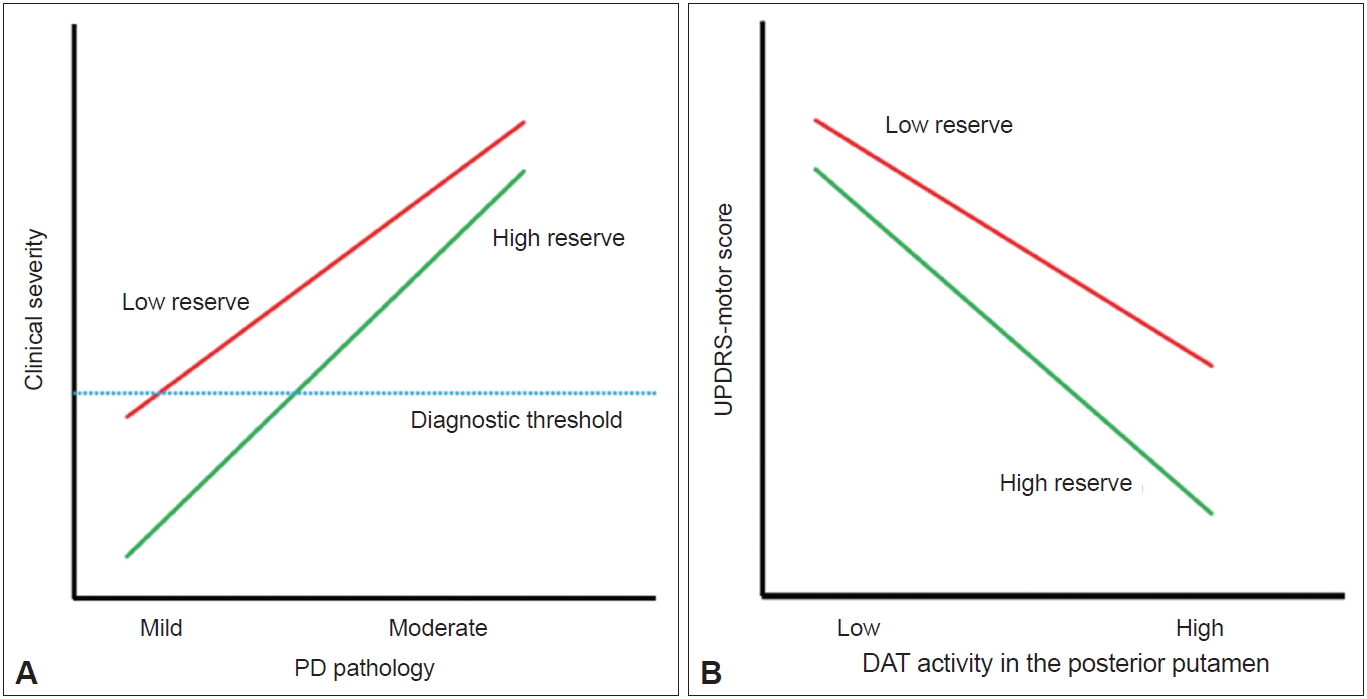
- 17,607 View
- 374 Download
- 50 Web of Science
- 50 Crossref
-
Abstract
PDF
- The concept of cognitive reserve (CR) in Alzheimer’s disease (AD) explains the differences between individuals in their susceptibility to AD-related pathologies. An enhanced CR may lead to less cognitive deficits despite severe pathological lesions. Parkinson’s disease (PD) is also a common neurodegenerative disease and is mainly characterized by motor dysfunction related to striatal dopaminergic depletion. The degree of motor deficits in PD is closely correlated to the degree of dopamine depletion; however, significant individual variations still exist. Therefore, we hypothesized that the presence of motor reserve (MR) in PD explains the individual differences in motor deficits despite similar levels of striatal dopamine depletion. Since 2015, we have performed a series of studies investigating MR in de novo patients with PD using the data of initial clinical presentation and dopamine transporter PET scan. In this review, we summarized the results of these published studies. In particular, some premorbid experiences (i.e., physical activity and education) and modifiable factors (i.e., body mass index and white matter hyperintensity on brain image studies) could modulate an individual’s capacity to tolerate PD pathology, which can be maintained throughout disease progression.
-
Citations
Citations to this article as recorded by- Cerebellar contributions to cognitive deterioration in Parkinson's disease: Insights from multi-omics and longitudinal data
Yukun Feng, Wei Zhang, Yinhao Xu, Qi Chang, Hao Zhou, Chunmei Wen, Jingzhe Li, Xiao Hu, Yi Xing, Da Zhang, Peiyu Huang, Junjie Zheng, Weiguo Liu
Neurobiology of Disease.2026; 219: 107275. CrossRef - Temporal Dynamics and Cross-Sectional and Longitudinal Factors Associated With Motor Reserve and Outcome in Patients With Parkinson Disease
Kazuto Tsukita, Akihiro Kikuya, Kenji Yoshimura, Etsuro Nakanishi, Riki Matsumoto, Ryosuke Takahashi
Neurology.2026;[Epub] CrossRef - Insole-Derived Plantar Pressure Variability Reveals Dual-Task Gait Differences in Early-Stage Parkinson’s Disease
Ye Joon Kim, Seung-Ick Choi, Huiwoo Yang, Wonhee Lee, Seongmin Hong, Na Young Kim
IEEE Journal of Translational Engineering in Health and Medicine.2026; 14: 104. CrossRef - Parkinson's disease and the concept of resilience, cognitive, and motor reserve
Merle C Hoenig
Journal of Parkinson’s Disease.2026; 16(3_suppl): 41. CrossRef - Effects of levodopa on the motor reserve network change with progression of Parkinson's disease
Danyan Rong, Peiyu Huang, Lei Yan, Jiaying Yang, Wan Liu, Yang Shen, Wenbin Zhang, Miao Yu, Weiguo Liu
Progress in Neuro-Psychopharmacology and Biological Psychiatry.2026; 147: 111755. CrossRef - Greater Motor and Nonmotor Burden at Diagnosis Is Associated With Amyloid Copathology in Parkinson's Disease
Han Kyu Na, Yeeun Sun, Chan Wook Park, Jung Hyun Lee, Yun Young Choi, Quynh Phuong Vo, Seok Jong Chung, Han Soo Yoo, Chul Hyoung Lyoo, Young H. Sohn, Jin Yong Hong, Phil Hyu Lee
Movement Disorders.2026; 41(9): 2299. CrossRef - Lifestyle medicine for neuroprotection: evidence and implementation in Asian contexts
Sumin Kim, Seok Jong Chung, Soyeon Yoon, Bastiaan R. Bloem, Elbrich Postma, Ryul Kim, Shinsuke Fujioka, Yukiko Nagaishi, Onanong Phokaewvarangkul, Kye Won Park, Eng-King Tan, Surasa Khongprasert, Jinyoung Youn
Journal of Neural Transmission.2026;[Epub] CrossRef - Behavioral markers of motor reserve: stability, lateralization, and consistency
David Vagni, Emanuela Principe, Melissa Pirrotta, Laura Catalano, Chiara Milasi, Morena De Francesco, Andreina Giustiniani, Chiara Arena, Francesco Scarfone, Angelo Quartarone, Domenico Bosco, Giovanni Pioggia, Antonio Cerasa
Frontiers in Aging Neuroscience.2026;[Epub] CrossRef - Is motor reserve associated with a rapid progression of Parkinson disease?
Myung Jun Lee, Kyoungjune Pak, Jae-Hyeok Lee, Seok Jong Chung, Min Seok Baek
Journal of Parkinson’s Disease.2025; 15(3): 552. CrossRef - Physical fitness trends and factors influencing them in community-dwelling older adults: a longitudinal cohort study involving multiple tests
Wang-Sheng Lin, Po-Jung Pan, Nai-Wei Hsu, Shung-Haur Yang, Chih-Chun Tsai, Ya-Hsien Wang
BMC Geriatrics.2025;[Epub] CrossRef - The Effects of Repetitive Transcranial Magnetic Stimulation on Gait, Motor Function, and Balance in Parkinson’s Disease: A Systematic Review and Meta-Analysis of Randomized Controlled Trials
Myoung-Ho Lee, Ju-Hak Kim, Je-Seung Han, Myoung-Kwon Kim
Journal of Clinical Medicine.2025; 15(1): 166. CrossRef - How long have you exercised in your life? The effect of motor reserve and current physical activity on cognitive performance
Veronica Pucci, Carolina Guerra, Amanda Barsi, Massimo Nucci, Sara Mondini
Journal of the International Neuropsychological Society.2024; 30(1): 11. CrossRef - Hippocampal Perfusion Affects Motor and Cognitive Functions in Parkinson Disease: An Early Phase 18F‐FP‐CIT Positron Emission Tomography Study
Min Young Chun, Seok Jong Chung, Su Hong Kim, Chan Wook Park, Seong Ho Jeong, Hye Sun Lee, Phil Hyu Lee, Young H. Sohn, Yong Jeong, Yun Joong Kim
Annals of Neurology.2024; 95(2): 388. CrossRef - Clinical severity in Parkinson’s disease is determined by decline in cortical compensation
Martin E Johansson, Ivan Toni, Roy P C Kessels, Bastiaan R Bloem, Rick C Helmich
Brain.2024; 147(3): 871. CrossRef - Differences in [123I]Ioflupane Striatal Binding Between African American and White Patients
Juebin Huang, Kevin J. Sullivan, Vani Vijayakumar
Journal of Nuclear Medicine Technology.2024; 52(2): 137. CrossRef - Plasma extracellular vesicle synaptic proteins as biomarkers of clinical progression in patients with Parkinson’s disease
Chien-Tai Hong, Chen-Chih Chung, Ruan-Ching Yu, Lung Chan
eLife.2024;[Epub] CrossRef - Plasma extracellular vesicle synaptic proteins as biomarkers of clinical progression in patients with Parkinson’s disease
Chien-Tai Hong, Chen-Chih Chung, Ruan-Ching Yu, Lung Chan
eLife.2024;[Epub] CrossRef - Considering the response in addition to the challenge – a narrative review in appraisal of a motor reserve framework
Daniel Zeller, Shawn Hiew, Thorsten Odorfer, Carine Nguemeni
Aging.2024; 16(6): 5772. CrossRef - The greatest loss of unpleasant smells may be related to the risk of more severe PD symptoms
Shih-Chi Chiu, Ting-Chun Fang, Hsin-Bei Lei, Yu-Hsuan Lin, Ming-Hong Chang, Yi-Jen Guo
Frontiers in Neurology.2024;[Epub] CrossRef - Lifestyle Modulators of Neuroplasticity in Parkinson’s Disease: Evidence
in Human Neuroimaging Studies
Silvia Paola Caminiti, Silvia Gallo, Federico Menegon, Andrea Naldi, Cristoforo Comi, Giacomo Tondo
CNS & Neurological Disorders - Drug Targets.2024; 23(5): 602. CrossRef - Defining the concept of reserve in the motor domain: a systematic review
Andreina Giustiniani, Angelo Quartarone
Frontiers in Neuroscience.2024;[Epub] CrossRef - Structural underpinnings and long-term effects of resilience in Parkinson’s disease
Verena Dzialas, Merle C. Hoenig, Stéphane Prange, Gérard N. Bischof, Alexander Drzezga, Thilo van Eimeren
npj Parkinson's Disease.2024;[Epub] CrossRef - Efficacy of personalized repetitive transcranial magnetic stimulation based on functional reserve to enhance ambulatory function in patients with Parkinson’s disease: study protocol for a randomized controlled trial
Seo Jung Yun, Ho Seok Lee, Dae Hyun Kim, Sun Im, Yeun Jie Yoo, Na Young Kim, Jungsoo Lee, Donghyeon Kim, Hae-Yeon Park, Mi-Jeong Yoon, Young Seok Kim, Won Hyuk Chang, Han Gil Seo
Trials.2024;[Epub] CrossRef - Right putamen and claustrum infarction mimicking normal pressure hydrocephalus
Natalia Chunga, Kyra Curtis, Colleen B Tomcik, Karlo J. Lizarraga
BMJ Case Reports.2024; 17(8): e259957. CrossRef - Metabolic and dopaminergic correlates of intellectual enrichment in de-novo Parkinson's disease patients
Stefano RAFFA, Luca SOFIA, Nicola GIRTLER, Matteo PARDINI, Dario ARNALDI, Beatrice ORSO, Maria I. DONEGANI, Francesca D’AMICO, Francesco LANFRANCHI, Guido ROVERA, Federico MASSA, Pietro MATTIOLI, Gianmario SAMBUCETI, Matteo BAUCKNEHT, Silvia MORBELLI
The Quarterly Journal of Nuclear Medicine and Molecular Imaging.2024;[Epub] CrossRef - The association of motor reserve and clinical progression in Parkinson’s disease
Xueqin Bai, Shiwei Zhang, Qiuyue Li, Tao Guo, Xiaojun Guan, Andan Qian, Shuangli Chen, Ronghui Zhou, Yitong Cheng, Haoxin Chen, Zhaoke Gou, Chenglong Xie, Zhen Wang, Minming Zhang, Xiangwu Zheng, Meihao Wang
NeuroImage: Clinical.2024; 44: 103704. CrossRef - Occipital hypoperfusion and motor reserve in Parkinson’s disease: an early-phase 18F-FP-CIT PET study
Yeo Jun Yoon, Su Hong Kim, Seong Ho Jeong, Chan Wook Park, Hye Sun Lee, Phil Hyu Lee, Yun Joong Kim, Young H. Sohn, Yong Jeong, Seok Jong Chung
npj Parkinson's Disease.2024;[Epub] CrossRef - Editorial: Cognitive, motor and brain reserves: bio-behavioral mechanisms, phenotypes, and prognostic value in ageing and neurodegeneration
Sonia Di Tella, Sara Isernia, Niels Bergsland, Gabriella Bottini, Annalena Venneri
Frontiers in Psychology.2024;[Epub] CrossRef - Motor progression marker for newly diagnosed drug‐naïve patients with Parkinson's disease: A resting‐state functional MRI study
Yanbing Hou, Lingyu Zhang, Ruwei Ou, Qianqian Wei, Xiaojing Gu, Kuncheng Liu, Junyu Lin, Tianmi Yang, Yi Xiao, Qiyong Gong, Huifang Shang
Human Brain Mapping.2023; 44(3): 901. CrossRef - The Concept of Motor Reserve in Parkinson's Disease: New Wine in Old Bottles?
Merle C. Hoenig, Verena Dzialas, Alexander Drzezga, Thilo van Eimeren
Movement Disorders.2023; 38(1): 16. CrossRef - Patterns of striatal dopamine depletion and motor deficits in de novo Parkinson’s disease
Seong Ho Jeong, Chan Wook Park, Hye Sun Lee, Yun Joong Kim, Mijin Yun, Phil Hyu Lee, Young H. Sohn, Seok Jong Chung
Journal of Neural Transmission.2023; 130(1): 19. CrossRef - Sex Differences in Brain Structure in de novo Parkinson’s Disease: A Cross-Sectional and Longitudinal Neuroimaging Study
Hui Li, Xuejia Jia, Min Chen, Xiuqin Jia, Qi Yang
Journal of Parkinson’s Disease.2023; 13(5): 785. CrossRef - Exploring the Complex Phenotypes of Impaired Finger Dexterity in Mild-to-moderate Stage Parkinson’s Disease: A Time-Series Analysis
Pattamon Panyakaew, Kotchakorn Duangjino, Apiwoot Kerddonfag, Teerit Ploensin, Krerk Piromsopa, Chanon Kongkamol, Roongroj Bhidayasiri
Journal of Parkinson’s Disease.2023; 13(6): 975. CrossRef - Prevention of Falls in Parkinson's Disease: Guidelines and Gaps
Richard Camicioli, Meg E. Morris, Frederico Pieruccini‐Faria, Manuel Montero‐Odasso, Surim Son, David Buzaglo, Jeffrey M. Hausdorff, Alice Nieuwboer
Movement Disorders Clinical Practice.2023; 10(10): 1459. CrossRef - The incidence of deep venous thrombosis in Parkinson’s disease
Emine Afsin, Zeliha Coşgun, Ramazan Kurul, Şule Aydın Türkoğlu
Neurological Research.2023; 45(11): 1050. CrossRef - Premorbid Educational Attainment and Long-Term Motor Prognosis in Parkinson’s Disease
Seong Ho Jeong, Seok Jong Chung, Han Soo Yoo, Jin Ho Jung, Kyoungwon Baik, Yang Hyun Lee, Phil Hyu Lee, Young H. Sohn
Journal of Parkinson's Disease.2022; 12(1): 129. CrossRef - Parkinsonism and cerebrovascular disease
Manisha Narasimhan, Raymond Schwartz, Glenda Halliday
Journal of the Neurological Sciences.2022; 433: 120011. CrossRef - Impact of α‐synuclein spreading on the nigrostriatal dopaminergic pathway depends on the onset of the pathology
Fanfan Sun, Armando G. Salinas, Severin Filser, Sonja Blumenstock, Jose Medina‐Luque, Jochen Herms, Carmelo Sgobio
Brain Pathology.2022;[Epub] CrossRef - Premorbid cancer and motor reserve in patients with Parkinson’s disease
Yoon-Sang Oh, Sang-Won Yoo, Chul Hyoung Lyoo, Kwang-Soo Lee, Joong-Seok Kim
Scientific Reports.2022;[Epub] CrossRef - Behavioral Reserve in Behavioral Variant Frontotemporal Dementia
Su Hong Kim, Yae Ji Kim, Byung Hwa Lee, Peter Lee, Ji Hyung Park, Sang Won Seo, Yong Jeong
Frontiers in Aging Neuroscience.2022;[Epub] CrossRef - Identifying the white matter structural network of motor reserve in early Parkinson's disease
Yae Ji Kim, Chan Wook Park, Hye Won Shin, Hye Sun Lee, Yun Joong Kim, Mijin Yun, Phil Hyu Lee, Young H. Sohn, Yong Jeong, Seok Jong Chung
Parkinsonism & Related Disorders.2022; 102: 108. CrossRef - Comparison of disease progression between brain-predominant Parkinson's disease versus Parkinson's disease with body-involvement phenotypes
Dong-Woo Ryu, Sang-Won Yoo, Yoon-Sang Oh, Kwang-Soo Lee, Seunggyun Ha, Joong-Seok Kim
Neurobiology of Disease.2022; 174: 105883. CrossRef - Genetically-informed prediction of short-term Parkinson’s disease progression
Hossein J. Sadaei, Aldo Cordova-Palomera, Jonghun Lee, Jaya Padmanabhan, Shang-Fu Chen, Nathan E. Wineinger, Raquel Dias, Daria Prilutsky, Sandor Szalma, Ali Torkamani
npj Parkinson's Disease.2022;[Epub] CrossRef - Potential Link Between Cognition and Motor Reserve in Patients With Parkinson’s Disease
Seok Jong Chung, Yae Ji Kim, Yun Joong Kim, Hye Sun Lee, Mijin Yun, Phil Hyu Lee, Yong Jeong, Young H. Sohn
Journal of Movement Disorders.2022; 15(3): 249. CrossRef - Local striatal volume and motor reserve in drug-naïve Parkinson’s disease
Seong Ho Jeong, Eun-Chong Lee, Seok Jong Chung, Hye Sun Lee, Jin Ho Jung, Young H. Sohn, Joon-Kyung Seong, Phil Hyu Lee
npj Parkinson's Disease.2022;[Epub] CrossRef - Effectiveness and safety of electroacupuncture in treating Parkinson disease
Wei Xu, Sha OuYang, Zhenhai Chi, ZhiQin Wang, DaoCheng Zhu, RiXin Chen, GenPing Zhong, FengTing Zhang, GuiQin Zhou, SiWei Duan, Lin Jiao
Medicine.2021; 100(10): e25095. CrossRef - Differences in cause and 12-month follow-up outcome of parkinsonian symptoms in depressed older adults treated with antipsychotics: a case series
Anastasios Politis, Nikolaos Kokras, Michael Souvatzoglou, Kostas Siarkos, Panagiotis Toulas, Constantin Potagas, Theodoros Hatzipanagiotou, Georgios Limouris, Panagiotis Alexopoulos
BMC Psychiatry.2021;[Epub] CrossRef - Effectiveness and safety of moxibustion for Parkinson disease
Yonghui Hou, Baile Ning, Yamin Liu, Ying Liu, Wenbin Fu, Zehuai Wen
Medicine.2021; 100(23): e26256. CrossRef - Glucocerebrosidase Mutations and Motor Reserve in Parkinson’s Disease
Seok Jong Chung, Phil Hyu Lee, Young H. Sohn, Yun Joong Kim
Journal of Parkinson's Disease.2021; 11(4): 1715. CrossRef - Analysis of pupillometer results according to disease stage in patients with Parkinson’s disease
Sooyeoun You, Jeong-Ho Hong, Joonsang Yoo
Scientific Reports.2021;[Epub] CrossRef
- Cerebellar contributions to cognitive deterioration in Parkinson's disease: Insights from multi-omics and longitudinal data
- Principles of Electrophysiological Assessments for Movement Disorders
- Kai-Hsiang Stanley Chen, Robert Chen
- J Mov Disord. 2020;13(1):27-38. Published online January 31, 2020
- DOI: https://doi.org/10.14802/jmd.19064

- 32,695 View
- 2,166 Download
- 47 Web of Science
- 48 Crossref
-
Abstract
PDFSupplementary Material
- Electrophysiological studies can provide objective and quantifiable assessments of movement disorders. They are useful in the diagnosis of hyperkinetic movement disorders, particularly tremors and myoclonus. The most commonly used measures are surface electromyography (sEMG), electroencephalography (EEG) and accelerometry. Frequency and coherence analyses of sEMG signals may reveal the nature of tremors and the source of the tremors. The effects of voluntary tapping, ballistic movements and weighting of the limbs can help to distinguish between organic and functional tremors. The presence of Bereitschafts-potentials and beta-band desynchronization recorded by EEG before movement onset provide strong evidence for functional movement disorders. EMG burst durations, distributions and muscle recruitment orders may identify and classify myoclonus to cortical, subcortical or spinal origins and help in the diagnosis of functional myoclonus. Organic and functional cervical dystonia can potentially be distinguished by EMG power spectral analysis. Several reflex circuits, such as the long latency reflex, blink reflex and startle reflex, can be elicited with different types of external stimuli and are useful in the assessment of myoclonus, excessive startle and stiff person syndrome. However, limitations of the tests should be recognized, and the results should be interpreted together with clinical observations.
-
Citations
Citations to this article as recorded by- A review of treatment methods for movement disorders
Mahdi Khezri, Shakiba Afsar
Behavioural Brain Research.2026; 500: 115979. CrossRef - Central and peripheral excitability in restless limbs syndrome
Amedeo De Grado, Gaia Fanella, James Howells, Benjamin Yamin Ali Khan, Anna Bystrup Jacobsen, Bülent Cengiz, Gintaute Samusyte, Marit Otto, Paola Lanteri, Ambra Stefani, Hatice Tankisi
Brain Communications.2026;[Epub] CrossRef - Dystonia: from phenotypes to genetics and therapeutic advances
Han-Lin Chiang, Yih-Chih Kuo, Chin-Hsien Lin
Current Opinion in Neurology.2026; 39(4): 423. CrossRef - Evolution and trends in tremor diagnosis and differential diagnosis—a bibliometric study
Jiayun Liu, Xiangming Xu, Jingliang Liu, Ruihao Bian, Jiaxuan Zheng, Ke Dong, Xiaoxia Zhu, Xi Chen
Frontiers in Aging Neuroscience.2026;[Epub] CrossRef - Phenotypic characterization of presumptive propriospinal myoclonus in young dogs (2013-2025)
Dakir Polidoro, Sofie F M Bhatti, Patrick Santens, Paul Mandigers, Koen M Santifort, Shinichi Kanazono, Diane Lu, Daniel Sánchez-Masián, Alberta de Stefani, Intan Nur Fatiha Shafie, Patricia Álvarez, Nina Meyerhoff, Tadej Jeroncic, Serene R Lai, Guillaume
Journal of Veterinary Internal Medicine.2026;[Epub] CrossRef - Bilateral multi-condition surface electromyographic characterization of tremor in Parkinson’s disease and essential tremor
Ayşen Süzen Ekinci, Sevgin Gündoğan, Zeynep Tanrıverdi, Şehnaz Arıcı, Yaprak Seçil
Acta Neurologica Belgica.2026;[Epub] CrossRef - Diagnostic Value of Bereitschaftspotential in People With Functional Seizures
Christoph S. Dietze, Dieke van Waart-Houtman, Anne Marthe Meppelink, Mireille Bourez-Swart, Job van der Palen, Maeike Zijlmans, Sandra M. A. van der Salm
Journal of Clinical Neurophysiology.2025; 42(4): 331. CrossRef - Diagnostic Utility of Clinical Neurophysiology in Jerky Movement Disorders: A Review from the MDS Clinical Neurophysiology Study Group
Anna Latorre, Christos Ganos, Masashi Hamada, Nicolas Phielipp, Lorenzo Rocchi, Shabbir Merchant, Marina A. Tijssen, Sterre van der Veen, Robert Chen
Movement Disorders Clinical Practice.2025; 12(3): 272. CrossRef - Utility and Value of Movement Recording with Combined EEG-EMG Monitoring in the Intensive Care Unit
Julie Lévi-Strauss, Clémence Marois, Yulia Worbe, Laurine Bedoucha, Raouf Benchikh Lehocine, Benjamin Rohaut, Nicolas Weiss, Sophie Demeret, Emmanuelle Apartis, Virginie Lambrecq
Neurocritical Care.2025; 43(1): 333. CrossRef - Application of surface electromyography in dentistry for diagnosis and treatment evaluation
So Ra Kim, Yeong-Gwan Im
Journal of Korean Dental Association.2025; 63(3): 64. CrossRef - Advances in sciatic nerve regeneration: A review of contemporary techniques
Sardar Ali, Ming Sun, Muhammad Nadeem Khan, Fang Qiang
Regenerative Therapy.2025; 29: 563. CrossRef - Surface‐electromyography characteristics of clonic seizures with no scalp‐EEG correlate: A comparative analysis with tremors
Veena V. Kumar, Akshaya R. Sivaji, Shwetank Singh, Zachary Scicchitano, Brandy Woods, Roohi Katyal, Neel Fotedar
Epileptic Disorders.2025; 27(4): 609. CrossRef - Impact of clinical neurophysiological assessment on diagnosis and management of tremor disorders
Katherine Longardner, Yasoda Satpathy, Irene Litvan, Dietrich Haubenberger
Clinical Neurophysiology Practice.2025; 10: 188. CrossRef - Hyperkinetic movement disorder analysis using multidimensional projections
Andressa Silva da Silva, Eduardo F. Ribeiro, Jelle R. Dalenberg, Alexandru C. Telea, Marina A.J. Tijssen, João Luiz Dihl Comba
Computers & Graphics.2025; 131: 104276. CrossRef - A Dynamic Current Pulsing Technique to Improve the Noise Efficiency Factor of Neural Recording Amplifiers
Yujia Huo, Roy H. Olsson
Journal of Low Power Electronics and Applications.2025; 15(4): 67. CrossRef - Surface electromyography for evaluating patients with oromandibular dystonia
Jae-Hyung Kim, Byung-Gook Kim, Yeong-Gwan Im
CRANIO®.2024; 42(3): 316. CrossRef - Clinical neurophysiology of functional motor disorders: IFCN Handbook Chapter
M.J. Edwards, L.H. Koens, J. Liepert, J. Nonnekes, P. Schwingenschuh, A.M.M. van de Stouwe, F. Morgante
Clinical Neurophysiology Practice.2024; 9: 69. CrossRef - Multimodal imaging and electrophysiological study in the differential diagnosis of rest tremor
Federica Aracri, Andrea Quattrone, Maria Giovanna Bianco, Alessia Sarica, Marida De Maria, Camilla Calomino, Marianna Crasà, Rita Nisticò, Jolanda Buonocore, Basilio Vescio, Maria Grazia Vaccaro, Aldo Quattrone
Frontiers in Neurology.2024;[Epub] CrossRef - Simple biomarkers to distinguish Parkinson’s disease from its mimics in clinical practice: a comprehensive review and future directions
Andrea Quattrone, Mario Zappia, Aldo Quattrone
Frontiers in Neurology.2024;[Epub] CrossRef - Substantiating the Short Burst Duration in Cortical Myoclonus
Sterre van der Veen, Amber Maliepaard, Madelein van der Stouwe, Jelle Dalenberg, Inge Tuitert, Jan Willem J. Elting, Marina A.J. Tijssen
Movement Disorders.2024; 39(12): 2275. CrossRef - Asterixis of peripheral origin: isolated lower limb asterixis in Guillain–Barre syndrome
Boby Varkey Maramattom
Acta Neurologica Belgica.2023; 123(3): 1095. CrossRef - Moving Beyond Movement: Diagnosing Functional Movement Disorder
Gabriela S. Gilmour, Sarah C. Lidstone
Seminars in Neurology.2023; 43(01): 106. CrossRef - Neurophysiology of Brain Networks Underlies Symptoms of Parkinson’s Disease: A Basis for Diagnosis and Management
Martha Teresa Acosta-Mejia, Nelson Villalobos
Diagnostics.2023; 13(14): 2394. CrossRef - Utility of Neurophysiological Evaluation in Movement Disorders Clinical Practice
Talyta Grippe, Robert Chen
Movement Disorders Clinical Practice.2023; 10(11): 1599. CrossRef - Development of a New Wearable Device for the Characterization of Hand Tremor
Basilio Vescio, Marida De Maria, Marianna Crasà, Rita Nisticò, Camilla Calomino, Federica Aracri, Aldo Quattrone, Andrea Quattrone
Bioengineering.2023; 10(9): 1025. CrossRef - Electrophysiology in Functional Movement Disorders: An Update
Nitish Kamble, Pramod Kumar Pal
Tremor and Other Hyperkinetic Movements.2023;[Epub] CrossRef - The clinical and electrophysiological investigation of tremor
Günther Deuschl, Jos S. Becktepe, Michiel Dirkx, Dietrich Haubenberger, Anhar Hassan, Rick C. Helmich, Muthuraman Muthuraman, Pattamon Panyakaew, Petra Schwingenschuh, Kirsten E. Zeuner, Rodger J. Elble
Clinical Neurophysiology.2022; 136: 93. CrossRef - Remote measurement and home monitoring of tremor
Zoltan Mari, Dietrich Haubenberger
Journal of the Neurological Sciences.2022; 435: 120201. CrossRef - Functional tremor
Petra Schwingenschuh, Alberto J. Espay
Journal of the Neurological Sciences.2022; 435: 120208. CrossRef - Speech-induced action myoclonus
Hugh D. Simpson, Joseph R. Duffy, Julie A.G. Stierwalt, J. Eric Ahlskog, Anhar Hassan
Parkinsonism & Related Disorders.2022; 98: 41. CrossRef - Simulation of the physical process of neural electromagnetic signal generation based on a simple but functional bionic Na+ channel
Fan Wang, Jingjing Xu, Yanbin Ge, Shengyong Xu, Yanjun Fu, Caiyu Shi, Jianming Xue
Chinese Physics B.2022; 31(6): 068701. CrossRef - Functional Patients Referred for Deep Brain Stimulation: How Common Is it?
Carolina Gorodetsky, Paula Azevedo, Alfonso Fasano
Movement Disorders Clinical Practice.2022; 9(6): 841. CrossRef - Myoclonus and other jerky movement disorders
Sterre van der Veen, John N. Caviness, Yasmine E.M. Dreissen, Christos Ganos, Abubaker Ibrahim, Johannes H.T.M. Koelman, Ambra Stefani, Marina A.J. Tijssen
Clinical Neurophysiology Practice.2022; 7: 285. CrossRef - Posthypoxic Segmental Spinal “Flutter”-Like Myoclonus
Boby V Maramattom
Neurology India.2022; 70(5): 2202. CrossRef - Contemporary clinical neurophysiology applications in dystonia
Petr Kaňovský, Raymond Rosales, Pavel Otruba, Martin Nevrlý, Lenka Hvizdošová, Robert Opavský, Michaela Kaiserová, Pavel Hok, Kateřina Menšíková, Petr Hluštík, Martin Bareš
Journal of Neural Transmission.2021; 128(4): 509. CrossRef - Suggestibility as a valuable criterion for laboratory-supported definite functional movement disorders
Gerard Saranza, Daniel Vargas-Mendez, Anthony E. Lang, Robert Chen
Clinical Neurophysiology Practice.2021; 6: 103. CrossRef - Peribuccal and pharyngeal myorhythmia as a presenting symptom of hypertrophic olivary degeneration: Expert commentary
Robert Chen
Parkinsonism & Related Disorders.2021; 85: 144. CrossRef - Nano‐dielectrics in biosystems
Jingjing Xu, Fan Wang, Yihan Song, Song Ge, Shengyong Xu
IET Nanodielectrics.2021; 4(4): 179. CrossRef - Jaw Pain and Oromandibular Dysfunction After a Complex Hospital Course
Sarah Smith, Ny-Ying Lam
American Journal of Physical Medicine & Rehabilitation.2021; 100(5): e62. CrossRef - Factors Influencing the Surgical Decision in Dystonia Patients Referred for Deep Brain Stimulation
Carolina Gorodetsky, Paula Azevedo, Carolina Candeias da Silva, Alfonso Fasano
Toxins.2021; 13(8): 511. CrossRef - Tremor Syndromes: An Updated Review
Abhishek Lenka, Joseph Jankovic
Frontiers in Neurology.2021;[Epub] CrossRef - The diagnostic value of clinical neurophysiology in hyperkinetic movement disorders: A systematic review
S. van der Veen, M.R. Klamer, J.W.J. Elting, J.H.T.M. Koelman, A.M.M. van der Stouwe, M.A.J. Tijssen
Parkinsonism & Related Disorders.2021; 89: 176. CrossRef - Wearable monitoring of positive and negative myoclonus in progressive myoclonic epilepsy type 1
Saara M. Rissanen, Jelena Hyppönen, Katri Silvennoinen, Laura Säisänen, Pasi A. Karjalainen, Esa Mervaala, Reetta Kälviäinen
Clinical Neurophysiology.2021; 132(10): 2464. CrossRef - Evaluation of movement and brain activity
Mark Hallett, Lourdes M. DelRosso, Rodger Elble, Raffaele Ferri, Fay B. Horak, Stephan Lehericy, Martina Mancini, Masao Matsuhashi, Riki Matsumoto, Muthuraman Muthuraman, Jan Raethjen, Hiroshi Shibasaki
Clinical Neurophysiology.2021; 132(10): 2608. CrossRef - Clinical and Psychological Aspects of Myoclonus in Different age Periods
Т.А. Литовченко, О.Ю. Сухоносова
Психиатрия, психотерапия и клиническая психология.2021; (2): 303. CrossRef - FEATURES OF EPILEPTIC MYOCLONIC SEIZURES IN PATIENTS AT DIFFERENT AGE PERIODS
T. A. Litovchenko, O. Yu. Sukhonosova, A. I. Ekzarkhova, S. M. Korenev, V. V. Salnikova, V. B. Olenich
International Medical Journal.2021; (4(108)): 61. CrossRef - Minimum Electromyographic Burst Duration in Healthy Controls: Implications for Electrodiagnosis in Movement Disorders
Alexis F. Collins, Steven T.R. Brown, Mark R. Baker
Movement Disorders Clinical Practice.2020; 7(7): 827. CrossRef - Physiology-Based Treatment of Myoclonus
Ashley B. Pena, John N. Caviness
Neurotherapeutics.2020; 17(4): 1665. CrossRef
- A review of treatment methods for movement disorders
- Genetics of Progressive Supranuclear Palsy
- Sun Young Im, Young Eun Kim, Yun Joong Kim
- J Mov Disord. 2015;8(3):122-129. Published online September 10, 2015
- DOI: https://doi.org/10.14802/jmd.15033
- 38,687 View
- 440 Download
- 46 Web of Science
- 46 Crossref
-
Abstract
PDF
- Progressive supranuclear palsy (PSP) is a neurodegenerative syndrome that is clinically characterized by progressive postural instability, supranuclear gaze palsy, parkinsonism and cognitive decline. Pathologically, diagnosis of PSP is based on characteristic features, such as neurofibrillary tangles, neutrophil threads, tau-positive astrocytes and their processes in basal ganglia and brainstem, and the accumulation of 4 repeat tau protein. PSP is generally recognized as a sporadic disorder; however, understanding of genetic background of PSP has been expanding rapidly. Here we review relevant publications to outline the genetics of PSP. Although only small number of familial PSP cases have been reported, the recognition of familial PSP has been increasing. In some familial cases of clinically probable PSP, PSP pathologies were confirmed based on NINDS neuropathological diagnostic criteria. Several mutations in MAPT, the gene that causes a form of familial frontotemporal lobar degeneration with tauopathy, have been identified in both sporadic and familial PSP cases. The H1 haplotype of MAPT is a risk haplotype for PSP, and within H1, a sub-haplotype (H1c) is associated with PSP. A recent genome-wide association study on autopsyproven PSP revealed additional PSP risk alleles in STX6 and EIF2AK3. Several heredodegenerative parkinsonian disorders are referred to as PSP-look-alikes because their clinical phenotype, but not their pathology, mimics PSP. Due to the fast development of genomics and bioinformatics, more genetic factors related to PSP are expected to be discovered. Undoubtedly, these studies will provide a better understanding of the pathogenesis of PSP and clues for developing therapeutic strategies.
-
Citations
Citations to this article as recorded by- Myelin basic protein and TREM2 quantification in the CSF of patients with Multiple System Atrophy and other Parkinsonian conditions
Fabian Maass, Sezgi Canaslan, Christoph van Riesen, Peter Hermann, Matthias Schmitz, Claudia Schulte, Kathrin Brockmann, Matthis Synofzik, Mathias Bähr, Inga Zerr
Journal of Neurology.2025;[Epub] CrossRef - Multifactorial etiology of progressive supranuclear palsy (PSP): the genetic component
Ulrich Müller, Günter Höglinger, Dennis W. Dickson
Acta Neuropathologica.2025;[Epub] CrossRef - Diagnostic Spectrum in an “Atypical” Atypical Parkinsonism Syndrome Cohort: A Single Center Experience
Pavankumar Katragadda, Vikram V Holla, Nitish Kamble, Rohan R Mahale, Ravi Yadav, Pramod Kumar Pal
Journal of Movement Disorders.2025; 18(3): 208. CrossRef - Corticobasal degeneration with progressive supranuclear palsy syndrome: a clinical case
E. S. Ostapchuk, A. Yu. Mingaleva, M. V. Malakhov
Medical alphabet.2025; (32): 45. CrossRef - Progressive supranuclear palsy: Neuropathology, clinical presentation, diagnostic challenges, management, and emerging therapies
Frederick DeRosier, Cody Hibbs, Kaitlyn Alessi, Inderbir Padda, Jeanette Rodriguez, Swati Pradeep, Mayur S. Parmar
Disease-a-Month.2024; 70(8): 101753. CrossRef - Identification of Genetic Variants in Progressive Supranuclear Palsy in Southeast Asia
Adeline Su Lyn Ng, Ai Huey Tan, Yi Jayne Tan, Jia Lun Lim, Michelle Mulan Lian, Alfand Marl Dy Closas, Azlina Ahmad‐Annuar, Shanthi Viswanathan, Yuen Kang Chia, Jia Nee Foo, Weng Khong Lim, Eng‐King Tan, Shen‐Yang Lim
Movement Disorders.2024; 39(10): 1829. CrossRef - Recent advances in stem cell therapy: efficacy, ethics, safety concerns, and future directions focusing on neurodegenerative disorders – a review
Rekha Khandia, Pankaj Gurjar, Priyanka, Victoria Romashchenko, Sami A. Al-Hussain, Magdi E.A. Zaki
International Journal of Surgery.2024; 110(10): 6367. CrossRef - Genetic Architecture of Primary Tauopathies
Daniel Gallo, Agustín Ruiz, Pascual Sánchez-Juan
Neuroscience.2023; 518: 27. CrossRef - Direct and Indirect Effects of Filamin A on Tau Pathology in Neuronal Cells
Stéphanie Levert, Julie Pilliod, Étienne Aumont, Sandrine Armanville, Cyntia Tremblay, Frédéric Calon, Nicole Leclerc
Molecular Neurobiology.2023; 60(2): 1021. CrossRef - Identification of phosphorylated tau protein interactors in progressive supranuclear palsy (PSP) reveals networks involved in protein degradation, stress response, cytoskeletal dynamics, metabolic processes, and neurotransmission
Rowan A. W. Radford, Stephanie L. Rayner, Paulina Szwaja, Marco Morsch, Flora Cheng, Tianyi Zhu, Jocelyn Widagdo, Victor Anggono, Dean L. Pountney, Roger Chung, Albert Lee
Journal of Neurochemistry.2023; 165(4): 563. CrossRef - Pathomechanisms of cognitive impairment in progressive supranuclear palsy
Kurt A. Jellinger
Journal of Neural Transmission.2023; 130(4): 481. CrossRef - Differential Diagnosis of Rare Subtypes of Progressive Supranuclear Palsy and PSP-Like Syndromes—Infrequent Manifestations of the Most Common Form of Atypical Parkinsonism
Patrycja Krzosek, Natalia Madetko, Anna Migda, Bartosz Migda, Dominika Jaguś, Piotr Alster
Frontiers in Aging Neuroscience.2022;[Epub] CrossRef - Characterisation of the Function of a SINE-VNTR-Alu Retrotransposon to Modulate Isoform Expression at the MAPT Locus
Alexander Fröhlich, Abigail L. Pfaff, Vivien J. Bubb, Sulev Koks, John P. Quinn
Frontiers in Molecular Neuroscience.2022;[Epub] CrossRef - Case of a Man with Hemichorea and Behavioral Changes: “A Red Herring”
Galit Kleiner, Stephen A. Ryan, Juan Bilbao, Julia Keith, Ekaterina Rogaeva, Sandra E. Black, Anthony E. Lang, Mario Masellis
Movement Disorders Clinical Practice.2022; 9(4): 501. CrossRef - MAPT gene mutation in familiar progressive supranuclear palsy, a case report
M. Rodríguez, H. Kreinter, N. Zapa, O. Oliveros, C. Jiménez
Neurology Perspectives.2022; 2(3): 184. CrossRef - Investigational therapeutics for the treatment of progressive supranuclear palsy
David G Coughlin, Irene Litvan
Expert Opinion on Investigational Drugs.2022; 31(8): 813. CrossRef - Mass spectrometry‐based proteomics analysis of human globus pallidus from progressive supranuclear palsy patients discovers multiple disease pathways
Yura Jang, Thujitha Thuraisamy, Javier Redding‐Ochoa, Olga Pletnikova, Juan C. Troncoso, Zhen Zhang, Liana S. Rosenthal, Ted M. Dawson, Alexander Y. Pantelyat, Chan Hyun Na
Clinical and Translational Medicine.2022;[Epub] CrossRef - Reference SVA insertion polymorphisms are associated with Parkinson’s Disease progression and differential gene expression
Abigail L. Pfaff, Vivien J. Bubb, John P. Quinn, Sulev Koks
npj Parkinson's Disease.2021;[Epub] CrossRef - Cellular and pathological heterogeneity of primary tauopathies
Dah-eun Chloe Chung, Shanu Roemer, Leonard Petrucelli, Dennis W. Dickson
Molecular Neurodegeneration.2021;[Epub] CrossRef - Tau and MAPT genetics in tauopathies and synucleinopathies
Etienne Leveille, Owen A. Ross, Ziv Gan-Or
Parkinsonism & Related Disorders.2021; 90: 142. CrossRef - A case report of Multi System Atrophy (MSA) with cross over features of Progressive Supranuclear Palsy (PSP)
Judah Rajendran R, Ramesh Kannan, Hannah Ranjee Prasanth
International Journal of Clinical and Experimental Ophthalmology.2021; 5(2): 019. CrossRef - Optimizing intracellular antibodies (intrabodies/nanobodies) to treat neurodegenerative disorders
Anne Messer, David C. Butler
Neurobiology of Disease.2020; 134: 104619. CrossRef - Heavy metals contaminating the environment of a progressive supranuclear palsy cluster induce tau accumulation and cell death in cultured neurons
Carolina Alquezar, Jessica B. Felix, Elizabeth McCandlish, Brian T. Buckley, Dominique Caparros-Lefebvre, Celeste M. Karch, Lawrence I. Golbe, Aimee W. Kao
Scientific Reports.2020;[Epub] CrossRef - LRP10 variants in progressive supranuclear palsy
Leonie J.M. Vergouw, Shamiram Melhem, Laura Donker Kaat, Wang Z. Chiu, Demy J.S. Kuipers, Guido Breedveld, Agnita J.W. Boon, Li-San Wang, Adam C. Naj, Elizabeth Mlynarksi, Laura Cantwell, Marialuisa Quadri, Owen A. Ross, Dennis W. Dickson, Gerard D. Schel
Neurobiology of Aging.2020;[Epub] CrossRef - Neuro-ophthalmology in the Geriatric Eye
Subhan Tabba, Yi-Hsien Yeh, Ashwini Kini, Bayan Al Othman, Andrew G Lee
US Ophthalmic Review.2020; 13(1): 30. CrossRef - Genetic Risk Factors for Essential Tremor: A Review
Vasileios Siokas, Athina-Maria Aloizou, Zisis Tsouris, Ioannis Liampas, Paraskevi Aslanidou, Metaxia Dastamani, Alexandros G. Brotis, Dimitrios P. Bogdanos, Georgios M. Hadjigeorgiou, Efthimios Dardiotis
Tremor and Other Hyperkinetic Movements.2020; 10: 4. CrossRef - PSP-FTD Complex: A Possible Variant of PSP
Sunil Pradhan, Ruchika Tandon
American Journal of Alzheimer's Disease & Other Dementias®.2020;[Epub] CrossRef - Microglial Activation and Inflammation as a Factor in the Pathogenesis of Progressive Supranuclear Palsy (PSP)
Piotr Alster, Natalia Madetko, Dariusz Koziorowski, Andrzej Friedman
Frontiers in Neuroscience.2020;[Epub] CrossRef - Tau at the interface between neurodegeneration and neuroinflammation
Alessandro Didonna
Genes & Immunity.2020; 21(5): 288. CrossRef - Efficiency of Transcranial Magnetic Stimulation in Progressive Supranuclear Palsy: Estimation Using Goniometry and Dinamometry
K. A. Major, Z. Zs. Major, R. Craciunas, G. Carbone, C. Vaida, D. L. Pîslă
Neurophysiology.2019; 51(1): 57. CrossRef - Four-repeat tauopathies
Thomas W. Rösler, Amir Tayaranian Marvian, Matthias Brendel, Niko-Petteri Nykänen, Matthias Höllerhage, Sigrid C. Schwarz, Franziska Hopfner, Thomas Koeglsperger, Gesine Respondek, Kerstin Schweyer, Johannes Levin, Victor L. Villemagne, Henryk Barthel, Os
Progress in Neurobiology.2019; 180: 101644. CrossRef - One decade ago, one decade ahead in progressive supranuclear palsy
Maria Stamelou, Nikolaos Giagkou, Günter U Höglinger
Movement Disorders.2019; 34(9): 1284. CrossRef - The genetic and clinico‐pathological profile of early‐onset progressive supranuclear palsy
Edwin Jabbari, John Woodside, Manuela M.X. Tan, Nicola Pavese, Oliver Bandmann, Boyd C.P. Ghosh, Luke A. Massey, Erica Capps, Tom T. Warner, Andrew J. Lees, Tamas Revesz, Janice L. Holton, Nigel M. Williams, Donald G. Grosset, Huw R. Morris
Movement Disorders.2019; 34(9): 1307. CrossRef - Tau-Induced Pathology in Epilepsy and Dementia: Notions from Patients and Animal Models
Marina Sánchez, Ana García-Cabrero, Gentzane Sánchez-Elexpuru, Daniel Burgos, José Serratosa
International Journal of Molecular Sciences.2018; 19(4): 1092. CrossRef - Replication of progressive supranuclear palsy genome-wide association study identifies SLCO1A2 and DUSP10 as new susceptibility loci
Monica Y. Sanchez-Contreras, Naomi Kouri, Casey N. Cook, Daniel J. Serie, Michael G. Heckman, NiCole A. Finch, Richard J. Caselli, Ryan J. Uitti, Zbigniew K. Wszolek, Neill Graff-Radford, Leonard Petrucelli, Li-San Wang, Gerard D. Schellenberg, Dennis W.
Molecular Neurodegeneration.2018;[Epub] CrossRef - Improving Mouse Models for Dementia. Are All the Effects in Tau Mouse Models Due to Overexpression?
Zelah Joel, Pablo Izquierdo, Dervis A. Salih, Jill C. Richardson, Damian M. Cummings, Frances A. Edwards
Cold Spring Harbor Symposia on Quantitative Biology.2018; 83: 151. CrossRef - Clinical heterogeneity of progressive supranuclear palsy
Alexey A. Tappakhov, Tatiana E. Popova, Tatiana G. Govorova, Alyona Yu. Petrova
Annals of Clinical and Experimental Neurology.2018; 12(2): 33. CrossRef - Clinical heterogeneity of progressive supranuclear palsy
Alexey A. Tappakhov, Tatiana E. Popova, Tatiana G. Govorova, Alyona Yu. Petrova
Annals of Clinical and Experimental Neurology.2018; 12(2): 33. CrossRef - Signature of an aggregation-prone conformation of tau
Neil A. Eschmann, Elka R. Georgieva, Pritam Ganguly, Peter P. Borbat, Maxime D. Rappaport, Yasar Akdogan, Jack H. Freed, Joan-Emma Shea, Songi Han
Scientific Reports.2017;[Epub] CrossRef - Chronic traumatic encephalopathy-integration of canonical traumatic brain injury secondary injury mechanisms with tau pathology
Jacqueline R. Kulbe, Edward D. Hall
Progress in Neurobiology.2017; 158: 15. CrossRef - MAPT mutation associated with frontotemporal dementia and parkinsonism (FTDP-17)
Robert Haussmann, Marek Wysocki, Moritz D. Brandt, Andreas Hermann, Markus Donix
International Psychogeriatrics.2017; 29(5): 869. CrossRef - Progressieve supranucleaire parese
Peter van Domburg
Neuropraxis.2016; 20(2): 68. CrossRef - Gene expression, methylation and neuropathology correlations at progressive supranuclear palsy risk loci
Mariet Allen, Jeremy D. Burgess, Travis Ballard, Daniel Serie, Xue Wang, Curtis S. Younkin, Zhifu Sun, Naomi Kouri, Saurabh Baheti, Chen Wang, Minerva M. Carrasquillo, Thuy Nguyen, Sarah Lincoln, Kimberly Malphrus, Melissa Murray, Todd E. Golde, Nathan D.
Acta Neuropathologica.2016; 132(2): 197. CrossRef - Current status of biomarker research in neurology
Jiri Polivka, Jiri Polivka, Kristyna Krakorova, Marek Peterka, Ondrej Topolcan
EPMA Journal.2016;[Epub] CrossRef - Genetic and Transcriptomic Profiles of Inflammation in Neurodegenerative Diseases: Alzheimer, Parkinson, Creutzfeldt-Jakob and Tauopathies
Irene López González, Paula Garcia-Esparcia, Franc Llorens, Isidre Ferrer
International Journal of Molecular Sciences.2016; 17(2): 206. CrossRef - Genetic Disorders with Tau Pathology: A Review of the Literature and Report of Two Patients with Tauopathy and Positive Family Histories
Pawel Tacik, Monica Sanchez-Contreras, Rosa Rademakers, Dennis W. Dickson, Zbigniew K. Wszolek
Neurodegenerative Diseases.2016; 16(1-2): 12. CrossRef
- Myelin basic protein and TREM2 quantification in the CSF of patients with Multiple System Atrophy and other Parkinsonian conditions
- Mechanism of Anti-α-Synuclein Immunotherapy
- Jun Sung Lee, Seung-Jae Lee
- J Mov Disord. 2016;9(1):14-19. Published online January 25, 2016
- DOI: https://doi.org/10.14802/jmd.15059
- 33,071 View
- 385 Download
- 43 Web of Science
- 44 Crossref
-
Abstract
PDF
- Immunization therapy targeting α-synuclein has emerged as a promising approach for Parkinson’s disease and perhaps for other synucleinopathies. Several antibodies have shown therapeutic effects in mouse models of synucleinopathies and have alleviated the pathological and behavioral phenotypes of these mice. The mechanisms through which the immunization therapy works were initially puzzling, especially given that α-synuclein is a typical cytosolic protein. Recent studies, however, suggested that extracellular α-synuclein is an important pathogenic entity, and hence, a target for immunotherapy. Here, we review the literature describing immunization therapy for synucleinopathies in mouse models and provide current thoughts on the potential mechanisms underlying the therapeutic effects of α-synuclein immunotherapy.
-
Citations
Citations to this article as recorded by- Impact of membrane lipid composition on α-synuclein structural dynamics and misfolding: Comparative analysis of monomeric vs. dimeric forms
Ahmad Sajjad, Mengke Jia, Chuanbo Wang, Hongqi Ai
ChemPhysMater.2027; 6(1): 92. CrossRef - The Molecular Architecture of Neurodegeneration: An Integrative Overview of Convergent Mechanisms
Gonzalo Emiliano Aranda-Abreu, Fausto Rojas-Durán, María Elena Hernández-Aguilar, Deissy Herrera-Covarrubias, Luis Roberto Tlapa-Monge, Sonia Lilia Mestizo-Gutiérrez
NeuroSci.2026; 7(1): 7. CrossRef - Mechanistic Insights into the Pharmacological Actions of Flavonoids: A Comprehensive Review
Abdur Rasheed, Gowhar Ali, Md. Rezaul Islam, Abdur Rauf, Rahaf Ajaj, Hassan A. Hemeg, Marcello Iriti
Natural Product Communications.2026;[Epub] CrossRef - Mitochondrial dysfunction and disrupted neuronal lipid homeostasis in Parkinson’s disease: Potential mechanisms and therapeutic implications
Zehao Quan, Chun-Yuan Ku, Tian Xie, Ho Tin Fok, Daniel Schweitzer, Isaac Oluwatobi Akefe
Experimental Neurology.2026; 400: 115703. CrossRef - Flavone scaffold: A polypharmacological strategy in multifactorial disease
Nilotpal Choudhury, Haradeep Nath, Nilanjana Medhi, Rajdeep Bhuyan, Debaprotim Dasgupta, Bhargab Jyoti Sahariah, Deijy Choudhury, Babita Deka, Pooja Patowary
Journal of Holistic Integrative Pharmacy.2026; 7(2): 388. CrossRef - A triosmium carbonyl cluster that inhibits α-synuclein aggregation and disassembles preformed aggregates
Xin Liang, Balasz Gulyas, Mathangi Palanivel, Weng Kee Leong
Chemical Communications.2025; 61(41): 7446. CrossRef - Unraveling synucleinopathies: Recent breakthroughs in Parkinson’s disease therapy
Anjuman Nanda, Shivam Kumar Pandey, Rakesh Kumar Singh
The Journal of Pharmacology and Experimental Therapeutics.2025; 392(11): 103735. CrossRef - Aggregation-Induced Emission Luminogens: A New Possibility for Efficient Visualization of RNA in Plants
Zheng-Chao Yang, Li-Xiang Zhao, Yu-Qi Sang, Xin Huang, Xuan-Chen Lin, Zhi-Ming Yu
Plants.2024; 13(5): 743. CrossRef - Oxidative Stress and Dopaminergic Metabolism: A Major PD Pathogenic
Mechanism and Basis of Potential Antioxidant Therapies
Aamir Rasool, Robina Manzoor, Kaleem Ullah, Ramsha Afzal, Asad Ul-Haq, Hadia Imran, Imdad Kaleem, Tanveer Akhtar, Anum Farrukh, Sahir Hameed, Shahid Bashir
CNS & Neurological Disorders - Drug Targets.2024; 23(7): 852. CrossRef - Effectiveness of Flavonoid-Rich Diet in Alleviating Symptoms of Neurodegenerative Diseases
Aneta Szulc, Karolina Wiśniewska, Magdalena Żabińska, Lidia Gaffke, Maria Szota, Zuzanna Olendzka, Grzegorz Węgrzyn, Karolina Pierzynowska
Foods.2024; 13(12): 1931. CrossRef - Immunisation with UB-312 in the Thy1SNCA mouse prevents motor performance deficits and oligomeric α-synuclein accumulation in the brain and gut
Jacqui T. Nimmo, Harry Smith, Chang Yi Wang, Jessica L. Teeling, James A. R. Nicoll, Ajay Verma, Jean-Cosme Dodart, Zhi Liu, Feng Lin, Roxana O. Carare
Acta Neuropathologica.2022; 143(1): 55. CrossRef - Autophagy-Related Pathways in Vesicular Unconventional Protein Secretion
Shin Hye Noh, Ye Jin Kim, Min Goo Lee
Frontiers in Cell and Developmental Biology.2022;[Epub] CrossRef - Targeting Macroautophagy as a Therapeutic Opportunity to Treat Parkinson’s Disease
Irene Sanchez-Mirasierra, Saurav Ghimire, Sergio Hernandez-Diaz, Sandra-Fausia Soukup
Frontiers in Cell and Developmental Biology.2022;[Epub] CrossRef - A quantitative systems pharmacology model for simulating OFF-Time in augmentation trials for Parkinson’s disease: application to preladenant
Rachel Rose, Emma Mitchell, Piet Van Der Graaf, Daisuke Takaichi, Jun Hosogi, Hugo Geerts
Journal of Pharmacokinetics and Pharmacodynamics.2022; 49(6): 593. CrossRef - Neuroimmune crosstalk and evolving pharmacotherapies in neurodegenerative diseases
Falguni Baidya, Mariya Bohra, Aishika Datta, Deepaneeta Sarmah, Birva Shah, Priya Jagtap, Swapnil Raut, Ankan Sarkar, Upasna Singh, Kiran Kalia, Anupom Borah, Xin Wang, Kunjan R. Dave, Dileep R. Yavagal, Pallab Bhattacharya
Immunology.2021; 162(2): 160. CrossRef - Electrogastrography for diagnosis of early-stage Parkinson's disease
Nobuyuki Araki, Yoshitaka Yamanaka, Anupama Poudel, Yoshikatsu Fujinuma, Akira Katagiri, Satoshi Kuwabara, Masato Asahina
Parkinsonism & Related Disorders.2021; 86: 61. CrossRef - Natural Alkaloid Compounds as Inhibitors for Alpha-Synuclein Seeded Fibril Formation and Toxicity
Simona S. Ghanem, Hend S. Fayed, Qi Zhu, Jia-Hong Lu, Nishant N. Vaikath, Janarthanan Ponraj, Said Mansour, Omar M. A. El-Agnaf
Molecules.2021; 26(12): 3736. CrossRef - Tat-p27 Ameliorates Neuronal Damage Reducing α-Synuclein and Inflammatory Responses in Motor Neurons After Spinal Cord Ischemia
Woosuk Kim, Hyun Jung Kwon, Hyo Young Jung, Kyu Ri Hahn, Seung Myung Moon, Yeo Sung Yoon, In Koo Hwang, Soo Young Choi, Dae Won Kim
Neurochemical Research.2021; 46(12): 3123. CrossRef - Immunotherapies for Parkinson’s Disease: Progression of Clinical Development
Jet Shee Teng, Yin Yin Ooi, Soi Moi Chye, Anna Pick Kiong Ling, Rhun Yian Koh
CNS & Neurological Disorders - Drug Targets.2021; 20(9): 802. CrossRef - Parkinson Disease: Translating Insights from Molecular Mechanisms to Neuroprotection
Sheila K. Pirooznia, Liana S. Rosenthal, Valina L. Dawson, Ted M. Dawson
Pharmacological Reviews.2021; 73(4): 1204. CrossRef - Anti-inflammatory and Neuroprotective Agents in Clinical Trials for CNS Disease and Injury: Where Do We Go From Here?
Khalil Mallah, Christine Couch, Davis M. Borucki, Amer Toutonji, Mohammed Alshareef, Stephen Tomlinson
Frontiers in Immunology.2020;[Epub] CrossRef - Targeting α-synuclein by PD03 AFFITOPE® and Anle138b rescues neurodegenerative pathology in a model of multiple system atrophy: clinical relevance
Miguel Lemos, Serena Venezia, Violetta Refolo, Antonio Heras-Garvin, Sabine Schmidhuber, Armin Giese, Andrei Leonov, Sergey Ryazanov, Christian Griesinger, Gergana Galabova, Guenther Staffler, Gregor Karl Wenning, Nadia Stefanova
Translational Neurodegeneration.2020;[Epub] CrossRef - Insights Into Peptide Inhibition of Alpha-Synuclein Aggregation
James H. Torpey, Richard M. Meade, Ravina Mistry, Jody M. Mason, Jillian Madine
Frontiers in Neuroscience.2020;[Epub] CrossRef - Novel antibodies detect additional α-synuclein pathology in synucleinopathies: potential development for immunotherapy
Jacqui T. Nimmo, Ajay Verma, Jean-Cosme Dodart, Chang Yi Wang, Jimmy Savistchenko, Ronald Melki, Roxana O. Carare, James A. R. Nicoll
Alzheimer's Research & Therapy.2020;[Epub] CrossRef - Cellular and Molecular Aspects of Parkinson Treatment: Future Therapeutic Perspectives
Khosro Jamebozorgi, Eskandar Taghizadeh, Daryoush Rostami, Hosein Pormasoumi, George E. Barreto, Seyed Mohammad Gheibi Hayat, Amirhossein Sahebkar
Molecular Neurobiology.2019; 56(7): 4799. CrossRef - The Associations between Immunological Reactivity to the Haptenation of Unconjugated Bisphenol A to Albumin and Protein Disulfide Isomerase with Alpha-Synuclein Antibodies
Datis Kharrazian, Martha Herbert, Aristo Vojdani
Toxics.2019; 7(2): 26. CrossRef - Effects of single and combined immunotherapy approach targeting amyloid β protein and α‐synuclein in a dementia with Lewy bodies–like model
Markus Mandler, Edward Rockenstein, Cassia Overk, Michael Mante, Jazmin Florio, Anthony Adame, Changyoun Kim, Radmila Santic, Achim Schneeberger, Frank Mattner, Sabine Schmidhuber, Gergana Galabova, Brian Spencer, Eliezer Masliah, Robert A. Rissman
Alzheimer's & Dementia.2019; 15(9): 1133. CrossRef - Translational therapies for multiple system atrophy: Bottlenecks and future directions
Nadia Stefanova
Autonomic Neuroscience.2018; 211: 7. CrossRef - Integrin CD11b mediates α-synuclein-induced activation of NADPH oxidase through a Rho-dependent pathway
Liyan Hou, Xiuqi Bao, Caixia Zang, Hanyu Yang, Fuqiang Sun, Yuning Che, Xuefei Wu, Shao Li, Dan Zhang, Qingshan Wang
Redox Biology.2018; 14: 600. CrossRef - Serum titers of autoantibodies against α-synuclein and tau in child- and adulthood
Isabell Kuhn, Tobias Rogosch, Theresa I. Schindler, Björn Tackenberg, Michael Zemlin, Rolf F. Maier, Richard Dodel, Yannick Kronimus
Journal of Neuroimmunology.2018; 315: 33. CrossRef - Beneficial Effects of Flavonoids Against Parkinson's Disease
Un Ju Jung, Sang Ryong Kim
Journal of Medicinal Food.2018; 21(5): 421. CrossRef - Unconventional protein secretion – new insights into the pathogenesis and therapeutic targets of human diseases
Jiyoon Kim, Heon Yung Gee, Min Goo Lee
Journal of Cell Science.2018;[Epub] CrossRef - Region-Specific Effects of Immunotherapy With Antibodies Targeting α-synuclein in a Transgenic Model of Synucleinopathy
Martin Kallab, Marcos Herrera-Vaquero, Malin Johannesson, Fredrik Eriksson, Jessica Sigvardson, Werner Poewe, Gregor K. Wenning, Eva Nordström, Nadia Stefanova
Frontiers in Neuroscience.2018;[Epub] CrossRef - Gene therapy for neurological disorders: progress and prospects
Benjamin E. Deverman, Bernard M. Ravina, Krystof S. Bankiewicz, Steven M. Paul, Dinah W. Y. Sah
Nature Reviews Drug Discovery.2018; 17(9): 641. CrossRef - Combined Active Humoral and Cellular Immunization Approaches for the Treatment of Synucleinopathies
Edward Rockenstein, Gary Ostroff, Fusun Dikengil, Florentina Rus, Michael Mante, Jazmin Florio, Anthony Adame, Ivy Trinh, Changyoun Kim, Cassia Overk, Eliezer Masliah, Robert A. Rissman
The Journal of Neuroscience.2018; 38(4): 1000. CrossRef - Holocranohistochemistry enables the visualization of α-synuclein expression in the murine olfactory system and discovery of its systemic anti-microbial effects
Julianna J. Tomlinson, Bojan Shutinoski, Li Dong, Fanyi Meng, Dina Elleithy, Nathalie A. Lengacher, Angela P. Nguyen, Greg O. Cron, Qiubo Jiang, Erik D. Roberson, Robert L. Nussbaum, Nour K. Majbour, Omar M. El-Agnaf, Steffany A. Bennett, Diane C. Lagace,
Journal of Neural Transmission.2017; 124(6): 721. CrossRef - Structure, Distribution, and Genetic Profile of α-Synuclein and Their Potential Clinical Application in Parkinson’s Disease
Xiaoli Si, Jiali Pu, Baorong Zhang
Journal of Movement Disorders.2017; 10(2): 69. CrossRef - Membrane Trafficking Illuminates a Path to Parkinson’s Disease
Takafumi Hasegawa, Naoto Sugeno, Akio Kikuchi, Toru Baba, Masashi Aoki
The Tohoku Journal of Experimental Medicine.2017; 242(1): 63. CrossRef - Decelerated neurodegeneration after intravitreal injection of α-synuclein antibodies in a glaucoma animal model
J. Teister, F. Anders, S. Beck, S. Funke, H. von Pein, V. Prokosch, N. Pfeiffer, F. Grus
Scientific Reports.2017;[Epub] CrossRef - Impact of aging immune system on neurodegeneration and potential immunotherapies
Zhanfeng Liang, Yang Zhao, Linhui Ruan, Linnan Zhu, Kunlin Jin, Qichuan Zhuge, Dong-Ming Su, Yong Zhao
Progress in Neurobiology.2017; 157: 2. CrossRef - A novel panel of α-synuclein antibodies reveal distinctive staining profiles in synucleinopathies
Jess-Karan S. Dhillon, Cara Riffe, Brenda D. Moore, Yong Ran, Paramita Chakrabarty, Todd E. Golde, Benoit I. Giasson, Stephan N. Witt
PLOS ONE.2017; 12(9): e0184731. CrossRef - Vaccination strategies in tauopathies and synucleinopathies
Anne K. Braczynski, Jörg B. Schulz, Jan‐Philipp Bach
Journal of Neurochemistry.2017; 143(5): 467. CrossRef - Missions of <italic>Journal of Movement Disorders</italic>
Yun Joong Kim
Journal of Movement Disorders.2016; 9(1): 1. CrossRef - How strong is the evidence that Parkinson's disease is a prion disorder?
Patrik Brundin, Jiyan Ma, Jeffrey H. Kordower
Current Opinion in Neurology.2016; 29(4): 459. CrossRef
- Impact of membrane lipid composition on α-synuclein structural dynamics and misfolding: Comparative analysis of monomeric vs. dimeric forms
Original Article
- Can Postural Instability Respond to Galvanic Vestibular Stimulation in Patients with Parkinson’s Disease?
- Hiroshi Kataoka, Yohei Okada, Takao Kiriyama, Yorihiro Kita, Junji Nakamura, Shu Morioka, Koji Shomoto, Satoshi Ueno
- J Mov Disord. 2016;9(1):40-43. Published online December 3, 2015
- DOI: https://doi.org/10.14802/jmd.15030
- 28,490 View
- 210 Download
- 44 Crossref
-
Abstract
PDFSupplementary Material
- Objective
Galvanic vestibular stimulation (GVS) activates the vestibular afferents, and these changes in vestibular input exert a strong influence on the subject’s posture or standing balance. In patients with Parkinson’s disease (PD), vestibular dysfunction might contribute to postural instability and gait disorders.
Methods
Current intensity was increased to 0.7 mA, and the current was applied to the patients for 20 minutes. To perform a sham stimulation, the current intensity was increased as described and then decreased to 0 mA over the course of 10 seconds. The patient’s status was recorded continuously for 20 minutes with the patient in the supine position.
Results
Three out of 5 patients diagnosed with PD with postural instability and/or abnormal axial posture showed a reduction in postural instability after GVS. The score for item 12 of the revised Unified Parkinson’s Disease Rating Scale part 3 was decreased in these patients.
Conclusions
The mechanism of postural instability is complex and not completely understood. In 2 out of the 5 patients, postural instability was not changed in response to GVS. Nonetheless, the GVS-induced change in postural instability for 3 patients in our study suggests that GVS might be a therapeutic option for postural instability. -
Citations
Citations to this article as recorded by- Galvanic vestibular stimulation in improving balance in an individual with Parkinson's disease totally dependent for activities of daily living: A case report
Maria Luiza Diniz, Stéfane Laura Brandão, Alessandra Cardoso Ribeiro, Anna Paula Batista de Ávila Pires, Renata Cristina Cordeiro Diniz Oliveira, Denise Utsch Gonçalves, Ludimila Labanca
Revista CEFAC.2026;[Epub] CrossRef - A estimulação vestibular galvânica na melhora do equilíbrio de um indivíduo com doença de Parkinson e dependência total para atividades de vida diária: relato de caso
Maria Luiza Diniz, Stéfane Laura Brandão, Alessandra Cardoso Ribeiro, Anna Paula Batista de Ávila Pires, Renata Cristina Cordeiro Diniz Oliveira, Denise Utsch Gonçalves, Ludimila Labanca
Revista CEFAC.2026;[Epub] CrossRef - Evaluating the Effects of Levodopa on the Vestibulo-Ocular Reflex in Parkinson's Disease: A Case Series
Devin L. McCaslin, Taylor Brown, Jaimie Barr, Stiven Roytman, Kevin Kerber, Nicolaas I. Bohnen
American Journal of Audiology.2025; 34(1): 139. CrossRef - Galvanic vestibular stimulation for postural rehabilitation in neurological disorders: a systematic review
Wei Fu, Ya Bai, Xiaoming Wang
Frontiers in Neuroscience.2025;[Epub] CrossRef - Galvanic vestibular stimulation to rehabilitate postural instability in Parkinson's disease
Anna Paula Batista de Ávila Pires, Ludimila Labanca, Paulo Pereira Christo, Maurício Campelo Tavares, Jordana Carvalhais Barroso, Maria Luiza Diniz, Denise Utsch Gonçalves
Arquivos de Neuro-Psiquiatria.2025; 83(03): 001. CrossRef - A wide-ranging review of galvanic vestibular stimulation: from its genesis to basic science and clinical applications
Sarah Marchand, Alba Langlade, Quentin Legois, Alexandra Séverac Cauquil
Experimental Brain Research.2025;[Epub] CrossRef - Individualising Galvanic Vestibular Stimulation Further Improves Visuomotor Performance in Parkinson’s Disease
Anjali Menon, Madhini Vigneswaran, Tina Zhang, Varsha Sreenivasan, Christina Kim, Martin J. McKeown
Bioengineering.2025; 12(5): 523. CrossRef - Noisy galvanic vestibular stimulation and static balance in parkinson’s disease: a multimodal resting‑state fMRI feasibility study
Yun Su Hwang, Jihwan Min, Yongseon Yoo, Jin-Ju Kang, Marianne Dieterich, Seung-Bae Hwang, Jong-Min Lee, Sun-Young Oh
Journal of NeuroEngineering and Rehabilitation.2025;[Epub] CrossRef - Vestibular dysfunction in Parkinson’s disease: a neglected topic
Meilin Gui, Lingling Lv, Lixia Qin, Chunyu Wang
Frontiers in Neurology.2024;[Epub] CrossRef - Vestibular Neurostimulation for Parkinson’s Disease: A Novel Device-Aided Non-Invasive Therapeutic Option
K. Ray Chaudhuri, Karolina Poplawska-Domaszewicz, Naomi Limbachiya, Mubasher Qamar, Lucia Batzu, Aleksandra Podlewska, Kristen Ade
Journal of Personalized Medicine.2024; 14(9): 933. CrossRef - Beyond balance: The role of the Vestibular system in action recognition
Roberto Gammeri, Maria-Chiara Villa, Tommaso Ciorli, Anna Berti, Raffaella Ricci
Heliyon.2024; 10(18): e38019. CrossRef - Impact of galvanic vestibular stimulation electrode current density on brain current flow patterns: Does electrode size matter?
Dennis Q. Truong, Alexander Guillen, Mujda Nooristani, Maxime Maheu, Francois Champoux, Abhishek Datta, Mohammad Ali Salehinejad
PLOS ONE.2023; 18(2): e0273883. CrossRef - The Effectiveness of Electrical Vestibular Stimulation (VeNS) on Symptoms of Anxiety: Study Protocol of a Randomized, Double-Blinded, Sham-Controlled Trial
Teris Cheung, Joyce Yuen Ting Lam, Kwan Hin Fong, Yuen Shan Ho, Alex Ho, Calvin Pak-Wing Cheng, Julie Sittlington, Yu-Tao Xiang, Tim Man Ho Li
International Journal of Environmental Research and Public Health.2023; 20(5): 4218. CrossRef - Acceptability and feasibility of a vestibular nerve stimulation headset protocol in children with cerebral palsy
Karen McConnell, Daniel Topley, Jason McKeown, Claire Kerr
BMC Pediatrics.2022;[Epub] CrossRef - Effect of galvanic vestibular stimulation on axial symptoms in Parkinson’s disease
Hiroshi Kataoka, Yohei Okada, Takao Kiriyama, Yorihiro Kita, Junji Nakamura, Koji Shomoto, Kazuma Sugie
Journal of Central Nervous System Disease.2022;[Epub] CrossRef - Galvanic vestibular stimulation and its applications: a systematic review
Anna Paula Batista de Ávila Pires, Tatiana Rocha Silva, Maíra Soares Torres, Maria Luiza Diniz, Maurício Campelo Tavares, Denise Utsch Gonçalves
Brazilian Journal of Otorhinolaryngology.2022; 88: S202. CrossRef - Detection and assessment of Parkinson's disease based on gait analysis: A survey
Yao Guo, Jianxin Yang, Yuxuan Liu, Xun Chen, Guang-Zhong Yang
Frontiers in Aging Neuroscience.2022;[Epub] CrossRef - EFFECT OF VESTIBULAR STIMULATION ON BEHAVIORAL CHANGES IN PARKINSON DISEASE-INDUCED MICE
Ram Mohan, Mohan Jayabal, Rashmi Ramanathan, Jeevithan Shanmugam, Archana R
Asian Journal of Pharmaceutical and Clinical Research.2022; : 84. CrossRef - IMPACT OF CALORIC VESTIBULAR STIMULATION ON CO-ORDINATION IN PARKINSON DISEASE INDUCED MICE
RAM MOHAN, KAYALVIZHI, RASHMI RAMANATHAN, JEEVITHAN SHANMUGAM, ARCHANA R.
International Journal of Pharmacy and Pharmaceutical Sciences.2022; : 46. CrossRef - The effect of galvanic vestibular stimulation on postural balance in Parkinson's disease: A systematic review and meta-analysis
Mohammad Mahmud, Zaeem Hadi, Mabel Prendergast, Matteo Ciocca, Abdel Rahman Saad, Yuscah Pondeca, Yen Tai, Gregory Scott, Barry M. Seemungal
Journal of the Neurological Sciences.2022; 442: 120414. CrossRef - A systematic review of vestibular stimulation in cerebral palsy
Daniel Topley, Karen McConnell, Claire Kerr
Disability and Rehabilitation.2021; 43(23): 3291. CrossRef - The link between lateral trunk flexion in Parkinson’s disease and vestibular dysfunction: a clinical study
Haiyan Tang, You Chen, Zhidong Cen, Zhiyuan Ouyang, Danning Lou, Ying Tan, Wei Luo
International Journal of Neuroscience.2021; 131(6): 521. CrossRef - Vestibular stimulation: a noninvasive brain stimulation in Parkinson’s disease & its implications
Thanalakshmi Jagadeesan, Archana Rajagopal, Senthilkumar Sivanesan
Journal of Complementary and Integrative Medicine.2021; 18(4): 657. CrossRef - Current perspectives on galvanic vestibular stimulation in the treatment of Parkinson’s disease
Soojin Lee, Aiping Liu, Martin J. McKeown
Expert Review of Neurotherapeutics.2021; 21(4): 405. CrossRef - Caloric and galvanic vestibular stimulation for the treatment of Parkinson’s disease: rationale and prospects
David Wilkinson
Expert Review of Medical Devices.2021; 18(7): 649. CrossRef - Early balance impairment in Parkinson’s Disease: Evidence from Robot-assisted axial rotations
Alessandro Zampogna, Ilaria Mileti, Francesca Martelli, Marco Paoloni, Zaccaria Del Prete, Eduardo Palermo, Antonio Suppa
Clinical Neurophysiology.2021; 132(10): 2422. CrossRef - Dizziness in Parkinson’s disease patients is associated with vestibular function
Jeong-Ho Park, Suk Yun Kang
Scientific Reports.2021;[Epub] CrossRef - c-Fos Expression after Stochastic Vestibular Stimulation and Levodopa in 6-OHDA Hemilesioned Rats
Ghazaleh Samoudi, Andrea Nilsson, Thomas Carlsson, Filip Bergquist
Neuroscience.2020; 424: 146. CrossRef - Sensory Neuromodulation
Robert D. Black, Lesco L. Rogers
Frontiers in Systems Neuroscience.2020;[Epub] CrossRef - Efficacy of transmastoidal galvanic stimulation on recovery outcomes in patients with unilateral peripheral vestibular disorders: a randomized controlled trial
Reham Ali Mohamed Ali Ahmed, Ebtesam Mohamed Fahmy, Amina Mohamed Awad, Mona Mohamed Hamdy, Hussein Ahmed Abd Rahman Shaker
The Egyptian Journal of Neurology, Psychiatry and Neurosurgery.2020;[Epub] CrossRef - Effect of caloric vestibular stimulation on brain neurochemicals in rotenone induced mouse model of Parkinson’s disease
Srilatha Bashetti, Sai Sailesh Kumar G
International Journal of Clinical Biochemistry and Research.2020; 7(1): 49. CrossRef - The Effect of L-dopa on Postural Stability in Parkinson’s Disease Patients
Jacek Wilczyński, Natalia Habik
Applied Sciences.2019; 9(3): 409. CrossRef - Receptor Ligands as Helping Hands to L-DOPA in the Treatment of Parkinson’s Disease
Fabio Bello, Mario Giannella, Gianfabio Giorgioni, Alessandro Piergentili, Wilma Quaglia
Biomolecules.2019; 9(4): 142. CrossRef - Aplicações dos potenciais evocados miogênicos vestibulares: revisão sistemática de literatura
Tatiana Rocha Silva, Marco Aurélio Rocha Santos, Luciana Macedo de Resende, Ludimila Labanca, Júlia Fonseca de Morais Caporali, Marjore Rhaissa de Sousa, Denise Utsch Gonçalves
Audiology - Communication Research.2019;[Epub] CrossRef - Caloric vestibular stimulation for the management of motor and non-motor symptoms in Parkinson's disease
David Wilkinson, Aleksandra Podlewska, Sarah E. Banducci, Tracy Pellat-Higgins, Martin Slade, Mayur Bodani, Mohamed Sakel, Lanty Smith, Peter LeWitt, Kristen K. Ade
Parkinsonism & Related Disorders.2019; 65: 261. CrossRef - Deterioration of postural deformity in Parkinson’s disease patients with punding and hobbyism
Ryoma Aoki, Makoto Shiraishi, Kyohei Mikami, Tsutomu Kamo
Journal of Clinical Neuroscience.2019; 69: 179. CrossRef - Recent advancements in lateral trunk flexion in Parkinson disease
Hiroshi Kataoka, Kazuma Sugie
Neurology Clinical Practice.2019; 9(1): 74. CrossRef - Galvanic Vestibular Stimulation (GVS) Augments Deficient Pedunculopontine Nucleus (PPN) Connectivity in Mild Parkinson's Disease: fMRI Effects of Different Stimuli
Jiayue Cai, Soojin Lee, Fang Ba, Saurabh Garg, Laura J. Kim, Aiping Liu, Diana Kim, Z. Jane Wang, Martin J. McKeown
Frontiers in Neuroscience.2018;[Epub] CrossRef - Effects of Galvanic Vestibular Stimulation on Upper and Lower Extremities Motor Symptoms in Parkinson’s Disease
Mahta Khoshnam, Daniela M. C. Häner, Eunice Kuatsjah, Xin Zhang, Carlo Menon
Frontiers in Neuroscience.2018;[Epub] CrossRef - Vestibular Functions and Parkinson's Disease
Paul F. Smith
Frontiers in Neurology.2018;[Epub] CrossRef - Body Posture, Postural Stability, and Metabolic Age in Patients with Parkinson’s Disease
Jacek Wilczyński, Agnieszka Pedrycz, Dariusz Mucha, Tadeusz Ambroży, Dawid Mucha
BioMed Research International.2017; 2017: 1. CrossRef - Vestibular Deficits in Neurodegenerative Disorders: Balance, Dizziness, and Spatial Disorientation
Thomas Cronin, Qadeer Arshad, Barry M. Seemungal
Frontiers in Neurology.2017;[Epub] CrossRef - Vestibular neuromodulation: stimulating the neural crossroads of psychiatric illness
Steven M Miller
Bipolar Disorders.2016; 18(6): 539. CrossRef - Non-Invasive Neuromodulation Using Time-Varying Caloric Vestibular Stimulation
Robert D. Black, Lesco L. Rogers, Kristen K. Ade, Heather A. Nicoletto, Heather D. Adkins, Daniel T. Laskowitz
IEEE Journal of Translational Engineering in Health and Medicine.2016; 4: 1. CrossRef
- Galvanic vestibular stimulation in improving balance in an individual with Parkinson's disease totally dependent for activities of daily living: A case report
Review Articles
- α-Synuclein: A Promising Biomarker for Parkinson’s Disease and Related Disorders
- Taku Hatano, Ayami Okuzumi, Gen Matsumoto, Taiji Tsunemi, Nobutaka Hattori
- J Mov Disord. 2024;17(2):127-137. Published online April 9, 2024
- DOI: https://doi.org/10.14802/jmd.24075

- 30,757 View
- 916 Download
- 41 Web of Science
- 43 Crossref
-
Abstract
PDF
- Mutations in the SNCA gene, which encodes α-synuclein (α-syn), play a key role in the development of genetic Parkinson’s disease (PD). α-Syn is a major component of Lewy bodies in PD and glial cytoplasmic inclusions in multiple system atrophy (MSA). Rapid eye movement sleep behavior disorder patients often progress to PD, dementia with Lewy bodies, or MSA, which are collectively known as α-synucleinopathies. The loss of dopaminergic neurons with Lewy bodies precedes motor dysfunction in these diseases, but the mechanisms of neurodegeneration due to α-syn aggregation are poorly understood. Monitoring α-syn aggregation in vivo could serve as a diagnostic biomarker and help elucidate pathogenesis, necessitating a simple and accurate detection method. Seed amplification assays (SAAs), such as real-time quaking-induced conversion and protein misfolding cyclic amplification, are used to detect small amounts of abnormally structured α-syn protofibrils, which are central to aggregation. These methods are promising for the early diagnosis of α-synucleinopathy. Differences in α-syn filament structures between α-synucleinopathies, as observed through transmission electron microscopy and cryo-electron microscopy, suggest their role in the pathogenesis of neurodegeneration. SAAs may differentiate between subtypes of α-synucleinopathy and other diseases. Efforts are also being made to identify α-syn from blood using various methods. This review introduces body fluid α-syn biomarkers based on pathogenic α-syn seeds, which are expected to redefine α-synucleinopathy diagnosis and staging, improving clinical research accuracy and facilitating biomarker development.
-
Citations
Citations to this article as recorded by- GeoStim-DBSNet: A geometry-aware multimodal fusion network for deep brain stimulation response prediction in Parkinson’s disease
Chongjing Sun, Yue Xu, Jin Xu, Hongwei Wang, Liangliang Yang, Tengfei Liu, Wenxiao Li, Lin Chen, Xi Wu, Wei Zhu
Information Fusion.2027; 139: 104818. CrossRef - Drug delivery systems for enhanced neuroprotective effects of polyphenols: Current status and challenges
Mohammad Rumman, Mohsin Vahid Khan
Journal of Drug Delivery Science and Technology.2026; 115: 107767. CrossRef - Neuromodulation of excitation-inhibition balance in dementia with lewy bodies: a translational framework
Charalampos L. Kandilakis, Panagiotis Felemegkas, Anastasios D. Papanastasiou, Ioannis Sotiropoulos, Joseph Kane, Iracema Leroi, Jon B Toledo, Panagiotis Alexopoulos
Journal of Neural Transmission.2026; 133(7): 1017. CrossRef - pH Sensitivity of the SERF1a Conformational Ensemble
Shu-Yu Huang, Orion Shih, U-Ser Jeng, Chi-Fon Chang, Jung-Hsin Lin, Thérèse E. Malliavin
ACS Omega.2026; 11(2): 2614. CrossRef - Tricyclic Antidepressants as Prospective α-Synucleinopathy Fighters: Evidence of Protein Binding and Antiaggregation Activity
Bulat I. Khairutdinov, Diliara R. Khaibrakhmanova, Evgeniia V. Leisi, Ekaterina R. Sidorova, Yegor A. Sofronov, Vladimir I. Muronetz, Yuriy F. Zuev, Igor A. Sedov
ACS Chemical Neuroscience.2026; 17(3): 635. CrossRef - Diagnostic Performance of the α-Synuclein Seed Amplification Assay for Dementia With Lewy Bodies
Rakesh Kumar, Stephanie Gravett, Vesna Jelic, Johannes Lange, Linn Oftedal, Arianna Ciullini, Merve Begüm Bacınoğlu, Chiara Maria Giulia De Luca, Lola Hamied, Catherine Birck, Frederic Blanc, Patty L. Hoede, Afina W. Lemstra, Maria Camila Gonzalez, Dag Aa
Neurology.2026;[Epub] CrossRef - Natural Polyphenols Versus Standard Therapy: Effects on Neuroinflammation and Alpha-Synuclein Expression in a 1-Methyl-4-Phenyl-1,2,3,6-Tetrahydropyridine (MPTP)-Induced Mouse Model of Parkinson’s Disease
Shalini Singh, Karan Suneja, Ipshita Jain, Suyog Sindhu, Satyendra Singh, Rishi Pal, Rakesh Dixit, Rajendra Nath
Cureus.2026;[Epub] CrossRef - The role of synucleins in epileptogenesis
Anastasia A. Fedulina, Mariya V. Matveeva, Andrei V. Rozov
Genes & Cells.2026; 21(1): 17. CrossRef - Global Research Trends, Hotspots and Collaborative Networks in Brain-Derived Extracellular Vesicles: A Multi-Database Bibliometric Analysis
Adhish Mazumder, Shubhankhi Dey, Prasenjit Mitra
Neuroinformatics.2026;[Epub] CrossRef - Sustained activation of M1 microglia by oligomerized alpha-synuclein released from dopaminergic neuronal damage through CD11b/Src/Erk/NOX2 axis after Paraquat exposure
Qian Cai, Qianqian Jing, Ge Shi, Yaqin Liu, Liang Gong, Nan Chen, Min Huang
Toxicology.2026; 525: 154500. CrossRef - Seed Amplification Assays for Parkinson's Disease: A Review of α‐Synuclein Assays in Body Fluids and Tissues
Weijie Kong, Katsuya Satoh, Mika Inada Shimamura, Tetsuya Maeda, Kenta Takahashi, Masanori Kurihara, Atsushi Iwata
Journal of Neurochemistry.2026;[Epub] CrossRef - A Biological Framework for Parkinson's Disease: Advances in α‐Synuclein–Centered Biomarkers and Staging
Taku Hatano, Chin‐Hsien Lin, Francisco Cardoso
Journal of Neurochemistry.2026;[Epub] CrossRef - 3D-printed lab-on-chip platforms for the detection of neurodegenerative diseases: opportunities and challenges
Subham Preetam, Richa Mishra, Shailendra Thapliyal, Sagar Mondal, Sarvesh Rustagi, R. K. Govindarajan, Soumya Pandit, Jutishna Bora, Nayan Talukdar, Muhammad Fazle Rabbee, Sumira Malik
Journal of Materials Chemistry B.2026; 14(27): 8352. CrossRef - von Willebrand Factor fibers formed at pathological high shear provide a scaffold for α-synuclein binding and aggregation
Jason M. Rossi, Scott L. Diamond
Scientific Reports.2026;[Epub] CrossRef - EPIC4ND—European Prospective Investigation into Cancer and Nutrition follow-up for neurodegenerative diseases
Christina M. Lill, Jan Homann, Olena Ohlei, Karl Smith-Byrne, Vivian Viallon, Jose Maria Huerta, Fanny Artaud, Yujia Zhao, Abigail Britten, Laura Deecke, Valerija Dobricic, Olatz Mokoroa, Marcela Guevara, Dafina Petrova, Miles Trupp, Jara Sabin, Mareike G
European Journal of Epidemiology.2026;[Epub] CrossRef - Neuroprotective Effects of Distilled Extract of Zanthoxylum piperitum in Parkinson’s Disease Models
Su Bin Park, Jihun Gong, Gabsik Yang, Ye-eun Baek, Amjad Khan, Tae Han Yook, Ji Yong Jang, Jong Uk Kim
Nutrients.2026; 18(14): 2350. CrossRef - α‐Synuclein Seeds Amplification Assays for Parkinson's Disease and Related Synucleinopathies
Rosalie Elvira, Qing Wang, Yun‐Cheng Wu, Eng King Tan, Zhi Dong Zhou
Medicinal Research Reviews.2026; 46(6): 1922. CrossRef - Serum Neuronal Extracellular Vesicles for RT-QuIC Assays to Detect Pathological α-Synuclein in Synucleinopathies
Hye Joung Choi, Dong Gyun Ko, JeKuk Yu, Nguyen Thi Hai Thanh, Hyeo-il Ma, Young Eun Kim
Journal of Movement Disorders.2026; 19(3): 304. CrossRef - Human biomarker navigator
Meng‐Yao Li, Qian Zhang, Zijie Wang, Zeping Gui, Jing Liu, Jingda Li, Maojun Jiang, Zukang Chang, Qingqing Han, Bendong Yang, Tariq Saeed, Jun Li, Jinghan Jia, Chenghu Song, Tong Shao, Tianhuan Peng, Xueying Zhang, Pingping Guo, Jun Luo, Gangao Yang, Yuan
iMeta.2026;[Epub] CrossRef - Parkinson’s Disease: Pathophysiology, Treatment Strategies, Wellness Approaches, and Obstacles/Paths Forward
Frank C. Church, Jill C. Rau, Stefania Brotini
NeuroSci.2026; 7(4): 93. CrossRef - Neurofilament impairment in neurodegenerative diseases: pathogenesis, biomarkers and diagnostic values
Xiaowen Zhao, Yiying Hu
Ageing and Neurodegenerative Diseases.2026;[Epub] CrossRef - Next-Generation Optical Biosensors for Ultra-Early Detection of Alzheimer’s and Parkinson’s Diseases: Recent Advances, Challenges, and Future Perspectives
Muhammad Waqas Usmani, Abdur Rahim, Faiza Farid, Essam R.I. Mahmoud, Akhtar Hayat, Jun Wang
Talanta.2026; : 130609. CrossRef - Urine‐Derived Neuronal Extracellular Vesicle α‐Synuclein Seed Amplification Assay for Synucleinopathies: A Non‐Invasive Biomarker Study
Hoang Bao Tram Tran, Huu Dat Nguyen, Thanh Trung Nguyen, Hye Joung Choi, Suk‐Jun Song, In Hee Kwak, Dong Gyun Ko, Jung Hyun Lim, Je Kook Yu, Hyeo‐il Ma, Young Eun Kim
Movement Disorders.2026;[Epub] CrossRef - Identification of a shared blood–brain transcriptomic signature in Parkinson’s disease using bioinformatic and network pharmacology approaches
Hafsa Mohammad, Akanksha Singh, Dipika Bansal
Neuroscience.2026; 618: 70. CrossRef - Quantum Sensing Technologies for Ultrasensitive Biomarker Detection in Biomedical Diagnostics from Fundamental Principles to Clinical Translation
Umapathi Krishnamoorthy
ACS Sensors.2026;[Epub] CrossRef - Selective detection of alpha synuclein amyloid fibrils by faradaic and non-faradaic electrochemical impedance spectroscopic approaches
Hussaini Adam, Subash C.B. Gopinath, Hemavathi Krishnan, Tijjani Adam, Makram A. Fakhri, Evan T. Salim, A. Shamsher, Sreeramanan Subramaniam, Yeng Chen
Bioelectrochemistry.2025; 161: 108800. CrossRef - Evolving Landscape of Parkinson’s Disease Research: Challenges and Perspectives
Rumiana Tenchov, Janet M. Sasso, Qiongqiong Angela Zhou
ACS Omega.2025; 10(2): 1864. CrossRef - Seeding amplification assay: Limitations and insights for enhanced clinical and research applications
Ilham Y Abdi, Sara A Hashish, Omar A El-Agnaf
Journal of Parkinson’s Disease.2025; 15(3): 447. CrossRef - Elucidating Pathological Mechanisms and Developing Biomarkers of Parkinson's Disease
Taku Hatano
Neurology and Clinical Neuroscience.2025; 13(4): 236. CrossRef - Knowledge map of artificial intelligence in neurodegenerative diseases: a decade-long bibliometric and visualization study
Junwei Huang, Shuqi Wang, Xuankai Liao, Danting Su, Rubing Lin, Tao Zhang, Long Zhao
Frontiers in Aging Neuroscience.2025;[Epub] CrossRef - RT-QuIC: a highly promising diagnostic method for neurodegenerative diseases—advantages and limitations
D. Koníčková, D. Hraboš, K. Menšíková, L. Tučková, M. Kaleta, M. Strnad, C. Colosimo, P. Kaňovský
Frontiers in Neurology.2025;[Epub] CrossRef - α-Synuclein Pathology in Synucleinopathies: Mechanisms, Biomarkers, and Therapeutic Challenges
Oscar Arias-Carrión, Magdalena Guerra-Crespo, Francisco J. Padilla-Godínez, Luis O. Soto-Rojas, Elías Manjarrez
International Journal of Molecular Sciences.2025; 26(11): 5405. CrossRef - Vascular parkinsonism: an update
Kurt A. Jellinger
Journal of Neural Transmission.2025; 132(7): 899. CrossRef - GBA1 variants and Parkinson’s Disease: A dual approach combining clinical data and literature review
Sezin Canbek, Goncagül Mert, Muhammed Fatih Gülseven, Mehmet Güney Şenol
Ege Tıp Dergisi.2025; 64(2): 231. CrossRef - Correlations of gait kinematics and cognitive skills in Parkinson disease
Joshua J. Lander, Matthew F. Moran, Hannah R. Alexanian, Miray Budak
PLOS One.2025; 20(6): e0317389. CrossRef - Revisiting Parkinson’s disease definition and classification: insights from two emerging biological frameworks
Nikolai Gil D. Reyes, Azalea Tenerife Pajo, Gerard Saranza, Günther U. Höglinger, Anthony E. Lang
Journal of Neural Transmission.2025;[Epub] CrossRef - Natural Products from Chinese Medicine Targeting NF-κB Signaling: Emerging Therapeutic Avenues for Neurodegenerative Diseases
Lihui Wang, Lina Feng, Baicheng Ning, Zhuolin Wang, Chunmei Dai, Mingquan Li
Drug Design, Development and Therapy.2025; Volume 19: 8135. CrossRef - Pharmacological strategies for managing dementia with Lewy bodies: an expert review of symptom-targeted care
Oluwatosin Atewogboye, John Paul Taylor, Judith R. Harrison
Expert Review of Clinical Pharmacology.2025; 18(9): 645. CrossRef - Recent Advances in Parkinson’s Disease Research: From Pathophysiology to Novel Therapeutic Approaches
Sujung Yeo
Biomedicines.2025; 13(9): 2283. CrossRef - Multifractal detrended fluctuation analysis and persistent homology of α-synuclein aggregates across Parkinson's disease stages
Pranathi Jalapally, Lakshmi Sowmya Emani, Sminu Izudheen, Jagannatha Rao K S
Journal of Alzheimer’s Disease.2025; 108(4): 1875. CrossRef - Alpha-Synuclein Neurobiology in Parkinson’s Disease: A Comprehensive Review of Its Role, Mechanisms, and Therapeutic Perspectives
Jamir Pitton Rissardo, Andrew McGarry, Yiwen Shi, Ana Leticia Fornari Caprara, George T. Kannarkat
Brain Sciences.2025; 15(12): 1260. CrossRef - Hypoxia Pathways in Parkinson’s Disease: From Pathogenesis to Therapeutic Targets
Yuanyuan Gao, Jiarui Zhang, Tuoxian Tang, Zhenjiang Liu
International Journal of Molecular Sciences.2024; 25(19): 10484. CrossRef - Circadian rhythm disruption: a potential trigger in Parkinson’s disease pathogenesis
Ke Xu, Yu Zhang, Yue Shi, Yake Zhang, Chengguang Zhang, Tianjiao Wang, Peizhu Lv, Yan Bai, Shun Wang
Frontiers in Cellular Neuroscience.2024;[Epub] CrossRef
- GeoStim-DBSNet: A geometry-aware multimodal fusion network for deep brain stimulation response prediction in Parkinson’s disease
- Untangling the Thorns: Advances in the Neuroacanthocytosis Syndromes
- Ruth H. Walker
- J Mov Disord. 2015;8(2):41-54. Published online May 31, 2015
- DOI: https://doi.org/10.14802/jmd.15009
- 40,223 View
- 467 Download
- 50 Web of Science
- 43 Crossref
-
Abstract
PDF
- There have been significant advances in neuroacanthocytosis (NA) syndromes in the past 20 years, however, confusion still exists regarding the precise nature of these disorders and the correct nomenclature. This article seeks to clarify these issues and to summarise the recent literature in the field. The four key NA syndromes are described here–chorea-acanthocytosis, McLeod syndrome, Huntington’s disease-like 2, and pantothenate kinase- associated neurodegeneration. In the first two, acanthocytosis is a frequent, although not invariable, finding; in the second two, it occurs in approximately 10% of patients. Degeneration affecting the basal ganglia is the key neuropathologic finding, thus the clinical presentations can be remarkably similar. The characteristic phenotype comprises a variety of movement disorders, including chorea, dystonia, and parkinsonism, and also psychiatric and cognitive symptoms attributable to basal ganglia dysfunction. The age of onset, inheritance patterns, and ethnic background differ in each condition, providing diagnostic clues. Other investigations, including routine blood testing and neuroimaging can be informative. Genetic diagnosis, if available, provides a definitive diagnosis, and is important for genetic counseling, and hopefully molecular therapies in the future. In this article I provide a historical perspective on each NA syndrome. The first 3 disorders, chorea-acanthocytosis, McLeod syndrome, Huntington’s disease-like 2, are discussed in detail, with a comprehensive review of the literature to date for each, while pantothenate kinase-associated neurodegeneration is presented in summary, as this disorder has recently been reviewed in this journal. Therapy for all of these diseases is, at present, purely symptomatic.
-
Citations
Citations to this article as recorded by- Homozygous VPS13A Splice‐Site Variant Causing Chorea‐Acanthocytosis With Feeding Dystonia and Rubber‐Man Gait
Jeevan Morey, Anil Venkitachalam, Haresh Bharote, Dnyaneshwar Asole, Amarnath Chavan, Anarya Karle, Kamalesh Tayade
Neurology and Clinical Neuroscience.2026;[Epub] CrossRef - Chorea-Acanthocytosis Without Chorea: VPS13A Disease Manifesting as Parkinsonism
Thomas A. Pecha, Campbell D. Dewey, Benjamin H. Eidelman, Ashley B. Pena, Karthik Muthusamy
Mayo Clinic Proceedings: Innovations, Quality & Outcomes.2026; 10(6): 100762. CrossRef - Disease course, survival, and genetic heterogeneity in chorea-acanthocytosis: a case series of 34 patients
Aida Ghasemi, Elahe Amini, Ahmad Chitsaz, Gholamali Shahidi, Seyed Amir Hassan Habibi, Atieh Jafarabadi Ashtiani, Arezoo Farzi, Vadieh Ghodsinezhad, Afagh Alavi, Mohammad Rohani
Journal of Movement Disorders.2026;[Epub] CrossRef - Supranuclear Vertical Gaze Palsy in Movement Disorders
Mehri Salari, Alireza Alikhani, Fatemeh Hojjati Pour, Masoud Etemadifar
Neuro-Ophthalmology.2025; 49(1): 17. CrossRef - Immunology of familial chorea-acanthocytosis with presenting generalized tonic-clonic seizure: Blood cell study for early diagnosis and management
Amineh Salem, Narges Omidvar
Cellular Immunology.2025; 411-412: 104946. CrossRef - An Interesting Case of Chorea in a Young Male
Anchit Raj Singh, Rajagopal Srinath, Subramanian Shankar, Deepti Mutreja, F M H Ahmad, Subrat Kumar Nanda
Neurology India.2025; 73(4): 865. CrossRef - Identification of four novel mutations in VSP13A in Iranian patients with Chorea-acanthocytosis (ChAc)
Vadieh Ghodsinezhad, Abdoreza Ghoreishi, Mohammad Rohani, Mahdi Dadfar, Akbar Mohammadzadeh, Ali Rostami, Hamzeh Rahimi
Molecular Genetics and Genomics.2024;[Epub] CrossRef - Case report: Misdiagnosed orolingual dyskinesia as a consequence of seizures in a chorea-acanthocytosis patient with a novel VPS13A variation from a family with consanguineous marriage
Mengying Wang, Huimin Li, Qing Zhou, Qin Zhao, Man Wang, Yumei Geng, Huicong Kang
Frontiers in Neurology.2024;[Epub] CrossRef - A case of chorea-acanthocytosis with significant improvement of symptoms at one year with deep brain stimulation: case report and literature review
Yan Xu, Jiabin Yu, Yimeng Gao, Qiaozhen Su, Haitao Xie, Hongfeng Liang, Chunye Zheng
Frontiers in Neurology.2024;[Epub] CrossRef - Early Onset Parkinsonism: Differential diagnosis and what not to miss
Norlinah Mohamed Ibrahim, Chin Hsien Lin
Parkinsonism & Related Disorders.2024; 129: 107100. CrossRef - Exploring the pathophysiological mechanisms and wet biomarkers of VPS13A disease
Jingqi Lin, Hongmei Meng, Nilupaer Shafeng, Jiaai Li, Huaiyu Sun, Xi Yang, Zhiqing Chen, Shuai Hou
Frontiers in Neurology.2024;[Epub] CrossRef - Acupuncture for treating symptoms associated with chorea-acanthocytosis: A CARE-compliant case report
Qiqi Wu, Zengtu Li, Yingying Cheng, Hantong Hu, Hong Gao, Jiawei Wang, Dexiong Han
EXPLORE.2023; 19(1): 127. CrossRef - Two case reports of chorea-acanthocytosis and review of literature
Shuangfeng Huang, Junliang Zhang, Manli Tao, Yaodong Lv, Luyao Xu, Zhigang Liang
European Journal of Medical Research.2022;[Epub] CrossRef - Skin Conditions and Movement Disorders: Hiding in Plain Sight
Kristina Kulcsarova, Janette Baloghova, Jan Necpal, Matej Skorvanek
Movement Disorders Clinical Practice.2022; 9(5): 566. CrossRef - The XK plasma membrane scramblase and the VPS13A cytosolic lipid transporter for ATP‐induced cell death
Yuta Ryoden, Shigekazu Nagata
BioEssays.2022;[Epub] CrossRef - Pallidus Stimulation for Chorea-Acanthocytosis: A Systematic Review and Meta-Analysis of Individual Data
Weibin He, Chenhui Li, Hongjuan Dong, Lingmin Shao, Bo Yin, Dianyou Li, Liguo Ye, Ping Hu, Chencheng Zhang, Wei Yi
Journal of Movement Disorders.2022; 15(3): 197. CrossRef - Chorea-acanthocytosis: Time-dependent changes of symptoms and imaging findings
Fumio Suzuki, Noriko Sato, Atsuhiko Sugiyama, Keiya Iijima, Yoko Shigemoto, Emiko Morimoto, Yukio Kimura, Hiroyuki Fujii, Yuji Takahashi, Yasuhiro Nakata, Hiroshi Matsuda, Osamu Abe
Journal of Neuroradiology.2021; 48(6): 419. CrossRef - Prionopathies and Prionlike Protein Aberrations in Neurodegenerative Diseases
K.N. Anderson, W.B. Overcast, J.R. Brosch, B.D. Graner, M.C. Veronesi
Neurographics.2021; 11(2): 127. CrossRef - Brain F-18 FDG and F-18 FP-CIT PET/CT Findings of c.856_860delCTCTA Mutation McLeod Syndrome
Ho-Sung Ryu, Chae Moon Hong
Cognitive and Behavioral Neurology.2021; 34(3): 207. CrossRef - Vacuolar Protein-Sorting Receptor MoVps13 Regulates Conidiation and Pathogenicity in Rice Blast Fungus Magnaporthe oryzae
Xueming Zhu, Lin Li, Jiaoyu Wang, Lili Zhao, Huanbin Shi, Jiandong Bao, Zhenzhu Su, Xiaohong Liu, Fucheng Lin
Journal of Fungi.2021; 7(12): 1084. CrossRef - Involuntary movements, vocalizations and cognitive decline
Olafur Sveinsson, Bjarne Udd, Per Svenningsson, Christoph Gassner, Charlotte Engström, José Laffita-Mesa, Göran Solders, Stellan Hertegård, Irina Savitcheva, Hans H. Jung, Markus Tolnay, Beat M. Frey, Martin Paucar
Parkinsonism & Related Disorders.2020; 79: 135. CrossRef - Discriminating chorea-acanthocytosis from Huntington's disease with single-case voxel-based morphometry analysis
Fumio Suzuki, Noriko Sato, Miho Ota, Atsuhiko Sugiyama, Yoko Shigemoto, Emiko Morimoto, Yukio Kimura, Noritaka Wakasugi, Yuji Takahashi, Akinori Futamura, Mitsuru Kawamura, Kenjiro Ono, Masayuki Nakamura, Akira Sano, Masako Watanabe, Hiroshi Matsuda, Osam
Journal of the Neurological Sciences.2020; 408: 116545. CrossRef - Identification of two compound heterozygous VPS13A large deletions in chorea‐acanthocytosis only by protein and quantitative DNA analysis
Derek Spieler, Antonio Velayos‐Baeza, Alžbeta Mühlbäck, Florian Castrop, Christian Maegerlein, Julia Slotta‐Huspenina, Benedikt Bader, Bernhard Haslinger, Adrian Danek
Molecular Genetics & Genomic Medicine.2020;[Epub] CrossRef - Neuroacanthocytosis with unusual clinical features
Hui Zhu, Xue-min Feng, Teng Zhao, Jing-yao Liu
Medicine.2019; 98(2): e14050. CrossRef - VPS13A, a closely associated mitochondrial protein, is required for efficient lysosomal degradation
Sandra Muñoz-Braceras, Alba R. Tornero-Écija, Olivier Vincent, Ricardo Escalante
Disease Models & Mechanisms.2019;[Epub] CrossRef - Juvenile parkinsonism: Differential diagnosis, genetics, and treatment
Nicki Niemann, Joseph Jankovic
Parkinsonism & Related Disorders.2019; 67: 74. CrossRef - Chorea
Pichet Termsarasab
Continuum.2019; 25(4): 1001. CrossRef - Neuroacanthocytosis: a case report of chorea-acanthocytosis
Yuanyuan Xiang, Shan Li, Xiaohui Liu, Jifeng, Li, Qinjian, Sun, Yan, Chen, Yifeng Du, Junwei Wu
Journal of Integrative Neuroscience.2019;[Epub] CrossRef - Chorea-acanthocytosis
Susan Walker, Rubina Dad, Bhooma Thiruvahindrapuram, Muhammed Ikram Ullah, Arsalan Ahmad, Muhammad Jawad Hassan, Stephen W. Scherer, Berge A. Minassian
Neurology Genetics.2018;[Epub] CrossRef - Huntington's disease-like disorders in Latin America and the Caribbean
Ruth H. Walker, Emilia M. Gatto, M. Leonor Bustamante, Oscar Bernal-Pacheco, Francisco Cardoso, Raphael M. Castilhos, Pedro Chana-Cuevas, Mario Cornejo-Olivas, Ingrid Estrada-Bellmann, Laura B. Jardim, Ricardo López-Castellanos, Ricardo López-Contreras, D
Parkinsonism & Related Disorders.2018; 53: 10. CrossRef - Feeding Dystonia
Ritu Shree, Sahil Mehta, Venugopalan Y. Vishnu
Movement Disorders Clinical Practice.2018; 5(4): 442. CrossRef - Comment on: Consequences of Delayed Dental Extraction in Lesch‐Nyhan Disease
Harriet Van Den Tooren, Benjamin M. Davies, Monty Silverdale, David McKee
Movement Disorders Clinical Practice.2017; 4(3): 463. CrossRef - Novel VPS13A Gene Mutations Identified in Patients Diagnosed with Chorea-acanthocytosis (ChAc): Case Presentation and Literature Review
Yan Shen, Xiaoming Liu, Xi Long, Chao Han, Fang Wan, Wenliang Fan, Xingfang Guo, Kai Ma, Shiyi Guo, Luxi Wang, Yun Xia, Ling Liu, Jinsha Huang, Zhicheng Lin, Nian Xiong, Tao Wang
Frontiers in Aging Neuroscience.2017;[Epub] CrossRef - Stepwise partitioning of Xp21: a profiling method for XK deletions causative of the McLeod syndrome
Christoph Gassner, Chantal Brönnimann, Yvonne Merki, Maja P. Mattle‐Greminger, Sonja Sigurdardottir, Eduardo Meyer, Charlotte Engström, John D. O'Sullivan, Hans H. Jung, Beat M. Frey
Transfusion.2017; 57(9): 2125. CrossRef - Disruption of GABA(A)-mediated intracortical inhibition in patients with chorea-acanthocytosis
Raffaele Dubbioso, Marcello Esposito, Silvio Peluso, Rosa Iodice, Giuseppe De Michele, Lucio Santoro, Fiore Manganelli
Neuroscience Letters.2017; 654: 107. CrossRef - The First Genetically Confirmed McLeod Syndrome in Korea
Kye Won Park, Soo Jeong, Eul-Ju Seo, Chong S. Lee
Journal of the Korean Neurological Association.2017; 35(2): 85. CrossRef - Hippocampal sclerosis and mesial temporal lobe epilepsy in chorea‐acanthocytosis: a case with clinical, pathologic and genetic evaluation
K. Mente, S. A. Kim, C. Grunseich, M. M. Hefti, J. F. Crary, A. Danek, B. I. Karp, R. H. Walker
Neuropathology and Applied Neurobiology.2017; 43(6): 542. CrossRef - Yeast and other lower eukaryotic organisms for studies of Vps13 proteins in health and disease
Weronika Rzepnikowska, Krzysztof Flis, Sandra Muñoz‐Braceras, Regina Menezes, Ricardo Escalante, Teresa Zoladek
Traffic.2017; 18(11): 711. CrossRef - Peripheral neuropathy in complex inherited diseases: an approach to diagnosis
Alexander M Rossor, Aisling S Carr, Helen Devine, Hoskote Chandrashekar, Ana Lara Pelayo-Negro, Davide Pareyson, Michael E Shy, Steven S Scherer, Mary M Reilly
Journal of Neurology, Neurosurgery & Psychiatry.2017; 88(10): 846. CrossRef - Huntington's Disease, Huntington's Disease Look‐Alikes, and Benign Hereditary Chorea: What's New?
Susanne A. Schneider, Thomas Bird
Movement Disorders Clinical Practice.2016; 3(4): 342. CrossRef - Clinical Heterogeneity of Atypical Pantothenate Kinase-Associated Neurodegeneration in Koreans
Jae-Hyeok Lee, Jongkyu Park, Ho-Sung Ryu, Hyeyoung Park, Young Eun Kim, Jin Yong Hong, Sang Ook Nam, Young-Hee Sung, Seung-Hwan Lee, Jee-Young Lee, Myung Jun Lee, Tae-Hyoung Kim, Chul Hyoung Lyoo, Sun Ju Chung, Seong Beom Koh, Phil Hyu Lee, Jin Whan Cho,
Journal of Movement Disorders.2016; 9(1): 20. CrossRef - Neurological Disorders Associated with Striatal Lesions: Classification and Diagnostic Approach
Davide Tonduti, Luisa Chiapparini, Isabella Moroni, Anna Ardissone, Giovanna Zorzi, Federica Zibordi, Sergio Raspante, Celeste Panteghini, Barbara Garavaglia, Nardo Nardocci
Current Neurology and Neuroscience Reports.2016;[Epub] CrossRef - Clinical variability of neuroacanthocytosis syndromes—a series of six patients with long follow-up
J. Dulski, W. Sołtan, M. Schinwelski, M. Rudzińska, M. Wójcik-Pędziwiatr, L. Wictor, F. Schön, A. Puschmann, J. Klempíř, L. Tilley, J. Roth, P. Tacik, S. Fujioka, W. Drozdowski, E.J. Sitek, Z. Wszolek, J. Sławek
Clinical Neurology and Neurosurgery.2016; 147: 78. CrossRef
- Homozygous VPS13A Splice‐Site Variant Causing Chorea‐Acanthocytosis With Feeding Dystonia and Rubber‐Man Gait
- Long-Term Outcomes of Genetic Parkinson’s Disease
- Jan O. Aasly
- J Mov Disord. 2020;13(2):81-96. Published online May 29, 2020
- DOI: https://doi.org/10.14802/jmd.19080
- 29,616 View
- 513 Download
- 43 Web of Science
- 42 Crossref
-
Abstract
PDF
- Parkinson’s disease (PD) is a progressive neurodegenerative disorder that affects 1–2% of people by the age of 70 years. Age is the most important risk factor, and most cases are sporadic without any known environmental or genetic causes. Since the late 1990s, mutations in the genes SNCA, PRKN, LRRK2, PINK1, DJ-1, VPS35, and GBA have been shown to be important risk factors for PD. In addition, common variants with small effect sizes are now recognized to modulate the risk for PD. Most studies in genetic PD have focused on finding new genes, but few have studied the long-term outcome of patients with the specific genetic PD forms. Patients with known genetic PD have now been followed for more than 20 years, and we see that they may have distinct and different prognoses. New therapeutic possibilities are emerging based on the genetic cause underlying the disease. Future medication may be based on the pathophysiology individualized to the patient’s genetic background. The challenge is to find the biological consequences of different genetic variants. In this review, the clinical patterns and long-term prognoses of the most common genetic PD variants are presented.
-
Citations
Citations to this article as recorded by- tGeCoNet: a framework for constructing temporal gene co-expression networks
Pietro Cinaglia
Neurocomputing.2026; 665: 132151. CrossRef - Tracking Motor Progression and Device‐Aided Therapy Eligibility in Parkinson's Disease
David Ledingham, Sahana Sathyanarayana, Charlotte B. Stewart, Robyn Iredale, Victoria Foster, Debra Galley, Mark Baker, Nicola Pavese
Annals of Clinical and Translational Neurology.2026; 13(5): 958. CrossRef - Progression in Parkinson's Disease
Krithi Irmady, Serge Przedborski
Cold Spring Harbor Perspectives in Medicine.2026; 16(6): a041641. CrossRef - Glyoxalase activities of Parkinson’s disease relevant protein DJ-1/PARK7: Past discoveries and future perspectives
Shizuka OGIWARA, Masahiro YAMASHINA, Mark A. WILSON, Noriyuki MATSUDA
Proceedings of the Japan Academy, Series B.2026; 102(6): 214. CrossRef - Pathogenesis-Driven Drug Repurposing with a Self-Nanoemulsifying Delivery System for Parkinson’s Disease
Kunal Verma, Jaskiran Kaur, Mohit Kumar, Ankit Awasthi, Dinesh Kumar, Neeraj Choudhary, Emad M. Abdallah
Pharmaceuticals.2026; 19(8): 1311. CrossRef - Does genetic testing remain relevant in advanced Parkinson’s disease?
Ana Westenberger, Nadine J. Endaya, Norbert Brüggemann
Journal of Neural Transmission.2026;[Epub] CrossRef - Attention-deficit/hyperactivity disorder-related psychomotor activity and altered neuronal activity in the medial prefrontal cortex and striatum in the A53T mouse model of Parkinson's disease and other synucleinopathies: Findings from an “endophenotype” a
Olga Dubljević, Željko Pavković, Maja Srbovan, Milica Potrebić, Miloš Stanojlović, Vesna Pešić
Progress in Neuro-Psychopharmacology and Biological Psychiatry.2025; 137: 111273. CrossRef - Clinical approach to monogenic Parkinson’s disease
Manu S. Girija, Asha Kishore
Annals of Movement Disorders.2025; 8(1): 1. CrossRef - Plasma and urinary metabolomic signatures differentiate genetic and idiopathic Parkinson’s disease
Juliana Cordovil Cotrin, Gilson Costa dos Santos Junior, André Simões Cadaxo, Joao Santos Pereira, Mariana Spitz, Ana Lúcia Zuma de Rosso, Renato Peixoto Veras, Ana Paula Valente, Márcia Mattos Gonçalves Pimentel, Cíntia Barros Santos-Rebouças
Brain Research.2025; 1858: 149625. CrossRef - RNA‐Based Therapies for Neurodegenerative Diseases Targeting Pathogenic Proteins
Syed Arman Rabbani, Mohamed El‐Tanani, Shrestha Sharma, Yahia El‐Tanani, Rakesh Kumar, Manita Saini, Monu Yadav, Mohammad Ahmed Khan, Suhel Parvez
European Journal of Neuroscience.2025;[Epub] CrossRef - Unlocking molecular secrets: The role of miRNAs in Parkinson's disease dynamics
Rehab A. Ismail, Mohamed Abobakr, Mostafa Mohamed, Ahmed Hussieny, Mohamed Alaa, Mostafa tarek, Shereen Saeid Elshaer
Neuropharmacology.2025; 278: 110542. CrossRef - α‐Synuclein Sequences from Long‐Lived Animals Display Generally Diminished Aggregation Compared to Shorter‐Lived Animals Including Humans
Gilbert B. Ampomah, Eldon R. Hard, Matthew R. Pratt
ChemBioChem.2025;[Epub] CrossRef - Cognitive Decline in Parkinsonism: From Clinical Phenotypes to the Genetic Background
Christos Koros, Evangelia Stanitsa, Efthalia Angelopoulou, Sokratis G. Papageorgiou, Leonidas Stefanis
Biomedicines.2025; 13(7): 1624. CrossRef - Compound Heterozygous Structural Variants in Cases with Unsolved PRKN‐Associated Parkinson's Disease
Agata Fant, Sara Trova, Edoardo Monfrini, Gaia Treves, Francesco Musacchia, Fabio Landuzzi, Paola Mandich, Antonio Amoroso, Remo Sanges, Luca Pandolfini, Francesco Cavallieri, Franco Valzania, Valentina Fioravanti, Giulia Di Rauso, Gloria Brescia, Enza Ma
Movement Disorders.2025; 40(12): 2722. CrossRef - The APOE ε4 allele affects the survival of patients with Parkinson's disease independent of dementia
Zheng Wang, Lu Li, Qian Xu, Hongxu Pan, Yijing Wang, Qin Long, Yuanfeng Huang, Yinghong Dai, Shiyu Zhang, Qiao Zhou, Guihu Zhao, Bin Li, Beisha Tang, Jian Qiu, Jinchen Li
Journal of Translational Medicine.2025;[Epub] CrossRef - Maternal gut-microbiota impacts the influence of intrauterine environmental stressors on the modulation of human cognitive development and behavior
Oluwatayo Israel Olasunkanmi, John Aremu, Ma-Li Wong, Julio Licinio, Peng Zheng
Journal of Psychiatric Research.2024; 180: 307. CrossRef - Navigating the Frontiers of Machine Learning in Neurodegenerative Disease Therapeutics
Yoonjeong Cha, Mohamedi N. Kagalwala, Jermaine Ross
Pharmaceuticals.2024; 17(2): 158. CrossRef - The Molecular Impact of Glucosylceramidase Beta 1 (Gba1) in Parkinson’s Disease: a New Genetic State of the Art
Júlio César Claudino dos Santos, Gabriela Braga Cabrera Mano, André Rodrigues da Cunha Barreto-Vianna, Tulia Fernanda Meira Garcia, Aline Vieira de Vasconcelos, Caio Sérgio Gomes Sá, Sarah Lopes de Souza Santana, Ana Gabriela Ponte Farias, Beatriz Seimaru
Molecular Neurobiology.2024; 61(9): 6754. CrossRef - Early Onset Parkinson’s Disease and It’s Genetic Consequences
Hatice ÖMERCİKOĞLU ÖZDEN, Dilek GÜNAL
OSMANGAZİ JOURNAL OF MEDICINE.2024;[Epub] CrossRef - Genotype–phenotype correlation in PRKN-associated Parkinson’s disease
Poornima Jayadev Menon, Sara Sambin, Baptiste Criniere-Boizet, Thomas Courtin, Christelle Tesson, Fanny Casse, Melanie Ferrien, Louise-Laure Mariani, Stephanie Carvalho, Francois-Xavier Lejeune, Sana Rebbah, Gaspard Martet, Marion Houot, Aymeric Lanore, G
npj Parkinson's Disease.2024;[Epub] CrossRef - Factors Influencing Patient Disclosure of Parkinson's Disease Genetic Testing Results to Relatives
Jeanine Schulze, Jasmine Kaur Dhaliwal, Mandy Miller, Emily Quinn, Leah Wetherill, Lola Cook
Movement Disorders Clinical Practice.2024; 11(7): 786. CrossRef - Disparities in Access to Deep Brain Stimulation for Parkinson’s Disease and Proposed Interventions: A Literature Review
Anthony E. Bishay, Natasha C. Hughes, Michael Zargari, Danika L. Paulo, Steven Bishay, Alexander T. Lyons, Mariam N. Morkos, Tyler J. Ball, Dario J. Englot, Sarah K. Bick
Stereotactic and Functional Neurosurgery.2024; 102(3): 179. CrossRef - Targeting Mitochondrial Dysfunction and Reactive Oxygen Species for Neurodegenerative Disease Treatment
Eui-Hwan Choi, Mi-Hye Kim, Sun-Ji Park
International Journal of Molecular Sciences.2024; 25(14): 7952. CrossRef - Suppression of Glioblastoma Stem Cell Potency and Tumor Growth via LRRK2 Inhibition
Saewhan Park, Kyung-Hee Kim, Yun-Hee Bae, Young Taek Oh, Hyemi Shin, Hyung Joon Kwon, Chan Il Kim, Sung Soo Kim, Hwan-Geun Choi, Jong Bae Park, Byoung Dae Lee
International Journal of Stem Cells.2024; 17(3): 319. CrossRef - Genetic heterogeneity of early onset Parkinson disease: The dilemma of clinico-genetic correlation
Roopa Rajan, Vikram V. Holla, Nitish Kamble, Ravi Yadav, Pramod Kumar Pal
Parkinsonism & Related Disorders.2024; 129: 107146. CrossRef - Staging Parkinson’s Disease According to the MNCD (Motor/Non-motor/Cognition/Dependency) Classification Correlates with Disease Severity and Quality of Life
Diego Santos-García, Teresa de Deus Fonticoba, Carlos Cores Bartolomé, Maria J. Feal Painceiras, Maria Cristina Íñiguez-Alvarado, Iago García Díaz, Silvia Jesús, Maria Teresa Buongiorno, Lluís Planellas, Marina Cosgaya, Juan García Caldentey, Nuria Caball
Journal of Parkinson’s Disease.2023; 13(3): 379. CrossRef - To lump or to split? Deep brain stimulation may improve non-motor symptoms in certain Parkinson's disease subtypes
Neepa Patel
Parkinsonism & Related Disorders.2023; 109: 105369. CrossRef - Emerging Roles of Signal Transduction Pathways in Neurodegenerative Diseases. Hunting New Possible Therapeutic Molecular Targets
Vincenza Rita Lo Vasco
OBM Geriatrics.2023; 07(02): 1. CrossRef - Genome- and Exome-Wide Association Studies Revealed Candidate Genes Associated with DaTscan Imaging Features
Arash Yaghoobi, Homa Seyedmirzaei, Moein Ala, Cristine Alves da Costa
Parkinson's Disease.2023; 2023: 1. CrossRef - Cardiac 123I-Metaiodobenzylguanidine (MIBG) Scintigraphy in Parkinson’s Disease: A Comprehensive Review
Jamir Pitton Rissardo, Ana Letícia Fornari Caprara
Brain Sciences.2023; 13(10): 1471. CrossRef - Applicability of clinical genetic testing for deep brain stimulation treatment in monogenic Parkinson’s disease and monogenic dystonia: a multidisciplinary team perspective
Valentino Rački, Mario Hero, Eliša Papić, Gloria Rožmarić, Nada Starčević Čizmarević, Darko Chudy, Borut Peterlin, Vladimira Vuletić
Frontiers in Neuroscience.2023;[Epub] CrossRef - PTEN-Induced Putative Kinase 1 Dysfunction Accelerates Synucleinopathy
Tinh Thi Nguyen, Yun Joong Kim, Thuy Thi Lai, Phuong Thi Nguyen, Young Ho Koh, Linh Thi Nhat Nguyen, Hyeo-il Ma, Young Eun Kim
Journal of Parkinson's Disease.2022; 12(4): 1201. CrossRef - Oncogenic Pathways in Neurodegenerative Diseases
Luis Varela, Maria E. R. Garcia-Rendueles
International Journal of Molecular Sciences.2022; 23(6): 3223. CrossRef - Genetic Determinants of Survival in Parkinson's Disease in the Asian Population
Chunyu Li, Yanbing Hou, Ruwei Ou, Xiaojing Gu, Yongping Chen, Lingyu Zhang, Kuncheng Liu, Junyu Lin, Bei Cao, Qianqian Wei, Xueping Chen, Wei Song, Bi Zhao, Ying Wu, Yiyuan Cui, Huifang Shang
Movement Disorders.2022; 37(8): 1624. CrossRef - Obituary for Jan O. Aasly (1950–2022)
Matthew J. Farrer
Movement Disorders.2022; 37(9): 1783. CrossRef - Genetics in parkinson’s disease: From better disease understanding to machine learning based precision medicine
Mohamed Aborageh, Peter Krawitz, Holger Fröhlich
Frontiers in Molecular Medicine.2022;[Epub] CrossRef - Recent developments in nucleic acid-based therapies for Parkinson’s disease: Current status, clinical potential, and future strategies
Shivam Kumar Pandey, Rakesh Kumar Singh
Frontiers in Pharmacology.2022;[Epub] CrossRef - Genetic stratification of motor and QoL outcomes in Parkinson's disease in the EARLYSTIM study
Daniel Weiss, Zied Landoulsi, Patrick May, Manu Sharma, Michael Schüpbach, Hana You, Jean Christophe Corvol, Steffen Paschen, Ann-Kristin Helmers, Michael Barbe, Gereon Fink, Andrea A. Kühn, Christine Brefel Courbon, Lars Wojtecki, Philippe Damier, Valeri
Parkinsonism & Related Disorders.2022; 103: 169. CrossRef - Single Nucleotide Polymorphisms of Indoleamine 2,3-Dioxygenase 1 Influenced the Age Onset of Parkinson's Disease
Nóra Török, Rita Maszlag-Török, Kinga Molnár, Zoltán Szolnoki, Ferenc Somogyvári, Krisztina Boda, Masaru Tanaka, Péter Klivényi, László Vécsei
Frontiers in Bioscience-Landmark.2022;[Epub] CrossRef - Inflammatory Diseases Among Norwegian LRRK2 Mutation Carriers. A 15-Years Follow-Up of a Cohort
Jan O. Aasly
Frontiers in Neuroscience.2021;[Epub] CrossRef - Increased Mortality in Young-Onset Parkinson’s Disease
Eldbjørg Hustad, Tor Åge Myklebust, Sasha Gulati, Jan O. Aasly
Journal of Movement Disorders.2021; 14(3): 214. CrossRef - Contributing Factors and Evolution of Impulse Control Disorder in the Luxembourg Parkinson Cohort
Sylvia Binck, Claire Pauly, Michel Vaillant, Geraldine Hipp, Manon Gantenbein, Rejko Krueger, Nico J Diederich
Frontiers in Neurology.2020;[Epub] CrossRef
- tGeCoNet: a framework for constructing temporal gene co-expression networks
Original Articles
- Validation of the Korean Version of the Scale for Outcomes in Parkinson’s Disease-Autonomic
- Ji-Young Kim, In-Uk Song, Seong-Beom Koh, Tae-Beom Ahn, Sang Jin Kim, Sang-Myung Cheon, Jin Whan Cho, Yun Joong Kim, Hyeo-Il Ma, Mee-Young Park, Jong Sam Baik, Phil Hyu Lee, Sun Ju Chung, Jong-Min Kim, Han-Joon Kim, Young-Hee Sung, Do Young Kwon, Jae-Hyeok Lee, Jee-Young Lee, Ji Sun Kim, Ji Young Yun, Hee Jin Kim, Jin Young Hong, Mi-Jung Kim, Jinyoung Youn, Ji Seon Kim, Eung Seok Oh, Hui-Jun Yang, Won Tae Yoon, Sooyeoun You, Kyum-Yil Kwon, Hyung-Eun Park, Su-Yun Lee, Younsoo Kim, Hee-Tae Kim, Joong-Seok Kim
- J Mov Disord. 2017;10(1):29-34. Published online January 18, 2017
- DOI: https://doi.org/10.14802/jmd.16057
- 21,698 View
- 391 Download
- 44 Web of Science
- 42 Crossref
-
Abstract
PDFSupplementary Material
- Objective
Autonomic symptoms are commonly observed in patients with Parkinson’s disease (PD) and often limit the activities of daily living. The Scale for Outcomes in Parkinson’s disease-Autonomic (SCOPA-AUT) was developed to evaluate and quantify autonomic symptoms in PD. The goal of this study was to translate the original SCOPA-AUT, which was written in English, into Korean and to evaluate its reliability and validity for Korean PD patients.
Methods
For the translation, the following processes were performed: forward translation, backward translation, expert review, pretest of the pre-final version and development of the final Korean version of SCOPA-AUT (K-SCOPA-AUT). In total, 127 patients with PD from 31 movement disorder clinics of university-affiliated hospitals in Korea were enrolled in this study. All patients were assessed using the K-SCOPA-AUT and other motor, non-motor, and quality of life scores. Test-retest reliability for the K-SCOPA-AUT was assessed over a time interval of 10−14 days.
Results
The internal consistency and reliability of the K-SCOPA-AUT was 0.727 as measured by the mean Cronbach’s α-coefficient. The test-retest correlation reliability was 0.859 by the Guttman split-half coefficient. The total K-SCOPA-AUT score showed a positive correlation with other non-motor symptoms [the Korean version of non-motor symptom scale (K-NMSS)], activities of daily living (Unified Parkinson’s Disease Rating Scale part II) and quality of life [the Korean version of Parkinson’s Disease Quality of Life 39 (K-PDQ39)].
Conclusion
The K-SCOPA-AUT had good reliability and validity for the assessment of autonomic dysfunction in Korean PD patients. Autonomic symptom severities were associated with many other motor and non-motor impairments and influenced quality of life. -
Citations
Citations to this article as recorded by- Associations of depression and apathy with subjective and objective autonomic measures in early Parkinson's disease
Hak-Loh Lee, Seong-Min Choi, Byeong C. Kim
Clinical Neurology and Neurosurgery.2027; 272: 109683. CrossRef - Clinical Characteristics of Geriatric Patients With de novo Parkinson’s Disease Compared with the Non-Geriatric Population: Adapting to Changes in the Era of Aging
Kyum-Yil Kwon, Jihwan You, Rae On Kim
Revista de Neurología.2026;[Epub] CrossRef - Plasma neurofilament light chain as a predictor of multiple system atrophy in idiopathic REM sleep behavior disorder
Bora Jin, Seoyeon Kim, Seungmin Lee, Su Hyeon Ha, Kyung Ah Woo, Jung Hwan Shin, Ki-Young Jung, Han-Joon Kim
Journal of Neurology.2026;[Epub] CrossRef - Cycling exercise for autonomic symptoms in early Parkinson's disease
Jin-Sun Jun, Nyeonju Kang, Kiwon Park, Beomseok Jeon, Kyeongho Byun, Ryul Kim
Autonomic Neuroscience.2026; 264: 103397. CrossRef - Mild behavioral impairment in idiopathic REM sleep behavior disorder and Lewy body disease continuum
Bora Jin, Eun Jin Yoon, Kyung Ah Woo, Seoyeon Kim, Seungmin Lee, Ryul Kim, Jung Hwan Shin, Yu Kyeong Kim, Jee-Young Lee
Journal of Neural Transmission.2025; 132(5): 637. CrossRef - Clinical characteristics and phenoconversion in isolated REM sleep behavior disorder: a prospective single-center study in Korea, compared with Montreal cohort
Jung-Ick Byun, Jun-Sang Sunwoo, Yong Woo Shin, Jung-Won Shin, Tae-Joon Kim, Jin-Sun Jun, Jung Hwan Shin, Han-Joon Kim, Jacques Montplaisir, Jean-François Gagnon, Amelie Pelletier, Aline Delva, Ronald B. Postuma, Ki-Young Jung
Journal of Clinical Sleep Medicine.2025; 21(1): 81. CrossRef - Impact of motor features on non‐motor symptoms in patients with de novo Parkinson's disease: Cognition, depression, anxiety, fatigue, and dysautonomia
Kyum‐Yil Kwon, Byung‐Euk Joo, Jihwan You, Rae On Kim
Geriatrics & Gerontology International.2025; 25(3): 392. CrossRef - The Korean medicine for aging cohort (KoMAC) study: A protocol for a prospective, multicenter cohort study on healthy aging in the population entering old age in South Korea
Mi Mi Ko, Seojae Jeon, Wonbae Ha, Young-Eun Kim, So Young Jung, Bo-Young Kim, Myunghwa Kim, Kwang-Ho Choi, Geonhui Kang, So Min Lee, You Mee Ahn, Nahyun Cho, Hanbit Jin, Jungtae Leem, Seungkwan Choi, Jungho Jo, Junghan Lee, Jeeyoun Jung, Tatsuo Shimosawa
PLOS ONE.2025; 20(2): e0316986. CrossRef - Tracking glymphatic dysfunction in isolated rapid eye movement sleep behavior disorder: a longitudinal neuroimaging study
Jung-Ick Byun, Jun-Sang Sunwoo, Jung-Won Shin, Tae-Joon Kim, Jin-Sun Jun, Chul-Ho Sohn, Hongyoon Choi, Jung Hwan Shin, Han-Joon Kim, Won Chul Shin, Ki-Young Jung
Sleep and Breathing.2025;[Epub] CrossRef - Baseline prevalence and longitudinal assessment of autonomic dysfunction in early Parkinson’s disease
Lanqing Yang, Huan Gao, Min Ye
Journal of Neural Transmission.2024; 131(2): 127. CrossRef - Clinical Characteristics and Relevance of Dizziness in Patients with de novo Parkinson’s Disease
Kyum-Yil Kwon, Jihwan You, Rae On Kim, Eun Ji Lee
Journal of Integrative Neuroscience.2024;[Epub] CrossRef - Association Between Gait and Dysautonomia in Patients With De Novo Parkinson’s Disease: Forward Gait Versus Backward Gait
Seon-Min Lee, Mina Lee, Eun Ji Lee, Rae On Kim, Yongduk Kim, Kyum-Yil Kwon
Journal of Movement Disorders.2023; 16(1): 59. CrossRef - Beyond shallow feelings of complex affect: Non-motor correlates of subjective emotional experience in Parkinson’s disease
Claudia Carricarte Naranjo, Claudia Sánchez Luaces, Ivonne Pedroso Ibáñez, Andrés Machado, Hichem Sahli, María Antonieta Bobes, Vincenzo De Luca
PLOS ONE.2023; 18(2): e0281959. CrossRef - Autonomic function and motor subtypes in Parkinson’s disease: a multicentre cross-sectional study
Si-Chun Gu, Rong Shi, Chen Gao, Xiao-Lei Yuan, You Wu, Zhen-Guo Liu, Chang-De Wang, Shao-Rong Zhao, Xiqun Chen, Can-Xing Yuan, Qing Ye
Scientific Reports.2023;[Epub] CrossRef - Association of Dizziness-Related Handicap or Disability with Clinical Features in Patients with Early Parkinson’s Disease
Kyum-Yil Kwon, Jihwan You, Rae On Kim, Eun Ji Lee
Journal of Integrative Neuroscience.2023;[Epub] CrossRef - Clinical manifestation of patients with isolated rapid eye movement sleep behavior disorder after modest-to-long disease duration
Jung Kyung Hong, Jong-Min Kim, Ki-woong Kim, Ji Won Han, Soyeon Ahn, In-Young Yoon
Sleep.2022;[Epub] CrossRef - Associations of cognitive dysfunction with motor and non-motor symptoms in patients with de novo Parkinson’s disease
Kyum-Yil Kwon, Suyeon Park, Rae On Kim, Eun Ji Lee, Mina Lee
Scientific Reports.2022;[Epub] CrossRef - Autonomic dysfunction in Parkinson's disease: Results from the Faroese Parkinson's disease cohort
Aksel Berg, Sára Bech, Jan Aasly, Matthew J. Farrer, Maria Skaalum Petersen
Neuroscience Letters.2022; 785: 136789. CrossRef - Prevalence of lower urinary tract symptoms, urinary incontinence and retention in Parkinson's disease: A systematic review and meta-analysis
Fang-Fei Li, Yu-Sha Cui, Rui Yan, Shuang-Shuang Cao, Tao Feng
Frontiers in Aging Neuroscience.2022;[Epub] CrossRef - White matter tract-specific microstructural disruption is associated with depressive symptoms in isolated RBD
Jung-Ick Byun, Seunghwan Oh, Jun-Sang Sunwoo, Jung-Won Shin, Tae-Joon Kim, Jin-Sun Jun, Han-Joon Kim, Won Chul Shin, Joon-Kyung Seong, Ki-Young Jung
NeuroImage: Clinical.2022; 36: 103186. CrossRef - Comparison of disease progression between brain-predominant Parkinson's disease versus Parkinson's disease with body-involvement phenotypes
Dong-Woo Ryu, Sang-Won Yoo, Yoon-Sang Oh, Kwang-Soo Lee, Seunggyun Ha, Joong-Seok Kim
Neurobiology of Disease.2022; 174: 105883. CrossRef - Corneal confocal microscopy differentiates patients with Parkinson’s disease with and without autonomic involvement
Ning-Ning Che, Shuai Chen, Qiu-Huan Jiang, Si-Yuan Chen, Zhen-Xiang Zhao, Xue Li, Rayaz A. Malik, Jian-Jun Ma, Hong-Qi Yang
npj Parkinson's Disease.2022;[Epub] CrossRef - Association of Nucleus Basalis of Meynert Functional Connectivity and Cognition in Idiopathic Rapid-Eye-Movement Sleep Behavior Disorder
Jung-Ick Byun, Kwang Su Cha, Minah Kim, Woo-Jin Lee, Han Sang Lee, Jun-Sang Sunwoo, Jung-Won Shin, Tae-Joon Kim, Jin-Sun Jun, Han-Joon Kim, Won Chul Shin, Carlos H. Schenck, Sang Kun Lee, Ki-Young Jung
Journal of Clinical Neurology.2022; 18(5): 562. CrossRef - White Matter Tract-Specific Microstructural Disruption is Associated with Depressive Symptoms in Isolated Rbd
Jung-Ick Byun, Seunghwan Oh, Jun-Sang Sunwoo, Jung-Won Shin, Tae-Joon Kim, Jin-Sun Jun, Han-Joon Kim, Won Chul Shin, Joon-Kyung Seong, Ki-Young Jung
SSRN Electronic Journal .2022;[Epub] CrossRef - Impact of subjective dizziness on motor and non-motor symptoms in patients with early stages of Parkinson's disease
Kyum-Yil Kwon, Suyeon Park, Eun Ji Lee, Mina Lee, Hyunjin Ju
Journal of Integrative Neuroscience.2022;[Epub] CrossRef - Altered insular functional connectivity in isolated REM sleep behavior disorder: a data-driven functional MRI study
Jung-Ick Byun, Kwang Su Cha, Minah Kim, Woo-Jin Lee, Han Sang Lee, Jun-Sang Sunwoo, Jung-Won Shin, Tae-Joon Kim, Jangsup Moon, Soon-Tae Lee, Keun-Hwa Jung, Kon Chu, Man-Ho Kim, Han-Joon Kim, Won Chul Shin, Sang Kun Lee, Ki-Young Jung
Sleep Medicine.2021; 79: 88. CrossRef - Association of fall risk factors and non-motor symptoms in patients with early Parkinson’s disease
Kyum-Yil Kwon, Suyeon Park, Eun Ji Lee, Mina Lee, Hyunjin Ju
Scientific Reports.2021;[Epub] CrossRef - Impact of motor subtype on non‐motor symptoms and fall‐related features in patients with early Parkinson's disease
Kyum‐Yil Kwon, Eun Ji Lee, Mina Lee, Hyunjin Ju, Kayeong Im
Geriatrics & Gerontology International.2021; 21(5): 416. CrossRef - Extra-basal ganglia iron content and non-motor symptoms in drug-naïve, early Parkinson’s disease
Minkyeong Kim, Seulki Yoo, Doyeon Kim, Jin Whan Cho, Ji Sun Kim, Jong Hyun Ahn, Jun Kyu Mun, Inyoung Choi, Seung-Kyun Lee, Jinyoung Youn
Neurological Sciences.2021; 42(12): 5297. CrossRef - Clinical Assessment Scales in Autonomic Nervous System Disorders
Eun Bin Cho, Ki-Jong Park
Journal of the Korean Neurological Association.2021; 39(2 Suppl): 60. CrossRef - Cardiac sympathetic burden reflects Parkinson disease burden, regardless of high or low orthostatic blood pressure changes
Sang-Won Yoo, Joong-Seok Kim, Yoon-Sang Oh, Dong-Woo Ryu, Seunggyun Ha, Ji-Yeon Yoo, Kwang-Soo Lee
npj Parkinson's Disease.2021;[Epub] CrossRef - Understanding fatigue in progressive supranuclear palsy
Jong Hyeon Ahn, Joomee Song, Dong Yeong Lee, Jinyoung Youn, Jin Whan Cho
Scientific Reports.2021;[Epub] CrossRef - Validation of the Korean version of the composite autonomic symptom scale 31 in patients with Parkinson’s disease
Jong Hyeon Ahn, Jin Myoung Seok, Jongkyu Park, Heejeong Jeong, Younsoo Kim, Joomee Song, Inyoung Choi, Jin Whan Cho, Ju-Hong Min, Byoung Joon Kim, Jinyoung Youn, Antonina Luca
PLOS ONE.2021; 16(10): e0258897. CrossRef - Cardiac Autonomic Dysfunction Is Associated with Severity of REM Sleep without Atonia in Isolated REM Sleep Behavior Disorder
Sooyeoun You, Kyoung Sook Won, Keun Tae Kim, Hyang Woon Lee, Yong Won Cho
Journal of Clinical Medicine.2021; 10(22): 5414. CrossRef - Characteristics of Autonomic Dysfunction in Parkinson’s Disease: A Large Chinese Multicenter Cohort Study
Zhou Zhou, Xiaoting Zhou, Xiaoxia Zhou, Yaqin Xiang, Liping Zhu, Lixia Qin, Yige Wang, Hongxu Pan, Yuwen Zhao, Qiying Sun, Qian Xu, Xinyin Wu, Xinxiang Yan, Jifeng Guo, Beisha Tang, Zhenhua Liu
Frontiers in Aging Neuroscience.2021;[Epub] CrossRef - Autonomic Dysfunction in Parkinson's Disease: Results from the Faroese Parkinson's Disease Cohort
Aksel Kambsskarð Berg, Sára Bech, Jan O. Aasly, Matthew J. Farrer, Maria Skaalum Petersen
SSRN Electronic Journal .2021;[Epub] CrossRef - Subtypes of Sleep Disturbance in Parkinson's Disease Based on the Cross-Culturally Validated Korean Version of Parkinson's Disease Sleep Scale-2
Hui-Jun Yang, Han-Joon Kim, Seong-Beom Koh, Joong-Seok Kim, Tae-Beom Ahn, Sang-Myung Cheon, Jin Whan Cho, Yoon-Joong Kim, Hyeo-Il Ma, Mee Young Park, Jong Sam Baik, Phil Hyu Lee, Sun Ju Chung, Jong-Min Kim, In-Uk Song, Ji-Young Kim, Young-Hee Sung, Do You
Journal of Clinical Neurology.2020; 16(1): 66. CrossRef - Risk Factors for Falls in Patients with de novo Parkinson’s Disease: A Focus on Motor and Non-Motor Symptoms
Kyum-Yil Kwon, Mina Lee, Hyunjin Ju, Kayeong Im
Journal of Movement Disorders.2020; 13(2): 142. CrossRef - Peripheral Blood Inflammatory Cytokines in Idiopathic REM Sleep Behavior Disorder
Ryul Kim, Jin‐Sun Jun, Han‐Joon Kim, Ki‐Young Jung, Yong‐Won Shin, Tae‐Won Yang, Keun Tae Kim, Tae‐Joon Kim, Jung‐Ick Byun, Jun‐Sang Sunwoo, Beomseok Jeon
Movement Disorders.2019; 34(11): 1739. CrossRef - Urinary Dysfunctions and Post-Void Residual Urine in Typical and Atypical Parkinson Diseases
Yang-Hyun Lee, Jee-Eun Lee, Dong-Woo Ryu, Yoon-Sang Oh, Kwang-Soo Lee, Sung-Hoo Hong, Joong-Seok Kim
Journal of Parkinson’s Disease.2018; 8(1): 145. CrossRef - Rasch Analysis of the Clinimetric Properties of the Korean Dizziness Handicap Inventory in Patients with Parkinson Disease
Da-Young Lee, Hui-Jun Yang, Dong-Seok Yang, Jin-Hyuk Choi, Byoung-Soo Park, Ji-Yun Park
Research in Vestibular Science.2018; 17(4): 152. CrossRef - Clinical Characteristics of Parkinson’s Disease Developed from Essential Tremor
Dong-Woo Ryu, Si-Hoon Lee, Yoon-Sang Oh, Jae-Young An, Jeong-Wook Park, In-Uk Song, Kwang-Soo Lee, Joong-Seok Kim
Journal of Parkinson’s Disease.2017; 7(2): 369. CrossRef
- Associations of depression and apathy with subjective and objective autonomic measures in early Parkinson's disease
- Neuropsychiatric Symptoms in Parkinson’s Disease Dementia Are Associated with Increased Caregiver Burden
- Yoon-Sang Oh, Ji E. Lee, Phil Hyu Lee, Joong-Seok Kim
- J Mov Disord. 2015;8(1):26-32. Published online January 31, 2015
- DOI: https://doi.org/10.14802/jmd.14019

- 26,444 View
- 137 Download
- 45 Web of Science
- 41 Crossref
-
Abstract
PDF
- Objective Neuropsychiatric symptoms are common in Parkinson’s disease dementia (PDD). Frequent and severe neuropsychiatric symptoms create high levels of distress for patients and caregivers, decreasing their quality of life. The aim of this study was to investigate neuropsychiatric symptoms that may contribute to increased caregiver burden in PDD patients.
Methods Forty-eight PDD patients were assessed using the 12-item Neuropsychiatric Inventory (NPI) to determine the frequency and severity of mental and behavioral problems. The Burden Interview and Caregiver Burden Inventory were used to evaluate caregiver burden.
Results All but one patient showed one or more neuropsychiatric symptoms. The three most frequent neuropsychiatric symptoms were apathy (70.8%) and anxiety (70.8%), followed by depression (68.7%). More severe neuropsychiatric symptoms were significantly correlated with increased caregiver burden. The domains of delusion, hallucination, agitation and aggression, anxiety, irritability and lability, and aberrant motor behavior were associated with caregiver stress. After controlling for age and other potential confounding variables, total NPI score was significantly associated with caregiver burden.
Conclusions The results of this study confirm that neuropsychiatric symptoms are frequent and severe in patients with PDD and are associated with increased caregiver distress. A detailed evaluation and management of neuropsychiatric symptoms in PDD patients appears necessary to improve patient quality of life and reduce caregiver burden. -
Citations
Citations to this article as recorded by- Factors impacting caregiver burden in Parkinson's disease: A systematic review and meta-analysis
Wilfred Wing Fung Sin, Lily Man Lee Chan, Christine Tsz Ying Ng, Edmond Pui Hang Choi, Kris Yuet Wan Lok, Daniel Yee Tak Fong, Jojo Yan Yan Kwok
International Journal of Nursing Studies.2026; 174: 105299. CrossRef - Management of Parkinson's disease psychosis—a European perspective
Walter Pirker, Joaquim J. Ferreira, Olivier Rascol, Werner Poewe
The Lancet Regional Health - Europe.2026; 62: 101569. CrossRef - Predictors of Informal Caregiver Burden in Parkinson’s Disease: A Systematic Review
Rosie Lesley, Jane Simpson, Maria Dale, Fiona Eccles, Selina Lock, Sarah Gunn
Western Journal of Nursing Research.2025; 47(6): 524. CrossRef - Self- versus caregiver-reported apathy across neurological disorders
Sijia Zhao, Anna Scholcz, Matthew A Rouse, Verena S Klar, Akke Ganse-Dumrath, Sofia Toniolo, M John Broulidakis, Matthew A Lambon Ralph, James B Rowe, Peter Garrard, Sian Thompson, Sarosh R Irani, Sanjay G Manohar, Masud Husain
Brain Communications.2025;[Epub] CrossRef - The prevalence of apathy in Lewy body dementia: A systematic review and meta‐analysis
Jenny Jia Yu, Kai Sin Chin, Paula M. Loveland, Leonid Churilov, Samantha M. Loi, Nawaf Yassi, Rosie Watson
Alzheimer's & Dementia.2025;[Epub] CrossRef - Natural Evolution and Heterogeneity of Neuropsychiatric Symptoms Across Neurocognitive Disorders: A Systematic Review and Meta‐Analysis of Longitudinal Studies
Owen Skoda, Miguel Conant, Vincent Couture, Marie‐Andrée Bruneau, Marie‐France Forget, Quoc Dinh Nguyen, Philippe Desmarais
International Journal of Geriatric Psychiatry.2025;[Epub] CrossRef - Caregiver Burden of Patients With Huntington’s Disease in South Korea
Chan Young Lee, Chaewon Shin, Yun Su Hwang, Eungseok Oh, Manho Kim, Hyun Sook Kim, Sun Ju Chung, Young Hee Sung, Won Tae Yoon, Jin Whan Cho, Jae-Hyeok Lee, Han-Joon Kim, Hee Jin Chang, Beomseok Jeon, Kyung Ah Woo, Seong-Beom Koh, Kyum-Yil Kwon, Jangsup Mo
Journal of Movement Disorders.2024; 17(1): 30. CrossRef - Risk factors and intervention of caregiver burden in Parkinson’s disease: a systematic review and meta-analysis
Yan Zhao, Wenxiang Wu, Jianjun Wu, Bin Shen, Yanpei Cao, Yafang Xu
Quality of Life Research.2024; 33(7): 1753. CrossRef - Impact of advanced Parkinson’s disease on caregivers: an international real-world study
Pablo Martinez-Martin, Matej Skorvanek, Tove Henriksen, Susanna Lindvall, Josefa Domingos, Ali Alobaidi, Prasanna L. Kandukuri, Vivek S. Chaudhari, Apeksha B. Patel, Juan Carlos Parra, James Pike, Angelo Antonini
Journal of Neurology.2023; 270(4): 2162. CrossRef - Motor Complications and Treatment in Advanced Parkinson's Disease #456
Caroline E. Olvera, Jori E. Fleisher, Neha M. Kramer
Journal of Palliative Medicine.2023; 26(5): 730. CrossRef - A single centre prospective study of three device-assisted therapies for Parkinson’s disease
Hugo Morales-Briceño, Ainhi D. Ha, Han-Lin Chiang, Yicheng Tai, Florence C. F. Chang, David S. Tsui, Jane Griffith, Donna Galea, Samuel D. Kim, Belinda Cruse, Neil Mahant, Victor S. C. Fung
npj Parkinson's Disease.2023;[Epub] CrossRef - Unawareness of Apathy in Parkinson’s Disease: The Role of Executive Dysfunction on Symptom Recognition
Gianpaolo Maggi, Carmine Vitale, Alessia Delle Curti, Marianna Amboni, Gabriella Santangelo
Brain Sciences.2023; 13(6): 964. CrossRef - Caregiver Burden in Late-Stage Parkinsonism and Its Associations
Stefania Kalampokini, Adrianus L. A. J. Hommel, Stefan Lorenzl, Joaquim J. Ferreira, Wassilios G. Meissner, Per Odin, Bastiaan R. Bloem, Richard Dodel, Anette-Eleonore Schrag
Journal of Geriatric Psychiatry and Neurology.2022; 35(1): 110. CrossRef - Psychometric Properties of Clinical Indicators for Identification and Management of Advanced Parkinson’s Disease: Real-World Evidence From G7 Countries
Angelo Antonini, Rajesh Pahwa, Per Odin, Tove Henriksen, Michael J. Soileau, Ramon Rodriguez-Cruz, Stuart H. Isaacson, Aristide Merola, Susanna Lindvall, Josefa Domingos, Ali Alobaidi, Yash J. Jalundhwala, Prasanna L. Kandukuri, Juan Carlos Parra, Pavnit
Neurology and Therapy.2022; 11(1): 303. CrossRef - Impact of Isolation During the COVID-19 Pandemic on the Patient Burden of Parkinson’s Disease: A PMD Alliance Survey
Neal Hermanowicz, Maria Cristina Ospina, Yasar Torres-Yaghi, Sherrie Gould, Kelly Papesh, Jason A Rivera, Susan Miller, Sarah Jones, Kelli Musick, Damian May
Neuropsychiatric Disease and Treatment.2022; Volume 18: 633. CrossRef - Exploring the experiences of living with Lewy body dementia: An integrative review
Allison Bentley, Tessa Morgan, Yakubu Salifu, Catherine Walshe
Journal of Advanced Nursing.2021; 77(12): 4632. CrossRef - Neuropsychiatric symptoms in Parkinson’s disease: association with caregiver distress and disease severity
Wan-Chen Tsai, Hui-Chen Lin, Chiung-Chih Chang, Wen-Neng Chang, Chih-Cheng Huang, Kuei-Yueh Cheng, Hung-Chen Wang, Wei-Che Lin, Sheng-Yuan Hsiao, Yun-Ru Lai, Cheng-Hsien Lu, Nai-Wen Tsai
International Psychogeriatrics.2020; 32(6): 733. CrossRef - Caregiver Burden, Quality of Life and Related Factors in Family Caregivers of Dementia Patients in Turkey
Zeliha Tulek, Dilek Baykal, Sumeyye Erturk, Basar Bilgic, Hasmet Hanagasi, I. Hakan Gurvit
Issues in Mental Health Nursing.2020; 41(8): 741. CrossRef - Identifying and responding to fatigue and apathy in Parkinson’s disease: a review of current practice
Claudia Lazcano-Ocampo, Yi Min Wan, Daniel J van Wamelen, Lucia Batzu, Iro Boura, Nataliya Titova, Valentina Leta, Mubasher Qamar, Pablo Martinez-Martin, K Ray Chaudhuri
Expert Review of Neurotherapeutics.2020; 20(5): 477. CrossRef - A systematic review of the association between individual behavioural and psychological symptoms in dementia and carer burden
Catriona George, Nuno Ferreira, Rosalind Evans, Victoria Honeyman
Working with Older People.2020; 24(3): 181. CrossRef Impact of Supporting People with Advanced Parkinson’s Disease on Carer’s Quality of Life and Burden
Nicola Modugno, Angelo Antonini, Alessandro Tessitore, Pietro Marano, Francesco Ernesto Pontieri, Nicola Tambasco, Margherita Canesi, Giovanni Fabbrini, Mariachiara Sensi, Rocco Quatrale, Paolo Solla, Giovanni Defazio, Gabriella Melzi, Giuliana Gualberti,
Neuropsychiatric Disease and Treatment.2020; Volume 16: 2899. CrossRef- A Comparative Study of the Behavioral Profile of the Behavioral Variant of Frontotemporal Dementia and Parkinson’s Disease Dementia
Dinesh Saini, Adreesh Mukherjee, Arijit Roy, Atanu Biswas
Dementia and Geriatric Cognitive Disorders Extra.2020; 10(3): 182. CrossRef - The long‐term direct and indirect economic burden among Parkinson's disease caregivers in the United States
Pablo Martinez‐Martin, Dendy Macaulay, Yash J. Jalundhwala, Fan Mu, Erika Ohashi, Thomas Marshall, Kavita Sail
Movement Disorders.2019; 34(2): 236. CrossRef - The association between specific neuropsychiatric disturbances in people with Alzheimer's disease and dementia with Lewy bodies and carer distress
Toril Marie Terum, Ingelin Testad, Arvid Rongve, Dag Aarsland, Ellen Svendsboe, John Roger Andersen
International Journal of Geriatric Psychiatry.2019; 34(10): 1421. CrossRef - Trait Impulsivity Is Independent of Mild Cognitive Impairment in a Parkinson’s Disease Cohort
Ashani Jeyadevan, Megan C. Bakeberg, Michelle Byrnes, Jade Kenna, Soumya Ghosh, Rick Stell, Sue Walters, Tess Evans, Sarah McGregor, Malcolm Horne, Frank L. Mastaglia, Ryan S. Anderton
Parkinson's Disease.2019; 2019: 1. CrossRef - Caregiver burden and its related factors in advanced Parkinson’s disease: data from the PREDICT study
Alessandro Tessitore, Pietro Marano, Nicola Modugno, Francesco E. Pontieri, Nicola Tambasco, Margherita Canesi, Anna Latorre, Leonardo Lopiano, Mariachiara Sensi, Rocco Quatrale, Paolo Solla, Giovanni Defazio, Gabriella Melzi, Anna Maria Costanzo, Giulian
Journal of Neurology.2018; 265(5): 1124. CrossRef - Estudio observacional transversal de la sobrecarga en cuidadoras informales y los determinantes relacionados con la atención a las personas dependientes
Ana María Rodríguez-González, Eva Rodríguez-Míguez, Ana Duarte-Pérez, Eduardo Díaz-Sanisidro, Ángel Barbosa-Álvarez, Ana Clavería
Atención Primaria.2017; 49(3): 156. CrossRef - Cognitive impairment in Parkinson's disease: impact on quality of life of carers
RA Lawson, AJ Yarnall, F Johnston, GW Duncan, TK Khoo, D Collerton, JP Taylor, DJ Burn
International Journal of Geriatric Psychiatry.2017; 32(12): 1362. CrossRef - Rivastigmine as a Symptomatic Treatment for Apathy in Parkinson’s Dementia Complex: New Aspects for This Riddle
Rita Moretti, Paola Caruso, Matteo Dal Ben
Parkinson's Disease.2017; 2017: 1. CrossRef - The relationship of specific items on the Neuropsychiatric Inventory to caregiver burden in dementia: a systematic review
Toril Marie Terum, John Roger Andersen, Arvid Rongve, Dag Aarsland, Ellen J. Svendsboe, Ingelin Testad
International Journal of Geriatric Psychiatry.2017; 32(7): 703. CrossRef - Neuropsychiatric symptoms in Alzheimer’s disease: associations with caregiver burden and treatment outcomes
C.T. Chen, C.-C. Chang, W.-N. Chang, N.-W. Tsai, C.-C. Huang, Y.-T. Chang, H.-C. Wang, C.-T. Kung, Y.-J. Su, W.-C. Lin, B.-C. Cheng, C.-M. Su, S.-Y. Hsiao, C.-W. Hsu, C.-H. Lu
QJM: An International Journal of Medicine.2017; 110(9): 565. CrossRef - Hallucinations in Healthy Older Adults: An Overview of the Literature and Perspectives for Future Research
Johanna C. Badcock, Hedwige Dehon, Frank Larøi
Frontiers in Psychology.2017;[Epub] CrossRef - Dementia Caregiver Burden: a Research Update and Critical Analysis
Sheung-Tak Cheng
Current Psychiatry Reports.2017;[Epub] CrossRef - Patients and Their Caregivers’ Burdens for Parkinson’s Disease in Korea
Jong Sam Baik, Joong-Seok Kim, Seong-Beom Koh, Jin Whan Cho, Phil Hyu Lee, Hyeo-Il Ma, Yun Joong Kim, Tae-Beom Ahn, Sang Jin Kim, Yong Duk Kim, Seong-min Choi, Ho-Won Lee, Hee Tae Kim
Journal of Movement Disorders.2017; 10(3): 109. CrossRef - Prevalence and treatment pattern ofParkinson's disease dementia inKorea
Yoon‐Sang Oh, Joong‐Seok Kim, In‐Seok Park, Yong‐Soo Shim, In‐Uk Song, Jeong‐Wook Park, Phil‐Hyu Lee, Chul‐Hyung Lyoo, Tae‐Beom Ahn, Hyo‐Il Ma, Yong‐Duk Kim, Seong‐Beom Koh, Seung‐Jae Lee, Kwang‐Soo Lee
Geriatrics & Gerontology International.2016; 16(2): 230. CrossRef - Genetic architecture for human aggression: A study of gene–phenotype relationship in OMIM
Yanli Zhang‐James, Stephen V. Faraone
American Journal of Medical Genetics Part B: Neuropsychiatric Genetics.2016; 171(5): 641. CrossRef - The relationship between specific cognitive defects and burden of care in Parkinson's disease
Michael Zhong, Richard Peppard, Dennis Velakoulis, Andrew H. Evans
International Psychogeriatrics.2016; 28(2): 275. CrossRef - Effect of lumbo-peritoneal shunt surgery on neuropsychiatric symptoms in patients with idiopathic normal pressure hydrocephalus
Hideki Kanemoto, Hiroaki Kazui, Yukiko Suzuki, Syunsuke Sato, Haruhiko Kishima, Toshiki Yoshimine, Kenji Yoshiyama
Journal of the Neurological Sciences.2016; 361: 206. CrossRef - The safety, tolerability and efficacy of pimavanserin tartrate in the treatment of psychosis in Parkinson’s disease
Stefan Hermanowicz, Neal Hermanowicz
Expert Review of Neurotherapeutics.2016; 16(6): 625. CrossRef - Neuropsychiatric symptoms in Serbian patients with Parkinson's disease
Mirjana Petrovic, Elka Stefanova, Ljubomir Ziropadja, Tanja Stojkovic, Vladimir S. Kostic
Journal of the Neurological Sciences.2016; 367: 342. CrossRef - Managing Cognition in Progressive Supranuclear Palsy
Timothy Rittman, Ian TS Coyle-Gilchrist, James B Rowe
Neurodegenerative Disease Management.2016; 6(6): 499. CrossRef
- Factors impacting caregiver burden in Parkinson's disease: A systematic review and meta-analysis
- Gender Differences in Age-Related Striatal Dopamine Depletion in Parkinson’s Disease
- Jae Jung Lee, Jee Hyun Ham, Phil Hyu Lee, Young H. Sohn
- J Mov Disord. 2015;8(3):130-135. Published online September 10, 2015
- DOI: https://doi.org/10.14802/jmd.15031
- 28,720 View
- 143 Download
- 40 Web of Science
- 40 Crossref
-
Abstract
PDFSupplementary Material
- Objective Gender differences are a well-known clinical characteristic of Parkinson’s disease (PD). In-vivo imaging studies demonstrated that women have greater striatal dopamine transporter (DAT) activity than do men, both in the normal population and in PD patients. We hypothesize that women exhibit more rapid aging-related striatal DAT reduction than do men, as the potential neuroprotective effect of estrogen wanes with age. Methods This study included 307 de novo PD patients (152 men and 155 women) who underwent DAT scans for an initial diagnostic work-up. Gender differences in age-related DAT decline were assessed in striatal sub-regions using linear regression analysis. Results Female patients exhibited greater DAT activity compared with male patients in all striatal sub-regions. The linear regression analysis revealed that age-related DAT decline was greater in the anterior and posterior caudate, and the anterior putamen in women compared with men; we did not observe this difference in other sub-regions. Conclusions This study demonstrated the presence of gender differences in age-related DAT decline in striatal sub-regions, particularly in the antero-dorsal striatum, in patients with PD, presumably due to aging-related decrease in estrogen. Because this difference was not observed in the sensorimotor striatum, this finding also suggests that women may not have a greater capacity to tolerate PD pathogenesis than do men.
-
Citations
Citations to this article as recorded by- Striatal (a-)symmetry reveals sex-specific autonomic vulnerabilities in early Parkinson’s disease
Anthony Nuber-Champier, Julie Anne Péron
npj Women's Health.2026;[Epub] CrossRef - Ulcerative colitis model triggers gut α-Synuclein aggregation without brain involvement or neuronal loss in female rats
Ana María Espinosa-Oliva, María Dolores Vázquez-Carretero, Rocío Ruiz, María A. Roca-Ceballos, Pablo García-Miranda, María José Peral, Manuel Sarmiento Soto, Antonio J. Herrera, José Luis Venero, Rocío M. de Pablos
Frontiers in Immunology.2026;[Epub] CrossRef - Striatal dopamine synthesis capacity in Parkinson’s disease: Effects of age, sex, and body mass index in a large [18F]fluorodopa PET cohort
Tuulia Malén, Jouni Tuisku, Marco Bucci, Severi Santavirta, Valtteri Kaasinen, Sakari Kaasalainen, Janne Isojärvi, Jarmo Hietala, Juha Rinne, Lauri Nummenmaa
NeuroImage: Clinical.2026; 49: 103944. CrossRef - Sex-Dependent Dynamics of Behavioural and Neuropathological Changes in an A53T Alpha-Synuclein Mouse Model of Parkinson’s Disease
Maider Zubelzu, Raphaelle Bidgood, Ane Murueta-Goyena, José Ángel Ruiz-Ortega, José Vicente Lafuente, Teresa Morera-Herreras
Cellular and Molecular Neurobiology.2026;[Epub] CrossRef - Chronic ethanol self-administration alters dopamine in the caudate nucleus and putamen of rhesus macaques in a sex-dependent manner
Charles C. Levy, Verginia C. Cuzon Carlson, Kathleen A. Grant, Armando G. Salinas
Neuropsychopharmacology.2026;[Epub] CrossRef - Differential associations between tongue pressure and handgrip strength with MDS-UPDRS part III motor symptoms in Parkinson’s disease
Haruna Ushimura, Tomoko Yamaji, Kiyoka Seto, Hidetoshi Miyata, Hiromasa Tsujiguchi, Hiroyuki Nakamura, Kazuo Iwasa
Frontiers in Neurology.2026;[Epub] CrossRef - Instrumental assessment of INPH: structural and functional neuroimaging
Chifumi ISEKI, Kazunari ISHII, Nicolò G. POZZI, Massimiliano TODISCO, Claudio PACCHETTI
Journal of Neurosurgical Sciences.2025;[Epub] CrossRef - Sex differences in 6-OHDA lesioned rats in a preclinical model for Parkinson’s disease
Raquel de Souza Lima, Jaime Fornaguera
Behavioural Brain Research.2025; 490: 115642. CrossRef - Sex-related differences in phenotype and nigro-striatal degeneration of c-rel-/- mouse model of Parkinson’s disease
Edoardo Parrella, Vanessa Porrini, Michele Mario Gennari, Marina Benarese, Federico Del Gallo, Anna Andrioli, Chiara Fritzsch, Marina Bentivoglio, Paolo Francesco Fabene, Marina Pizzi
Biology of Sex Differences.2025;[Epub] CrossRef - Impact of frailty and sex-related differences on postural control and gait in older adults with Parkinson's Disease
Mathieu Dallaire, Alexandra Houde-Thibeault, Jérôme Bouchard-Tremblay, Enafa Anais Wotto, Sharlène Côté, Claudia Santos Oliveira, Suzy Ngomo, Rubens A. da Silva
Experimental Gerontology.2024; 186: 112360. CrossRef - Dysphagia Pattern in Early to Moderate Parkinson’s Disease Caused by Abnormal Pharyngeal Kinematic Function
Ping Wang, Xinhui Chen, Miao Chen, Leilei Gao, Bing Xiong, Changmeng Ji, Qian Shen, Yuanqing Shen, Sheng Wu, Yanhong Pan, Jinhui Li, Bo Wang, Wei Luo
Dysphagia.2024; 39(5): 905. CrossRef - Age and gender effects on striatal dopamine transporter density and cerebral perfusion in individuals with non-degenerative parkinsonism: a dual-phase 18F-FP-CIT PET study
Ji-Young Kim, Seo Young Kang, Byung Seok Moon, Bom Sahn Kim, Jee Hyang Jeong, Hai-Jeon Yoon
EJNMMI Research.2024;[Epub] CrossRef - Temporal trends in Parkinson's disease among older adults in the United States from 1999 to 2020: Retrospective analysis from CDC WONDER database
Zoaib Habib Tharwani, F.N.U. Deepak, Muhammad Sameer Arshad, Saba Zaheer, Rakesh Kumar, Riteeka Kumari Bhimani, Maheen Jabbar, Zehra Habib, Adarsh Raja, Ramesh Shivani
Parkinsonism & Related Disorders.2024; 127: 107110. CrossRef - Potential Regulation of the Long Non-Coding RNA Metastasis-Associated Lung Adenocarcinoma Transcript1 by Estrogen in Parkinson’s Disease
Eman Adel, Maya Nicolas
Life.2024; 14(12): 1662. CrossRef - Cut-Off Value of Voluntary Peak Cough Flow in Patients with Parkinson’s Disease and Its Association with Severe Dysphagia: A Retrospective Pilot Study
Kyeong-Woo Lee, Sang-Beom Kim, Jong-Hwa Lee, Seong-Woo Kim
Medicina.2023; 59(5): 921. CrossRef - The impact of COVID-19 on patients with Parkinson disease
Esma KOBAK TUR, Buse Çağla ARI
Journal of Health Sciences and Medicine.2023; 6(4): 815. CrossRef - Worldwide trends in mortality related to Parkinson's disease in the period of 1994–2019: Analysis of vital registration data from the WHO Mortality Database
Ioannis C. Lampropoulos, Foteini Malli, Olga Sinani, Konstantinos I. Gourgoulianis, Georgia Xiromerisiou
Frontiers in Neurology.2022;[Epub] CrossRef - Sex differences in Parkinson's Disease: An emerging health question
Luiz Philipe de Souza Ferreira, Rafael André da Silva, Matheus Marques Mesquita da Costa, Vinicius Moraes de Paiva Roda, Santiago Vizcaino, Nilma R.L.L. Janisset, Renata Ramos Vieira, José Marcos Sanches, José Maria Soares Junior, Manuel de Jesus Simões
Clinics.2022; 77: 100121. CrossRef - Parkinson's disease in women: Mechanisms underlying sex differences
Bhupesh Vaidya, Kritika Dhamija, Priyanka Guru, Shyam Sunder Sharma
European Journal of Pharmacology.2021; 895: 173862. CrossRef - Temporalis Muscle Thickness as an Indicator of Sarcopenia Is Associated With Long-term Motor Outcomes in Parkinson’s Disease
Seok Jong Chung, Yun Joong Kim, Han Soo Yoo, Jin Ho Jung, KyoungWon Baik, Hye Sun Lee, Yang Hyun Lee, Ji-Man Hong, Young H Sohn, Phil Hyu Lee, Jay Magaziner
The Journals of Gerontology: Series A.2021; 76(12): 2242. CrossRef - Dopamine Transporter Imaging, Current Status of a Potential Biomarker: A Comprehensive Review
Giovanni Palermo, Sara Giannoni, Gabriele Bellini, Gabriele Siciliano, Roberto Ceravolo
International Journal of Molecular Sciences.2021; 22(20): 11234. CrossRef - Sex‐specific association of urate and levodopa‐induced dyskinesia in Parkinson’s disease
J. H. Jung, S. J. Chung, H. S. Yoo, Y. H. Lee, K. Baik, B. S. Ye, Y. H. Sohn, P. H. Lee
European Journal of Neurology.2020; 27(10): 1948. CrossRef - Sex differences in primary delusional infestatation: An insight into etiology and potential novel therapy
Stephanie Y. Chan, John Koo
International Journal of Women's Dermatology.2020; 6(3): 226. CrossRef - Joint Multi-modal Parcellation of the Human Striatum: Functions and Clinical Relevance
Xiaojin Liu, Simon B. Eickhoff, Felix Hoffstaedter, Sarah Genon, Svenja Caspers, Kathrin Reetz, Imis Dogan, Claudia R. Eickhoff, Ji Chen, Julian Caspers, Niels Reuter, Christian Mathys, André Aleman, Renaud Jardri, Valentin Riedl, Iris E. Sommer, Kaustubh
Neuroscience Bulletin.2020; 36(10): 1123. CrossRef - Predictors of Pharyngeal Dysphagia in Patients with Parkinson’s Disease
Inga Claus, Paul Muhle, Judith Suttrup, Bendix Labeit, Sonja Suntrup-Krueger, Rainer Dziewas, Tobias Warnecke
Journal of Parkinson's Disease.2020; : 1. CrossRef - Emerging Concepts of Motor Reserve in Parkinson’s Disease
Seok Jong Chung, Jae Jung Lee, Phil Hyu Lee, Young H. Sohn
Journal of Movement Disorders.2020; 13(3): 171. CrossRef - Lack of consistent sex differences in d-amphetamine-induced dopamine release measured with [18F]fallypride PET
Christopher T. Smith, Linh C. Dang, Leah L. Burgess, Scott F. Perkins, M. Danica San Juan, Darcy K. Smith, Ronald L. Cowan, Nam T. Le, Robert M. Kessler, Gregory R. Samanez-Larkin, David H. Zald
Psychopharmacology.2019; 236(2): 581. CrossRef - Predictive clinical factors for penetration and aspiration in Parkinson's disease
Julie Cläre Nienstedt, Moritz Bihler, Almut Niessen, Rosemarie Plaetke, Monika Pötter‐Nerger, Christian Gerloff, Carsten Buhmann, Christina Pflug
Neurogastroenterology & Motility.2019;[Epub] CrossRef - Does the Side Onset of Parkinson’s Disease Influence the Time to Develop Levodopa-Induced Dyskinesia?
Seok Jong Chung, Han Soo Yoo, Hye Sun Lee, Phil Hyu Lee, Young H. Sohn
Journal of Parkinson's Disease.2019; 9(1): 241. CrossRef - Beneficial effect of estrogen on nigrostriatal dopaminergic neurons in drug-naïve postmenopausal Parkinson’s disease
Yang Hyun Lee, Jungho Cha, Seok Jong Chung, Han Soo Yoo, Young H. Sohn, Byoung Seok Ye, Phil Hyu Lee
Scientific Reports.2019;[Epub] CrossRef - The sex-specific interaction of the microbiome in neurodegenerative diseases
Laura M. Cox, Hadi Abou-El-Hassan, Amir Hadi Maghzi, Julia Vincentini, Howard L. Weiner
Brain Research.2019; 1724: 146385. CrossRef - Patterns of age related changes for phosphodiesterase type-10A in comparison with dopamine D 2/3 receptors and sub-cortical volumes in the human basal ganglia: A PET study with 18 F-MNI-659 and 11 C-raclopride with correction for partial volume effect
Patrik Fazio, Martin Schain, Ladislav Mrzljak, Nahid Amini, Sangram Nag, Nabil Al-Tawil, Cheryl J. Fitzer-Attas, Juliana Bronzova, Bernhard Landwehrmeyer, Cristina Sampaio, Christer Halldin, Andrea Varrone
NeuroImage.2017; 152: 330. CrossRef - Potential therapeutic effects of odorants through their ectopic receptors in pigmented cells
Barbara Pavan, Antonio Capuzzo, Alessandro Dalpiaz
Drug Discovery Today.2017; 22(7): 1123. CrossRef - Gender differences in Parkinson's disease: A clinical perspective
D. Georgiev, K. Hamberg, M. Hariz, L. Forsgren, G.-M. Hariz
Acta Neurologica Scandinavica.2017; 136(6): 570. CrossRef - The relationship between subcortical brain volume and striatal dopamine D2/3receptor availability in healthy humans assessed with [11C]‐raclopride and [11C]‐(+)‐PHNO PET
Fernando Caravaggio, Jun Ku Chung, Eric Plitman, Isabelle Boileau, Philip Gerretsen, Julia Kim, Yusuke Iwata, Raihaan Patel, M. Mallar Chakravarty, Gary Remington, Ariel Graff‐Guerrero
Human Brain Mapping.2017; 38(11): 5519. CrossRef - Single nucleotide polymorphisms in the toll-like receptor 2 (TLR2) gene are associated with sporadic Parkinson’s disease in the North-eastern Han Chinese population
Xiaoyuan Li, Li Xue, Jinfang Sun, Yanping Sun, Anmu Xie
Neuroscience Letters.2017; 656: 72. CrossRef - Trait impulsiveness is related to smaller post‐commissural putamen volumes in males but not females
Fernando Caravaggio, Eric Plitman, Jun Ku Chung, Philip Gerretsen, Julia Kim, Yusuke Iwata, Mallar Chakravarty, Gary Remington, Ariel Graff‐Guerrero
European Journal of Neuroscience.2017; 46(7): 2253. CrossRef - Does smoking impact dopamine neuronal loss in de novo Parkinson disease?
Yoonju Lee, Jungsu S. Oh, Seok Jong Chung, Su Jin Chung, Soo‐Jong Kim, Chung Mo Nam, Phil Hyu Lee, Jae Seung Kim, Young H. Sohn
Annals of Neurology.2017; 82(5): 850. CrossRef - The analysis of relationship between selected sociodemografic factors and disorders of speech organs in Parkinson`s patients
Wioletta Pawlukowska, Karolina Skonieczna-Żydecka, Iwona Rotter, Krystyna Honczarenko, Przemysław Nowacki
BMC Neurology.2017;[Epub] CrossRef - Dose‐Response Analysis of the Effect of Carbidopa‐Levodopa Extended‐Release Capsules (IPX066) in Levodopa‐Naive Patients With Parkinson Disease
Zhongping Lily Mao, Nishit B. Modi
The Journal of Clinical Pharmacology.2016; 56(8): 974. CrossRef
- Striatal (a-)symmetry reveals sex-specific autonomic vulnerabilities in early Parkinson’s disease
Review Article
- Electrophysiological Evaluation of Oropharyngeal Dysphagia in Parkinson’s Disease
- Cumhur Ertekin
- J Mov Disord. 2014;7(2):31-56. Published online October 30, 2014
- DOI: https://doi.org/10.14802/jmd.14008
- 40,599 View
- 300 Download
- 42 Web of Science
- 40 Crossref
-
Abstract
PDF
- Parkinson’s disease (PD) is a chronic, neurodegenerative movement disorder that typically affects elderly patients. Swallowing disorders are highly prevalent in PD and can have grave consequences, including pneumonia, malnutrition, dehydration and mortality. Neurogenic dysphagia in PD can manifest with both overt clinical symptoms or silent dysphagia. Regardless, early diagnosis and objective follow- up of dysphagia in PD is crucial for timely and appropriate care for these patients. In this review, we provide a comprehensive summary of the electrophysiological methods that can be used to objectively evaluate dysphagia in PD. We discuss the electrophysiological abnormalities that can be observed in PD, their clinical correlates and the pathophysiology underlying these findings.
-
Citations
Citations to this article as recorded by- Consensus expert recommendations for management of dysphagia during hospital admission in Parkinson's disease
Delaram Safarpour, Annie Brooks, Adrianne Smiley, David A Katzka, David R Shprecher, James G Greene, Rajesh Pahwa, Michelle S Troche, Zoe Kriegel, Emily P Peron, Amanda Bryant, Alfonso Fasano, Mary Ochoa, Adolfo Ramirez-Zamora, Marty Acevedo, Gina Mari Bl
Journal of Parkinson’s Disease.2026; 16(1): 16. CrossRef - Patterns of spontaneous saliva swallowings during awake and sleep states in Parkinson’s disease
Gaye Yıldırım, Sehnaz Arıcı, Yaprak Seçil, Yeşim Beckmann, Tülay Incesu Kurt, Figen Tokuçoğlu, Nevin Gürgör, Cumhur Ertekin
Neurological Sciences.2026;[Epub] CrossRef - Dysphagia screening with sEMG, accelerometry and speech: Multimodal machine and deep learning approaches
Sebastian Roldan-Vasco, Andres Orozco-Duque, Juan Rafael Orozco-Arroyave
Biomedical Signal Processing and Control.2025; 100: 107030. CrossRef - Gastrointestinal neuromuscular interfaces: Bioelectronic device design for gastrointestinal motility
Kathy Liu, Andrea Elizabeth Biju, Amro Alshareef, Sabrina Liu, Braden Kuo, Shriya Srinivasan
Device.2025; 3(11): 100867. CrossRef - Electrophysiologic Evaluation of Neurogenic Dysphagia: Mechanisms, Methods, and Clinical Insights
Seyma Aykac, Ibrahim Aydogdu, Cumhur Ertekin
Neurological Sciences and Neurophysiology.2025; 42(3): 84. CrossRef - Pathophysiology and Etiology of Brainstem-Related Dysphagia
Lucia D’Alatri, Maria Raffaella Marchese, Angelo Tizio, Jacopo Galli
Audiology Research.2025; 15(6): 153. CrossRef - Impact of autonomic symptoms on the clinical course of Parkinson’s disease
Hiroaki Fujita, Keitaro Ogaki, Tomohiko Shiina, Hirotaka Sakuramoto, Narihiro Nozawa, Keisuke Suzuki
Neurological Sciences.2024; 45(8): 3799. CrossRef - Appropriate volumes of water for non-invasive swallowing assessments of nursing home residents: A descriptive correlational study
Meng Rung Tsai, Wann Yun Shieh, Hsiu Hsin Tsai, Yea Ing Lotus Shyu, Kuo Hsuan Chang, Fur Hsing Wen, Chia Yih Liu
Heliyon.2024; 10(17): e37340. CrossRef - Early Transient Dysphagia in Acute Brain Stem Infarction
Nazlı Gamze Bülbül, Yeşim Beckmann, Şehnaz Arıcı, Nevin Gürgör, Tülay Kurt İncesu
Hamidiye Medical Journal.2024; 5(4): 203. CrossRef - Electrokinesiographic Study of Oropharyngeal Swallowing in Neurogenic Dysphagia
Enrico Alfonsi, Massimiliano Todisco, Mauro Fresia, Cristina Tassorelli, Giuseppe Cosentino
Dysphagia.2023; 38(2): 543. CrossRef - Respiratory-Swallow Coordination in Individuals with Parkinson’s Disease: A Systematic Review and Meta-Analysis
Rabab Rangwala, Raneh Saadi, Jungwha Julia Lee, Erin L. Reedy, Cagla Kantarcigil, Megan Roberts, Bonnie Martin-Harris
Journal of Parkinson’s Disease.2023; 13(5): 681. CrossRef - History of Oropharyngeal Organs and Swallowing
Cumhur Ertekin, İbrahim Aydoğdu
Turkish Journal Of Neurology.2023; 29(3): 165. CrossRef - Wearable, epidermal devices for assessment of swallowing function
Tarek Rafeedi, Abdulhameed Abdal, Beril Polat, Katherine A. Hutcheson, Eileen H. Shinn, Darren J. Lipomi
npj Flexible Electronics.2023;[Epub] CrossRef - Endoscopic Characteristics of Dysphagia in Multiple System Atrophy Compared to Parkinson's Disease
Annemarie Vogel, Inga Claus, Sigrid Ahring, Doreen Gruber, Aiden Haghikia, Ulrike Frank, Rainer Dziewas, Georg Ebersbach, Florin Gandor, Tobias Warnecke
Movement Disorders.2022; 37(3): 535. CrossRef - Deep Learning Analysis to Automatically Detect the Presence of Penetration or Aspiration in Videofluoroscopic Swallowing Study
Jeoung Kun Kim, Yoo Jin Choo, Gyu Sang Choi, Hyunkwang Shin, Min Cheol Chang, Donghwi Park
Journal of Korean Medical Science.2022;[Epub] CrossRef - Pilot study of a novel transmembranous electromyography device for assessment of oral cavity and oropharyngeal muscles
Deepak Menon, Perry Mansfield, Derrick Cordice, Chris Studer, Michael O'Leary, Geoffrey Sheean, Vera Bril
Muscle & Nerve.2022; 65(3): 303. CrossRef - Role of Catechol-O-methyltransferase Val158Met Polymorphism on Transcranial Direct Current Stimulation in Swallowing
Hyemi Hwang, Yeonjae Han, Geun-Young Park, Soohwan Lee, Hae-Yeon Park, Sun Im
Journal of Personalized Medicine.2022; 12(3): 488. CrossRef - Parkinson Hastalığında Yutma Bozukluklarına Yaklaşım
Merve SAPMAZ ATALAR, Gençer GENÇ
Muğla Sıtkı Koçman Üniversitesi Tıp Dergisi.2022; 9(2): 189. CrossRef - A new swallowing supplement for dysphagia in patients with Parkinson’s disease
Eungseok Oh, Sungju Jee, Bum Keun Kim, Jung Seon Lee, Kanghee Cho, Soyoung Ahn
Neurological Sciences.2021; 42(5): 1949. CrossRef - The Potential of Electromyography Signals as Markers to Detect and Monitor Parkinson’s Disease
Elta Diah Pasmanasari, Jeanne Adiwinata Pawitan
Biomedical and Pharmacology Journal.2021; 14(1): 373. CrossRef - Autonomic dysfunction in Parkinson’s disease: Implications for pathophysiology, diagnosis, and treatment
Zhichun Chen, Guanglu Li, Jun Liu
Neurobiology of Disease.2020; 134: 104700. CrossRef - Prevalence and characterisation of vocal fold motion impairment (VFMI) in patients with Multiple system atrophy compared with Parkinson's disease
S. Grimaldi, M. Renaud, D. Robert, A. Lagier, H. Somma, S. Soulayrol, D. Korchia, F. Fluchère, O. Lagha-Boukbiza, M. Schaeffer, T. Witjas, J.-P. Azulay, A. Eusebio
Revue Neurologique.2020; 176(7-8): 608. CrossRef - A comprehensive review of the diagnosis and treatment of Parkinson’s disease dysphagia and aspiration
Bhavana Patel, Joseph Legacy, Karen W. Hegland, Michael S. Okun, Nicole E. Herndon
Expert Review of Gastroenterology & Hepatology.2020; 14(6): 411. CrossRef - PARKİNSON HASTALARINDA KİNEZYO BANTLAMANIN YUTMA FONKSİYONUNA ETKİSİ: BİR YÜZEYEL ELEKTROMİYOGRAFİK YUTMA ÇALIŞMASI
Ediz NECATİ, Numan DEMIR, Selen SEREL ARSLAN, Amber EKER, Bahar KAYMAKAMZADE, Aynur Ayşe KARADUMAN
Türk Fizyoterapi ve Rehabilitasyon Dergisi.2020; 31(2): 202. CrossRef - Effects of age and gender on swallowing activity assessed by electromyography and laryngeal elevation
Hiroshi Endo, Nobuyuki Ohmori, Manabu Chikai, Hiroyasu Miwa, Shuichi Ino
Journal of Oral Rehabilitation.2020; 47(11): 1358. CrossRef - Swallow-breathing coordination during incremental ascent to altitude
Alyssa Huff, Trevor A. Day, Mason English, Mitchell D. Reed, Shaelynn Zouboules, Gurkarn Saran, Jack K. Leacy, Carli Mann, Joel D.B. Peltonen, Ken D. O’Halloran, Mingma T. Sherpa, Teresa Pitts
Respiratory Physiology & Neurobiology.2019; 265: 121. CrossRef - Swallowing in Parkinson’s disease: How is it affected?
Ebru Umay, Erhan Ozturk, Eda Gurcay, Oguz Delibas, Feyza Celikel
Clinical Neurology and Neurosurgery.2019; 177: 37. CrossRef - Synergistically enhanced piezoelectric output in highly aligned 1D polymer nanofibers integrated all-fiber nanogenerator for wearable nano-tactile sensor
Sujoy Kumar Ghosh, Dipankar Mandal
Nano Energy.2018; 53: 245. CrossRef - NEURAL CONTROL OF SWALLOWING
Milton Melciades Barbosa COSTA
Arquivos de Gastroenterologia.2018; 55(suppl 1): 61. CrossRef - Soft Electronics Enabled Ergonomic Human-Computer Interaction for Swallowing Training
Yongkuk Lee, Benjamin Nicholls, Dong Sup Lee, Yanfei Chen, Youngjae Chun, Chee Siang Ang, Woon-Hong Yeo
Scientific Reports.2017;[Epub] CrossRef - Improving surface EMG burst detection in infrahyoid muscles during swallowing using digital filters and discrete wavelet analysis
Sebastian Restrepo-Agudelo, Sebastian Roldan-Vasco, Lina Ramirez-Arbelaez, Santiago Cadavid-Arboleda, Estefania Perez-Giraldo, Andres Orozco-Duque
Journal of Electromyography and Kinesiology.2017; 35: 1. CrossRef - Spontaneous yawning in patients with multiple sclerosis: A polygraphic study
Hülya Uluğut Erkoyun, Yeşim Beckmann, Nazlı Gamze Bülbül, Tülay Kurt İncesu, Nevin Gürgör Kanat, Cumhur Ertekin
Multiple Sclerosis and Related Disorders.2017; 17: 179. CrossRef - Parkinson Disease-Mediated Gastrointestinal Disorders and Rational for Combinatorial Therapies
Syed Ali, Ning Yin, Arkam Rehman, Verline Justilien
Medical Sciences.2016; 4(1): 1. CrossRef - Clinical Characteristics and Lesions Responsible for Swallowing Hesitation After Acute Cerebral Infarction
Tsukasa Saito, Keisuke Hayashi, Hajime Nakazawa, Tetsuo Ota
Dysphagia.2016; 31(4): 567. CrossRef - Spontaneous Swallowing during All-Night Sleep in Patients with Parkinson Disease in Comparison with Healthy Control Subjects
Irem Fatma Uludag, Bedile Irem Tiftikcioglu, Cumhur Ertekin
Sleep.2016; 39(4): 847. CrossRef - Combination Technique with Ultrasonography and Electromyography for Botulinum Injection in the Cricopharyngeal Muscle: A Case Report
이상억, 심희정, 김효정, 손석일, 김민솔, 황성혜, 김병희, 허진희
Journal of the Korean Dysphagia Society.2016; 6(1): 42. CrossRef - Electrophysiological association of spontaneous yawning and swallowing
Cumhur Ertekin, Nazlı Gamze Bulbul, Irem Fatma Uludag, Bedile Irem Tiftikcioglu, Sehnaz Arici, Nevin Gurgor
Experimental Brain Research.2015; 233(7): 2073. CrossRef - Central cholinergic dysfunction could be associated with oropharyngeal dysphagia in early Parkinson’s disease
Kyung Duck Lee, Jung Hoi Koo, Sun Hong Song, Kwang Deog Jo, Moon Kyu Lee, Wooyoung Jang
Journal of Neural Transmission.2015; 122(11): 1553. CrossRef - Electrophysiological Techniques to Evaluate Swallowing in Central and Peripheral Nervous System Disorders
Cumhur Ertekin
Journal of Clinical Neurophysiology.2015; 32(4): 314. CrossRef - Management of oropharyngeal neurogenic dysphagia in adults
Anna Miles, Jacqui E. Allen
Current Opinion in Otolaryngology & Head and Neck Surgery.2015; 23(6): 433. CrossRef
- Consensus expert recommendations for management of dysphagia during hospital admission in Parkinson's disease
Original Articles
- Association between Olfactory Deficit and Motor and Cognitive Function in Parkinson’s Disease
- Han Soo Yoo, Seok Jong Chung, Yang Hyun Lee, Byoung Seok Ye, Young H. Sohn, Phil Hyu Lee
- J Mov Disord. 2020;13(2):133-141. Published online April 6, 2020
- DOI: https://doi.org/10.14802/jmd.19082
- 16,494 View
- 311 Download
- 37 Web of Science
- 37 Crossref
-
Abstract
PDFSupplementary Material
- Objective
To investigate whether baseline olfactory dysfunction in Parkinson’s disease (PD) patients is associated with baseline and longitudinal motor and cognitive function.
Methods
We recruited 228 drug-naïve PD patients who were followed for a mean of 6 years. Patients underwent the Cross-Cultural Smell Identification Test (CCSIT), a neuropsychological test, and N-(3-[18F]fluoropropyl)-2β-carbomethoxy-3β-(4-iodophenyl) nortropane positron emission tomography within 6 months of the baseline evaluation. Olfactory dysfunction was categorized as normosmia (CCSIT score ≥ 9), hyposmia (CCSIT score 5–8), and anosmia (CCSIT score ≤ 4). During the follow-up period, we investigated changes in the levodopa-equivalent dose (LED) and the occurrence of wearing-off, levodopa-induced dyskinesia, and dementia.
Results
Among the PD patients, 80.7% were hyposmic at the time of diagnosis, and 26.1% were anosmic. Baseline olfactory dysfunction was not associated with either initial parkinsonian motor symptoms or with the longitudinal LED increment and motor complications. Meanwhile, the anosmic group had lower baseline scores on the Korea version of the Boston Naming Test and Stroop color reading test than the normosmic and hyposmic groups. The anosmic group exhibited a higher rate of conversion to dementia than the normosmic [adjusted hazard ratio (HR) 3.99, 95% confidence interval (CI) 1.08–14.72] and hyposmic (adjusted HR 2.48, 95% CI 1.15–5.32) PD groups, regardless of baseline motor deficits and cognitive status.
Conclusion
Baseline olfactory dysfunction was not associated with motor deficits and complications, but it was associated with cognitive dysfunction and prognosis, suggesting that severe olfactory impairment may reflect early cortical involvement, probably in the frontotemporal region, and rapid spreading of Lewy body pathology. -
Citations
Citations to this article as recorded by- Correlation between right vagus nerve cross-sectional area and abnormal heart rate with deep breathing in Parkinson’s disease
Jungyeun Lee, Hyelim Lee, Soon Young Hwang, Seong-Beom Koh
Clinical Autonomic Research.2026; 36(2): 205. CrossRef - Functional magnetic resonance-based analysis of dynamic functional connectivity in patients with olfactory impairment in Parkinson's disease
Fangling He, Huihua Liu
Brain Research Bulletin.2026; 236: 111750. CrossRef - Association of Olfactory Loss With Cognition Is Mediated by Striatal Dopamine Loss and Cerebral Perfusion in Parkinson's Disease
Seong Ho Jeong, Su Hong Kim, Chan Wook Park, Hye Sun Lee, Phil Hyu Lee, Yun Joong Kim, Young H. Sohn, Yong Jeong, Seok Jong Chung
Clinical Nuclear Medicine.2026; 51(8): e554. CrossRef - Neural correlates of olfactory dysfunction: A systematic review
Yanyang Huang, Paul A.M. Smeets, Stefanie Schrooten, Sanne Boesveldt
Neuroscience & Biobehavioral Reviews.2026; 186: 106665. CrossRef - Genetic context unmasks olfactory loss as a marker for dyskinesia risk via levodopa exposure trajectories in Parkinson's disease
Zhiying Zhang, Meiqi Zhan, Jiangpei Zhao, Yuzhou Wang
Parkinsonism & Related Disorders.2026; 152: 108942. CrossRef - Odor‐Specific Symptoms in Parkinson’s Disease—UPSIT‐TC Odor Identification Status Versus Clinical Severity
Ting-Chun Lin, Lan-Yan Yang, Yu-Hsuan Lin, Hsin-Bei Lei, Shih-Chi Chiu, Ting-Chun Fang, Ming-Hong Chang, Yi-Jen Guo, Suraiya Saleem
Parkinson's Disease.2026;[Epub] CrossRef - Gastric emptying time and its correlation with cardiac MIBG in body-first and brain-first subtype Parkinson’s disease
Min Seung Kim, Don Gueu Park, In Ja Shin, Young Sil An, Jung Han Yoon
Journal of Neurology.2025;[Epub] CrossRef - Olfactory dysfunction as potential biomarker in neurodegenerative diseases: a narrative review
Nicolas De Cleene, Katarína Schwarzová, Samuel Labrecque, Clancy Cerejo, Atbin Djamshidian, Klaus Seppi, Beatrice Heim
Frontiers in Neuroscience.2025;[Epub] CrossRef - Clinical predictors of freezing of gait in patients with Parkinson's disease: A systematic review
Sohaila Alshimemeri, Abdulrahman alhayssoni, Reema Hazazi
Clinical Neurology and Neurosurgery.2025; 252: 108848. CrossRef - Microstructural patterns in substantia nigra subregions are associated with depression and olfactory impairments in Parkinson’s disease
Mehrdad Mozafar, Zobeydeh Dehghan Manshadi, Zohreh Molaei, Hedye Babaei, Meysam Mansouri, Sahba Shahbazi, Shayan Shakeri, Hanieh Mirhosseini, David Gulisashvili, Mahsa Mayeli
Clinical Neurology and Neurosurgery.2025; 251: 108817. CrossRef - A Head-to-Head Comparison of 18F-FP-CIT and 18F-FDOPA PET/CT in Early Parkinson Disease
Sang-Won Yoo, Seunggyun Ha, Dong-Woo Ryu, Yoonsang Oh, Joong-Seok Kim
Clinical Nuclear Medicine.2025; 50(9): 809. CrossRef - Olfactory Impairment and Incident Cognitive Decline: A Systematic Review and Meta‐Analysis
Brian Sheng Yep Yeo, Harris Jun Jie Muhammad Danial Song, Benjamin Kye Jyn Tan, Adithya Suresh, Owen Tsung Wen Ho, Jun He Chan, Esther Yanxin Gao, Claire Jing‐Wen Tan, Chong Boon Teo, Christopher Li‐Hsian Chen, Laura Tay, Ecosse L. Lamoureux, Thomas Humme
International Forum of Allergy & Rhinology.2025; 15(12): 1347. CrossRef - Olfactory Dysfunction as a Window Into the Heterogeneity of Parkinson Disease
Yeeun Sun, Han Kyu Na, So Hoon Yoon, Quynh Phuong Vo, Chan Wook Park, Jung Hyun Lee, Yun Young Choi, Han Soo Yoo, Young H. Sohn, Chul Hyoung Lyoo, Phil Hyu Lee
European Journal of Neurology.2025;[Epub] CrossRef - Correlation of olfactory function factors with cardiac sympathetic denervation in Parkinson’s disease
Dong-Woo Ryu, Sang-Won Yoo, Ko-Eun Choi, Yoon-Sang Oh, Joong-Seok Kim
Journal of Neurology.2024; 271(3): 1397. CrossRef - Estimating motor progression trajectory pursuant to temporal dynamic status of cardiac denervation in Parkinson’s disease
Sang-Won Yoo, Dong-Woo Ryu, Yoon-Sang Oh, Seunggyun Ha, Chul Hyoung Lyoo, Yuna Kim, Ji-Yeon Yoo, Joong-Seok Kim
Journal of Neurology.2024; 271(4): 2019. CrossRef - Parkinson’s disease with hyposmia and dysautonomia: does it represent a distinct subtype?
So Hoon Yoon, Dae Hyuk You, Han Kyu Na, Sungwoo Kang, Kyoungwon Baik, Mincheol Park, Chul Hyoung Lyoo, Young H. Sohn, Phil Hyu Lee
Journal of Neurology.2024; 271(8): 5064. CrossRef - Unraveling olfactory subtypes in Parkinson’s disease and their effect on the natural history of the disease
Sang-Won Yoo, Dong-Woo Ryu, Yoonsang Oh, Seunggyun Ha, Chul Hyoung Lyoo, Joong-Seok Kim
Journal of Neurology.2024; 271(9): 6102. CrossRef - Determination of objective taste perception among Iranian medical sciences students during COVID‑19 pandemic in Yazd, Eastern Iran: a case-control pilot study
Samira Hajimaghsoodi, Elham Paydar, Fatemeh Owlia
BMC Infectious Diseases.2024;[Epub] CrossRef - Olfactory Dysfunction in Parkinson’s Disease, Its Functional and Neuroanatomical Correlates
Gabriel Torres-Pasillas, Donají Chi-Castañeda, Porfirio Carrillo-Castilla, Gerardo Marín, María Elena Hernández-Aguilar, Gonzalo Emiliano Aranda-Abreu, Jorge Manzo, Luis I. García
NeuroSci.2023; 4(2): 134. CrossRef - Impact of deep brain stimulation (DBS) on olfaction in Parkinson's disease: Clinical features and functional hypotheses
G. Brand, C. Bontempi, L. Jacquot
Revue Neurologique.2023; 179(9): 947. CrossRef - Sequential change in olfaction and (non) motor symptoms: the difference between anosmia and non-anosmia in Parkinson’s disease
Ting-Chun Fang, Yu-Shan Tsai, Ming-Hong Chang
Frontiers in Aging Neuroscience.2023;[Epub] CrossRef - Traumatic brain injury-induced inflammatory changes in the olfactory bulb disrupt neuronal networks leading to olfactory dysfunction
Xiang Liu, Zhuofan Lei, Dylan Gilhooly, Junyun He, Yun Li, Rodney M. Ritzel, Hui Li, Long-Jun Wu, Shaolin Liu, Junfang Wu
Brain, Behavior, and Immunity.2023; 114: 22. CrossRef - Serum Biomarkers of Olfactory Identification Deficits in Patients with Parkinson’s Disease
Fu-Jia Li, Yang-Dan-Yu Li, Xu Liu, Jie Zu, Wei Zhang, Qi-Hua Xiao, Xue-Bin Niu, Li Du, Chen-Chen Cui, Ru-Yu Zhang, Xiao-Qing He, Gui-Yun Cui, Chuan-Ying Xu, Dominic B. Fee
Acta Neurologica Scandinavica.2023; 2023: 1. CrossRef - UPSIT subitems may predict motor progression in Parkinson’s disease
Yu-Hsuan Lin, Ting-Chun Fang, Hsin-Bei Lei, Shih-Chi Chiu, Ming-Hong Chang, Yi-Jen Guo
Frontiers in Neurology.2023;[Epub] CrossRef - Olfactory dysfunction is associated with motor function only in tremor-dominant Parkinson’s disease
Fardin Nabizadeh, Kasra Pirahesh, Elham Khalili
Neurological Sciences.2022; 43(7): 4193. CrossRef - Novel diagnostic tools for identifying cognitive impairment using olfactory-stimulated functional near-infrared spectroscopy: patient-level, single-group, diagnostic trial
Jaewon Kim, Dong Keon Yon, Kyu Yeong Choi, Jang Jae Lee, Namwoo Kim, Kun Ho Lee, Jae Gwan Kim
Alzheimer's Research & Therapy.2022;[Epub] CrossRef - The Role of Olfactory System in the Etiogenesis of Parkinson’s Diseases: An Overview
Jiju Narayanan Avanipully, Dithu Thekkekkara, Sahyadri M, Vipan K. Parihar, Santhepete Nanjundaiah Manjula
Journal of Pharmacology and Pharmacotherapeutics.2022; 13(1): 31. CrossRef - International consensus statement on allergy and rhinology: Olfaction
Zara M. Patel, Eric H. Holbrook, Justin H. Turner, Nithin D. Adappa, Mark W. Albers, Aytug Altundag, Simone Appenzeller, Richard M. Costanzo, Ilona Croy, Greg E. Davis, Puya Dehgani‐Mobaraki, Richard L. Doty, Valerie B. Duffy, Bradley J. Goldstein, David
International Forum of Allergy & Rhinology.2022; 12(4): 327. CrossRef - Does Olfactory Dysfunction Correlate with Disease Progression in Parkinson’s Disease? A Systematic Review of the Current Literature
Tommaso Ercoli, Carla Masala, Gianluca Cadeddu, Marcello Mario Mascia, Gianni Orofino, Angelo Fabio Gigante, Paolo Solla, Giovanni Defazio, Lorenzo Rocchi
Brain Sciences.2022; 12(5): 513. CrossRef - Olfactory dysfunction and striatal dopamine transporter binding in motor subtypes of Parkinson’s disease
Fardin Nabizadeh, Fatemeh Sodeifian, Kasra Pirahesh
Neurological Sciences.2022; 43(8): 4745. CrossRef - Olfaction and Executive Cognitive Performance: A Systematic Review
Vasudeva Murthy Challakere Ramaswamy, Peter William Schofield
Frontiers in Psychology.2022;[Epub] CrossRef - Nasal and Parotid Blood Pool Activity Is Significantly Correlated with Metabolic Syndrome Components and Sleep Apnea
William T. Phillips, Nasser J. Issa, Shereef B. Elhalwagi, Hilda T. Draeger, Joyce G. Schwartz, Jonathan A. Gelfond
Metabolic Syndrome and Related Disorders.2022; 20(7): 395. CrossRef - Chronic neuropsychiatric sequelae of SARS‐CoV‐2: Protocol and methods from the Alzheimer's Association Global Consortium
Gabriel A. de Erausquin, Heather Snyder, Traolach S. Brugha, Sudha Seshadri, Maria Carrillo, Rajesh Sagar, Yueqin Huang, Charles Newton, Carmela Tartaglia, Charlotte Teunissen, Krister Håkanson, Rufus Akinyemi, Kameshwar Prasad, Giovanni D'Avossa, Gabriel
Alzheimer's & Dementia: Translational Research & Clinical Interventions.2022;[Epub] CrossRef - Machine learning-based prediction of cognitive outcomes in de novo Parkinson’s disease
Joshua Harvey, Rick A. Reijnders, Rachel Cavill, Annelien Duits, Sebastian Köhler, Lars Eijssen, Bart P. F. Rutten, Gemma Shireby, Ali Torkamani, Byron Creese, Albert F. G. Leentjens, Katie Lunnon, Ehsan Pishva
npj Parkinson's Disease.2022;[Epub] CrossRef - Impact of Subthalamic Deep Brain Stimulation on Hyposmia in Patients With Parkinson's Disease Is Influenced by Constipation and Dysbiosis of Microbiota
Chao Li, Ying Hou, Xu Wang, Yue-xuan Li, Feng Li, Chao Zhang, Wei-guo Li
Frontiers in Neurology.2021;[Epub] CrossRef - Hyposmia may predict development of freezing of gait in Parkinson’s disease
Jae Jung Lee, Jin Yong Hong, Jong Sam Baik
Journal of Neural Transmission.2021; 128(6): 763. CrossRef - Clinical and Dopamine Depletion Patterns in Hyposmia- and Dysautonomia-Dominant Parkinson’s Disease
Han Soo Yoo, Sangwon Lee, Seong Ho Jeong, Byoung Seok Ye, Young H. Sohn, Mijin Yun, Phil Hyu Lee
Journal of Parkinson's Disease.2021; 11(4): 1703. CrossRef
- Correlation between right vagus nerve cross-sectional area and abnormal heart rate with deep breathing in Parkinson’s disease
- Effect of Rivastigmine on Behavioral and Psychiatric Symptoms of Parkinson’s Disease Dementia
- Yoon-Sang Oh, Joong-Seok Kim, Phil Hyu Lee
- J Mov Disord. 2015;8(2):98-102. Published online May 31, 2015
- DOI: https://doi.org/10.14802/jmd.15041
- 29,722 View
- 303 Download
- 33 Web of Science
- 37 Crossref
-
Abstract
PDF
- Objective
A recent study showed that rivastigmine and memantin improved behavioral and psychiatric symptoms of dementia (BPSD) in Alzheimer’s dementia. Furthermore, according to recent guidelines presented by the Movement Disorder Society, rivastigmine is efficacious for the treatment of dementia in Parkinson’s disease (PD). We investigated the efficacy of rivastigmine for BPSD in patients with Parkinson’s disease dementia (PDD).
Methods Twenty-three patients in whom cognitive impairment occurred at least one year after a diagnosis of PD participated in this open-label trial. Cognitive, psychiatric, and motor symptoms were assessed before and after 24 weeks of treatment with rivastigmine using unstructured clinical assessments and rating scales including the Unified Parkinson’s Disease Rating Scale, Mini-Mental State Examination (MMSE), and the Neuropsychiatric Inventory.
Results Age (± standard deviation) was 74.7 ± 5.9 years, average duration of PD was 3.5 ± 3.7 years, Hoehn and Yahr scores were 2.2 ± 0.8, and baseline MMSE scores were 19.1 ± 4.2. Improvements in global mental symptoms and neuropsychiatric symptoms were significant; among them, hallucination, depression and appetite changes improved. Caregiver distress significantly decreased, including distress resulting from hallucinations, depression, apathy, and appetite changes.
Conclusions Although controlled trials are required, the findings suggest that rivastigmine is useful for control of several neuropsychiatric symptoms and beneficial for caregiver distress in patients with PDD. -
Citations
Citations to this article as recorded by- Engineering a Transferosomal Nanogel for Sustained Transdermal Delivery of Trifluoperazine: A Strategy for Improved Schizophrenia Management
Jay Gadge, Pramod.S. Salve, Mohammad Qutub, Ujban Md Hussain, Ram Satpute, Amol A. Tatode, Samiksha Tammewar, Tanvi Premchandani
BioNanoScience.2026;[Epub] CrossRef - New Sulfonate-Semicarbazone Hybrid Molecules: Synthesis, Theoretical Evaluations, Molecular Simulations, and Butyrylcholinesterase Inhibition Activity
Bedriye Seda Kurşun-Aktar, Emine Elçin Oruç-Emre, Zafer Bulut, Emel Ekinci, Volkan Eyüpoğlu, Şevki Adem, Ayşegül Karaküçük-İyidoğan
ACS Omega.2026; 11(1): 1727. CrossRef - Les troubles du comportement dans la maladie de Parkinson : de la physiopathologie à la prise en charge
M.S. Bouchetara, A. Chentouf
Pratique Neurologique - FMC.2026; 17(2): 103. CrossRef - Rivastigmine for Behavioural Symptoms in Parkinson's Disease: Evidence and Open Questions
Antonina Luca
Human Psychopharmacology: Clinical and Experimental.2026;[Epub] CrossRef - The prevalence of apathy in Lewy body dementia: A systematic review and meta‐analysis
Jenny Jia Yu, Kai Sin Chin, Paula M. Loveland, Leonid Churilov, Samantha M. Loi, Nawaf Yassi, Rosie Watson
Alzheimer's & Dementia.2025;[Epub] CrossRef - Visual hallucinations in Parkinson’s disease: spotlight on central cholinergic dysfunction
Anna Ignatavicius, Elie Matar, Simon J G Lewis
Brain.2025; 148(2): 376. CrossRef - Effectiveness of a home-based computerized cognitive training in Parkinson's disease: a pilot randomized cross-over study
Serena Tagliente, Brigida Minafra, Simona Aresta, Paola Santacesaria, Andrea Buccoliero, Cinzia Palmirotta, Gianvito Lagravinese, Davide Mongelli, Christian Gelao, Luigi Macchitella, Stefania Pazzi, Domenico Scrutinio, Paola Baiardi, Petronilla Battista
Frontiers in Psychology.2025;[Epub] CrossRef - The treatment of behavioural and psychological symptoms in dementia: pragmatic recommendations
Camille Mercier, Victoria Rollason, Mohamed Eshmawey, Aline Mendes, Giovanni B. Frisoni
Psychogeriatrics.2024; 24(4): 968. CrossRef - Pharmacological and Non-Pharmacological Treatments for Depression in Parkinson’s Disease: An Updated Review
Efthalia Angelopoulou, Evangelia Stanitsa, Claire Chrysanthi Karpodini, Anastasia Bougea, Dionysia Kontaxopoulou, Stella Fragkiadaki, Christos Koros, Vasiliki Epameinondas Georgakopoulou, George Fotakopoulos, Yiannis Koutedakis, Christina Piperi, Sokratis
Medicina.2023; 59(8): 1454. CrossRef - Treatment of Alzheimer’s disease
Aleksandra Klimkowicz-Mrowiec
Aktualności Neurologiczne.2023; 23(4): 145. CrossRef - Parkinsonism and dementia
Christos Koros, Leonidas Stefanis, Nikolaos Scarmeas
Journal of the Neurological Sciences.2022; 433: 120015. CrossRef - Current concepts in treating mild cognitive impairment in Parkinson's disease
Jay S. Schneider, Sandhya Kortagere
Neuropharmacology.2022; 203: 108880. CrossRef - Apathy in Parkinson’s Disease: Defining the Park Apathy Subtype
Ségolène De Waele, Patrick Cras, David Crosiers
Brain Sciences.2022; 12(7): 923. CrossRef - Acetylcholinesterase Inhibitors in the Treatment of Neurodegenerative Diseases and the Role of Acetylcholinesterase in their Pathogenesis
Łucja Justyna Walczak-Nowicka, Mariola Herbet
International Journal of Molecular Sciences.2021; 22(17): 9290. CrossRef - Diagnosis and treatment of old-onset Parkinson's disease
久大 立花
Nippon Ronen Igakkai Zasshi. Japanese Journal of Geriatrics.2021; 58(3): 341. CrossRef - Neuropsychiatrische Störungen bei idiopathischem Parkinson-Syndrom
Mario Paulig
Nervenheilkunde.2021; 40(10): 752. CrossRef - Cannabis Dopaminergic Effects Induce Hallucinations in a Patient with Parkinson’s Disease
Katie Pizzolato, David Thacker, Nicole Del Toro-Pagán, Abeer Hanna, Jacques Turgeon, Adriana Matos, Nishita Amin, Veronique Michaud
Medicina.2021; 57(10): 1107. CrossRef - Effectiveness of clozapine, oxcarbazepine and rivastigmine combination in a bipolar disorder patient with initial cerebral atrophy
Paolo Morana, Federico Mucci, Stefano Baroni, Alessandra Della Vecchia, Armando Piccinni, Benedetto Morana, Donatella Marazziti
Clinical Case Reports.2020; 8(2): 254. CrossRef - Neuropsychiatric Disorders in Parkinson’s Disease: What Do We Know About the Role of Dopaminergic and Non-dopaminergic Systems?
Kathy Dujardin, Véronique Sgambato
Frontiers in Neuroscience.2020;[Epub] CrossRef - Depression Comorbid With Stroke, Traumatic Brain Injury, Parkinson’s Disease, and Multiple Sclerosis: Diagnosis and Treatment
Susan K. Conroy, Katherine B. Brownlowe, Thomas W. McAllister
Focus.2020; 18(2): 150. CrossRef - Identifying and responding to fatigue and apathy in Parkinson’s disease: a review of current practice
Claudia Lazcano-Ocampo, Yi Min Wan, Daniel J van Wamelen, Lucia Batzu, Iro Boura, Nataliya Titova, Valentina Leta, Mubasher Qamar, Pablo Martinez-Martin, K Ray Chaudhuri
Expert Review of Neurotherapeutics.2020; 20(5): 477. CrossRef - Diagnosis, treatment and management of apathy in Parkinson’s disease: a scoping review
Bria Mele, Shinia Van, Jayna Holroyd-Leduc, Zahinoor Ismail, Tamara Pringsheim, Zahra Goodarzi
BMJ Open.2020; 10(9): e037632. CrossRef - Pharmacological treatment of apathy in Lewy body disorders: A systematic review
Jennifer Liu, Christine A. Cooper, Daniel Weintraub, Nabila Dahodwala
Parkinsonism & Related Disorders.2019; 60: 14. CrossRef - Current treatment of behavioral and cognitive symptoms of Parkinson's disease
Irena Rektorova
Parkinsonism & Related Disorders.2019; 59: 65. CrossRef - Approach to the management of psychosis in Parkinson’s disease
Abhishek Lenka, Vasanthi Gomathinayagam, Laxman Bahroo
Annals of Movement Disorders.2019; 2(3): 83. CrossRef - Risk factors for non-motor symptoms in Parkinson's disease
Johan Marinus, Kangdi Zhu, Connie Marras, Dag Aarsland, Jacobus J van Hilten
The Lancet Neurology.2018; 17(6): 559. CrossRef - The efficacy of pharmacological approaches to therapy of the apathy syndrome in dementia disorders (the review)
A. S. Avedisova, A. B. Guekht, K. V. Zakharova, R. G. Akzhigitov
Zhurnal nevrologii i psikhiatrii im. S.S. Korsakova.2018; 118(4): 126. CrossRef - Rivastigmine as a Symptomatic Treatment for Apathy in Parkinson’s Dementia Complex: New Aspects for This Riddle
Rita Moretti, Paola Caruso, Matteo Dal Ben
Parkinson's Disease.2017; 2017: 1. CrossRef - Caregiver Burden in Parkinson Disease: A Critical Review of Recent Literature
Philip E. Mosley, Rebecca Moodie, Nadeeka Dissanayaka
Journal of Geriatric Psychiatry and Neurology.2017; 30(5): 235. CrossRef - Imaging the Etiology of Apathy, Anxiety, and Depression in Parkinson’s Disease: Implication for Treatment
Stephane Thobois, Stephane Prange, Véronique Sgambato-Faure, Léon Tremblay, Emmanuel Broussolle
Current Neurology and Neuroscience Reports.2017;[Epub] CrossRef - Parkinson’s Disease Psychosis: Presentation, Diagnosis and Management
Ruth B Schneider, Julia Iourinets, Irene H Richard
Neurodegenerative Disease Management.2017; 7(6): 365. CrossRef - Recent Advance in the Relationship between Excitatory Amino Acid Transporters and Parkinson’s Disease
Yunlong Zhang, Feng Tan, Pingyi Xu, Shaogang Qu
Neural Plasticity.2016; 2016: 1. CrossRef - Neuropsychiatric Issues in Parkinson’s Disease
Jeffrey W. Cooney, Mark Stacy
Current Neurology and Neuroscience Reports.2016;[Epub] CrossRef - Parkinson’s Disease Psychosis: Therapy Tips and the Importance of Communication Between Neurologists and Psychiatrists
Daniel Martinez-Ramirez, Michael S Okun, Michael S Jaffee
Neurodegenerative Disease Management.2016; 6(4): 319. CrossRef - Pimavanserin for the treatment of Parkinson’s disease psychosis
Ines Chendo, Joaquim J Ferreira
Expert Opinion on Pharmacotherapy.2016; 17(15): 2115. CrossRef - Apathy in Dementia: Systematic Review of Recent Evidence on Pharmacological Treatments
Fleur Harrison, Liesbeth Aerts, Henry Brodaty
Current Psychiatry Reports.2016;[Epub] CrossRef - Pharmacotherapies for Parkinson’s disease symptoms related to cholinergic degeneration
Santiago Perez-Lloret, María Cecilia Peralta, Francisco J. Barrantes
Expert Opinion on Pharmacotherapy.2016; 17(18): 2405. CrossRef
- Engineering a Transferosomal Nanogel for Sustained Transdermal Delivery of Trifluoperazine: A Strategy for Improved Schizophrenia Management
Review Articles
- X-Linked Dystonia Parkinsonism: Clinical Phenotype, Genetics and Therapeutics
- Raymond L. Rosales
- J Mov Disord. 2010;3(2):32-38.
- DOI: https://doi.org/10.14802/jmd.10009
- 65,100 View
- 531 Download
- 37 Crossref
-
Abstract
PDF
The clinical phenotype of X-Linked Dystonia Parkinsonism (XDP) is typically one that involves a Filipino adult male whose ancestry is mostly traced in the Philippine island of Panay. Dystonia usually starts focally in the lower limbs or oromandibular regions, then spreads to become generalized eventually. Parkinsonism sets in later into the disease and usually in combination with dystonia. /DYT3/ and /TAF1/ are the two genes associated with XDP. An SVA retrotransposon insertion in an intron of /TAF1/ may reduce neuron-specific expression of the /TAF1/ isoform in the caudate nucleus, and subsequently interfere with the transcription of many neuronal genes. Polypharmacy with oral benzodiazepines, anticholinergic agents and muscle relaxants leaves much to be desired in terms of efficacy. The medications to date that may appear beneficial, especially in disabling dystonias, are zolpidem, muscle afferent block with lidocaine-ethanol and botulinum toxin type A. Despite the few cases undergoing deep brain stimulation, this functional surgery has shown the greatest promise in XDP. An illustrative case of XDP in a family depicts the variable course of illness, including a bout of “status dystonicus,” challenges in therapy, reckoning with the social impact of the disease, and eventual patient demise. Indeed, there remains some gaps in understanding some phenomenological, genetic and treatment aspects of XDP, the areas upon which future research directions may be worthwhile.
-
Citations
Citations to this article as recorded by- Ethnic and Epidemiological Peculiarities of Movement Disorders across the World
João Moura, Bettina Balint, Patrick Cullinane, Hessah Alhashash, Francesca Magrinelli, Anna Latorre, Kailash P. Bhatia
Movement Disorders Clinical Practice.2026; 13(7): 1621. CrossRef - Impact of X-linked dystonia-parkinsonism on caregiver strain, anxiety and depression
Paulo Cataniag, Jed Noel Ong, Cid Czarina Diesta
BMJ Neurology Open.2026; 8(1): e001612. CrossRef - Emerging directions in tauopathy research
Luc Buée, Kristin R. Wildsmith, Suvarna Alladi, Taylor Bertucci, Delphine Boche, Kathryn R. Bowles, Adam Boxer, Jennifer Brummet, Sarah L. DeVos, Kristophe Diaz, Anna Jane Dreyer, Karen Duff, Claudia Duran‐Aniotz, Claire S. Durrant, Kurt Farrell, Igor C.
Alzheimer's & Dementia.2026;[Epub] CrossRef - The Clinical, Genetic, Psychosocial, and Care Landscape of X-Linked Dystonia-Parkinsonism in Filipino Men: A Scoping Review
Mary Dioise Ramos, Jennifer Manning, Jolie Harris, Marie Adorno, Rowan Marye, Lorraine Evangelista
American Journal of Men's Health.2026;[Epub] CrossRef - Retrotransposon: an insight into neurological disorders from perspectives of neurodevelopment and aging
Wenchuan Zhang, Chenxuan Huang, Haiyang Yao, Shangzhi Yang, Zeyidan Jiapaer, Juan Song, Xianli Wang
Translational Neurodegeneration.2025;[Epub] CrossRef - Sustained Effect of Posteroventral Pallidotomy for X-Linked Dystonia Parkinsonism
Paulo Cataniag, Cid Diesta, Julie Gamboa, Jean Oropilla
International Journal of Neurosurgery.2025; 9(1): 17. CrossRef - A scoping review on the diagnosis and treatment of X-linked dystonia-parkinsonism
Anisah Hayaminnah D. Alonto, Roland Dominic G. Jamora
Parkinsonism & Related Disorders.2024; 119: 105949. CrossRef -
Taf1 knockout is lethal in embryonic male mice and heterozygous females show weight and movement disorders
Elisa M. Crombie, Andrea J. Korecki, Karen Cleverley, Bethany A. Adair, Thomas J. Cunningham, Weaverly Colleen Lee, Tess C. Lengyell, Cheryl Maduro, Victor Mo, Liam M. Slade, Ines Zouhair, Elizabeth M. C. Fisher, Elizabeth M. Simpson
Disease Models & Mechanisms.2024;[Epub] CrossRef - Establishing and developing a magnetic resonance-guided focused ultrasound program in a resource-limited setting: the Philippine experience
Kathleen Joy O. Khu, Roland Dominic G. Jamora, Jose A. Aguilar, Juan Silvestre G. Pascual, Kevin Ivan P. Chan, Toni Marie R. Espenido, Jacob L. Mata, Antonio Marlo P. Nievera, Gerardo D. Legaspi
Neurosurgical Review.2024;[Epub] CrossRef - Early Onset Parkinsonism: Differential diagnosis and what not to miss
Norlinah Mohamed Ibrahim, Chin Hsien Lin
Parkinsonism & Related Disorders.2024; 129: 107100. CrossRef - Dysphagia is a risk factor of malnutrition in X-linked Dystonia-Parkinsonism
Tabitha H. Kao, Perman Gochyyev, Nutan Sharma, Jan K. de Guzman, Melanie Supnet Wells, Patrick Acuna, Shasha Li, Hannah P. Rowe, Bridget J. Perry
Clinical Parkinsonism & Related Disorders.2024; 11: 100282. CrossRef - Progressive Decline in Voice and Voice-Related Quality of Life in X-Linked Dystonia Parkinsonism
Sungjin A. Song, Criscely L. Go, Patrick B. Acuna, Jan Kristopher Palentinos De Guzman, Nutan Sharma, Phillip C. Song
Journal of Voice.2023; 37(1): 134. CrossRef - X-linked dystonia parkinsonism: epidemiology, genetics, clinical features, diagnosis, and treatment
Hok Leong Chin, Chia-Yi Lin, Oscar Hou-In Chou
Acta Neurologica Belgica.2023; 123(1): 45. CrossRef - Basal Ganglia Atrophy as a Marker for Prodromal X‐Linked Dystonia‐Parkinsonism
Henrike Hanssen, Cid C. E. Diesta, Marcus Heldmann, Jackson Dy, Jeffrey Tantianpact, Julia Steinhardt, Rosanna Sauza, Hans T. S. Manalo, Andreas Sprenger, Charles Jourdan Reyes, Raphael Tuazon, Björn‐Hergen Laabs, Aloysius Domingo, Raymond L. Rosales, Chr
Annals of Neurology.2023; 93(5): 999. CrossRef - Oculomotor abnormalities indicate early executive dysfunction in prodromal X-linked dystonia-parkinsonism (XDP)
Renana Mertin, Cid Diesta, Norbert Brüggemann, Raymond L. Rosales, Henrike Hanssen, Ana Westenberger, Julia Steinhardt, Marcus Heldmann, Hans T. S. Manalo, Jean Q. Oropilla, Christine Klein, Christoph Helmchen, Andreas Sprenger
Journal of Neurology.2023; 270(9): 4262. CrossRef - Endemic parkinsonism: clusters, biology and clinical features
Katerina Menšíková, John C. Steele, Raymond Rosales, Carlo Colosimo, Peter Spencer, Annie Lannuzel, Yoshikazu Ugawa, Ryogen Sasaki, Santiago Giménez-Roldán, Radoslav Matej, Lucie Tuckova, Dominik Hrabos, Kristyna Kolarikova, Radek Vodicka, Radek Vrtel, Mi
Nature Reviews Neurology.2023; 19(10): 599. CrossRef - Elucidating Hexanucleotide Repeat Number and Methylation within the X-Linked Dystonia-Parkinsonism (XDP)-Related SVA Retrotransposon in TAF1 with Nanopore Sequencing
Theresa Lüth, Joshua Laβ, Susen Schaake, Inken Wohlers, Jelena Pozojevic, Roland Dominic G. Jamora, Raymond L. Rosales, Norbert Brüggemann, Gerard Saranza, Cid Czarina E. Diesta, Kathleen Schlüter, Ronnie Tse, Charles Jourdan Reyes, Max Brand, Hauke Busch
Genes.2022; 13(1): 126. CrossRef - Prodromal X‐Linked Dystonia‐Parkinsonism is Characterized by a Subclinical Motor Phenotype
Julia Steinhardt, Henrike Hanssen, Marcus Heldmann, Andreas Sprenger, Björn‐Hergen Laabs, Aloysius Domingo, Charles Jourdan Reyes, Jannik Prasuhn, Max Brand, Raymond Rosales, Thomas F. Münte, Christine Klein, Ana Westenberger, Jean Q. Oropilla, Cid Diesta
Movement Disorders.2022; 37(7): 1474. CrossRef - A Community-based study on the prevalence and predisposing factors of Parkinson’s disease in Barangay Mangilag Sur, Quezon Province, Philippines
Raymond L. Rosales, Mary Camille E. Rosales, Danica Jane S.J. Robles, Ron Christian Neil T. Rodriguez, Nadia Beatrice S. Romana, Joseph Mariuz B. Rosales, Gerardo B. Salazar, Richelle Ann S. Santiano
Clinical Parkinsonism & Related Disorders.2022; 7: 100169. CrossRef - Retroelement-derived RNA and its role in the brain
Taylor A. Evans, Jennifer Ann Erwin
Seminars in Cell & Developmental Biology.2021; 114: 68. CrossRef - Behandlungsstrategien bei oromandibulärer Dystonie
Kazuya Yoshida
Fortschritte der Neurologie · Psychiatrie.2021; 89(11): 562. CrossRef - X-linked dystonia Parkinsonism: crossing a new threshold
Arlene R. Ng, Roland Dominic G. Jamora, Raymond L. Rosales
Journal of Neural Transmission.2021; 128(4): 567. CrossRef - A Cross-Cultural Validation of the Filipino and Hiligaynon Versions of the Parts IIIB (Non-Motor Features) and IV (Activities of Daily Living) of the X-Linked Dystonia-Parkinsonism– MDSP Rating Scale
Richelle Ann S. Santiano, Raymond L. Rosales
Clinical Parkinsonism & Related Disorders.2021; 5: 100100. CrossRef - Speech and swallowing deficits in X-Linked Dystonia-Parkinsonism
Ana Luiza Zaninotto, Jan K. de Guzman, Kaila L. Stipancic, Bridget J. Perry, Melanie L. Supnet, Criscely Go, Nutan Sharma, Jordan R. Green
Parkinsonism & Related Disorders.2021; 89: 105. CrossRef - Tremor in Primary Monogenic Dystonia
Sanjay Pandey, Sonali Bhattad, Shreya Dinesh
Current Neurology and Neuroscience Reports.2021;[Epub] CrossRef - Oromandibular Dystonia: A Clinical Examination of 2,020 Cases
Laura M. Scorr, Stewart A. Factor, Sahyli Perez Parra, Rachel Kaye, Randal C. Paniello, Scott A. Norris, Joel S. Perlmutter, Tobias Bäumer, Tatiana Usnich, Brian D. Berman, Marie Mailly, Emmanuel Roze, Marie Vidailhet, Joseph Jankovic, Mark S. LeDoux, Ric
Frontiers in Neurology.2021;[Epub] CrossRef - Voice and swallowing dysfunction in X‐linked dystonia parkinsonism
Phillip C. Song, Hoai Le, Patrick Acuna, Jan Kristopher Palentinos De Guzman, Nutan Sharma, Taylor N. Francouer, Marisela E. Dy, Criscely L. Go
The Laryngoscope.2020; 130(1): 171. CrossRef - Increased insula-putamen connectivity in X-linked dystonia-parkinsonism
Anne J. Blood, Jeff L. Waugh, Thomas F. Münte, Marcus Heldmann, Aloysius Domingo, Christine Klein, Hans C. Breiter, Lillian V. Lee, Raymond L. Rosales, Norbert Brüggemann
NeuroImage: Clinical.2018; 17: 835. CrossRef - Altered glutamate response and calcium dynamics in iPSC-derived striatal neurons from XDP patients
P. Capetian, N. Stanslowsky, E. Bernhardi, K. Grütz, A. Domingo, N. Brüggemann, M. Naujock, P. Seibler, C. Klein, F. Wegner
Experimental Neurology.2018; 308: 47. CrossRef - Eye movement deficits in X-linked dystonia-parkinsonism are related to striatal degeneration
Andreas Sprenger, Henrike Hanssen, Imke Hagedorn, Jannik Prasuhn, Raymond L. Rosales, Roland Dominic G. Jamora, Cid C. Diesta, Aloysius Domingo, Christine Klein, Norbert Brüggemann, Christoph Helmchen
Parkinsonism & Related Disorders.2018;[Epub] CrossRef - Validation of a screening questionnaire for X‐linked dystonia parkinsonism: The first phase of the population‐based prevalence study of X‐linked dystonia parkinsonism in Panay
Jose Danilo B Diestro, Paul Matthew D Pasco, Lillian V Lee
Neurology and Clinical Neuroscience.2017; 5(3): 79. CrossRef - Validation of the XDP–MDSP rating scale for the evaluation of patients with X-linked dystonia-parkinsonism
Paul Matthew D. Pasco, Roland Dominic G. Jamora, Raymond L. Rosales, Cid Czarina E. Diesta, Arlene R. Ng, Rosalia A. Teleg, Criscely L. Go, Lillian Lee, Hubert H. Fernandez
npj Parkinson's Disease.2017;[Epub] CrossRef - Clinicopathological Phenotype and Genetics of X-Linked Dystonia–Parkinsonism (XDP; DYT3; Lubag)
Toshitaka Kawarai, Ryoma Morigaki, Ryuji Kaji, Satoshi Goto
Brain Sciences.2017; 7(7): 72. CrossRef - Prevalence and Predisposing Factors of Parkinson Disease: A Community-Based Study In Barangay Mangilag Sur, Candelaria, Quezon: A Research Protocol
Danica Jane S.J Robles, Ron Christian Neil T Rodriguez, Nadia Beatrice S Romana, Joseph Mariuz B Rosales, Mary Camille E Rosales, Gerardo B Salazar, Raymond L Rosales
Journal of Medicine, University of Santo Tomas.2017; 1(1): 109. CrossRef - Evidence of TAF1 dysfunction in peripheral models of X-linked dystonia-parkinsonism
Aloysius Domingo, David Amar, Karen Grütz, Lillian V. Lee, Raymond Rosales, Norbert Brüggemann, Roland Dominic Jamora, Eva Cutiongco-dela Paz, Arndt Rolfs, Dirk Dressler, Uwe Walter, Dimitri Krainc, Katja Lohmann, Ron Shamir, Christine Klein, Ana Westenbe
Cellular and Molecular Life Sciences.2016; 73(16): 3205. CrossRef - Can a Positive Allosteric Modulation of GABAergic Receptors Improve Motor Symptoms in Patients with Parkinson’s Disease? The Potential Role of Zolpidem in the Treatment of Parkinson’s Disease
Antonio Daniele, Francesco Panza, Antonio Greco, Giancarlo Logroscino, Davide Seripa
Parkinson's Disease.2016; 2016: 1. CrossRef - Introduction
Erle C.H. Lim, Roongroj Bhidayasiri, Raymond L. Rosales, Ryuji Kaji
Parkinsonism & Related Disorders.2011; 17: S1. CrossRef
- Ethnic and Epidemiological Peculiarities of Movement Disorders across the World
- GBA1 Variants and Parkinson’s Disease: Paving the Way for Targeted Therapy
- Young Eun Huh, Tatiana Usnich, Clemens R. Scherzer, Christine Klein, Sun Ju Chung
- J Mov Disord. 2023;16(3):261-278. Published online June 12, 2023
- DOI: https://doi.org/10.14802/jmd.23023
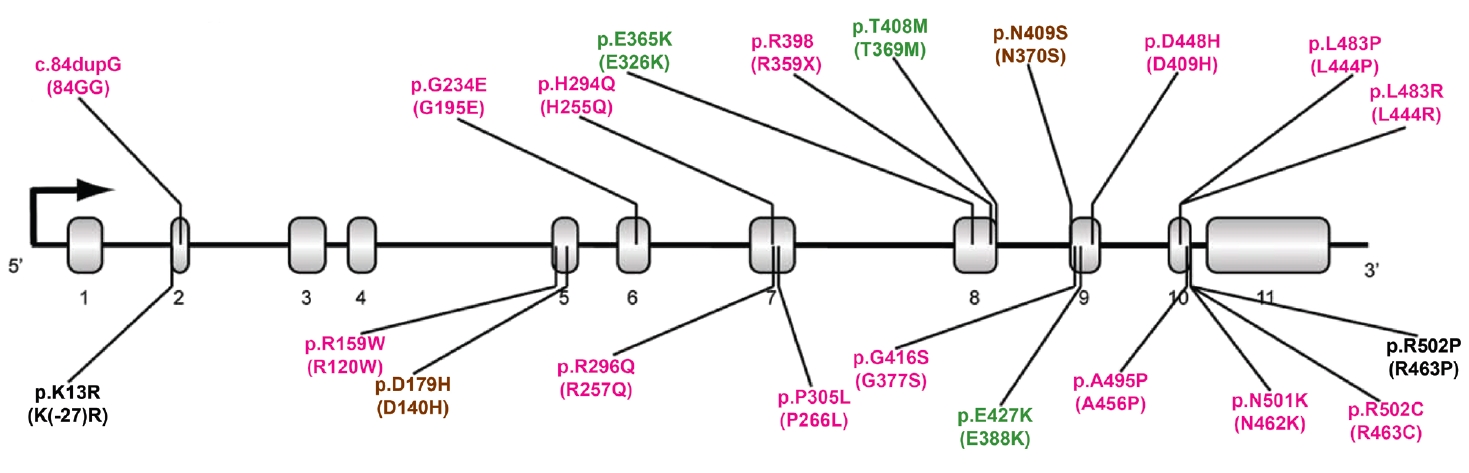
- 23,759 View
- 672 Download
- 36 Web of Science
- 36 Crossref
-
Abstract
PDF
- Glucosylceramidase beta 1 (GBA1) variants have attracted enormous attention as the most promising and important genetic candidates for precision medicine in Parkinson’s disease (PD). A substantial correlation between GBA1 genotypes and PD phenotypes could inform the prediction of disease progression and promote the development of a preventive intervention for individuals at a higher risk of a worse disease prognosis. Moreover, the GBA1-regulated pathway provides new perspectives on the pathogenesis of PD, such as dysregulated sphingolipid metabolism, impaired protein quality control, and disrupted endoplasmic reticulum-Golgi trafficking. These perspectives have led to the development of novel disease-modifying therapies for PD targeting the GBA1-regulated pathway by repositioning treatment strategies for Gaucher’s disease. This review summarizes the current hypotheses on a mechanistic link between GBA1 variants and PD and possible therapeutic options for modulating GBA1-regulated pathways in PD patients.
-
Citations
Citations to this article as recorded by- Polymeric nanoparticle-mediated GBA1 gene therapy is neuroprotective in a preclinical model of Parkinson’s disease
Mohit Kwatra, Gijung Kwak, Haolin Li, Jung Soo Suk, Han Seok Ko
Drug Delivery and Translational Research.2026; 16(3): 894. CrossRef - Selenoureido-N-alkyl-3,4,5-trihydroxypiperidines: probing their dual-target role in Gaucher disease
Debora Pratesi, Francesca Clemente, Camilla Matassini, Silvia Falliano, Amelia Morrone, Rebecca Sodano, Paolo Paoli, Andrea Goti, José G. Fernández-Bolanos, Óscar López, Francesca Cardona
Bioorganic & Medicinal Chemistry.2026; 132: 118453. CrossRef - GBA1 Variants with Unknown Classification Are Modest Contributors to Parkinson's Disease Susceptibility
Sitki Cem Parlar, Yoomin Lee, Ziv Gan‐Or
Movement Disorders.2026; 41(3): 761. CrossRef - Racial and Ethnic Diversity in Clinical Trials for Disease Modifying Drugs in Parkinson Disease: A Systematic Review & Meta‐Analysis
Farley Reis Rodrigues, Gabriel Bolner, Giovana Barros e Silva Ribeiro, Aishwarya Koppanatham, Raul Vinícius da Silva, Conor Fearon, Artur F. Schumacher Schuh, Ece Bayram, Juan Blas M. Couto, Mwiza Ushe, Daniel G. Di Luca
Movement Disorders Clinical Practice.2026; 13(5): 1295. CrossRef - Multi-cohort, cross-species urinary proteomics reveals signatures of LRRK2 dysfunction in Parkinson’s disease
Duc Tung Vu, William Sibran, Andreas Metousis, Laurine Vandewynckel, Basak Eraslan, Liesel Goveas, Ericka CM Itang, Claire Deldycke, Adriana Figueroa-Garcia, Réginald Lefèbvre, Johannes Bruno Müller-Reif, Sebastian Virreira Winter, Marie-Christine Chartie
Molecular Systems Biology.2026; 22(5): 712. CrossRef - Benchmarking Lysosome Enrichment Methods: A Guide for Research and Clinical Translation
Anniek L. de Jager, Sara Kassem, Louis Alesha, Brigitta A.E. Naber, Inge F. de Laat, Bas de Mooij, Kyra van der Pan, Erik Bos, Roman I. Koning, Jacques J.M. van Dongen, Cristina Teodosio, Paula Díez
Analytical Chemistry.2026; 98(6): 4585. CrossRef - Lysosome pH Dynamics in Physiology and Disease: Molecular Mechanisms and Therapeutic Insights
Sonia Infante‐Tadeo, Diane L. Barber
Acta Physiologica.2026;[Epub] CrossRef - Genetic and environmental risk factors of Parkinsonism
Petr Kanovsky, Katerina Mensikova, Pavel Cupr, Radek Vodicka, Kristyna Kolarikova, Tereza Strnadova, Sarah Elizabeth Victoria Cook, Dorota Sebelova-Konickova, Jana Klanova, Carlo Colosimo, Raymond Rosales
Journal of Neural Transmission.2026; 133(7): 1105. CrossRef - Genetic Associations of Parkinson’s Disease Clinical, Pathological, and Data-Driven Subtypes
Ahmed Negida, Moaz Elsayed Abouelmagd, Belal Mohamed Hamed, Yousef Hawas, Aya Dziri, Yasmin Negida, Brian D. Berman, Matthew J. Barrett
Genes.2026; 17(4): 449. CrossRef - The GBA1 p.E427K (p.E388K) Variant Is a Risk Factor for Synucleinopathies: A Meta‐Analysis
Leah V. Chifamba, Sitki Cem Parlar, Emma N. Somerville, Lang Liu, Eric Yu, Farnaz Asayesh, Jamil Ahmad, Meron Teferra, Jennifer A. Ruskey, Cheryl Waters, Oury Monchi, Yves Dauvilliers, Nicolas Dupré, Alla Timofeeva, Anton Emelyanov, Sofya Pchelina, Irina
Movement Disorders.2026;[Epub] CrossRef - Interplay of GBA1 with lysosomal dysfunction and inflammation in Parkinson’s disease
Ruochen Wang, Taku Hatano, Nobutaka Hattori, Davide Cossu
Neural Regeneration Research.2026; 21(10): 4803. CrossRef - Global research synergy: Advancing fundamental Parkinson's research through international collaboration
Jesus Gutierrez-Arratia, Paula Saffie-Awad, Artur F Schuh, Mario Cornejo-Olivas
Journal of Parkinson’s Disease.2026;[Epub] CrossRef - Does genetic testing remain relevant in advanced Parkinson’s disease?
Ana Westenberger, Nadine J. Endaya, Norbert Brüggemann
Journal of Neural Transmission.2026;[Epub] CrossRef - Building Scalable Recruitment Models for Precision Medicine in Parkinson's Disease: Insights from GBA1 Trials
Jean‐Christophe Corvol, Christelle Tesson, Sophie Liot, Stéphanie Carvalho, Giovanni Castelnovo, Philippe Damier, Luc Defebvre, Caroline Giordana, Jean‐Luc Houeto, Ana Marques, Wassilios G. Meissner, Philippe Remy, Stéphane Thobois, Margherita Fabbri, Oli
Movement Disorders.2026;[Epub] CrossRef - COVID-19 pleiotropy with brain imaging-derived phenotypes highlights novel insights into the biology shared between immune function and brain variation
Qianyu Chen, Jun He, Brenda Cabrera-Mendoza, Ziang Xu, Dan Qiu, Renato Polimanti
Brain Communications.2026;[Epub] CrossRef -
GBA1
Canada initiative (G-can), a pre-competitive, open science platform for
GBA1
research
Priyabrata Halder, Lorna Chebon-Bore, Emma N Sommerville, Konstantin Senkevich, Andrew N Bayne, Isabella Pietrantonio, Mahtab Tavasoli, Jeremy M Van Raamsdonk, Martin Parent, Gary AB Armstrong, Madeleine Sharp, Carl Laflamme, Peter S McPherson, Massimo Pa
Journal of Parkinson’s Disease.2026;[Epub] CrossRef - Male sex accelerates cognitive decline in GBA1 Parkinson’s disease
Silvia Paola Caminiti, Micol Avenali, Alice Galli, Rachele Malito, Giada Cuconato, Caterina Galandra, Rosaria Calabrese, Andrea Pilotto, Alessandro Padovani, Fabio Blandini, Daniela Perani, Cristina Tassorelli, Enza Maria Valente
npj Parkinson's Disease.2025;[Epub] CrossRef - Classification and Genotype–Phenotype Relationships of GBA1 Variants: MDSGene Systematic Review
Malco Rossi, Susen Schaake, Tatiana Usnich, Josephine Boehm, Nina Steffen, Nathalie Schell, Clara Krüger, Tuğçe Gül‐Demirkale, Natascha Bahr, Teresa Kleinz, Harutyun Madoev, Björn‐Hergen Laabs, Ziv Gan‐Or, Roy N. Alcalay, Katja Lohmann, Christine Klein
Movement Disorders.2025; 40(4): 605. CrossRef - Challenges in Gaucher disease: Perspectives from an expert panel
Gregory A. Grabowski, Priya S. Kishnani, Roy N. Alcalay, S. Grace Prakalapakorn, Barry E. Rosenbloom, Dominick A. Tuason, Neal J. Weinreb
Molecular Genetics and Metabolism.2025; 145(1): 109074. CrossRef - Acetal functionalized iminosugars for targeting β-glucocerebrosidase modulation
Maria Giulia Davighi, Francesca Clemente, Camilla Matassini, Martina Cacciarini, Damiano Tanini, Andrea Goti, Amelia Morrone, Paolo Paoli, Francesca Cardona
European Journal of Medicinal Chemistry.2025; 290: 117529. CrossRef - Comparative analysis of methods for measuring glucocerebrosidase enzyme activity in patients with Parkinson’s disease with the GBA1 variant
Jin Hwangbo, Myung Jun Lee, Sang Jin Kim, Hyun Kyung Park, Jae-Hyeok Lee
Frontiers in Neurology.2025;[Epub] CrossRef - A drug screening platform for protein expression levels in neurological disorders
Farida Emran, Ibrahim Kays, Chiu-An Lo, Yueyang Li, Brian E. Chen
BioTechniques.2025; 77(3): 113. CrossRef - Investigating plasma lipid profiles in association with Parkinson’s disease risk
Houwen Zhang, Fangzheng Cao, Jialin Yu, Yu Liang, You Wu
npj Parkinson's Disease.2025;[Epub] CrossRef - Efficient GBA1 editing via HDR with ssODNs by outcompeting pseudogene-mediated gene conversion upon CRISPR/Cas9 cleavage
Joseph S. Lagas, Monica F. Sentmanat, Xiaoxia Cui
Frontiers in Genome Editing.2025;[Epub] CrossRef - Adaptive immunity in the pathogenesis and treatments of Parkinson’s disease
Xiaoqing Du, Samia Akter, Davina B. Oludipe, Susmita Sil, Chen Zhang, Howard E. Gendelman, R. Lee Mosley
NeuroImmune Pharmacology and Therapeutics.2025; 4(2): 273. CrossRef - Protective Effects of Genetic Proxies of Cognitive Reserve in Parkinson's Disease: A Longitudinal Multi‐Cohort Study
Young Eun Huh, Beomjin Jang, Sang‐Hyuk Jung, Dokyoon Kim, Towfique Raj, Hong‐Hee Won
Movement Disorders.2025; 40(10): 2158. CrossRef - Intrathecal Therapies for Neurodegenerative Diseases: A Review of Current Approaches and the Urgent Need for Advanced Delivery Systems
Thomas Gabriel Schreiner, Manuel Menéndez-González, Oliver Daniel Schreiner, Romeo Cristian Ciobanu
Biomedicines.2025; 13(9): 2167. CrossRef - Clinical Variability and Genotype–Phenotype Correlation in Spanish Patients with Type 1 Gaucher Disease: A Focus on Non-c.[1226A>G]; [1448T>C] Genotypes
Irene Serrano-Gonzalo, Francisco Bauza, Laura Lopez de Frutos, Isidro Arevalo-Vargas, Mercedes Roca-Espiau, Marcio Andrade-Campos, Esther Valero-Tena, Sonia Roca-Esteve, David Iniguez, Pilar Giraldo
International Journal of Molecular Sciences.2025; 26(20): 10088. CrossRef - Secondary Mitochondrial Dysfunction in Gaucher Disease Type I, II and III—Review of the Experimental and Clinical Evidence
Mollie Dewsbury, Tyler Purcell, Derralynn Hughes, Aimee Donald, Iain P. Hargreaves, Karolina M. Stepien
Genes.2025; 16(11): 1269. CrossRef - Inhibition or genetic reduction of ASAH1/acid ceramidase restore α-synuclein clearance in mutant GBA1 dopamine neurons from Parkinson’s patients
Manoj Kumar, Ricardo A Feldman
Human Molecular Genetics.2025; 34(24): 2075. CrossRef - A novel peptide-based strategy to enhance GBA1 expression for treating Parkinson’s disease
Hyerynn Kim, Jiyeon Na, Hye Guk Ryu, Eunmin Lee, Hyeonwoo Park, Haeun Park, Younwoo Nam, Geon-Hwi Jeong, In-Hyeok Pyo, Jung-Hyun Choi, Jihoon Nah, Sang-Min Jang, Jun-Ho Song, Sung-Jin Cho, Sangjune Kim
npj Parkinson's Disease.2025;[Epub] CrossRef - A Comparative Biochemical and Pathological Evaluation of Brain Samples from Knock-In Murine Models of Gaucher Disease
Makaila L. Furderer, Bahafta Berhe, Tiffany C. Chen, Stephen Wincovitch, Xuntian Jiang, Nahid Tayebi, Ellen Sidransky, Tae-Un Han
International Journal of Molecular Sciences.2024; 25(3): 1827. CrossRef - Towards a Global View of Parkinson's Disease Genetics
Marzieh Khani, Catalina Cerquera‐Cleves, Mariam Kekenadze, Peter Wild Crea, Andrew B. Singleton, Sara Bandres‐Ciga
Annals of Neurology.2024; 95(5): 831. CrossRef - Exploring the Association between Cathepsin B and Parkinson’s Disease
Changhao Lu, Xinyi Cai, Shilin Zhi, Xiaofen Wen, Jiaxin Shen, Tommaso Ercoli, Elena Rita Simula, Carla Masala, Leonardo A. Sechi, Paolo Solla
Brain Sciences.2024; 14(5): 482. CrossRef - Clinical, mechanistic, biomarker, and therapeutic advances in GBA1-associated Parkinson’s disease
Xuxiang Zhang, Heng Wu, Beisha Tang, Jifeng Guo
Translational Neurodegeneration.2024;[Epub] CrossRef - Microglia: roles and genetic risk in Parkinson’s disease
Alex R. Trainor, Debra S. MacDonald, Jay Penney
Frontiers in Neuroscience.2024;[Epub] CrossRef
- Polymeric nanoparticle-mediated GBA1 gene therapy is neuroprotective in a preclinical model of Parkinson’s disease
Original Article
- Oromandibular Dystonia: Demographics and Clinical Data from 240 Patients
- Linda Slaim, Myriam Cohen, Patrick Klap, Marie Vidailhet, Alain Perrin, Daniel Brasnu, Denis Ayache, Marie Mailly
- J Mov Disord. 2018;11(2):78-81. Published online May 30, 2018
- DOI: https://doi.org/10.14802/jmd.17065
- 15,252 View
- 269 Download
- 30 Web of Science
- 36 Crossref
-
Abstract
PDF
- Objective
To report demographic data from a large cohort of patients with oromandibular dystonia (OMD).
Methods
This is a retrospective review of patients with OMD referred to our institution between 1989 and 2015. Demographic (age of onset, gender, and familial history of dystonia) and clinical (type of OMD, associated dystonia, and etiology of dystonia) data were collected from a cohort of 240 individuals.
Results
The mean age of onset of OMD was 51.6 years old, with a female predominance (2:1). A family history of dystonia was found in 6 patients (2.5%). One hundred and forty-nine patients (62.1%) had the jaw-opening type of OMD, 48 patients (20.0%) had the jaw-closing type, and 43 patients (17.9%) had a mixed form of OMD. Lingual dystonia was also present in 64 (26.7%) of these patients. Eighty-two patients (34.2%) had a focal dystonia, 131 patients (54.6%) had a segmental dystonia, and 27 patients (11.3%) had a generalized dystonia. One hundred and seventy-one patients (71.3%) had idiopathic OMD.
Conclusion
OMD is a chronic and disabling focal dystonia. Our study found a prevalence of female patients, an onset in middle age and a predominantly idiopathic etiology. Unlike other studies, jaw-opening was found to be the most frequent clinical type of OMD. -
Citations
Citations to this article as recorded by- Clinical Presentation and Evolution of Isolated Focal and Segmental Dystonia in Adults – 20 Years’ Experience from a Botulinum Toxin Clinic
Asish Vijayaraghavan, Syam Krishnan, Khushboo Subash Patel, SM Krishna Mohan, Vineeth Radhakrishnan, Anju Sanalkumar, S Gangadhara Sarma, Ajith Cherian, Divya Kalikavil Puthanveedu
Annals of Indian Academy of Neurology.2026; 29(1): 28. CrossRef - Severe closed-mouth oromandibular dystonia secondary to stroke
Yage Wang, Xu Wang, Beibei Lei, Weisheng Zhuang
Journal of Neurosciences in Rural Practice.2026; 17: 322. CrossRef - Are dental practitioners prepared to recognize stomatognathic movement disorders? A cross-sectional study of knowledge, diagnostic confidence, and educational needs
Omer Mohammed Jamali, Rahma Jamali, Maram Al Riachi, Meena Al-sharjabi, Kholud Abu sanad, Bushra Hussein, Ferdus Zahrah, Mohammed Sultan Alak’hali, Hana’a Hezam Algadi, Ahmed Yaseen Alqutaibi
BDJ Open.2026;[Epub] CrossRef - Botulinum toxin treatment of oromandibular and laryngeal dystonia
Monika Turčanová Koprušáková, Jozef Haring, Ján Necpál
Neurologie pro praxi.2026; 27(3): 181. CrossRef - Oromandibular dystonia unresponsive to botulinum toxin: two illustrative cases of condylar dislocation as a structural mimic
Olcay Şakar, Berk Bilgen, Bora Edim Akalın, Kazuya Yoshida
Frontiers in Neurology.2026;[Epub] CrossRef - Repeated Mandibular Fracture in Chronic Oromandibular Dystonia: A Case Report and Multidisciplinary Management Approach
Hemanga Kumar Dhing, Hanifa Akhtar, Masaraf Hussain, Md Jamil
Indian Journal of Otolaryngology and Head & Neck Surgery.2026; 78(10): 5322. CrossRef - Application of surface electromyography in dentistry for diagnosis and treatment evaluation
So Ra Kim, Yeong-Gwan Im
Journal of Korean Dental Association.2025; 63(3): 64. CrossRef - Measurement of Disease Comorbidity Using Semantic Profiling of Disease Genes
Seong Beom Cho
International Journal of Molecular Sciences.2025; 26(8): 3906. CrossRef - Surface electromyography for evaluating patients with oromandibular dystonia
Jae-Hyung Kim, Byung-Gook Kim, Yeong-Gwan Im
CRANIO®.2024; 42(3): 316. CrossRef - Tongue dystonia as CIS and presenting symptom of multiple sclerosis
Farid Shamlou, Narges Ebrahimi, Ahmad Chitsaz
Neuroimmunology Reports.2024; 5: 100191. CrossRef - Oromandibular dystonia: from onset to spread a multicenter italian study
Assunta Trinchillo, Marcello Esposito, Carmen Terranova, Vincenzo Rizzo, Giovanni Fabbrini, Gina Ferrazzano, Daniele Belvisi, Roberto Erro, Paolo Barone, Francesco Bono, Francesca Di Biasio, Anna Rita Bentivoglio, Christian Lettieri, Maria Concetta Altavi
Neurological Sciences.2024; 45(9): 4341. CrossRef - A Case Study of Korean Medicine Treatment in a Patient Complaining of Generalized Dystonia
Kyeong-hwa Lee, Hye-min Heo, Dong-joo Kim, Min-jae Kwak, Ye-chae Hwang, Seung-yeon Cho, Jung-mi Park, Chang-nam Ko, Seong-uk Park
The Journal of Internal Korean Medicine.2024; 45(2): 208. CrossRef - Treatment with OnabotulinumtoxinA for Oromandibular Dystonia: A Systematic Review and Meta-Analysis
Kazuya Yoshida, Ryuji Kaji
Toxins.2024; 16(12): 546. CrossRef - Oromandibular Dystonia: Clinical and Demographic Data from Eight-Two Patients
Mehmet Balal, Meltem Demirkiran
Tremor and Other Hyperkinetic Movements.2023;[Epub] CrossRef - Oromandibular Dystonia is a Prominent Feature in Patients with Aromatic L-Amino Acid Decarboxylase (AADC) Deficiency
Helio van der Linden Jr., Christiane Cobas, Andre Felipe Pinto Duarte, Marcelo Rodrigues Masruha
Journal of Inborn Errors of Metabolism and Screening.2023;[Epub] CrossRef - Clinical Presentation and Management of Peripheral-induced Oromandibular Dystonia in Nigeria: A Case Report and Literature Update
Nonso Emmanuel Onyia, Mercy Okoh, Obinna Francis Igwilo, Izegboya Vivian Ukpebor, Eze Stephen Nwauzor
Nigerian Journal of Medicine.2023; 32(4): 433. CrossRef - Oromandibular Dystonia – A Systematic Review
Udit Saraf, Mitesh Chandarana, K. P Divya, Syam Krishnan
Annals of Indian Academy of Neurology.2022; 25(1): 26. CrossRef - Botulinum Toxin Therapy for Oromandibular Dystonia and Other Movement Disorders in the Stomatognathic System
Kazuya Yoshida
Toxins.2022; 14(4): 282. CrossRef - Botulinum toxin injections in jaw-opening dystonia. The lateral pterygoid – maxillary artery problem
Sena Ünal, F. Tugra Karaarslan-Turk, Muhittin Cenk Akbostanci, Elif Peker, Rezzak Yilmaz
Journal of Clinical Neuroscience.2022; 101: 217. CrossRef - Oromandibular dystonia seen during pramipexole treatment: A rare case
Fatma KARA, Mehmet Fatih GÖL, Ayhan VARLIBAŞ
Journal of Surgery and Medicine.2022; 6(6): 1. CrossRef - Dystonia, chorea, hemiballismus and other dyskinesias
Matteo Bologna, Josep Valls-Solè, Nitish Kamble, Pramod Kumar Pal, Antonella Conte, Andrea Guerra, Daniele Belvisi, Alfredo Berardelli
Clinical Neurophysiology.2022; 140: 110. CrossRef - Movement disorders of the mouth: a review of the common phenomenologies
C. M. Ghadery, L. V. Kalia, B. S. Connolly
Journal of Neurology.2022; 269(11): 5812. CrossRef - Botulinum Toxin in Movement Disorders: An Update
Charenya Anandan, Joseph Jankovic
Toxins.2021; 13(1): 42. CrossRef - Temporomandibular disorder–related characteristics and treatment outcomes in Oromandibular Dystonia patients in two different clinical settings: A cross‐sectional study
Asha Sude, Joseph Matsumoto, Shanti Kaimal, Ashley Petersen, Donald R. Nixdorf
Journal of Oral Rehabilitation.2021; 48(5): 542. CrossRef - Jaw Pain and Oromandibular Dysfunction After a Complex Hospital Course
Sarah Smith, Ny-Ying Lam
American Journal of Physical Medicine & Rehabilitation.2021; 100(5): e62. CrossRef - Oromandibular Dystonia: A Clinical Examination of 2,020 Cases
Laura M. Scorr, Stewart A. Factor, Sahyli Perez Parra, Rachel Kaye, Randal C. Paniello, Scott A. Norris, Joel S. Perlmutter, Tobias Bäumer, Tatiana Usnich, Brian D. Berman, Marie Mailly, Emmanuel Roze, Marie Vidailhet, Joseph Jankovic, Mark S. LeDoux, Ric
Frontiers in Neurology.2021;[Epub] CrossRef - Evaluation of Treatment Outcomes in Oromandibular Dystonia Using Surface Electromyography: A Case Series
Yeong-Gwan Im, Jae-Hyung Kim, Byung-Gook Kim
Journal of Oral Medicine and Pain.2021; 46(4): 143. CrossRef - Application of botulinum toxin in pregnancy and its impact on female reproductive health
Wu Li, Min Tang
Expert Opinion on Drug Safety.2020; 19(1): 83. CrossRef - Prevalence and clinical characteristics of patients with oromandibular dystonia seen in the orofacial pain clinic: a retrospective study
Asha Sude, Donald R. Nixdorf
Oral Surgery, Oral Medicine, Oral Pathology and Oral Radiology.2020; 130(2): 169. CrossRef - Clinical spectrum of focal dystonias: Experience from a tertiary care center
Rupesh Prasad, Deepika Joshi, VijayN Mishra, RameshwarN Chaurasia, Abhishek Pathak
Annals of Movement Disorders.2020; 3(2): 99. CrossRef - Bite injury related to oromandibular dystonia extending to the maxillary sinus: A case report
Yoshiro Koma, Takehiro Fujimoto, Shinji Uejima, Kotaro Sato, Keisuke Sugimoto, Satoshi Yamaguchi, Jun Ishikawa, Kazuya Nambu, Hideharu Hibi
Journal of Oral and Maxillofacial Surgery, Medicine, and Pathology.2020; 32(6): 503. CrossRef - Botulinum neurotoxin a therapy efficacy and safety for oromandibular dystonia: a meta-analysis
Pariessa D. Dadgardoust, Raymond L. Rosales, Ria Monica Asuncion, Dirk Dressler
Journal of Neural Transmission.2019; 126(2): 141. CrossRef - Botulinum Neurotoxin Therapy for Lingual Dystonia Using an Individualized Injection Method Based on Clinical Features
Kazuya Yoshida
Toxins.2019; 11(1): 51. CrossRef - Oromandibular dystonia, mental distress and oro‐facial dysfunction—A follow‐up 8‐10 years after start of treatment with botulinum toxin
Merete Bakke, Sara Baram, Torben Dalager, Heidi Bryde Biernat, Eigild Møller
Journal of Oral Rehabilitation.2019; 46(5): 441. CrossRef - Pseudodystonia: A new perspective on an old phenomenon
Rok Berlot, Kailash P. Bhatia, Maja Kojović
Parkinsonism & Related Disorders.2019; 62: 44. CrossRef - Severe Jaw‐Opening Dystonia as an Unusual Manifestation of Levodopa‐Related Wearing‐Off in Parkinson's Disease, and Successful Treatment With Botulinum Toxin Injection
Pankaj Ashok Agarwal
Movement Disorders Clinical Practice.2019; 6(6): 500. CrossRef
- Clinical Presentation and Evolution of Isolated Focal and Segmental Dystonia in Adults – 20 Years’ Experience from a Botulinum Toxin Clinic
Review Articles
- New Perspective on Parkinsonism in Frontotemporal Lobar Degeneration
- Hee Kyung Park, Sun J. Chung
- J Mov Disord. 2013;6(1):1-8.
- DOI: https://doi.org/10.14802/jmd.13001
- 35,426 View
- 293 Download
- 36 Crossref
-
Abstract
PDF
Frontotemporal dementia (FTD) is the second most common type of presenile dementia. Three clinical prototypes have been defined; behavioral variant FTD, semantic dementia, and progressive nonfluent aphasia. Progressive supranuclear palsy, corticobasal degeneration, and motor neuron disease may possess clinical and pathological characteristics that overlap with FTD, and it is possible that they may all belong to the same clinicopathological spectrum. Frontotemporal lobar degeneration (FTLD) is a clinicopathological syndrome that encompasses a heterogenous group of neurodegenerative disorders. Owing to the advancement in the field of molecular genetics, diagnostic imaging, and pathology, FTLD has been the focus of great interest. Nevertheless, parkinsonism in FTLD has received relatively less attention. Parkinsonism is found in approximately 20–30% of patients in FTLD. Furthermore, parkinsonism can be seen in all FTLD subtypes, and some patients with familial and sporadic FTLD can present with prominent parkinsonism. Therefore, there is a need to understand parkinsonism in FTLD in order to obtain a better understanding of the disease. With regard to the clinical characteristics, the akinetic rigid type of parkinsonism has predominantly been described. Parkinsonism is frequently observed in familial FTD, more specifically, in FTD with parkinsonism linked to chromosome 17q (FTDP-17). The genes associated with parkinsonism are microtubule associated protein tau (
MAPT ), progranulin (GRN orPGRN ), and chromosome 9 open reading frame 72 (C9ORF72 ) repeat expansion. The neural substrate of parkinsonism remains to be unveiled. Dopamine transporter (DAT) imaging revealed decreased uptake of DAT, and imaging findings indicated atrophic changes of the basal ganglia. Parkinsonism can be an important feature in FTLD and, therefore, increased attention is needed on the subject.-
Citations
Citations to this article as recorded by- Ethnic and Epidemiological Peculiarities of Movement Disorders across the World
João Moura, Bettina Balint, Patrick Cullinane, Hessah Alhashash, Francesca Magrinelli, Anna Latorre, Kailash P. Bhatia
Movement Disorders Clinical Practice.2026; 13(7): 1621. CrossRef - Frontotemporal dementia: Clinical aspects, genetics, and neuropathology of a family with a C9ORF72 expansion in Argentina
Karen Daniela Román, Carolina Agata Ardohain, Ezequiel I. Surace, Mónica Beatriz Mezmezian, Alejandro Levy, Alice Baez Lovera, Carlos Turizo, Marcos G. Sorbara, María M. Esnaola y Rojas, Gastón H. Graviotto, Gustavo Sevlever, Ricardo F. Allegri, Cecilia M
Brain Pathology.2026;[Epub] CrossRef - Caudate-Predominant Striatal Dopaminergic Deficit Distinguishes Behavioral Variant of Frontotemporal Dementia With Parkinsonism From Other Parkinsonian Syndromes
Lu Feng, Wen Liu, Yi-Xin Zhao, Kun-Wang Chan, Qi Shen, Xin-Yi Li, Jia-Ying Lu, Jing-Jie Ge, Chuan-Tao Zuo, Jian Wang, Jing Wang, Feng-Tao Liu
Clinical Nuclear Medicine.2026; 51(10): e886. CrossRef - AI-aided neuroimaging for the diagnosis of Alzheimer's disease: A concise review of recent studies
Yeonwoo Lee, Priscilla Nadalin, Emre Onemli, Rafi Hadad, Fengyi Yu, Lior Greenbaum, Alon Greenbaum, Jinhyun Ahn
Heliyon.2026; 12(14): e45308. CrossRef - Time to diagnosis in FTLD‐associated syndromes in Latin America
Nahuel Magrath‐Guimet, Florentina Morello‐Garcia, Loana De Los Santos, Carolina Ardohain‐Cristalli, Eugenia Tabernero, Hernán Chaves, Pablo Bagnati, Ricardo Francisco Allegri, Joaquin Migeot, Juliana Acosta‐Uribe, Isabel Elaine Allen, David Aguillon, Jose
Alzheimer's & Dementia: Diagnosis, Assessment & Disease Monitoring.2026;[Epub] CrossRef - Multitracer PET/CT Findings in a Case of Behavioral Variant Frontotemporal Dementia With Parkinsonism
Shuai Chen, Chang Fu, Jing-Yu Shao, Jun-Ling Xu, Jie-Wen Zhang
Clinical Nuclear Medicine.2025; 50(2): 176. CrossRef - Analyses of NOTCH3 variants in Chinese patients with clinically diagnosed Alzheimer's disease and frontotemporal dementia
Haitian Nan, Min Chu, Ailing Yue, Qianqian He, Jieying Li, Yanchen Liu, Lijun Chi, Xiaoyan Liu, Guoping Peng, Liyong Wu
Alzheimer's Research & Therapy.2025;[Epub] CrossRef - Unraveling the complex role of MAPT-containing H1 and H2 haplotypes in neurodegenerative diseases
Chiara Pedicone, Sarah A. Weitzman, Alan E. Renton, Alison M. Goate
Molecular Neurodegeneration.2024;[Epub] CrossRef - Genetic and clinical landscape of Chinese frontotemporal dementia: dominance of TBK1 and OPTN mutations
Haitian Nan, Yeon-Jeong Kim, Min Chu, Dan Li, Jieying Li, Deming Jiang, Yiming Wu, Toshihisa Ohtsuka, Liyong Wu
Alzheimer's Research & Therapy.2024;[Epub] CrossRef - Treatment of Acquired Deforming Hypertonia with Botulinum Toxin in Older Population: A Retrospective Study
Pablo Maldonado, Hugo Bessaguet, Cédric Chol, Pascal Giraux, Ludovic Lafaie, Ahmed Adham, Romain David, Thomas Celarier, Etienne Ojardias
Toxins.2024; 16(8): 365. CrossRef - Artificial Intelligence-Assisted Comparative Analysis of the Overlapping Molecular Pathophysiology of Alzheimer’s Disease, Amyotrophic Lateral Sclerosis, and Frontotemporal Dementia
Zihan Wei, Meghna R. Iyer, Benjamin Zhao, Jennifer Deng, Cassie S. Mitchell
International Journal of Molecular Sciences.2024; 25(24): 13450. CrossRef - Antidepressant medications in dementia: evidence and potential mechanisms of treatment-resistance
Harry Costello, Jonathan P. Roiser, Robert Howard
Psychological Medicine.2023; 53(3): 654. CrossRef - Movement disorders are linked to TDP-43 burden in the substantia nigra of FTLD-TDP brain donors
Luigi Fiondella, Priya Gami-Patel, Christian A. Blok, Annemieke J. M. Rozemuller, Jeroen J. M. Hoozemans, Yolande A. L. Pijnenburg, Marta Scarioni, Anke A. Dijkstra
Acta Neuropathologica Communications.2023;[Epub] CrossRef - Demencias degenerativas: ¿un dilema de síndromes o de enfermedades?
A. Robles Bayón
Neurología.2022; 37(6): 480. CrossRef - Degenerative dementias: a question of syndrome or disease?
A. Robles Bayón
Neurología (English Edition).2022; 37(6): 480. CrossRef - Deficient neurotransmitter systems and synaptic function in frontotemporal lobar degeneration—Insights into disease mechanisms and current therapeutic approaches
Nadine Huber, Sonja Korhonen, Dorit Hoffmann, Stina Leskelä, Hannah Rostalski, Anne M. Remes, Paavo Honkakoski, Eino Solje, Annakaisa Haapasalo
Molecular Psychiatry.2022; 27(3): 1300. CrossRef - Novel frameshift CTSF mutation causing kufs disease type B mimicking frontotemporal dementia-parkinsonism
Murat Gultekin, Zeynep Tufekcioglu, Recep Baydemir
Neurocase.2022; 28(1): 107. CrossRef - Dopamine Transporter Imaging for Frontotemporal Lobar Degeneration With Motor Neuron Disease
Ryota Kobayashi, Shinobu Kawakatsu, Makoto Ohba, Daichi Morioka, Masafumi Kanoto, Koichi Otani
Frontiers in Neuroscience.2022;[Epub] CrossRef - Investigational therapeutics for the treatment of progressive supranuclear palsy
David G Coughlin, Irene Litvan
Expert Opinion on Investigational Drugs.2022; 31(8): 813. CrossRef - Frequency and Longitudinal Course of Motor Signs in Genetic Frontotemporal Dementia
Sonja Schönecker, Francisco J. Martinez-Murcia, Boris-Stephan Rauchmann, Nicolai Franzmeier, Catharina Prix, Elisabeth Wlasich, Sandra V. Loosli, Katja Bochmann, Juan-Manuel Gorriz Saez, Robert Laforce, Simon Ducharme, Maria Carmela Tartaglia, Elizabeth F
Neurology.2022;[Epub] CrossRef - Multi-Modal Synergistic 99mTc-TRODAT-1 SPECT and MRI for Evaluation of the Efficacy of Hyperbaric Oxygen Therapy in CO-Induced Delayed Parkinsonian and Non-Parkinsonian Syndromes
Skye Hsin-Hsien Yeh, Chuang-Hsin Chiu, Hung-Wen Kao, Ching-Po Lin, Yu-Hus Lai, Wen-Sheng Huang
Antioxidants.2022; 11(11): 2289. CrossRef - Defective Lysosomal Lipid Catabolism as a Common Pathogenic Mechanism for Dementia
Jun Yup Lee, Oana C. Marian, Anthony S. Don
NeuroMolecular Medicine.2021; 23(1): 1. CrossRef - Different miRNA Profiles in Plasma Derived Small and Large Extracellular Vesicles from Patients with Neurodegenerative Diseases
Daisy Sproviero, Stella Gagliardi, Susanna Zucca, Maddalena Arigoni, Marta Giannini, Maria Garofalo, Martina Olivero, Michela Dell’Orco, Orietta Pansarasa, Stefano Bernuzzi, Micol Avenali, Matteo Cotta Ramusino, Luca Diamanti, Brigida Minafra, Giulia Peri
International Journal of Molecular Sciences.2021; 22(5): 2737. CrossRef - Parkin beyond Parkinson’s Disease—A Functional Meaning of Parkin Downregulation in TDP-43 Proteinopathies
Katarzyna Gaweda-Walerych, Emilia Jadwiga Sitek, Ewa Narożańska, Emanuele Buratti
Cells.2021; 10(12): 3389. CrossRef - Joint contractures and acquired deforming hypertonia in older people: Which determinants?
Patrick Dehail, Nathaly Gaudreault, Haodong Zhou, Véronique Cressot, Anne Martineau, Julie Kirouac-Laplante, Guy Trudel
Annals of Physical and Rehabilitation Medicine.2019; 62(6): 435. CrossRef - Review: Clinical, genetic and neuroimaging features of frontotemporal dementia
R. Convery, S. Mead, J. D. Rohrer
Neuropathology and Applied Neurobiology.2019; 45(1): 6. CrossRef - Granulin in Frontotemporal Lobar Degeneration: Molecular Mechanisms of the Disease
Zemfira N. Karamysheva, Elena B. Tikhonova, Andrey L. Karamyshev
Frontiers in Neuroscience.2019;[Epub] CrossRef - The Whole Exome Sequencing Clarifies the Genotype- Phenotype Correlations in Patients with Early-Onset Dementia
Yangqi Xu, Xiaoli Liu, Junyi Shen, Wotu Tian, Rong Fang, Binyin Li, Jianfang Ma, Li Cao, Shengdi Chen, Guanjun Li, Huidong Tang
Aging and disease.2018; 9(4): 696. CrossRef - Mouse models of frontotemporal dementia: A comparison of phenotypes with clinical symptomatology
Rebekah M. Ahmed, Muireann Irish, Janet van Eersel, Arne Ittner, Yazi D. Ke, Alexander Volkerling, Julia van der Hoven, Kimi Tanaka, Tim Karl, Michael Kassiou, Jillian J. Kril, Olivier Piguet, Jürgen Götz, Matthew C. Kiernan, Glenda M. Halliday, John R. H
Neuroscience & Biobehavioral Reviews.2017; 74: 126. CrossRef - Translocator Protein-18 kDa (TSPO) Positron Emission Tomography (PET) Imaging and Its Clinical Impact in Neurodegenerative Diseases
Anne-Claire Dupont, Bérenger Largeau, Maria Santiago Ribeiro, Denis Guilloteau, Claire Tronel, Nicolas Arlicot
International Journal of Molecular Sciences.2017; 18(4): 785. CrossRef - Intrinsic functional connectivity alterations in progressive supranuclear palsy: Differential effects in frontal cortex, motor, and midbrain networks
Johannes Rosskopf, Martin Gorges, Hans‐Peter Müller, Dorothée Lulé, Ingo Uttner, Albert C. Ludolph, Elmar Pinkhardt, Freimut D. Juengling, Jan Kassubek
Movement Disorders.2017; 32(7): 1006. CrossRef - Phenotypic variability related to C9orf72 mutation in a large Sardinian kindred
Gianluca Floris, Giuseppe Borghero, Francesca Di Stefano, Rosanna Melis, Roberta Puddu, Laura Fadda, Maria R. Murru, Daniela Corongiu, Stefania Cuccu, Stefania Tranquilli, Antonino Cannas, Maria G. Marrosu, Adriano Chiò, Francesco Marrosu
Amyotrophic Lateral Sclerosis and Frontotemporal Degeneration.2016; 17(3-4): 245. CrossRef - Clinical features ofTBK1carriers compared withC9orf72,GRNand non-mutation carriers in a Belgian cohort
Sara Van Mossevelde, Julie van der Zee, Ilse Gijselinck, Sebastiaan Engelborghs, Anne Sieben, Tim Van Langenhove, Jan De Bleecker, Jonathan Baets, Mathieu Vandenbulcke, Koen Van Laere, Sarah Ceyssens, Marleen Van den Broeck, Karin Peeters, Maria Mattheijs
Brain.2016; 139(2): 452. CrossRef - Characterization of Movement Disorder Phenomenology in Genetically Proven, Familial Frontotemporal Lobar Degeneration: A Systematic Review and Meta-Analysis
Carmen Gasca-Salas, Mario Masellis, Edwin Khoo, Binit B. Shah, David Fisman, Anthony E. Lang, Galit Kleiner-Fisman, Patrick Lewis
PLOS ONE.2016; 11(4): e0153852. CrossRef - The clinical spectrum of sporadic and familial forms of frontotemporal dementia
Ione O. C. Woollacott, Jonathan D. Rohrer
Journal of Neurochemistry.2016; 138(S1): 6. CrossRef - Genetics of Progressive Supranuclear Palsy
Sun Young Im, Young Eun Kim, Yun Joong Kim
Journal of Movement Disorders.2015; 8(3): 122. CrossRef
- Ethnic and Epidemiological Peculiarities of Movement Disorders across the World
- The Supplementary Motor Complex in Parkinson’s Disease
- Shervin Rahimpour, Shashank Rajkumar, Mark Hallett
- J Mov Disord. 2022;15(1):21-32. Published online November 25, 2021
- DOI: https://doi.org/10.14802/jmd.21075

- 17,164 View
- 523 Download
- 33 Web of Science
- 35 Crossref
-
Abstract
PDF
- Parkinson’s disease (PD) is a neurodegenerative disorder characterized by both motor and nonmotor symptoms. Although the basal ganglia is traditionally the primary brain region implicated in this disease process, this limited view ignores the roles of the cortex and cerebellum that are networked with the basal ganglia to support motor and cognitive functions. In particular, recent research has highlighted dysfunction in the supplementary motor complex (SMC) in patients with PD. Using the PubMed and Google Scholar search engines, we identified research articles using keywords pertaining to the involvement of the SMC in action sequencing impairments, temporal processing disturbances, and gait impairment in patients with PD. A review of abstracts and full-text articles was used to identify relevant articles. In this review of 63 articles, we focus on the role of the SMC in PD, highlighting anatomical and functional data to create new perspectives in understanding clinical symptoms and, potentially, new therapeutic targets. The SMC has a nuanced role in the pathophysiology of PD, with both hypo- and hyperactivation associated with various symptoms. Further studies using more standardized patient populations and functional tasks are needed to more clearly elucidate the role of this region in the pathophysiology and treatment of PD.
-
Citations
Citations to this article as recorded by- Noninvasive brain stimulation for motor function and quality of life in Parkinson’s disease: a systematic review and network meta-analysis
Song Hu, Jia Liu, Fengjiao Wang, Guoyu Wang, Yong Zhi, Xiaoxue Gao, Daehee Kim
Journal of Clinical Neuroscience.2027; 155: 112347. CrossRef - Supplementary motor area: A promising neurostimulation target to improve speech production
Fatemeh Tabari, Karim Johari
Journal of Communication Disorders.2026; 120: 106630. CrossRef - Is neurofeedback A reliable therapy for managing Parkinson’s Disease?
Giovanni Mirabella, Alberto Borboni, Michele Guerreschi, Antonio Suppa, Cinzia Amici
Clinical Neurophysiology.2026; 187: 2111890. CrossRef - Quadrato Motor Training in Parkinson’s Disease: Resting-State fMRI Changes and Exploratory Whole-Brain Radiomics
Carlo Cosimo Quattrocchi, Claudia Piervincenzi, Raffaella Di Giacopo, Donatella Ottaviani, Maria Chiara Malaguti, Chiara Longo, Francesca Cattoi, Nikolaos Petsas, Loredana Verdone, Micaela Caserta, Sabrina Venditti, Bruno Giometto, Rossana Franciosi, Fede
Bioengineering.2026; 13(5): 486. CrossRef - Disrupted neural response timing and duration during hand movement preparation in schizophrenia spectrum disorder: An fMRI study
Harun A. Rashid, Tilo Kircher, Benjamin Straube
Scientific Reports.2026;[Epub] CrossRef - Exploring fNIRS-guided neurofeedback for supplementary motor area training in Parkinson’s disease and healthy older adults
Franziska Klein, Michael Lührs, Stefanie Topp, Stefan Debener, Karsten Witt, Cornelia Kranczioch
npj Parkinson's Disease.2026;[Epub] CrossRef - Regional brain dysfunction patterns associated with rapid eye movement sleep behavior disorder and visual hallucinations in Parkinson’s disease: a resting-state fMRI study with exploratory ROI-based factorial analysis
Lifang She, Xiong Wei, Hongyang Cai, Liuchen Zhou, Zonghong Li, Yang Pan
Frontiers in Neurology.2026;[Epub] CrossRef - Temporal processing variability as a scalable marker of Parkinson's disease progression
Michael Schwartze, Anika Voerman, Sonja A. Kotz
Neuropsychologia.2026; 232: 109564. CrossRef - High-frequency rTMS over supplementary motor or primary motor cortex on reach-to-grasp in Parkinson’s disease: A randomised controlled trial
Jenjira Thanakamchokchai, Weerawat Saengphatrachai, Suweena Khacharoen, Pornpiroon Phuegsilp, Prachaya Srivanitchapoom, Yuvadee Pitakpatapee, Narawut Pakaprot, Beth E. Fisher, Jarugool Tretriluxana
Clinical Neurophysiology.2026; : 2112404. CrossRef - Dissociable Handwriting Domains in Parkinson's Disease?
Beyza Nur Cetin, Selcuk Comoglu, Aycan Cemil Ulker, Halil Onder
Movement Disorders Clinical Practice.2026;[Epub] CrossRef - Reliability, Concurrent Validity, Responsiveness and Measurement Error of the Portuguese Version of Comprehensive Motor Coordination Scale in Individuals With Parkinson's Disease
Clara Rezende Rocha, Caroline Rodrigues Osawa, Maria Eduarda Salum Aveiro Henrique, Pedro Henrique Sousa de Andrade, Luciane Aparecida Pascucci Sande de Souza, Gustavo José Luvizutto
Physiotherapy Research International.2025;[Epub] CrossRef - Grey matter volume differences across Parkinson’s disease motor subtypes in the supplementary motor cortex
A. Martin, J. Nassif, L. Chaluvadi, C. Schammel, R. Newman-Norlund, S. Bollmann, J. Absher
NeuroImage: Clinical.2025; 45: 103724. CrossRef - Effects of non-invasive brain stimulation over the supplementary motor area on motor function in Parkinson's disease: A systematic review and meta-analysis
Yawen Chen, Hanhong Jiang, Yixin Wei, Saiqing Ye, Jiaxin Jiang, Margaret K.Y. Mak, Marco Y.C. Pang, Qiang Gao, Meizhen Huang
Brain Stimulation.2025; 18(1): 1. CrossRef - Motor learning-based clinical pilates training for the Parkinson’s disease rehabilitation @Parkinsonpilates: A parallel group, randomised controlled trial with 3-month follow-up
Fahriye Coban, Beliz Belgen Kaygisiz, Ferda Selcuk
Complementary Therapies in Medicine.2025; 90: 103161. CrossRef - Parkinsonism Disrupts Neuronal Modulation in the Presupplementary Motor Area during Movement Preparation
Claudia M. Hendrix, Hannah E. Baker, Ying Yu, David D. Schneck, Jing Wang, Luke A. Johnson, Jerrold L. Vitek
The Journal of Neuroscience.2025; 45(13): e1802242025. CrossRef - Modulatory effect of levodopa on the basal ganglia-cerebellum connectivity in Parkinson’s disease
Juyoung Jenna Yun, Subati Abulikemu, Kodchakorn Love Jangwanich, Yen F. Tai, Shlomi Haar
npj Parkinson's Disease.2025;[Epub] CrossRef - Resting-state functional MRI metrics to detect freezing of gait in Parkinson's disease: a machine learning approach
Caterina Vicidomini, Francesco Fontanella, Tiziana D'Alessandro, Giovanni Nicola Roviello, Claudio De Stefano, Fabrizio Stocchi, Mario Quarantelli, Maria Francesca De Pandis
Computers in Biology and Medicine.2025; 192: 110244. CrossRef - A Pilot Study on the Influence of Self-Paced Auditory Cues and Preferred Music on Gait in Persons with Parkinson’s Disease
Maddie Brant, Callan Barrick, Lindsay Muno, Elizabeth Stegemoller
Brain Sciences.2025; 15(5): 528. CrossRef - Preoperative network activity predicts the response to subthalamic DBS for Parkinson's disease
Prashin Unadkat, An Vo, Yilong Ma, Chris C. Tang, Vijay Dhawan, Martin Niethammer, Nha Nguyen, Shichun Peng, Akash Mishra, Ritesh Ramdhani, Albert Fenoy, Silvia Paola Caminiti, Daniela Perani, David Eidelberg
Neurotherapeutics.2025; 22(5): e00699. CrossRef - Morphometric characterization of early- and late-onset Parkinson's disease: An ROI-based study of classification and correlation
Sadhana Kumari, Bharti Rana, Shefali Chaudhary, Roopa Rajan, S. Senthil Kumaran, Achal Kumar Srivastava, Leve Joseph Devarajan
Neuroscience Informatics.2025; 5(4): 100228. CrossRef - Bilateral intermittent theta-burst stimulation as a priming strategy to enhance action observation and imitation training in early parkinson’s disease: a proof-of-concept study
Yu Shi, Jun Ma, Xiaoqi Zhao, Hongbo Zhao, Deyu Wang, Xiaofei Zhang, Xiaodong Zhu, Lin Meng, Dong Ming
Journal of NeuroEngineering and Rehabilitation.2025;[Epub] CrossRef - Impaired topological properties of cortical morphological brain networks correlate with motor symptoms in Parkinson's disease
Su Yan, Jun Lu, Yuanhao Li, Tian Tian, Yiran Zhou, Hongquan Zhu, Yuanyuan Qin, Wenzhen Zhu
Journal of Neuroradiology.2024; 51(4): 101155. CrossRef - Libet’s legacy: A primer to the neuroscience of volition
Tomáš Dominik, Alfred Mele, Aaron Schurger, Uri Maoz
Neuroscience & Biobehavioral Reviews.2024; 157: 105503. CrossRef - Neural correlates of fine motor grasping skills: Longitudinal insights into motor cortex activation using fNIRS
Xiaoli Li, Minxia Jin, Nan Zhang, Wei Hongman, LianHui Fu, Qi Qi
Brain and Behavior.2024;[Epub] CrossRef - Affection of Motor Network Regions by Tau Pathology Across the Alzheimer's Disease Spectrum
Gérard N. Bischof, Elena Jaeger, Kathrin Giehl, Merle C. Hönig, Peter H. Weiss, Alexander Drzezga
eneuro.2024; 11(1): ENEURO.0242-23.2023. CrossRef - Parkinson’s Disease Risk Variant rs9638616 is Non-Specifically Associated with Altered Brain Structure and Function
Thomas Welton, Thomas Wei Jun Teo, Ling Ling Chan, Eng-King Tan, Louis Chew Seng Tan
Journal of Parkinson’s Disease.2024; 14(4): 713. CrossRef - HD-tDCS over left supplementary motor area differentially modulated neural correlates of motor planning for speech vs. limb movement
Fatemeh Tabari, Celeste Patron, Hope Cryer, Karim Johari
International Journal of Psychophysiology.2024; 201: 112357. CrossRef - Addressing the sources of inter-subject variability in E-field parameters in anodal tDCS stimulation over motor cortical network
Pablo Franco-Rosado, M Amparo Callejón, Javier Reina-Tosina, Laura M Roa, Juan F Martin-Rodriguez, Pablo Mir
Physics in Medicine & Biology.2024; 69(14): 145013. CrossRef - Cortical networks of parkinsonian gait: a metabolic and functional connectivity study
Franziska Pellegrini, Nicoló G. Pozzi, Chiara Palmisano, Giorgio Marotta, Andreas Buck, Stefan Haufe, Ioannis U. Isaias
Annals of Clinical and Translational Neurology.2024; 11(10): 2597. CrossRef - Combining Transcranial Direct Current Stimulation with Exercise to Improve Mobility, Stability, and Tremor Management in 25 Individuals with Parkinson’s Disease
Fabrício D. de Almeida, Yiyu Wang, Rodrigo C. de Mello Pedreiro, Ana Carolina B. Brizzi, Shirley F. Campos, Melina P. Sales, Deanna M. Kennedy, Osmar Pinto Neto
Neurology International.2024; 16(6): 1223. CrossRef - Static and Dynamic Functional Network Connectivity in Parkinson's Disease Patients With Postural Instability and Gait Disorder
Bo Shen, Qun Yao, Yixuan Zhang, Yinyin Jiang, Yaxi Wang, Xu Jiang, Yang Zhao, Haiying Zhang, Shuangshuang Dong, Dongfeng Li, Yaning Chen, Yang Pan, Jun Yan, Feng Han, Shengrong Li, Qi Zhu, Daoqiang Zhang, Li Zhang, Yun‐cheng Wu
CNS Neuroscience & Therapeutics.2024;[Epub] CrossRef - Functional anatomy of the subthalamic nucleus and the pathophysiology of cardinal features of Parkinson’s disease unraveled by focused ultrasound ablation
Rafael Rodriguez-Rojas, Jorge U. Máñez-Miró, José A. Pineda-Pardo, Marta del Álamo, Raúl Martínez-Fernández, José A. Obeso
Science Advances.2024;[Epub] CrossRef - Sensorimotor network connectivity correlates with motor improvement after repetitive transcranial magnetic stimulation in patients with Parkinson's disease
Shumei Chi, Xinrui Wen, Yang Yu, Guanjun Wang, Jie Zhang, Chuang Xue, Xiaoying Zhang, Zheng Wang, Meiduo Gesang, Jiefang Chen, Sha Wu, Man Jin, Jian Liu, Benyan Luo
Parkinsonism & Related Disorders.2023; 106: 105218. CrossRef - A new model for freedom of movement using connectomic analysis
Diego Alonzo Rodríguez-Méndez, Daniel San-Juan, Mark Hallett, Chris G. Antonopoulos, Erick López-Reynoso, Ricardo Lara-Ramírez
PeerJ.2022; 10: e13602. CrossRef - Cortical and subcortical morphological alterations in motor subtypes of Parkinson’s disease
Jianyu Li, Yuanchao Zhang, Zitong Huang, Yihan Jiang, Zhanbing Ren, Daihong Liu, Jiuquan Zhang, Roberta La Piana, Yifan Chen
npj Parkinson's Disease.2022;[Epub] CrossRef
- Noninvasive brain stimulation for motor function and quality of life in Parkinson’s disease: a systematic review and network meta-analysis
Original Article
- Heterogeneous Patterns of Striatal Dopamine Loss in Patients with Young- versus Old-Onset Parkinson’s Disease: Impact on Clinical Features
- Seok Jong Chung, Han Soo Yoo, Yang Hyun Lee, Phil Hyu Lee, Young H. Sohn
- J Mov Disord. 2019;12(2):113-119. Published online May 30, 2019
- DOI: https://doi.org/10.14802/jmd.18064
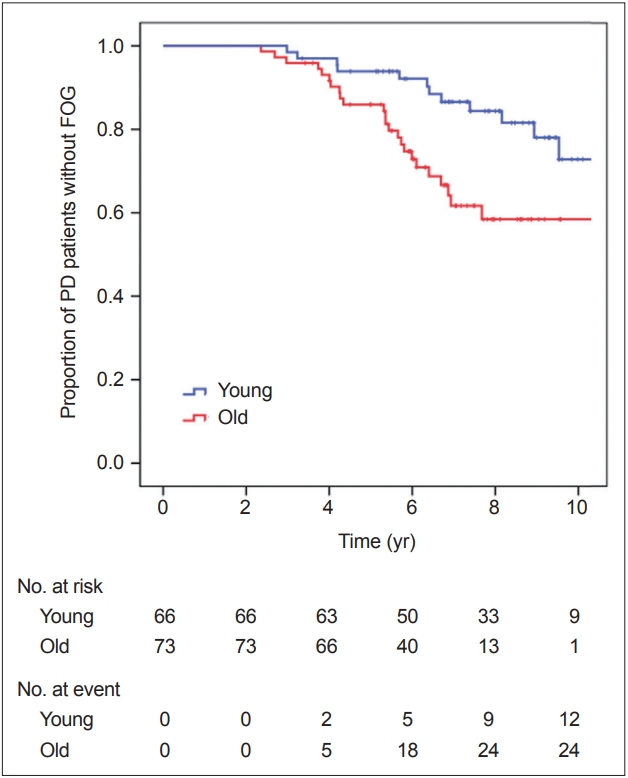
- 12,933 View
- 179 Download
- 34 Web of Science
- 35 Crossref
-
Abstract
PDFSupplementary Material
- Objective
Ample evidence has suggested that age at onset of Parkinson’s disease (PD) is associated with heterogeneous clinical features in individuals. We hypothesized that this may be attributed to different patterns of nigrostriatal dopamine loss.
Methods
A total of 205 consecutive patients with de novo PD who underwent 18F-FP-CIT PET scans (mean follow-up duration, 6.31 years) were divided into three tertile groups according to their age at onset of parkinsonian motor symptoms. Striatal dopamine transporter (DAT) availability was compared between the old- (n = 73) and young-onset (n = 66) groups. In addition, the risk of developing freezing of gait (FOG) and longitudinal requirements for dopaminergic medications were examined.
Results
The old-onset PD group (mean age at onset, 72.66 years) exhibited more severe parkinsonian motor signs than the young-onset group (52.58 years), despite comparable DAT availability in the posterior putamen; moreover, the old-onset group exhibited more severely decreased DAT availability in the caudate than the young-onset group. A Cox regression model revealed that the old-onset PD group had a higher risk for developing FOG than the young-onset group [hazard ratio 2.523, 95% confidence interval (1.239–5.140)]. The old-onset group required higher doses of dopaminergic medications for symptom control than the young-onset group over time.
Conclusion
The present study demonstrated that the old-onset PD group exhibited more severe dopamine loss in the caudate and were more likely to develop gait freezing, suggesting that age at onset may be one of the major determinants of the pattern of striatal dopamine depletion and progression of gait disturbance in PD. -
Citations
Citations to this article as recorded by- Development of AI-based dopamine transporter (DAT) image generation technique using early phase [18F]-FP-CIT PET imaging
Changhwan Sung, Jungsu S. Oh, Sun Young Chae, Dong Yun Lee, Minyoung Oh, Sang Ju Lee, Seung Jun Oh, Sungyang Jo, Sun Ju Chung, Jae Seung Kim, Kewei Chen
PLOS One.2026; 21(5): e0349375. CrossRef - Spatiotemporal Progression Patterns of Striatal Dopamine Depletion and Cerebral Hypoperfusion in Parkinson's Disease
Yeeun Sun, Youngseok Choi, Chan Wook Park, Han Kyu Na, Hye Sun Lee, Yun Joong Kim, Young H. Sohn, Phil Hyu Lee, Jeyeon Lee, Seok Jong Chung
Movement Disorders.2026; 41(9): 2408. CrossRef - Iron dyshomeostasis and enhanced myelination in the prefrontal cortex and ventral basal ganglia of a DJ-1 knockout model of early-onset Parkinson's disease
Sijie Liu, Wei Chen, Xi Chen, Yue Cai, Linlin Cheng, Haodong Guo, Fuchun Lin, Yan Kang, Fuyi Wang, Yao Zhao, Hao Lei
Neurobiology of Disease.2026; 227: 107519. CrossRef - Dissecting divergent outcomes in stem cell-derived dopamine cell therapy trials for Parkinson’s disease
Chan Wook Park, Sanghyun Park, Seok Jong Chung, Phil Hyu Lee, Dong-Wook Kim
Cell Stem Cell.2026; 33(8): 1257. CrossRef - Dopamine‐Deficiency‐Related Reorganization of the Somatomotor Network in Prodromal and Early Parkinson's Disease
Adrian L. Asendorf, Verena Dzialas, Thilo van Eimeren, Merle C. Hoenig
Movement Disorders.2026;[Epub] CrossRef - Identifying brain degeneration patterns in early-stage Parkinson’s disease: a multimodal MRI study
Zihao Zhu, Jiaqi Wen, Xiaojie Duanmu, Weijin Yuan, Qianshi Zheng, Tao Guo, Chenqing Wu, Haoting Wu, Cheng Zhou, Qingze Zeng, Jianmei Qin, Jingjing Wu, Jingwen Chen, Yuelin Fang, Bingting Zhu, Yaping Yan, Jun Tian, Baorong Zhang, Minming Zhang, Xiaojun Gua
npj Parkinson's Disease.2025;[Epub] CrossRef - Analysis of Clinical Characteristics and Rehabilitation Outcomes in Elderly Patients with Parkinson’s Disease: A Retrospective Study
Toshiya Shimamoto, Yohei Misumi, Katsuhisa Uchino, Akira Mori, Takuya Motoshima, Makoto Uchino, Mitsuharu Ueda
Geriatrics.2025; 10(6): 163. CrossRef - The Molecular Pathway of p75 Neurotrophin Receptor (p75NTR) in Parkinson’s Disease: The Way of New Inroads
Naif H. Ali, Hayder M. Al-kuraishy, Ali I. Al-Gareeb, Saud A. Alnaaim, Hebatallah M. Saad, Gaber El-Saber Batiha
Molecular Neurobiology.2024; 61(5): 2469. CrossRef - Patterns of regional cerebral hypoperfusion in early Parkinson's disease: Clinical implications
Seok Jong Chung, Su Hong Kim, Chan Wook Park, Hye Sun Lee, Mijin Yun, Yun Joong Kim, Young H. Sohn, Yong Jeong, Phil Hyu Lee
Parkinsonism & Related Disorders.2024; 121: 106024. CrossRef - Therapeutic Potential Effect of Glycogen Synthase Kinase 3 Beta (GSK-3β) Inhibitors in Parkinson Disease: Exploring an Overlooked Avenue
Areej Turkistani, Hayder M. Al-kuraishy, Ali I. Al-Gareeb, Ali K. Albuhadily, Athanasios Alexiou, Marios Papadakis, Mohamed M. Elfiky, Hebatallah M. Saad, Gaber El-Saber Batiha
Molecular Neurobiology.2024; 61(9): 7092. CrossRef - Imaging Procedure and Clinical Studies of [18F]FP-CIT PET
Changhwan Sung, Seung Jun Oh, Jae Seung Kim
Nuclear Medicine and Molecular Imaging.2024; 58(4): 185. CrossRef - Association of Family History and Polygenic Risk Score With Longitudinal Prognosis in Parkinson Disease
Mincheol Park, Young-gun Lee
Neurology Genetics.2024;[Epub] CrossRef - Hippocampal Perfusion Affects Motor and Cognitive Functions in Parkinson Disease: An Early Phase 18F‐FP‐CIT Positron Emission Tomography Study
Min Young Chun, Seok Jong Chung, Su Hong Kim, Chan Wook Park, Seong Ho Jeong, Hye Sun Lee, Phil Hyu Lee, Young H. Sohn, Yong Jeong, Yun Joong Kim
Annals of Neurology.2024; 95(2): 388. CrossRef - The effects of cholesterol and statins on Parkinson’s neuropathology: a narrative review
Hayder M. Al-kuraishy, Esraa H. Fahad, Salah Al-Windy, Suzy A. El-Sherbeni, Walaa A. Negm, Gaber El-Saber Batiha
Inflammopharmacology.2024; 32(2): 917. CrossRef - BDNF/TrkB activators in Parkinson's disease: A new therapeutic strategy
Naif H. Ali, Hayder M. Al‐Kuraishy, Ali I. Al‐Gareeb, Athanasios Alexiou, Marios Papadakis, Ali Abdullah AlAseeri, Mubarak Alruwaili, Hebatallah M. Saad, Gaber El‐Saber Batiha
Journal of Cellular and Molecular Medicine.2024;[Epub] CrossRef - Mid- and late-life lifestyle activities as main drivers of general and domain-specific cognitive reserve in individuals with Parkinson’s disease: cross-sectional and longitudinal evidence from the LANDSCAPE study
Anja Ophey, Kathrin Wirtz, Steffen Wolfsgruber, Monika Balzer-Geldsetzer, Daniela Berg, Rüdiger Hilker-Roggendorf, Jan Kassubek, Inga Liepelt-Scarfone, Sara Becker, Britt Mollenhauer, Kathrin Reetz, Oliver Riedel, Jörg B. Schulz, Alexander Storch, Claudia
Journal of Neurology.2024; 271(8): 5411. CrossRef - The Concept of Motor Reserve in Parkinson's Disease: New Wine in Old Bottles?
Merle C. Hoenig, Verena Dzialas, Alexander Drzezga, Thilo van Eimeren
Movement Disorders.2023; 38(1): 16. CrossRef - Memory Phenotypes In Early, De Novo Parkinson's Disease Patients with Mild Cognitive Impairment
Mattia Siciliano, Rosa De Micco, Andrea Gerardo Russo, Fabrizio Esposito, Valeria Sant'Elia, Lucia Ricciardi, Francesca Morgante, Antonio Russo, Jennifer G. Goldman, Carlo Chiorri, Gioacchino Tedeschi, Luigi Trojano, Alessandro Tessitore
Movement Disorders.2023; 38(8): 1461. CrossRef - A meta-analysis identifies factors predicting the future development of freezing of gait in Parkinson’s disease
Talia Herman, Yael Barer, Michal Bitan, Shani Sobol, Nir Giladi, Jeffrey M. Hausdorff
npj Parkinson's Disease.2023;[Epub] CrossRef - Premorbid Educational Attainment and Long-Term Motor Prognosis in Parkinson’s Disease
Seong Ho Jeong, Seok Jong Chung, Han Soo Yoo, Jin Ho Jung, Kyoungwon Baik, Yang Hyun Lee, Phil Hyu Lee, Young H. Sohn
Journal of Parkinson's Disease.2022; 12(1): 129. CrossRef - Treatment Enhances Betweenness Centrality of Fronto-Parietal Network in Parkinson’s Patients
Qing Liu, ZhongYan Shi, Kexin Wang, Tiantian Liu, Shintaro Funahashi, Jinglong Wu, Jian Zhang
Frontiers in Computational Neuroscience.2022;[Epub] CrossRef - Identifying the white matter structural network of motor reserve in early Parkinson's disease
Yae Ji Kim, Chan Wook Park, Hye Won Shin, Hye Sun Lee, Yun Joong Kim, Mijin Yun, Phil Hyu Lee, Young H. Sohn, Yong Jeong, Seok Jong Chung
Parkinsonism & Related Disorders.2022; 102: 108. CrossRef - Potential Link Between Cognition and Motor Reserve in Patients With Parkinson’s Disease
Seok Jong Chung, Yae Ji Kim, Yun Joong Kim, Hye Sun Lee, Mijin Yun, Phil Hyu Lee, Yong Jeong, Young H. Sohn
Journal of Movement Disorders.2022; 15(3): 249. CrossRef - Association Between White Matter Networks and the Pattern of Striatal Dopamine Depletion in Patients With Parkinson Disease
Seok Jong Chung, Yae Ji Kim, Yun Joong Kim, Hye Sun Lee, Seong Ho Jeong, Ji-Man Hong, Young H. Sohn, Mijin Yun, Yong Jeong, Phil Hyu Lee
Neurology.2022;[Epub] CrossRef - Gut microbiota-derived metabolite trimethylamine N-oxide as a biomarker in early Parkinson's disease
Seok Jong Chung, John Hoon Rim, Dajeong Ji, Sangwon Lee, Han Soo Yoo, Jin Ho Jung, KyoungWon Baik, Yonghoon Choi, Byoung Seok Ye, Young H. Sohn, Mijin Yun, Sang-Guk Lee, Phil Hyu Lee
Nutrition.2021; 83: 111090. CrossRef - White Matter Hyperintensities, Dopamine Loss, and Motor Deficits in De Novo Parkinson's Disease
Seong Ho Jeong, Hye Sun Lee, Jin Ho Jung, Kyoungwon Baik, Yang Hyun Lee, Han Soo Yoo, Young H. Sohn, Seok Jong Chung, Phil Hyu Lee
Movement Disorders.2021; 36(6): 1411. CrossRef - Temporalis Muscle Thickness as an Indicator of Sarcopenia Is Associated With Long-term Motor Outcomes in Parkinson’s Disease
Seok Jong Chung, Yun Joong Kim, Han Soo Yoo, Jin Ho Jung, KyoungWon Baik, Hye Sun Lee, Yang Hyun Lee, Ji-Man Hong, Young H Sohn, Phil Hyu Lee, Jay Magaziner
The Journals of Gerontology: Series A.2021; 76(12): 2242. CrossRef - Perivascular Spaces in the Basal Ganglia and Long-term Motor Prognosis in Newly Diagnosed Parkinson Disease
Seok Jong Chung, Han Soo Yoo, Na-Young Shin, Yae Won Park, Hye Sun Lee, Ji-Man Hong, Yun Joong Kim, Seung-Koo Lee, Phil Hyu Lee, Young H. Sohn
Neurology.2021;[Epub] CrossRef - Diagnosis and treatment of old-onset Parkinson's disease
久大 立花
Nippon Ronen Igakkai Zasshi. Japanese Journal of Geriatrics.2021; 58(3): 341. CrossRef - Genetic factors affecting dopaminergic deterioration during the premotor stage of Parkinson disease
Myung Jun Lee, Kyoungjune Pak, Han-Kyeol Kim, Kelly N. Nudelman, Jong Hun Kim, Yun Hak Kim, Junho Kang, Min Seok Baek, Chul Hyoung Lyoo
npj Parkinson's Disease.2021;[Epub] CrossRef - Dopamine Transporter, Age, and Motor Complications in Parkinson's Disease: A Clinical and Single‐Photon Emission Computed Tomography Study
Giovanni Palermo, Sara Giannoni, Daniela Frosini, Riccardo Morganti, Duccio Volterrani, Ubaldo Bonuccelli, Nicola Pavese, Roberto Ceravolo
Movement Disorders.2020; 35(6): 1028. CrossRef - Positron emission tomography/computed tomography dual imaging using 18-fluorine flurodeoxyglucose and 11C-labeled 2-β-carbomethoxy-3-β-(4-fluorophenyl) tropane for the severity assessment of Parkinson disease
Xiaohong Li, Qizhou Zhang, Yongde Qin, Yubin Li, Nazimuguli Mutaerbieke, Xiaojia Zhao, Amina Yibulayin
Medicine.2020; 99(14): e19662. CrossRef - DaTSCAN (123I-FP-CIT SPECT) imaging in early versus mid and late onset Parkinson's disease: Longitudinal data from the PPMI study
Christos Koros, Athina-Maria Simitsi, Andreas Prentakis, Nikolaos Papagiannakis, Anastasia Bougea, Ioanna Pachi, Dimitra Papadimitriou, Ion Beratis, Sokratis G. Papageorgiou, Maria Stamelou, Xenia Geronicola Trapali, Leonidas Stefanis
Parkinsonism & Related Disorders.2020; 77: 36. CrossRef - Prediction of age at onset in Parkinson’s disease using objective specific neuroimaging genetics based on a sparse canonical correlation analysis
Ji Hye Won, Mansu Kim, Jinyoung Youn, Hyunjin Park
Scientific Reports.2020;[Epub] CrossRef - Emerging Concepts of Motor Reserve in Parkinson’s Disease
Seok Jong Chung, Jae Jung Lee, Phil Hyu Lee, Young H. Sohn
Journal of Movement Disorders.2020; 13(3): 171. CrossRef
- Development of AI-based dopamine transporter (DAT) image generation technique using early phase [18F]-FP-CIT PET imaging
Review Articles
- Clinical and Imaging Features of Multiple System Atrophy: Challenges for an Early and Clinically Definitive Diagnosis
- Hirohisa Watanabe, Yuichi Riku, Kazuhiro Hara, Kazuya Kawabata, Tomohiko Nakamura, Mizuki Ito, Masaaki Hirayama, Mari Yoshida, Masahisa Katsuno, Gen Sobue
- J Mov Disord. 2018;11(3):107-120. Published online August 9, 2018
- DOI: https://doi.org/10.14802/jmd.18020
- 39,318 View
- 1,413 Download
- 34 Web of Science
- 35 Crossref
-
Abstract
PDF
- Multiple system atrophy (MSA) is an adult-onset, progressive neurodegenerative disorder. Patients with MSA show various phenotypes during the course of their illness, including parkinsonism, cerebellar ataxia, autonomic failure, and pyramidal signs. Patients with MSA sometimes present with isolated autonomic failure or motor symptoms/ signs. The median duration from onset to the concomitant appearance of motor and autonomic symptoms is approximately 2 years but can range up to 14 years. As the presence of both motor and autonomic symptoms is essential for the current diagnostic criteria, early diagnosis is difficult when patients present with isolated autonomic failure or motor symptoms/signs. In contrast, patients with MSA may show severe autonomic failure and die before the presentation of motor symptoms/signs, which are currently required for the diagnosis of MSA. Recent studies have also revealed that patients with MSA may show nonsupporting features of MSA such as dementia, hallucinations, and vertical gaze palsy. To establish early diagnostic criteria and clinically definitive categorization for the successful development of disease-modifying therapy or symptomatic interventions for MSA, research should focus on the isolated phase and atypical symptoms to develop specific clinical, imaging, and fluid biomarkers that satisfy the requirements for objectivity, for semi- or quantitative measurements, and for uncomplicated, worldwide availability. Several novel techniques, such as automated compartmentalization of the brain into multiple parcels for the quantification of gray and white matter volumes on an individual basis and the visualization of α-synuclein and other candidate serum and cerebrospinal fluid biomarkers, may be promising for the early and clinically definitive diagnosis of MSA.
-
Citations
Citations to this article as recorded by-
Serotonin Transporter Distribution in the Brainstem of Multiple-System AtrophyParkinsonian Type: Insights from Pathology and
123
I-FP-CIT SPECT Findings
Cong Shang, Ryunosuke Nagao, Yuichi Riku, Takashi Ichihara, Yoshitaka Inui, Masanobu Ishiguro, Yuumi Tanaka, Yasuaki Mizutani, Masanori Inoue, Yasushi Iwasaki, Mari Yoshida, Mizuki Ito, Hirohisa Watanabe, Hiroshi Toyama
Journal of Nuclear Medicine.2026; 67(4): 629. CrossRef - Imaging biomarkers for early prediction of the transition from idiopathic late-onset cerebellar ataxia to multiple system atrophy
Jun Seok Lee, Junmo Kwon, Jongmok Ha, Ji Hye Won, Jinyoung Youn, Hirohisa Watanabe, Hee Tae Kim, Hyunjin Park, Jin Whan Cho
Parkinsonism & Related Disorders.2026; 144: 108176. CrossRef - Correlation of MRI Markers with Clinical Features in Multiple System Atrophy
Nan Jin, Jiaxiang Li, Xinhui Chen, Yixin Kang, Haotian Wang, Xinchen Wang, Xiaosheng Zheng, Zhiru Lin, Bo Wang, Wei Luo
American Journal of Neuroradiology.2026; 47(5): 1296. CrossRef - Validation of Orthostatic Hypotension in MDS Diagnostic Criteria for Multiple System Atrophy
Satoko Yoshizaki, Yoshitaka Yamanaka, Tatsuya Yamamoto, Nobuyuki Araki, Atsuhiko Sugiyama, Shigeki Hirano, Satoshi Kuwabara
European Neurology.2026; : 1. CrossRef - Small-fiber degeneration, sensory dysfunction, and nociception comorbidity in central neurodegenerative disease
Will Hauser, Jessica E. Keller, Mamatha Pasnoor, Douglas E. Wright
Frontiers in Aging Neuroscience.2026;[Epub] CrossRef - Automated Magnetic Resonance Volumetry to Measure Multiple System Atrophy Disease Progression in Clinical Trials
Andrea Quattrone, Ida Wilkens, Zeyu Zhu, Irfan A. Qureshi, Nicolai Franzmeier, Günter U. Höglinger
Movement Disorders.2026;[Epub] CrossRef - Deep profiling of nocturnal hypokinesia in multiple system atrophy and its clinical implications
Jongmok Ha, Suin Lee, Yoonha Hwang, Jinyoung Youn, Jin Whan Cho, Eun Yeon Joo
Sleep Medicine.2025; 131: 106516. CrossRef - Predictive clinical factors for the progression from idiopathic late-onset cerebellar ataxia to multiple system atrophy cerebellar type
Seungmin Lee, Seoyeon Kim, Bora Jin, Su Hyeon Ha, Chanhee Jeong, Jung Hwan Shin, Han-Joon Kim
Journal of Neurology.2025;[Epub] CrossRef - Cranial Nerve Thinning Distinguishes RFC1‐Related Disorder from Other Late‐Onset Ataxias
Camila C. Lobo, Guilherme S.O. Wertheimer, Gabriel S. Schmitt, Paula C.A.A.P. Matos, Thiago J.R. Rezende, Joyce M. Silva, Fabrício C. Borba, Fabrício D. Lima, Alberto R.M. Martinez, Orlando G.P. Barsottini, José Luiz Pedroso, Wilson Marques, Marcondes C.
Movement Disorders Clinical Practice.2024; 11(1): 45. CrossRef - The potential of phosphorylated α‐synuclein as a biomarker for the diagnosis and monitoring of multiple system atrophy
Toufik Abdul‐Rahman, Ranferi Eduardo Herrera‐Calderón, Arjun Ahluwalia, Andrew Awuah Wireko, Tomas Ferreira, Joecelyn Kirani Tan, Maximillian Wolfson, Shankhaneel Ghosh, Viktoriia Horbas, Vandana Garg, Asma Perveen, Marios Papadakis, Ghulam Md Ashraf, Ath
CNS Neuroscience & Therapeutics.2024;[Epub] CrossRef - Data-Driven Subtypes of Multiple System Atrophy and Their Implications for Prognosis
Cheng-Cheng Fan, Chao Han, Xue-Mei Wang, Jagadish K. Chhetri, Wei Mao, Er-He Xu, Shu-Ying Liu, Piu Chan
Journal of Parkinson’s Disease.2024; 14(6): 1211. CrossRef - The effect of continuous positive airway pressure (CPAP) on the quality of life in patients with multiple system atrophy
Hee Jin Chang, Han-Joon Kim, Kyung Ah Woo, Jung Hwan Shin, Ki-Young Jung
Sleep and Breathing.2023; 27(4): 1481. CrossRef - Psychosis treatment in a patient with Parkinsonian type multiple system atrophy using modified electroconvulsive therapy: a case report
Takumi Yawata, Shunsuke Takagi, Takehiro Tamura, Genichi Sugihara, Hidehiko Takahashi
Psychogeriatrics.2023; 23(2): 364. CrossRef - Comparison of the second consensus statement with the movement disorder society criteria for multiple system atrophy: A single-center analysis
Yunchuang Sun, Wei Sun, Luhua Wei, Fan Li, Yanyan Jiang, Fei Zhai, Mingyue Luan, Jing Chen, Zhaoxia Wang
Parkinsonism & Related Disorders.2023; 106: 105242. CrossRef - Multiple System Atrophy: Advances in Diagnosis and Therapy
Hirohisa Watanabe, Sayuri Shima, Yasuaki Mizutani, Akihiro Ueda, Mizuki Ito
Journal of Movement Disorders.2023; 16(1): 13. CrossRef - Multiple system atrophy-cerebellar: A case report and literature review
Thi Thuong Doan, Thuy Dung Pham, Duy Duan Nguyen, Dac Hong An Ngo, Trong Binh Le, Thanh Thao Nguyen
Radiology Case Reports.2023; 18(3): 1121. CrossRef - Hjerne med kors
Linh Tran, Tuba Ahmad, Anniken Haslund, Phuoc Ngoc Thi Nguyen
Tidsskrift for Den norske legeforening.2023;[Epub] CrossRef - α-Synuclein Strains and Their Relevance to Parkinson’s Disease, Multiple System Atrophy, and Dementia with Lewy Bodies
Noah J. Graves, Yann Gambin, Emma Sierecki
International Journal of Molecular Sciences.2023; 24(15): 12134. CrossRef - A Rare Case of Cerebellar Ataxia
Aanchal Arora, Nidhi Hooda, Jasneet Singh Channa, Motilal Negi
Neurology India.2023; 71(5): 1031. CrossRef - Neurodegenerative disorders affecting the autonomic nervous system: Pure autonomic failure and multiple system atrophy
Yoshitaka Yamanaka, Nobuyuki Araki, Satoshi Kuwabara
Neurology and Clinical Neuroscience.2022; 10(3): 115. CrossRef - Glia Imaging Differentiates Multiple System Atrophy from Parkinson's Disease: A Positron Emission Tomography Study with [11C]PBR28 and Machine Learning Analysis
Aurelija Jucaite, Zsolt Cselényi, William C. Kreisl, Eugenii A. Rabiner, Andrea Varrone, Richard E. Carson, Juha O. Rinne, Alicia Savage, Magnus Schou, Peter Johnström, Per Svenningsson, Olivier Rascol, Wassilios G. Meissner, Paolo Barone, Klaus Seppi, Ho
Movement Disorders.2022; 37(1): 119. CrossRef - Data-driven subtype classification of patients with early-stage multiple system atrophy
Hui-Jun Yang, Han-Joon Kim, Yu Jin Jung, Dallah Yoo, Ji-Hyun Choi, Jin Hee Im, Beomseok Jeon
Parkinsonism & Related Disorders.2022; 95: 92. CrossRef - Clinicopathological correlates of pyramidal signs in multiple system atrophy
Chi‐Ying R. Lin, Anisha Viswanathan, Tiffany X. Chen, Hiroshi Mitsumoto, Jean P. Vonsattel, Phyllis L. Faust, Sheng‐Han Kuo
Annals of Clinical and Translational Neurology.2022; 9(7): 988. CrossRef - The “Black Straight-Line Sign” in the Putamen in Diffusion-Weighted Imaging: A Potential Diagnostic MRI Marker for Multiple System Atrophy
Yiming Zheng, Xiwen Wang, Huajian Zhao, Yanyan Jiang, Ying Zhu, Jing Chen, Wei Sun, Zhaoxia Wang, Yunchuang Sun
Frontiers in Neurology.2022;[Epub] CrossRef - Clinical Aspects of the Differential Diagnosis of Parkinson’s Disease and Parkinsonism
Hae-Won Shin, Sang-Wook Hong, Young Chul Youn
Journal of Clinical Neurology.2022; 18(3): 259. CrossRef - Clinical Features and Neuroimaging Findings of Neuropil Antibody–Positive Idiopathic Sporadic Ataxia of Unknown Etiology
Akira Takekoshi, Akio Kimura, Nobuaki Yoshikura, Isamu Yamakawa, Makoto Urushitani, Katsuya Nakamura, Kunihiro Yoshida, Takayoshi Shimohata
The Cerebellum.2022; 22(5): 915. CrossRef - Determinants of cognitive impairment in multiple system atrophy: Clinical and genetic study
Amina Nasri, Alya Gharbi, Ikram Sghaier, Saloua Mrabet, Amira Souissi, Amina Gargouri, Mouna Ben Djebara, Imen Kacem, Riadh Gouider, Tuhin Virmani
PLOS ONE.2022; 17(12): e0277798. CrossRef - Management of balance problems in an elderly with multiple system atrophy with predominant cerebellar ataxia (MSA-C) and sick sinus syndrome
Amber Eker, Pembe Hare Yıgıtoglu, Hamza Duygu, Ersin Tan
Journal of Gerontology and Geriatrics.2021; 69(3): 208. CrossRef - Immunotherapies in Huntington's disease and α-Synucleinopathies
Oluwaseun Fatoba, Yosuke Ohtake, Takahide Itokazu, Toshihide Yamashita
Frontiers in Immunology.2020;[Epub] CrossRef - The Dysfunctional Autonomic Function and “Dysfunctional” Fatigue in Drug Naïve Parkinson’s Disease
Jong Hyeon Ahn, Minkyeong Kim, Jun Kyu Mun, Yoonsu Cho, Ji Sun Kim, Jinyoung Youn, Joong-Seok Kim, Jin Whan Cho
Journal of Parkinson's Disease.2020; 10(2): 605. CrossRef - Early autonomic and cognitive dysfunction in PD, DLB and MSA: blurring the boundaries between α-synucleinopathies
Giovanni Palermo, Eleonora Del Prete, Ubaldo Bonuccelli, Roberto Ceravolo
Journal of Neurology.2020; 267(12): 3444. CrossRef - Changes of Amide Proton Transfer Imaging in Multiple System Atrophy Parkinsonism Type
Shuhua Li, Piu Chan, Chunmei Li, Haibo Chen, Min Chen, Wen Su, Kai Li, Na Lu, Lu Yu, Defa Chu, Pu-Yeh Wu
Frontiers in Aging Neuroscience.2020;[Epub] CrossRef - Frontline of Non-genetic Cerebellar Ataxia
Nobuaki Yoshikura, Akio Kimura, Takayoshi Shimohata
Nihon Naika Gakkai Zasshi.2020; 109(6): 1138. CrossRef - Purva Rupeeyam of bhela indriya sthana-an explorative study
Kshama Gupta, Prasad Mamidi
International Journal of Complementary & Alternative Medicine.2020; 13(6): 228. CrossRef - A case of multiple system atrophy
Jing Guo, Fuying Liu, Tingting Liu, Xin Zhang, Yong Luo
Journal of International Medical Research.2019; 47(11): 5839. CrossRef
-
Serotonin Transporter Distribution in the Brainstem of Multiple-System AtrophyParkinsonian Type: Insights from Pathology and
123
I-FP-CIT SPECT Findings
- Movement Disorders Following Cerebrovascular Lesions in Cerebellar Circuits
- Seong-Min Choi
- J Mov Disord. 2016;9(2):80-88. Published online May 25, 2016
- DOI: https://doi.org/10.14802/jmd.16004
- 32,997 View
- 613 Download
- 42 Web of Science
- 35 Crossref
-
Abstract
PDF
- Cerebellar circuitry is important to controlling and modifying motor activity. It conducts the coordination and correction of errors in muscle contractions during active movements. Therefore, cerebrovascular lesions of the cerebellum or its pathways can cause diverse movement disorders, such as action tremor, Holmes’ tremor, palatal tremor, asterixis, and dystonia. The pathophysiology of abnormal movements after stroke remains poorly understood. However, due to the current advances in functional neuroimaging, it has recently been described as changes in functional brain networks. This review describes the clinical features and pathophysiological mechanisms in different types of movement disorders following cerebrovascular lesions in the cerebellar circuits.
-
Citations
Citations to this article as recorded by- Paroxysmal dyskinesia-like movement disorder in a Ragdoll cat after a rostral cerebellar infarct
Clare Rusbridge, Freya Townsend, Anne-Lorraine Peschard, Brian Love, Matthew James, Fabio Stabile
Journal of Feline Medicine and Surgery Open Reports.2026;[Epub] CrossRef - Frequency, phenotypes, and neuroimaging of early post stroke movement disorders: a prospective study
Eslam Samra, Tamer Roushdy, Amr S. Zaki, Alia H. Mansour, Ahmed Elbassiouny, Ali Shalash
The Egyptian Journal of Neurology, Psychiatry and Neurosurgery.2025;[Epub] CrossRef - The clinical and neuroradiological features of hypertrophic olivary degeneration following brainstem stroke
Ziqu Zhang, Wen Jian, Nan Li, Xin Gao, Lin Chen, Xiaowei Zhang, Dan Cai, Jianle He, Yaqiong Nie, Yaoyao Shen
Neurological Sciences.2025; 46(6): 2697. CrossRef - Hypertrophic olivary degeneration following cerebral infarction: a case report
Zhuo Qun Li, An Xie
BMC Neurology.2025;[Epub] CrossRef - Holmes Tremor as a Delayed Sequelae of Cerebral Venous Sinus Thrombosis: A Case Report
Kamalesh Tayade, Amarnath Chavan, Haresh Bharote, Dnyaneshwar Asole, Anil Venkitachalam, Anarya Karle, Jivan Morey
Annals of Movement Disorders.2025; 8(2): 141. CrossRef - Clinical characteristics of hypertrophic olivary degeneration following brainstem or cerebellar hemorrhage
Lin Lin, Xiaofeng Ye, Jianming Zheng
Scientific Reports.2025;[Epub] CrossRef - Neuroengineering approaches assessing structural and functional changes of motor descending pathways in stroke
Jordan N Williamson, Rita Huan-Ting Peng, Joohwan Sung, Mahmood Rajabtabar Darvish, Xiaoxi Chen, Mehreen Ali, Sheng Li, Yuan Yang
Progress in Biomedical Engineering.2025; 7(4): 042006. CrossRef - Hypertrophic olivary degeneration secondary to brain abscess: a case report and literature review
Shihan Tian, Biqiu Tang, Kai Zhang, Xiaohe Tian, Na Hu
Frontiers in Human Neuroscience.2025;[Epub] CrossRef - Clinical study of six patients with pure dysarthria and dysarthria—(Central) facial nerve palsy/isolated central facial nerve palsy caused by extracerebellar infarction
Katsuhiko Ogawa, Takayoshi Akimoto, Makoto Hara, Midori Fujishiro, Hideto Nakajima
Neurology and Clinical Neuroscience.2024; 12(2): 100. CrossRef - Flapping Tremor: Unraveling Asterixis—A Narrative Review
Jamir Pitton Rissardo, Sara Muhammad, Venkatesh Yatakarla, Nilofar Murtaza Vora, Paras Paras, Ana Letícia Fornari Caprara
Medicina.2024; 60(3): 362. CrossRef - Influencing factors of corticomuscular coherence in stroke patients
Zhixian Gao, Shiyang Lv, Xiangying Ran, Yuxi Wang, Mengsheng Xia, Junming Wang, Mengyue Qiu, Yinping Wei, Zhenpeng Shao, Zongya Zhao, Yehong Zhang, Xuezhi Zhou, Yi Yu
Frontiers in Human Neuroscience.2024;[Epub] CrossRef - Hypertrophic olivary degeneration following head injury: a case report
Neha Singh, Kishan Kumar Thakur, Deepak Kumar Singh, James Marak
Egyptian Journal of Radiology and Nuclear Medicine.2024;[Epub] CrossRef - Meningioma‑associated parkinsonism related to basal ganglia and cerebellar motor circuits: A case report and literature review
Shintaro Takeda, Shohei Nagasaka, Kohei Suzuki, Koichiro Futatsuya, Junkoh Yamamoto
Experimental and Therapeutic Medicine.2024;[Epub] CrossRef - Unveiling Benedikt’s syndrome: A rare midbrain stroke presenting with oculomotor nerve palsy
Arumugam Balraj, Sunil Kumar
Indian Journal of Ophthalmology - Case Reports.2024; 4(4): 908. CrossRef - Genome-wide association study of cerebellar white matter microstructure and genetic overlap with common brain disorders
Bang-Sheng Wu, Yi-Jun Ge, Wei Zhang, Shi-Dong Chen, Shi-Tong Xiang, Ya-Ru Zhang, Ya-Nan Ou, Yu-Chao Jiang, Lan Tan, Wei Cheng, John Suckling, Jian-Feng Feng, Jin-Tai Yu, Ying Mao
NeuroImage.2023; 269: 119928. CrossRef - Deep Brain Stimulation for Holmes Tremors and Literature Review
Kunkala Lavanya, P. Vijaya Shankar, K. Visvanathan, S. Sundar, P. Philohazeena
Annals of Indian Academy of Neurology.2023; 26(3): 296. CrossRef - The Guillain-Mollaret triangle: a key player in motor coordination and control with implications for neurological disorders
Eren Ogut, Kutay Armagan, Doruktan Tufekci
Neurosurgical Review.2023;[Epub] CrossRef - Morphological and Functional Principles Governing the Plasticity Reserve in the Cerebellum: The Cortico-Deep Cerebellar Nuclei Loop Model
Hiroshi Mitoma, Shinji Kakei, Hirokazu Tanaka, Mario Manto
Biology.2023; 12(11): 1435. CrossRef - Holmes tremor: an updated review
Efstratios-Stylianos Pyrgelis, Eleni Agapiou, Efthalia Angelopoulou
Neurological Sciences.2022; 43(12): 6731. CrossRef - Post-stroke Movement Disorders
Priyanka Tater, Sanjay Pandey
Neurology India.2021; 69(2): 272. CrossRef - Delayed cervicobrachial segmental dystonia secondary to ipsilateral cerebellar infarction
Vikram V. Holla, Sudhakar Pushpa Chaithra, Shweta Prasad, Pramod Kumar Pal
Annals of Movement Disorders.2021; 4(2): 89. CrossRef - Pathophysiology of Cerebellar Tremor: The Forward Model-Related Tremor and the Inferior Olive Oscillation-Related Tremor
Shinji Kakei, Mario Manto, Hirokazu Tanaka, Hiroshi Mitoma
Frontiers in Neurology.2021;[Epub] CrossRef - Case Report: Dual Target Deep Brain Stimulation With Externalized Programming for Post-traumatic Complex Movement Disorder
Ron Gadot, Ben Shofty, Ricardo A. Najera, Adrish Anand, Garrett Banks, Abdul Basit Khan, Melissa A. LoPresti, Nora Vanegas Arroyave, Sameer A. Sheth
Frontiers in Neuroscience.2021;[Epub] CrossRef - Gadolinium-based contrast agents – what is the evidence for ‘gadolinium deposition disease’ and the use of chelation therapy?
Kerry A. Layne, David M. Wood, Paul I. Dargan
Clinical Toxicology.2020; 58(3): 151. CrossRef - POLR3A variants with striatal involvement and extrapyramidal movement disorder
Inga Harting, Murtadha Al-Saady, Ingeborg Krägeloh-Mann, Annette Bley, Maja Hempel, Tatjana Bierhals, Stephanie Karch, Ute Moog, Geneviève Bernard, Richard Huntsman, Rosalina M. L. van Spaendonk, Maaike Vreeburg, Agustí Rodríguez-Palmero, Aurora Pujol, Ma
neurogenetics.2020; 21(2): 121. CrossRef - Ataxic hemiparesis after corona radiata infarct: Diffusion tensor imaging correlation of corticoponto-cerebellar tract injury
Jun Young Kim, Jeong Pyo Seo, Min Cheol Chang
Translational Neuroscience.2020; 11(1): 1. CrossRef - The Rehapiano—Detecting, Measuring, and Analyzing Action Tremor Using Strain Gauges
Norbert Ferenčík, Miroslav Jaščur, Marek Bundzel, Filippo Cavallo
Sensors.2020; 20(3): 663. CrossRef - Oxygen Cost During Walking in Individuals With Stroke: Hemiparesis Versus Cerebellar Ataxia
Maxence Compagnat, Jean-Christophe Daviet, Charles Batcho, Nicolas Vuillerme, Jean-Yves Salle, Romain David, Stephane Mandigout
Neurorehabilitation and Neural Repair.2020; 34(4): 289. CrossRef - An Observational Study of Social Interaction Skills and Behaviors in Cornelia de Lange, Fragile X and Rubinstein-Taybi Syndromes
Katherine Ellis, Chris Oliver, Chrysi Stefanidou, Ian Apperly, Jo Moss
Journal of Autism and Developmental Disorders.2020; 50(11): 4001. CrossRef - Injury of the dentato-rubro-thalamic tract in a patient with intentional tremor after mild traumatic brain injury: a case report
Min Cheol Chang, Jeong Pyo Seo
Brain Injury.2020; 34(9): 1283. CrossRef - KCND3-Related Neurological Disorders: From Old to Emerging Clinical Phenotypes
Luca Pollini, Serena Galosi, Manuela Tolve, Caterina Caputi, Carla Carducci, Antonio Angeloni, Vincenzo Leuzzi
International Journal of Molecular Sciences.2020; 21(16): 5802. CrossRef - Posterior Subthalamic Area Deep Brain Stimulation for Treatment of Refractory Holmes Tremor
Malgorzata Dec-Ćwiek, Marcin Tutaj, Wojciech Pietraszko, Witold Libionka, Mariusz Krupa, Marek Moskała, Monika Rudzińska-Bar, Agnieszka Słowik, Joanna Pera
Stereotactic and Functional Neurosurgery.2019; 97(3): 183. CrossRef - Teaching Video NeuroImages: A patient with Holmes tremor due to demyelinating lesion of the inferior cerebellar peduncle
Daniel G. Di Luca, Andres De Leon-Benedetti, Stacey Williamson, Le Treice Irving, Jason Margolesky
Neurology.2019;[Epub] CrossRef - Acute hemorrhagic cerebellar infarction presenting with isolated head titubation
Tatsuya Ueno, Haruo Nishijima, Akira Arai, Masahiko Tomiyama
Journal of the Neurological Sciences.2017; 372: 456. CrossRef - Rubral Tremor Associated with Klinefelter Syndrome: A Case Report and Literature Review
Reihaneh Dehghani, Elmira Agah, Zeinab Falsafi, Abbas Tafakhori
Archives of Neuroscience.2017;[Epub] CrossRef
- Paroxysmal dyskinesia-like movement disorder in a Ragdoll cat after a rostral cerebellar infarct
- Gastrointestinal Dysfunction in Parkinson’s Disease: Neuro-Gastroenterology Perspectives on a Multifaceted Problem
- Ai Huey Tan, Kee Huat Chuah, Yuan Ye Beh, Jie Ping Schee, Sanjiv Mahadeva, Shen-Yang Lim
- J Mov Disord. 2023;16(2):138-151. Published online May 24, 2023
- DOI: https://doi.org/10.14802/jmd.22220

- 41,944 View
- 701 Download
- 30 Web of Science
- 34 Crossref
-
Abstract
PDF
- Patients with Parkinson’s disease (PD) face a multitude of gastrointestinal (GI) symptoms, including nausea, bloating, reduced bowel movements, and difficulties with defecation. These symptoms are common and may accumulate during the course of PD but are often under-recognized and challenging to manage. Objective testing can be burdensome to patients and does not correlate well with symptoms. Effective treatment options are limited. Evidence is often based on studies in the general population, and specific evidence in PD is scarce. Upper GI dysfunction may also interfere with the pharmacological treatment of PD motor symptoms, which poses significant management challenges. Several new less invasive assessment tools and novel treatment options have emerged in recent years. The current review provides an overview and a practical approach to recognizing and diagnosing common upper and lower GI problems in PD, e.g., dyspepsia, gastroparesis, small bowel dysfunction, chronic constipation, and defecatory dysfunction. Management aspects are discussed based on the latest evidence from the PD and general populations, with insights for future research pertaining to GI dysfunction in PD.
-
Citations
Citations to this article as recorded by- Coriander (Coriandrum sativum L. leaves) improves brain and gut pathology in mouse models of brain-first and gut-first Parkinson's disease
Hanbyeol Lee, Jin Hee Kim, Yujin Choi, Minji Lee, Hi-Joon Park, Myung Sook Oh
The Journal of Nutritional Biochemistry.2026; 147: 110116. CrossRef - A neuroprotective effect of newly isolated probiotic bacterium Lactobacillus acidophilus SLAM_LAA02 in a rotenone-induced mouse model of Parkinson’s disease
Yeonsoo Kim, Eunsol Seo, Anna Kang, Min-Geun Kang, Ki Beom Jang, Sangnam Oh, Younghoon Kim
Biomedicine & Pharmacotherapy.2026; 194: 118896. CrossRef - Isotopically enriched 64ZN-aspartate attenuates systemic inflammation and gut dysbiosis in an LPS-induced rat model of Parkinson’s disease
Max Temnik, Mariia Rudyk, Alexandr Balakin, Sergey Gurin, Taisa Dovbynchuk, Roman Byshovets, Nataliia Dzubenko, Roman Dovhyi, Tetyana Serhiichuk, Ganna Tolstanova, Larysa Skivka
Scientific Reports.2026;[Epub] CrossRef - The taste of Parkinson's: How food choices reflect nutritional health
Onanong Phokaewvarangkul, Narumol Sukmueng, Panthitra Kuwattanasuchati, Kanyawat Sanyawut, Naruemon Rattanapitak, Roongroj Bhidayasiri
Journal of Parkinson’s Disease.2026; 16(4): 736. CrossRef - Electrochemical biosensing across microsampled blood and interstitial fluid for metabolic, hormonal, and therapeutic monitoring
Soon Joo Yoon, Jin Tae Park, Jae Mo Yun, Yoon Kyeung Lee
Soft Science.2026;[Epub] CrossRef - Gastroparesis in Parkinson's disease: Diagnostic and clinical implications for optimizing pharmacological treatment
Quentin Damiens, Victor Mille, Justin Faure, Eric Toussirot, Marie-Blanche Valnet-Rabier, Matthieu Béreau
Journal of Parkinson’s Disease.2026; 16(5): 842. CrossRef - Skin-Conformal Electronics for Wearable Electrogastrography Monitoring
Liuxi Xing, Yulu Cai, Yunnuo Zhang, Vittorio Mottini, Linux Heller, Jinxing Li
IEEE Journal on Flexible Electronics.2026; 5(6): 209. CrossRef - Ageing-driven gastrointestinal variability in Parkinson’s disease: implications for oral levodopa pharmacokinetics and formulation design
Muzaffaruddin Ahmed Madny, Khushwant S. Yadav
European Journal of Pharmaceutics and Biopharmaceutics.2026; 226: 115179. CrossRef - Dietitian-led intervention to manage constipation in Parkinson’s disease: Study protocol for a parallel-group randomized controlled trial (NUTRI-GUT-PD)
Juliana Heitich Brendler, Khadija Younes da Silva, Valesca Dall’Alba, Andreza Francisco Martins, Daniel Teixeira-dos-Santos, Artur Francisco Schumacher Schuh, Maira Rozenfeld Olchik, Zehra Batu
PLOS One.2026; 21(7): e0354608. CrossRef - Synergistic Neuroprotective Effects of Cortex of Albizia julibrissin Durazzini and Stems and Branches of Uncariae rhynchophylla (Miq.) Miq. in Models of 6-Hydroxydopamine-Induced Parkinson’s Disease
Eugene Huh, Hyeryeong Ju, Dongjin Noh, Jin Hee Kim, Myung Sook Oh
Complementary Medicine Research.2026; : 1. CrossRef - Wireless Electrochemical Sensor Capsules Endoscopy for Gastrointestinal Health Monitoring: A Comprehensive Review
Parisa Navid, Hamid Reza Akbari‐Hasanjani, Reza Akbari‐Hasanjani
Electroanalysis.2026;[Epub] CrossRef - Clinical presentation, diagnosis and management of chronic intestinal and colonic pseudo-obstruction in neurological diseases
Carolina Malagelada, Matteo Guarino, Elena Bonora, Lisa Lungaro, Giovanni Barbara, Vincenzo Stanghellini, Roberto De Giorgio
Autonomic Neuroscience.2026; 268: 103473. CrossRef - Lactiplantibacillus plantarum SG5 inhibits neuroinflammation in MPTP-induced PD mice through GLP-1/PGC-1α pathway
Yueyan Qi, Yuxuan Dong, Jinhu Chen, Siyou Xie, Xin Ma, Xueping Yu, Yang Yu, Yanqin Wang
Experimental Neurology.2025; 383: 115001. CrossRef - Gastrointestinal Dysfunction Bears on the Clinical‐Biological Profile of Parkinson's Disease
Jacopo Bissacco, Roberta Bovenzi, Matteo Conti, Clara Simonetta, Davide Mascioli, Rocco Cerroni, Giulia Maria Sancesario, Piergiorgio Grillo, Mariangela Pierantozzi, Alessandro Stefani, Nicola Biagio Mercuri, Marta Camacho, Tommaso Schirinzi
Movement Disorders Clinical Practice.2025; 12(4): 497. CrossRef - Leveraging animal models to understand non-motor symptoms of Parkinson's disease
Thomas Wichmann, Alexandra Nelson, Eileen Ruth S. Torres, Per Svenningsson, Roberta Marongiu
Neurobiology of Disease.2025; 208: 106848. CrossRef - The interrelationship between intestinal immune cells and enteric α-synuclein in the progression of Parkinson’s disease
Yuan-Kai Cheng, Hao-Sen Chiang
Neurological Sciences.2025; 46(7): 2965. CrossRef - Gastrointestinal Manifestations in Parkinson's Disease Using a Validated Arabic Version of Gastrointestinal Dysfunction Scale: A Multicenter Study
Ali Soliman Shalash, Marwa Yassien Badr, Yara Salah, Shimaa Elgamal, Shaimaa Ahmed Elaidy, Eman Abdel‐Mageed Elhamrawy, Hayam Abdel‐Tawab, Eman Hamid, Ehab Ahmed El‐Seidy, Noha Lotfy Dawood
Movement Disorders Clinical Practice.2025; 12(7): 947. CrossRef - Vital nutrition: enhancing health in advanced Parkinson’s disease with device-aided therapies
Onanong Phokaewvarangkul, Ioanna Markaki, Harmen R. Moes, Igor Petrovic, Anette Schrag, Roongroj Bhidayasiri
Journal of Neural Transmission.2025; 132(11): 1685. CrossRef - Association between cognitive and autonomic dysfunctions in patients with de novo Parkinson’s disease
Byung-Euk Joo, Jihwan You, Rae On Kim, Kyum-Yil Kwon
Scientific Reports.2025;[Epub] CrossRef - Type 2 Diabetes Mellitus and Parkinson's Disease: An Emerging Link
Shubham Teli, Mallappa Shalavadi, Chandrashekhar V.M., Lingaraj Anawal
Current Signal Transduction Therapy.2025;[Epub] CrossRef - Dynamic Changes in Oxidative Stress and Epigenetic Modifications in the Ventral Mesencephalon and Striatum of MPTP-Treated Mice: Implications for Parkinson's Disease Pathogenesis
Pablo Gallo-Soljancic, Maria Egle De Stefano, Ana-Maria Gonzalez-Cuello, Emiliano Fernandez-Villalba, Lode Godderis, Maria Trinidad Herrero
Neurotoxicity Research.2025;[Epub] CrossRef - Far from being the end of the road: taking a closer look at neuropalliative care in Parkinson’s disease
Manon Auffret, Fran Borovecki, Beatrice Heim, Wolfgang H. Jost, Per Odin, Fabrizio Stocchi, Maja Trost, Marc Vérin
Journal of Neural Transmission.2025; 132(11): 1727. CrossRef - Naringenin targets and inhibits Monoamine Oxidase A/B to bidirectionally regulate intestinal motility.
Qi Li, Yi Chen, Yige Zhang, Canwei Xu, Ting Tang, Yunzhi Qian, Ong Shun seng, Yujuan Wang, Ling Fang, Tianshu Xu
Chemico-Biological Interactions.2025; 421: 111742. CrossRef - A Review of the Recent Advances in the Pharmacological Management of Parkinson’s Disease
Allan Li, Alex Cha, Maria Huang, Sanya Dhami, Sudhakar Pemminati
Cureus.2025;[Epub] CrossRef - Fecal Microbiota Transplantation for Treatment of Parkinson’s Disease: A Systematic Review and Meta-Analysis of Randomized Controlled Trials
Muhammad Hassan Waseem, Zain ul Abideen, Areeba Shoaib, Nohela Rehman, Muhammad Osama, Barka Sajid, Rowaid Ahmad, Zara Fahim, Muhammad Wajih Ansari, Sania Aimen, Ameer Haider Cheema, Pawan Kumar Thada
Journal of Central Nervous System Disease.2025;[Epub] CrossRef - Management of Gastrointestinal Symptoms in Patients with Movement Disorders: Focusing on Parkinson's Disease
Jungyeun Lee, Kyung Min Kim, Byung-Su Kim, Seung Woo Kim, Hee-Jin Kim, Kyoungwon Baik, Jin Myoung Seok, Jun-Sang Sunwoo, In-Uk Song, Ho Geol Woo, Eek-Sung Lee, Jin-Man Jung, Kyomin Choi, Yun Ho Choi, Seong-Beom Koh, Kwang Ik Yang
Journal of the Korean Neurological Association.2025; 43(4): 222. CrossRef - Associations between gut microbiota characteristics and non‐motor symptoms following pharmacological and surgical treatments in Parkinson's disease patients
Agnieszka Gorecka‐Mazur, Anna Krygowska‐Wajs, Agata Furgala, Jiaqi Li, Benjamin Misselwitz, Wojciech Pietraszko, Borys Kwinta, Bahtiyar Yilmaz
Neurogastroenterology & Motility.2024;[Epub] CrossRef - Clinical diagnosis, prevention, and treatment of neurodyspepsia syndrome using intelligent medicine
Jingyu Zhu, Wei Meng, Liang Liu, Peixin Hu, Yuling Liang, Wenwen Zhu, Xiaoyan Zhu
Open Life Sciences.2024;[Epub] CrossRef - Levodopa-induced dyskinesia in Parkinson's disease: Insights from cross-cohort prognostic analysis using machine learning
Rebecca Ting Jiin Loo, Olena Tsurkalenko, Jochen Klucken, Graziella Mangone, Fouad Khoury, Marie Vidailhet, Jean-Christophe Corvol, Rejko Krüger, Enrico Glaab, Geeta Acharya, Gloria Aguayo, Myriam Alexandre, Muhammad Ali, Wim Ammerlann, Giuseppe Arena, Mi
Parkinsonism & Related Disorders.2024; 126: 107054. CrossRef - Acupuncture for constipation in Parkinson’s disease: A systematic review and meta-analysis of randomized controlled trials
Zhao Li, Qun Niu, Kai Yang, Keni Zhao, Shao Yin, Fengya Zhu
Medicine.2024; 103(29): e38937. CrossRef - Alpha Synuclein Toxicity and Non-Motor Parkinson’s
Gabriella M. Mazzotta, Carmela Conte
Cells.2024; 13(15): 1265. CrossRef - Novel strategies in Parkinson’s disease treatment: a review
Charles L. Mitchell, Dmitry Kurouski
Frontiers in Molecular Neuroscience.2024;[Epub] CrossRef - Advice to People with Parkinson’s in My Clinic: Probiotics and Prebiotics
Jia Wei Hor, Tzi Shin Toh, Shen-Yang Lim, Ai Huey Tan
Journal of Parkinson’s Disease.2024; 14(7): 1507. CrossRef - Unmasking bowel obstruction in a Parkinson’s patient: the influence of cognitive bias in frailty medicine
Harvey Stevenson, Daniele Ramsay, Waseem Jerjes
Oxford Medical Case Reports.2024;[Epub] CrossRef
- Coriander (Coriandrum sativum L. leaves) improves brain and gut pathology in mouse models of brain-first and gut-first Parkinson's disease
- Current Status and Future Perspectives on Stem Cell-Based Therapies for Parkinson’s Disease
- Young Cha, Tae-Yoon Park, Pierre Leblanc, Kwang-Soo Kim
- J Mov Disord. 2023;16(1):22-41. Published online January 12, 2023
- DOI: https://doi.org/10.14802/jmd.22141

- 22,369 View
- 753 Download
- 34 Web of Science
- 34 Crossref
-
Abstract
PDF
- Parkinson’s disease (PD) is the second most common neurodegenerative disorder after Alzheimer’s disease, affecting 1%–2% of the population over the age of 65. As the population ages, it is anticipated that the burden on society will significantly escalate. Although symptom reduction by currently available pharmacological and/or surgical treatments improves the quality of life of many PD patients, there are no treatments that can slow down, halt, or reverse disease progression. Because the loss of a specific cell type, midbrain dopamine neurons in the substantia nigra, is the main cause of motor dysfunction in PD, it is considered a promising target for cell replacement therapy. Indeed, numerous preclinical and clinical studies using fetal cell transplantation have provided proof of concept that cell replacement therapy may be a viable therapeutic approach for PD. However, the use of human fetal cells remains fraught with controversy due to fundamental ethical, practical, and clinical limitations. Groundbreaking work on human pluripotent stem cells (hPSCs), including human embryonic stem cells and human induced pluripotent stem cells, coupled with extensive basic research in the stem cell field offers promising potential for hPSC-based cell replacement to become a realistic treatment regimen for PD once several major issues can be successfully addressed. In this review, we will discuss the prospects and challenges of hPSC-based cell therapy for PD.
-
Citations
Citations to this article as recorded by- Nanotechnology in Parkinson’s Disease: overcoming drug delivery challenges and enhancing therapeutic outcomes
Irfan Ali, Mohammad Adil, Mohammad Imran, Saba Asif Qureshi, Saima Qureshi, Nazeer Hasan, Farhan Jalees Ahmad
Drug Delivery and Translational Research.2026; 16(3): 855. CrossRef - Viral and non-viral cellular therapies for neurodegeneration
Jyotsna Srivastav, Sachin Sharma
Frontiers in Medicine.2026;[Epub] CrossRef - Preclinical biodistribution and safety evaluation of human iPSC-derived dopaminergic neural progenitor cells for Parkinson’s disease
Ying Huang, Hairuo Wen, Lily Li, Lulu Li, Qianqian Li, Chao Qin, Yiyang Mao, Zhi Lin, Hua Jiang, Frank Zhu, Xiang Li, Xingchao Geng
Frontiers in Cell and Developmental Biology.2026;[Epub] CrossRef - Biopreservation of a tissue engineered nigrostriatal pathway for tract reconstruction in Parkinson’s disease
Dimple Chouhan, Kevin D. Browne, Wisberty J. Gordián Vélez, Saarang P. Karandikar, Ronit Patel, Kiera N.A. Yankson, Robert B. Shultz, John E. Duda, D. Kacy Cullen
Acta Biomaterialia.2026; 215: 51. CrossRef - Extracellular vesicles produced by a large-scale protocol are therapeutically effective in preclinical model of Parkinson’s disease
Agnė Pociūtė, Virginijus Tunaitis, Arūnas Žebrauskas, Vladimirs Pilipenko, Baiba Jansone, Karina Narbute, Marianne Pultar, Matthias Hackl, Augustas Pivoriūnas
Stem Cells Translational Medicine.2026;[Epub] CrossRef - Limitations of Stem Cell Therapy for Parkinson’s Disease
Zhuowei Li, Shijun Peng, Jia Ouyang, Ruen Liu
Cells.2026; 15(9): 839. CrossRef - Stem cell-based therapies combined with nano-biomaterials for nerve regeneration and repair
Vishnu Mittal, Anjali Sharma, Rajat Goyal, Kashish Wilson, Tanuj Hooda, Shivani Chopra, Hitesh Chopra
Scripta Medica.2026; 57(3): 701. CrossRef - From patient cells to patient therapy: Twenty years of iPSC-based translation in neurodegenerative disease
Young Cha, Kwang-Soo Kim
Cell Reports Medicine.2026; 7(10): 103104. CrossRef - Emerging Role of Mesenchymal Stromal Cell and Exosome Therapies in Treating Cognitive Impairment
Vick Key Tew, Muttiah Barathan, Fazlina Nordin, Jia Xian Law, Min Hwei Ng
Pharmaceutics.2025; 17(3): 284. CrossRef - Advantages and challenges of using allogeneic vs. autologous sources for neuronal cell replacement in Parkinson’s disease: Insights from non-human primate studies
Marina E. Emborg, Jeanette M. Metzger, Kevin D’Amour, Julia C. Colwell, Lindsey C. Neumann, Ai Zhang, Howard J. Federoff
Brain Research Bulletin.2025; 224: 111297. CrossRef - Stem Cell-Based Approaches in Parkinson's Disease Research
Min Seong Kim, Subeen Yoon, Jiwoo Choi, Yong Jun Kim, Gabsang Lee
International Journal of Stem Cells.2025; 18(1): 21. CrossRef - Central and Peripheral Immunity Responses in Parkinson’s Disease: An Overview and Update
Ghaidaa Ebrahim, Hunter Hutchinson, Melanie Gonzalez, Abeer Dagra
Neuroglia.2025; 6(2): 17. CrossRef - Induced pluripotent stem cell models for advancing neurodevelopmental disorder research and regenerative medicine: a narrative review
Moawiah M Naffaa
Regenerative Medicine Reports.2025; 2(4): 169. CrossRef - Clinical translation of human iPSC technologies: advances, safety concerns, and future directions
Sarah Dhaiban, Sanjana Chandran, Mohammed Noshi, Abdulrahim A. Sajini
Frontiers in Cell and Developmental Biology.2025;[Epub] CrossRef - Understanding Parkinson’s disease: current trends and its multifaceted complications
Sameer A. Chaudhary, Sapana Chaudhary, Sakshi Rawat
Frontiers in Aging Neuroscience.2025;[Epub] CrossRef - Multimodal Detection of Magnetically and Fluorescently Dual-Labeled Murine Macrophages After Intravenous Administration
Anna N. Gabashvili, Sergey L. Znoyko, Anastasia V. Ryabova, Elizaveta N. Mochalova, Olga Yu. Griaznova, Tatiana A. Tortunova, Olga N. Sheveleva, Nina N. Butorina, Valeriia I. Kuziaeva, Irina V. Lyadova, Petr I. Nikitin
Molecules.2025; 30(18): 3726. CrossRef - Synergy between stem cell therapy and brain-derived neurotrophic factor (BDNF) in Parkinson’s disease: a mini-review of combined neuroregenerative strategies
Jonny Jonny, Astrid Devina Larasati, Queenesa Amabel Sunjaya, Ahmad Faried
Chinese Neurosurgical Journal.2025;[Epub] CrossRef - RNA-based controllers for engineering gene and cell therapies
Kei Takahashi, Kate E Galloway
Current Opinion in Biotechnology.2024; 85: 103026. CrossRef - Precision Medicine in Parkinson's Disease Using Induced Pluripotent Stem Cells
Min Seong Kim, Hyesoo Kim, Gabsang Lee
Advanced Healthcare Materials.2024;[Epub] CrossRef - A recent update on drugs and alternative approaches for parkinsonism
Sneha Kispotta, Debajyoti Das, Shakti Ketan Prusty
Neuropeptides.2024; 104: 102415. CrossRef - Recent Research Trends in Neuroinflammatory and Neurodegenerative Disorders
Jessica Cohen, Annette Mathew, Kirk D. Dourvetakis, Estella Sanchez-Guerrero, Rajendra P. Pangeni, Narasimman Gurusamy, Kristina K. Aenlle, Geeta Ravindran, Assma Twahir, Dylan Isler, Sara Rukmini Sosa-Garcia, Axel Llizo, Alison C. Bested, Theoharis C. Th
Cells.2024; 13(6): 511. CrossRef - Continuous immunosuppression is required for suppressing immune responses to xenografts in non-human primate brains
Su Feng, Ting Zhang, Zhengxiao He, Wenchang Zhang, Yingying Chen, Chunmei Yue, Naihe Jing
Cell Regeneration.2024;[Epub] CrossRef - The role of neuroinflammation in neurodegenerative diseases: current understanding and future therapeutic targets
Alhamdu Adamu, Shuo Li, Fankai Gao, Guofang Xue
Frontiers in Aging Neuroscience.2024;[Epub] CrossRef - Past, present, and future of cell replacement therapy for parkinson’s disease: a novel emphasis on host immune responses
Tae-Yoon Park, Jeha Jeon, Young Cha, Kwang-Soo Kim
Cell Research.2024; 34(7): 479. CrossRef - Dopamine synthesis and transport: current and novel therapeutics for parkinsonisms
Mary Dayne Sia Tai, Gloria Gamiz-Arco, Aurora Martinez
Biochemical Society Transactions.2024; 52(3): 1275. CrossRef - Experimental models of Parkinson's disease: Challenges and Opportunities
Roshan Lal, Aditi singh, Shivam watts, Kanwaljit Chopra
European Journal of Pharmacology.2024; 980: 176819. CrossRef - The prospective role of mesenchymal stem cells in Parkinson's disease
Pratima Tambe, Vaishali Undale, Avinash Sanap, Ramesh Bhonde, Nishant Mante
Parkinsonism & Related Disorders.2024; 127: 107087. CrossRef - Current Landscape of iPSC Haplobanks
Rubén Escribá, Meral Beksac, Annelise Bennaceur-Griscelli, Joel C. Glover, Satu Koskela, Helen Latsoudis, Sergi Querol, Belén Alvarez-Palomo
Stem Cell Reviews and Reports.2024; 20(8): 2155. CrossRef - Circuit integration by transplanted human neurons
Qiang Yuan, Su-Chun Zhang
Current Opinion in Genetics & Development.2024; 89: 102225. CrossRef - The Abnormal Proliferation of Midbrain Dopamine Cells From Human Pluripotent Stem Cells Is Induced by Exposure to the Tumor Microenvironment
Jun Xue, Dongyan Wu, Yuting Bao, Yifan Wu, Xin Zhang, Liang Chen
CNS Neuroscience & Therapeutics.2024;[Epub] CrossRef - Potential for Therapeutic-Loaded Exosomes to Ameliorate the Pathogenic Effects of α-Synuclein in Parkinson’s Disease
David J. Rademacher
Biomedicines.2023; 11(4): 1187. CrossRef - Neural Stem Cell Therapies: Promising Treatments for Neurodegenerative Diseases
Amir Gholamzad, Hadis Sadeghi, Maryam Azizabadi Farahani, Ali Faraji, Mahya Rostami, Sajad Khonche, Shirin Kamrani, Mahsa Khatibi, Omid Moeini, Seyed Armit Hosseini, Mohammadmatin Nourikhani, Mehrdad Gholamzad
Neurology Letters.2023; 2(2): 55. CrossRef - Should continuous dopaminergic stimulation be a standard of care in advanced Parkinson’s disease?
Z. Pirtošek, V. Leta, P. Jenner, M. Vérin
Journal of Neural Transmission.2023; 130(11): 1395. CrossRef - Xeno-free generation of new Yazd human embryonic stem cell lines (Yazd4-7) as a prior stage toward good manufacturing practice of clinical-grade raw materials from discarded embryos: A lab resources report
Fatemeh Hajizadeh-Tafti, Jalal Golzadeh, Fatemeh Akyash, Somayyeh-Sadat Tahajjodi, Ehsan Farashahi-Yazd, Hassan Heidarian-Meimandi, Behrouz Aflatoonian
International Journal of Reproductive BioMedicine (IJRM).2023; 21(8): 619. CrossRef
- Nanotechnology in Parkinson’s Disease: overcoming drug delivery challenges and enhancing therapeutic outcomes
 First
 Prev